service DODGE NEON SRT 2004 2.G Owner's Guide
[x] Cancel search | Manufacturer: DODGE, Model Year: 2004, Model line: NEON SRT, Model: DODGE NEON SRT 2004 2.GPages: 200, PDF Size: 3.23 MB
Page 145 of 200
Power Steering Fluid Check
Checking the power steering fluid level at a defined
service interval is not required. The fluid should only be
checked if a leak is suspected, abnormal noises are
apparent, and/or the system is not functioning as antici-
pated. Coordinate inspection efforts through a certified
DaimlerChrysler Dealership.9
WARNING!
Fluid level should be checked on a level surface and
with the engine off to prevent injury from moving
parts and to insure accurate fluid level reading. Do
not overfill. Use only manufacturers recommended
power steering fluid.
If necessary, add fluid to restore to the proper indicated
level. With a clean cloth, wipe any spilled fluid from all
surfaces. Refer to Recommended Fluids, Lubricants, and
Genuine Parts for correct fluid types.
Front Suspension Ball Joints
There are two front suspension lower ball joints that are
permanently lubricated. Inspect these ball joints when-
ever under-vehicle service is done. Damaged seals
should be replaced to prevent leakage or grease contami-
nation.
Body Lubrication
Locks and all body pivot points, including such items as
seat tracks, doors, trunk and hood hinges, should be
lubricated periodically to assure quiet, easy operation
and to protect against rust and wear. Prior to the appli-
cation of any lubricant, the parts concerned should be
wiped clean to remove dust and grit; after lubricating
excess oil and grease should be removed. Particular
attention should also be given to hood latching compo-
nents to insure proper function. When performing other
underhood services, the hood latch, release mechanism
and safety catch should be cleaned and lubricated.
The external lock cylinders should be lubricated twice a
year, preferably in the fall and spring. Apply a small
amount of a high quality lubricant such as MopartLock
Cylinder Lubricant directly into the lock cylinder.
MAINTAINING YOUR VEHICLE 145
7
Page 151 of 200
The radiator normally remains completely full, so there is
no need to remove the radiator cap unless checking for
coolant freeze point or replacing coolant. Advise your
service attendant of this. As long as the engine operating
temperature is satisfactory, the coolant bottle need only
be checked once a month.
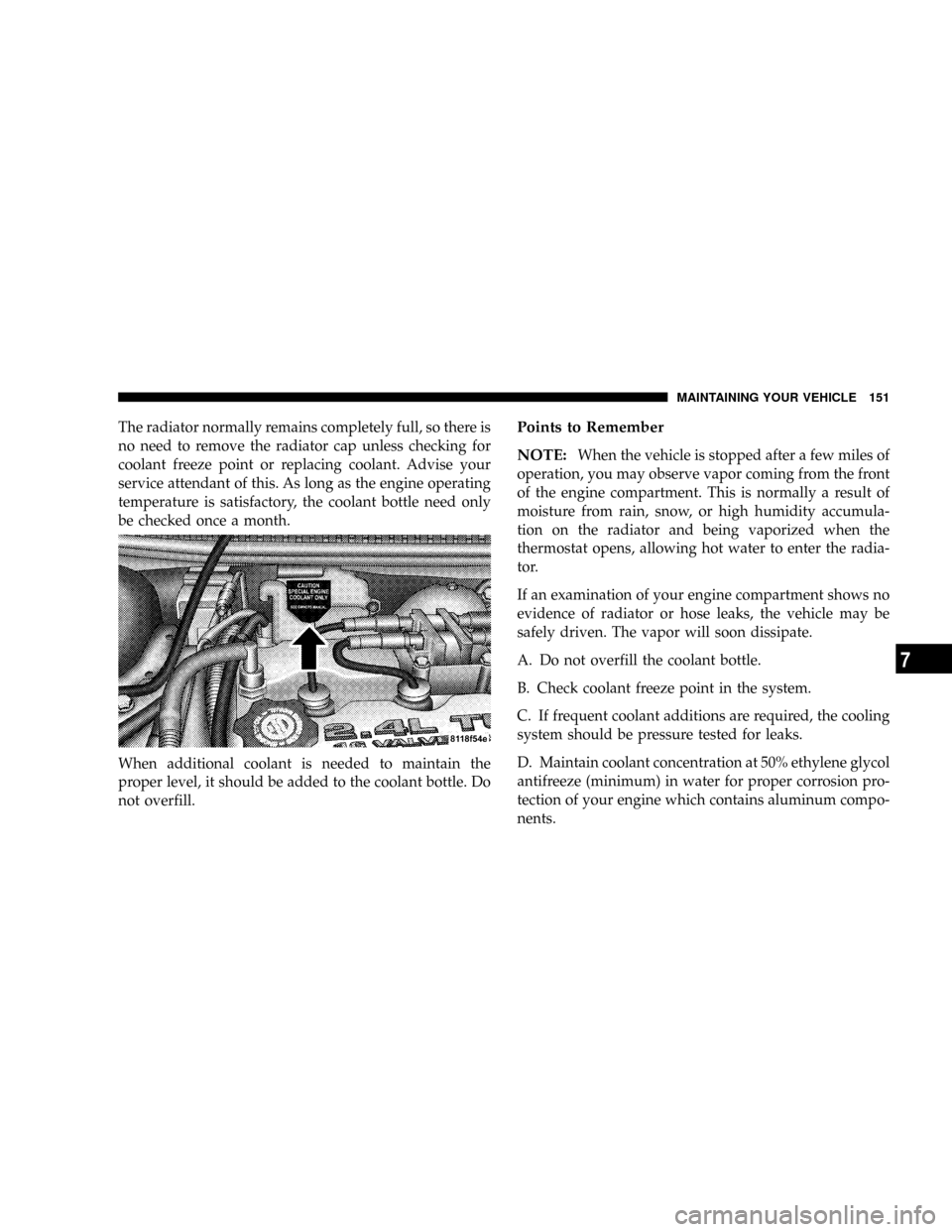
When additional coolant is needed to maintain the
proper level, it should be added to the coolant bottle. Do
not overfill.Points to Remember
NOTE:
When the vehicle is stopped after a few miles of
operation, you may observe vapor coming from the front
of the engine compartment. This is normally a result of
moisture from rain, snow, or high humidity accumula-
tion on the radiator and being vaporized when the
thermostat opens, allowing hot water to enter the radia-
tor.
If an examination of your engine compartment shows no
evidence of radiator or hose leaks, the vehicle may be
safely driven. The vapor will soon dissipate.
A. Do not overfill the coolant bottle.
B. Check coolant freeze point in the system.
C. If frequent coolant additions are required, the cooling
system should be pressure tested for leaks.
D. Maintain coolant concentration at 50% ethylene glycol
antifreeze (minimum) in water for proper corrosion pro-
tection of your engine which contains aluminum compo-
nents.
MAINTAINING YOUR VEHICLE 151
7
Page 153 of 200
Brake System
In order to assure brake system performance, all brake
system components should be inspected periodically.
Suggested service intervals can be found in the Mainte-
nance Section.
WARNING!
Riding the brakes can lead to brake failure and
possibly an accident. Driving with your foot resting
or riding on the brake pedal can result in abnormally
high brake temperatures, excessive lining wear, and
possible brake damage. You wouldn't have your full
braking capacity in an emergency.
Brake and Power Steering System Hoses
When servicing the vehicle for scheduled maintenance,
inspect surface of hoses and nylon tubing for evidence of
heat and mechanical damage. Hard and brittle rubber,
cracking, checking, tears, cuts, abrasions, and excessive
swelling suggest deterioration of the rubber. Particularattention should be made to examining those hose sur-
faces nearest to high heat sources, such as the exhaust
manifold.
Inspect all hose clamps and couplings to make sure they
are secure and no leaks are present.
Insure nylon tubing in these areas has not melted or
collapsed.
NOTE:Often, fluids such as oil, power steering fluid,
and brake fluid are used during assembly plant opera-
tions to ease the assembly of hoses to couplings. There-
fore, oil wetness at the hose-coupling area is not neces-
sarily an indication of leakage. Actual dripping of hot
fluid when systems are under pressure (during vehicle
operation) should be noted before hose is replaced based
on leakage.
NOTE:Inspection of brake hoses should be done
whenever the brake system is serviced and every engine
oil change.
MAINTAINING YOUR VEHICLE 153
7
Page 154 of 200
WARNING!
Worn brake hoses can burst and cause brake failure.
You could have an accident. If you see any signs of
cracking, scuffing, or worn spots, have the brake
hoses replaced immediately.
Brake Master Cylinder
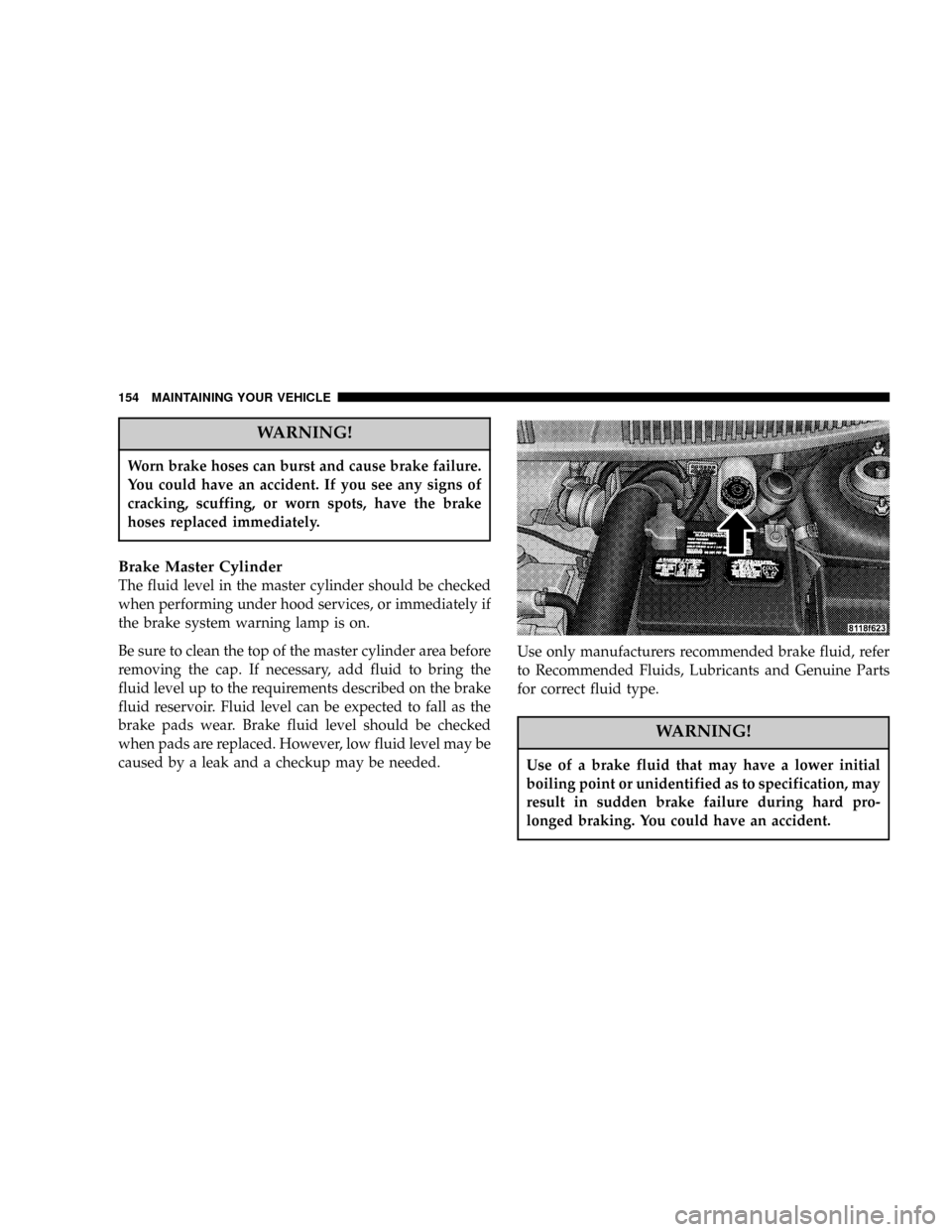
The fluid level in the master cylinder should be checked
when performing under hood services, or immediately if
the brake system warning lamp is on.
Be sure to clean the top of the master cylinder area before
removing the cap. If necessary, add fluid to bring the
fluid level up to the requirements described on the brake
fluid reservoir. Fluid level can be expected to fall as the
brake pads wear. Brake fluid level should be checked
when pads are replaced. However, low fluid level may be
caused by a leak and a checkup may be needed.Use only manufacturers recommended brake fluid, refer
to Recommended Fluids, Lubricants and Genuine Parts
for correct fluid type.
WARNING!
Use of a brake fluid that may have a lower initial
boiling point or unidentified as to specification, may
result in sudden brake failure during hard pro-
longed braking. You could have an accident.
154 MAINTAINING YOUR VEHICLE
Page 168 of 200
EMISSION CONTROL SYSTEM MAINTENANCE
The ªScheduledº maintenance services, listed inbold
typemust be done at the times or mileages specified to
assure the continued proper functioning of the emission
control system. These, and all other maintenance services
included in this manual, should be done to provide best
vehicle performance and reliability. More frequent main-
tenance may be needed for vehicles in severe operating
conditions such as dusty areas and very short trip
driving.
Inspection and service also should be done any time a
malfunction is suspected.
NOTE:Maintenance, replacement, or repair of the
emission control devices and systems on your vehicle
may be performed by any automotive repair establish-
ment or individual using any automotive part which has
been certified pursuant to U.S. EPA or, in the State of
California, California Air Resources Board regulations.
MAINTENANCE SCHEDULE
There are three maintenance schedules that showre-
quiredservice for your vehicle.
First is ScheduleªBº. It is for vehicles that are operated
under the conditions that are listed below and at the
beginning of the schedule.
²Day or night temperatures are below 32É F (0É C).
²Stop and go driving.
²Extensive engine idling.
²Driving in dusty conditions.
²Short trips of less than 10 miles (16 km).
²More than 50% of your driving is at sustained high
speeds during hot weather, above 90É F (32É C).
²Trailer towing.²
²Taxi, police, or delivery service (commercial service).²
²Off-road or desert operation.
²If equipped for and operating with E-85 (ethanol)
fuel.
168 MAINTENANCE SCHEDULES
8
M
A
I
N
T
E
N
A
N
C
E
S
C
H
E
D
U
L
E
S
Page 171 of 200
SCHEDULE ªBº
Follow schedule ªBº If you usually operate your vehicle
under one or more of the following conditions.
Change the manual transaxle fluid every 48,000 miles (77
000 km) if the vehicle is usually operated under one or
more of the conditions marked with an ².
²Day or night temperatures are below 32É F (0É C ).
²Stop and go driving.
²Extensive engine idling.
²Driving in dusty conditions.
²Short trips of less than 10 miles (16.2 km).
²More than 50% of your driving is at sustained high
speeds during hot weather, above 90É F (32É C).
²Trailer towing.²
²Taxi, police, or delivery service (commercial service).²
²Off-road or desert operation.
²If equipped for and operating with E-85 (ethanol)
fuel.
NOTE:IfANYof these apply to you then change your
engine oil every 3,000 miles (5 000 km) or 3 months,
whichever comes first and follow schedule ªBº of the
9Maintenance Schedules9section of this manual.
If none of these apply to you, then change your engine oil
at every interval shown on schedule9A9of the9Mainte-
nance Schedules9section of this manual.
SCHEDULE ªBº 171
8
M
A
I
N
T
E
N
A
N
C
E
S
C
H
E
D
U
L
E
S
Page 177 of 200
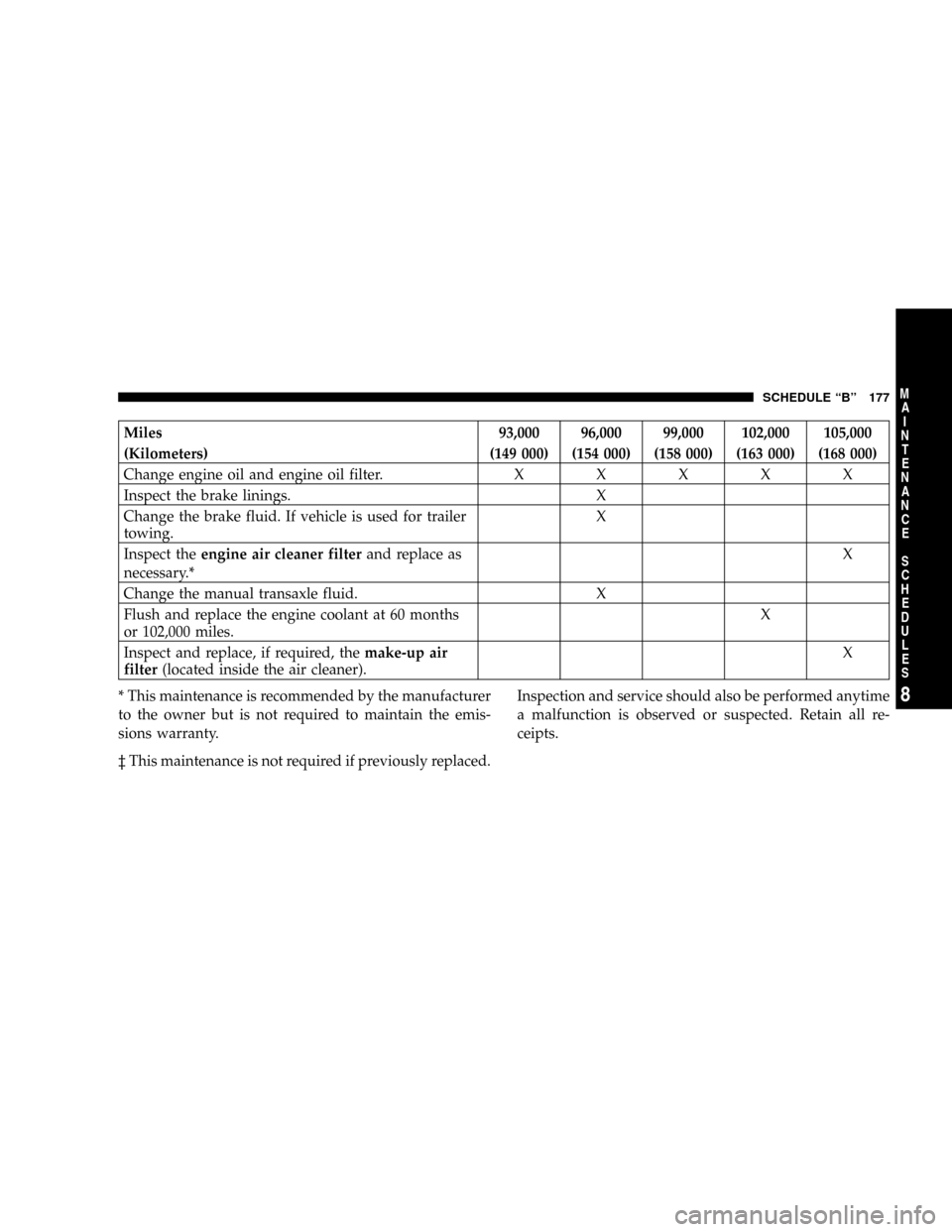
Miles 93,000 96,000 99,000 102,000 105,000
(Kilometers) (149 000) (154 000) (158 000) (163 000) (168 000)
Change engine oil and engine oil filter.XXXXX
Inspect the brake linings. X
Change the brake fluid. If vehicle is used for trailer
towing.X
Inspect theengine air cleaner filterand replace as
necessary.*X
Change the manual transaxle fluid. X
Flush and replace the engine coolant at 60 months
or 102,000 miles.X
Inspect and replace, if required, themake-up air
filter(located inside the air cleaner).X
* This maintenance is recommended by the manufacturer
to the owner but is not required to maintain the emis-
sions warranty.
³ This maintenance is not required if previously replaced.Inspection and service should also be performed anytime
a malfunction is observed or suspected. Retain all re-
ceipts.
SCHEDULE ªBº 177
8
M
A
I
N
T
E
N
A
N
C
E
S
C
H
E
D
U
L
E
S
Page 181 of 200
![DODGE NEON SRT 2004 2.G Owners Guide Miles 90,000 95,000 100,000 105,000
(Kilometers) (144 000) (156 000) (160 000) (168 000)
[Months] [72] [78] [84]
Change engine oil and engine oil filter. X X X X
Inspect the brake linings. X
Replace t](/img/12/5662/w960_5662-180.png "DODGE NEON SRT 2004 2.G Owners Guide Miles 90,000 95,000 100,000 105,000
(Kilometers) (144 000) (156 000) (160 000) (168 000)
[Months] [72] [78] [84]
Change engine oil and engine oil filter. X X X X
Inspect the brake linings. X
Replace t")
Miles 90,000 95,000 100,000 105,000
(Kilometers) (144 000) (156 000) (160 000) (168 000)
[Months] [72] [78] [84]
Change engine oil and engine oil filter. X X X X
Inspect the brake linings. X
Replace theengine air cleaner filter.X
Replace thespark plugs.X
Adjust the generator drive belt tension. X
Inspect the tie rod ends and boot seals. X
Inspect thePCV valveand replace if necessary. Not required if
previously changed. * ³X
Flush and replace the engine coolant if not done at 60 months. X
Replace themake-up air filter(located inside the air cleaner). X
Replace theengine timing belt.X
* This maintenance is recommended by the manufacturer
to the owner but is not required to maintain the emis-
sions warranty.
³ This maintenance is not required if previously replaced.Inspection and service should also be performed anytime
a malfunction is observed or suspected. Retain all re-
ceipts.
SCHEDULE ªAº 181
8
M
A
I
N
T
E
N
A
N
C
E
S
C
H
E
D
U
L
E
S
Page 182 of 200
WARNING!
You can be badly injured working on or around a
motor vehicle. Do only that service work for which
you have the knowledge and the right equipment. If
you have any doubt about your ability to perform a
service job, take your vehicle to a competent me-
chanic.
182 SCHEDULE ªAº
8
M
A
I
N
T
E
N
A
N
C
E
S
C
H
E
D
U
L
E
S
Page 183 of 200

IF YOU NEED CONSUMER ASSISTANCE
CONTENTS
mSuggestions For Obtaining Service For Your
Vehicle
..............................184
NPrepare For The Appointment............184
NPrepare A List........................184
NBe Reasonable With Requests.............184
mIf You Need Assistance..................184
mWarranty Information...................186
mMopartParts.........................187
mReporting Safety Defects.................187
NIn Canada..........................187
mPublication Order Forms.................188
mDepartment Of Transportation Uniform Tire
Quality Grades
........................189
NTreadwear..........................189
NTraction Grades......................189
NTemperature Grades...................190
9