lock DODGE NITRO 2008 1.G Owners Manual
[x] Cancel search | Manufacturer: DODGE, Model Year: 2008, Model line: NITRO, Model: DODGE NITRO 2008 1.GPages: 434, PDF Size: 6.2 MB
Page 338 of 434
CAUTION!
The winch mechanism is designed for use with the
jack extension tube only. Use of an air wrench or
other power tools is not recommended and they can
damage the winch.
When the spare is clear, tilt the retainer at the end of the
cable, and pull it through the center of the wheel.
Preparations For Jacking
²
Park the vehicle on a firm level surface as far from the
edge of the roadway as possible. Avoid icy or slippery
areas.
²Set the parking brakeand place the gear selector in
PARK (automatic transmission) or REVERSE (manual
transmission).
²Turn the ignition to the LOCK position.
WARNING!
Do not attempt to change a tire on the side of the
vehicle close to moving traffic. Pull far enough off
the road to avoid being hit when operating the jack
or changing the wheel.
²Turn on the Hazard Warning Flasher.
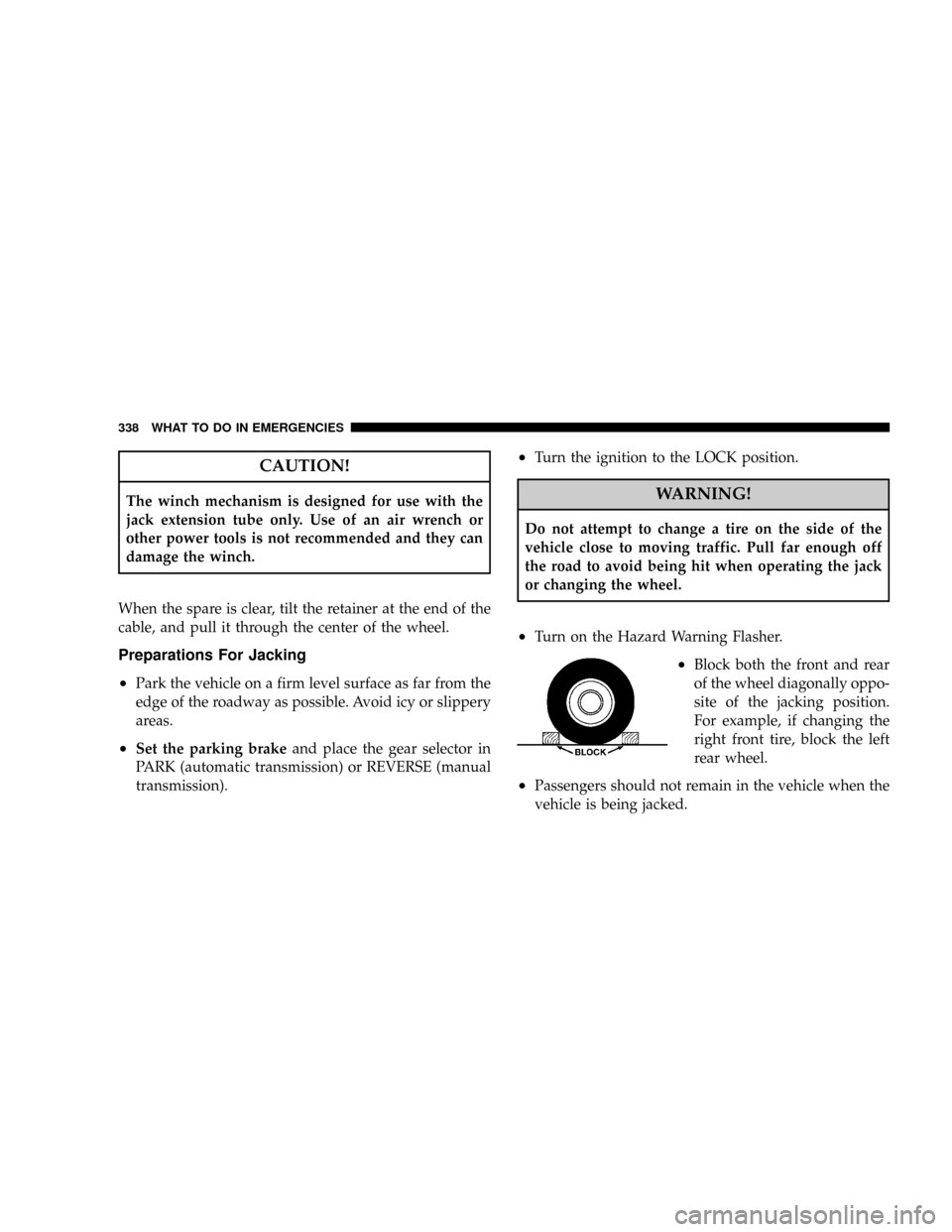
²Block both the front and rear
of the wheel diagonally oppo-
site of the jacking position.
For example, if changing the
right front tire, block the left
rear wheel.
²Passengers should not remain in the vehicle when the
vehicle is being jacked.
338 WHAT TO DO IN EMERGENCIES
Page 340 of 434

5. Raise the vehicle by turning the jack screw to the right.
Raise the vehicle only until the tire just clears the surface
and enough clearance is obtained to install the spare tire.
Minimum tire lift provides maximum stability.
WARNING!
Raising the vehicle higher than necessary can make
the vehicle less stable and cause an accident. It could
slip off the jack and hurt someone near it. Raise the
vehicle only enough to remove the tire.
6. Remove the lug nuts and wheel.
7. Position the spare wheel/tire on the vehicle and install
lug nuts with cone-shaped end toward wheel. Lightly
tighten the nuts. To avoid the risk of forcing the vehicle
off the jack, do not tighten the nuts fully until the vehicle
has been lowered.
8. Lower the vehicle by turning the jack screw to the left,
and remove the jack and wheel blocks.
Rear Jacking Location
340 WHAT TO DO IN EMERGENCIES
Page 344 of 434

NOTE:Transmission must be in ªNº (Neutral) under
any towing configuration.
Two-Wheel Drive Vehicles
Front Wheels Raised
The speed mustnotexceed 30 mph (50 km/h) and the
distance mustnotexceed 15 miles (25 km).
This vehicle may be towed with the transmission in ªNº,
the ignition key in the LOCK position, the front wheels
raised, and the rear wheels on the ground.
NOTE:Towing the vehicle, with the rear wheels on the
ground, at more than 30 mph (50 km/h) or for more than
15 miles (25 km) can cause severe transmission damage.
If the vehicle is to be towed more than 15 miles (25 km )
or faster than 30 mph, it must be towed on a flatbed.
Rear Wheels Raised
The speed mustnotexceed 30 mph (50 km/h) and the
distance mustnotexceed 15 miles (25 km).
This vehicle may be towed with the transmission in ªNº,
the ignition key in the LOCK position, the rear wheels
raised, and the front wheels on the ground.
If the vehicle is to be towed more than 15 miles (25 km )
or faster than 30 mph, it must be towed on a flatbed.
Four-Wheel Drive Vehicles
The manufacturer recommends flatbed towing with all
wheelsOFFthe ground.
344 WHAT TO DO IN EMERGENCIES
Page 364 of 434

WARNING!
Fluid level should be checked on a level surface with
the engine off to prevent injury from moving parts,
and to insure accurate fluid level reading. Do not
overfill. Use only the manufacturer's recommended
fluid.
If necessary, add fluid to restore to the proper indicated
level. With a clean cloth, wipe any spilled fluid from all
surfaces. Refer to Fluids, Lubricants, and Genuine Parts
for correct fluid type.
NOTE:Upon initial start-up in cold weather, the power
steering pump may make noise for a short period of time.
This is due to the cold, thick fluid in the steering system.
This noise should be considered normal, and does not in
any way damage the steering system.
Driveline And Steering Component Lubrication
All driveline and steering components are sealed and do
not require lubrication. Driveshafts are not serviceable.
Body Lubrication
Locks and all body pivot points, including such items as
seat tracks, doors, tailgate and hood hinges, should be
lubricated periodically to assure quiet, easy operation
and to protect against rust and wear. Prior to the appli-
cation of any lubricant, the parts concerned should be
wiped clean to remove dust and grit; after lubricating
excess oil and grease should be removed. Particular
attention should also be given to hood latching compo-
nents to insure proper function. When performing other
underhood services, the hood latch, release mechanism
and safety catch should be cleaned and lubricated.
The external lock cylinders should be lubricated twice a
year, preferably in the fall and spring. Apply a small
364 MAINTAINING YOUR VEHICLE
Page 365 of 434

amount of a high quality lubricant such as MopartLock
Cylinder Lubricant directly into the lock cylinder.
Windshield Wiper Blades
Clean the rubber edges of the wiper blades and the
windshield periodically with a sponge or soft cloth and a
mild non-abrasive cleaner. This will remove accumula-
tions of salt or road film.
Operation of the wipers on dry glass for long periods
may cause deterioration of the wiper blades. Always use
washer fluid when using the wipers to remove salt or dirt
from a dry windshield. Avoid using the wiper blades to
remove frost or ice from the windshield. Keep the blade
rubber out of contact with petroleum products such as
engine oil, gasoline, etc.
Windshield Washers
The fluid reservoir in the engine compartment should be
checked for fluid level at regular intervals. Fill the
reservoir with windshield washer solvent/antifreeze (not
radiator antifreeze). Operate the system for a few seconds
to flush out the residual water.
WARNING!
Commercial windshield washer solvents are flam-
mable. They could ignite and burn you. Care must be
exercised when filling or working around the washer
solution.
MAINTAINING YOUR VEHICLE 365
7
Page 382 of 434
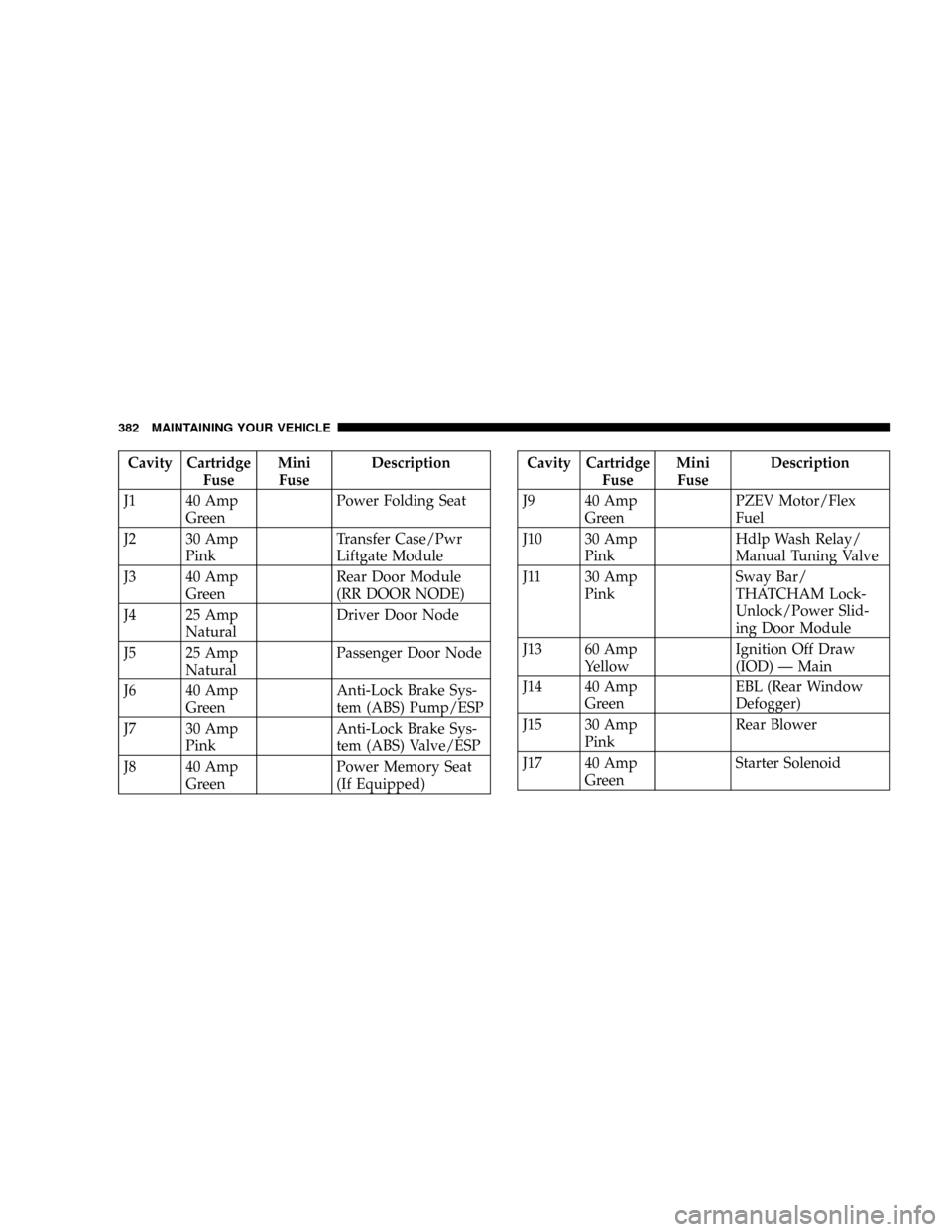
Cavity Cartridge
FuseMini
FuseDescription
J1 40 Amp
GreenPower Folding Seat
J2 30 Amp
PinkTransfer Case/Pwr
Liftgate Module
J3 40 Amp
GreenRear Door Module
(RR DOOR NODE)
J4 25 Amp
NaturalDriver Door Node
J5 25 Amp
NaturalPassenger Door Node
J6 40 Amp
GreenAnti-Lock Brake Sys-
tem (ABS) Pump/ESP
J7 30 Amp
PinkAnti-Lock Brake Sys-
tem (ABS) Valve/ESP
J8 40 Amp
GreenPower Memory Seat
(If Equipped)Cavity Cartridge
FuseMini
FuseDescription
J9 40 Amp
GreenPZEV Motor/Flex
Fuel
J10 30 Amp
PinkHdlp Wash Relay/
Manual Tuning Valve
J11 30 Amp
PinkSway Bar/
THATCHAM Lock-
Unlock/Power Slid-
ing Door Module
J13 60 Amp
YellowIgnition Off Draw
(IOD) Ð Main
J14 40 Amp
GreenEBL (Rear Window
Defogger)
J15 30 Amp
PinkRear Blower
J17 40 Amp
GreenStarter Solenoid
382 MAINTAINING YOUR VEHICLE
Page 383 of 434
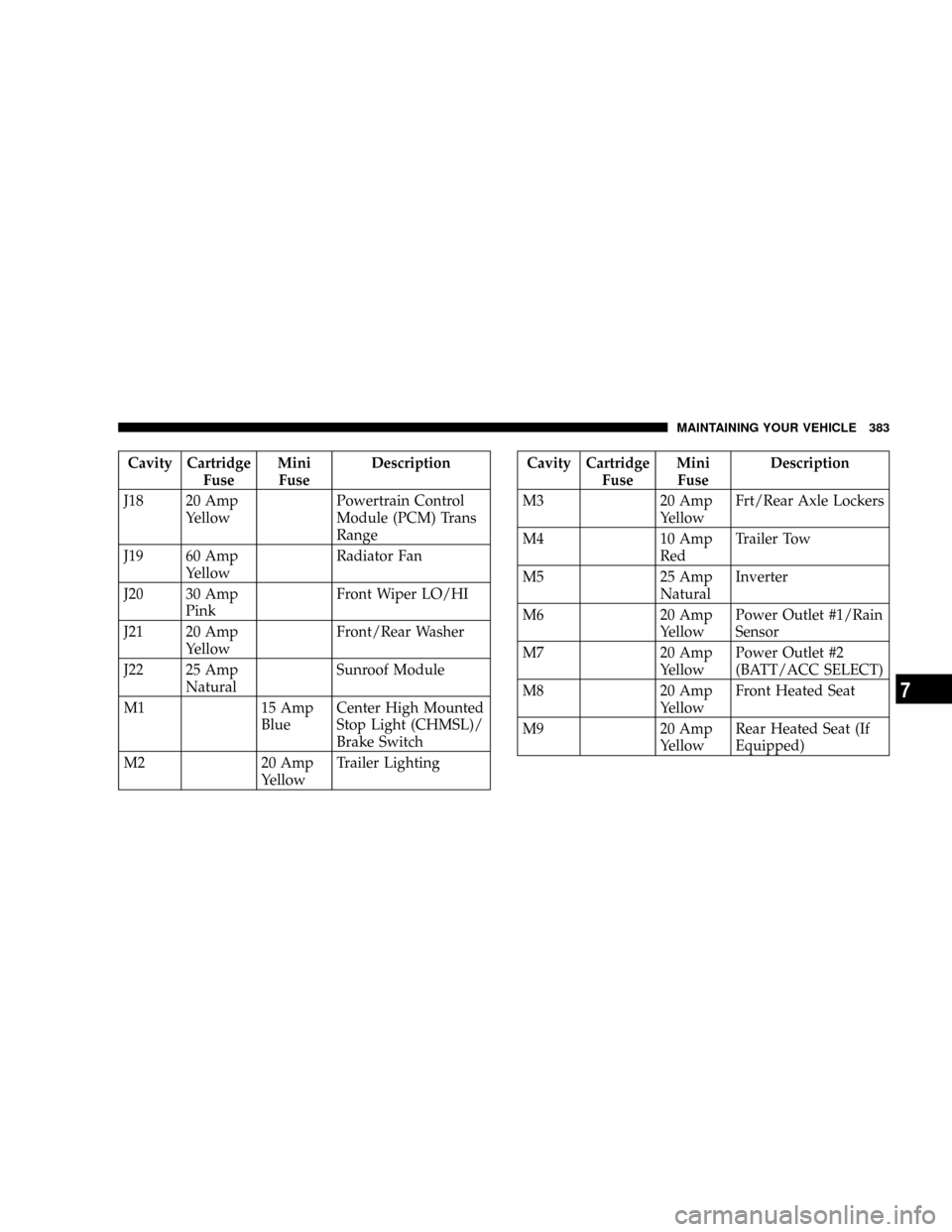
Cavity Cartridge
FuseMini
FuseDescription
J18 20 Amp
YellowPowertrain Control
Module (PCM) Trans
Range
J19 60 Amp
YellowRadiator Fan
J20 30 Amp
PinkFront Wiper LO/HI
J21 20 Amp
YellowFront/Rear Washer
J22 25 Amp
NaturalSunroof Module
M1 15 Amp
BlueCenter High Mounted
Stop Light (CHMSL)/
Brake Switch
M2 20 Amp
YellowTrailer LightingCavity Cartridge
FuseMini
FuseDescription
M3 20 Amp
YellowFrt/Rear Axle Lockers
M4 10 Amp
RedTrailer Tow
M5 25 Amp
NaturalInverter
M6 20 Amp
YellowPower Outlet #1/Rain
Sensor
M7 20 Amp
YellowPower Outlet #2
(BATT/ACC SELECT)
M8 20 Amp
YellowFront Heated Seat
M9 20 Amp
YellowRear Heated Seat (If
Equipped)
MAINTAINING YOUR VEHICLE 383
7
Page 384 of 434
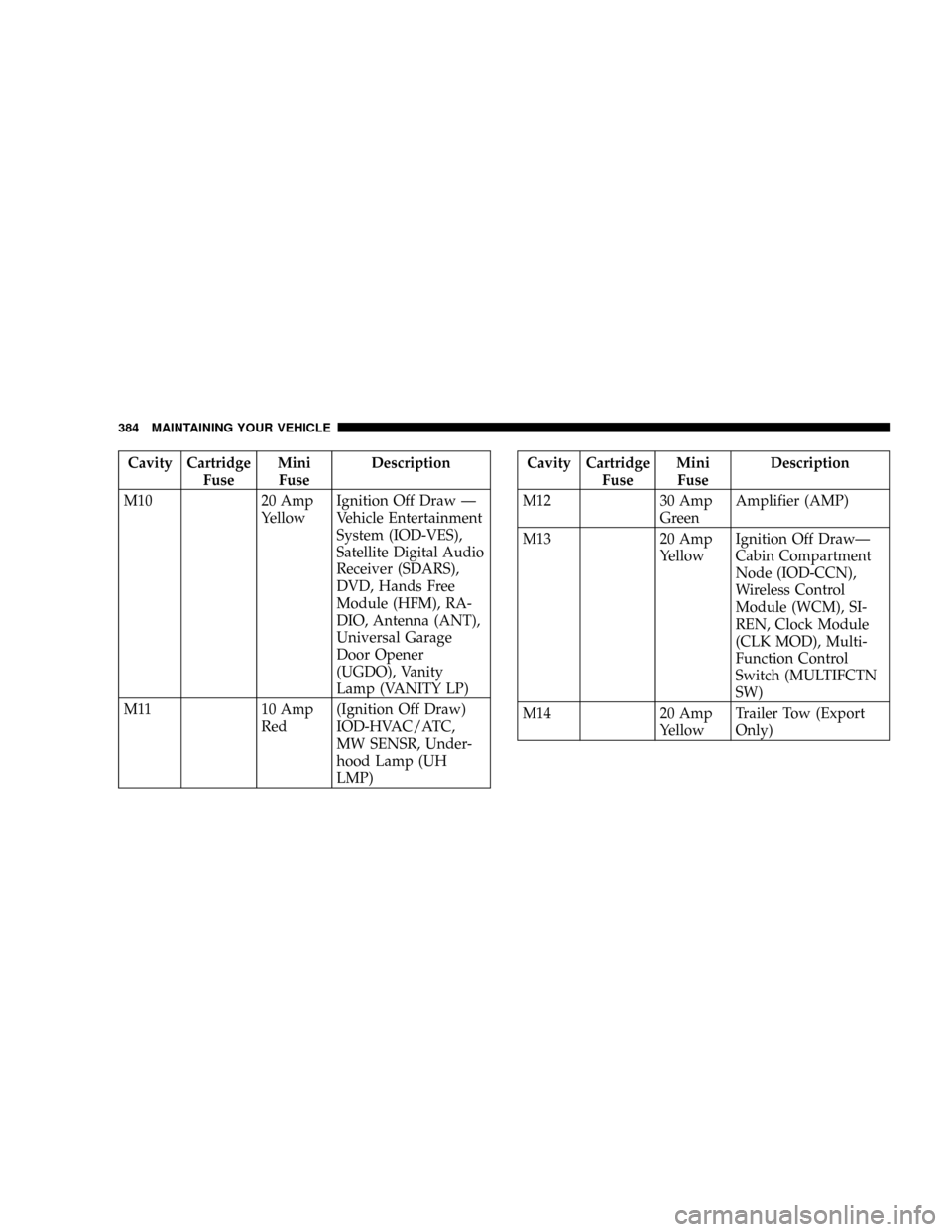
Cavity Cartridge
FuseMini
FuseDescription
M10 20 Amp
YellowIgnition Off Draw Ð
Vehicle Entertainment
System (IOD-VES),
Satellite Digital Audio
Receiver (SDARS),
DVD, Hands Free
Module (HFM), RA-
DIO, Antenna (ANT),
Universal Garage
Door Opener
(UGDO), Vanity
Lamp (VANITY LP)
M11 10 Amp
Red(Ignition Off Draw)
IOD-HVAC/ATC,
MW SENSR, Under-
hood Lamp (UH
LMP)Cavity Cartridge
FuseMini
FuseDescription
M12 30 Amp
GreenAmplifier (AMP)
M13 20 Amp
YellowIgnition Off DrawÐ
Cabin Compartment
Node (IOD-CCN),
Wireless Control
Module (WCM), SI-
REN, Clock Module
(CLK MOD), Multi-
Function Control
Switch (MULTIFCTN
SW)
M14 20 Amp
YellowTrailer Tow (Export
Only)
384 MAINTAINING YOUR VEHICLE
Page 388 of 434
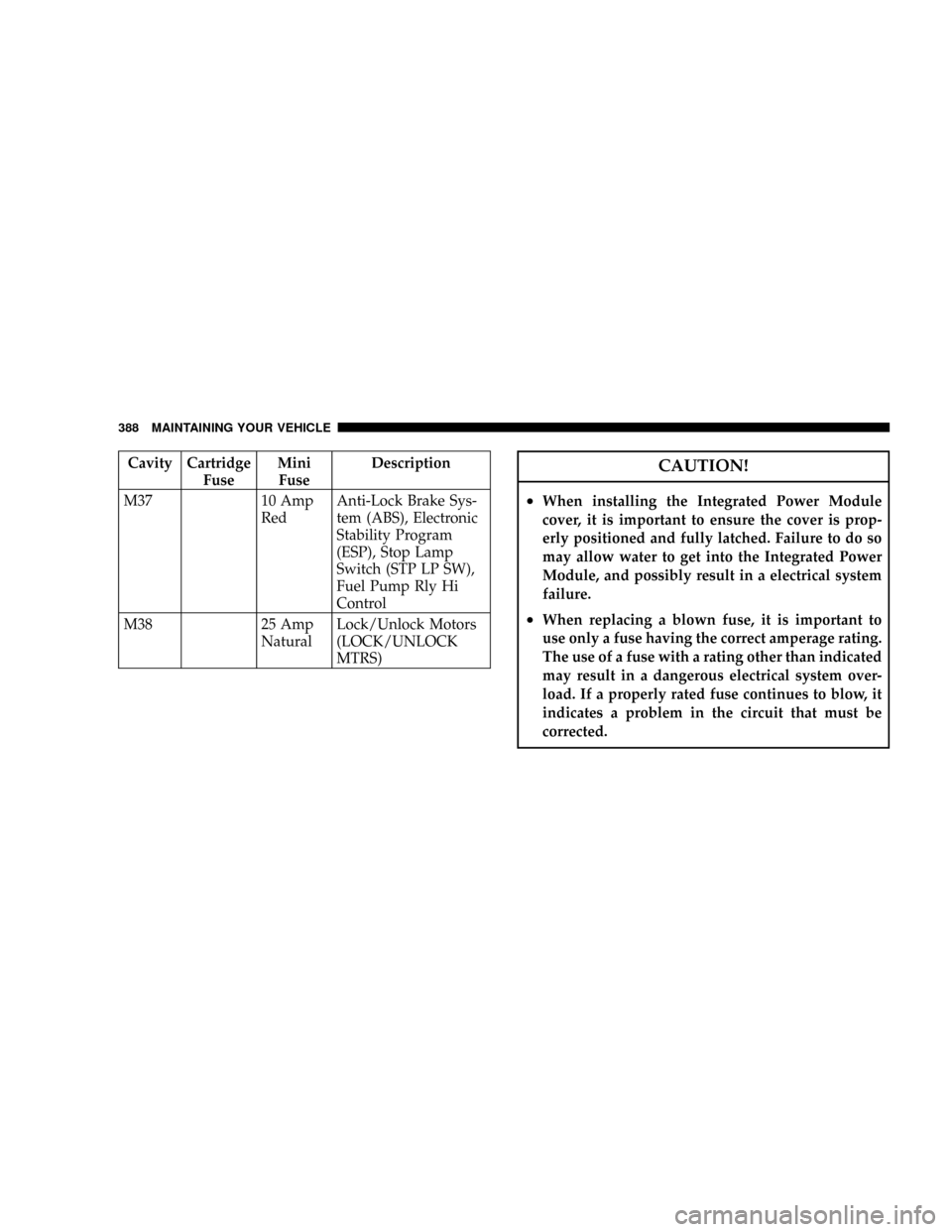
Cavity Cartridge
FuseMini
FuseDescription
M37 10 Amp
RedAnti-Lock Brake Sys-
tem (ABS), Electronic
Stability Program
(ESP), Stop Lamp
Switch (STP LP SW),
Fuel Pump Rly Hi
Control
M38 25 Amp
NaturalLock/Unlock Motors
(LOCK/UNLOCK
MTRS)CAUTION!
²When installing the Integrated Power Module
cover, it is important to ensure the cover is prop-
erly positioned and fully latched. Failure to do so
may allow water to get into the Integrated Power
Module, and possibly result in a electrical system
failure.
²When replacing a blown fuse, it is important to
use only a fuse having the correct amperage rating.
The use of a fuse with a rating other than indicated
may result in a dangerous electrical system over-
load. If a properly rated fuse continues to blow, it
indicates a problem in the circuit that must be
corrected.
388 MAINTAINING YOUR VEHICLE
Page 389 of 434

REPLACEMENT LIGHT BULBS
LIGHT BULBS Ð Interior Bulb No.
Dome Light........................WL212±2
Liftgate Lamp........................... 567
Overhead Console Lights............. PLW214±2A
Reading Light.......................WL212±2
LIGHT BULBS Ð Outside Bulb No.
Headlight..........................9008 H13
Front Park/Turn......................3157AK
Front Sidemarker......................... 168
Back-Up.............................4057K
Center High Mounted Stoplight.............. 921
Fog Lamp.......................... H109145
License Plate Light....................... 168
Rear Tail, Stop, Turn Signal................4057K
BULB REPLACEMENT
Head Light
1. Open the hood.
2. Reach behind the headlamp unit in the engine com-
partment to access the headlamp bulb lock ring.
3. Firmly grasp the lock ring on the back of the headlamp
unit housing.
4. Rotate the lock ring on the back of the headlamp
housing counter-clockwise to unlock it.
CAUTION!
Do not touch the new bulb with your fingers. Oil
contamination will severely shorten bulb life. If the
bulb comes in contact with any oily surface, clean the
bulb with rubbing alcohol.
MAINTAINING YOUR VEHICLE 389
7