warning light DODGE NITRO 2008 1.G Owner's Manual
[x] Cancel search | Manufacturer: DODGE, Model Year: 2008, Model line: NITRO, Model: DODGE NITRO 2008 1.GPages: 434, PDF Size: 6.2 MB
Page 171 of 434

after several ignition cycles, and the vehicle has been
driven several miles at speeds greater than 30 mph (48
km/h), see your authorized dealer as soon as possible.
NOTE:The9ESP/TCS Indicator Light9and the9ESP/
BAS Warning Lamp9come on momentarily each time the
ignition switch is turned ON. The ESP Control System
will make buzzing or clicking sounds when it is actively
operating.
11. TOW/HAUL Indicator Light Ð If Equipped
The TOW/HAUL button is located on the gear
shift bezel. This light will illuminate when the
TOW/HAUL button has been selected.
12. Turn Signal Indicator Light
When a turn signal is activated, a right-pointing or
left-pointing arrow lights up and flashes to indicate
the direction of the turn. These indicators also indicate
proper operation of the front and rear turn signal lights.If either indicator flashes at a faster rate than normal,
check for a defective bulb. If either indicator fails to light
up when the lever is moved, check for a defective turn
signal LED. A single chime is activated when the left/
right turn signal is left on with the engine RPM vehicle
speed greater than 15 mph (24 km/h) for more than one
mile.
13. Transmission Temperature Warning Light Ð If
Equipped
This light indicates that there is excessive trans-
mission fluid temperature that might occur
with severe usage such as trailer towing. If this
light comes on, stop the vehicle and run the
engine at idle or faster, with the transmission in N
(Neutral) until the light goes off.
14. Brake Warning Light
The red ªBRAKEº warning light will come on when the
ignition key is first turned on, and stay on briefly as a
INSTRUMENT PANEL AND CONTROLS 171
4
Page 172 of 434

bulb check. If the bulb does not come on during starting,
see your authorized dealer for service. If the light stays
on, it may be an indication that the parking brake has not
been released, or there is a low brake fluid level. If the
light remains on when the parking brake has been
disengaged, and the fluid level is at the full mark on the
master cylinder reservoir, it indicates a possible brake
hydraulic system malfunction or a problem with the
Brake Booster. In this case, the light will remain on until
the condition has been corrected. If the problem is related
to the brake Booster the ABS pump will run when
applying the brake.
The ªBRAKEº warning light will flash whether or not it
is in gear, if the park brake is applied, and the engine is
running (manual transmission only). The ªBRAKEº
warning light will remain on steady with the park brake
on and the shifter in the P (Park) position. If shifted out
of P (Park), it will begin to flash (automatic transmission
only).If brake failure is indicated, immediate repair is neces-
sary. Operating the vehicle in this condition is danger-
ous!
15. Electronic Throttle Control (ETC) Warning Light Ð
If Equipped
This light informs you of a problem with the
Electronic Throttle Control system. If a prob-
lem is detected the light will come on while the
engine is running. If the light remains lit with
the engine running your vehicle will usually be drivable,
however, see your dealer for service as soon as possible.
If the light is flashing when the engine is running,
immediate service is required and you may experience
reduced performance, an elevated/rough idle or engine
stall and your vehicle may require towing. The light will
come on when the ignition is first turned on and remain
on for 15 seconds as a bulb check. If the light does not
come on during starting, have the system checked by an
authorized dealer.
172 INSTRUMENT PANEL AND CONTROLS
Page 173 of 434

16. Electronic Stability Program (ESP) Indicator
Light/Traction Control System (TCS) Indicator Light
The yellow ESP indicator light in the speedom-
eter area illuminates with the key in the igni-
tion switch turned to the ON/RUN position. It
should go out with the engine running. The
9ESP/TCS Indicator Light9starts to flash as soon as the
tires lose traction and the ESP system becomes active. The
9ESP/TCS Indicator Light9also flashes when TCS is
active. If the9ESP/TCS Indicator Light9begins to flash
during acceleration, ease up on the accelerator and apply
as little throttle as possible. Be sure to adapt your speed
and driving to the prevailing road conditions. The ªESP/
TCS Indicator Lightº becomes illuminated when the
ESP-Off button has been pressed or ESP is only partially
available caused by lack of engine management or brake
thermal model.17. Voltage Warning Light
This light monitors the electrical system voltage.
The light should turn on momentarily as the
engine is started. If the light stays on or turns on while
driving, it indicates a problem with the charging system.
Immediate service should be obtained.
18. SERV (Service) 4WD Indicator Light Ð If Equipped
The ªSERV 4WD Indicator Lightº will come on
when the ignition key is turned to the ON
position and will stay on for 2 seconds. If the
light stays on or comes on during driving, it
means that the 4WD system is not functioning properly
and that service is required.
19. Anti-Lock Brake Warning Light
This light monitors the Anti-Lock Brake System
which is described elsewhere in this manual.
This light will come on when the ignition key is
turned to the ON position and may stay on for
INSTRUMENT PANEL AND CONTROLS 173
4
Page 174 of 434

approximately 3 seconds. If this light remains on or
comes on during driving, it indicates that the Anti-Lock
portion of the brake system is not functioning and that
service is required. See your authorized dealer immedi-
ately. With the ABS malfunctioning, the BAS and ESP are
also switched off. Both malfunction indicator lights illu-
minate with the engine running. If the charging voltage
falls below 10 volts, the malfunction indicator light
illuminates and the ABS is switched off. When the
voltage is above this value again, the malfunction indi-
cator light should go out and the ABS is operational. If
the malfunction indicator light stays illuminated, have
the system checked at your authorized dealer as soon as
possible.
20. Front Fog Light Indicator Light Ð If Equipped
This light shows when the fog lights are ON.21. Oil Pressure Warning Light
This light indicates that the engine oil pressure has
become too low. For a bulb check, this light will
come on momentarily when the ignition is turned On. If
the light turns on while driving, stop the vehicle and shut
off the engine as soon as possible. Immediate service
should be obtained.
22. Airbag Warning Light
The indicator lights and remains lit for 6 to 8
seconds when the ignition is first turned ON. If
the light does not come on when the ignition is
first turned on, or the light stays on or comes
on while driving, have the airbag system checked by an
authorized dealer.
23. Tachometer
This gauge measures engine revolutions-per-minute
(rpm x 1000).
174 INSTRUMENT PANEL AND CONTROLS
Page 186 of 434

Press and release the COMPASS/TEMPERATURE
button to display one of eight compass readings
and the outside temperature.
Electronic Vehicle Information Center (EVIC)
Displays
When the appropriate conditions exist, the Electronic
Vehicle Information Center (EVIC) displays the following
messages:
²Turn Signal On (with a continuous warning chime)
²Left Front Turn Signal Light Out (with a single chime)
²Left Rear Turn Signal Light Out (with a single chime)
²Right Front Turn Signal Light Out (with a single
chime)
²Right Rear Turn Signal Light Out (with a single chime)
²RKE Battery Low (with a single chime)
²Personal Settings Not Available ± Vehicle Not in Park
²Left/Right Front Door Ajar (one or more, with a single
chime if speed is above 1 mph)
²Left/Right Rear Door Ajar (one or more, with a single
chime if speed is above 1 mph)
²Door(s) Ajar (with a single chime if vehicle is in
motion)
²Liftgate Ajar (with a single chime)
²Left Front Low Pressure (with a single chime). Refer to
ªTire Pressure Monitoring Systemº in Section 5 of this
manual.
²Left Rear Low Pressure (with a single chime). Refer to
ªTire Pressure Monitoring Systemº in Section 5 of this
manual.
186 INSTRUMENT PANEL AND CONTROLS
Page 249 of 434
WARNING!
Remember to disconnect the cord before driving.
Damage to the 110-115 volt AC electrical cord could
cause electrocution.
Use the heater when temperatures below 0ÉF (-18ÉC) are
expected to last for several days.
MANUAL TRANSMISSION Ð IF EQUIPPED
6-Speed Manual Transmission
WARNING!
You or others could be injured if you leave the
vehicle unattended without having the parking
brake fully applied. The parking brake should al-
ways be applied when the driver is not in the vehicle,
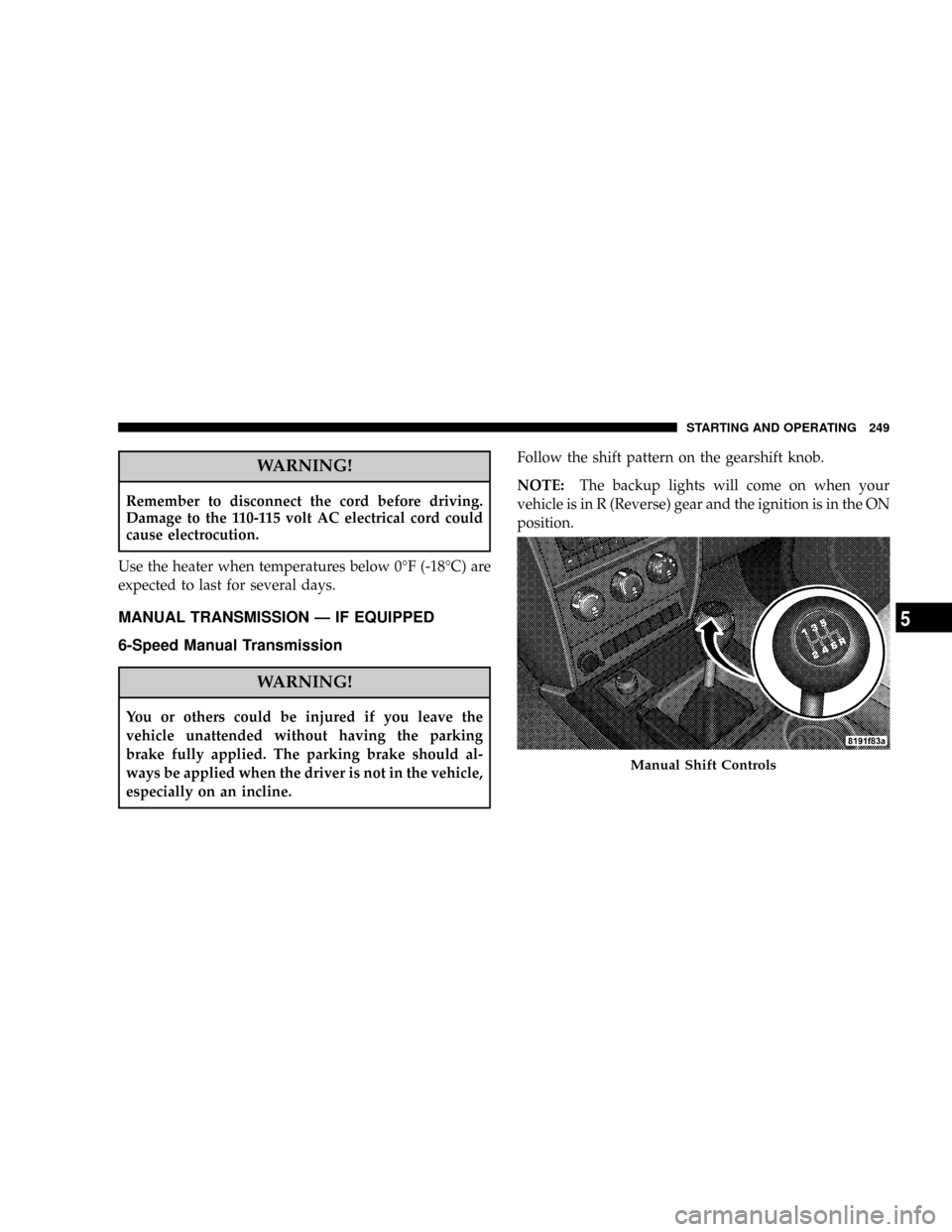
especially on an incline.Follow the shift pattern on the gearshift knob.
NOTE:The backup lights will come on when your
vehicle is in R (Reverse) gear and the ignition is in the ON
position.
Manual Shift Controls
STARTING AND OPERATING 249
5
Page 257 of 434

1 (First)
For hard pulling at low speeds in mud, sand, snow, or on
steep grades. Begins and stays in low gear with no
upshift. Provides engine compression braking at low
speeds.
Overdrive Operation
The overdrive automatic transmission contains an elec-
tronically controlled fourth and fifth speed (Overdrive).
The transmission will automatically shift from 3rd gear to
Overdrive if the following conditions are present:
²the transmission selector is in D (Drive);
²the engine coolant has reached normal operating tem-
perature;
²vehicle speed is above approximately 30 mph (48
km/h);
²the ªTOW/HAULº button has not been activated;
²transmission has reached normal operating tempera-
ture.
NOTE:If the vehicle is started in extremely cold tem-
peratures, the transmission may not shift into Overdrive
and will automatically select the most desirable gear for
operation at this temperature. Normal operation will
resume when the transmission fluid temperature has
risen to a suitable level. Refer also to the Note under
torque converter clutch, later in this section.
If the transmission temperature gets extremely hot, the
transmission will automatically select the most desirable
gear for operation at this temperature. If the transmission
temperature becomes hot enough the ªTransmission
Temperature Warning Lightº may illuminate and the
transmission may downshift out of Overdrive until the
transmission cools down. After cooldown, the transmis-
sion will resume normal operation.
STARTING AND OPERATING 257
5
Page 270 of 434

Driving In Snow, Mud and Sand
In heavy snow, when pulling a load, or for additional
control at slower speeds, shift the transmission to a low
gear and shift the transfer case to 4L or 4LO if necessary.
Refer to ªFour-Wheel Drive Operationº in this section.
Do not shift to a lower gear than necessary to maintain
headway. Over-revving the engine can spin the wheels
and traction will be lost.
Avoid abrupt downshifts on icy or slippery roads, be-
cause engine braking may cause skidding and loss of
control.
Hill Climbing
NOTE:Before attempting to climb a hill, determine the
conditions at the crest and/or on the other side.
Before climbing a steep hill,shift the transmission to a
lower gear and shift the transfer case to 4L or 4LO. Use
first gear and 4L or 4LO for very steep hills.If you stall or begin to lose headwaywhile climbing a
steep hill, allow your vehicle to come to a stop and
immediately apply the brakes. Restart the engine and
shift to R (Reverse). Back slowly down the hill allowing
the compression braking of the engine to help regulate
your speed. If the brakes are required to control vehicle
speed, apply them lightly and avoid locking or skidding
the tires.
WARNING!
If the engine stalls or you lose headway or cannot
make it to the top of a steep hill or grade, never
attempt to turn around. To do so may result in
tipping and rolling the vehicle. Always back straight
down a hill in R (Reverse) gear carefull. Never back
down a hill in N (Neutral) using only the brake.
270 STARTING AND OPERATING
Page 272 of 434
²After extended operation in mud, sand, water, or
similar dirty conditions, have brake rotors, wheels,
brake linings, and axle yokes inspected and cleaned as
soon as possible.
WARNING!
Abrasive material in any part of the brakes may cause
excessive wear or unpredictable braking. You might
not have full braking power when you need it to
prevent an accident. If you have been operating your
vehicle in dirty conditions, get your brakes checked
and cleaned as necessary.
²If you experience unusual vibration after driving in
mud, slush, or similar conditions, check the wheels for
impacted material. Impacted material can cause a
wheel imbalance and freeing the wheels of it will
correct the situation.
PARKING BRAKE
To set the parking brake, pull the lever up as firmly as
possible. When the parking brake is applied with the
ignition ON, the ªBrake Warning Lightº in the instru-
ment cluster will light. To release the parking brake, pull
up slightly, press the center button, then lower the lever
completely.
272 STARTING AND OPERATING
Page 273 of 434

NOTE:The instrument cluster ªBrake Warning Lightº
indicates only that the parking brake is applied. You must
be sure the parking brake is fully applied before leaving
the vehicle.Be sure the parking brake is firmly set when parked, and
the gear selector lever is in the ªPº (Park) position
(automatic transmission) or ªRº (Reverse) or 1st gear
(manual transmission). When parking on a hill, you
should apply the parking brake before placing the gear
selector lever in ªPº (Park); otherwise, the load on the
transmission locking mechanism may make it difficult to
move the selector out of ªPº (Park).
Parking Brake
STARTING AND OPERATING 273
5