light DODGE NITRO 2008 1.G Service Manual
[x] Cancel search | Manufacturer: DODGE, Model Year: 2008, Model line: NITRO, Model: DODGE NITRO 2008 1.GPages: 434, PDF Size: 6.2 MB
Page 142 of 434

Similar to this Canadian law, some U.S. gate operators are
designed to ªtime-outº in the same manner.
It may be helpful to unplug the device during the cycling
process to prevent possible overheating of the garage
door or gate motor.
If you are having difficulties programming a garage door
opener or a gate operator, replace ªProgramming
HomeLinktº Step 3 with the following:
3. Continue to press and hold the HomeLinktbutton
while you press and release - every two seconds
(ªcycleº) your hand-held transmitter until HomeLinkt
has successfully accepted the frequency signal. The
indicator light will flash slowly and then rapidly when
fully trained.
If you unplugged the device for training, plug it back in
at this time.Then proceed with Step 4 under ªProgramming
HomeLinkt.º earlier in this section.
Using HomeLinkT
To operate, simply press and release the programmed
HomeLinktbutton. Activation will now occur for the
trained device (i.e. garage door opener, gate operator,
security system, entry door lock, home/office lighting,
etc. The hand-held transmitter of the device may also be
used at any time.
Reprogramming a Single HomeLinkTButton
To re-program a channel that has been previously
trained, follow these steps:
1. Turn the ignition switch to the ON/RUN position.
2. Press and hold the desired HomeLinktbutton until
the indicator light begins to flash after 20 seconds.Do not
release the button.
142 UNDERSTANDING THE FEATURES OF YOUR VEHICLE
Page 147 of 434

Sunroof Maintenance
Use only a non-abrasive cleaner and a soft cloth to clean
the glass panel.
ELECTRICAL POWER OUTLET
This vehicle has two auxiliary power outlets that can
provide up to 20 Amps of current for accessories de-
signed for use with the standard power outlet adapters.
The front power outlet located in the lower portion of the
instrument panel has a snap on plastic cap so that it can
be covered when not in use. As a safety precaution, the
outlet in the instrument panel only operates with the
ignition switch ON. When the optional Cigar Lighter
heating element is used, it heats when pushed in and
pops out automatically when ready for use.To preserve
the heating element, do not hold the lighter in the
heating position.
Front Power Outlet
UNDERSTANDING THE FEATURES OF YOUR VEHICLE 147
3
Page 148 of 434
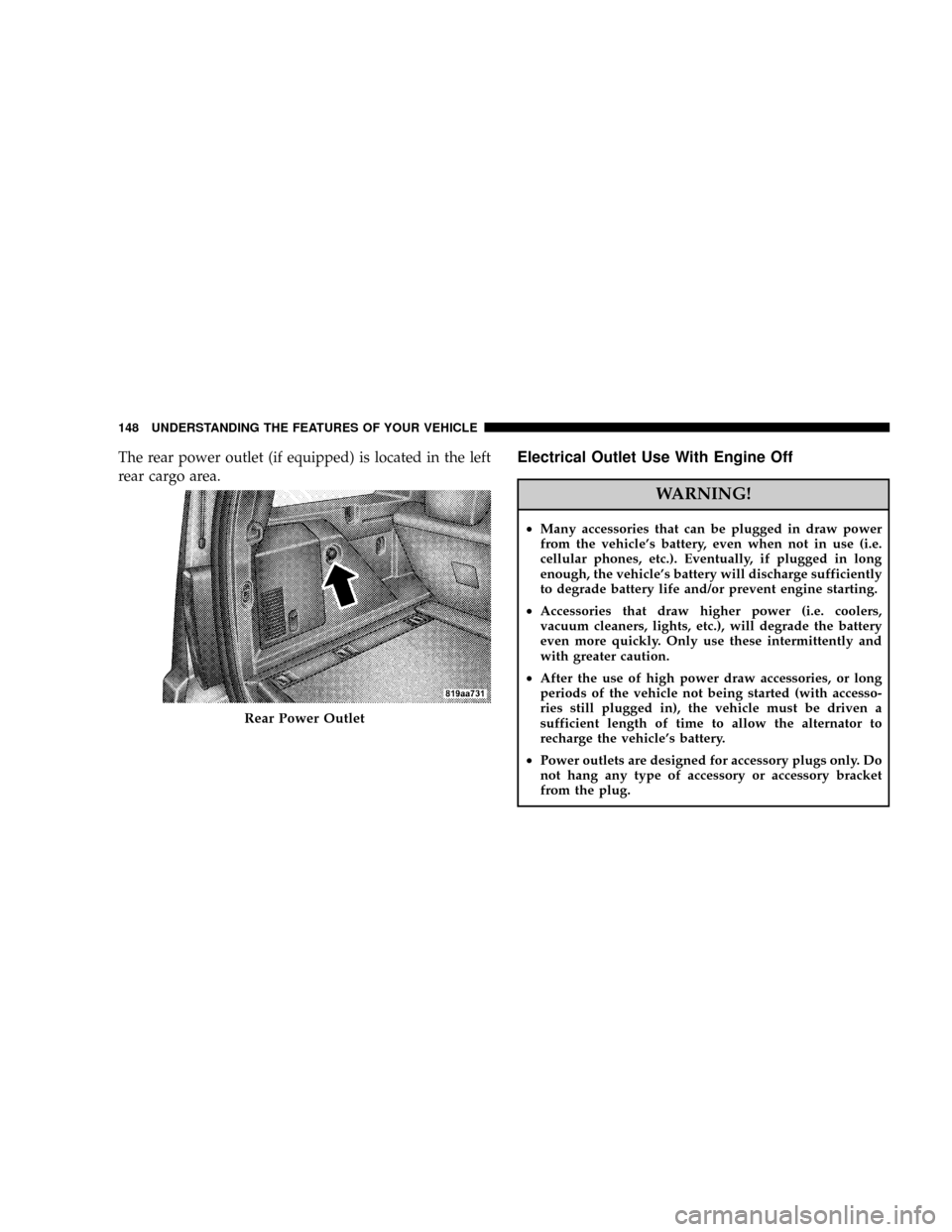
The rear power outlet (if equipped) is located in the left
rear cargo area.Electrical Outlet Use With Engine Off
WARNING!
²Many accessories that can be plugged in draw power
from the vehicle's battery, even when not in use (i.e.
cellular phones, etc.). Eventually, if plugged in long
enough, the vehicle's battery will discharge sufficiently
to degrade battery life and/or prevent engine starting.
²Accessories that draw higher power (i.e. coolers,
vacuum cleaners, lights, etc.), will degrade the battery
even more quickly. Only use these intermittently and
with greater caution.
²After the use of high power draw accessories, or long
periods of the vehicle not being started (with accesso-
ries still plugged in), the vehicle must be driven a
sufficient length of time to allow the alternator to
recharge the vehicle's battery.
²Power outlets are designed for accessory plugs only. Do
not hang any type of accessory or accessory bracket
from the plug.
Rear Power Outlet
148 UNDERSTANDING THE FEATURES OF YOUR VEHICLE
Page 153 of 434
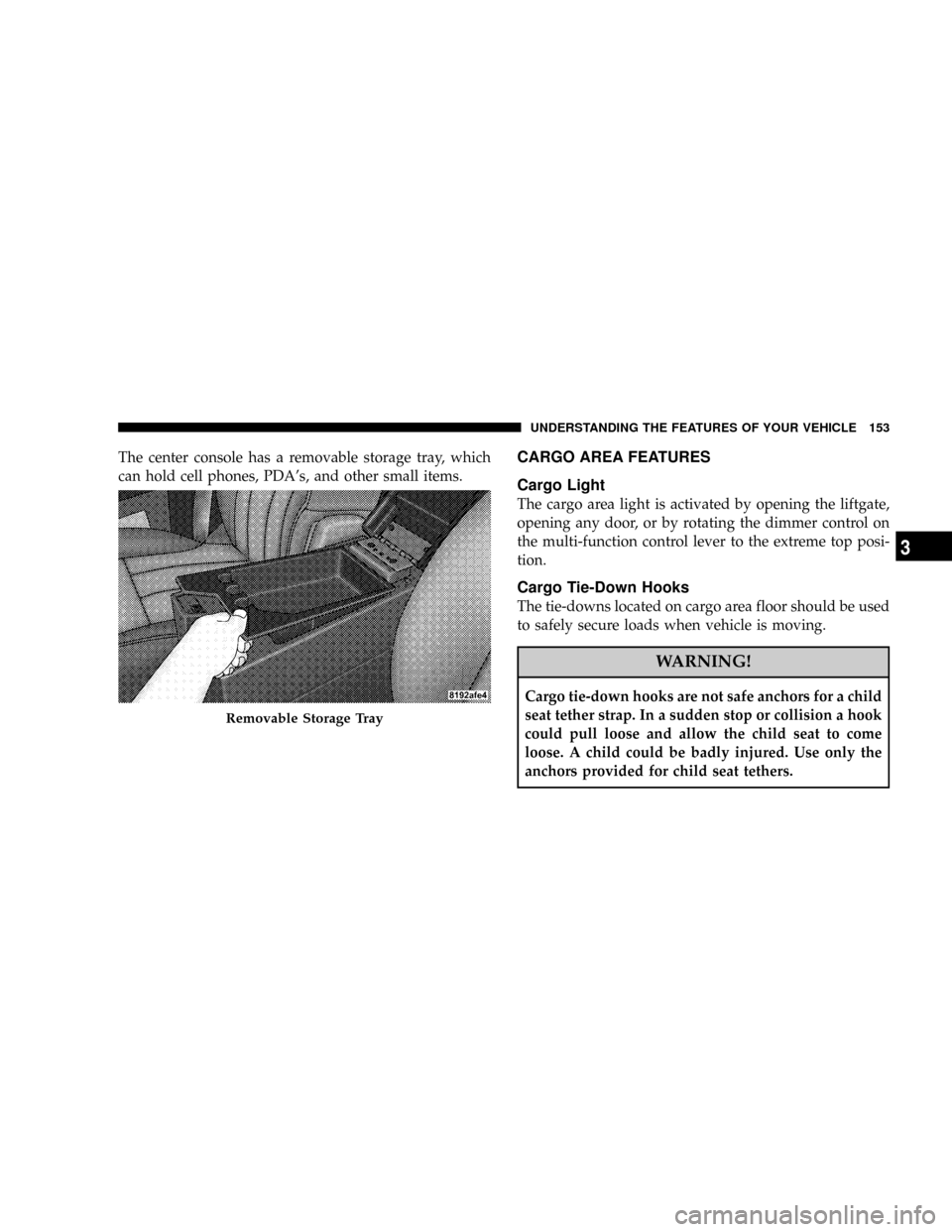
The center console has a removable storage tray, which
can hold cell phones, PDA's, and other small items.CARGO AREA FEATURES
Cargo Light
The cargo area light is activated by opening the liftgate,
opening any door, or by rotating the dimmer control on
the multi-function control lever to the extreme top posi-
tion.
Cargo Tie-Down Hooks
The tie-downs located on cargo area floor should be used
to safely secure loads when vehicle is moving.
WARNING!
Cargo tie-down hooks are not safe anchors for a child
seat tether strap. In a sudden stop or collision a hook
could pull loose and allow the child seat to come
loose. A child could be badly injured. Use only the
anchors provided for child seat tethers.
Removable Storage Tray
UNDERSTANDING THE FEATURES OF YOUR VEHICLE 153
3
Page 159 of 434

Adding Washer Fluid
The fluid reservoir for the windshield washers and the
rear window washer is shared. It is located in the front of
the engine compartment, and should be checked for fluid
level at regular intervals. Fill the reservoir with wind-
shield washer solvent (not radiator antifreeze) and oper-
ate the system for a few seconds to flush out the residual
water.
Rear Window Defroster Ð If Equipped
The push-button is located on
the bottom of the blower con-
trol knob. Press this button to
turn on the rear window de-
froster, and the optional elec-
tric remote control heated
mirrors. An amber light
shows that the defroster is on.The defroster will automatically turn off after about ten
minutes. For five more minutes of operation, press the
switch again. To prevent excessive battery drain, use the
defroster only when the engine is operating.
CAUTION!
Use care when washing the inside of the rear window
to prevent damage to heating elements. Use a soft
cloth and a mild washing solution, wiping parallel to
the heating elements. Also, keep all objects a safe
distance from the window to prevent damaging the
heating elements.
UNDERSTANDING THE FEATURES OF YOUR VEHICLE 159
3
Page 166 of 434

INSTRUMENT PANEL AND CONTROLS
1 Ð Air Outlet 6 Ð Glove Box 11 Ð Hazard Warning Flasher
2 Ð Instrument Cluster 7 Ð Climate Control 12 Ð * Electronic Stability Control /
Traction Control Switch
3 Ð Storage Tray8 Ð * Heated Seat Switch 13 Ð Cigar Lighter / Power Outlet
4 Ð Center Air Outlet9 Ð * Rear Park Assist Switch 14 Ð Storage Bin
5 Ð Radio 10 Ð Passenger Airbag Disable Light * Ð If Equipped 166 INSTRUMENT PANEL AND CONTROLS
Page 168 of 434

INSTRUMENT CLUSTER DESCRIPTION
1. Fuel Gauge
The fuel gauge shows level of fuel in tank when
ignition switch is in the ON position.
2. Fuel Cap Indicator
This symbol indicates the side of the vehicle
where the fuel cap is located.
3. Temperature Gauge
The temperature gauge indicates engine coolant
temperature. Any reading within the normal
range indicates that the cooling system is operat-
ing satisfactorily. The gauge needle will likely indicate a
high temperature when driving in hot weather, up moun-
tain grades, in heavy traffic, or when towing a trailer. If
the needle rises to the ªHº mark, stop the vehicle, shiftinto N (Neutral) increase engine speed for 2-3 minutes. If
the temperature reading does not return to normal, seek
authorized service immediately.
CAUTION!
Do not leave your vehicle unattended with the en-
gine running as you would not be able to react to the
temperature indicator if the engine overheats.
The gauge pointer will remain near its last reading when
the engine is turned off. It will return to a true reading
when the engine is restarted.
4. Low Fuel Warning Light
This indicator lights when the fuel gauge reads 1/8
of a tank or less.
168 INSTRUMENT PANEL AND CONTROLS
Page 169 of 434

5. Seat Belt Reminder Light
This light comes on for several seconds after the
ignition is turned ON as a reminder to ªbuckle
up.º This light will remain on as long as the driver
or passengers seat belt remains unbuckled. If the seat belt
indicator remains on and/or flashes with belts buckled,
this may indicate a fault in the seat belt reminder system.
Have the system checked by an authorized dealer.
6. Coolant Temperature Warning Light
This light warns of an overheated engine condi-
tion. For a bulb check, this light will come on
momentarily when the ignition is turned On. If the
light turns on while driving, stop the vehicle, shift into N
(Neutral) and increase the engine speed for 2 to 3
minutes. If the temperature reading does not return to
normal, seek authorized service immediately.As temperatures rise and the gauge approaches9H9, this
indicator will illuminate and a single chime will sound
after reaching a set threshold. Further overheating will
cause the temperature gauge to pass9H9, the indicator
will continuously flash, and a continuous chime will
occur until the engine is allowed to cool.
CAUTION!
Driving with a hot engine cooling system could
damage your vehicle. If the temperature light is on,
safely pull over and stop the vehicle. Idle the vehicle
in neutral with the air conditioner turned off until
the light turns off. If the if the light remains on, turn
the engine off immediately, and call for service.
INSTRUMENT PANEL AND CONTROLS 169
4
Page 170 of 434
WARNING!
A hot engine cooling system is dangerous. You or
others could be badly burned by steam or boiling
coolant. You may want to call a service center if your
vehicle overheats. If you decide to look under the
hood yourself, see Section 7 of this manual. Follow
the warnings under the Cooling System Pressure Cap
paragraph.
7. Speedometer
Shows the vehicles speed.
8. High Beam Indicator Light
Indicates that headlights are on high beam.9. Security Alarm System Indicator Light Ð If
Equipped
This light will flash rapidly for approximately 15 seconds
when the vehicle theft alarm is arming. The light will
flash at a slower speed continuously after the alarm is set.
The security light will also come on for about three
seconds when the ignition is first turned on.
10. Electronic Stability Program (ESP) Warning
Light/Brake Assist System (BAS) Warning Light ± If
Equipped
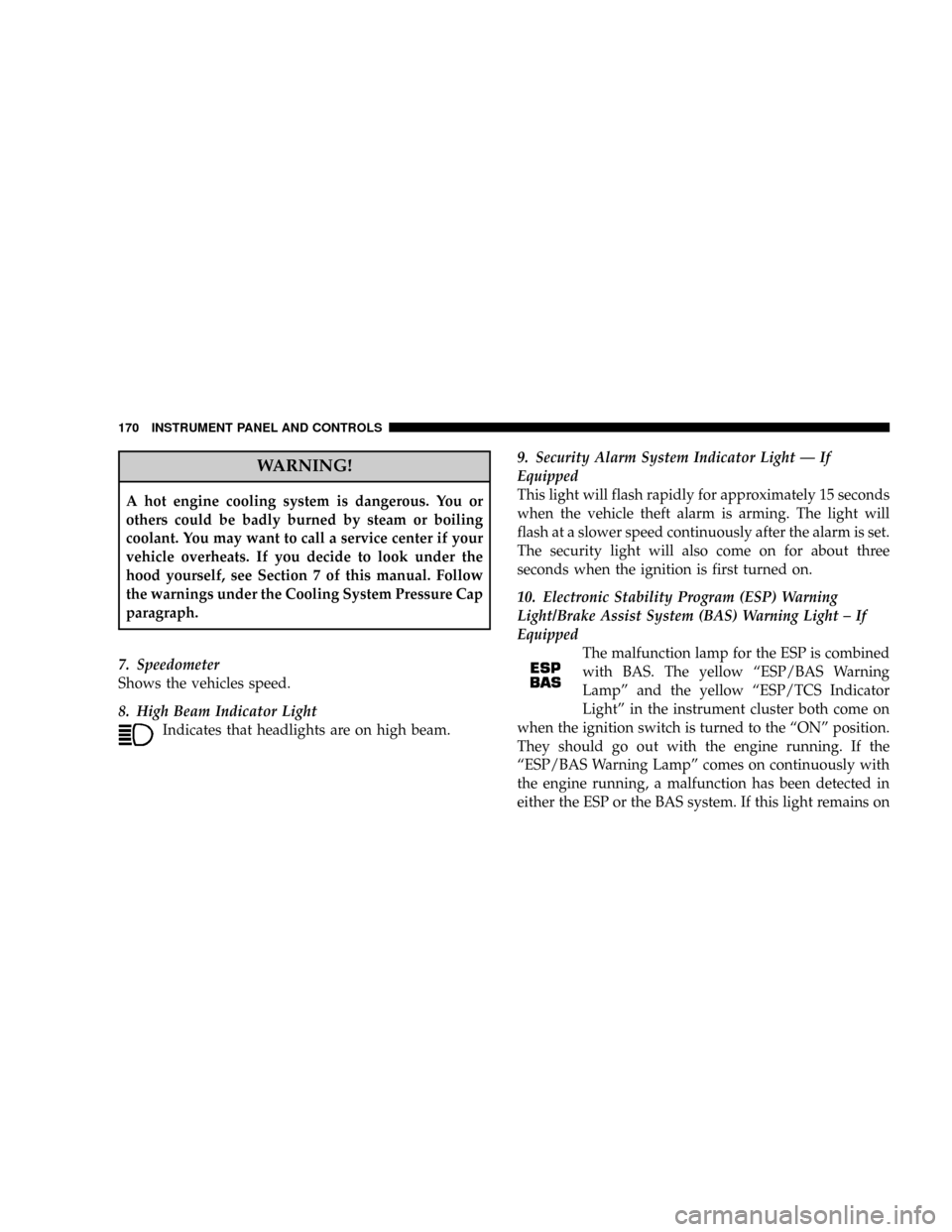
The malfunction lamp for the ESP is combined
with BAS. The yellow ªESP/BAS Warning
Lampº and the yellow ªESP/TCS Indicator
Lightº in the instrument cluster both come on
when the ignition switch is turned to the ªONº position.
They should go out with the engine running. If the
ªESP/BAS Warning Lampº comes on continuously with
the engine running, a malfunction has been detected in
either the ESP or the BAS system. If this light remains on
170 INSTRUMENT PANEL AND CONTROLS
Page 171 of 434

after several ignition cycles, and the vehicle has been
driven several miles at speeds greater than 30 mph (48
km/h), see your authorized dealer as soon as possible.
NOTE:The9ESP/TCS Indicator Light9and the9ESP/
BAS Warning Lamp9come on momentarily each time the
ignition switch is turned ON. The ESP Control System
will make buzzing or clicking sounds when it is actively
operating.
11. TOW/HAUL Indicator Light Ð If Equipped
The TOW/HAUL button is located on the gear
shift bezel. This light will illuminate when the
TOW/HAUL button has been selected.
12. Turn Signal Indicator Light
When a turn signal is activated, a right-pointing or
left-pointing arrow lights up and flashes to indicate
the direction of the turn. These indicators also indicate
proper operation of the front and rear turn signal lights.If either indicator flashes at a faster rate than normal,
check for a defective bulb. If either indicator fails to light
up when the lever is moved, check for a defective turn
signal LED. A single chime is activated when the left/
right turn signal is left on with the engine RPM vehicle
speed greater than 15 mph (24 km/h) for more than one
mile.
13. Transmission Temperature Warning Light Ð If
Equipped
This light indicates that there is excessive trans-
mission fluid temperature that might occur
with severe usage such as trailer towing. If this
light comes on, stop the vehicle and run the
engine at idle or faster, with the transmission in N
(Neutral) until the light goes off.
14. Brake Warning Light
The red ªBRAKEº warning light will come on when the
ignition key is first turned on, and stay on briefly as a
INSTRUMENT PANEL AND CONTROLS 171
4