warning DODGE NITRO 2008 1.G Workshop Manual
[x] Cancel search | Manufacturer: DODGE, Model Year: 2008, Model line: NITRO, Model: DODGE NITRO 2008 1.GPages: 434, PDF Size: 6.2 MB
Page 137 of 434

situation requiring ESP to be switched to the ªPartial Offº
mode is overcome, turn ESP back on by momentarily
depressing the ªESP OFFº switch. This may be done
while the vehicle is in motion.
ESP/BAS Warning Lamp
The malfunction indicator lamp for the ESP is
combined with BAS. The ªESP/BAS Warning
Lampº and the ªESP/TCS Indicator Lightº in
the instrument cluster both come on when the
ignition switch is turned to the ªONº position. They
should go out with the engine running. If the ªESP/BAS
Warning Lampº comes on continuously with the engine
running, a malfunction has been detected in either the
ESP or the BAS system. If this light remains on after
several ignition cycles, and the vehicle has been driven
several miles at speeds greater than 30 mph (48 km/h),
see your authorized dealer as soon as possible to have the
problem diagnosed and corrected.NOTE:
²9The9ESP/TCS Indicator Light9and the9ESP/BAS
Warning Lamp9come on momentarily each time the
ignition switch is turned ON.
²Each time the ignition is turned ON, the ESP System
will be ON even if it was turned off previously.
²The ESP Control System will make buzzing or clicking
sounds when it is active. This is normal; the sounds
will stop when ESP becomes inactive following the
maneuver that caused the ESP activation.
GARAGE DOOR OPENER Ð IF EQUIPPED
HomeLinktreplaces up to three remote controls (hand
held transmitters) that operate devices such as garage
door openers, motorized gates, lighting, or home security
systems. The HomeLinktunit operates off your vehicle's
battery.
UNDERSTANDING THE FEATURES OF YOUR VEHICLE 137
3
Page 138 of 434

The HomeLinktbuttons that are located in the headliner
or sun visor designate the three different HomeLinkt
channels.
NOTE:HomeLinktis disabled when the Vehicle Secu-
rity Alarm is active.WARNING!
Your motorized door or gate will open and close while
you are training the Universal Transceiver. Do not train
the transceiver if people or pets are in the path of the
door or gate. Only use this transceiver with a garage
door opener that has a ªstop and reverseº feature as
required by federal safety standards. This includes
most garage door opener models manufactured after
1982. Do not use a garage door opener without these
safety features. Call toll-free 1±800±355±3515 or, on the
Internet at www.HomeLink.com for safety information
or assistance.
HomeLink Buttons
138 UNDERSTANDING THE FEATURES OF YOUR VEHICLE
Page 139 of 434
WARNING!
Vehicle exhaust contains carbon monoxide, a danger-
ous gas. Do not run your vehicle in the garage while
training the transceiver. Exhaust gas can cause seri-
ous injury or death.
Programming HomeLinkT
Before You Begin
If you have not trained any of the HomeLinktbuttons,
erase all channels before you begin training.
To do this, press and hold the two outside buttons for 20
seconds until the red indicator flashes.
It is recommended that a new battery be placed in the
hand-held transmitter of the device being programmed
to HomeLinktfor more efficient training and accurate
transmission of the radio-frequency signal.Your vehicle should be parked outside of the garage
when programming.
1. Turn the ignition switch to the ON/RUN position.
2. Hold the battery side of the hand-held transmitter
away from the HomeLinktbutton you wish to program.
Place the hand-held transmitter 1±3 inches (3±8 cm) away
from the HomeLinktbutton you wish to program while
keeping the indicator light in view.
3. Simultaneously press and hold both the chosen
HomeLinktbutton and the hand-held transmitter button
until the HomeLinktindicator changes from a slow to a
rapidly blinking light, then release both the HomeLinkt
and hand-held transmitter buttons.
Watch for the HomeLinktindicator to change flash rates.
When it changes, it is programmed. It may take up to 30
seconds, or longer in rare cases. The garage door may
open & close while you train.
UNDERSTANDING THE FEATURES OF YOUR VEHICLE 139
3
Page 145 of 434
WARNING!
²Never leave children in a vehicle, with the keys in
the ignition switch. Occupants, particularly unat-
tended children, can become entrapped by the
power sunroof while operating the power sunroof
switch. Such entrapment may result in serious
injury or death.
²In an accident, there is a greater risk of being
thrown from a vehicle with an open sunroof. You
could also be seriously injured or killed. Always
fasten your seat belt properly and make sure all
passengers are properly secured too.
²Do not allow small children to operate the sun-
roof. Never allow fingers or other body parts, or
any object to project through the sunroof opening.
Injury may result.
Opening Sunroof - Express
Press the switch rearward and release, and the sunroof
will open automatically from any position. The sunroof
will open fully and stop automatically. This is called
Express Open. During Express Open operation, any
movement of the sunroof switch will stop the sunroof.
Closing Sunroof - Express
Press the switch forward and release, and the sunroof
will close automatically from any position. The sunroof
will close fully and stop automatically. This is called
Express Close. During Express Close operation, any
movement of the switch will stop the sunroof.
Pinch Protect Feature
This feature will detect an obstruction in the opening of
the sunroof during Express Close operation. If an ob-
struction in the path of the sunroof is detected, the
UNDERSTANDING THE FEATURES OF YOUR VEHICLE 145
3
Page 148 of 434
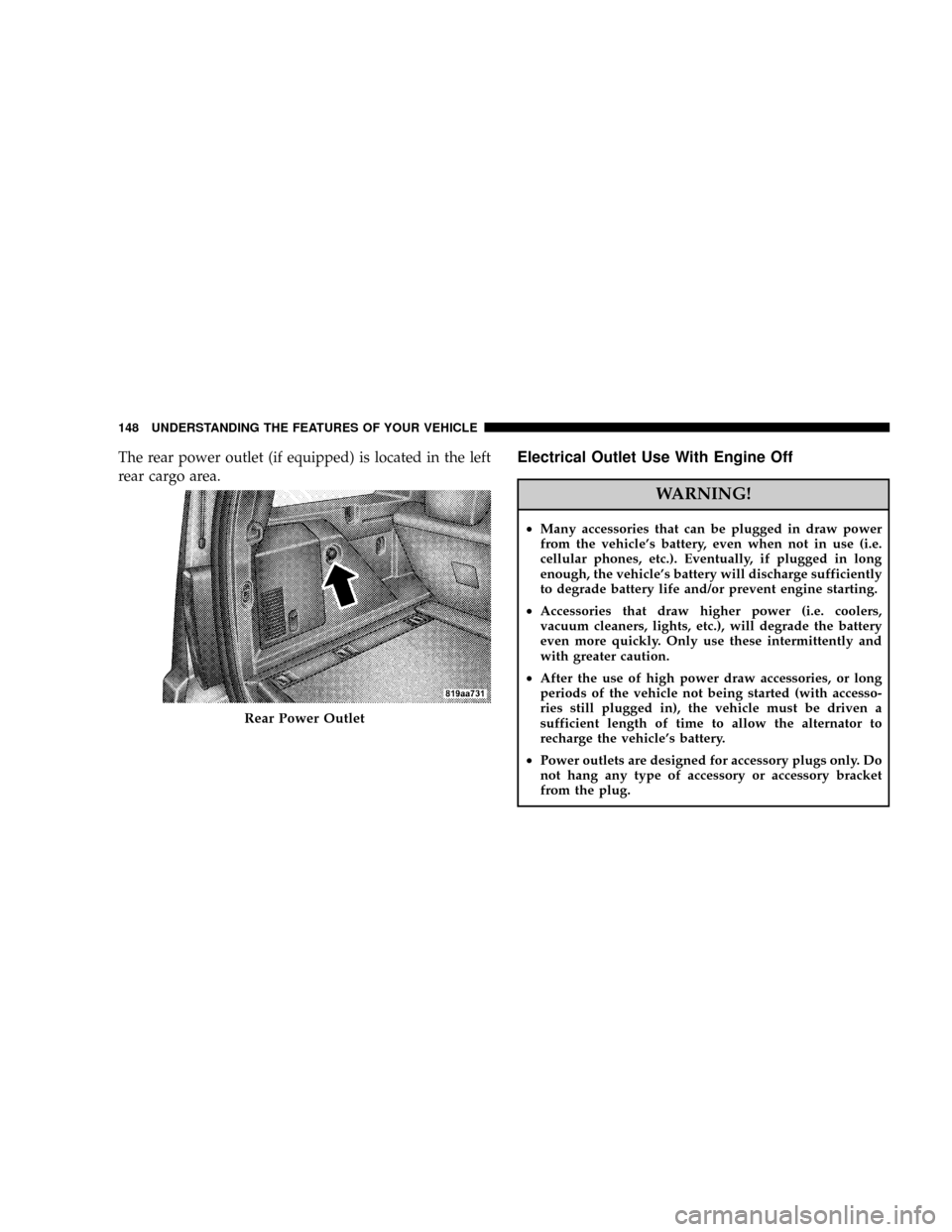
The rear power outlet (if equipped) is located in the left
rear cargo area.Electrical Outlet Use With Engine Off
WARNING!
²Many accessories that can be plugged in draw power
from the vehicle's battery, even when not in use (i.e.
cellular phones, etc.). Eventually, if plugged in long
enough, the vehicle's battery will discharge sufficiently
to degrade battery life and/or prevent engine starting.
²Accessories that draw higher power (i.e. coolers,
vacuum cleaners, lights, etc.), will degrade the battery
even more quickly. Only use these intermittently and
with greater caution.
²After the use of high power draw accessories, or long
periods of the vehicle not being started (with accesso-
ries still plugged in), the vehicle must be driven a
sufficient length of time to allow the alternator to
recharge the vehicle's battery.
²Power outlets are designed for accessory plugs only. Do
not hang any type of accessory or accessory bracket
from the plug.
Rear Power Outlet
148 UNDERSTANDING THE FEATURES OF YOUR VEHICLE
Page 150 of 434

NOTE:Due to build in overload protection the inverter
will shut down if the power rating is exceeded.
WARNING!
To Avoid Serious Injury or Death:
²Do not use a 3ÐProng Adaptor.
²Do not insert any objects into the receptacles.
²Do not touch with wet hands.
²Close the lid when not in use.
²If this outlet is mishandled it may cause an electric
shock and failure.
Power Inverter Switch
150 UNDERSTANDING THE FEATURES OF YOUR VEHICLE
Page 153 of 434
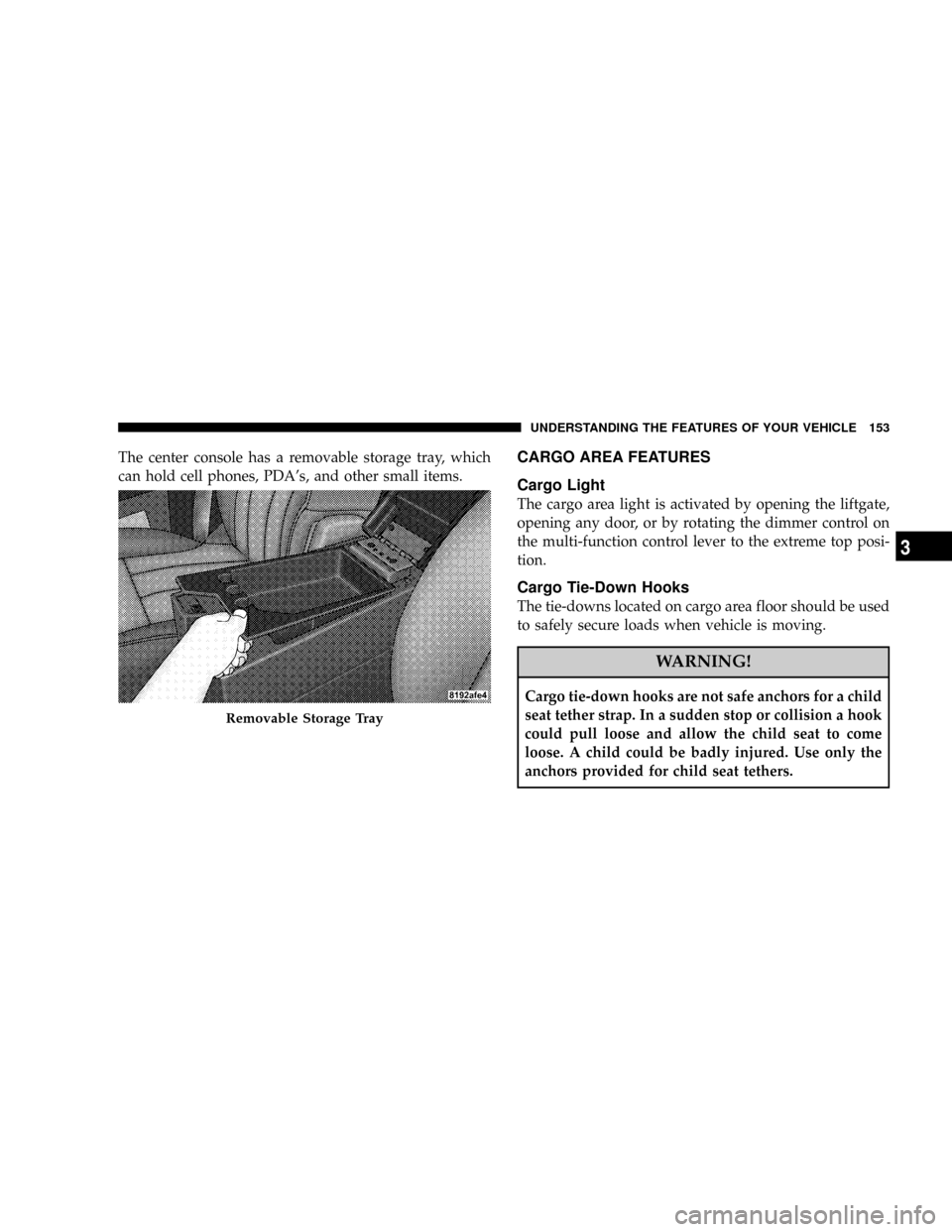
The center console has a removable storage tray, which
can hold cell phones, PDA's, and other small items.CARGO AREA FEATURES
Cargo Light
The cargo area light is activated by opening the liftgate,
opening any door, or by rotating the dimmer control on
the multi-function control lever to the extreme top posi-
tion.
Cargo Tie-Down Hooks
The tie-downs located on cargo area floor should be used
to safely secure loads when vehicle is moving.
WARNING!
Cargo tie-down hooks are not safe anchors for a child
seat tether strap. In a sudden stop or collision a hook
could pull loose and allow the child seat to come
loose. A child could be badly injured. Use only the
anchors provided for child seat tethers.
Removable Storage Tray
UNDERSTANDING THE FEATURES OF YOUR VEHICLE 153
3
Page 154 of 434
WARNING!
The weight and position of cargo and passengers can
change the vehicle center of gravity and vehicle
handling. To avoid loss of control resulting in per-
sonal injury, follow these guidelines for loading your
vehicle:
²Do not carry loads which exceed the load limits
described on the label attached to the left door or left
door center pillar.
²Always place cargo evenly on the cargo floor. Put
heavier objects as low and as far forward as possible.
²Place as much cargo as possible in front of the rear
axle. Too much weight or improperly placed weight
over or behind the rear axle can cause the vehicle to
sway.
²Do not pile luggage or cargo higher than the top of the
seatback. This could impair visibility or become a
dangerous projectile in a sudden stop or collision.
WARNING!
To help protect against personal injury, passengers
should not be seated in the rear cargo area. The rear
cargo space is intended for load carrying purposes
only, not for passengers, who should sit in seats and
use seat belts.
Cargo Load Floor Ð If Equipped
The panel in the load floor is reversible for added utility.
One side features a plastic lined tray which can hold a
variety of items. The maximum load capacity of the load
floor is 400 lbs (181 kg).
154 UNDERSTANDING THE FEATURES OF YOUR VEHICLE
Page 161 of 434
WARNING!
Cargo must be securely tied before driving your
vehicle. Improperly secured loads can fly off the
vehicle, particularly at high speeds, resulting in per-
sonal injury or property damage. Follow the roof rack
Cautions when carrying cargo on your roof rack.
UNDERSTANDING THE FEATURES OF YOUR VEHICLE 161
3
Page 166 of 434

INSTRUMENT PANEL AND CONTROLS
1 Ð Air Outlet 6 Ð Glove Box 11 Ð Hazard Warning Flasher
2 Ð Instrument Cluster 7 Ð Climate Control 12 Ð * Electronic Stability Control /
Traction Control Switch
3 Ð Storage Tray8 Ð * Heated Seat Switch 13 Ð Cigar Lighter / Power Outlet
4 Ð Center Air Outlet9 Ð * Rear Park Assist Switch 14 Ð Storage Bin
5 Ð Radio 10 Ð Passenger Airbag Disable Light * Ð If Equipped 166 INSTRUMENT PANEL AND CONTROLS