load capacity DODGE NITRO 2011 1.G User Guide
[x] Cancel search | Manufacturer: DODGE, Model Year: 2011, Model line: NITRO, Model: DODGE NITRO 2011 1.GPages: 497, PDF Size: 3.89 MB
Page 363 of 497
Curb Weight
The curb weight of a vehicle is defined as the total weight
of the vehicle with all fluids, including vehicle fuel, at full
capacity conditions, and with no occupants or cargo
loaded into the vehicle. The front and rear curb weight
values are determined by weighing your vehicle on a
commercial scale before any occupants or cargo are
added.
Loading
The actual total weight and the weight of the front and
rear of your vehicle at the ground can best be determined
by weighing it when it is loaded and ready for operation.
The entire vehicle should first be weighed on a commer-
cial scale to ensure that the GVWR has not been ex-
ceeded. The weight on the front and rear of the vehicle
should then be determined separately to be sure that the
load is properly distributed over front and rear axle.
Weighing the vehicle may show that the GAWR of eitherthe front or rear axles has been exceeded, but the total
load is within the specified GVWR. If so, weight must be
shifted from front to rear, or rear to front, as appropriate
until the specified weight limitations are met. Store the
heavier items down low and be sure that the weight is
distributed equally. Stow all loose items securely before
driving.
Improper weight distributions can have an adverse affect
on the way your vehicle steers and handles, and the way
the brakes operate.
CAUTION!
Do not load your vehicle any heavier than the GVWR
or the maximum front and rear GAWR. If you do,
parts on your vehicle can break, or it can change the
way your vehicle handles. This could cause you to
lose control. Also, overloading can shorten the life of
your vehicle.
360 STARTING AND OPERATING
Page 365 of 497
Gross Combination Weight Rating (GCWR)
The GCWR is the total permissible weight of your vehicle
and trailer when weighed in combination.
NOTE:The GCWR rating includes a 150 lbs (68 kg)
allowance for the presence of a driver.
Gross Axle Weight Rating (GAWR)
The GAWR is the maximum capacity of the front and rear
axles. Distribute the load over the front and rear axles
evenly. Make sure that you do not exceed either front or
rear GAWR. Refer to “Vehicle Loading/Vehicle Certifica-
tion Label” in Starting and Operating” for further infor-
mation.
WARNING!
It is important that you do not exceed the maximum
front or rear GAWR. A dangerous driving condition
can result if either rating is exceeded. You could lose
control of the vehicle and have a collision.
Tongue Weight
The tongue weight is the downward force exerted on the
hitch ball by the trailer. In most cases it should not be less
than 10% or more than 15% of the trailer load. You must
consider this as part of the load on your vehicle.
Frontal Area
The frontal area is the maximum height multiplied by the
maximum width of the front of a trailer.
Trailer Sway Control
The trailer sway control is a telescoping link that can be
installed between the hitch receiver and the trailer tongue
that typically provides adjustable friction associated with
the telescoping motion to dampen any unwanted trailer
swaying motions while traveling.
362 STARTING AND OPERATING
Page 375 of 497
Towing Requirements – Tires
Do not attempt to tow a trailer while using a compact
spare tire.
Proper tire inflation pressures are essential to the safe
and satisfactory operation of your vehicle. Refer to
“Tires – General Information” in “Starting and Oper-
ating” for proper tire inflation procedures.
Check the trailer tires for proper tire inflation pres-
sures before trailer usage.
Check for signs of tire wear or visible tire damage
before towing a trailer. Refer to “Tires – General
Information” in “Starting and Operating” for the
proper inspection procedure.
When replacing tires, refer to “Tires – General Infor-
mation” in “Starting and Operating” for proper tirereplacement procedures. Replacing tires with a higher
load carrying capacity will not increase the vehicle’s
GVWR and GAWR limits.
Towing Requirements – Trailer Brakes
Do
not interconnect the hydraulic brake system or
vacuum system of your vehicle with that of the trailer.
This could cause inadequate braking and possible
personal injury.
An electronically actuated trailer brake controller is
required when towing a trailer with electronically
actuated brakes. When towing a trailer equipped with
a hydraulic surge actuated brake system, an electronic
brake controller is not required.
Trailer brakes are recommended for trailers over
1,000 lbs (454 kg) and required for trailers in excess of
2,000 lbs (907 kg).
372 STARTING AND OPERATING
Page 376 of 497
CAUTION!
If the trailer weighs more than 1,000 lbs (454 kg)
loaded, it should have its own brakes and they
should be of adequate capacity. Failure to do this
could lead to accelerated brake lining wear, higher
brake pedal effort, and longer stopping distances.
WARNING!
•Do not connect trailer brakes to your vehicle’s
hydraulic brake lines. It can overload your brake
system and cause it to fail. You might not have
brakes when you need them and could have a
collision.(Continued)
WARNING! (Continued)
•Towing any trailer will increase your stopping
distance. When towing you should allow for addi-
tional space between your vehicle and the vehicle
in front of you. Failure to do so could result in a
collision.
Towing Requirements – Trailer Lights and Wiring
Whenever you pull a trailer, regardless of the trailer size,
stop lights and turn signals on the trailer are required for
motoring safety.
The trailer tow package may include a four-pin and
seven-pin wiring harness. Use a factory approved trailer
harness and connector.
NOTE:Do not cut or splice wiring into the vehicles
wiring harness.5
STARTING AND OPERATING 373
Page 479 of 497
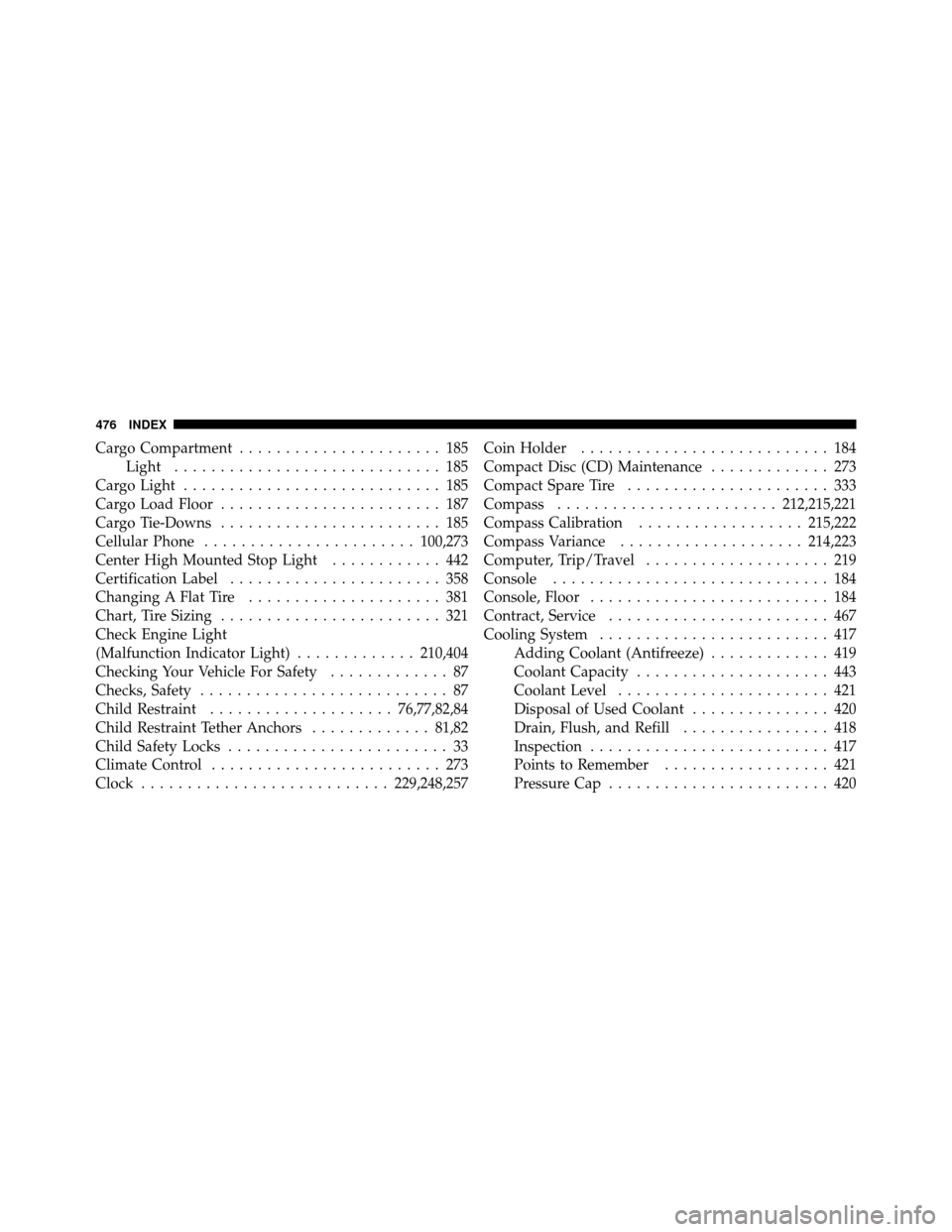
Cargo Compartment...................... 185
Light ............................. 185
Cargo Light ............................ 185
Cargo Load Floor ........................ 187
Cargo Tie-Downs ........................ 185
Cellular Phone ....................... 100,273
Center High Mounted Stop Light ............ 442
Certification Label ....................... 358
Changing A Flat Tire ..................... 381
Chart, Tire Sizing ........................ 321
Check Engine Light
(Malfunction Indicator Light) .............210,404
Checking Your Vehicle For Safety ............. 87
Checks, Safety ........................... 87
Child Restraint .................... 76,77,82,84
Child Restraint Tether Anchors .............81,82
Child Safety Locks ........................ 33
Climate Control ......................... 273
Clock ........................... 229,248,257Coin Holder
........................... 184
Compact Disc (CD) Maintenance ............. 273
Compact Spare Tire ...................... 333
Compass ........................ 212,215,221
Compass Calibration .................. 215,222
Compass Variance .................... 214,223
Computer, Trip/Travel .................... 219
Console .............................. 184
Console, Floor .......................... 184
Contract, Service ........................ 467
Cooling System ......................... 417
Adding Coolant (Antifreeze) ............. 419
Coolant Capacity ..................... 443
Coolant Level ....................... 421
Disposal of Used Coolant ............... 420
Drain, Flush, and Refill ................ 418
Inspection .......................... 417
Points to Remember .................. 421
Pressure Cap ........................ 420
476 INDEX
Page 491 of 497
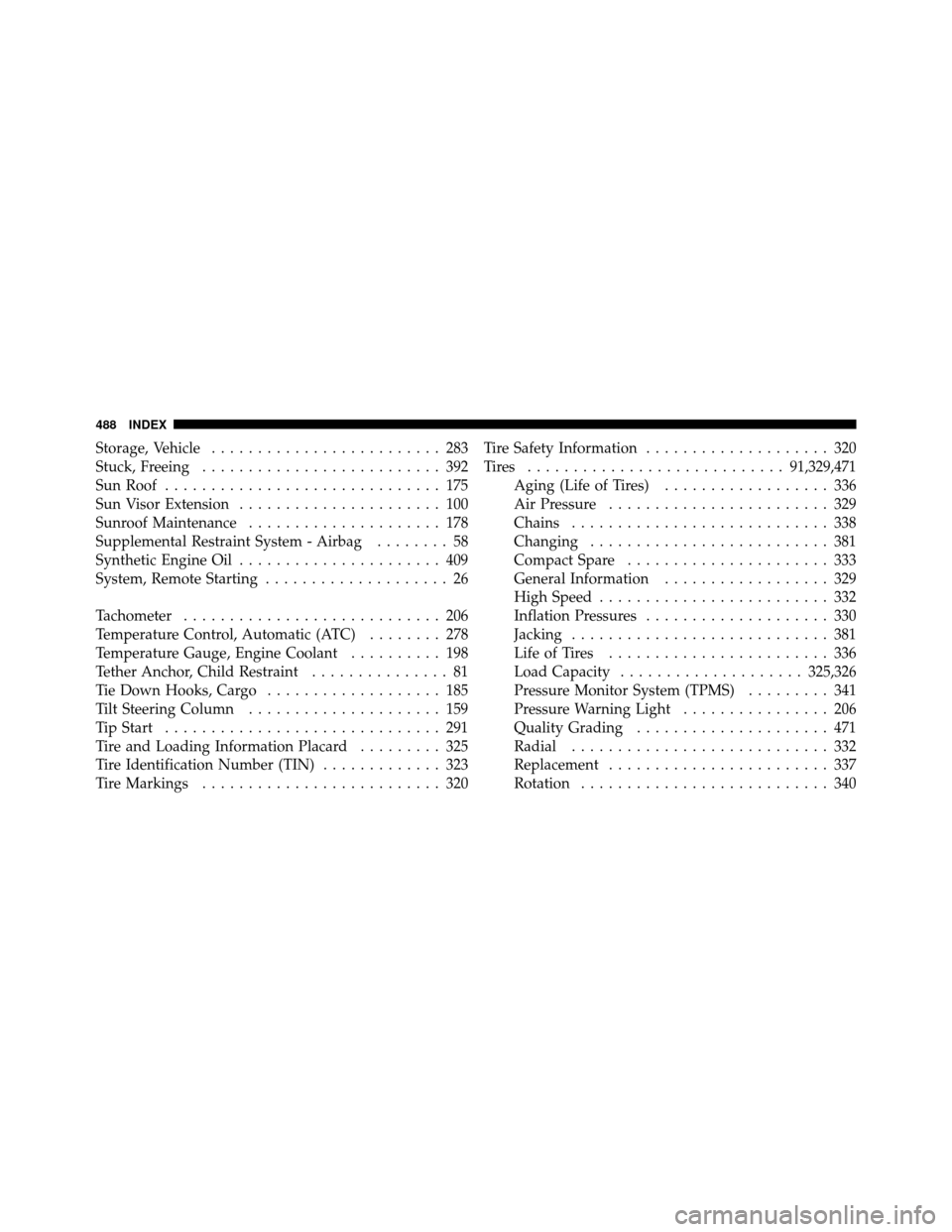
Storage, Vehicle......................... 283
Stuck, Freeing .......................... 392
Sun Roof .............................. 175
Sun Visor Extension ...................... 100
Sunroof Maintenance ..................... 178
Supplemental Restraint System - Airbag ........ 58
Synthetic Engine Oil ...................... 409
System, Remote Starting .................... 26
Tachometer ............................ 206
Temperature Control, Automatic (ATC) ........ 278
Temperature Gauge, Engine Coolant .......... 198
Tether Anchor, Child Restraint ............... 81
Tie Down Hooks, Cargo ................... 185
Tilt Steering Column ..................... 159
Tip Start .............................. 291
Tire and Loading Information Placard ......... 325
Tire Identification Number (TIN) ............. 323
Tire Markings .......................... 320 Tire Safety Information
.................... 320
Tires ............................ 91,329,471
Aging (Life of Tires) .................. 336
Air Pressure ........................ 329
Chains ............................ 338
Changing .......................... 381
Compact Spare ...................... 333
General Information .................. 329
High Speed ......................... 332
Inflation Pressures .................... 330
Jacking ............................ 381
Life of Tires ........................ 336
Load Capacity .................... 325,326
Pressure Monitor System (TPMS) ......... 341
Pressure Warning Light ................ 206
Quality Grading ..................... 471
Radial ............................ 332
Replacement ........................ 337
Rotation ........................... 340
488 INDEX