brake light DODGE POWER WAGON 2007 2.G User Guide
[x] Cancel search | Manufacturer: DODGE, Model Year: 2007, Model line: POWER WAGON, Model: DODGE POWER WAGON 2007 2.GPages: 492, PDF Size: 8.25 MB
Page 281 of 492
more weight on the down hill wheels, which increases
the possibilities of a down hill slide or roll over. Make
sure the surface has good traction with firm and stable
soils. If possible transverse the incline at an angle
heading slightly up or down.
WARNING!
Driving across an incline increases the risk of a roll
over, which may result in severe injury.
²If You Stall Or Begin To Lose Headway± If you stall
or begin to lose headway while climbing a steep hill,
allow your vehicle to come to a stop and immediately
apply the brake. Restart the engine and shift to R
(Reverse). Back slowly down the hill allowing the
compression braking of the engine and transmission tohelp regulate your speed. If the brakes are required to
control vehicle speed, apply them lightly and avoid
locking or skidding the tires.
WARNING!
If the engine stalls or you lose headway or cannot
make it to the top of a steep hill or grade, never
attempt to turn around. To do so may result in
tipping and rolling the vehicle, which may result in
severe injury. Always back carefully straight down a
hill in R (Reverse) gear. Never back down a hill in N
(Neutral) or with the clutch pedal depressed using
only the vehicle brakes. Never drive diagonally
across a hill, always drive straight up or down.
280 STARTING AND OPERATING
Page 282 of 492
Driving Through Water
Extreme care should be taken crossing any type of water.
Water crossings should be avoided if possible and only be
attempted when necessary, in a safe responsible manner.
You should only drive through areas which are desig-
nated and approved. You should tread lightly and avoid
damage to the environment. You should know your
vehicles abilities and be able to recover it if something
goes wrong. You should never stop or shut a vehicle off
when crossing deep water unless you ingested water into
the engine air intake. If the engine stalls do not attempt to
restart it. Determine if it has ingested water first. The key
to any crossing is low and slow. You want to use 1st gear
in 4L (low) and proceed very slowly with a constant slow
speed (3-5 mph maximum) and light throttle. Keep the
vehicle moving; do not try to accelerate through the
crossing. After crossing any water higher than the bottom
of the axle differentials, you should inspect all of the
vehicle fluids for signs of water ingestion.CAUTION!
Water ingestion into the axles, transmission, transfer
case, engine or vehicle interior can occur if you drive
too fast or through too deep of water. Water can cause
permanent damage to engine, driveline or other
vehicle components and your brakes will be less
effective once wet and/or muddy
²Before You Cross Any Type Of Water± As you
approach any type of water you need to determine if
you can cross it safely and responsibly. If necessary, get
out and walk through the water or probe it with a
stick. You need to be sure of its depth, approach angle,
current and bottom condition. Be careful of murky or
muddy waters, check for hidden obstacles. Make sure
you will not be intruding on any wildlife and you can
recover the vehicle if necessary. The key to a safe
STARTING AND OPERATING 281
5
Page 287 of 492
the two drivers. Good communication and line of sight
are required for a safe recovery. First connect the tow
strap to the correct attachment points on both vehicles.
There should be a least 20 to 30 feet between the
vehicles to allow for a safe recovery. If necessary join
two tow straps together using a 1
1¤2inch hard wood
dowel. This will keep the straps from becoming knot-
ted and is safer than using a clevis pin if the strap
breaks. Next have the tow vehicle backup, leaving 2 to
3 feet worth of slack in the strap. Then the tow vehicle,
using light throttle, should accelerate tightening the
strap providing the pulling force needed to free the
vehicle. The vehicle being recovered should assist in
the recovery, at the time of the snap, by slowly
spinning the tires in the same direction as the pulling
vehicle. After the vehicle becomes free, the driver of
the previously stuck vehicle should signal they are free
and should hit their brakes stopping both vehicles.
The driver of the pulling vehicle should let off thethrottle without using the brakes, once signaled by the
other driver. This sequence is important to avoid
having the recovered vehicle hit the pulling vehicle.WARNING!
Never use tow straps with end hooks or link two
straps with a clevis pin. These heavy metal objects
could become projectiles if a strap breaks, which
could cause severe injury. Never leave more than 2 or
3 feet of slack in the strap. More slack than this
greatly increases the risk of injury and vehicle dam-
age. Always keep everyone at least 30 feet away from
a strapping or winching situation.
²Winching (see the section on ªWinch Operationº for
additional information on the Power Wagon's winch)
± Winching is most commonly used in the following
situations: there is no support vehicle available, a high
286 STARTING AND OPERATING
Page 309 of 492
vehicle's frame/tow hook and run the wire rope through
a snatch block. Disengage the clutch and, using the
snatch block, pull out enough wire to reach your anchor
point. Do not attach hook to mounting kit. Secure to the
anchor point with a tree trunk protector or choker chain.
Attach the clevis/shackle. Attach the shackle to the two
ends of the strap/chain, being careful not to over tighten
(tighten and back-off 1/2 turn).
PARKING BRAKE
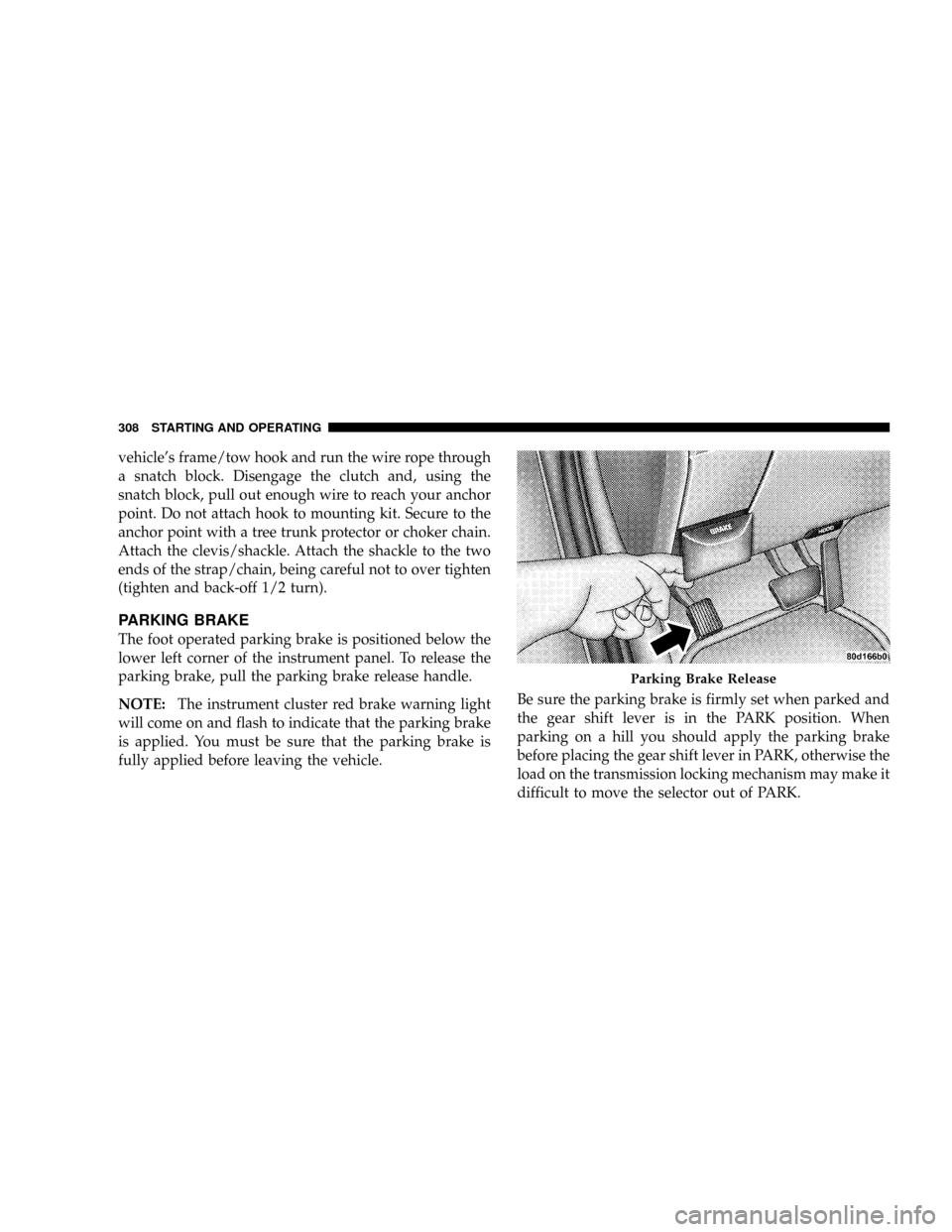
The foot operated parking brake is positioned below the
lower left corner of the instrument panel. To release the
parking brake, pull the parking brake release handle.
NOTE:The instrument cluster red brake warning light
will come on and flash to indicate that the parking brake
is applied. You must be sure that the parking brake is
fully applied before leaving the vehicle.Be sure the parking brake is firmly set when parked and
the gear shift lever is in the PARK position. When
parking on a hill you should apply the parking brake
before placing the gear shift lever in PARK, otherwise the
load on the transmission locking mechanism may make it
difficult to move the selector out of PARK.
Parking Brake Release
308 STARTING AND OPERATING
Page 311 of 492
Brake Noise
During normal operation of the brake system certain
noises may be present from time to time. Occasional
9groan9or9squeal9noises may occur during normal
operation of the brake system which may not be indica-
tive of a problem. These noises may be heard at any time
the brakes are applied but may be more noticeable during
the first few brake applications in the morning. Moisture,
hot or cold temperature, dust, and or other debris may
also contribute to the noise condition. Repeated or con-
tinuous noises during braking may be an indication that
the brake linings are worn and in need of replacement.
Four-Wheel Anti-Lock Brake System (ABS)Ð If
Equipped
This Anti-lock Brake System is designed to aid the driver
in maintaining vehicle control under adverse braking
conditions. The system operates with a separate com-
puter to modulate hydraulic pressure to prevent wheel
lockup and help avoid skidding on slippery surfaces.The system's pump motor runs during an ABS stop to
provide regulated hydraulic pressure. The pump motor
makes a low humming noise during operation. This is
normal.
When you are in a severe braking condition involving
use of the Anti-lock Brake System, you will experience
some pedal drop as the vehicle comes to a complete stop.
This is the result of the system reverting to the base brake
system and is normal.
Engagement of the Anti-lock Brake System may be
accompanied by a pulsing sensation. You may also hear a
clicking noise. These occurrences are normal, and indi-
cate that the system is functioning.ABS Warning Light
The Anti-lock Brake System includes an amber warning
light. When the light is illuminated, the Anti-lock Brake
System is not functioning. The system reverts to standard
non-anti-lock brakes.
310 STARTING AND OPERATING
Page 356 of 492
WARNING!
Do not connect trailer brakes to your vehicle's hy-
draulic brake lines. It can overload your brake sys-
tem and cause it to fail. You might not have brakes
when you need them and could have an accident.
Towing any trailer will increase your stopping dis-
tance. When towing you should allow for additional
space between your vehicle and the vehicle in front
of you. Failure to do so could result in an accident.
Towing Requirements Ð Trailer Lights & Wiring
Whenever you pull a trailer, regardless of the trailer size,
stop lights and turn signals on the trailer are required for
motoring safety.
The Trailer Tow Package may includea4and7pin
wiring harness. Use a factory approved trailer harness
and connector.NOTE:Do not cut or splice wiring into the vehicles
wiring harness.
The electrical connections are all complete to the vehicle
but you must mate the harness to a trailer connector.
Refer to the following illustrations.
4 - Pin Connector
STARTING AND OPERATING 355
5
Page 415 of 492
(upper) reference holes when the transmission reaches
180ÉF (82ÉC). Remember it is best to check the level at the
normal operating temperature.
CAUTION!
Be aware that if the fluid temperature is below 50ÉF
(10ÉC) it may not register on the dipstick. Do not add
fluid until the temperature is elevated enough to
produce an accurate reading.
7. Check for leaks. Release parking brake.
To prevent dirt and water from entering the transmission
after checking or replenishing fluid, make certain that the
dipstick cap is properly reseated. It is normal for the
dipstick cap to spring back slightly from its fully seated
position, as long as its seal remains engaged in the
dipstick tube.
Selection Of Lubricant
Refer to Fluids, Lubricants and Genuine Parts for correct
fluid type. It is important that the transmission fluid be
maintained at the prescribed level using the recom-
mended fluid.
CAUTION!
Using a transmission fluid other than the manufac-
turers recommended fluid may cause deterioration
in transmission shift quality and/or torque converter
shudder. Using a transmission fluid other than the
manufacturers recommended fluid will result in
more frequent fluid and filter changes. Refer to
Fluids, Lubricants and Genuine Parts for correct
fluid type.
414 MAINTAINING YOUR VEHICLE
Page 449 of 492
At Each Stop for Fuel
²Check the engine oil level about 5 minutes after a fully
warmed engine is shut off. Checking the oil level while
the vehicle is on level ground will improve the accu-
racy of the oil level reading. Add oil only when the
level is at or below the ADD or MIN mark.
²Check the windshield washer solvent and add if
required.
Once a Month
²Check tire pressure and look for unusual wear or
damage.
²Inspect the battery and clean and tighten the terminals
as required.
²Check the fluid levels of coolant bottle, brake master
cylinder, and transmission and add as needed.
²Check all lights and all other electrical items for correct
operation.
At Each Oil Change
²Change the engine oil filter.
²Lubricate the front driveshaft grease fitting and tie rod
end links.
²Inspect the exhaust system.
²Inspect the brake hoses.
²Inspect the UÐjoints and front suspension compo-
nents.
²Check the automatic transmission fluid level.
²Check the manual transmission fluid level.
²Check the coolant level, hoses, and clamps.
²Lubricate Front Drive Shaft Fitting.
448 MAINTENANCE SCHEDULES
8
M
A
I
N
T
E
N
A
N
C
E
S
C
H
E
D
U
L
E
S
Page 476 of 492
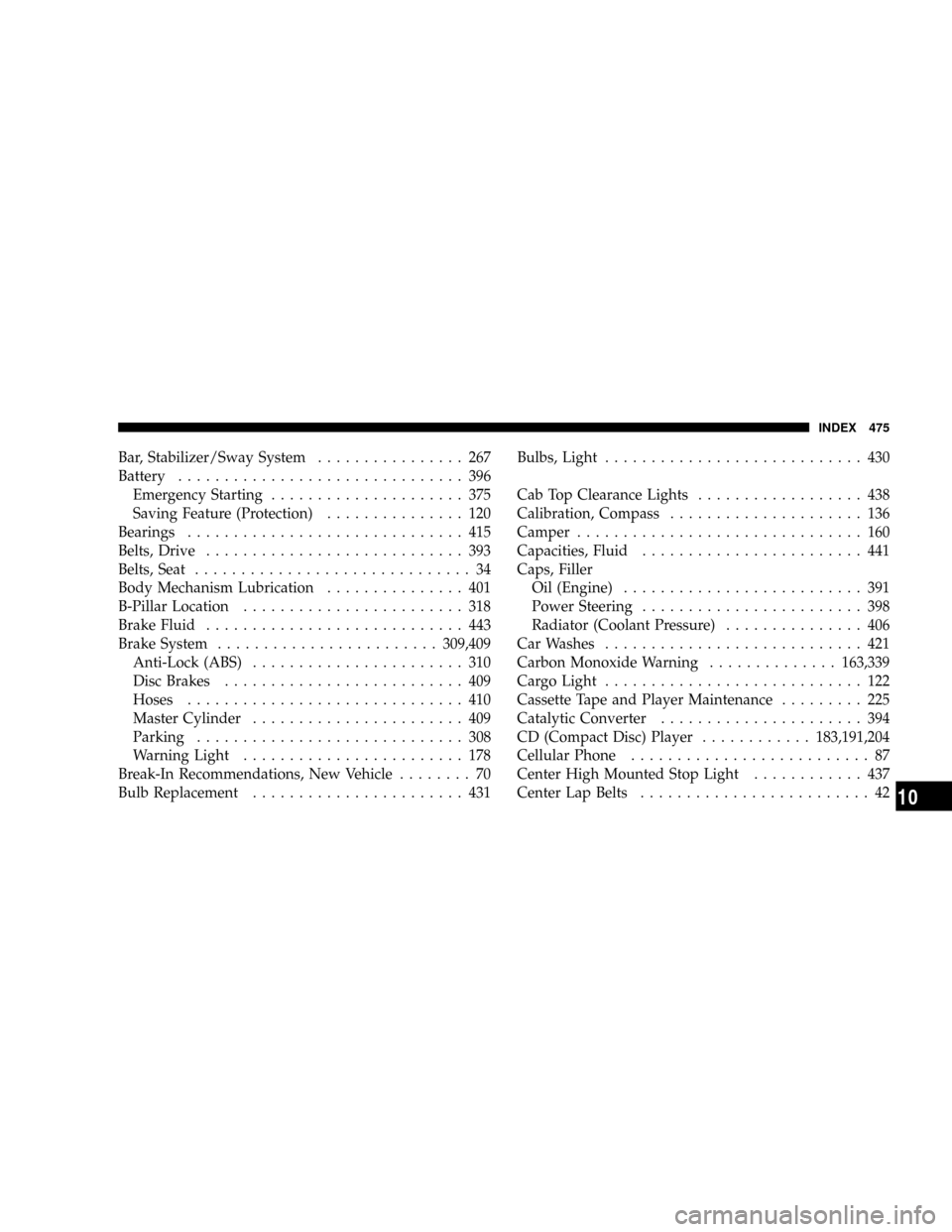
Bar, Stabilizer/Sway System................ 267
Battery............................... 396
Emergency Starting..................... 375
Saving Feature (Protection)............... 120
Bearings.............................. 415
Belts, Drive............................ 393
Belts, Seat.............................. 34
Body Mechanism Lubrication............... 401
B-Pillar Location........................ 318
Brake Fluid............................ 443
Brake System........................309,409
Anti-Lock (ABS)....................... 310
Disc Brakes.......................... 409
Hoses.............................. 410
Master Cylinder....................... 409
Parking............................. 308
Warning Light........................ 178
Break-In Recommendations, New Vehicle........ 70
Bulb Replacement....................... 431Bulbs, Light............................ 430
Cab Top Clearance Lights.................. 438
Calibration, Compass..................... 136
Camper............................... 160
Capacities, Fluid........................ 441
Caps, Filler
Oil (Engine).......................... 391
Power Steering........................ 398
Radiator (Coolant Pressure)............... 406
Car Washes............................ 421
Carbon Monoxide Warning..............163,339
Cargo Light............................ 122
Cassette Tape and Player Maintenance......... 225
Catalytic Converter...................... 394
CD (Compact Disc) Player............183,191,204
Cellular Phone.......................... 87
Center High Mounted Stop Light............ 437
Center Lap Belts......................... 42
INDEX 475
10
Page 478 of 492

Data Recorder, Event...................... 56
Daytime Running Lights................... 121
Dealer Service.......................... 388
Defroster, Rear Window.................86,154
Defroster, Windshield...............163,229,232
Delay (Intermittent) Wipers................. 125
Differential............................. 78
Differential, Limited-Slip.................. 262
Digital Video Disc (DVD) Player.............. 78
Dipsticks
Automatic Transmission................. 413
Power Steering........................ 398
Disc Brakes............................ 409
Disposal
Antifreeze (Engine Coolant)............... 406
Door Ajar............................. 181
Door Locks............................. 26
Door Opener, Garage..................... 139
Drive Belts............................ 393Driving
Off-Pavement......................... 268
Off-Road............................ 268
Electric Rear Window Defrost.............86,154
Electrical Power Outlets................... 148
Electronic Speed Control (Cruise Control)...... 128
Emergency Brake........................ 308
Emergency, In Case of
Freeing Vehicle When Stuck............... 378
Hazard Warning Flasher................. 366
Jacking............................. 369
Jump Starting......................... 375
Tow Hooks.......................... 379
Towing............................. 380
Emission Control System Maintenance......... 446
Emission Related Components.............. 396
Engine............................... 384
Air Cleaner.......................... 393
INDEX 477
10