clutch DODGE POWER WAGON 2007 2.G User Guide
[x] Cancel search | Manufacturer: DODGE, Model Year: 2007, Model line: POWER WAGON, Model: DODGE POWER WAGON 2007 2.GPages: 492, PDF Size: 8.25 MB
Page 293 of 492
1.Motor:The winch motor is powered by the vehicle
charging system and features a thermal protection switch
that automatically stops motor function in the power-in
direction if the motor gets too hot.
2.Remote Socket:The remote socket allows the remote
control to be attached to the control pack to allow the
winch to function.
3.Winch Drum w/ Integral Brake:The winch drum
allows the wire rope to be stored on the winch and
transmits force to the wire rope. The winch is equipped
with an integral brake that will stop rotation of the winch
drum if the winch motor is stopped.
4.3 Stage Planetary Gear Set:Provides balance between
speed and pulling power.
5.Wire Rope:The wire rope allows the winch to be
connected to an anchor to provide a pulling force.6.Clutch Lever:The clutch lever allows the winch drum
to be disconnected from the winch motor to allow the
wire rope to be pulled from the winch by hand.
7.Remote Control:The remote control provides the
interface between the winch operator and the winch. The
remote control provides the ability to power the winch in,
out, and stop the winch. To operate the winch, the toggle
switch is pressed down to power the winch in and up to
power the winch out. The winch will stop if the switch is
left in the neutral (center) position.
CAUTION!
If not installed, the hook strap must be placed on the
hook.
Fairlead:The fairlead acts as a guide for the wire rope
and minimizes damage to the rope.
292 STARTING AND OPERATING
Page 295 of 492
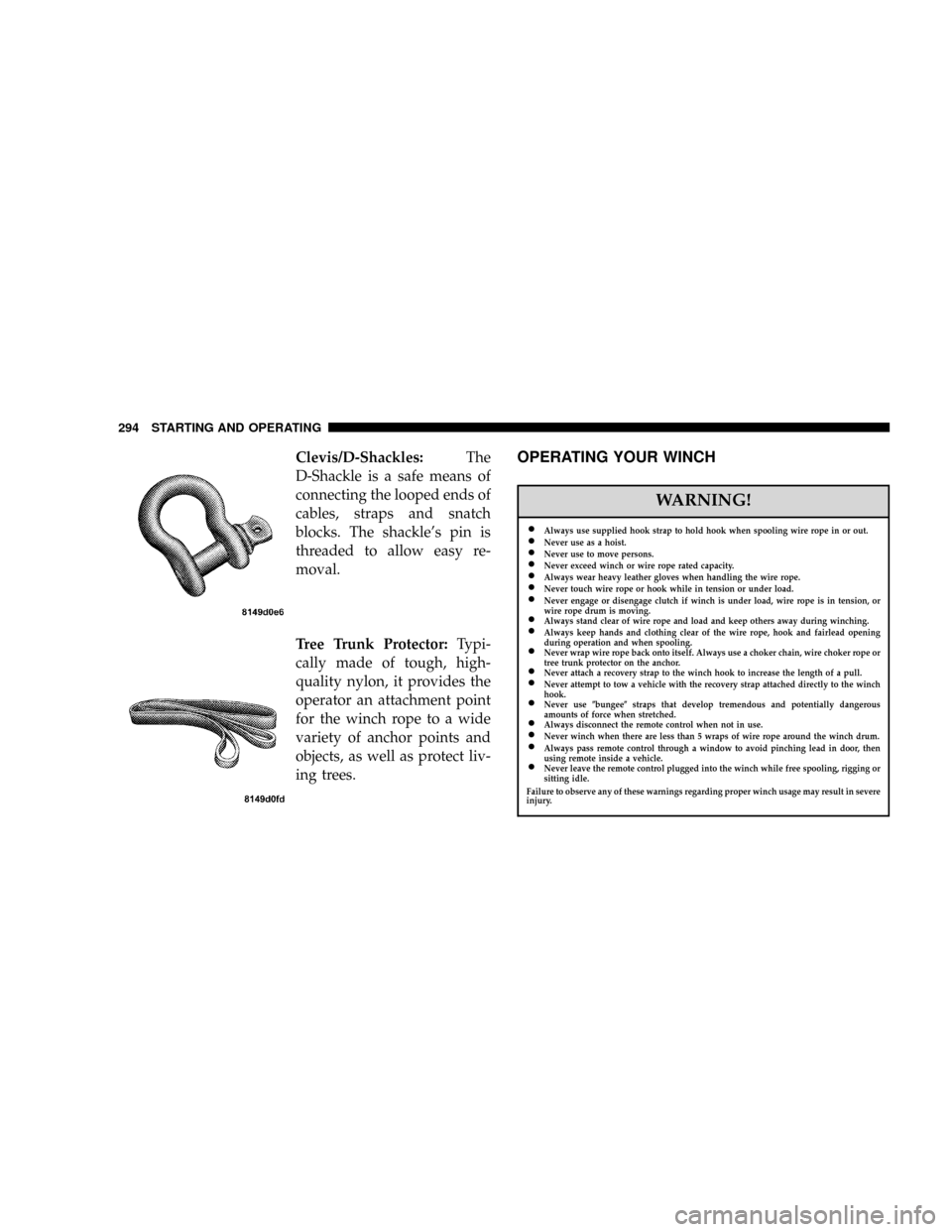
Clevis/D-Shackles:The
D-Shackle is a safe means of
connecting the looped ends of
cables, straps and snatch
blocks. The shackle's pin is
threaded to allow easy re-
moval.
Tree Trunk Protector:Typi-
cally made of tough, high-
quality nylon, it provides the
operator an attachment point
for the winch rope to a wide
variety of anchor points and
objects, as well as protect liv-
ing trees.OPERATING YOUR WINCH
WARNING!
²Always use supplied hook strap to hold hook when spooling wire rope in or out.²Never use as a hoist.²Never use to move persons.²Never exceed winch or wire rope rated capacity.²Always wear heavy leather gloves when handling the wire rope.²Never touch wire rope or hook while in tension or under load.²Never engage or disengage clutch if winch is under load, wire rope is in tension, or
wire rope drum is moving.
²Always stand clear of wire rope and load and keep others away during winching.²Always keep hands and clothing clear of the wire rope, hook and fairlead opening
during operation and when spooling.
²Never wrap wire rope back onto itself. Always use a choker chain, wire choker rope or
tree trunk protector on the anchor.
²Never attach a recovery strap to the winch hook to increase the length of a pull.²Never attempt to tow a vehicle with the recovery strap attached directly to the winch
hook.
²Never use(bungee(straps that develop tremendous and potentially dangerous
amounts of force when stretched.
²Always disconnect the remote control when not in use.²Never winch when there are less than 5 wraps of wire rope around the winch drum.²Always pass remote control through a window to avoid pinching lead in door, then
using remote inside a vehicle.
²Never leave the remote control plugged into the winch while free spooling, rigging or
sitting idle.
Failure to observe any of these warnings regarding proper winch usage may result in severe
injury.
294 STARTING AND OPERATING
Page 297 of 492
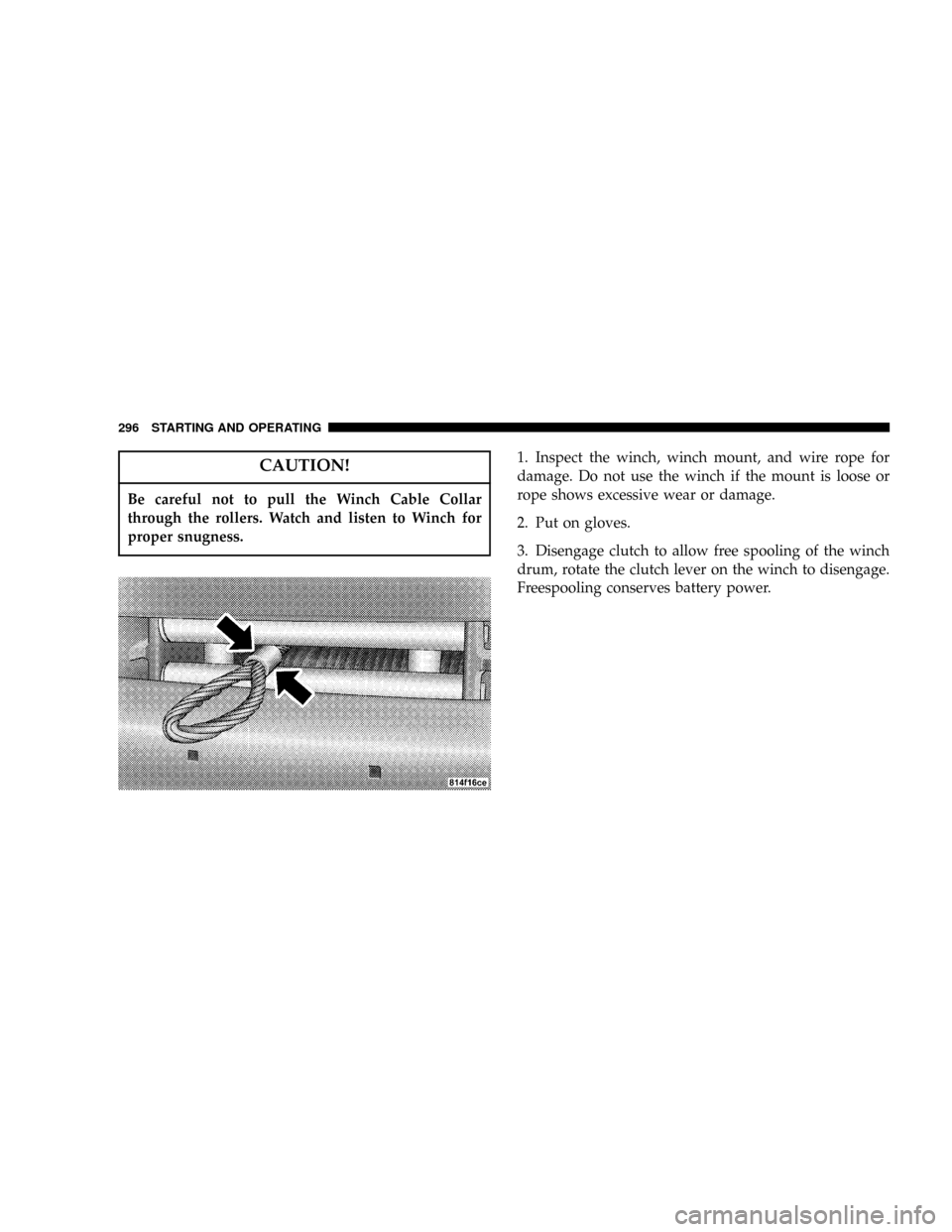
CAUTION!
Be careful not to pull the Winch Cable Collar
through the rollers. Watch and listen to Winch for
proper snugness.
1. Inspect the winch, winch mount, and wire rope for
damage. Do not use the winch if the mount is loose or
rope shows excessive wear or damage.
2. Put on gloves.
3. Disengage clutch to allow free spooling of the winch
drum, rotate the clutch lever on the winch to disengage.
Freespooling conserves battery power.
296 STARTING AND OPERATING
Page 300 of 492
NOTE: How to choose an anchor point:A secure
anchor is critical to winching operations. An anchor must
be strong enough to hold while winching. Natural an-
chors include trees, stumps and rocks. Hook the cable as
low as possible. If no natural anchors are available when
recovering another vehicle, your vehicle becomes the
anchor point. In this case, be sure to put the transmission
in neutral, apply the hand brake and block its wheels to
prevent your vehicle from moving. Ideally, you'll want
an anchor point that will enable you to pull straight in the
direction the vehicle will move. This allows the wire rope
to wind tightly and evenly onto the spooling drum. An
anchor point as far away as possible will provide the
winch with its greatest pulling power.
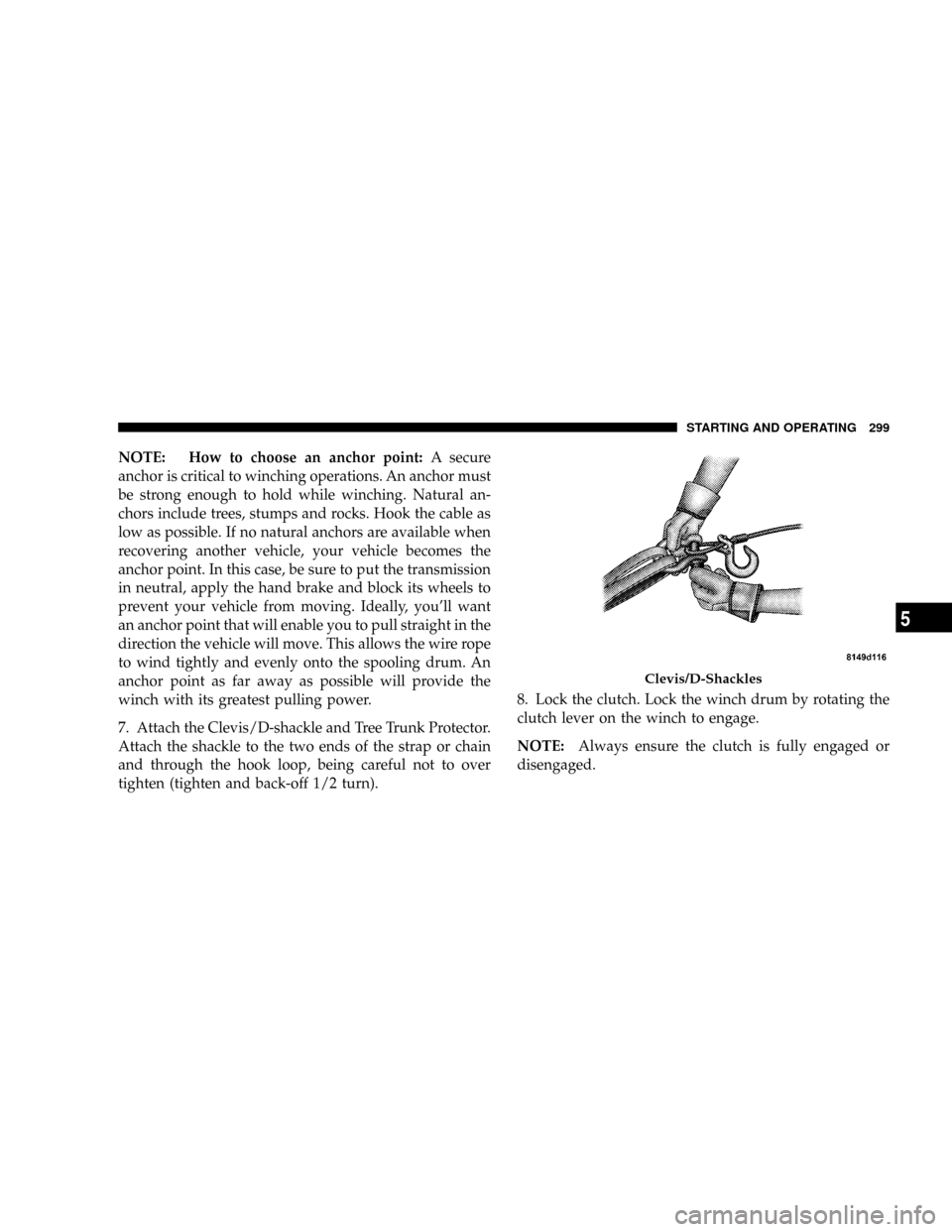
7. Attach the Clevis/D-shackle and Tree Trunk Protector.
Attach the shackle to the two ends of the strap or chain
and through the hook loop, being careful not to over
tighten (tighten and back-off 1/2 turn).8. Lock the clutch. Lock the winch drum by rotating the
clutch lever on the winch to engage.
NOTE:Always ensure the clutch is fully engaged or
disengaged.
Clevis/D-Shackles
STARTING AND OPERATING 299
5
Page 309 of 492
vehicle's frame/tow hook and run the wire rope through
a snatch block. Disengage the clutch and, using the
snatch block, pull out enough wire to reach your anchor
point. Do not attach hook to mounting kit. Secure to the
anchor point with a tree trunk protector or choker chain.
Attach the clevis/shackle. Attach the shackle to the two
ends of the strap/chain, being careful not to over tighten
(tighten and back-off 1/2 turn).
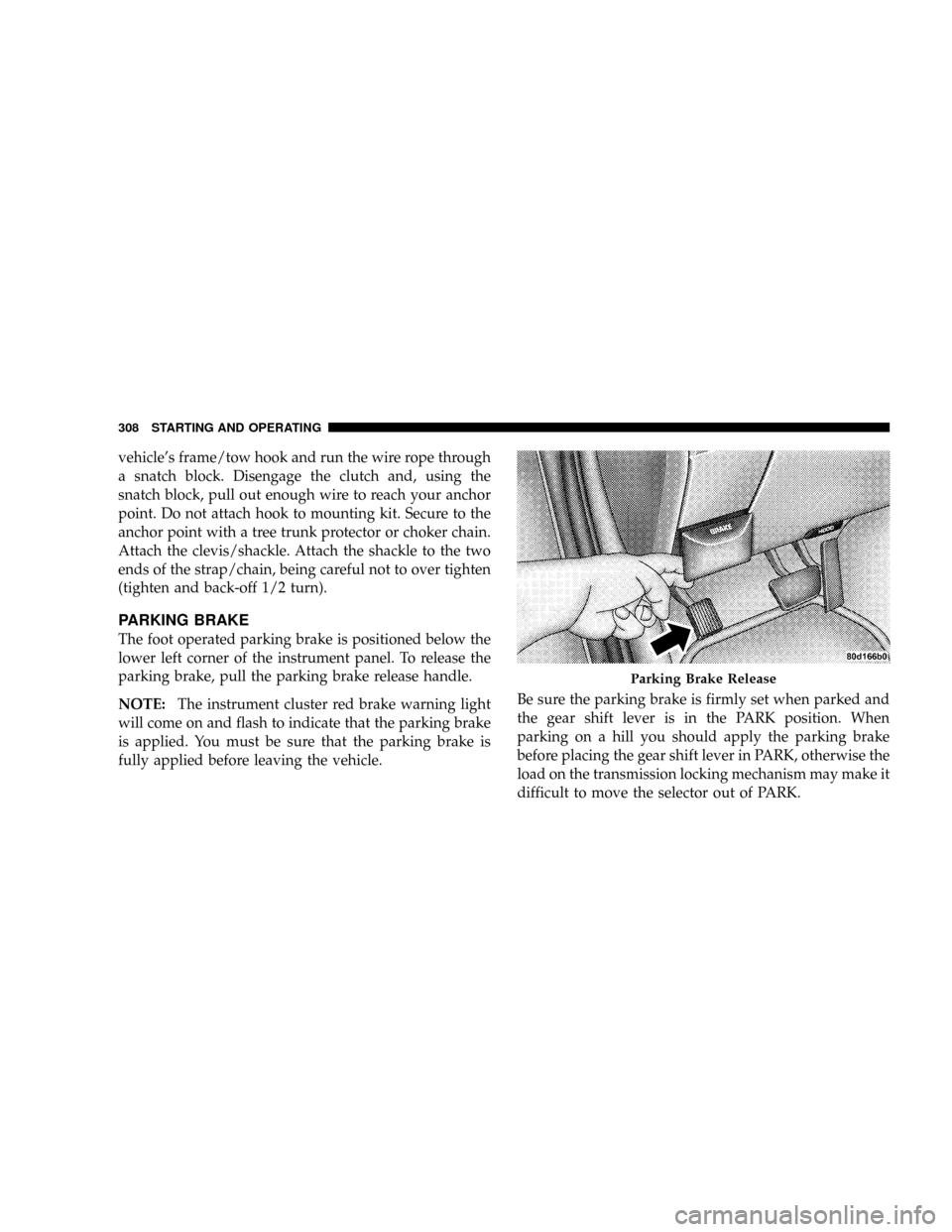
PARKING BRAKE
The foot operated parking brake is positioned below the
lower left corner of the instrument panel. To release the
parking brake, pull the parking brake release handle.
NOTE:The instrument cluster red brake warning light
will come on and flash to indicate that the parking brake
is applied. You must be sure that the parking brake is
fully applied before leaving the vehicle.Be sure the parking brake is firmly set when parked and
the gear shift lever is in the PARK position. When
parking on a hill you should apply the parking brake
before placing the gear shift lever in PARK, otherwise the
load on the transmission locking mechanism may make it
difficult to move the selector out of PARK.
Parking Brake Release
308 STARTING AND OPERATING
Page 357 of 492
Towing Tips
Before setting out on a trip, practice turning, stopping
and backing the trailer in an area away from heavy
traffic.If using a manual transmission vehicle for trailer towing,
all starts must be in FIRST gear to avoid excessive clutch
slippage.
Towing Tips Ð Automatic Transmission
The ªDº range can be selected when towing. However, if
frequent shifting occurs while in this range, the ªTOW
HAULº or ªOD/OFFº range should be selected.
NOTE:Using the ªTOW HAULº or ªOD/OFFº range
while operating the vehicle under heavy operating con-
ditions will improve performance and extend transmis-
sion life by reducing excessive shifting and heat build up.
This action will also provide better engine braking.
The automatic transmission fluid and filter should be
changed if you REGULARLY tow a trailer for more than
45 minutes of continuous operation. See Schedule ªBº in
section 8 of this manual for transmission fluid change
intervals.
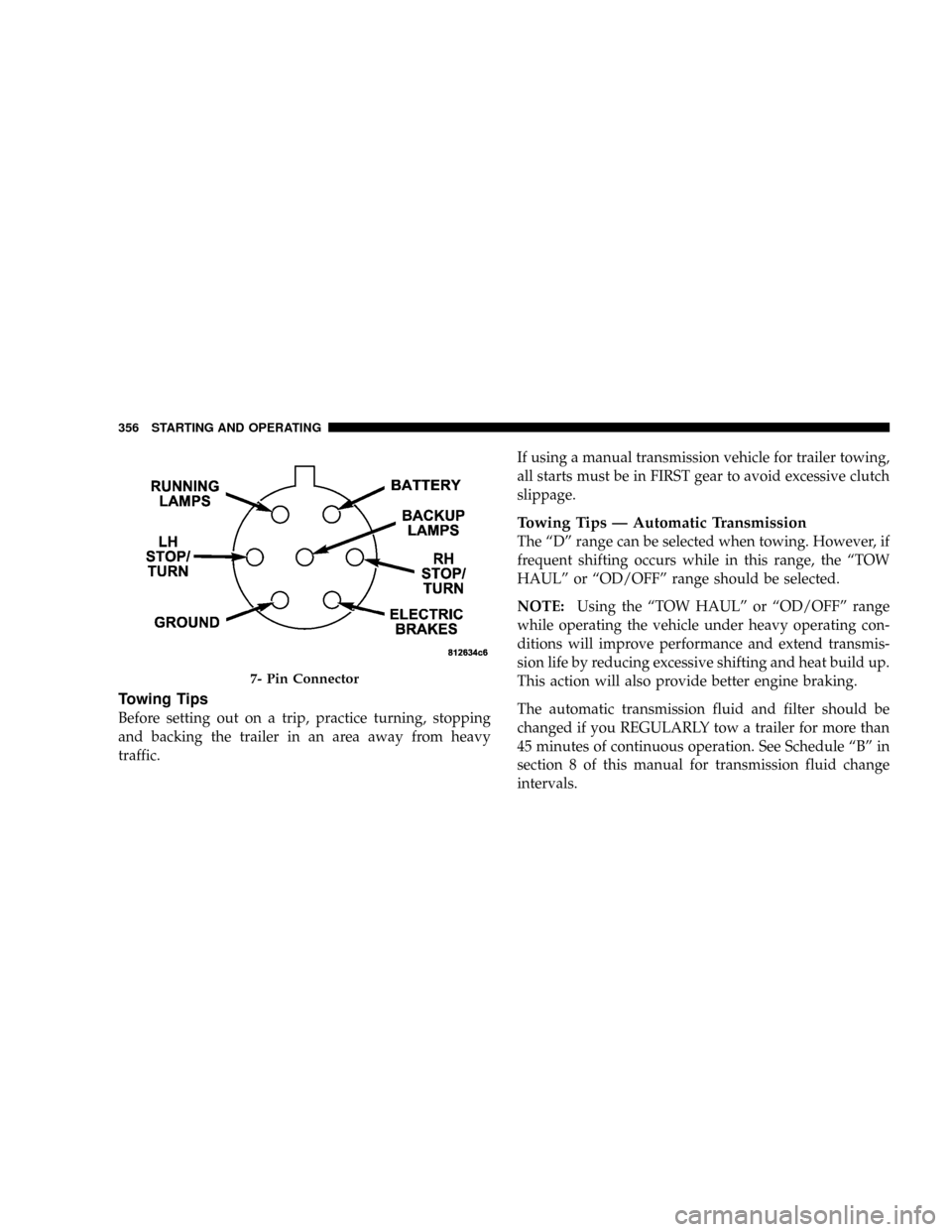
7- Pin Connector
356 STARTING AND OPERATING
Page 362 of 492
Recreational Towing Procedure Ð Manual Shift
Transfer Case Ð If Equipped
Use the following procedure to prepare your vehicle for
recreational towing:
CAUTION!
It is necessary to follow these steps to be certain that
the transfer case is fully in N (NEUTRAL) before
recreational towing to prevent damage to internal
parts.
1. Bring the vehicle to a complete stop.
2. Shut OFF the engine.
3. Depress the brake pedal.
4. Shift automatic transmission to N (NEUTRAL), or
depress the clutch on manual transmissions.5. Shift transfer case lever into N (NEUTRAL).
6. Start the engine.
7. Shift automatic transmission into Reverse (R).
8. Release brake pedal for five seconds and ensure that
there is no vehicle movement.
9. Repeat steps 7 and 8 with the transmission in Drive
(D).
10. Shut OFF the engine and place the ignition key to the
unlocked OFF position.
11. Shift automatic transmission into P (PARK).
12. Apply the parking brake.
13. Attach vehicle to tow vehicle with tow bar.
14. Release the parking brake.
STARTING AND OPERATING 361
5
Page 363 of 492
CAUTION!
Damage to the automatic transmission may occur if
the transmission is shifted into P (PARK) with the
transfer case in N (NEUTRAL) and the engine RUN-
NING. With the transfer case in N (NEUTRAL)
ensure that the engine is OFF prior to shifting the
transmission into P (PARK)
Returning to Normal Operation Ð Manual Shift
Transfer Case
Use the following procedure to prepare your vehicle for
normal usage:
1. Bring the vehicle to a complete stop.
2. Shut OFF the engine.
3. Depress the brake pedal.4. Shift automatic transmission to N (NEUTRAL), or
depress the clutch on manual transmissions.
5. Shift transfer case lever to desired position.
6. Shift automatic transmission into P (Park).
WARNING!
You or others could be injured if you leave the
vehicle unattended with the transfer case in the N
(NEUTRAL) position without first fully engaging
the parking brake. The transfer case N (NEUTRAL)
position disengages both the front and rear drive-
shafts from the powertrain and will allow the ve-
hicle to move regardless of the transmission posi-
tion. The parking brake should always be applied
when the driver is not in the vehicle.
362 STARTING AND OPERATING
Page 383 of 492
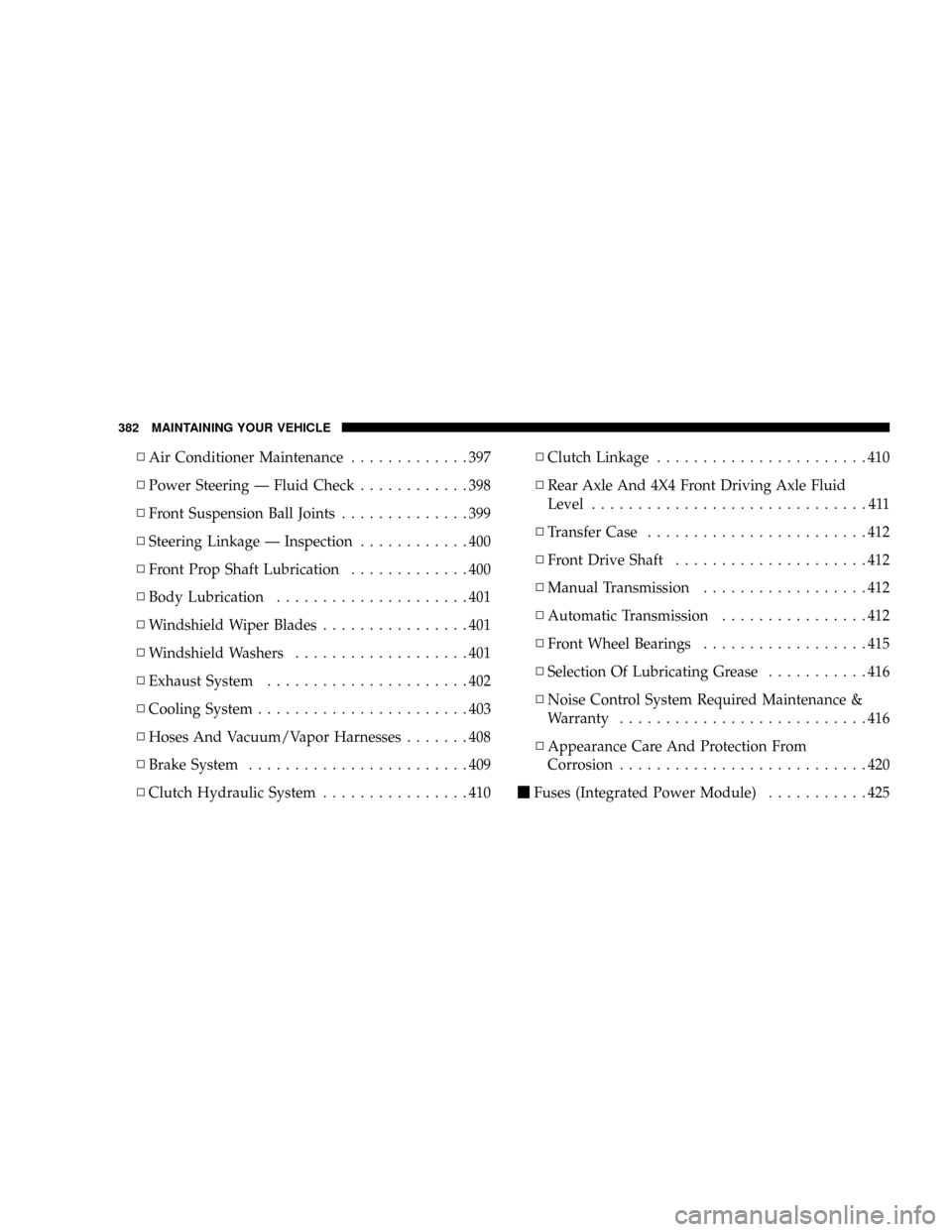
NAir Conditioner Maintenance.............397
NPower Steering Ð Fluid Check............398
NFront Suspension Ball Joints..............399
NSteering Linkage Ð Inspection............400
NFront Prop Shaft Lubrication.............400
NBody Lubrication.....................401
NWindshield Wiper Blades................401
NWindshield Washers...................401
NExhaust System......................402
NCooling System.......................403
NHoses And Vacuum/Vapor Harnesses.......408
NBrake System........................409
NClutch Hydraulic System................410NClutch Linkage.......................410
NRear Axle And 4X4 Front Driving Axle Fluid
Level..............................411
NTransfer Case........................412
NFront Drive Shaft.....................412
NManual Transmission..................412
NAutomatic Transmission................412
NFront Wheel Bearings..................415
NSelection Of Lubricating Grease...........416
NNoise Control System Required Maintenance &
Warranty...........................416
NAppearance Care And Protection From
Corrosion...........................420
mFuses (Integrated Power Module)...........425
382 MAINTAINING YOUR VEHICLE
Page 411 of 492
WARNING!
Overfilling the brake fluid reservoir can result in
spilling brake fluid on hot engine parts and the
brake fluid catching fire.
Use only brake fluid that has been in a tightly closed
container to avoid contamination from foreign matter or
moisture.
CAUTION!
Do not allow a petroleum-base fluid to contaminate
the brake fluid. Seal damage may result.
Brake Hoses
Inspection should be performed whenever the brake
system is serviced or at intervals specified. Inspect hy-
draulic brake hoses for surface cracking, scuffing or worn
spots. If there is any evidence of cracking, scuffing, or
worn spots, the hose should be replaced immediately!
Eventual deterioration of the hose can take place with
possible burst failure.
Clutch Hydraulic System
The clutch hydraulic system is a sealed maintenance-free
system. In the event of leakage or other malfunction, the
system must be replaced.
Clutch Linkage
If the clutch pedal linkage begins to squeak or grunt, the
clutch pedal pivot bushings should be lubricated. Refer
to Fluids, Lubricants and Genuine Parts for the correct
lubricant type.
410 MAINTAINING YOUR VEHICLE