engine oil DODGE POWER WAGON 2007 2.G User Guide
[x] Cancel search | Manufacturer: DODGE, Model Year: 2007, Model line: POWER WAGON, Model: DODGE POWER WAGON 2007 2.GPages: 492, PDF Size: 8.25 MB
Page 390 of 492
could adversely affect the engine or vehicle performance.
These items should be inspected if a malfunction is
observed or suspected.
Engine Oil
Checking Oil Level
To assure proper lubrication of your vehicle's engine, the
engine oil must be maintained at the correct level. The
best time to check the engine oil level is about 5 minutes
after a fully warmed up engine is shut off or before
starting the engine after it has sat overnight.
Checking the oil while the vehicle is on level ground will
improve the accuracy of the oil level readings. Maintain
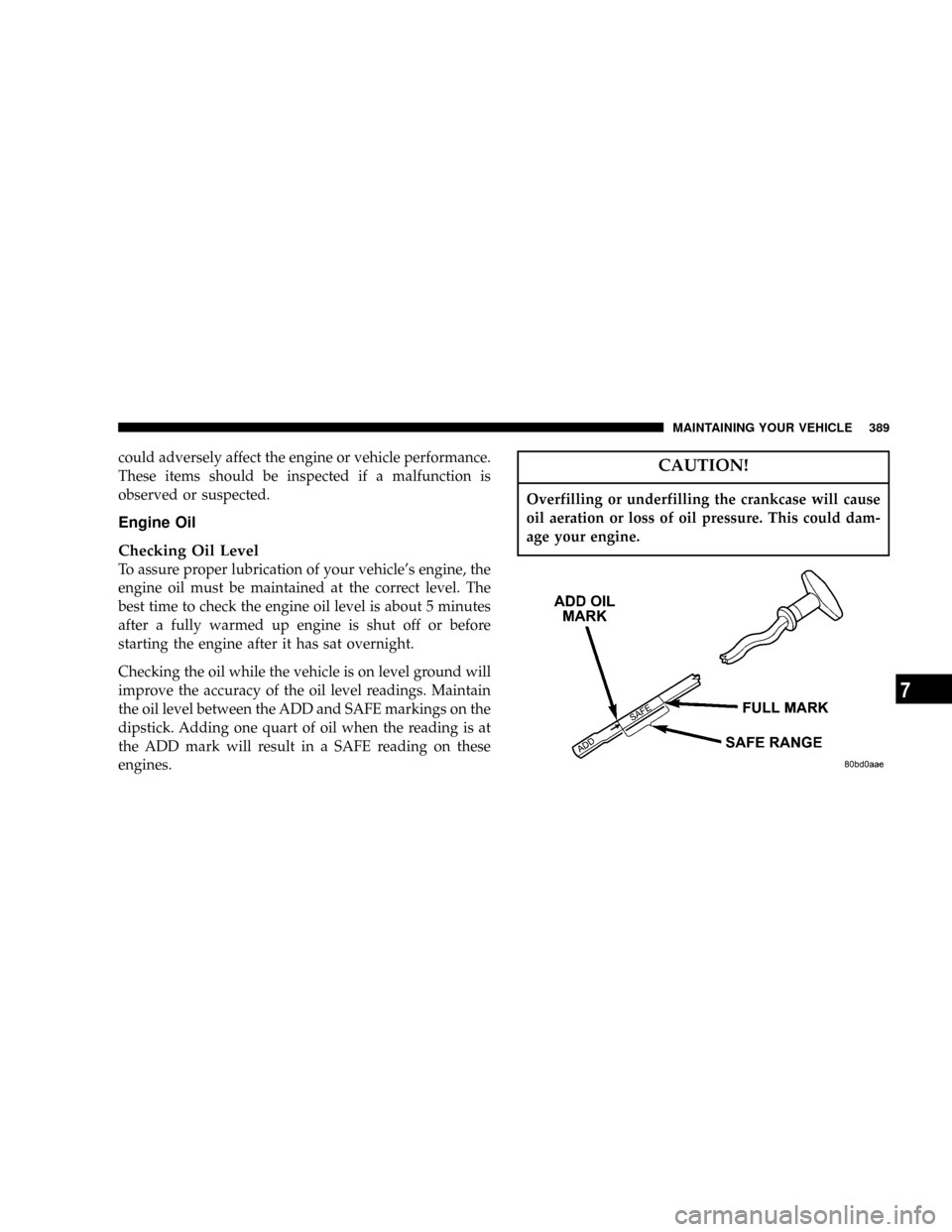
the oil level between the ADD and SAFE markings on the
dipstick. Adding one quart of oil when the reading is at
the ADD mark will result in a SAFE reading on these
engines.
CAUTION!
Overfilling or underfilling the crankcase will cause
oil aeration or loss of oil pressure. This could dam-
age your engine.
MAINTAINING YOUR VEHICLE 389
7
Page 391 of 492
Change Engine Oil
Road conditions as well as your kind of driving affect the
interval at which your oil should be changed. Check the
following to determine if any apply to you:
²Day or night temperatures are below 32ÉF (0ÉC).
²Stop and go driving.
²Extensive engine idling.
²Driving in dusty conditions
²Short trips of less than 10 miles (16.2 km)
²More than 50% of your driving is at sustained high
speeds during hot weather, above 32ÉC (90ÉF)
²Trailer towing
²Heavy Loading
²Taxi, Police or delivery service (commercial service)
²Off-road or desert operation
²If equipped for and operating with E-85 (ethanol)
fuel.
NOTE:IfANYof these apply to you then change your
engine oil every 3,000 miles (5 000 km) or 3 months,
whichever comes first and follow schedule ªBº of the
9Maintenance Schedules9section of this manual.
If none of these apply to you, then change your engine oil
at every interval shown on schedule9A9of the9Mainte-
nance Schedules9section of this manual.
NOTE:Under no circumstances should oil change in-
tervals exceed 6,000 miles (10 000 km) or 6 months
whichever comes first.
Dusty Conditions
Driving through dust-laden air increases the problems of
keeping abrasive materials out of the engine. Under these
conditions, special attention should be given to the
390 MAINTAINING YOUR VEHICLE
Page 392 of 492
engine air cleaner, the crankcase inlet air cleaner and the
crankcase ventilation system. Make sure that these units
are clean at all times. This will tend to reduce to a
minimum the amount of abrasive material that may enter
the engine.
Engine Oil Selection
For best performance and maximum protection under all
types of operating conditions, the manufacture only
recommends engine oils that are API certified and meet
the requirements of DaimlerChrysler Material Standard
MS-6395. Use Mopar or an equivalent oil meeting the
specification MS-6395.
American Petroleum Institute (API) Engine Oil
Identification Symbol
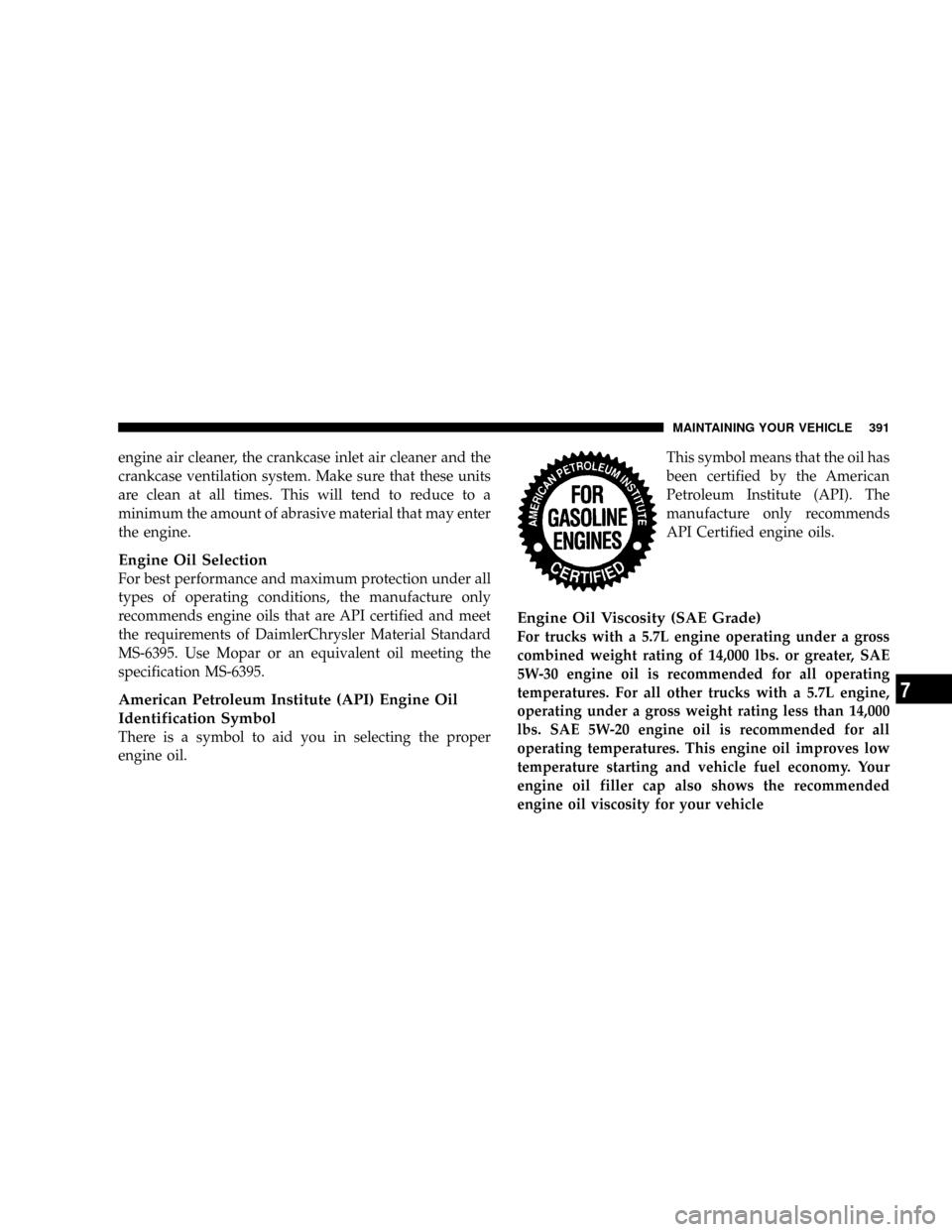
There is a symbol to aid you in selecting the proper
engine oil.This symbol means that the oil has
been certified by the American
Petroleum Institute (API). The
manufacture only recommends
API Certified engine oils.
Engine Oil Viscosity (SAE Grade)
For trucks with a 5.7L engine operating under a gross
combined weight rating of 14,000 lbs. or greater, SAE
5W-30 engine oil is recommended for all operating
temperatures. For all other trucks with a 5.7L engine,
operating under a gross weight rating less than 14,000
lbs. SAE 5W-20 engine oil is recommended for all
operating temperatures. This engine oil improves low
temperature starting and vehicle fuel economy. Your
engine oil filler cap also shows the recommended
engine oil viscosity for your vehicle
MAINTAINING YOUR VEHICLE 391
7
Page 393 of 492
For information on engine oil filler cap location, see the
Engine Compartment illustration in this section.
Lubricants which do not have both, the engine oil certi-
fication mark and the correct SAE viscosity grade num-
ber should not be used.
Synthetic Engine Oils
You may use synthetic engine oils provided the recom-
mended oil quality requirements are met, and the recom-
mended maintenance intervals for oil and filter changes
are followed.
Materials Added to Engine Oil
The manufacture strongly recommends against the addi-
tion of any additives (other than leak detection dyes) to
the engine oil. Engine oil is an engineered product and
it's performance may be impaired by supplemental ad-
ditives.
Disposing of Used Engine Oil And Oil Filters
Care should be taken in disposing of used engine oil and
oil filters from your vehicle. Used oil and oil filters,
indiscriminately discarded, can present a problem to the
environment. Contact your dealer, service station, or
governmental agency for advice on how and where used
oil and oil filters can be safely discarded in your area.
Engine Oil Filter
The engine oil filter should be replaced at every engine
oil change.
Engine Oil Filter Selection
The manufacturer's engines have a full-flow type oil
filter. Use a filter of this type for replacement. The quality
of replacement filters varies considerably. Only high
quality filters should be used to assure most efficient
service. Mopar Engine Oil Filters are a high quality oil
filter and are recommended.
392 MAINTAINING YOUR VEHICLE
Page 402 of 492
Body Lubrication
Locks and all body pivot points, including such items as
seat tracks, doors, tailgate and hood hinges, should be
lubricated periodically to assure quiet, easy operation
and to protect against rust and wear. Prior to the appli-
cation of any lubricant, the parts concerned should be
wiped clean to remove dust and grit; after lubricating
excess oil and grease should be removed. Particular
attention should also be given to hood latching compo-
nents to insure proper function. When performing other
underhood services, the hood latch, release mechanism
and safety catch should be cleaned and lubricated.
The external lock cylinders should be lubricated twice a
year, preferably in the fall and spring. Apply a small
amount of a high quality lubricant such as MopartLock
Cylinder Lubricant directly into the lock cylinder.
Windshield Wiper Blades
The rubber edges of the wiper blades and the windshield
should be cleaned periodically with a sponge or soft cloth
and a mild nonabrasive cleaner. This will remove accu-
mulations of salt or road film.
Operation of the wipers on dry glass for long periods
may cause deterioration of the wiper blades. Always use
washer fluid when using the wipers to remove salt or dirt
from a dry windshield.
Avoid using the wiper blades to remove frost or ice from
the windshield. Keep the blade rubber out of contact with
petroleum products such as engine oil, gasoline, etc.
Windshield Washers
The fluid reservoir is located under the hood and should
be checked for fluid level at regular intervals. Fill the
reservoir with windshield washer solvent only (not ra-
diator antifreeze).
MAINTAINING YOUR VEHICLE 401
7
Page 403 of 492
To prevent freeze-up of your windshield washer system
in cold weather, select a solution or mixture that meets or
exceeds the temperature range of your climate. This
rating information can be found on most washer fluid
containers.
WARNING!
Commercially available windshield washer solvents
are flammable. They could ignite and burn you. Care
must be exercised when filling or working around
the washer solution.
After the engine has warmed, operate the defroster for a
few minutes to reduce the possibility of smearing or
freezing the fluid on the cold windshield. Mopar All
Weather Windshield Washer Solution, used with water asdirected on the container, aids cleaning action, reduces
the freezing point to avoid line clogging, and is not
harmful to paint or trim.
Exhaust System
The best protection against carbon monoxide entry into
the vehicle body is a properly maintained engine exhaust
system.
Whenever a change is noticed in the sound of the exhaust
system, when exhaust fumes can be detected inside the
vehicle, or when the underside or rear of the vehicle is
damaged, have a competent mechanic inspect the com-
plete exhaust system and adjacent body areas for broken,
damaged, deteriorated, or mispositioned parts. Open
seams or loose connections could permit exhaust fumes
to seep into the passenger compartment. In addition,
inspect the exhaust system each time the vehicle is raised
for lubrication or oil change. Replace as required.
402 MAINTAINING YOUR VEHICLE
Page 413 of 492
Transfer Case
Fluid Level Check
This fluid level can be checked by removing the filler
plug. The fluid level should be to the bottom edge of the
filler plug hole with the vehicle in a level position.
Lubricant Selection
Refer to Fluids, Lubricants and Genuine Parts for correct
fluid type.
Front Drive Shaft
The front drive shaft contains a grease fitting which
should be serviced at every oil change (see maintenance
schedule A/B).
Manual Transmission
Fluid Level Check
This fluid level can be checked by removing the filler
plug. If the level of the lubricant is more than 1/4º (6.4
mm) below the bottom of the filler hole while the vehicleis on level ground, enough lubricant should be added to
bring the level to the bottom of the filler hole.
Lubricant Selection G56 (6 ± Speed Manual
Transmission Ð If Equipped)
This transmission does not require periodic changing. If
it becomes necessary to add or change the fluid in this
transmission, refer to Fluids, Lubricants and Genuine
Parts for correct fluid type.
Automatic Transmission
Fluid Level Check
The fluid level should be checked when the engine is
fully warmed up and the fluid in the transmission is at
normal operating temperature. Operation of the trans-
mission with an improper fluid level will greatly reduce
the life of the transmission and of the fluid. Check the
fluid level whenever the vehicle is serviced.
412 MAINTAINING YOUR VEHICLE
Page 414 of 492
Fluid Level Check ± 545RFE
Check the fluid level while the transmission is at normal
operating temperature 82ÉC (180ÉF). This occurs after at
least 15 miles (25 km) of driving. At normal operating
temperature the fluid cannot be held comfortably be-
tween the fingertips.
To check the automatic transmission fluid level properly,
the following procedure must be used:
1. Operate the engine at idle speed and normal operating
temperature.
2. The vehicle must be on level ground.
3. Fully apply the parking brake and press the brake
pedal.
4. Place the gear selector momentarily in each gear
position ending with the lever in P (Park).5. Remove the dipstick, wipe it clean and reinsert it until
seated.
6. Remove the dipstick again and note the fluid level on
both sides. The fluid level should be between the ªHOTº
(upper) reference holes on the dipstick at normal operat-
ing temperature. Verify that solid coating of oil is seen on
both sides of the dipstick. If the fluid is low, add as
required into the dipstick tube.Do not overfill.After
adding any quantity of oil through the oil fill tube, wait
a minimum of two (2) minutes for the oil to fully drain
into the transmission before rechecking the fluid level.
NOTE:If it is necessary to check the transmissionbelow
the operating temperature, the fluid level should be
between the two ªCOLDº (lower) holes on the dipstick
with the fluid at approximately 70ÉF (21ÉC) (room tem-
perature). If the fluid level is correctly established at
room temperature, it should be between the ªHOTº
MAINTAINING YOUR VEHICLE 413
7
Page 442 of 492
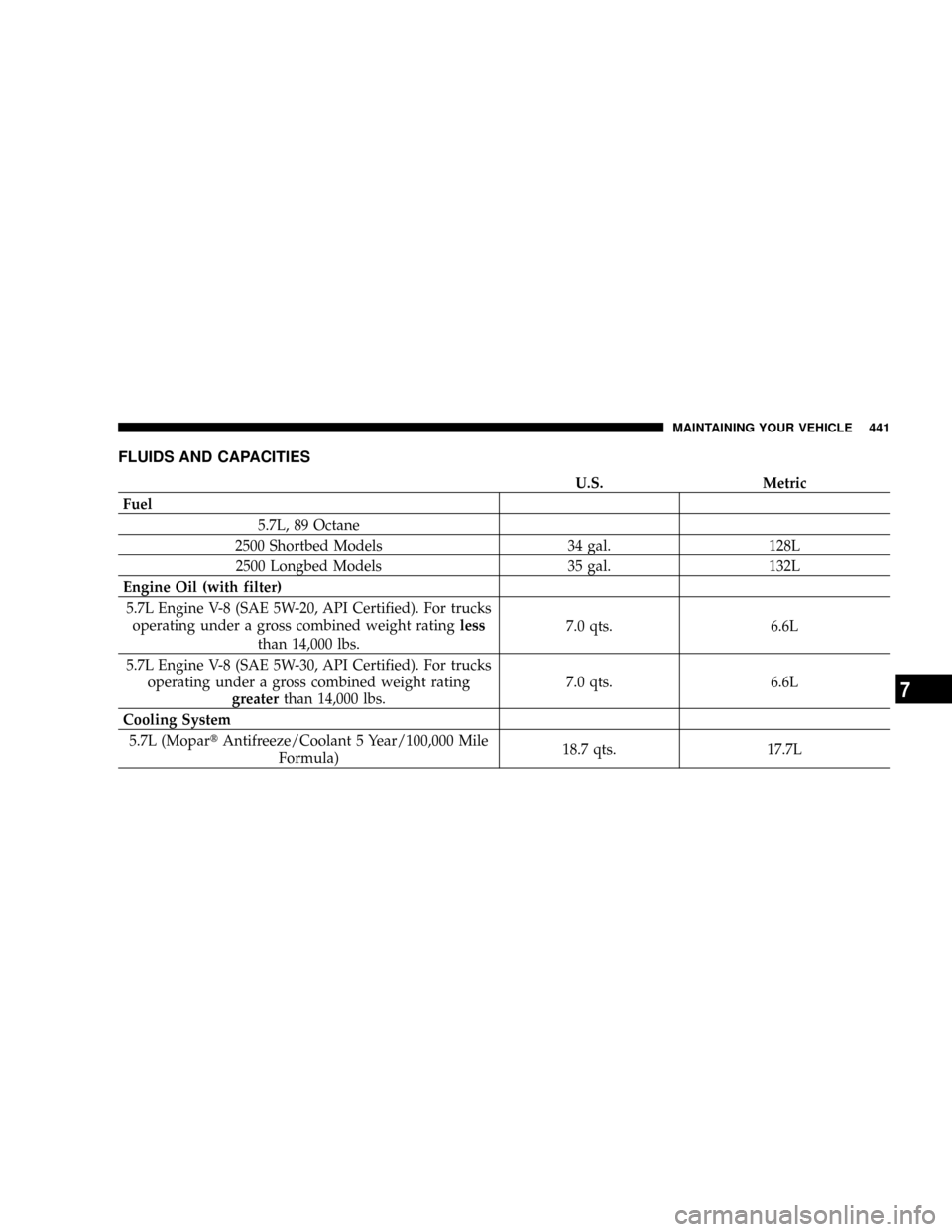
FLUIDS AND CAPACITIES
U.S. Metric
Fuel
5.7L, 89 Octane
2500 Shortbed Models 34 gal. 128L
2500 Longbed Models 35 gal. 132L
Engine Oil (with filter)
5.7L Engine V-8 (SAE 5W-20, API Certified). For trucks
operating under a gross combined weight ratingless
than 14,000 lbs.7.0 qts. 6.6L
5.7L Engine V-8 (SAE 5W-30, API Certified). For trucks
operating under a gross combined weight rating
greaterthan 14,000 lbs.7.0 qts. 6.6L
Cooling System
5.7L (MopartAntifreeze/Coolant 5 Year/100,000 Mile
Formula)18.7 qts. 17.7L
MAINTAINING YOUR VEHICLE 441
7
Page 443 of 492
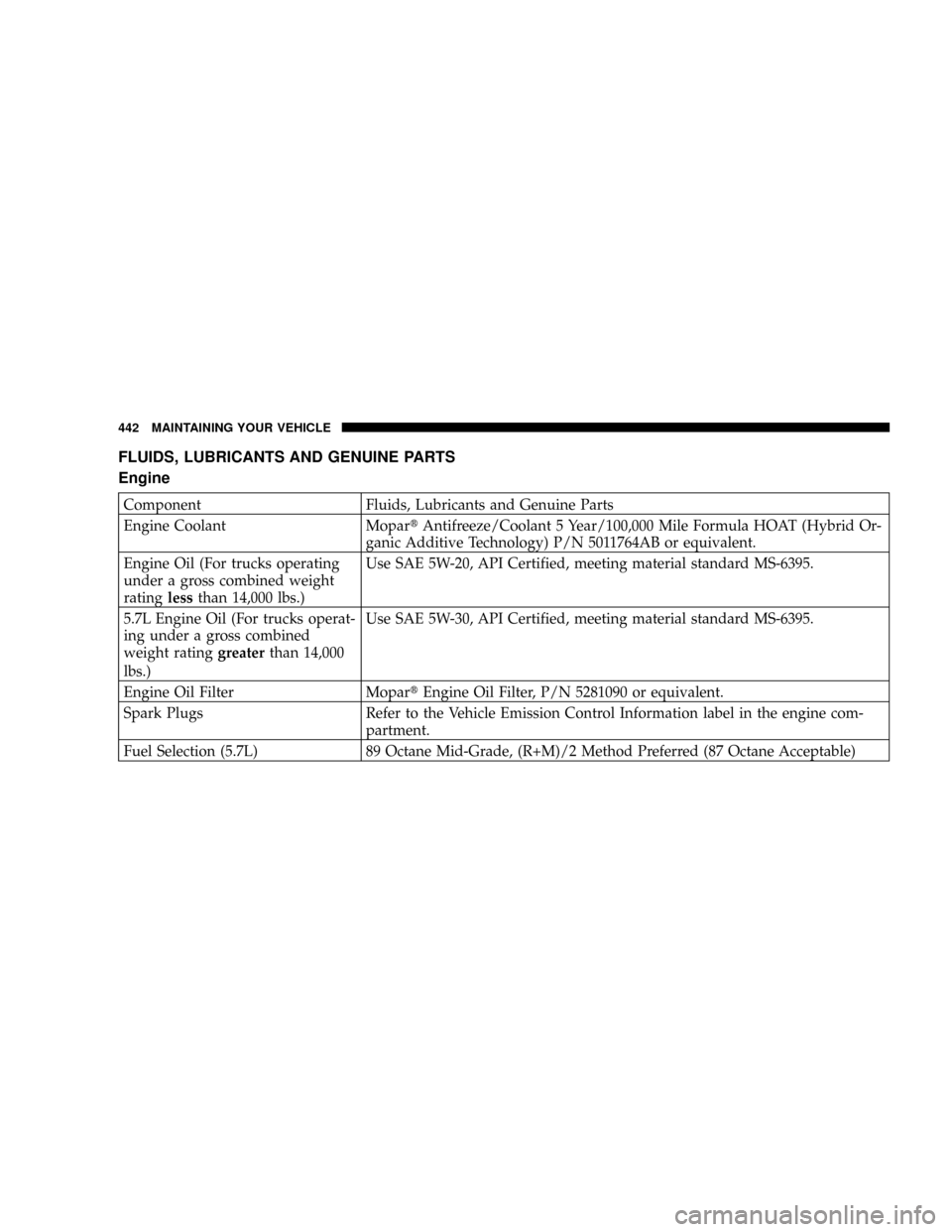
FLUIDS, LUBRICANTS AND GENUINE PARTS
Engine
Component Fluids, Lubricants and Genuine Parts
Engine Coolant MopartAntifreeze/Coolant 5 Year/100,000 Mile Formula HOAT (Hybrid Or-
ganic Additive Technology) P/N 5011764AB or equivalent.
Engine Oil (For trucks operating
under a gross combined weight
ratinglessthan 14,000 lbs.)Use SAE 5W-20, API Certified, meeting material standard MS-6395.
5.7L Engine Oil (For trucks operat-
ing under a gross combined
weight ratinggreaterthan 14,000
lbs.)Use SAE 5W-30, API Certified, meeting material standard MS-6395.
Engine Oil Filter MopartEngine Oil Filter, P/N 5281090 or equivalent.
Spark Plugs Refer to the Vehicle Emission Control Information label in the engine com-
partment.
Fuel Selection (5.7L) 89 Octane Mid-Grade, (R+M)/2 Method Preferred (87 Octane Acceptable)
442 MAINTAINING YOUR VEHICLE