tire type DODGE POWER WAGON 2007 2.G User Guide
[x] Cancel search | Manufacturer: DODGE, Model Year: 2007, Model line: POWER WAGON, Model: DODGE POWER WAGON 2007 2.GPages: 492, PDF Size: 8.25 MB
Page 375 of 492
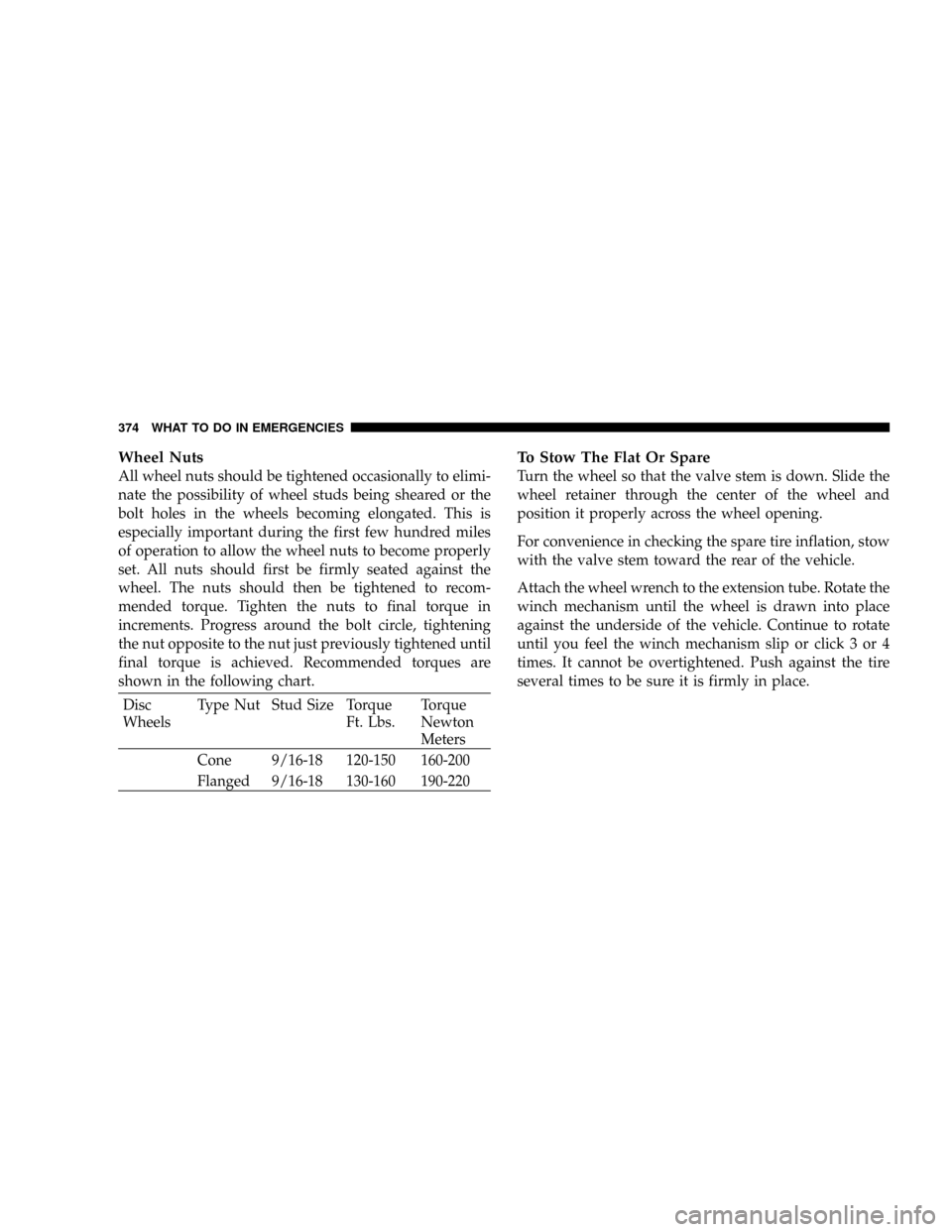
Wheel Nuts
All wheel nuts should be tightened occasionally to elimi-
nate the possibility of wheel studs being sheared or the
bolt holes in the wheels becoming elongated. This is
especially important during the first few hundred miles
of operation to allow the wheel nuts to become properly
set. All nuts should first be firmly seated against the
wheel. The nuts should then be tightened to recom-
mended torque. Tighten the nuts to final torque in
increments. Progress around the bolt circle, tightening
the nut opposite to the nut just previously tightened until
final torque is achieved. Recommended torques are
shown in the following chart.
Disc
WheelsType Nut Stud Size Torque
Ft. Lbs.Torque
Newton
Meters
Cone 9/16-18 120-150 160-200
Flanged 9/16-18 130-160 190-220
To Stow The Flat Or Spare
Turn the wheel so that the valve stem is down. Slide the
wheel retainer through the center of the wheel and
position it properly across the wheel opening.
For convenience in checking the spare tire inflation, stow
with the valve stem toward the rear of the vehicle.
Attach the wheel wrench to the extension tube. Rotate the
winch mechanism until the wheel is drawn into place
against the underside of the vehicle. Continue to rotate
until you feel the winch mechanism slip or click 3 or 4
times. It cannot be overtightened. Push against the tire
several times to be sure it is firmly in place.
374 WHAT TO DO IN EMERGENCIES
Page 394 of 492
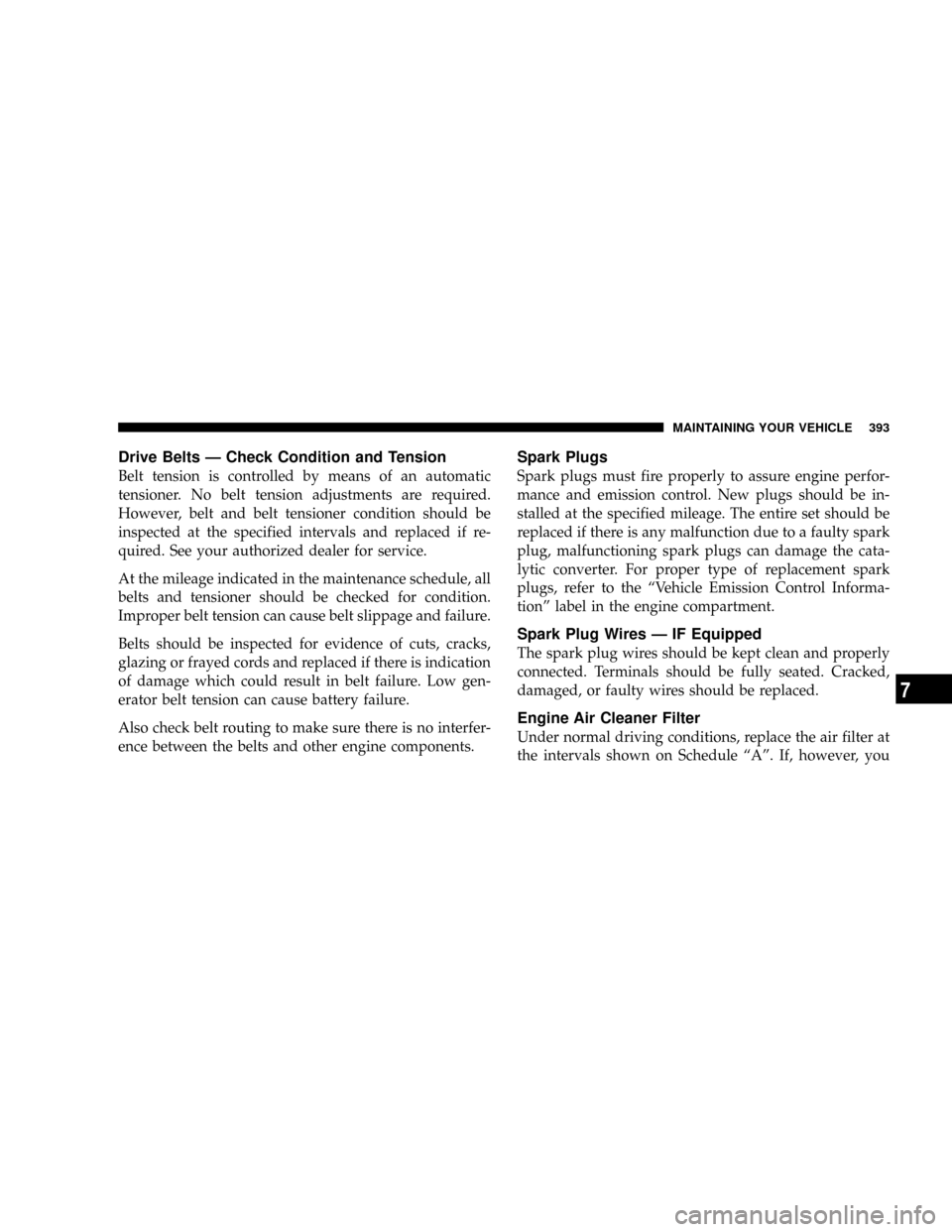
Drive Belts Ð Check Condition and Tension
Belt tension is controlled by means of an automatic
tensioner. No belt tension adjustments are required.
However, belt and belt tensioner condition should be
inspected at the specified intervals and replaced if re-
quired. See your authorized dealer for service.
At the mileage indicated in the maintenance schedule, all
belts and tensioner should be checked for condition.
Improper belt tension can cause belt slippage and failure.
Belts should be inspected for evidence of cuts, cracks,
glazing or frayed cords and replaced if there is indication
of damage which could result in belt failure. Low gen-
erator belt tension can cause battery failure.
Also check belt routing to make sure there is no interfer-
ence between the belts and other engine components.
Spark Plugs
Spark plugs must fire properly to assure engine perfor-
mance and emission control. New plugs should be in-
stalled at the specified mileage. The entire set should be
replaced if there is any malfunction due to a faulty spark
plug, malfunctioning spark plugs can damage the cata-
lytic converter. For proper type of replacement spark
plugs, refer to the ªVehicle Emission Control Informa-
tionº label in the engine compartment.
Spark Plug Wires Ð IF Equipped
The spark plug wires should be kept clean and properly
connected. Terminals should be fully seated. Cracked,
damaged, or faulty wires should be replaced.
Engine Air Cleaner Filter
Under normal driving conditions, replace the air filter at
the intervals shown on Schedule ªAº. If, however, you
MAINTAINING YOUR VEHICLE 393
7
Page 405 of 492
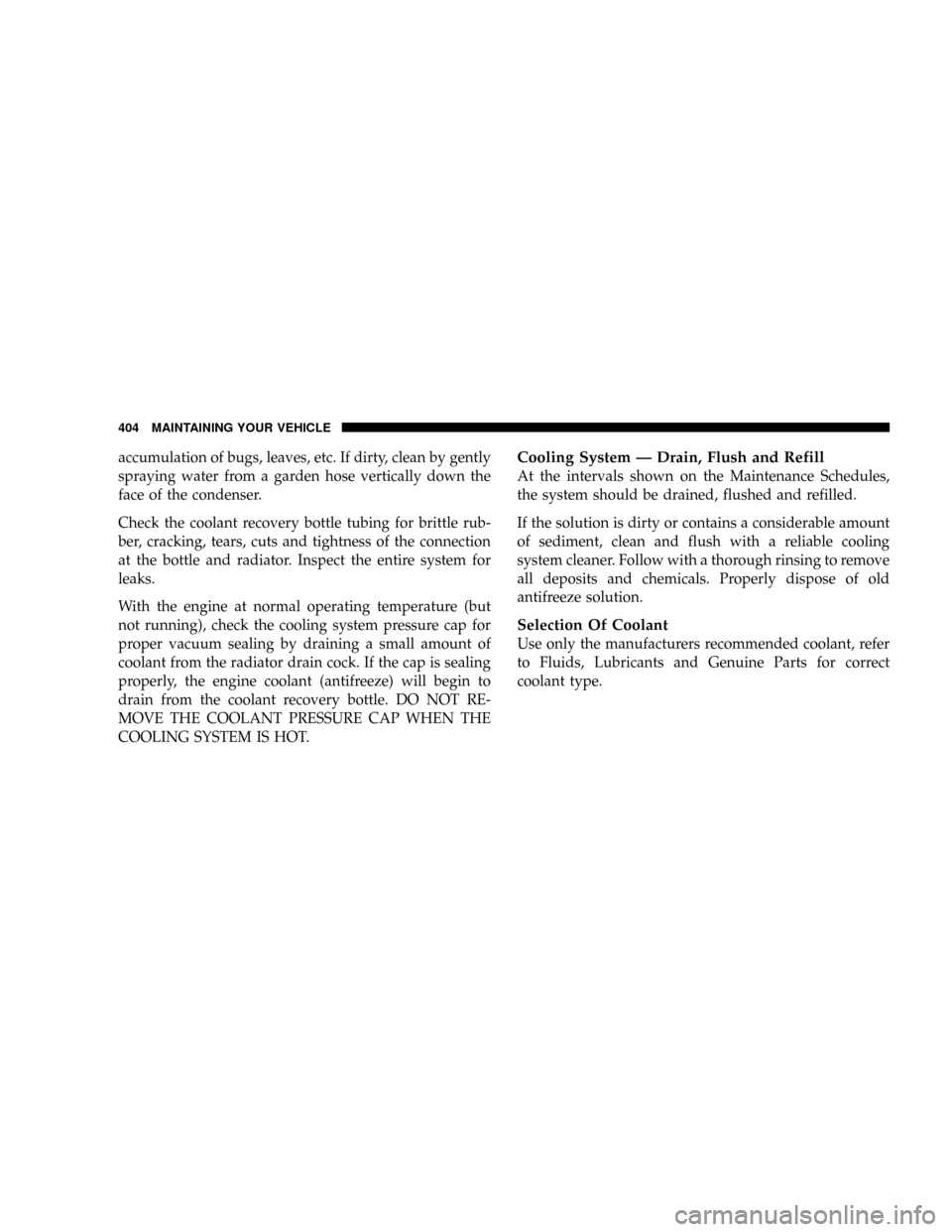
accumulation of bugs, leaves, etc. If dirty, clean by gently
spraying water from a garden hose vertically down the
face of the condenser.
Check the coolant recovery bottle tubing for brittle rub-
ber, cracking, tears, cuts and tightness of the connection
at the bottle and radiator. Inspect the entire system for
leaks.
With the engine at normal operating temperature (but
not running), check the cooling system pressure cap for
proper vacuum sealing by draining a small amount of
coolant from the radiator drain cock. If the cap is sealing
properly, the engine coolant (antifreeze) will begin to
drain from the coolant recovery bottle. DO NOT RE-
MOVE THE COOLANT PRESSURE CAP WHEN THE
COOLING SYSTEM IS HOT.Cooling System Ð Drain, Flush and Refill
At the intervals shown on the Maintenance Schedules,
the system should be drained, flushed and refilled.
If the solution is dirty or contains a considerable amount
of sediment, clean and flush with a reliable cooling
system cleaner. Follow with a thorough rinsing to remove
all deposits and chemicals. Properly dispose of old
antifreeze solution.
Selection Of Coolant
Use only the manufacturers recommended coolant, refer
to Fluids, Lubricants and Genuine Parts for correct
coolant type.
404 MAINTAINING YOUR VEHICLE
Page 475 of 492
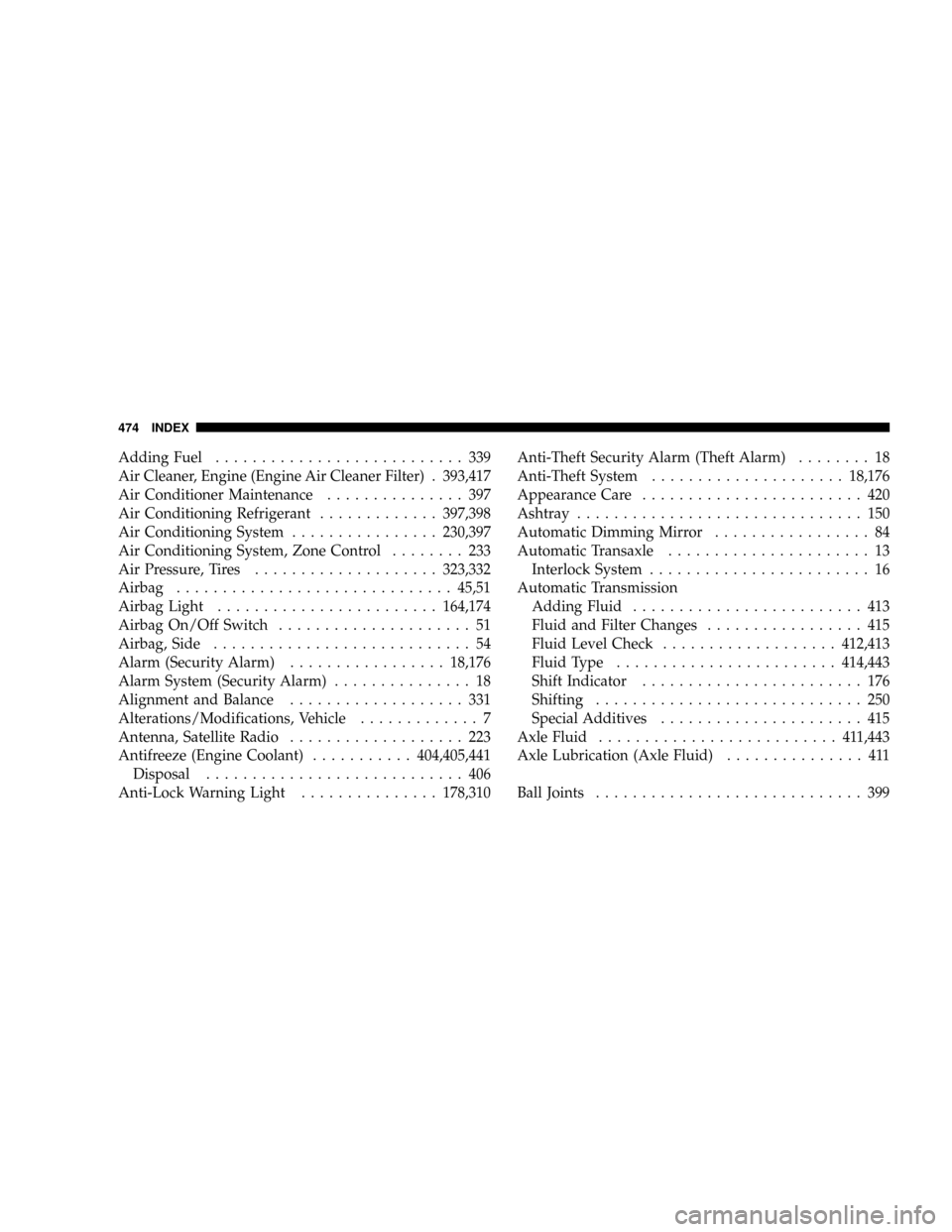
Adding Fuel........................... 339
Air Cleaner, Engine (Engine Air Cleaner Filter) . 393,417
Air Conditioner Maintenance............... 397
Air Conditioning Refrigerant.............397,398
Air Conditioning System................230,397
Air Conditioning System, Zone Control........ 233
Air Pressure, Tires....................323,332
Airbag..............................45,51
Airbag Light........................164,174
Airbag On/Off Switch..................... 51
Airbag, Side............................ 54
Alarm (Security Alarm).................18,176
Alarm System (Security Alarm)............... 18
Alignment and Balance................... 331
Alterations/Modifications, Vehicle............. 7
Antenna, Satellite Radio................... 223
Antifreeze (Engine Coolant)...........404,405,441
Disposal............................ 406
Anti-Lock Warning Light...............178,310Anti-Theft Security Alarm (Theft Alarm)........ 18
Anti-Theft System.....................18,176
Appearance Care........................ 420
Ashtray............................... 150
Automatic Dimming Mirror................. 84
Automatic Transaxle...................... 13
Interlock System........................ 16
Automatic Transmission
Adding Fluid......................... 413
Fluid and Filter Changes................. 415
Fluid Level Check...................412,413
Fluid Type........................414,443
Shift Indicator........................ 176
Shifting............................. 250
Special Additives...................... 415
Axle Fluid.......................... 411,443
Axle Lubrication (Axle Fluid)............... 411
Ball Joints............................. 399
474 INDEX