steering DODGE POWER WAGON 2007 2.G Owner's Guide
[x] Cancel search | Manufacturer: DODGE, Model Year: 2007, Model line: POWER WAGON, Model: DODGE POWER WAGON 2007 2.GPages: 492, PDF Size: 8.25 MB
Page 313 of 492
POWER STEERING
The standard power steering system will give you good
vehicle response and increased ease of maneuverability
in tight spaces. The system will provide mechanical
steering capability if power assist is lost.
If for some reason, the power assist is interrupted, it will
still be possible to steer your vehicle. Under these condi-
tions you will observe a substantial increase in steering
effort, especially at very low vehicle speeds and during
parking maneuvers.
NOTE:Increased noise levels at the end of the steering
wheel travel are considered normal and does not indicate
that there is a problem with the power steering system.
Upon initial start-up in cold weather, the power steering
pump may make noise for a short period of time. This is
due to the cold, thick fluid in the steering system. This
noise should be considered normal, and does not in any
way damage the steering system.WARNING!
Continued operation with reduced power steering
assist could pose a safety risk to yourself and others.
Service should be obtained as soon as possible.
CAUTION!
Prolong operation of the steering system at the end
of the steering wheel travel will increase the steering
fluid temperature and should be avoided when
possible. Damage to the power steering pump may
occur.
312 STARTING AND OPERATING
Page 324 of 492
1. SafetyÐ
WARNING!
²Improperly inflated tires are dangerous and can cause
accidents.
²Under inflation increases tire flexing and can result in
tire failure.
²Over inflation reduces a tire's ability to cushion shock.
Objects on the road and chuckholes can cause damage
that result in tire failure.
²Unequal tire pressures can cause steering problems.
You could lose control of your vehicle.
²Over inflated or under inflated tires can affect vehicle
handling and can fail suddenly, resulting in loss of
vehicle control.
²Unequal tire pressures from one side of the vehicle to
the other can cause the vehicle to drift to the right or left.
²Always drive with each tire inflated to the recom-
mended cold tire inflation pressure.
2. EconomyÐ
Improper inflation pressures can cause uneven wear
patterns to develop across the tire tread. These abnormal
wear patterns will reduce tread life resulting in a need for
earlier tire replacement. Under inflation, also increases
tire rolling resistance and results in higher fuel consump-
tion.
3. Ride Comfort and Vehicle StabilityÐ
Proper tire inflation contributes to a comfortable ride.
Over inflation produces a jarring and uncomfortable ride.
Tire Inflation Pressures
The proper cold tire inflation pressure is listed either on
the face of the driver's door or on the driver's side ªBº
pillar.
Some vehicles may have Supplemental Tire Pressure
Information for vehicle loads that are less than the
STARTING AND OPERATING 323
5
Page 332 of 492
WARNING!
²Do not use a tire, wheel size or rating other than that
specified for your vehicle. Some combinations of un-
approved tires and wheels may change suspension
dimensions and performance characteristics, resulting
in changes to steering, handling, and braking of your
vehicle. This can cause unpredictable handling and
stress to steering and suspension components. You
could lose control and have an accident resulting in
serious injury or death. Use only the tire and wheel
sizes with load ratings approved for your vehicle.
²Never use a tire with a smaller load index or capacity,
other than what was originally equipped on your
vehicle. Using a tire with a smaller load index could
result in tire overloading and failure. You could lose
control and have an accident.
²Failure to equip your vehicle with tires having ad-
equate speed capability can result in sudden tire
failure and loss of vehicle control.
CAUTION!
Replacing original tires with tires of a different size
may result in false speedometer and odometer read-
ings.
Alignment And Balance
Poor suspension alignment may result in:
²Fast tire wear.
²Uneven tire wear, such as feathering and one-sided
wear.
²Vehicle pull to right or left.
Tires may also cause the vehicle to pull to the left or right.
Alignment will not correct this condition. See your dealer
for proper diagnosis.
STARTING AND OPERATING 331
5
Page 335 of 492
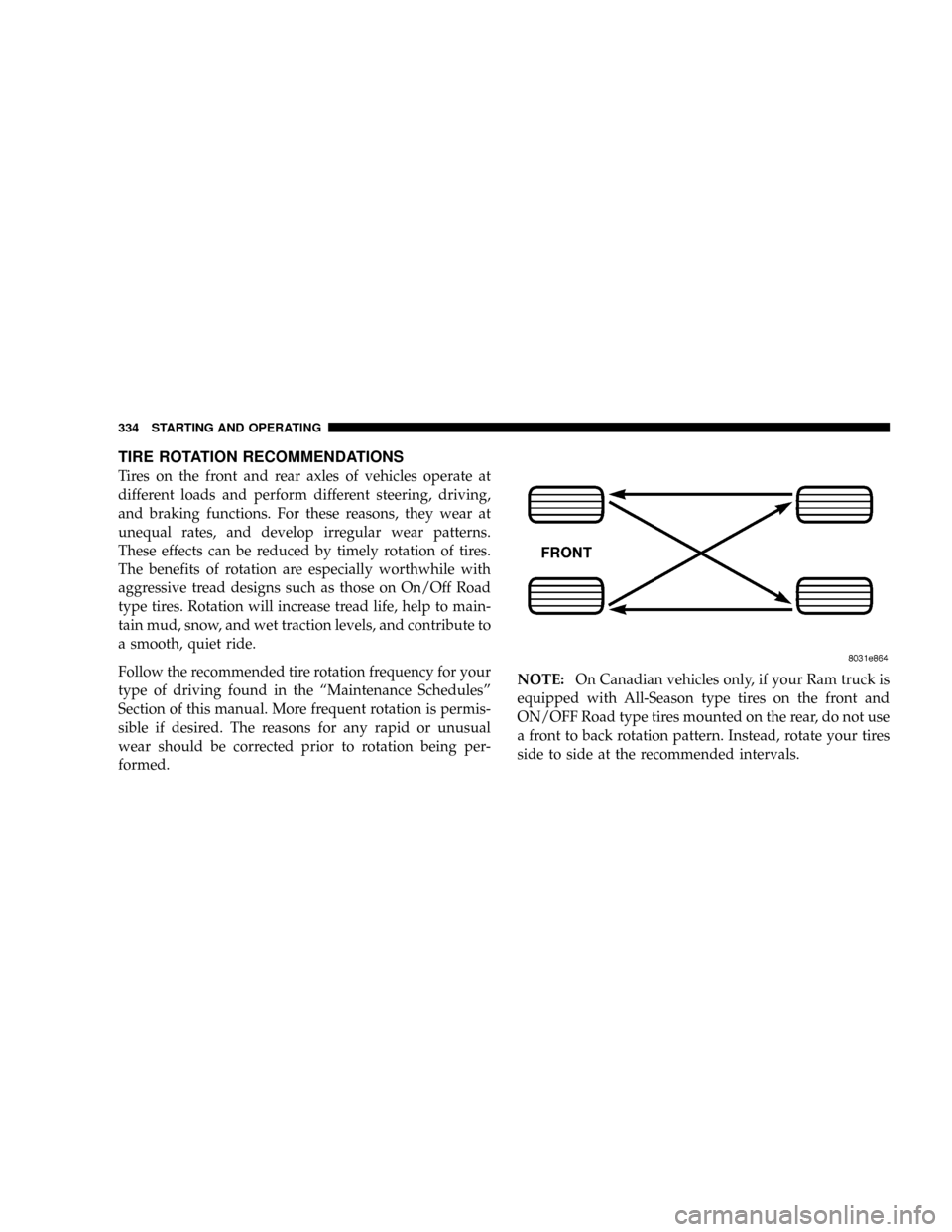
TIRE ROTATION RECOMMENDATIONS
Tires on the front and rear axles of vehicles operate at
different loads and perform different steering, driving,
and braking functions. For these reasons, they wear at
unequal rates, and develop irregular wear patterns.
These effects can be reduced by timely rotation of tires.
The benefits of rotation are especially worthwhile with
aggressive tread designs such as those on On/Off Road
type tires. Rotation will increase tread life, help to main-
tain mud, snow, and wet traction levels, and contribute to
a smooth, quiet ride.
Follow the recommended tire rotation frequency for your
type of driving found in the ªMaintenance Schedulesº
Section of this manual. More frequent rotation is permis-
sible if desired. The reasons for any rapid or unusual
wear should be corrected prior to rotation being per-
formed.NOTE:On Canadian vehicles only, if your Ram truck is
equipped with All-Season type tires on the front and
ON/OFF Road type tires mounted on the rear, do not use
a front to back rotation pattern. Instead, rotate your tires
side to side at the recommended intervals.
334 STARTING AND OPERATING
Page 348 of 492
Frontal Area
The maximum height and maximum width of the front of
a trailer.
Trailer Sway Control
The trailer sway control is a telescoping link that can be
installed between the hitch receiver and the trailer tongue
that typically provides adjustable friction associated with
the telescoping motion to dampen any unwanted trailer
swaying motions while traveling.
Weight-Carrying Hitch
A weight-carrying hitch supports the trailer tongue
weight, just as if it were luggage located at a hitch ball or
some other connecting point of the vehicle. These kind of
hitches are the most popular on the market today and
they're commonly used to tow small- and medium-sized
trailers.
Weight-Distributing Hitch
A weight-distributing system works by applying lever-
age through spring (load) bars. They are typically used
for heavier loads, to distribute trailer tongue weight to
the tow vehicle's front axle and the trailer axle(s). When
used in accordance with the manufacturers' directions, it
provides for a more level ride, offering more consistent
steering and brake control thereby enhancing towing
safety. The addition of a friction / hydraulic sway control
also dampens sway caused by traffic and crosswinds and
contributes positively to tow vehicle and trailer stability.
Trailer sway control and a weight distributing (load
equalizing) hitch are recommended for heavier Tongue
Weights (TW) and may be required depending on Vehicle
and Trailer configuration / loading to comply with gross
axle weight rating (GAWR) requirements.
STARTING AND OPERATING 347
5
Page 353 of 492
CAUTION!
²Avoid towing a trailer for the first 500 miles (805
km) of vehicle operation. Doing so may damage
your axles, driveline and vehicle.
²During the first 500 miles (805 km) of trailer
towing, limit your speed to 50 mph (80 km/h).
Perform the maintenance listed in Section 8 of this
manual. When towing a trailer, never exceed the GAWR,
or GCWR, ratings.
WARNING!
Improper towing can lead to an injury accident.
Follow these guidelines to make your trailer towing
as safe as possible:
Make certain that the load is secured in the trailer
and will not shift during travel. When trailering
cargo that is not fully secured, dynamic load shifts
can occur that may be difficult for the driver to
control. You could lose control of your vehicle and
have an accident.
²When hauling cargo or towing a trailer, do not over-
load your vehicle or trailer. Overloading can cause a
loss of control, poor performance or damage to brakes,
axle, engine, transmission, steering, suspension, chas-
sis structure or tires.
352 STARTING AND OPERATING
Page 367 of 492
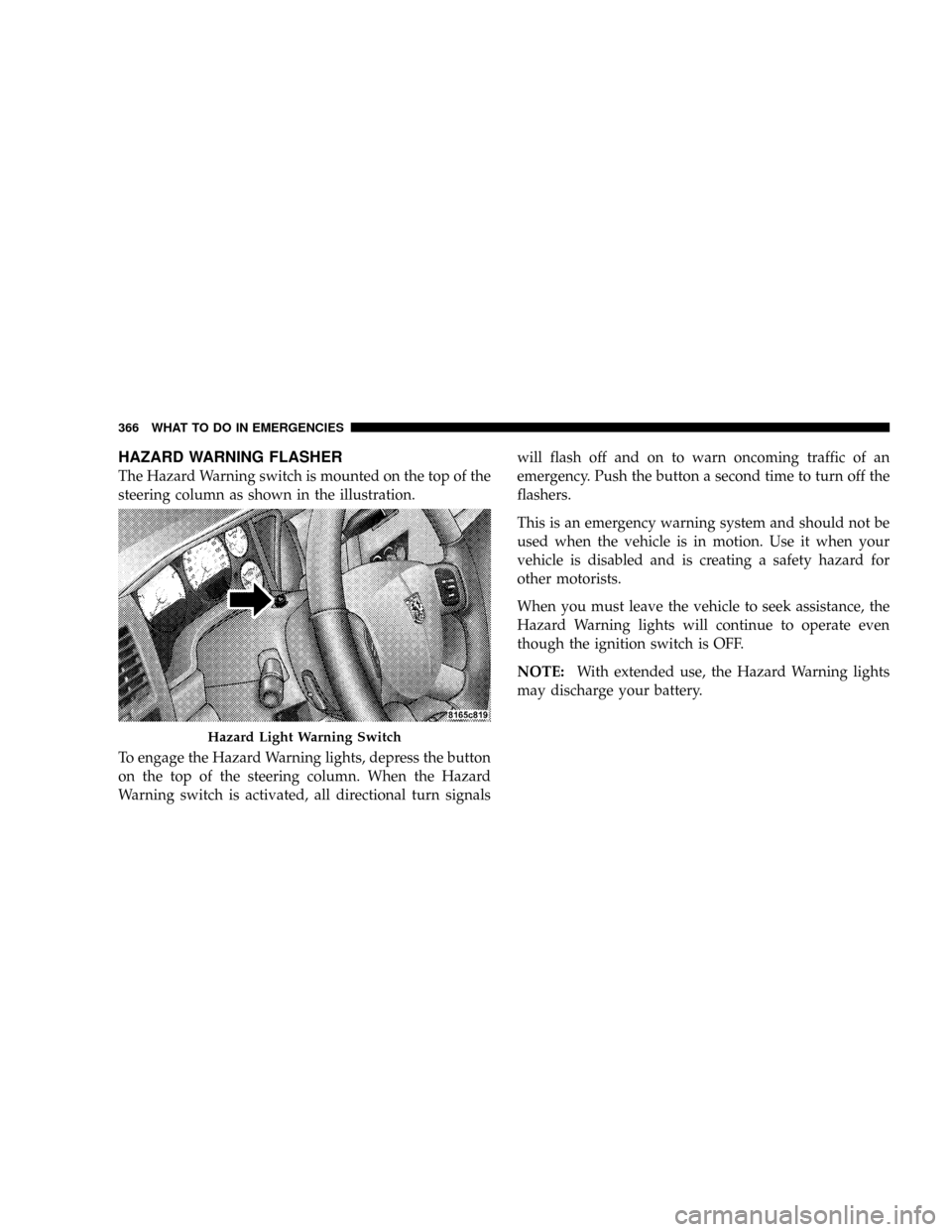
HAZARD WARNING FLASHER
The Hazard Warning switch is mounted on the top of the
steering column as shown in the illustration.
To engage the Hazard Warning lights, depress the button
on the top of the steering column. When the Hazard
Warning switch is activated, all directional turn signalswill flash off and on to warn oncoming traffic of an
emergency. Push the button a second time to turn off the
flashers.
This is an emergency warning system and should not be
used when the vehicle is in motion. Use it when your
vehicle is disabled and is creating a safety hazard for
other motorists.
When you must leave the vehicle to seek assistance, the
Hazard Warning lights will continue to operate even
though the ignition switch is OFF.
NOTE:With extended use, the Hazard Warning lights
may discharge your battery.
Hazard Light Warning Switch
366 WHAT TO DO IN EMERGENCIES
Page 383 of 492
NAir Conditioner Maintenance.............397
NPower Steering Ð Fluid Check............398
NFront Suspension Ball Joints..............399
NSteering Linkage Ð Inspection............400
NFront Prop Shaft Lubrication.............400
NBody Lubrication.....................401
NWindshield Wiper Blades................401
NWindshield Washers...................401
NExhaust System......................402
NCooling System.......................403
NHoses And Vacuum/Vapor Harnesses.......408
NBrake System........................409
NClutch Hydraulic System................410NClutch Linkage.......................410
NRear Axle And 4X4 Front Driving Axle Fluid
Level..............................411
NTransfer Case........................412
NFront Drive Shaft.....................412
NManual Transmission..................412
NAutomatic Transmission................412
NFront Wheel Bearings..................415
NSelection Of Lubricating Grease...........416
NNoise Control System Required Maintenance &
Warranty...........................416
NAppearance Care And Protection From
Corrosion...........................420
mFuses (Integrated Power Module)...........425
382 MAINTAINING YOUR VEHICLE
Page 399 of 492
WARNING!
²Use only refrigerants and compressor lubricants
approved by the manufacturer for your air condi-
tioning system. Some unapproved refrigerants are
flammable and can explode, injuring you. Other
unapproved refrigerants or lubricants can cause
the system to fail, requiring costly repairs.
²The air conditioning system contains refrigerant
under high pressure. To avoid risk of personal
injury or damage to the system, adding refrigerant
or any repair requiring lines to be disconnected
should be done by an experienced repairman.
Refrigerant Recovery and Recycling
R-134a Air Conditioning Refrigerant is a hydrofluorocar-
bon (HFC) that is endorsed by the Environmental Pro-
tection Agency and is an ozone-saving product. How-
ever, the manufacturer recommends that air conditioning
service be performed by dealers or other service facilities
using recovery and recycling equipment.
NOTE:Use only manufacturer approved A/C System
Sealers, Stop Leak Products, Seal Conditioners, Compres-
sor Oil, or Refrigerants.
Power Steering Ð Fluid Check
Checking the power steering fluid level at a defined
service interval is not required. The fluid should only be
checked if a leak is suspected, abnormal noises are
apparent, and/or the system is not functioning as antici-
pated. Coordinate inspection efforts through a certified
DaimlerChrysler Dealership.9
398 MAINTAINING YOUR VEHICLE
Page 400 of 492
WARNING!
Fluid level should be checked on a level surface and
with the engine off to prevent injury from moving
parts and to insure accurate fluid level reading. Do
not overfill. Use only manufacturers recommended
power steering fluid.
If necessary, add fluid to restore to the proper indicated
level. With a clean cloth, wipe any spilled fluid from all
surfaces. Refer to Fluids, Lubricants, and Genuine Parts
for correct fluid type.
Front Suspension Ball Joints
NOTE:When anticipating any severe offroad or hill
climbing maneuvers, the power steering fluid level may
be increased to the FULL HOT level (with a cold system).
In this way, the power steering system will continue toprovide assist as the inclination angle of the vehicle
increases, i.e. when the vehicle is not on level ground.
NOTE:When anticipating any severe offroad/dusty or
wet conditions, ensure that the outer tie rod ends are
properly greased before ans soon after the vehicle is
taken through such conditions. The greasing will help
purge contaminants and water from under the seal.
Regular greasing will prolong the life of the ball joints.
The ball joints and seals should be inspected whenever
the vehicle is serviced for other reasons.
The ball joints originally supplied with the vehicle are
permanently lubricated at the factory and do not require
service. However, if the seals on the ball joints are
damaged, the joints should be replaced. Serviceable
replacement ball joints are available.
MAINTAINING YOUR VEHICLE 399
7