wheel DODGE POWER WAGON 2007 2.G Workshop Manual
[x] Cancel search | Manufacturer: DODGE, Model Year: 2007, Model line: POWER WAGON, Model: DODGE POWER WAGON 2007 2.GPages: 492, PDF Size: 8.25 MB
Page 286 of 492
CAUTION!
Pulling the vehicle off an obstacle, without first
clearing the object, may result in additional under-
body damage.
²Rock Cycling Your Vehicle± Rock cycling your ve-
hicle is one of the easiest, fastest and most commonly
used methods. This simply involves shifting your
vehicle from drive to reverse, while applying throttle
after each shift. During this process, for additional
traction, try turning your steering wheel quickly back
and forth no more than a
1¤4turn. If you are stuck in
mud, sand, or snow try spinning your tires during this
process to clean the debris from the tread and improve
the traction. You want to create a rocking motion with
the vehicle. This helps build vehicle momentum,
which hopefully gets you out. Remember to ease off
and on the accelerator before and after the shift. If aftera few rock cycles your vehicle is not free, stop and try
another method of recovery. Continuous rock cycling
will only cause unnecessary damage to your vehicle
and the environment.
CAUTION!
Damage can occur when spinning your tires at an
excessive high speed. Do not spin your tires faster
than an indicated 35 mph
²Using The Tow Hooks With A Tow Strap±Tow
straps are a quick and easy way to recover your
vehicle from minor situations if you have a secondary
vehicle which is not stuck. The tow hooks on your
vehicle are designed to take the abusive force gener-
ated during vehicle recovery. Do not use the bumper
or any other vehicle component as an attachment
point. Using tow straps requires coordination between
STARTING AND OPERATING 285
5
Page 289 of 492
WARNING!
Winch cables are under high tension when in use
and can become a projectile if they fail. Never stand
over or straddle the winch cable. Never jerk or
overload the winch cable. Never stand in front of the
vehicle while winching. Failure to follow these in-
structions can result in serious or fatal injury.
After Driving Off-Road
Off-road operation puts more stress on your vehicle than
does most on-road driving. After driving off-road, it is
always a good idea to check for damage.
²Completely inspect the underbody of your vehicle.
Check tires, body structure, steering, suspension, and
exhaust system for damage.
²Check threaded fasteners for looseness, particularly on
the chassis, drivetrain components, steering, and sus-
pension. Retighten them, if required, and torque to the
values specified in the Service Manual.
²Check for accumulations of plants or brush. These
things could be a fire hazard, or they might hide
damage to fuel lines, brake hoses, axle pinion seals,
and propeller shafts.
²After extended operation in mud, sand, water, or
similar dirty conditions, have brake drums and rotors,
brake linings, and axle yokes inspected and cleaned as
soon as possible.
²If you experience unusual vibration after driving in
mud, slush or similar conditions, check the wheels for
packed material. Packed foreign material can cause a
wheel imbalance and cleaning the wheels will correct
the situation.
288 STARTING AND OPERATING
Page 300 of 492
NOTE: How to choose an anchor point:A secure
anchor is critical to winching operations. An anchor must
be strong enough to hold while winching. Natural an-
chors include trees, stumps and rocks. Hook the cable as
low as possible. If no natural anchors are available when
recovering another vehicle, your vehicle becomes the
anchor point. In this case, be sure to put the transmission
in neutral, apply the hand brake and block its wheels to
prevent your vehicle from moving. Ideally, you'll want
an anchor point that will enable you to pull straight in the
direction the vehicle will move. This allows the wire rope
to wind tightly and evenly onto the spooling drum. An
anchor point as far away as possible will provide the
winch with its greatest pulling power.
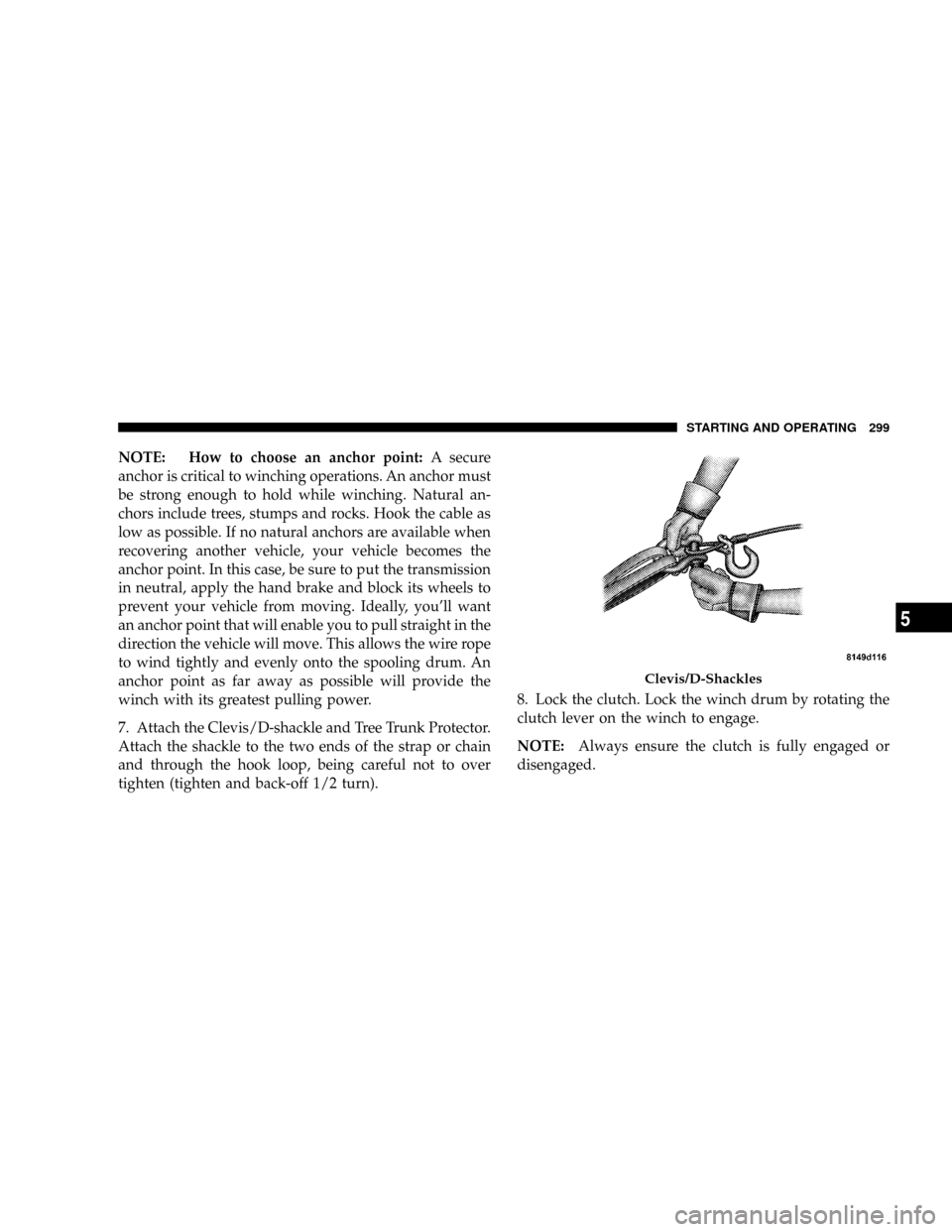
7. Attach the Clevis/D-shackle and Tree Trunk Protector.
Attach the shackle to the two ends of the strap or chain
and through the hook loop, being careful not to over
tighten (tighten and back-off 1/2 turn).8. Lock the clutch. Lock the winch drum by rotating the
clutch lever on the winch to engage.
NOTE:Always ensure the clutch is fully engaged or
disengaged.
Clevis/D-Shackles
STARTING AND OPERATING 299
5
Page 310 of 492
WARNING!
²Always fully apply the parking brake when leav-
ing your vehicle, or it may roll and cause damage
or injury. Also be certain to leave an automatic
transmission in Park, a manual transmission in
Reverse or First gear. Failure to do so may allow
the vehicle to roll and cause damage or injury.
²Never leave children alone in a vehicle. Leaving
children in a vehicle unattended is dangerous for
a number of reasons. A child or others could be
seriously or fatally injured. Don't leave the keys
in the ignition. A child could operate power
windows, other controls, or move the vehicle.
²Be sure the parking brake is fully disengaged
before driving, failure to do so can lead to brake
problems due to excessive heating of the rear
brakes.
When parking on a hill, turn the front wheels toward the
curb on a downhill grade and away from the curb on an
uphill grade.
The parking brake should always be applied whenever
the driver is not in the vehicle.
BRAKE SYSTEM
If power assist is lost for any reason (for example,
repeated brake applications with the engine off), the
brakes will still function. However, you will experience a
substantial increase in braking effort to stop the vehicle.
If either the front or rear hydraulic systems lose normal
capability, the remaining system will still function with
some loss of overall braking effectiveness. This will be
evident by increased pedal travel during application,
greater pedal force required to slow or stop, and activa-
tion of the BRAKE warning lamp and the ABS lamp (if
equipped) during brake use.
STARTING AND OPERATING 309
5
Page 311 of 492
Brake Noise
During normal operation of the brake system certain
noises may be present from time to time. Occasional
9groan9or9squeal9noises may occur during normal
operation of the brake system which may not be indica-
tive of a problem. These noises may be heard at any time
the brakes are applied but may be more noticeable during
the first few brake applications in the morning. Moisture,
hot or cold temperature, dust, and or other debris may
also contribute to the noise condition. Repeated or con-
tinuous noises during braking may be an indication that
the brake linings are worn and in need of replacement.
Four-Wheel Anti-Lock Brake System (ABS)Ð If
Equipped
This Anti-lock Brake System is designed to aid the driver
in maintaining vehicle control under adverse braking
conditions. The system operates with a separate com-
puter to modulate hydraulic pressure to prevent wheel
lockup and help avoid skidding on slippery surfaces.The system's pump motor runs during an ABS stop to
provide regulated hydraulic pressure. The pump motor
makes a low humming noise during operation. This is
normal.
When you are in a severe braking condition involving
use of the Anti-lock Brake System, you will experience
some pedal drop as the vehicle comes to a complete stop.
This is the result of the system reverting to the base brake
system and is normal.
Engagement of the Anti-lock Brake System may be
accompanied by a pulsing sensation. You may also hear a
clicking noise. These occurrences are normal, and indi-
cate that the system is functioning.ABS Warning Light
The Anti-lock Brake System includes an amber warning
light. When the light is illuminated, the Anti-lock Brake
System is not functioning. The system reverts to standard
non-anti-lock brakes.
310 STARTING AND OPERATING
Page 313 of 492
POWER STEERING
The standard power steering system will give you good
vehicle response and increased ease of maneuverability
in tight spaces. The system will provide mechanical
steering capability if power assist is lost.
If for some reason, the power assist is interrupted, it will
still be possible to steer your vehicle. Under these condi-
tions you will observe a substantial increase in steering
effort, especially at very low vehicle speeds and during
parking maneuvers.
NOTE:Increased noise levels at the end of the steering
wheel travel are considered normal and does not indicate
that there is a problem with the power steering system.
Upon initial start-up in cold weather, the power steering
pump may make noise for a short period of time. This is
due to the cold, thick fluid in the steering system. This
noise should be considered normal, and does not in any
way damage the steering system.WARNING!
Continued operation with reduced power steering
assist could pose a safety risk to yourself and others.
Service should be obtained as soon as possible.
CAUTION!
Prolong operation of the steering system at the end
of the steering wheel travel will increase the steering
fluid temperature and should be avoided when
possible. Damage to the power steering pump may
occur.
312 STARTING AND OPERATING
Page 327 of 492
WARNING!
High speed driving with your vehicle under maxi-
mum load is dangerous. The added strain on your
tires could cause them to fail. You could have a
serious accident. Don't drive a vehicle loaded to the
maximum capacity at continuous speeds above 75
mph (120 km/h).
Radial-Ply Tires
WARNING!
Combining radial ply tires with other types of tires
on your vehicle will cause your vehicle to handle
poorly. The instability could cause an accident. Al-
ways use radial ply tires in sets of four (or 6, in case
of trucks with dual rear wheels). Never combine
them with other types of tires.
Cuts and punctures in radial tires are repairable only in
the tread area because of sidewall flexing. Consult your
authorized tire dealer for radial tire repairs.
326 STARTING AND OPERATING
Page 328 of 492
Compact Spare Tire Ð If Equipped
The compact spare is for temporary emergency use with
radial tires. It is engineered to be used on your style
vehicle only. Since this tire has limited tread life, the
original tire should be repaired (or replaced) and rein-
stalled at the first opportunity.
WARNING!
Temporary use spare tires are for emergency use
only. With these tires, do not drive more than 50 mph
(80 km/h). Temporary-use spare tires have limited
tread life. When the tread is worn to the tread wear
indicators, the temporary use spare tire needs to be
replaced. Be sure to follow the warnings, which
apply to your spare. Failure to do so could result in
spare tire failure and loss of vehicle control.
Do not install a wheel cover or attempt to mount a
conventional tire on the compact spare wheel, since the
wheel is designed specifically for the compact spare.
Do not install more than one compact spare tire/wheel
on the vehicle at any given time.
CAUTION!
Because of the reduced ground clearance, do not take
your vehicle through an automatic car wash with the
compact spare installed. Damage to the vehicle may
result.
STARTING AND OPERATING 327
5
Page 329 of 492
Limited Use Spare Ð If Equipped
The limited use spare tire is for temporary emergency use
on your vehicle. This tire is identified by a limited use
spare tire warning label located on the limited use spare
tire and wheel assembly. This tire may look like the
original equipped tire on the front or rear axle of your
vehicle, but it is not. Installation of this limited use spare
tire affects vehicle handling. Since it is not the same tire,
replace (or repair) the original tire and reinstall on the
vehicle at the first opportunity.WARNING!
The limited use spare tires are for emergency use
only. Installation of this limited use spare tire affects
vehicle handling. With this tire, do not drive more
than 60 mph (100 km/h). Keep inflated to the cold
tire inflation pressure listed on either your tire
placard or limited use spare tire and wheel assembly.
Replace (or repair) the original tire at the first
opportunity and reinstall it on your vehicle. Failure
to do so could result in loss of vehicle control.
Tire Spinning
When stuck in mud, sand, snow, or ice conditions, do not
spin your vehicle's wheels above 35 mph (55 km/h).
Refer to the paragraph on ªFreeing A Stuck Vehicleº in
Section 6 of this manual.
328 STARTING AND OPERATING
Page 330 of 492
WARNING!
Fast spinning tires can be dangerous. Forces gener-
ated by excessive wheel speeds may cause tire dam-
age or failure. A tire could explode and injure
someone. Do not spin your vehicle's wheels faster
than 30 mph (48 km/h) for more than 30 seconds
continuously when you are stuck, and don't let
anyone near a spinning wheel, no matter what the
speed.
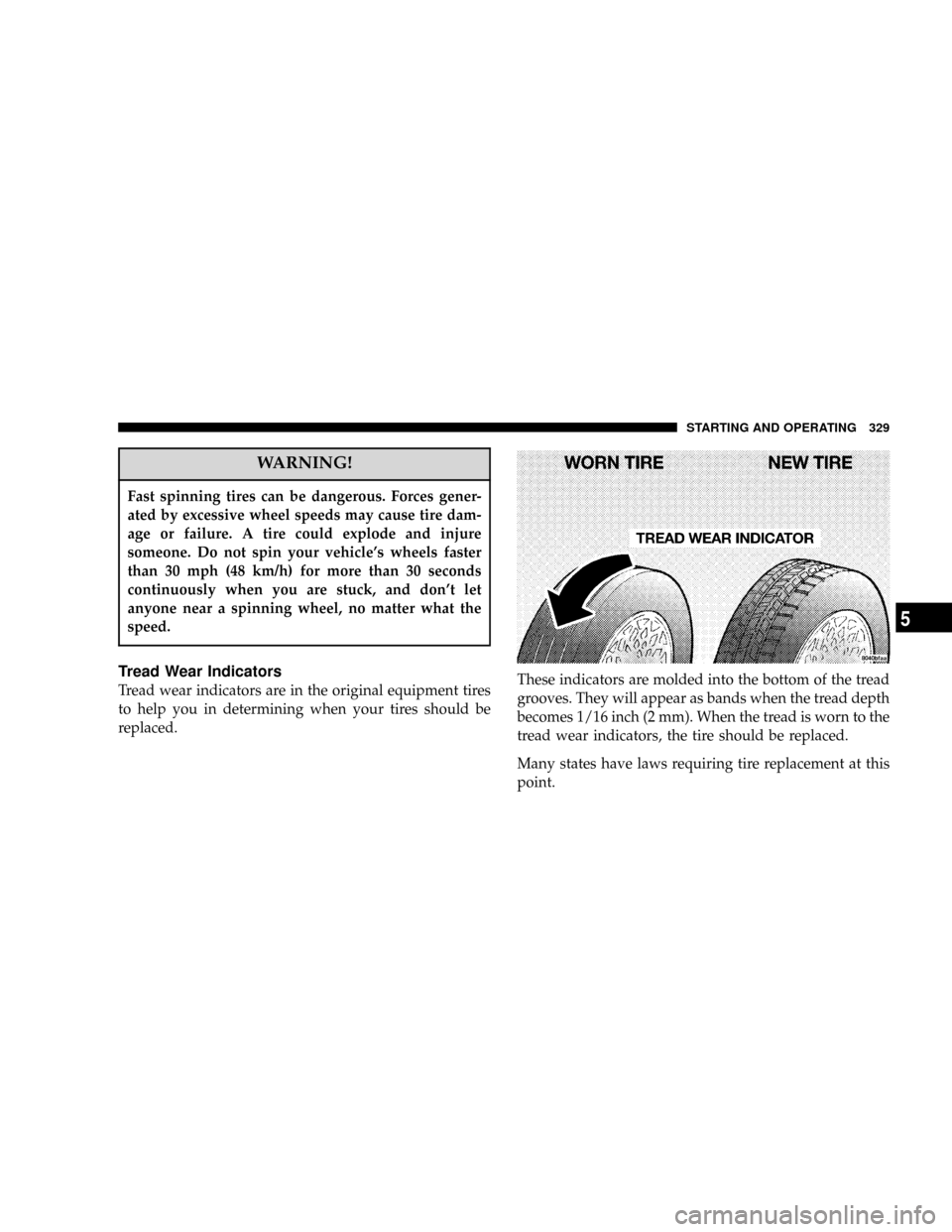
Tread Wear Indicators
Tread wear indicators are in the original equipment tires
to help you in determining when your tires should be
replaced.These indicators are molded into the bottom of the tread
grooves. They will appear as bands when the tread depth
becomes 1/16 inch (2 mm). When the tread is worn to the
tread wear indicators, the tire should be replaced.
Many states have laws requiring tire replacement at this
point.
STARTING AND OPERATING 329
5