wheel DODGE POWER WAGON 2007 2.G Repair Manual
[x] Cancel search | Manufacturer: DODGE, Model Year: 2007, Model line: POWER WAGON, Model: DODGE POWER WAGON 2007 2.GPages: 492, PDF Size: 8.25 MB
Page 332 of 492
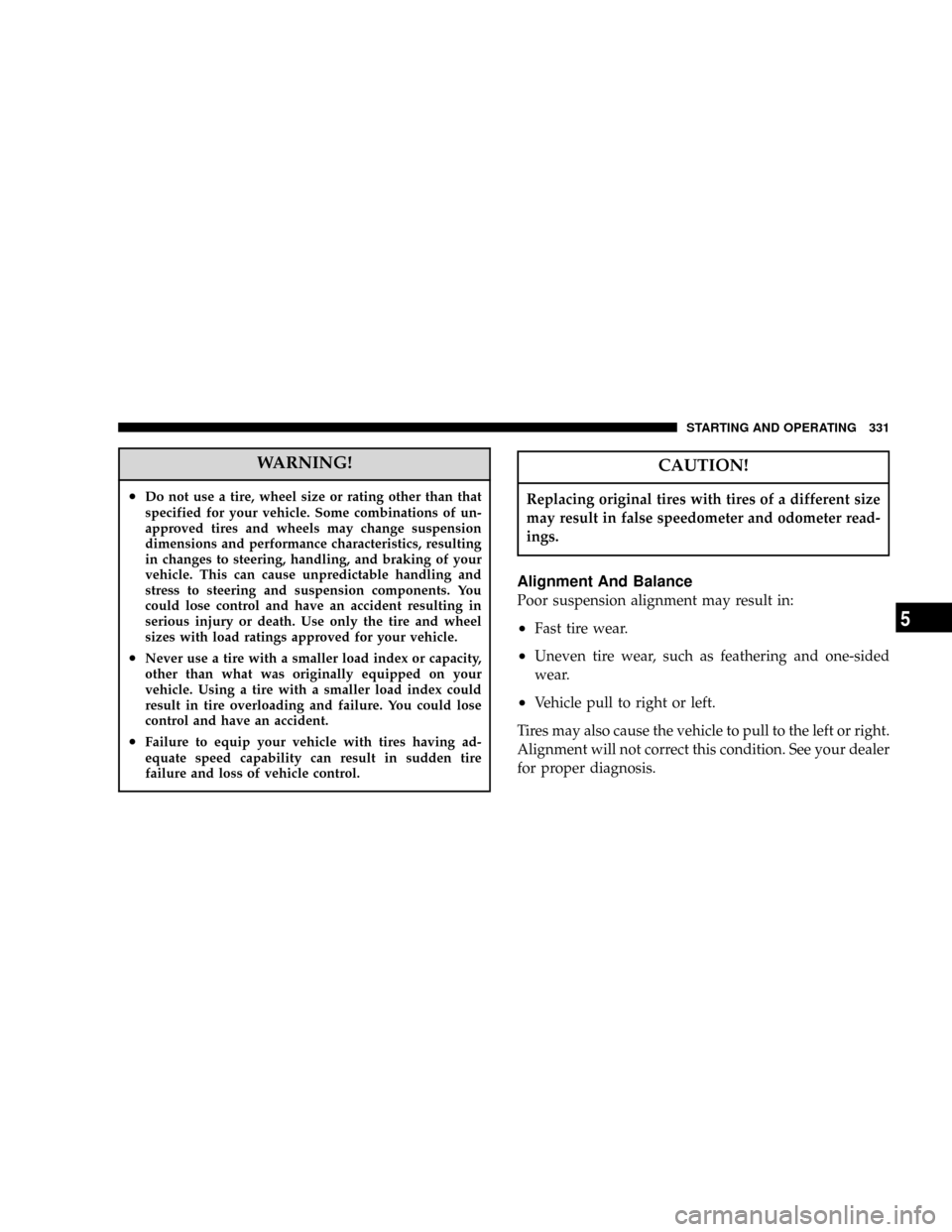
WARNING!
²Do not use a tire, wheel size or rating other than that
specified for your vehicle. Some combinations of un-
approved tires and wheels may change suspension
dimensions and performance characteristics, resulting
in changes to steering, handling, and braking of your
vehicle. This can cause unpredictable handling and
stress to steering and suspension components. You
could lose control and have an accident resulting in
serious injury or death. Use only the tire and wheel
sizes with load ratings approved for your vehicle.
²Never use a tire with a smaller load index or capacity,
other than what was originally equipped on your
vehicle. Using a tire with a smaller load index could
result in tire overloading and failure. You could lose
control and have an accident.
²Failure to equip your vehicle with tires having ad-
equate speed capability can result in sudden tire
failure and loss of vehicle control.
CAUTION!
Replacing original tires with tires of a different size
may result in false speedometer and odometer read-
ings.
Alignment And Balance
Poor suspension alignment may result in:
²Fast tire wear.
²Uneven tire wear, such as feathering and one-sided
wear.
²Vehicle pull to right or left.
Tires may also cause the vehicle to pull to the left or right.
Alignment will not correct this condition. See your dealer
for proper diagnosis.
STARTING AND OPERATING 331
5
Page 333 of 492
Improper alignment will not cause vehicle vibration.
Vibration may be a result of tire and wheel out-of-
balance. Proper balancing will reduce vibration and
avoid tire cupping and spotty wear.
SUPPLEMENTAL TIRE PRESSURE INFORMATION
± IF EQUIPPED
A light load vehicle condition is defined as two passen-
gers {150 lbs (68 kg) each} plus 200 lbs (91kg) of cargo.
Cold tire inflation pressures for a lightly loaded vehicle
will be found on the face of the driver's door.
TIRE CHAINS
Use ªClass Uº chains on Power Wagon models, or other
traction aids that meet SAE Type ªUº specifications.
NOTE:Chains must be the proper size for the vehicle,
as recommended by the chain manufacturer.
CAUTION!
To avoid damage to your vehicle, tires or chains, observe the
following precautions:
²Because of limited chain clearance between tires and other
suspension components, it is important that only chains
in good condition are used. Broken chains can cause
serious vehicle damage. Stop the vehicle immediately if
noise occurs that could suggest chain breakage. Remove
the damaged parts of the chain before further use.
²Install chains as tightly as possible and then retighten
after driving about 1/2 mile (0.8 km).
²Do not exceed 45 mph (72 km/h).
²Drive cautiously and avoid severe turns and large bumps,
especially with a loaded vehicle.
²Do not install tire chains on front wheels of 4x2 vehicles.
²Do not drive for a prolonged period on dry pavement.
²Observe the tire chain manufacturer's instructions on
method of installation, operating speed, and conditions
for usage. Always use the lower suggested operating
speed of the chain manufacturer if different than the
speed recommended by the manufacturer.
332 STARTING AND OPERATING
Page 334 of 492
These cautions apply to all chain traction devices, includ-
ing link and cable (radial) chains.
NOTE:On 4x4 Power Wagon models, class ªUº snow
chains are permitted on the rear wheels only of vehicles
equipped with LT285/70R17D.
CAUTION!
Do not use tire chains on the 4X4 front wheels of
Ram Trucks equipped with LT285/70R17D. There
may not be adequate clearance for the chains and
you are risking structural or body damage to your
vehicle.
SNOW TIRES
Snow tires should be of the same size and type construc-
tion as the front tires. Consult the manufacturer of the
snow tire to determine any maximum vehicle speed
requirement associated with the tire. These tires should
always be operated at the vehicle maximum capacity
inflation pressures under any load condition.
While studded tires improve performance on ice, skid
and traction capability on wet or dry surfaces may be
poorer than that of non-studded tires. Some states pro-
hibit studded tires; therefore, local laws should be
checked before using these tire types.
STARTING AND OPERATING 333
5
Page 343 of 492
included on this label and indicates the Month, Day and
Hour of manufacture. The bar code that appears on the
bottom of the label is your Vehicle Identification Number
(VIN).
Gross Vehicle Weight Rating (GVWR)
The GVWR is the total permissible weight of your vehicle
including driver, passengers, vehicle, options and cargo.
The label also specifies maximum capacities of front and
rear axle systems (GAWR). Total load must be limited so
GVWR and front and rear GAWR are not exceeded.
Payload
The payload of a vehicle is defined as the allowable load
weight a truck can carry, including the weight of the
driver, all passengers, options and cargo.
Gross Axle Weight Rating (GAWR)
The GAWR is the maximum permissible load on the front
and rear axles. The load must be distributed in the cargo
area so that the GAWR of each axle is not exceeded.Each axle GAWR is determined by the components in the
system with the lowest load carrying capacity (axle,
springs, tires or wheels). Heavier axles or suspension
components sometimes specified by purchasers for in-
creased durability does not necessarily increase the vehi-
cle's GVWR.
Tire Size
The tire size on the Label represents the actual tire size on
your vehicle. Replacement tires must be equal to the load
capacity of this tire size.
Rim Size
This is the rim size that is appropriate for the tire size
listed.
Inflation Pressure
This is the cold tire inflation pressure for your vehicle for
all loading conditions up to full GAWR.
342 STARTING AND OPERATING
Page 350 of 492
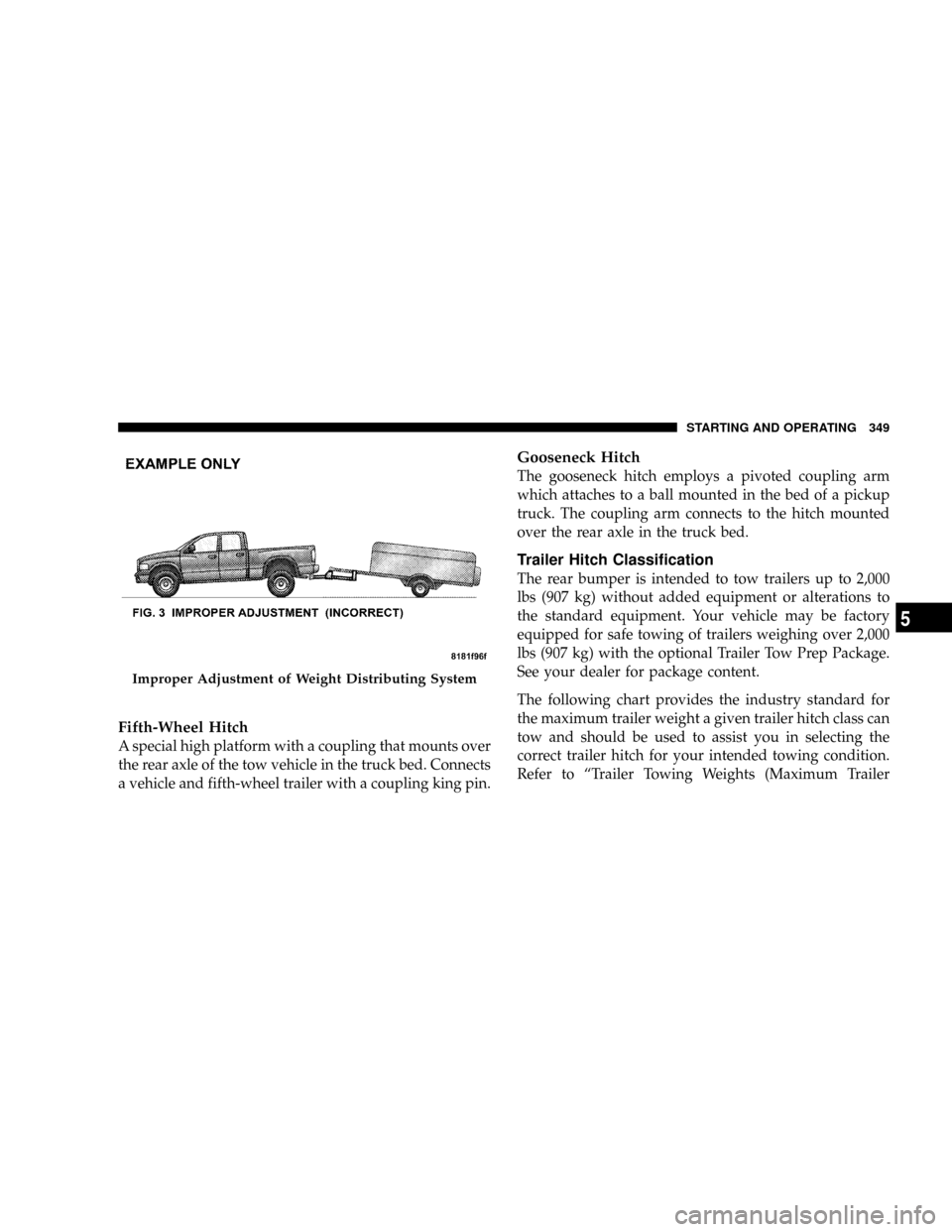
Fifth-Wheel Hitch
A special high platform with a coupling that mounts over
the rear axle of the tow vehicle in the truck bed. Connects
a vehicle and fifth-wheel trailer with a coupling king pin.
Gooseneck Hitch
The gooseneck hitch employs a pivoted coupling arm
which attaches to a ball mounted in the bed of a pickup
truck. The coupling arm connects to the hitch mounted
over the rear axle in the truck bed.
Trailer Hitch Classification
The rear bumper is intended to tow trailers up to 2,000
lbs (907 kg) without added equipment or alterations to
the standard equipment. Your vehicle may be factory
equipped for safe towing of trailers weighing over 2,000
lbs (907 kg) with the optional Trailer Tow Prep Package.
See your dealer for package content.
The following chart provides the industry standard for
the maximum trailer weight a given trailer hitch class can
tow and should be used to assist you in selecting the
correct trailer hitch for your intended towing condition.
Refer to ªTrailer Towing Weights (Maximum Trailer
Improper Adjustment of Weight Distributing System
STARTING AND OPERATING 349
5
Page 351 of 492
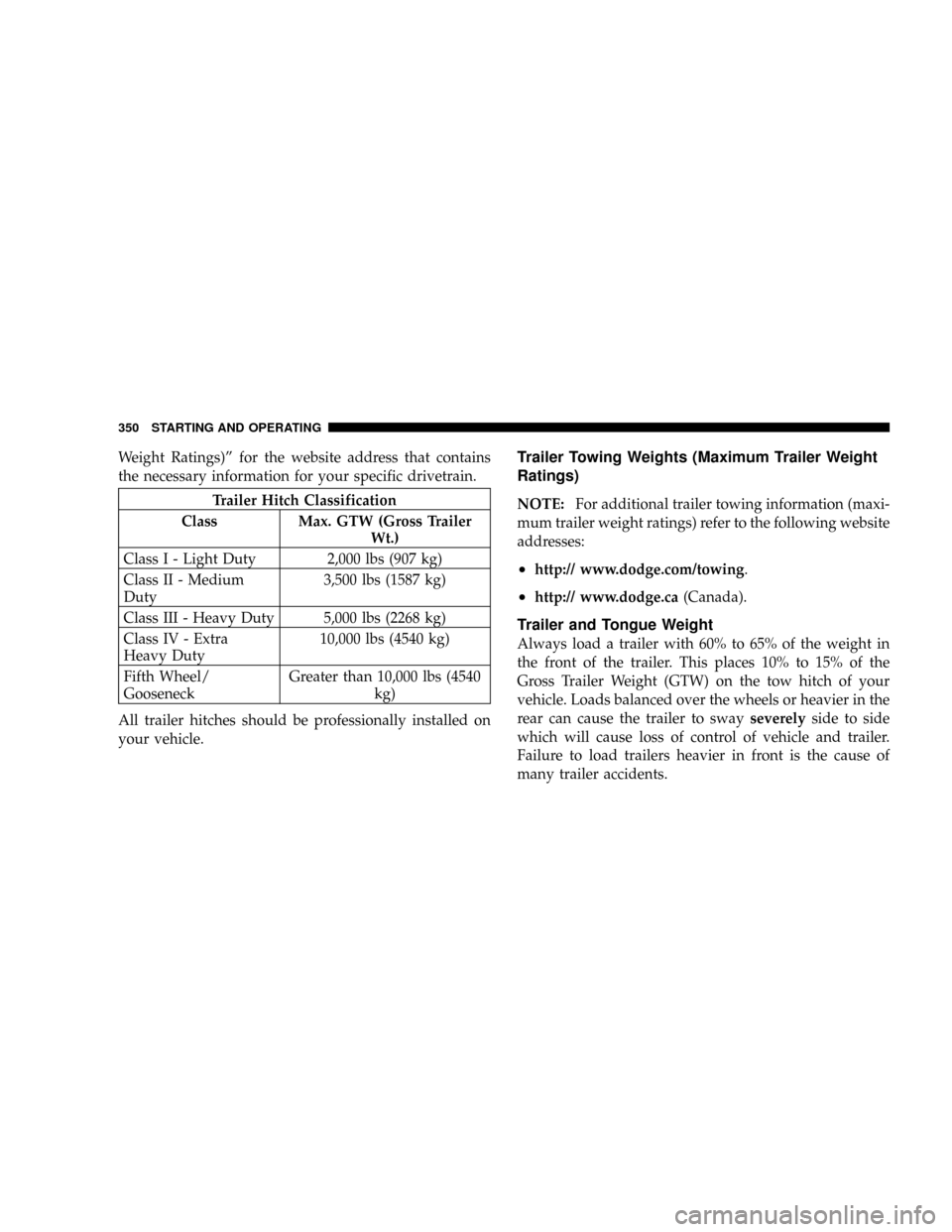
Weight Ratings)º for the website address that contains
the necessary information for your specific drivetrain.
Trailer Hitch Classification
Class Max. GTW (Gross Trailer
Wt.)
Class I - Light Duty 2,000 lbs (907 kg)
Class II - Medium
Duty3,500 lbs (1587 kg)
Class III - Heavy Duty 5,000 lbs (2268 kg)
Class IV - Extra
Heavy Duty10,000 lbs (4540 kg)
Fifth Wheel/
GooseneckGreater than 10,000 lbs (4540
kg)
All trailer hitches should be professionally installed on
your vehicle.
Trailer Towing Weights (Maximum Trailer Weight
Ratings)
NOTE:For additional trailer towing information (maxi-
mum trailer weight ratings) refer to the following website
addresses:
²http:// www.dodge.com/towing.
²http:// www.dodge.ca(Canada).
Trailer and Tongue Weight
Always load a trailer with 60% to 65% of the weight in
the front of the trailer. This places 10% to 15% of the
Gross Trailer Weight (GTW) on the tow hitch of your
vehicle. Loads balanced over the wheels or heavier in the
rear can cause the trailer to swayseverelyside to side
which will cause loss of control of vehicle and trailer.
Failure to load trailers heavier in front is the cause of
many trailer accidents.
350 STARTING AND OPERATING
Page 354 of 492
²Safety chains must always be used between your
vehicle and trailer. Always connect the chains to the
frame or hook retainers of the vehicle hitch. Cross the
chains under the trailer tongue and allow enough
slack for turning corners.
²Vehicles with trailers should not be parked on a grade.
When parking, apply the parking brake on the tow
vehicle. Put the tow vehicle automatic transmission in
P for Park. With a manual transmission, shift the
transmission into reverse. And with four-wheel-drive
vehicles, make sure the transfer case is not in neutral.
Always, block or9chock9the trailer wheels.
²GCWR must not be exceeded.
²Total weight must be distributed between the tow
vehicle and the trailer such that the following four
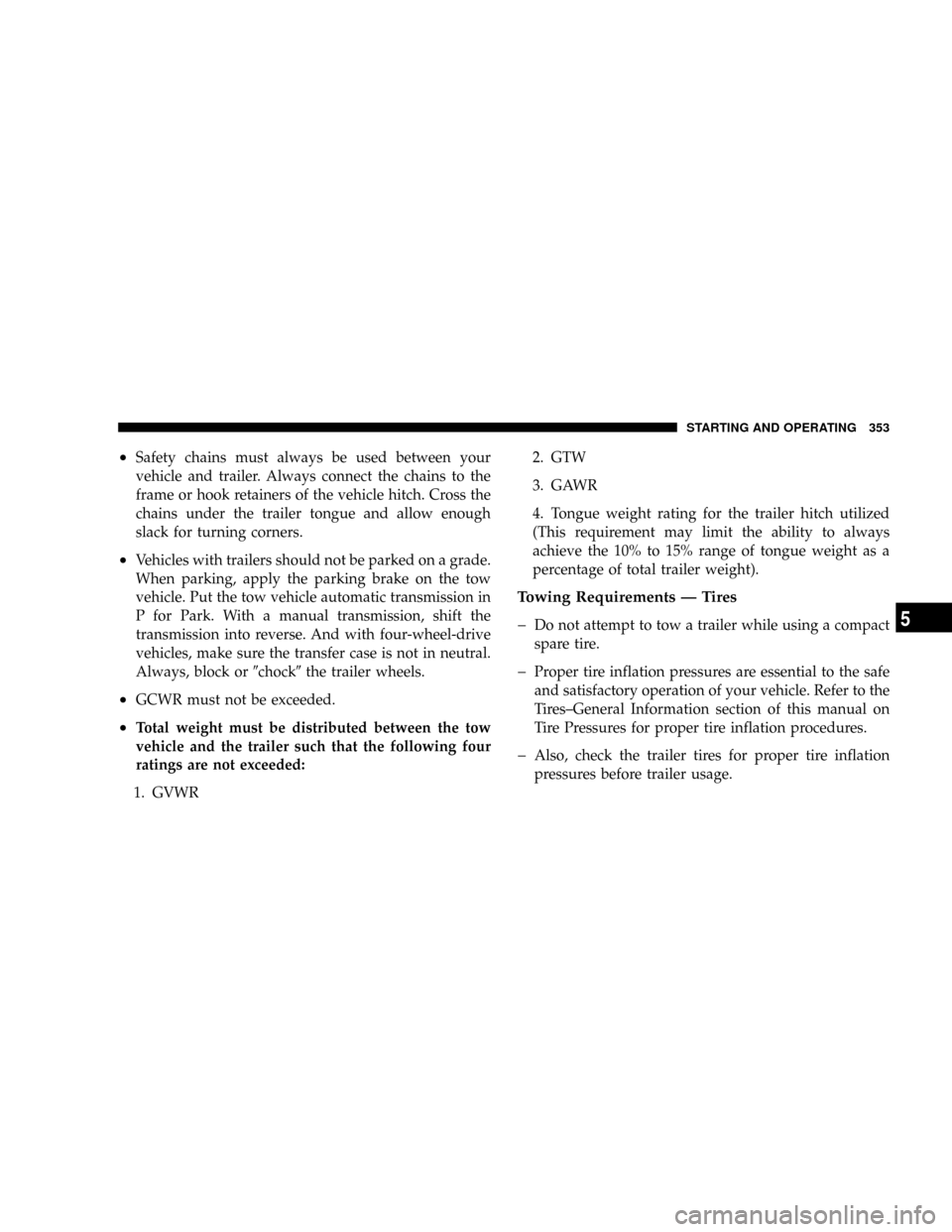
ratings are not exceeded:
1. GVWR2. GTW
3. GAWR
4. Tongue weight rating for the trailer hitch utilized
(This requirement may limit the ability to always
achieve the 10% to 15% range of tongue weight as a
percentage of total trailer weight).
Towing Requirements Ð Tires
þ
Do not attempt to tow a trailer while using a compact
spare tire.
þProper tire inflation pressures are essential to the safe
and satisfactory operation of your vehicle. Refer to the
Tires±General Information section of this manual on
Tire Pressures for proper tire inflation procedures.
þAlso, check the trailer tires for proper tire inflation
pressures before trailer usage.
STARTING AND OPERATING 353
5
Page 361 of 492
CAUTION!
Using this vehicle for snowplow applications can
cause damage to the vehicle.
WARNING!
Attaching a snowplow to this vehicle could ad-
versely affect performance of the airbag system in an
accident. Do not expect that the airbag will perform
as described earlier in this manual
RECREATIONAL TOWING Ð 4±WHEEL DRIVE
VEHICLES (BEHIND MOTORHOME, ETC.)
CAUTION!
Internal damage to the transfer case will occur if a
front or rear wheel lift is used when recreational
towing.
NOTE:The transfer case must be shifted into Neutral
(N) for recreational towing. Automatic transmissions
must be placed in P (Park) position for recreational
towing. Manual transmissions must be left in gear (not in
neutral) for recreational towing. Refer below for the
proper transfer case Neutral shifting procedure for your
vehicle.
360 STARTING AND OPERATING
Page 364 of 492
CAUTION!
²Do not use a bumper mounted clamp-on tow bar
on your vehicle. The bumper face bar will be
damaged.
²Do not disconnect the rear driveshaft because
fluid will leak from the transfer case and damage
the internal parts.
EQUIPMENT IDENTIFICATION PLATE
The equipment Identification Plate is located on the hood
inner surface.
The following information about your vehicle is dis-
played on this plate: Model, Wheelbase, Vehicle Identifi-
cation Number, Truck Order Number, and code numbers
with descriptions of all production and special equip-
ment on the truck as shipped from the factory.
NOTE:Always refer to the Equipment Identification
Plate When Ordering Parts.
STARTING AND OPERATING 363
5
Page 366 of 492
WHAT TO DO IN EMERGENCIES
CONTENTS
mHazard Warning Flasher..................366
mJacking And Tire Changing................367
NAll Models..........................367
mJacking Instructions.....................368
NRemoving The Spare Tire................368
NTire Changing Procedure................369
mHoisting.............................375mJump-Starting.........................375
mFreeing A Stuck Vehicle..................378
mEmergency Tow Hooks Ð If Equipped........379
mTowing A Disabled Vehicle................380
N4-Wheel-Drive Vehicles.................380
mWinch Usage..........................380
6