Passenger Window DODGE RAM 1500 1998 2.G User Guide
[x] Cancel search | Manufacturer: DODGE, Model Year: 1998, Model line: RAM 1500, Model: DODGE RAM 1500 1998 2.GPages: 2627
Page 1089 of 2627
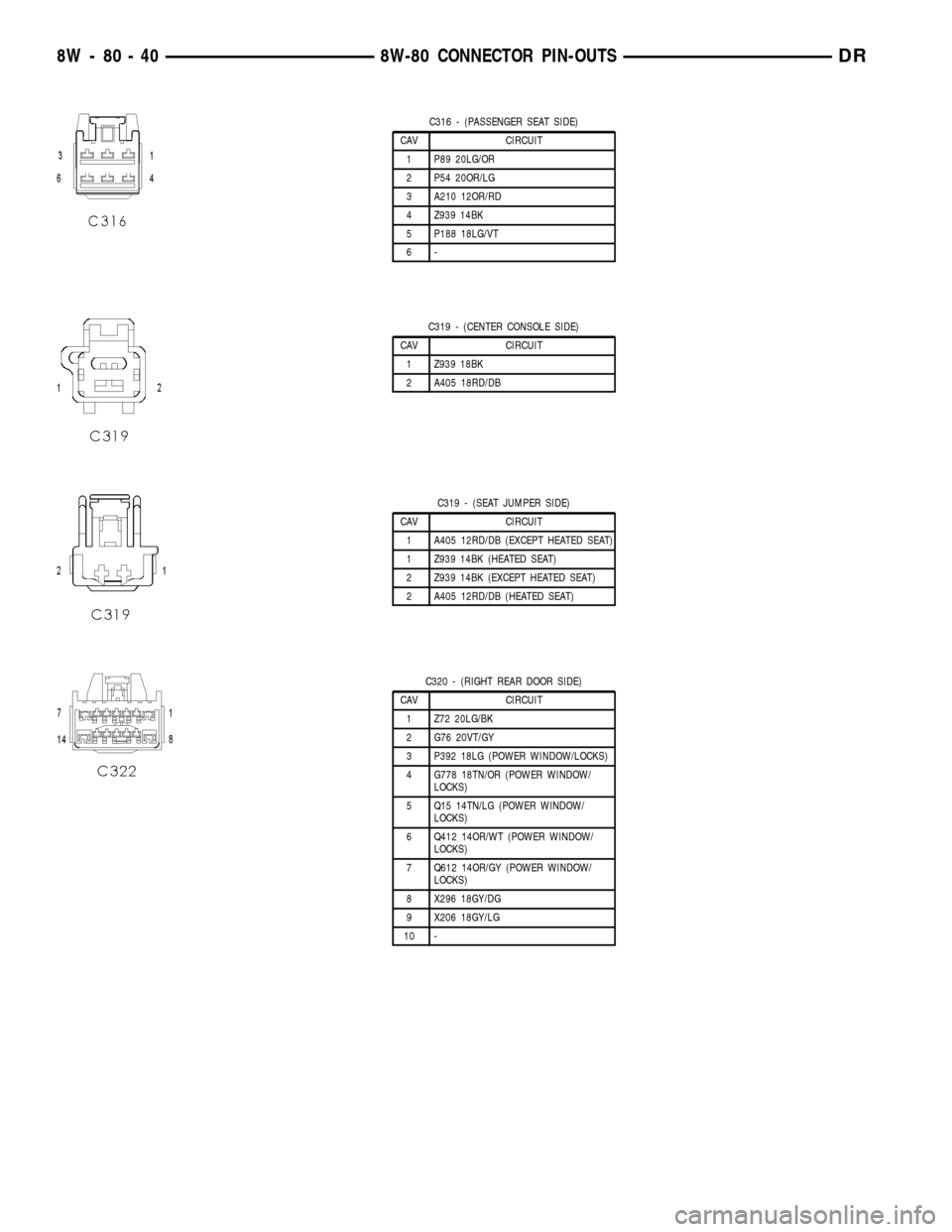
C316 - (PASSENGER SEAT SIDE)
CAV CIRCUIT
1 P89 20LG/OR
2 P54 20OR/LG
3 A210 12OR/RD
4 Z939 14BK
5 P188 18LG/VT
6-
C319 - (CENTER CONSOLE SIDE)
CAV CIRCUIT
1 Z939 18BK
2 A405 18RD/DB
C319 - (SEAT JUMPER SIDE)
CAV CIRCUIT
1 A405 12RD/DB (EXCEPT HEATED SEAT)
1 Z939 14BK (HEATED SEAT)
2 Z939 14BK (EXCEPT HEATED SEAT)
2 A405 12RD/DB (HEATED SEAT)
C320 - (RIGHT REAR DOOR SIDE)
CAV CIRCUIT
1 Z72 20LG/BK
2 G76 20VT/GY
3 P392 18LG (POWER WINDOW/LOCKS)
4 G778 18TN/OR (POWER WINDOW/
LOCKS)
5 Q15 14TN/LG (POWER WINDOW/
LOCKS)
6 Q412 14OR/WT (POWER WINDOW/
LOCKS)
7 Q612 14OR/GY (POWER WINDOW/
LOCKS)
8 X296 18GY/DG
9 X206 18GY/LG
10 -
8W - 80 - 40 8W-80 CONNECTOR PIN-OUTSDR
Page 1135 of 2627
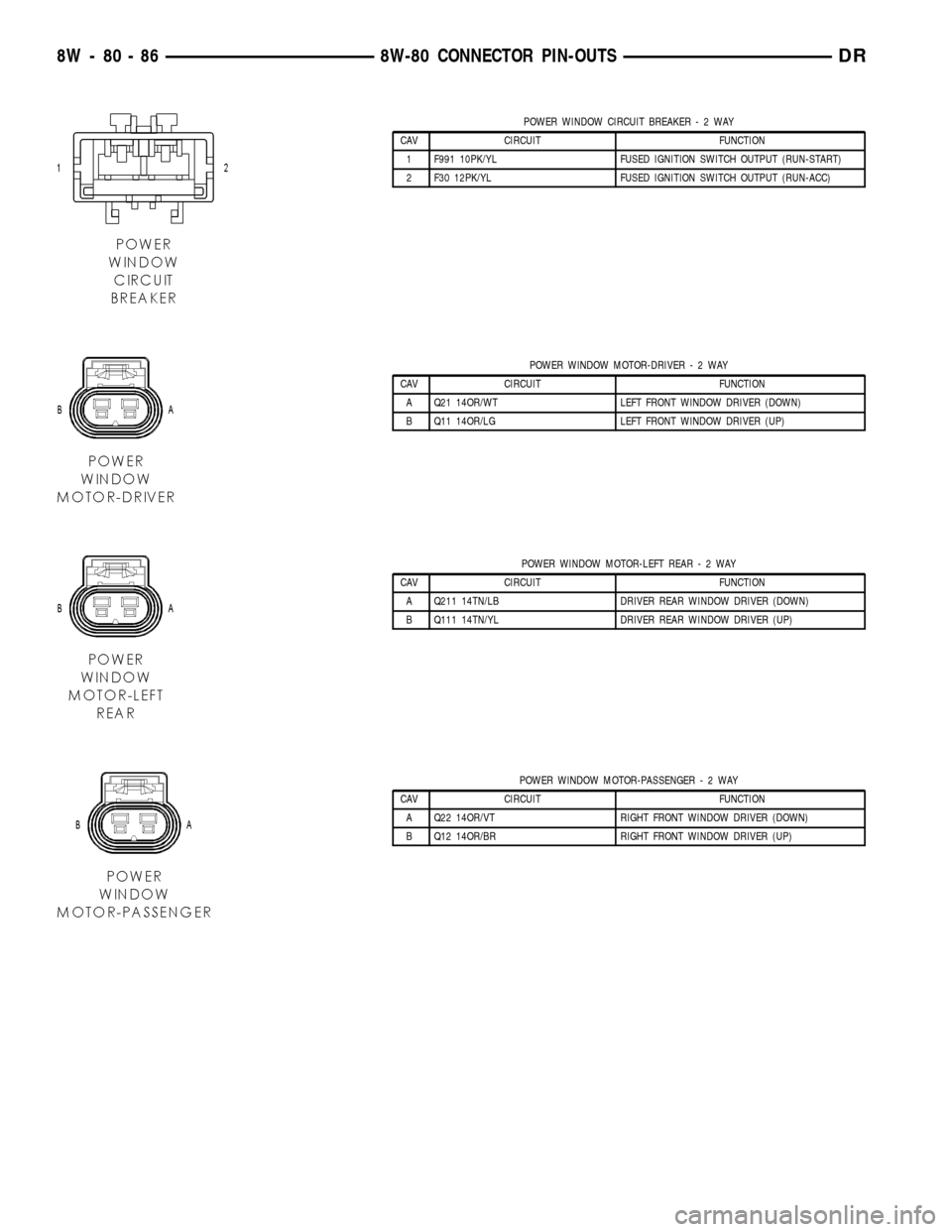
POWER WINDOW CIRCUIT BREAKER-2WAY
CAV CIRCUIT FUNCTION
1 F991 10PK/YL FUSED IGNITION SWITCH OUTPUT (RUN-START)
2 F30 12PK/YL FUSED IGNITION SWITCH OUTPUT (RUN-ACC)
POWER WINDOW MOTOR-DRIVER-2WAY
CAV CIRCUIT FUNCTION
A Q21 14OR/WT LEFT FRONT WINDOW DRIVER (DOWN)
B Q11 14OR/LG LEFT FRONT WINDOW DRIVER (UP)
POWER WINDOW MOTOR-LEFT REAR-2WAY
CAV CIRCUIT FUNCTION
A Q211 14TN/LB DRIVER REAR WINDOW DRIVER (DOWN)
B Q111 14TN/YL DRIVER REAR WINDOW DRIVER (UP)
POWER WINDOW MOTOR-PASSENGER-2WAY
CAV CIRCUIT FUNCTION
A Q22 14OR/VT RIGHT FRONT WINDOW DRIVER (DOWN)
B Q12 14OR/BR RIGHT FRONT WINDOW DRIVER (UP)
8W - 80 - 86 8W-80 CONNECTOR PIN-OUTSDR
Page 1136 of 2627
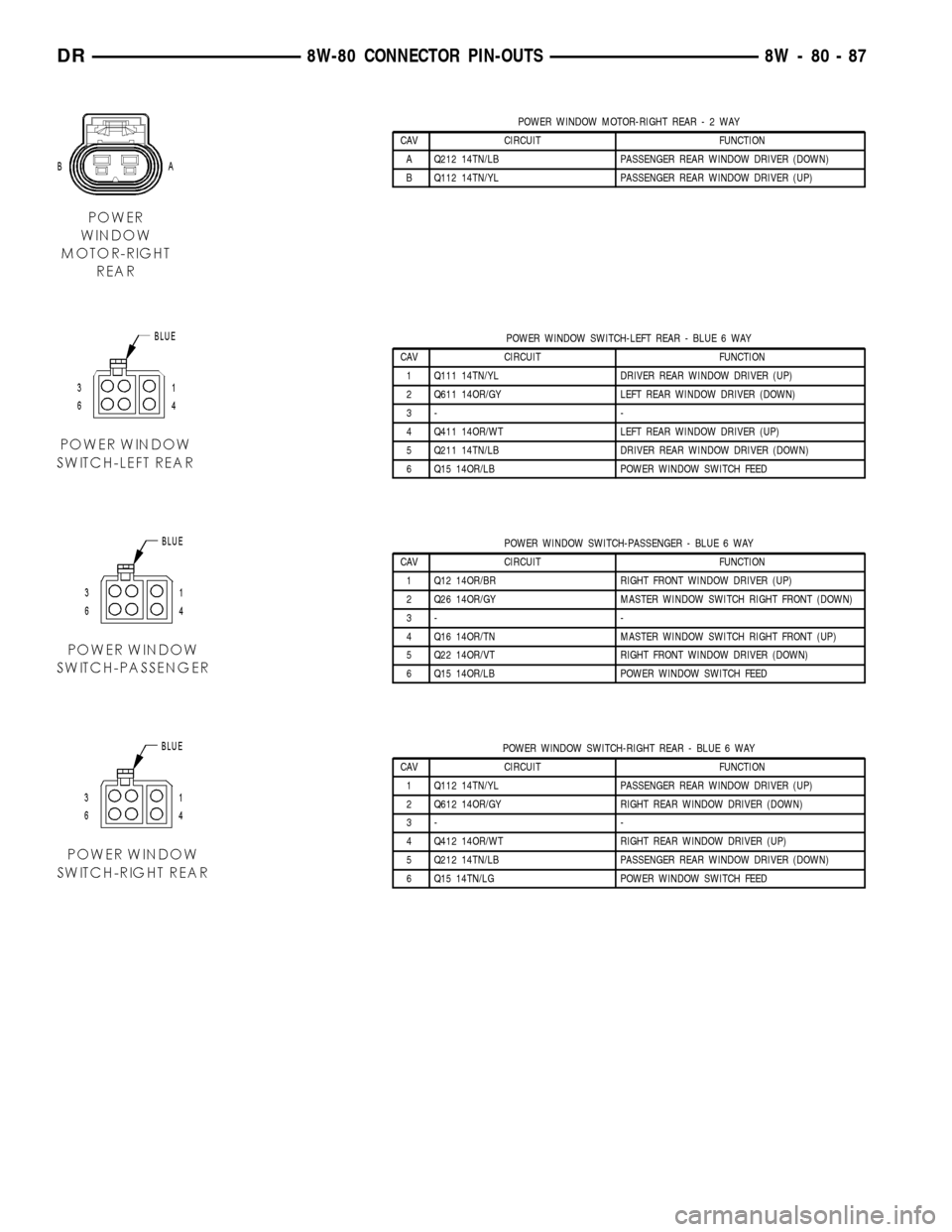
POWER WINDOW MOTOR-RIGHT REAR-2WAY
CAV CIRCUIT FUNCTION
A Q212 14TN/LB PASSENGER REAR WINDOW DRIVER (DOWN)
B Q112 14TN/YL PASSENGER REAR WINDOW DRIVER (UP)
POWER WINDOW SWITCH-LEFT REAR - BLUE 6 WAY
CAV CIRCUIT FUNCTION
1 Q111 14TN/YL DRIVER REAR WINDOW DRIVER (UP)
2 Q611 14OR/GY LEFT REAR WINDOW DRIVER (DOWN)
3- -
4 Q411 14OR/WT LEFT REAR WINDOW DRIVER (UP)
5 Q211 14TN/LB DRIVER REAR WINDOW DRIVER (DOWN)
6 Q15 14OR/LB POWER WINDOW SWITCH FEED
POWER WINDOW SWITCH-PASSENGER - BLUE 6 WAY
CAV CIRCUIT FUNCTION
1 Q12 14OR/BR RIGHT FRONT WINDOW DRIVER (UP)
2 Q26 14OR/GY MASTER WINDOW SWITCH RIGHT FRONT (DOWN)
3- -
4 Q16 14OR/TN MASTER WINDOW SWITCH RIGHT FRONT (UP)
5 Q22 14OR/VT RIGHT FRONT WINDOW DRIVER (DOWN)
6 Q15 14OR/LB POWER WINDOW SWITCH FEED
POWER WINDOW SWITCH-RIGHT REAR - BLUE 6 WAY
CAV CIRCUIT FUNCTION
1 Q112 14TN/YL PASSENGER REAR WINDOW DRIVER (UP)
2 Q612 14OR/GY RIGHT REAR WINDOW DRIVER (DOWN)
3- -
4 Q412 14OR/WT RIGHT REAR WINDOW DRIVER (UP)
5 Q212 14TN/LB PASSENGER REAR WINDOW DRIVER (DOWN)
6 Q15 14TN/LG POWER WINDOW SWITCH FEED
DR8W-80 CONNECTOR PIN-OUTS 8W - 80 - 87
Page 1159 of 2627
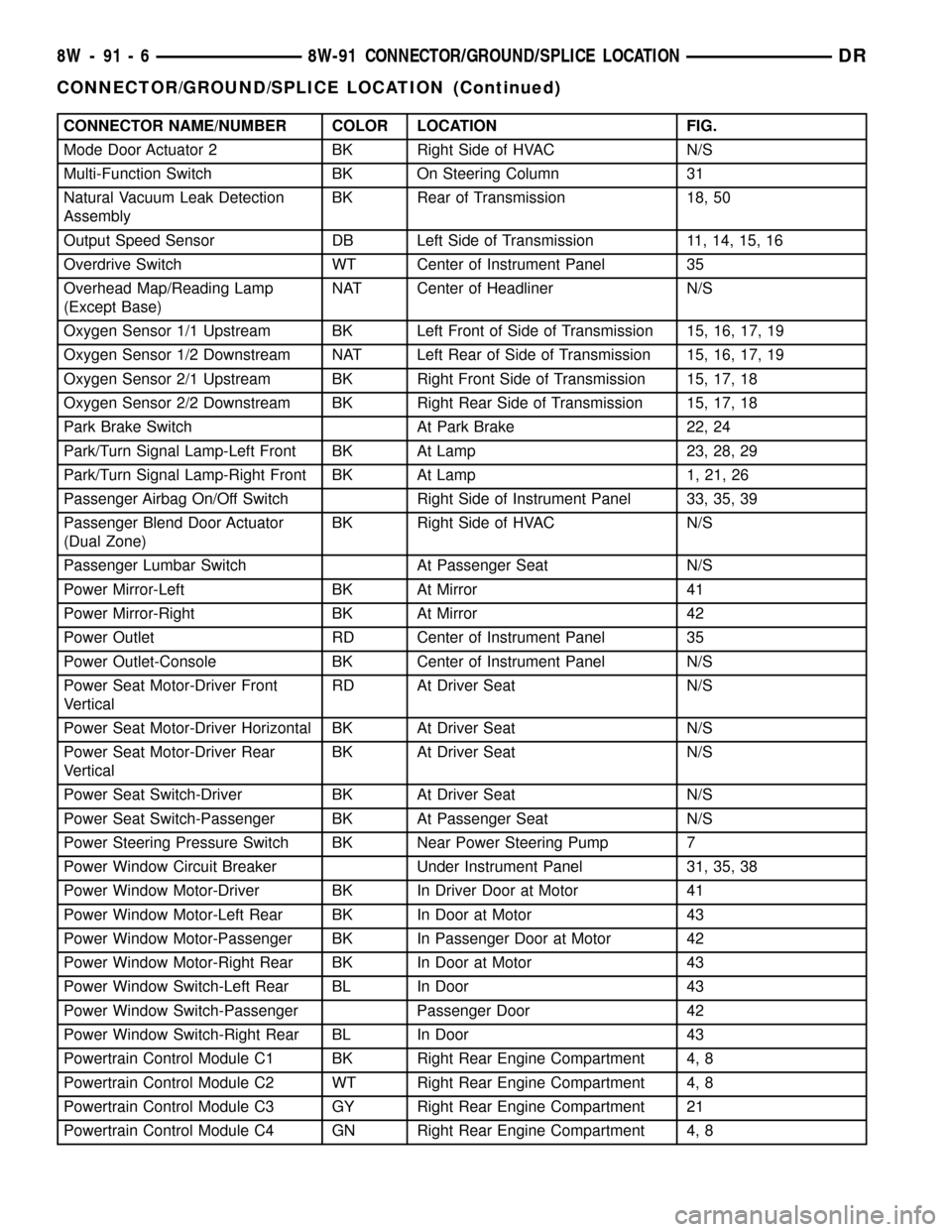
CONNECTOR NAME/NUMBER COLOR LOCATION FIG.
Mode Door Actuator 2 BK Right Side of HVAC N/S
Multi-Function Switch BK On Steering Column 31
Natural Vacuum Leak Detection
AssemblyBK Rear of Transmission 18, 50
Output Speed Sensor DB Left Side of Transmission 11, 14, 15, 16
Overdrive Switch WT Center of Instrument Panel 35
Overhead Map/Reading Lamp
(Except Base)NAT Center of Headliner N/S
Oxygen Sensor 1/1 Upstream BK Left Front of Side of Transmission 15, 16, 17, 19
Oxygen Sensor 1/2 Downstream NAT Left Rear of Side of Transmission 15, 16, 17, 19
Oxygen Sensor 2/1 Upstream BK Right Front Side of Transmission 15, 17, 18
Oxygen Sensor 2/2 Downstream BK Right Rear Side of Transmission 15, 17, 18
Park Brake Switch At Park Brake 22, 24
Park/Turn Signal Lamp-Left Front BK At Lamp 23, 28, 29
Park/Turn Signal Lamp-Right Front BK At Lamp 1, 21, 26
Passenger Airbag On/Off Switch Right Side of Instrument Panel 33, 35, 39
Passenger Blend Door Actuator
(Dual Zone)BK Right Side of HVAC N/S
Passenger Lumbar Switch At Passenger Seat N/S
Power Mirror-Left BK At Mirror 41
Power Mirror-Right BK At Mirror 42
Power Outlet RD Center of Instrument Panel 35
Power Outlet-Console BK Center of Instrument Panel N/S
Power Seat Motor-Driver Front
VerticalRD At Driver Seat N/S
Power Seat Motor-Driver Horizontal BK At Driver Seat N/S
Power Seat Motor-Driver Rear
VerticalBK At Driver Seat N/S
Power Seat Switch-Driver BK At Driver Seat N/S
Power Seat Switch-Passenger BK At Passenger Seat N/S
Power Steering Pressure Switch BK Near Power Steering Pump 7
Power Window Circuit Breaker Under Instrument Panel 31, 35, 38
Power Window Motor-Driver BK In Driver Door at Motor 41
Power Window Motor-Left Rear BK In Door at Motor 43
Power Window Motor-Passenger BK In Passenger Door at Motor 42
Power Window Motor-Right Rear BK In Door at Motor 43
Power Window Switch-Left Rear BL In Door 43
Power Window Switch-Passenger Passenger Door 42
Power Window Switch-Right Rear BL In Door 43
Powertrain Control Module C1 BK Right Rear Engine Compartment 4, 8
Powertrain Control Module C2 WT Right Rear Engine Compartment 4, 8
Powertrain Control Module C3 GY Right Rear Engine Compartment 21
Powertrain Control Module C4 GN Right Rear Engine Compartment 4, 8
8W - 91 - 6 8W-91 CONNECTOR/GROUND/SPLICE LOCATIONDR
CONNECTOR/GROUND/SPLICE LOCATION (Continued)
Page 2297 of 2627

VISUAL INSPECTION BEFORE WATER LEAK TESTS
Verify that floor and body plugs are in place, body
drains are clear, and body components are properly
aligned and sealed. If component alignment or seal-
ing is necessary, refer to the appropriate section of
this group for proper procedures.
WATER LEAK TESTS
WARNING: DO NOT USE ELECTRIC SHOP LIGHTS
OR TOOLS IN WATER TEST AREA. PERSONAL
INJURY CAN RESULT.
When the conditions causing a water leak have
been determined, simulate the conditions as closely
as possible.
²If a leak occurs with the vehicle parked in a
steady light rain, flood the leak area with an open-
ended garden hose.
²If a leak occurs while driving at highway speeds
in a steady rain, test the leak area with a reasonable
velocity stream or fan spray of water. Direct the
spray in a direction comparable to actual conditions.
²If a leak occurs when the vehicle is parked on an
incline, hoist the end or side of the vehicle to simu-
late this condition. This method can be used when
the leak occurs when the vehicle accelerates, stops or
turns. If the leak occurs on acceleration, hoist the
front of the vehicle. If the leak occurs when braking,
hoist the back of the vehicle. If the leak occurs on left
turns, hoist the left side of the vehicle. If the leak
occurs on right turns, hoist the right side of the vehi-
cle. For hoisting recommendations (Refer to LUBRI-
CATION & MAINTENANCE/HOISTING -
STANDARD PROCEDURE).
WATER LEAK DETECTION
To detect a water leak point-of-entry, do a water
test and watch for water tracks or droplets forming
on the inside of the vehicle. If necessary, remove inte-
rior trim covers or panels to gain visual access to the
leak area. If the hose cannot be positioned without
being held, have someone help do the water test.
Some water leaks must be tested for a considerable
length of time to become apparent. When a leak
appears, find the highest point of the water track or
drop. The highest point usually will show the point of
entry. After leak point has been found, repair the
leak and water test to verify that the leak has
stopped.
Locating the entry point of water that is leaking
into a cavity between panels can be difficult. The
trapped water may splash or run from the cavity,
often at a distance from the entry point. Most water
leaks of this type become apparent after accelerating,
stopping, turning, or when on an incline.MIRROR INSPECTION METHOD
When a leak point area is visually obstructed, use
a suitable mirror to gain visual access. A mirror can
also be used to deflect light to a limited-access area
to assist in locating a leak point.
BRIGHT LIGHT LEAK TEST METHOD
Some water leaks in the luggage compartment can
be detected without water testing. Position the vehi-
cle in a brightly lit area. From inside the darkened
luggage compartment inspect around seals and body
seams. If necessary, have a helper direct a drop light
over the suspected leak areas around the luggage
compartment. If light is visible through a normally
sealed location, water could enter through the open-
ing.
PRESSURIZED LEAK TEST METHOD
When a water leak into the passenger compart-
ment cannot be detected by water testing, pressurize
the passenger compartment and soap test exterior of
the vehicle. To pressurize the passenger compart-
ment, close all doors and windows, start engine, and
set heater control to high blower in HEAT position. If
engine can not be started, connect a charger to the
battery to ensure adequate voltage to the blower.
With interior pressurized, apply dish detergent solu-
tion to suspected leak area on the exterior of the
vehicle. Apply detergent solution with spray device or
soft bristle brush. If soap bubbles occur at a body
seam, joint, seal or gasket, the leak entry point could
be at that location.
DIAGNOSIS AND TESTING - WIND NOISE
Wind noise is the result of most air leaks. Air leaks
can be caused by poor sealing, improper body compo-
nent alignment, body seam porosity, or missing plugs
in the engine compartment or door hinge pillar areas.
All body sealing points should be airtight in normal
driving conditions. Moving sealing surfaces will not
always seal airtight under all conditions. At times,
side glass or door seals will allow wind noise to be
noticed in the passenger compartment during high
cross winds. Over compensating on door or glass
adjustments to stop wind noise that occurs under
severe conditions can cause premature seal wear and
excessive closing or latching effort. After a repair pro-
cedure has been performed, test vehicle to verify
noise has stopped before returning vehicle to use.
VISUAL INSPECTION BEFORE TESTS
Verify that floor and body plugs are in place and
body components are aligned and sealed. If compo-
nent alignment or sealing is necessary, refer to the
appropriate section of this group for proper proce-
dures.
23 - 2 BODYDR
BODY (Continued)
Page 2488 of 2627

HEATING & AIR CONDITIONING
TABLE OF CONTENTS
page page
HEATING & AIR CONDITIONING
DESCRIPTION
DESCRIPTION - ENGINE COOLING
SYSTEM REQUIREMENTS...............1
DESCRIPTION - HEATER AND AIR
CONDITIONER........................1
OPERATION - HEATER AND AIR
CONDITIONER........................1
DIAGNOSIS AND TESTING
DIAGNOSIS AND TESTING - A/C
PERFORMANCE.......................3DIAGNOSIS AND TESTING - HEATER
PERFORMANCE TEST..................6
SPECIFICATIONS - A/C SYSTEM............7
CONTROLS.............................9
DISTRIBUTION..........................26
PLUMBING.............................41
HEATING & AIR
CONDITIONING
DESCRIPTION
DESCRIPTION - ENGINE COOLING SYSTEM
REQUIREMENTS
To maintain the performance level of the heating,
ventilation and air conditioning (HVAC) system, the
engine cooling system must be properly maintained.
The use of a bug screen is not recommended. Any
obstructions in front of the radiator or A/C condenser
will reduce the performance of the A/C and engine
cooling systems.
The engine cooling system includes the radiator,
thermostat, radiator hoses and the engine coolant
pump. Refer to Cooling for more information before
opening or attempting any service to the engine cool-
ing system.
DESCRIPTION - HEATER AND AIR
CONDITIONER
A manually controlled single zone type heating-air
conditioning system or a manually controlled dual
zone type heating-air conditioning system is available
on this model.
All vehicles are equipped with a common heater,
ventilation and air conditioning (HVAC) housing (Fig.
1). The system combines air conditioning, heating,
and ventilating capabilities in a single unit housing
mounted within the passenger compartment under
the instrument panel. The HVAC housing includes:
²Blower motor
²Blower motor resistor block²Heater core
²Evaporator coil
²Blend door and actuator
²Defrost door and actuator
²Mode door and actuator
²Recirculation door and actuator
Based upon the system and mode selected, condi-
tioned air can exit the HVAC housing through one or
a combination of the three main housing outlets:
defrost, panel or floor. The defrost outlet is located on
the top of the housing, the panel outlet is located on
the face of the housing and the floor outlet is located
on the bottom of the housing. Once the conditioned
air exits the unit housing, it is further directed
through molded plastic ducts to the various outlets in
the vehicle interior. These outlets and their locations
are as follows:
²Defroster Outlet- A single large defroster out-
let is located in the center of the instrument panel
top cover, near the base of the windshield.
²Side Window Demister Outlets- There are
two side window demister outlets, one is located at
each outboard end of the instrument panel top cover,
near the belt line at the A-pillars.
²Panel Outlets- There are four panel outlets in
the instrument panel, one located near each outboard
end of the instrument panel facing the rear of the
vehicle and two located near the top of the instru-
ment panel center bezel.
²Front Floor Outlets- There are two front floor
outlets, one located above each side of the floor panel
center tunnel near the dash panel.
OPERATION - HEATER AND AIR CONDITIONER
The heating and air conditioning systems pulls
outside (ambient) air through the cowl opening at the
base of the windshield, then into the plenum cham-
DRHEATING & AIR CONDITIONING 24 - 1
Page 2489 of 2627

ber above the heating, ventilation and air condition-
ing (HVAC) housing. On models equipped with air
conditioning, the air passes through the evaporator
coil. Air flow can be directed either through or
around the heater core. This is done by adjusting the
blend door with the temperature control knob on the
A/C-heater control located the instrument panel. The
air flow can then be directed from the panel, floor
and defrost outlets in various combinations using the
mode control knob located on the A/C-heater control.
Air flow velocity can be adjusted with the blower
speed selector located on the A/C-heater control.
NOTE: It is important to keep the air intake opening
clear of debris. Leaf particles and other debris that
is small enough to pass through the cowl opening
screen can accumulate within the HVAC housing.
The closed, warm, damp and dark environment cre-
ated within the housing is ideal for the growth of
certain molds, mildews and other fungi. Any accu-mulation of decaying plant matter provides an addi-
tional food source for fungal spores, which enter
the housing with the fresh intake-air. Excess debris,
as well as objectionable odors created by decaying
plant matter and growing fungi can be discharged
into the passenger compartment during heater-A/C
operation if the air intake opening is not kept clear
of debris.
The heater and air conditioning systems are blend-
air type systems. In a blend-air system, a blend door
controls the amount of unconditioned air (or cooled
air from the evaporator on models with air condition-
ing) that is allowed to flow through, or around, the
heater core. A temperature control knob determines
the discharge air temperature by actuating an elec-
tric motor, which operates the blend door. This allows
an almost immediate control of the output air tem-
perature of the system.
On all models, the outside air intake can be shut
off by selecting the Recirculation Mode with the
mode control knob. This will operate a electric actu-
ated recirculation air door that closes off the outside
fresh air intake and recirculates the air that is
already inside the vehicle.
The air conditioning compressor can be engaged in
any mode by pressing the snowflake, A/C on/off but-
ton. It can also be engaged by placing the mode con-
trol in the mix to defrost positions. This will remove
heat and humidity from the air before it is directed
through or around the heater core. The mode control
knob on the A/C-heater control is used to also direct
the conditioned air to the selected system outlets.
The mode control switch uses an electric motor to
control the mode doors.
The defroster outlet receives airflow from the
HVAC housing through the molded plastic defroster
duct, which connects to the HVAC housing defroster
outlet. The airflow from the defroster outlets is
directed by fixed vanes in the defroster outlet grilles
and cannot be adjusted. The defroster outlet grilles
are integral to the instrument panel top cover.
The side window demister outlets receive airflow
from the HVAC housing through the molded plastic
defroster duct and two molded plastic demister ducts.
The airflow from the side window demister outlets is
directed by fixed vanes in the demister outlet grilles
and cannot be adjusted. The side window demister
outlet grilles are integral to the instrument panel.
The demisters direct air from the HVAC housing
through the outlets located on the top corners of the
instrument panel. The demisters operate when the
mode control knob is positioned in the floor-defrost
and defrost-only settings. Some air may be noticeable
from the demister outlets when the mode control is
in the bi-level to floor positions.
Fig. 1 HVAC Housing - Dual Zone Shown, Single
Zone Typical
1 - NUT
2 - PASSENGER BLEND DOOR ACTUATOR
3 - NUT
4 - INLET BAFFLE
5 - RECIRCULATION DOOR ACTUATOR
6 - RECIRCULATION DOOR
7 - DRIVER SIDE BLEND DOOR ACTUATOR
8 - HVAC HOUSING
9 - BOLT
10 - DEFROSTER DOOR ACTUATOR
11 - MODE DOOR ACTUATOR
24 - 2 HEATING & AIR CONDITIONINGDR
HEATING & AIR CONDITIONING (Continued)
Page 2490 of 2627

The panel outlets receive airflow from the HVAC
housing through a molded plastic main panel duct,
center panel duct and two end panel ducts. The two
end panel ducts direct airflow to the left and right
instrument panel outlets, while the center panel duct
directs airflow to the two center panel outlets. Each
of these outlets can be individually adjusted to direct
the flow of air.
The floor outlets receive airflow from the HVAC
housing through the floor distribution duct. The front
floor outlets are integral to the molded plastic floor
distribution duct, which is secured to the bottom of
the housing. The floor outlets cannot be adjusted.
The air conditioner for all models is designed for
the use of non-CFC, R-134a refrigerant. The air con-
ditioning system has an evaporator to cool and dehu-
midify the incoming air prior to blending it with the
heated air. This air conditioning system uses a fixed
orifice tube in the liquid line near the condenser out-
let tube to meter refrigerant flow to the evaporator
coil. To maintain minimum evaporator temperature
and prevent evaporator freezing, a evaporator tem-
perature sensor is used. The JTEC control module is
programmed to respond to the evaporator tempera-
ture sensor input by cycling the air conditioning com-
pressor clutch as necessary to optimize air
conditioning system performance and to protect the
system from evaporator freezing.
DIAGNOSIS AND TESTING
DIAGNOSIS AND TESTING - A/C
PERFORMANCE
The air conditioning system is designed to remove
heat and humidity from the air entering the passen-
ger compartment. The evaporator, located in the
HVAC housing, is cooled to temperatures near the
freezing point. As warm damp air passes over the
fins in the evaporator, moisture in the air condenses
to water, dehumidifying the air. Condensation on the
evaporator fins reduces the evaporators ability to
absorb heat. During periods of high heat and humid-
ity, an air conditioning system will be less effective.
With the instrument control set to Recirculation
mode, only air from the passenger compartment
passes through the evaporator. As the passenger com-
partment air dehumidifies, A/C performance levels
rise.
Humidity has an important bearing on the temper-
ature of the air delivered to the interior of the vehi-
cle. It is important to understand the effect that
humidity has on the performance of the air condition-
ing system. When humidity is high, the evaporator
has to perform a double duty. It must lower the air
temperature, and it must lower the temperature ofthe moisture in the air that condenses on the evapo-
rator fins. Condensing the moisture in the air trans-
fers heat energy into the evaporator fins and tubing.
This reduces the amount of heat the evaporator can
absorb from the air. High humidity greatly reduces
the ability of the evaporator to lower the temperature
of the air.
However, evaporator capacity used to reduce the
amount of moisture in the air is not wasted. Wring-
ing some of the moisture out of the air entering the
vehicle adds to the comfort of the passengers.
Although, an owner may expect too much from their
air conditioning system on humid days. A perfor-
mance test is the best way to determine whether the
system is performing up to standard. This test also
provides valuable clues as to the possible cause of
trouble with the air conditioning system.
PERFORMANCE TEST PROCEDURE
Review Safety Warnings and Cautions before per-
forming this procedure (Refer to 24 - HEATING &
AIR CONDITIONING/PLUMBING - WARNING) and
(Refer to 24 - HEATING & AIR CONDITIONING/
PLUMBING - CAUTION). Air temperature in test
room and on vehicle must be 21É C (70É F) minimum
for this test.
NOTE: When connecting the service equipment
coupling to the line fitting, verify that the valve of
the coupling is fully closed. This will reduce the
amount of effort required to make the connection.
(1) Connect a tachometer and a manifold gauge set
or A/C recycling/charging station.
(2) Set the A/C-heater mode control in the Recircu-
lation Mode position, the temperature control knob in
the full cool position, and the blower motor switch to
the highest speed position.
(3) Start the engine and hold at 1,000 rpm with
the A/C compressor clutch engaged.
(4) The engine should be warmed up to operating
temperature with the doors closed and windows
open.
(5) Insert a thermometer in the driver side center
panel A/C-heater outlet and operate the engine for
five minutes.
(6) The compressor clutch may cycle, depending
upon the ambient temperature and humidity.
(7) With the compressor clutch engaged, record the
discharge air temperature and the compressor dis-
charge pressure.
(8) If the discharge air temperature fails to meet
the specifications in the A/C Performance Tempera-
ture chart, refer to the Pressure Diagnosis chart.
DRHEATING & AIR CONDITIONING 24 - 3
HEATING & AIR CONDITIONING (Continued)
Page 2619 of 2627

SUPPLEMENTAL RESTRAINTS -
STANDARD PROCEDURE, HANDLING
NON-DEPLOYED......................8O-6
SUPPLIES - DESCRIPTION, 5 VOLT......8E-10
SUPPLIES - OPERATION, 5 VOLT........8E-11
SUPPLY TEST - DIAGNOSIS AND
TESTING, VACUUM....................8P-2
SUPPORT - INSTALLATION, SUN VISOR . . . 23-71
SUPPORT - REMOVAL, SUN VISOR......23-70
SUPPORT BRACKET - INSTALLATION,
REAR VIEW MIRROR.................23-70
SUPPORT BRACKET - INSTALLATION,
STEERING COLUMN OPENING..........23-60
SUPPORT BRACKET - REMOVAL,
STEERING COLUMN OPENING..........23-60
SUPPORT CYLINDER - INSTALLATION....23-48
SUPPORT CYLINDER - INSTALLATION,
LOAD FLOOR........................23-72
SUPPORT CYLINDER - REMOVAL........23-48
SUPPORT CYLINDER - REMOVAL, LOAD
FLOOR.............................23-72
SUPPORT HANDLE/BEZEL -
INSTALLATION, LUMBAR..............23-82
SUPPORT HANDLE/BEZEL - REMOVAL,
LUMBAR...........................23-82
SUPPORT PLATE - INSTALLATION........5-36
SUPPORT PLATE - REMOVAL............5-35
SUPPRESSION GROUND STRAP -
DESCRIPTION, RADIO NOISE............8A-9
SUPPRESSION GROUND STRAP -
INSTALLATION, RADIO NOISE...........8A-10
SUPPRESSION GROUND STRAP -
OPERATION, RADIO NOISE..............8A-9
SUPPRESSION GROUND STRAP -
REMOVAL, RADIO NOISE...............8A-9
SURFACE PREPARATION - STANDARD
PROCEDURE, ENGINE GASKET...........9-10
SURROUND - INSTALLATION,
INSTRUMENT PANEL LOWER...........23-59
SURROUND - REMOVAL, INSTRUMENT
PANEL LOWER......................23-59
SUSPENSION - DESCRIPTION, GEAR -
INDEPENDENT FRONT.................19-17
SUSPENSION - INSTALLATION, GEAR -
INDEPENDENT FRONT.................19-18
SUSPENSION - REMOVAL, GEAR -
INDEPENDENT FRONT.................19-17
SUSPENSION - STANDARD PROCEDURE,
ALIGNMENT LINK/COIL..................2-5
SUSPENSION ARM - INSTALLATION,
LOWER.............................2-38
SUSPENSION ARM - REMOVAL, LOWER . . . 2-38
SUSPENSION, SPECIAL TOOLS - FRONT . . . 2-12
SWITCH - DESCRIPTION................8P-7
SWITCH - DESCRIPTION, BACKUP LAMP . . . 8L-8
SWITCH - DESCRIPTION, BLOWER
MOTOR............................24-20
SWITCH - DESCRIPTION, BRAKE LAMP....8L-9
SWITCH - DESCRIPTION, CLUTCH
PEDAL POSITION.....................6-13
SWITCH - DESCRIPTION, DOOR AJAR....8L-27
SWITCH - DESCRIPTION, DRIVER SEAT . . . 8N-14
SWITCH - DESCRIPTION, HAZARD.......8L-14
SWITCH - DESCRIPTION, HEADLAMP....8L-14
SWITCH - DESCRIPTION, HEATED SEAT . . 8G-11
SWITCH - DESCRIPTION, HORN
..........8H-2
SWITCH - DESCRIPTION, IGNITION
.......19-9
SWITCH - DESCRIPTION, KEY-IN
IGNITION
...........................19-11
SWITCH - DESCRIPTION, LUMBAR
CONTROL
..........................8N-17
SWITCH - DESCRIPTION, PASSENGER
AIRBAG ON/OFF
.....................8O-42
SWITCH - DESCRIPTION, PASSENGER
SEAT
..............................8N-15
SWITCH - DESCRIPTION, POWER
STEERING PRESSURE
.................19-46
SWITCH - DESCRIPTION, PTO
.....14-36,14-85
SWITCH - DESCRIPTION, REAR
WINDOW DEFOGGER
..................8G-4
SWITCH - DESCRIPTION, SEAT BELT
.....8O-51
SWITCH - DESCRIPTION, SELECTOR
....21-510,
21-539,21-574
SWITCH - DESCRIPTION, TOW/HAUL
OVERDRIVE
..................21-261,21-392
SWITCH - DESCRIPTION, WASHER
FLUID LEVEL
.........................8R-9SWITCH - DIAGNOSIS AND TESTING,
BACKUP LAMP.......................8L-8
SWITCH - DIAGNOSIS AND TESTING,
BLOWER MOTOR....................24-20
SWITCH - DIAGNOSIS AND TESTING,
BRAKE LAMP.......................8L-10
SWITCH - DIAGNOSIS AND TESTING,
CLUTCH PEDAL POSITION..............6-13
SWITCH - DIAGNOSIS AND TESTING,
DRIVER SEAT.......................8N-14
SWITCH - DIAGNOSIS AND TESTING,
HEATED SEAT .......................8G-12
SWITCH - DIAGNOSIS AND TESTING,
HORN..............................8H-2
SWITCH - DIAGNOSIS AND TESTING,
IGNITION............................19-9
SWITCH - DIAGNOSIS AND TESTING,
MULTI-FUNCTION....................8L-18
SWITCH - DIAGNOSIS AND TESTING,
PASSENGER SEAT....................8N-16
SWITCH - DIAGNOSIS AND TESTING,
POWER LOCK........................8N-4
SWITCH - DIAGNOSIS AND TESTING,
POWER MIRROR....................8N-12
SWITCH - DIAGNOSIS AND TESTING,
SEAT BELT .........................8O-51
SWITCH - DIAGNOSIS AND TESTING,
WINDOW...........................8N-20
SWITCH - INSTALLATION...............8P-8
SWITCH - INSTALLATION, ADJUSTABLE
PEDAL...............................5-6
SWITCH - INSTALLATION, BRAKE LAMP . . 8L-11
SWITCH - INSTALLATION, DRIVER SEAT . . . 8N-15
SWITCH - INSTALLATION, HEADLAMP....8L-15
SWITCH - INSTALLATION, HEATED SEAT . . 8G-13
SWITCH - INSTALLATION, IGNITION......19-11
SWITCH - INSTALLATION, MULTI-
FUNCTION..........................8L-19
SWITCH - INSTALLATION, OIL
PRESSURE.........................9-294
SWITCH - INSTALLATION, PASSENGER
AIRBAG ON/OFF.....................8O-44
SWITCH - INSTALLATION, PASSENGER
SEAT ..............................8N-16
SWITCH - INSTALLATION, POWER LOCK . . . 8N-4
SWITCH - INSTALLATION, TOW/HAUL
OVERDRIVE..................21-262,21-393
SWITCH - INSTALLATION, WASHER
FLUID LEVEL........................8R-11
SWITCH - INSTALLATION, WINDOW.....8N-21
SWITCH - OPERATION.................8P-7
SWITCH - OPERATION, BACKUP LAMP....8L-8
SWITCH - OPERATION, BLOWER MOTOR . . 24-20
SWITCH - OPERATION, BRAKE LAMP......8L-9
SWITCH - OPERATION, CLUTCH PEDAL
POSITION...........................6-13
SWITCH - OPERATION, DOOR AJAR......8L-27
SWITCH - OPERATION, DRIVER SEAT....8N-14
SWITCH - OPERATION, HAZARD.........8L-14
SWITCH - OPERATION, HEADLAMP......8L-14
SWITCH - OPERATION, HEATED SEAT....8G-12
SWITCH - OPERATION, IGNITION.........19-9
SWITCH - OPERATION, LUMBAR
CONTROL..........................8N-18
SWITCH - OPERATION, PASSENGER
AIRBAG ON/OFF.....................8O-43
SWITCH - OPERATION, PASSENGER
SEAT ..............................8N-15
SWITCH - OPERATION, POWER
STEERING PRESSURE.................19-46
SWITCH - OPERATION, PTO.......14-36,14-85
SWITCH - OPERATION, REAR WINDOW
DEFOGGER..........................8G-4
SWITCH - OPERATION, SEAT BELT.......8O-51
SWITCH - OPERATION, SELECTOR.....21-510,
21-540,21-574
SWITCH - OPERATION, TOW/HAUL
OVERDRIVE..................21-262,21-392
SWITCH - OPERATION, WASHER FLUID
LEVEL..............................8R-9
SWITCH - REMOVAL...................8P-8
SWITCH - REMOVAL, ADJUSTABLE
PEDAL...............................5-6
SWITCH - REMOVAL, BRAKE LAMP
......8L-10
SWITCH - REMOVAL, DRIVER SEAT
......8N-15
SWITCH - REMOVAL, HEADLAMP
........8L-14
SWITCH - REMOVAL, HEATED SEAT
......8G-13
SWITCH - REMOVAL, IGNITION
.........19-10SWITCH - REMOVAL, LUMBAR
CONTROL..........................8N-18
SWITCH - REMOVAL, MULTI-FUNCTION . . . 8L-19
SWITCH - REMOVAL, OIL PRESSURE.....9-294
SWITCH - REMOVAL, PASSENGER
AIRBAG ON/OFF.....................8O-43
SWITCH - REMOVAL, PASSENGER SEAT . . 8N-16
SWITCH - REMOVAL, POWER LOCK......8N-4
SWITCH - REMOVAL, POWER MIRROR . . . 8N-12
SWITCH - REMOVAL, TOW/HAUL
OVERDRIVE..................21-262,21-392
SWITCH - REMOVAL, WASHER FLUID
LEVEL.............................8R-10
SWITCH - REMOVAL, WINDOW.........8N-20
SWITCH AND KEY LOCK CYLINDER -
DIAGNOSIS AND TESTING, IGNITION.....19-11
SWITCH BEZEL - INSTALLATION,
INSTRUMENT PANEL HEADLAMP........23-56
SWITCH BEZEL - REMOVAL,
INSTRUMENT PANEL HEADLAMP........23-56
SWITCH OPERATING MODES,
STANDARD PROCEDURE -
CONFIGURING A NEW MODULE..........8Q-3
SWITCH VALVE - DESCRIPTION,
SOLENOID.........................21-398
SWITCH VALVE - OPERATION, SOLENOID . 21-398
SWITCHES - DESCRIPTION, REMOTE.....8A-10
SWITCHES - DIAGNOSIS AND TESTING,
REMOTE...........................8A-11
SWITCHES - INSTALLATION, REMOTE....8A-12
SWITCHES - OPERATION, REMOTE........8A-11
SWITCHES - REMOVAL, REMOTE........8A-12
SYMBOLS - DESCRIPTION,
INTERNATIONAL....................Intro.-5
TACHOMETER - DESCRIPTION..........8J-38
TACHOMETER - OPERATION............8J-38
TAILGATE - INSTALLATION.............23-17
TAILGATE - REMOVAL.................23-17
TAILGATE MARKER LAMP -
INSTALLATION.......................8L-18
TAILGATE MARKER LAMP - REMOVAL....8L-18
TAILPIPE - 5.9L DIESEL - INSPECTION....11-10
TAILPIPE - 5.9L DIESEL - INSTALLATION . . 11-11
TAILPIPE - 5.9L DIESEL - REMOVAL.....11-10
TAILPIPE - INSPECTION...............11-11
TAILPIPE - INSTALLATION..............11-11
TAILPIPE - REMOVAL.................11-11
TANK - DESCRIPTION, FUEL............14-17
TANK - OPERATION, FUEL..............14-17
TANK MODULE - DESCRIPTION, FUEL....14-63
TANK MODULE - INSTALLATION, FUEL....14-64
TANK MODULE - OPERATION, FUEL......14-63
TANK MODULE - REMOVAL, FUEL.......14-63
TAPPETS - DIAGNOSIS AND TESTING,
HYDRAULIC.........................9-210
TAPPETS - INSTALLATION, HYDRAULIC . . . 9-211
TAPPETS - REMOVAL, HYDRAULIC.......9-211
TASK MANAGER - DESCRIPTION.........25-1
TASK MANAGER - OPERATION...........25-5
TCM QUICK LEARN - STANDARD
PROCEDURE........................8E-23
TEMP INDICATOR - DESCRIPTION,
TRANS.............................8J-40
TEMP INDICATOR - OPERATION, TRANS
. . 8J-40
TEMP SENSOR - DESCRIPTION,
AMBIENT
..........................8M-10
TEMP SENSOR - OPERATION, AMBIENT
. . 8M-10
TEMPERATURE GAUGE - DESCRIPTION,
ENGINE
............................8J-24
TEMPERATURE GAUGE - OPERATION,
ENGINE
............................8J-24
TEMPERATURE SENSOR - DESCRIPTION,
BATTERY
...........................8F-21
TEMPERATURE SENSOR - DESCRIPTION,
ENGINE COOLANT
.....................7-38
TEMPERATURE SENSOR - DESCRIPTION,
EVAPORATOR
.......................24-22
TEMPERATURE SENSOR - DESCRIPTION,
INTAKE AIR
.........................14-30
TEMPERATURE SENSOR - DESCRIPTION,
TRANSMISSION
...............21-267,21-408
TEMPERATURE SENSOR - DIAGNOSIS
AND TESTING, AMBIENT
..............8M-10
TEMPERATURE SENSOR -
INSTALLATION, BATTERY
..............8F-21
TEMPERATURE SENSOR -
INSTALLATION, ENGINE COOLANT
........7-41
32 INDEXDR
Description Group-Page Description Group-Page Description Group-Page