open gas tank DODGE RAM 1500 1998 2.G User Guide
[x] Cancel search | Manufacturer: DODGE, Model Year: 1998, Model line: RAM 1500, Model: DODGE RAM 1500 1998 2.GPages: 2627
Page 539 of 2627

LOW FUEL INDICATOR
DESCRIPTION
A low fuel indicator is standard equipment on all
instrument clusters (Fig. 21). The low fuel indicator
is located on the left side of the instrument cluster, to
the left of the fuel gauge. The low fuel indicator con-
sists of a stencil-like cutout of the International Con-
trol and Display Symbol icon for ªFuelº in the opaque
layer of the instrument cluster overlay. The dark
outer layer of the overlay prevents the indicator from
being clearly visible when it is not illuminated. An
amber Light Emitting Diode (LED) behind the cutout
in the opaque layer of the overlay causes the icon to
appear in amber through the translucent outer layer
of the overlay when the indicator is illuminated from
behind by the LED, which is soldered onto the
instrument cluster electronic circuit board. The low
fuel indicator is serviced as a unit with the instru-
ment cluster.
OPERATION
The low fuel indicator gives an indication to the
vehicle operator when the level of fuel in the fuel
tank becomes low. This indicator is controlled by a
transistor on the instrument cluster circuit board
based upon cluster programming and electronic mes-
sages received by the cluster from the Powertrain
Control Module (PCM) on vehicles equipped with a
gasoline engine, or from the Engine Control Module
(ECM) on vehicles equipped with a diesel engine over
the Programmable Communications Interface (PCI)
data bus. The low fuel indicator Light Emitting
Diode (LED) is completely controlled by the instru-
ment cluster logic circuit, and that logic will only
allow this indicator to operate when the instrument
cluster receives a battery current input on the fused
ignition switch output (run-start) circuit. Therefore,
the LED will always be off when the ignition switch
is in any position except On or Start. The LED only
illuminates when it is provided a path to ground by
the instrument cluster transistor. The instrument
cluster will turn on the low fuel indicator for the fol-
lowing reasons:
²Bulb Test- Each time the ignition switch is
turned to the On position the low fuel indicator is
illuminated for about two seconds as a bulb test.
²Less Than Twenty Percent Tank Full Mes-
sage- Each time the cluster receives messages from
the PCM or ECM indicating the percent tank full is
about twenty percent or less for ten consecutive sec-
onds and the vehicle speed is zero, or for sixty con-secutive seconds and the vehicle speed is greater
than zero, the fuel gauge needle is moved to the one-
eighth graduation or below on the gauge scale, the
low fuel indicator is illuminated and a single chime
tone is sounded. The low fuel indicator remains illu-
minated until the cluster receives messages from the
PCM or ECM indicating that the percent tank full is
greater than about twenty percent for ten consecu-
tive seconds and the vehicle speed is zero, or for sixty
consecutive seconds and the vehicle speed is greater
than zero, or until the ignition switch is turned to
the Off position, whichever occurs first. The chime
tone feature will only repeat during the same igni-
tion cycle if the low fuel indicator is cycled off and
then on again by the appropriate percent tank full
messages from the PCM or ECM.
²Less Than Empty Percent Tank Full Mes-
sage- Each time the cluster receives a message from
the PCM or ECM indicating the percent tank full is
less than empty, the low fuel indicator is illuminated
immediately. This message would indicate that the
fuel tank sender input to the PCM or ECM is a short
circuit.
²More Than Full Percent Tank Full Message
- Each time the cluster receives a message from the
PCM or ECM indicating the percent tank full is more
than full, the low fuel indicator is illuminated imme-
diately. This message would indicate that the fuel
tank sender input to the PCM or ECM is an open cir-
cuit.
²Actuator Test- Each time the cluster is put
through the actuator test, the low fuel indicator will
be turned on, then off again during the bulb check
portion of the test to confirm the functionality of the
LED and the cluster control circuitry.
On vehicles with a gasoline engine, the PCM con-
tinually monitors the fuel tank sending unit to deter-
mine the level of fuel in the fuel tank. On vehicles
with a diesel engine, the ECM continually monitors
the fuel tank sending unit to determine the level of
fuel in the fuel tank. The PCM or ECM then sends
the proper fuel level messages to the instrument
cluster. For further diagnosis of the low fuel indicator
or the instrument cluster circuitry that controls the
LED, (Refer to 8 - ELECTRICAL/INSTRUMENT
CLUSTER - DIAGNOSIS AND TESTING). For
proper diagnosis of the fuel tank sending unit, the
PCM, the ECM, the PCI data bus, or the electronic
message inputs to the instrument cluster that control
the low fuel indicator, a DRBIIItscan tool is
required. Refer to the appropriate diagnostic infor-
mation.
Fig. 21 Low Fuel Indicator
8J - 30 INSTRUMENT CLUSTERDR
Page 1575 of 2627

OPERATION
Fuel Pressure Regulator Operation:The pres-
sure regulator is a mechanical device that is not con-
trolled by engine vacuum or the Powertrain Control
Module (PCM).
The regulator is calibrated to maintain fuel system
operating pressure of approximately 58 2 psi at the
fuel injectors. It contains a diaphragm, calibrated
springs and a fuel return valve. The internal fuel fil-
ter (Fig. 2) is also part of the assembly.
Fuel is supplied to the filter/regulator by the elec-
tric fuel pump through an opening tube at the bot-
tom of filter/regulator (Fig. 2).
The regulator acts as a check valve to maintain
some fuel pressure when the engine is not operating.
This will help to start the engine. A second check
valve is located at the outlet end of the electric fuel
pump.Refer to Fuel Pump - Description and
Operation for more information.
If fuel pressure at the pressure regulator exceeds
approximately 60 psi, an internal diaphragm opens
and excess fuel pressure is routed back into the tank
through the bottom of pressure regulator.
Both fuel filters (at bottom of fuel pump module
and within fuel pressure regulator) are designed for
extended service. They do not require normal sched-
uled maintenance. Filters should only be replaced if
a diagnostic procedure indicates to do so.
FUEL LEVEL SENDING UNIT /
SENSOR
DESCRIPTION
The fuel gauge sending unit (fuel level sensor) is
attached to the side of the fuel pump module. The
sending unit consists of a float, an arm, and a vari-
able resistor track (card).
OPERATION
The fuel pump module has 4 different circuits
(wires). Two of these circuits are used for the fuel
gauge sending unit for fuel gauge operation, and for
certain OBD II emission requirements. The other 2
wires are used for electric fuel pump operation.
For Fuel Gauge Operation:A constant current
source is supplied to the resistor track on the fuel
gauge sending unit. This is fed directly from the
Powertrain Control Module (PCM).NOTE: For
diagnostic purposes, this 12V power source can
only be verified with the circuit opened (fuel
pump module electrical connector unplugged).
With the connectors plugged, output voltages
will vary from about 0.6 volts at FULL, to about
8.6 volts at EMPTY (about 8.6 volts at EMPTY
for Jeep models, and about 7.0 volts at EMPTY
for Dodge Truck models).The resistor track is
used to vary the voltage (resistance) depending on
fuel tank float level. As fuel level increases, the float
and arm move up, which decreases voltage. As fuel
level decreases, the float and arm move down, which
increases voltage. The varied voltage signal is
returned back to the PCM through the sensor return
circuit.
Both of the electrical circuits between the fuel
gauge sending unit and the PCM are hard-wired (not
multi-plexed). After the voltage signal is sent from
the resistor track, and back to the PCM, the PCM
will interpret the resistance (voltage) data and send
a message across the multi-plex bus circuits to the
instrument panel cluster. Here it is translated into
the appropriate fuel gauge level reading. Refer to
Instrument Panel for additional information.
For OBD II Emission Monitor Requirements:
The PCM will monitor the voltage output sent from
the resistor track on the sending unit to indicate fuel
level. The purpose of this feature is to prevent the
OBD II system from recording/setting false misfire
and fuel system monitor diagnostic trouble codes.
The feature is activated if the fuel level in the tank
is less than approximately 15 percent of its rated
capacity. If equipped with a Leak Detection Pump
(EVAP system monitor), this feature will also be acti-
vated if the fuel level in the tank is more than
approximately 85 percent of its rated capacity.
Fig. 2 SIDE VIEW - FILTER/REGULATOR
1 - INTERNAL FUEL FILTER
2 - FUEL FLOW TO FUEL INJECTORS
3 - FUEL FILTER/FUEL PRESSURE REGULATOR
4 - EXCESS FUEL BACK TO TANK
5 - FUEL INLET
6 - RUBBER GROMMET
7 - TOP OF PUMP MODULE
14 - 6 FUEL DELIVERY - GASDR
FUEL FILTER/PRESSURE REGULATOR (Continued)
Page 1581 of 2627
REMOVAL
WARNING: THE FUEL SYSTEM IS UNDER A CON-
STANT PRESSURE (EVEN WITH THE ENGINE OFF).
BEFORE SERVICING THE FUEL PUMP MODULE,
THE FUEL SYSTEM PRESSURE MUST BE
RELEASED.
(1) Drain and remove fuel tank. Refer to Fuel
Tank Removal/Installation.
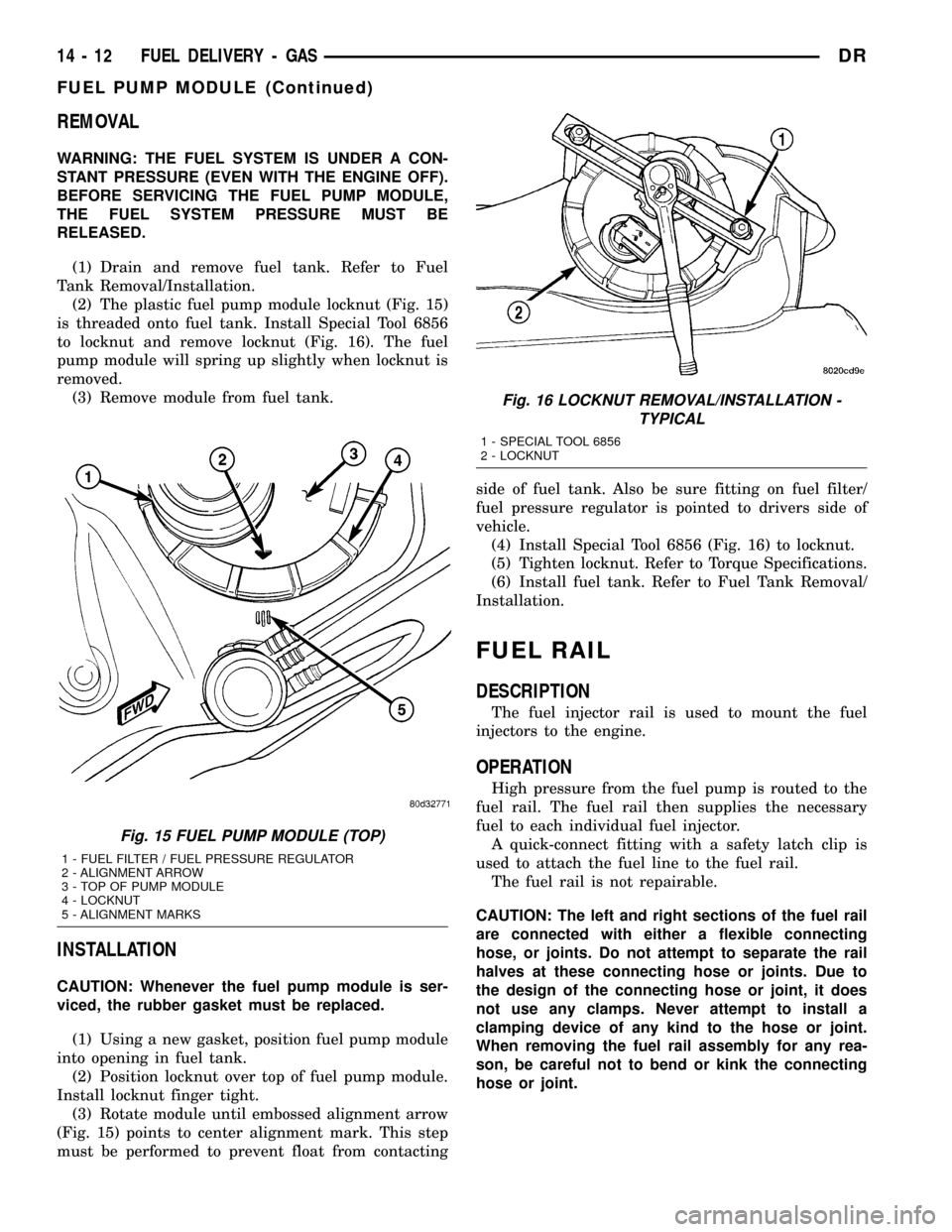
(2) The plastic fuel pump module locknut (Fig. 15)
is threaded onto fuel tank. Install Special Tool 6856
to locknut and remove locknut (Fig. 16). The fuel
pump module will spring up slightly when locknut is
removed.
(3) Remove module from fuel tank.
INSTALLATION
CAUTION: Whenever the fuel pump module is ser-
viced, the rubber gasket must be replaced.
(1) Using a new gasket, position fuel pump module
into opening in fuel tank.
(2) Position locknut over top of fuel pump module.
Install locknut finger tight.
(3) Rotate module until embossed alignment arrow
(Fig. 15) points to center alignment mark. This step
must be performed to prevent float from contactingside of fuel tank. Also be sure fitting on fuel filter/
fuel pressure regulator is pointed to drivers side of
vehicle.
(4) Install Special Tool 6856 (Fig. 16) to locknut.
(5) Tighten locknut. Refer to Torque Specifications.
(6) Install fuel tank. Refer to Fuel Tank Removal/
Installation.
FUEL RAIL
DESCRIPTION
The fuel injector rail is used to mount the fuel
injectors to the engine.
OPERATION
High pressure from the fuel pump is routed to the
fuel rail. The fuel rail then supplies the necessary
fuel to each individual fuel injector.
A quick-connect fitting with a safety latch clip is
used to attach the fuel line to the fuel rail.
The fuel rail is not repairable.
CAUTION: The left and right sections of the fuel rail
are connected with either a flexible connecting
hose, or joints. Do not attempt to separate the rail
halves at these connecting hose or joints. Due to
the design of the connecting hose or joint, it does
not use any clamps. Never attempt to install a
clamping device of any kind to the hose or joint.
When removing the fuel rail assembly for any rea-
son, be careful not to bend or kink the connecting
hose or joint.
Fig. 15 FUEL PUMP MODULE (TOP)
1 - FUEL FILTER / FUEL PRESSURE REGULATOR
2 - ALIGNMENT ARROW
3 - TOP OF PUMP MODULE
4 - LOCKNUT
5 - ALIGNMENT MARKS
Fig. 16 LOCKNUT REMOVAL/INSTALLATION -
TYPICAL
1 - SPECIAL TOOL 6856
2 - LOCKNUT
14 - 12 FUEL DELIVERY - GASDR
FUEL PUMP MODULE (Continued)
Page 1586 of 2627

(15) Install air duct to air box.
(16) Connect battery cable to battery.
(17) Start engine and check for leaks.
5.7L V-8
(1) If fuel injectors are to be installed, refer to Fuel
Injector Removal/Installation.
(2) Clean out fuel injector machined bores in
intake manifold.
(3) Apply a small amount of engine oil to each fuel
injector o-ring. This will help in fuel rail installation.
(4) Position fuel rail/fuel injector assembly to
machined injector openings in intake manifold.
(5) Guide each injector into intake manifold. Be
careful not to tear injector o-rings.
(6) Pushrightside of fuel rail down until fuel
injectors have bottomed on shoulders. Pushleftfuel
rail down until injectors have bottomed on shoulders.
(7) Install 4 fuel rail holdown clamps and 4 mount-
ing bolts. Refer to Torque Specifications.
(8) Position spark plug cable tray and cable assem-
bly to intake manifold. Snap 4 cable tray retaining
clips into intake manifold.
(9) Install all cables to spark plugs and ignition
coils.
(10) Connect electrical connector to throttle body.
(11) Install electrical connectors to all 8 ignition
coils. Refer to Ignition Coil Removal/Installation.
(12) Connect electrical connector to throttle body.
(13) Connect electrical connectors at all fuel injec-
tors. To install connector, refer to (Fig. 17). Push con-
nector onto injector (1) and then push and lock red
colored slider (2). Verify connector is locked to injec-
tor by lightly tugging on connector.
(14) Connect fuel line latch clip and fuel line to
fuel rail. Refer to Quick-Connect Fittings.
(15) Install air resonator to throttle body (2 bolts).
(16) Install flexible air duct to air box.
(17) Connect battery cable to battery.
(18) Start engine and check for leaks.
FUEL TANK
DESCRIPTION
The fuel tank is constructed of a plastic material.
Its main functions are for fuel storage and for place-
ment of the fuel pump module, and (if equipped) cer-
tain ORVR components.
OPERATION
All models pass a full 360 degree rollover test
without fuel leakage. To accomplish this, fuel and
vapor flow controls are required for all fuel tank con-
nections.Two check (control) valves are mounted into the
top of the fuel tank. Refer to Fuel Tank Check Valve
for additional information.
An evaporation control system is connected to the
fuel tank to reduce emissions of fuel vapors into the
atmosphere. When fuel evaporates from the fuel
tank, vapors pass through vent hoses or tubes to a
charcoal canister where they are temporarily held.
When the engine is running, the vapors are drawn
into the intake manifold. Certain models are also
equipped with a self-diagnosing system using a Leak
Detection Pump (LDP) and/or an On-Board Refueling
Vapor Recovery (ORVR) system. Refer to Emission
Control System for additional information.
REMOVAL- EXCEPT DIESEL
Fuel Tank Draining
WARNING: THE FUEL SYSTEM MAY BE UNDER
CONSTANT FUEL PRESSURE EVEN WITH THE
ENGINE OFF. THIS PRESSURE MUST BE
RELEASED BEFORE SERVICING FUEL TANK.
Two different procedures may be used to drain fuel
tank: through the fuel fill fitting on tank, or using
the DRBtscan tool. Due to a one-way check valve
installed into the fuel fill opening fitting at the tank,
the tank cannot be drained conventionally at the fill
cap.
The quickest draining procedure involves removing
the rubber fuel fill hose.
As an alternative procedure, the electric fuel pump
may be activated allowing tank to be drained at fuel
rail connection. Refer to DRB scan tool for fuel pump
activation procedures. Before disconnecting fuel line
at fuel rail, release fuel pressure. Refer to the Fuel
System Pressure Release Procedure for procedures.
Attach end of special test hose tool number 6541,
6539, 6631 or 6923 at fuel rail disconnection (tool
number will depend on model and/or engine applica-
tion). Position opposite end of this hose tool to an
approved gasoline draining station. Activate fuel
pump and drain tank until empty.
If electric fuel pump is not operating, fuel must be
drained through fuel fill fitting at tank. Refer to fol-
lowing procedures.
(1) Release fuel system pressure.
(2) Raise vehicle.
(3) Thoroughly clean area around fuel fill fitting
and rubber fuel fill hose at tank.
(4) If vehicle is equipped with 4 doors and a 6 foot
(short) box, remove left-rear tire/wheel.
(5) Loosen clamp (Fig. 23) and disconnect rubber
fuel fill hose at tank fitting. Using an approved gas
holding tank, drain fuel tank through this fitting.
DRFUEL DELIVERY - GAS 14 - 17
FUEL RAIL (Continued)
Page 1626 of 2627

FUEL LEVEL SENDING UNIT /
SENSOR
DESCRIPTION
The fuel gauge sending unit (fuel level sensor) is
attached to the side of the fuel tank module. The
sending unit consists of a float, an arm, and a vari-
able resistor track (card).
OPERATION
The fuel tank module on diesel powered models
has 2 different circuits (wires). Two of these circuits
are used at the fuel gauge sending unit for fuel
gauge operation. The diesel engine does not have a
fuel tank module mounted electric fuel pump. The
electric fuel pump (fuel transfer pump) is mounted to
the engine.
For Fuel Gauge Operation:A constant input
voltage source of about 12 volts (battery voltage) is
supplied to the resistor track on the fuel gauge send-
ing unit. This is fed directly from the Engine Control
Module (ECM).NOTE: For diagnostic purposes,
this 12V power source can only be verified with
the circuit opened (fuel tank module electrical
connector unplugged). With the connectors
plugged, output voltages will vary from about .6
volts at FULL, to about 7.0 volts at EMPTY.The
resistor track is used to vary the voltage (resistance)
depending on fuel tank float level. As fuel level
increases, the float and arm move up, which
decreases voltage. As fuel level decreases, the float
and arm move down, which increases voltage. The
varied voltage signal is returned back to the ECM
through the sensor return circuit.
Both of the electrical circuits between the fuel
gauge sending unit and the ECM are hard-wired (not
multi-plexed). After the voltage signal is sent from
the resistor track, and back to the ECM, the ECM
will interpret the resistance (voltage) data and send
a message across the multi-plex bus circuits to the
instrument panel cluster. Here it is translated into
the appropriate fuel gauge level reading. Refer to
Instrument Panel for additional information.
REMOVAL
REMOVAL/INSTALLATION
For diesel removal and installation procedures,
refer to the gas section of Fuel System/Fuel Delivery.
See Fuel Level Sending Unit/Sensor Removal/Instal-
lation.
FUEL LINES
DESCRIPTION
Low-Pressure Lines Are:
²the fuel supply line from fuel tank to fuel trans-
fer (lift) pump.
²the fuel return line back to fuel tank.
²the fuel drain (manifold) line at rear of cylinder
head.
²the fuel supply line from fuel filter to fuel injec-
tion pump.
²the fuel injection pump return line.
High-Pressure Lines Are:
²the fuel line from fuel injection pump to fuel
rail.
²the 6 fuel lines from fuel rail up to injector con-
nector tubes
WARNING: HIGH-PRESSURE FUEL LINES DELIVER
DIESEL FUEL UNDER EXTREME PRESSURE FROM
THE INJECTION PUMP TO THE FUEL INJECTORS.
THIS MAY BE AS HIGH AS 160,000 KPA (23,206
PSI). USE EXTREME CAUTION WHEN INSPECTING
FOR HIGH-PRESSURE FUEL LEAKS. INSPECT FOR
HIGH-PRESSURE FUEL LEAKS WITH A SHEET OF
CARDBOARD. HIGH FUEL INJECTION PRESSURE
CAN CAUSE PERSONAL INJURY IF CONTACT IS
MADE WITH THE SKIN.
OPERATION
High-Pressure Lines
CAUTION: The high-pressure fuel lines must be
held securely in place in their holders. The lines
cannot contact each other or other components. Do
not attempt to weld high-pressure fuel lines or to
repair lines that are damaged. If lines are ever
kinked or bent, they must be replaced. Use only the
recommended lines when replacement of high-pres-
sure fuel line is necessary.
High-pressure fuel lines deliver fuel (under pres-
sure) of up to approximately 160,000 kPa (23,206
PSI) from the injection pump to the fuel injectors.
The lines expand and contract from the high-pres-
sure fuel pulses generated during the injection pro-
cess. All high-pressure fuel lines are of the same
length and inside diameter. Correct high-pressure
fuel line usage and installation is critical to smooth
engine operation.
DRFUEL DELIVERY - DIESEL 14 - 57
Page 1631 of 2627
FUEL TANK
DESCRIPTION - DIESEL
The fuel tank is similar to the tank used with gas-
oline powered models. The tank is equipped with a
separate fuel return line and a different fuel tank
module for diesel powered models. A fuel tank
mounted, electric fuel pump is not used with diesel
powered models. Refer to Fuel Tank Module for addi-
tional information.
REMOVAL - DIESEL
Fuel Tank Draining
Due to a one-way check valve installed into the
fuel fill opening fitting at the tank, the tank cannot
be drained conventionally at the fill cap.
(1) Raise vehicle.
(2) If vehicle is equipped with 4 doors and a 6 foot
(short) box, remove left-rear tire/wheel.
(3) Thoroughly clean area at top of fuel tank
around fuel tank module.
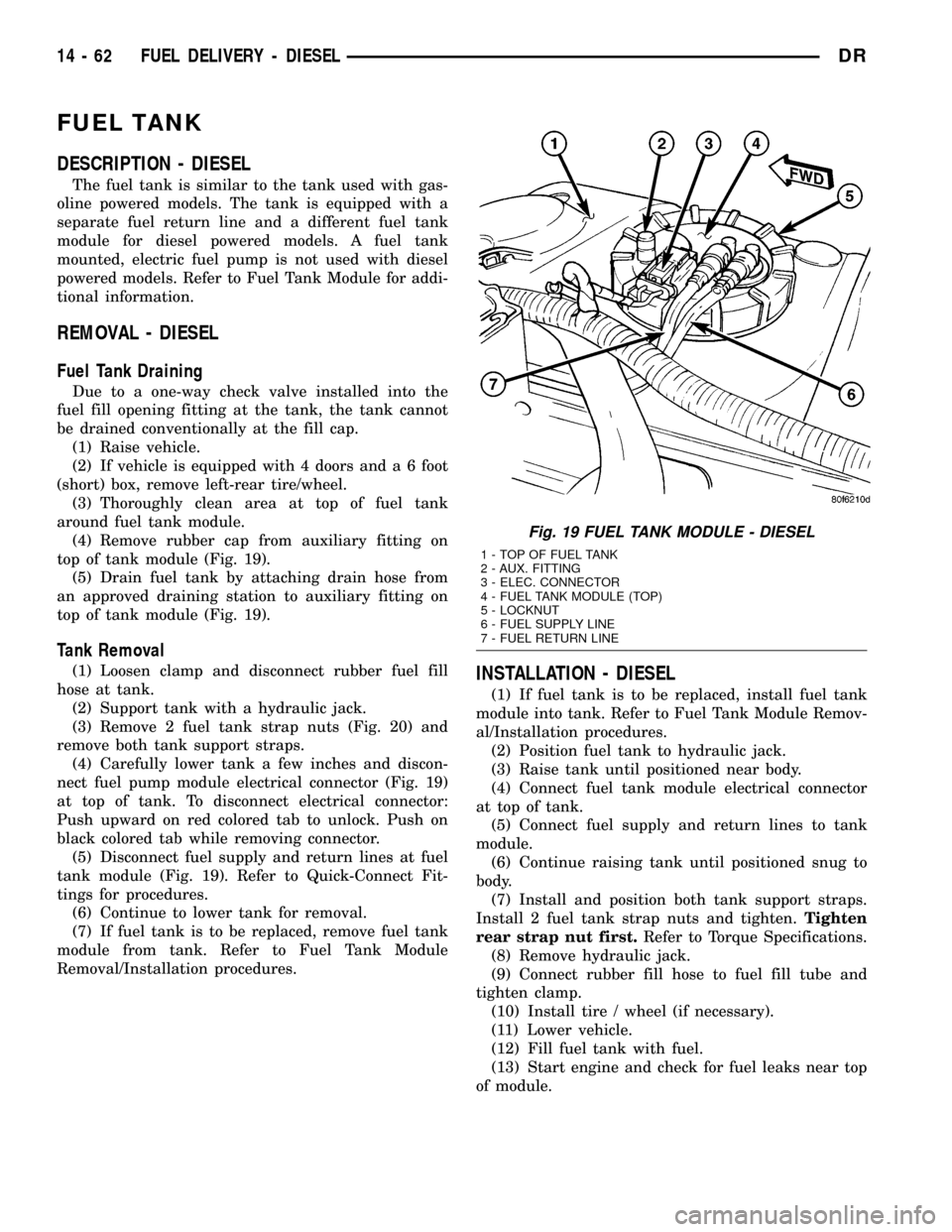
(4) Remove rubber cap from auxiliary fitting on
top of tank module (Fig. 19).
(5) Drain fuel tank by attaching drain hose from
an approved draining station to auxiliary fitting on
top of tank module (Fig. 19).
Tank Removal
(1) Loosen clamp and disconnect rubber fuel fill
hose at tank.
(2) Support tank with a hydraulic jack.
(3) Remove 2 fuel tank strap nuts (Fig. 20) and
remove both tank support straps.
(4) Carefully lower tank a few inches and discon-
nect fuel pump module electrical connector (Fig. 19)
at top of tank. To disconnect electrical connector:
Push upward on red colored tab to unlock. Push on
black colored tab while removing connector.
(5) Disconnect fuel supply and return lines at fuel
tank module (Fig. 19). Refer to Quick-Connect Fit-
tings for procedures.
(6) Continue to lower tank for removal.
(7) If fuel tank is to be replaced, remove fuel tank
module from tank. Refer to Fuel Tank Module
Removal/Installation procedures.INSTALLATION - DIESEL
(1) If fuel tank is to be replaced, install fuel tank
module into tank. Refer to Fuel Tank Module Remov-
al/Installation procedures.
(2) Position fuel tank to hydraulic jack.
(3) Raise tank until positioned near body.
(4) Connect fuel tank module electrical connector
at top of tank.
(5) Connect fuel supply and return lines to tank
module.
(6) Continue raising tank until positioned snug to
body.
(7) Install and position both tank support straps.
Install 2 fuel tank strap nuts and tighten.Tighten
rear strap nut first.Refer to Torque Specifications.
(8) Remove hydraulic jack.
(9) Connect rubber fill hose to fuel fill tube and
tighten clamp.
(10) Install tire / wheel (if necessary).
(11) Lower vehicle.
(12) Fill fuel tank with fuel.
(13) Start engine and check for fuel leaks near top
of module.
Fig. 19 FUEL TANK MODULE - DIESEL
1 - TOP OF FUEL TANK
2 - AUX. FITTING
3 - ELEC. CONNECTOR
4 - FUEL TANK MODULE (TOP)
5 - LOCKNUT
6 - FUEL SUPPLY LINE
7 - FUEL RETURN LINE
14 - 62 FUEL DELIVERY - DIESELDR
Page 1633 of 2627
INSTALLATION
CAUTION: Whenever the fuel tank module is ser-
viced, the rubber gasket must be replaced.
(1) Thoroughly clean locknut and locknut threads
at top of tank.(2) Using new gasket, carefully position fuel tank
module into opening in fuel tank.
(3) Position locknut over top of fuel tank module.
Install locknut finger tight.
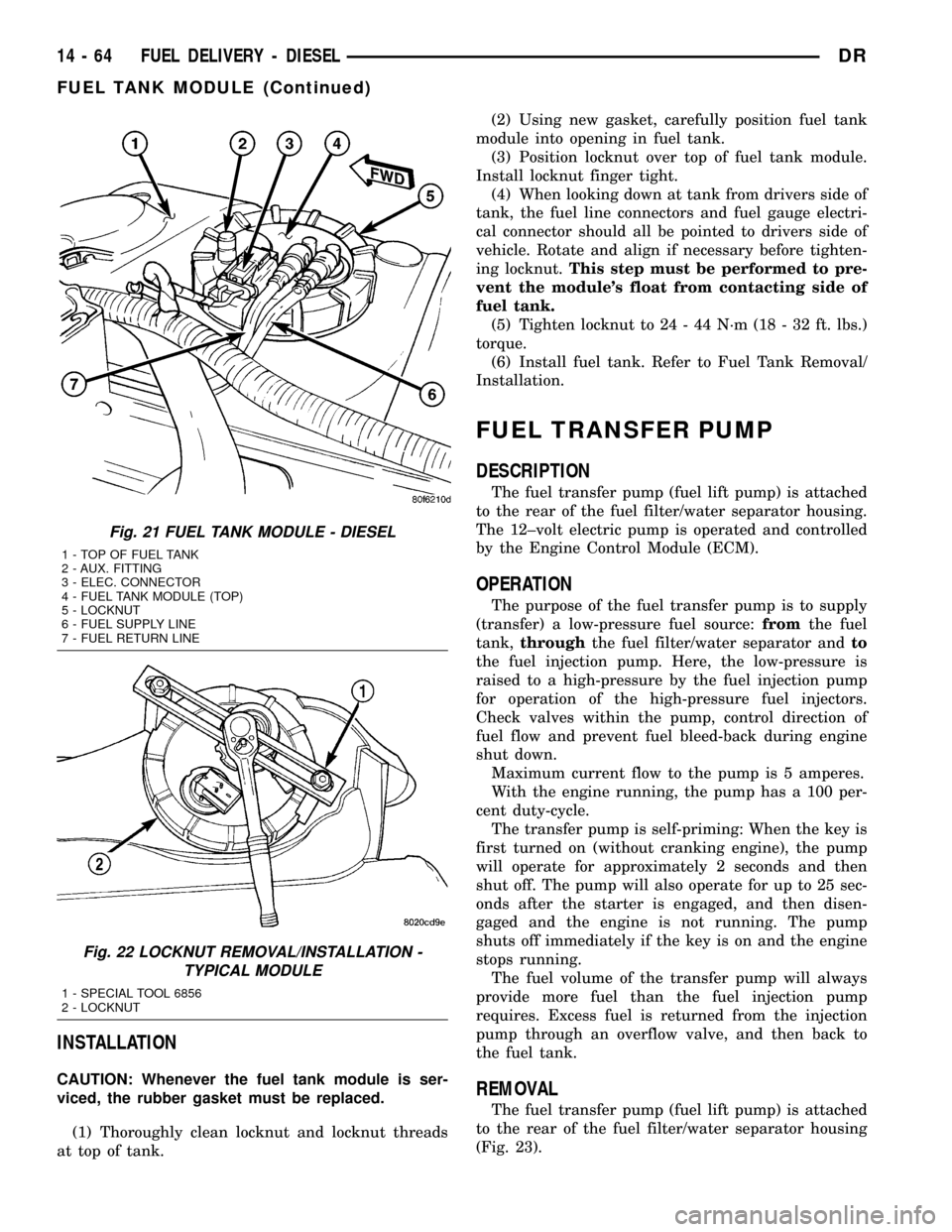
(4) When looking down at tank from drivers side of
tank, the fuel line connectors and fuel gauge electri-
cal connector should all be pointed to drivers side of
vehicle. Rotate and align if necessary before tighten-
ing locknut.This step must be performed to pre-
vent the module's float from contacting side of
fuel tank.
(5) Tighten locknut to 24 - 44 N´m (18 - 32 ft. lbs.)
torque.
(6) Install fuel tank. Refer to Fuel Tank Removal/
Installation.
FUEL TRANSFER PUMP
DESCRIPTION
The fuel transfer pump (fuel lift pump) is attached
to the rear of the fuel filter/water separator housing.
The 12±volt electric pump is operated and controlled
by the Engine Control Module (ECM).
OPERATION
The purpose of the fuel transfer pump is to supply
(transfer) a low-pressure fuel source:fromthe fuel
tank,throughthe fuel filter/water separator andto
the fuel injection pump. Here, the low-pressure is
raised to a high-pressure by the fuel injection pump
for operation of the high-pressure fuel injectors.
Check valves within the pump, control direction of
fuel flow and prevent fuel bleed-back during engine
shut down.
Maximum current flow to the pump is 5 amperes.
With the engine running, the pump has a 100 per-
cent duty-cycle.
The transfer pump is self-priming: When the key is
first turned on (without cranking engine), the pump
will operate for approximately 2 seconds and then
shut off. The pump will also operate for up to 25 sec-
onds after the starter is engaged, and then disen-
gaged and the engine is not running. The pump
shuts off immediately if the key is on and the engine
stops running.
The fuel volume of the transfer pump will always
provide more fuel than the fuel injection pump
requires. Excess fuel is returned from the injection
pump through an overflow valve, and then back to
the fuel tank.
REMOVAL
The fuel transfer pump (fuel lift pump) is attached
to the rear of the fuel filter/water separator housing
(Fig. 23).
Fig. 21 FUEL TANK MODULE - DIESEL
1 - TOP OF FUEL TANK
2 - AUX. FITTING
3 - ELEC. CONNECTOR
4 - FUEL TANK MODULE (TOP)
5 - LOCKNUT
6 - FUEL SUPPLY LINE
7 - FUEL RETURN LINE
Fig. 22 LOCKNUT REMOVAL/INSTALLATION -
TYPICAL MODULE
1 - SPECIAL TOOL 6856
2 - LOCKNUT
14 - 64 FUEL DELIVERY - DIESELDR
FUEL TANK MODULE (Continued)
Page 2619 of 2627

SUPPLEMENTAL RESTRAINTS -
STANDARD PROCEDURE, HANDLING
NON-DEPLOYED......................8O-6
SUPPLIES - DESCRIPTION, 5 VOLT......8E-10
SUPPLIES - OPERATION, 5 VOLT........8E-11
SUPPLY TEST - DIAGNOSIS AND
TESTING, VACUUM....................8P-2
SUPPORT - INSTALLATION, SUN VISOR . . . 23-71
SUPPORT - REMOVAL, SUN VISOR......23-70
SUPPORT BRACKET - INSTALLATION,
REAR VIEW MIRROR.................23-70
SUPPORT BRACKET - INSTALLATION,
STEERING COLUMN OPENING..........23-60
SUPPORT BRACKET - REMOVAL,
STEERING COLUMN OPENING..........23-60
SUPPORT CYLINDER - INSTALLATION....23-48
SUPPORT CYLINDER - INSTALLATION,
LOAD FLOOR........................23-72
SUPPORT CYLINDER - REMOVAL........23-48
SUPPORT CYLINDER - REMOVAL, LOAD
FLOOR.............................23-72
SUPPORT HANDLE/BEZEL -
INSTALLATION, LUMBAR..............23-82
SUPPORT HANDLE/BEZEL - REMOVAL,
LUMBAR...........................23-82
SUPPORT PLATE - INSTALLATION........5-36
SUPPORT PLATE - REMOVAL............5-35
SUPPRESSION GROUND STRAP -
DESCRIPTION, RADIO NOISE............8A-9
SUPPRESSION GROUND STRAP -
INSTALLATION, RADIO NOISE...........8A-10
SUPPRESSION GROUND STRAP -
OPERATION, RADIO NOISE..............8A-9
SUPPRESSION GROUND STRAP -
REMOVAL, RADIO NOISE...............8A-9
SURFACE PREPARATION - STANDARD
PROCEDURE, ENGINE GASKET...........9-10
SURROUND - INSTALLATION,
INSTRUMENT PANEL LOWER...........23-59
SURROUND - REMOVAL, INSTRUMENT
PANEL LOWER......................23-59
SUSPENSION - DESCRIPTION, GEAR -
INDEPENDENT FRONT.................19-17
SUSPENSION - INSTALLATION, GEAR -
INDEPENDENT FRONT.................19-18
SUSPENSION - REMOVAL, GEAR -
INDEPENDENT FRONT.................19-17
SUSPENSION - STANDARD PROCEDURE,
ALIGNMENT LINK/COIL..................2-5
SUSPENSION ARM - INSTALLATION,
LOWER.............................2-38
SUSPENSION ARM - REMOVAL, LOWER . . . 2-38
SUSPENSION, SPECIAL TOOLS - FRONT . . . 2-12
SWITCH - DESCRIPTION................8P-7
SWITCH - DESCRIPTION, BACKUP LAMP . . . 8L-8
SWITCH - DESCRIPTION, BLOWER
MOTOR............................24-20
SWITCH - DESCRIPTION, BRAKE LAMP....8L-9
SWITCH - DESCRIPTION, CLUTCH
PEDAL POSITION.....................6-13
SWITCH - DESCRIPTION, DOOR AJAR....8L-27
SWITCH - DESCRIPTION, DRIVER SEAT . . . 8N-14
SWITCH - DESCRIPTION, HAZARD.......8L-14
SWITCH - DESCRIPTION, HEADLAMP....8L-14
SWITCH - DESCRIPTION, HEATED SEAT . . 8G-11
SWITCH - DESCRIPTION, HORN
..........8H-2
SWITCH - DESCRIPTION, IGNITION
.......19-9
SWITCH - DESCRIPTION, KEY-IN
IGNITION
...........................19-11
SWITCH - DESCRIPTION, LUMBAR
CONTROL
..........................8N-17
SWITCH - DESCRIPTION, PASSENGER
AIRBAG ON/OFF
.....................8O-42
SWITCH - DESCRIPTION, PASSENGER
SEAT
..............................8N-15
SWITCH - DESCRIPTION, POWER
STEERING PRESSURE
.................19-46
SWITCH - DESCRIPTION, PTO
.....14-36,14-85
SWITCH - DESCRIPTION, REAR
WINDOW DEFOGGER
..................8G-4
SWITCH - DESCRIPTION, SEAT BELT
.....8O-51
SWITCH - DESCRIPTION, SELECTOR
....21-510,
21-539,21-574
SWITCH - DESCRIPTION, TOW/HAUL
OVERDRIVE
..................21-261,21-392
SWITCH - DESCRIPTION, WASHER
FLUID LEVEL
.........................8R-9SWITCH - DIAGNOSIS AND TESTING,
BACKUP LAMP.......................8L-8
SWITCH - DIAGNOSIS AND TESTING,
BLOWER MOTOR....................24-20
SWITCH - DIAGNOSIS AND TESTING,
BRAKE LAMP.......................8L-10
SWITCH - DIAGNOSIS AND TESTING,
CLUTCH PEDAL POSITION..............6-13
SWITCH - DIAGNOSIS AND TESTING,
DRIVER SEAT.......................8N-14
SWITCH - DIAGNOSIS AND TESTING,
HEATED SEAT .......................8G-12
SWITCH - DIAGNOSIS AND TESTING,
HORN..............................8H-2
SWITCH - DIAGNOSIS AND TESTING,
IGNITION............................19-9
SWITCH - DIAGNOSIS AND TESTING,
MULTI-FUNCTION....................8L-18
SWITCH - DIAGNOSIS AND TESTING,
PASSENGER SEAT....................8N-16
SWITCH - DIAGNOSIS AND TESTING,
POWER LOCK........................8N-4
SWITCH - DIAGNOSIS AND TESTING,
POWER MIRROR....................8N-12
SWITCH - DIAGNOSIS AND TESTING,
SEAT BELT .........................8O-51
SWITCH - DIAGNOSIS AND TESTING,
WINDOW...........................8N-20
SWITCH - INSTALLATION...............8P-8
SWITCH - INSTALLATION, ADJUSTABLE
PEDAL...............................5-6
SWITCH - INSTALLATION, BRAKE LAMP . . 8L-11
SWITCH - INSTALLATION, DRIVER SEAT . . . 8N-15
SWITCH - INSTALLATION, HEADLAMP....8L-15
SWITCH - INSTALLATION, HEATED SEAT . . 8G-13
SWITCH - INSTALLATION, IGNITION......19-11
SWITCH - INSTALLATION, MULTI-
FUNCTION..........................8L-19
SWITCH - INSTALLATION, OIL
PRESSURE.........................9-294
SWITCH - INSTALLATION, PASSENGER
AIRBAG ON/OFF.....................8O-44
SWITCH - INSTALLATION, PASSENGER
SEAT ..............................8N-16
SWITCH - INSTALLATION, POWER LOCK . . . 8N-4
SWITCH - INSTALLATION, TOW/HAUL
OVERDRIVE..................21-262,21-393
SWITCH - INSTALLATION, WASHER
FLUID LEVEL........................8R-11
SWITCH - INSTALLATION, WINDOW.....8N-21
SWITCH - OPERATION.................8P-7
SWITCH - OPERATION, BACKUP LAMP....8L-8
SWITCH - OPERATION, BLOWER MOTOR . . 24-20
SWITCH - OPERATION, BRAKE LAMP......8L-9
SWITCH - OPERATION, CLUTCH PEDAL
POSITION...........................6-13
SWITCH - OPERATION, DOOR AJAR......8L-27
SWITCH - OPERATION, DRIVER SEAT....8N-14
SWITCH - OPERATION, HAZARD.........8L-14
SWITCH - OPERATION, HEADLAMP......8L-14
SWITCH - OPERATION, HEATED SEAT....8G-12
SWITCH - OPERATION, IGNITION.........19-9
SWITCH - OPERATION, LUMBAR
CONTROL..........................8N-18
SWITCH - OPERATION, PASSENGER
AIRBAG ON/OFF.....................8O-43
SWITCH - OPERATION, PASSENGER
SEAT ..............................8N-15
SWITCH - OPERATION, POWER
STEERING PRESSURE.................19-46
SWITCH - OPERATION, PTO.......14-36,14-85
SWITCH - OPERATION, REAR WINDOW
DEFOGGER..........................8G-4
SWITCH - OPERATION, SEAT BELT.......8O-51
SWITCH - OPERATION, SELECTOR.....21-510,
21-540,21-574
SWITCH - OPERATION, TOW/HAUL
OVERDRIVE..................21-262,21-392
SWITCH - OPERATION, WASHER FLUID
LEVEL..............................8R-9
SWITCH - REMOVAL...................8P-8
SWITCH - REMOVAL, ADJUSTABLE
PEDAL...............................5-6
SWITCH - REMOVAL, BRAKE LAMP
......8L-10
SWITCH - REMOVAL, DRIVER SEAT
......8N-15
SWITCH - REMOVAL, HEADLAMP
........8L-14
SWITCH - REMOVAL, HEATED SEAT
......8G-13
SWITCH - REMOVAL, IGNITION
.........19-10SWITCH - REMOVAL, LUMBAR
CONTROL..........................8N-18
SWITCH - REMOVAL, MULTI-FUNCTION . . . 8L-19
SWITCH - REMOVAL, OIL PRESSURE.....9-294
SWITCH - REMOVAL, PASSENGER
AIRBAG ON/OFF.....................8O-43
SWITCH - REMOVAL, PASSENGER SEAT . . 8N-16
SWITCH - REMOVAL, POWER LOCK......8N-4
SWITCH - REMOVAL, POWER MIRROR . . . 8N-12
SWITCH - REMOVAL, TOW/HAUL
OVERDRIVE..................21-262,21-392
SWITCH - REMOVAL, WASHER FLUID
LEVEL.............................8R-10
SWITCH - REMOVAL, WINDOW.........8N-20
SWITCH AND KEY LOCK CYLINDER -
DIAGNOSIS AND TESTING, IGNITION.....19-11
SWITCH BEZEL - INSTALLATION,
INSTRUMENT PANEL HEADLAMP........23-56
SWITCH BEZEL - REMOVAL,
INSTRUMENT PANEL HEADLAMP........23-56
SWITCH OPERATING MODES,
STANDARD PROCEDURE -
CONFIGURING A NEW MODULE..........8Q-3
SWITCH VALVE - DESCRIPTION,
SOLENOID.........................21-398
SWITCH VALVE - OPERATION, SOLENOID . 21-398
SWITCHES - DESCRIPTION, REMOTE.....8A-10
SWITCHES - DIAGNOSIS AND TESTING,
REMOTE...........................8A-11
SWITCHES - INSTALLATION, REMOTE....8A-12
SWITCHES - OPERATION, REMOTE........8A-11
SWITCHES - REMOVAL, REMOTE........8A-12
SYMBOLS - DESCRIPTION,
INTERNATIONAL....................Intro.-5
TACHOMETER - DESCRIPTION..........8J-38
TACHOMETER - OPERATION............8J-38
TAILGATE - INSTALLATION.............23-17
TAILGATE - REMOVAL.................23-17
TAILGATE MARKER LAMP -
INSTALLATION.......................8L-18
TAILGATE MARKER LAMP - REMOVAL....8L-18
TAILPIPE - 5.9L DIESEL - INSPECTION....11-10
TAILPIPE - 5.9L DIESEL - INSTALLATION . . 11-11
TAILPIPE - 5.9L DIESEL - REMOVAL.....11-10
TAILPIPE - INSPECTION...............11-11
TAILPIPE - INSTALLATION..............11-11
TAILPIPE - REMOVAL.................11-11
TANK - DESCRIPTION, FUEL............14-17
TANK - OPERATION, FUEL..............14-17
TANK MODULE - DESCRIPTION, FUEL....14-63
TANK MODULE - INSTALLATION, FUEL....14-64
TANK MODULE - OPERATION, FUEL......14-63
TANK MODULE - REMOVAL, FUEL.......14-63
TAPPETS - DIAGNOSIS AND TESTING,
HYDRAULIC.........................9-210
TAPPETS - INSTALLATION, HYDRAULIC . . . 9-211
TAPPETS - REMOVAL, HYDRAULIC.......9-211
TASK MANAGER - DESCRIPTION.........25-1
TASK MANAGER - OPERATION...........25-5
TCM QUICK LEARN - STANDARD
PROCEDURE........................8E-23
TEMP INDICATOR - DESCRIPTION,
TRANS.............................8J-40
TEMP INDICATOR - OPERATION, TRANS
. . 8J-40
TEMP SENSOR - DESCRIPTION,
AMBIENT
..........................8M-10
TEMP SENSOR - OPERATION, AMBIENT
. . 8M-10
TEMPERATURE GAUGE - DESCRIPTION,
ENGINE
............................8J-24
TEMPERATURE GAUGE - OPERATION,
ENGINE
............................8J-24
TEMPERATURE SENSOR - DESCRIPTION,
BATTERY
...........................8F-21
TEMPERATURE SENSOR - DESCRIPTION,
ENGINE COOLANT
.....................7-38
TEMPERATURE SENSOR - DESCRIPTION,
EVAPORATOR
.......................24-22
TEMPERATURE SENSOR - DESCRIPTION,
INTAKE AIR
.........................14-30
TEMPERATURE SENSOR - DESCRIPTION,
TRANSMISSION
...............21-267,21-408
TEMPERATURE SENSOR - DIAGNOSIS
AND TESTING, AMBIENT
..............8M-10
TEMPERATURE SENSOR -
INSTALLATION, BATTERY
..............8F-21
TEMPERATURE SENSOR -
INSTALLATION, ENGINE COOLANT
........7-41
32 INDEXDR
Description Group-Page Description Group-Page Description Group-Page