Rear suspension DODGE RAM 1500 1998 2.G Owner's Manual
[x] Cancel search | Manufacturer: DODGE, Model Year: 1998, Model line: RAM 1500, Model: DODGE RAM 1500 1998 2.GPages: 2627
Page 251 of 2627

FLUID RESERVOIR
REMOVAL.............................23
INSTALLATION.........................24
BRAKE JUNCTION BLOCK
REMOVAL.............................24
INSTALLATION.........................24
MASTER CYLINDER
DESCRIPTION.........................24
OPERATION...........................25
DIAGNOSIS AND TESTING - MASTER
CYLINDER/POWER BOOSTER...........25
STANDARD PROCEDURE - MASTER
CYLINDER BLEEDING..................26
REMOVAL
REMOVAL - ALL EXCEPT HYDROBOOST . . . 26
REMOVAL - HYDROBOOST.............26
INSTALLATION
INSTALLATION - ALL EXCEPT
HYDROBOOST.......................27
INSTALLATION - HYDROBOOST..........27
PEDAL
DESCRIPTION.........................28
OPERATION...........................28
REMOVAL.............................28
INSTALLATION.........................28
POWER BRAKE BOOSTER
DESCRIPTION.........................29
OPERATION...........................29
REMOVAL.............................29
INSTALLATION.........................29
HYDRO-BOOST BRAKE BOOSTER
DIAGNOSIS AND TESTING - HYDRAULIC
BOOSTER...........................30
STANDARD PROCEDURE - BLEEDING......31
REMOVAL.............................31
INSTALLATION.........................32
ROTORS
DIAGNOSIS AND TESTING
DISC BRAKE ROTOR..................32
REMOVAL
REMOVAL - FRONT....................33
REMOVAL - REAR.....................34REMOVAL - REAR DUAL WHEELS........34
INSTALLATION
INSTALLATION - FRONT................34
INSTALLATION - REAR.................34
INSTALLATION - REAR DUAL WHEELS....35
SUPPORT PLATE
REMOVAL.............................35
INSTALLATION.........................36
PARKING BRAKE
DESCRIPTION.........................36
OPERATION...........................36
CABLES
REMOVAL
REMOVAL - FRONT PARKING BRAKE
CABLE..............................36
REMOVAL - REAR PARK BRAKE CABLE . . . 37
REMOVAL - RIGHT REAR CABLE.........37
REMOVAL - LEFT REAR CABLE..........38
INSTALLATION
INSTALLATION - FRONT PARKING BRAKE
CABLE..............................38
INSTALLATION - REAR PARK BRAKE
CABLE..............................38
INSTALLATION - RIGHT REAR CABLE.....38
INSTALLATION - LEFT REAR CABLE......39
SHOES
REMOVAL.............................39
CLEANING - REAR DRUM IN HAT BRAKE....39
INSPECTION - REAR DRUM IN HAT BRAKE . . 39
INSTALLATION.........................40
ADJUSTMENTS
ADJUSTMENT - PARKING BRAKE SHOES . . 41
ADJUSTMENT - WITH ADJUSTING TOOL . . . 42
PEDAL
REMOVAL.............................42
INSTALLATION.........................42
CABLE TENSIONER
ADJUSTMENTS
ADJUSTMENT........................43
RELEASE HANDLE
REMOVAL.............................44
INSTALLATION.........................44
BRAKES - BASE
DIAGNOSIS AND TESTING - BASE BRAKE
SYSTEM
Base brake components consist of the brake pads,
calipers, brake drum in hat rotor in the rear, rotors,
brake lines, master cylinder, booster, and parking
brake components.
Brake diagnosis involves determining if the prob-
lem is related to a mechanical, hydraulic, or vacuum
operated component.
The first diagnosis step is the preliminary check.
PRELIMINARY BRAKE CHECK
(1) Check condition of tires and wheels. Damaged
wheels and worn, damaged, or underinflated tires
can cause pull, shudder, vibration, and a condition
similar to grab.
(2) If complaint was based on noise when braking,
check suspension components. Jounce front and rear
of vehicle and listen for noise that might be caused
by loose, worn or damaged suspension or steering
components.
(3) Inspect brake fluid level and condition. Note
that the brake reservoir fluid level will decrease in
proportion to normal lining wear.Also note that
brake fluid tends to darken over time. This is
5 - 2 BRAKES - BASEDR
Page 253 of 2627

²Drum brake shoes binding on worn/damaged
support plates.
²Mis-assembled components.
²Long booster output rod.
If brake drag occurs at all wheels, the problem
may be related to a blocked master cylinder return
port, or faulty power booster (binds-does not release).
BRAKE FADE
Brake fade is usually a product of overheating
caused by brake drag. However, brake overheating
and resulting fade can also be caused by riding the
brake pedal, making repeated high deceleration stops
in a short time span, or constant braking on steep
mountain roads. Refer to the Brake Drag information
in this section for causes.
BRAKE PULL
Front brake pull condition could result from:
²Contaminated lining in one caliper
²Seized caliper piston
²Binding caliper
²Loose caliper
²Rusty caliper slide surfaces
²Improper brake pads
²Damaged rotor
A worn, damaged wheel bearing or suspension
component are further causes of pull. A damaged
front tire (bruised, ply separation) can also cause
pull.
A common and frequently misdiagnosed pull condi-
tion is where direction of pull changes after a few
stops. The cause is a combination of brake drag fol-
lowed by fade at one of the brake units.
As the dragging brake overheats, efficiency is so
reduced that fade occurs. Since the opposite brake
unit is still functioning normally, its braking effect is
magnified. This causes pull to switch direction in
favor of the normally functioning brake unit.
An additional point when diagnosing a change in
pull condition concerns brake cool down. Remember
that pull will return to the original direction, if the
dragging brake unit is allowed to cool down (and is
not seriously damaged).
REAR BRAKE GRAB OR PULL
Rear grab or pull is usually caused by improperly
adjusted or seized parking brake cables, contami-
nated lining, bent or binding shoes and support
plates, or improperly assembled components. This is
particularly true when only one rear wheel is
involved. However, when both rear wheels are
affected, the master cylinder or proportioning valve
could be at fault.BRAKES DO NOT HOLD AFTER DRIVING THROUGH DEEP
WATER PUDDLES
This condition is generally caused by water soaked
lining. If the lining is only wet, it can be dried by
driving with the brakes very lightly applied for a
mile or two. However, if the lining is both soaked and
dirt contaminated, cleaning and/or replacement will
be necessary.
BRAKE LINING CONTAMINATION
Brake lining contamination is mostly a product of
leaking calipers or worn seals, driving through deep
water puddles, or lining that has become covered
with grease and grit during repair. Contaminated lin-
ing should be replaced to avoid further brake prob-
lems.
WHEEL AND TIRE PROBLEMS
Some conditions attributed to brake components
may actually be caused by a wheel or tire problem.
A damaged wheel can cause shudder, vibration and
pull. A worn or damaged tire can also cause pull.
Severely worn tires with very little tread left can
produce a grab-like condition as the tire loses and
recovers traction. Flat-spotted tires can cause vibra-
tion and generate shudder during brake operation. A
tire with internal damage such as a severe bruise,
cut, or ply separation can cause pull and vibration.
BRAKE NOISES
Some brake noise is common with rear drum
brakes and on some disc brakes during the first few
stops after a vehicle has been parked overnight or
stored. This is primarily due to the formation of trace
corrosion (light rust) on metal surfaces. This light
corrosion is typically cleared from the metal surfaces
after a few brake applications causing the noise to
subside.
BRAKE SQUEAK/SQUEAL
Brake squeak or squeal may be due to linings that
are wet or contaminated with brake fluid, grease, or
oil. Glazed linings and rotors with hard spots can
also contribute to squeak. Dirt and foreign material
embedded in the brake lining will also cause squeak/
squeal.
A very loud squeak or squeal is frequently a sign of
severely worn brake lining. If the lining has worn
through to the brake pads in spots, metal-to-metal
contact occurs. If the condition is allowed to continue,
rotors can become so scored that replacement is nec-
essary.
BRAKE CHATTER
Brake chatter is usually caused by loose or worn
components, or glazed/burnt lining. Rotors with hard
spots can also contribute to chatter. Additional causes
5 - 4 BRAKES - BASEDR
BRAKES - BASE (Continued)
Page 254 of 2627

of chatter are out-of-tolerance rotors, brake lining not
securely attached to the shoes, loose wheel bearings
and contaminated brake lining.
THUMP/CLUNK NOISE
Thumping or clunk noises during braking are fre-
quentlynotcaused by brake components. In many
cases, such noises are caused by loose or damaged
steering, suspension, or engine components. However,
calipers that bind on the slide surfaces can generate
a thump or clunk noise.
STANDARD PROCEDURE
STANDARD PROCEDURE - MANUAL BLEEDING
Use Mopar brake fluid, or an equivalent quality
fluid meeting SAE J1703-F and DOT 3 standards
only. Use fresh, clean fluid from a sealed container at
all times.
(1) Remove reservoir filler caps and fill reservoir.
(2) If calipers were overhauled, open all caliper
bleed screws. Then close each bleed screw as fluid
starts to drip from it. Top off master cylinder reser-
voir once more before proceeding.
(3) Attach one end of bleed hose to bleed screw
and insert opposite end in glass container partially
filled with brake fluid (Fig. 1). Be sure end of bleed
hose is immersed in fluid.
NOTE: Bleed procedure should be in this order (1)
Right rear (2) Left rear (3) Right front (4) Left front.(4) Open up bleeder, then have a helper press
down the brake pedal. Once the pedal is down close
the bleeder. Repeat bleeding until fluid stream is
clear and free of bubbles. Then move to the next
wheel.
(5) Before moving the vehicle verify the pedal is
firm and not mushy.
(6) Top off the brake fluid and install the reservoir
cap.
STANDARD PROCEDURE - PRESSURE
BLEEDING
Use Mopar brake fluid, or an equivalent quality
fluid meeting SAE J1703-F and DOT 3 standards
only. Use fresh, clean fluid from a sealed container at
all times.
Follow the manufacturers instructions carefully
when using pressure equipment. Do not exceed the
tank manufacturers pressure recommendations. Gen-
erally, a tank pressure of 15-20 psi is sufficient for
bleeding.
Fill the bleeder tank with recommended fluid and
purge air from the tank lines before bleeding.
Do not pressure bleed without a proper master cyl-
inder adapter. The wrong adapter can lead to leak-
age, or drawing air back into the system.
SPECIAL TOOLS
BASE BRAKES
Fig. 1 Bleed Hose Setup
1 - BLEED HOSE
2 - FLUID CONTAINER PARTIALLY FILLED WITH FLUID
INSTALLER, BRAKE CALIPER DUST BOOT C-4340
INSTALLER, BRAKE CALIPER DUST BOOT
C-3716-A
DRBRAKES - BASE 5 - 5
BRAKES - BASE (Continued)
Page 283 of 2627

REMOVAL - REAR
(1) Raise and support the vehicle
(2) Remove the tire and wheel assembly.
(3) Remove the disc brake caliper, (Refer to 5 -
BRAKES/HYDRAULIC/MECHANICAL/DISC
BRAKE CALIPERS - REMOVAL).
(4) Remove the caliper adapter bolts (Fig.
61).(Refer to 5 - BRAKES/HYDRAULIC/MECHANI-
CAL/DISC BRAKE CALIPER ADAPTER -
REMOVAL)
(5) Remove the retaining clips and rotor assembly
(Fig. 61).
REMOVAL - REAR DUAL WHEELS
(1) Raise and support the vehicle
(2) Remove the tire and wheel assembly.
(3) Remove the disc brake caliper, (Refer to 5 -
BRAKES/HYDRAULIC/MECHANICAL/DISC
BRAKE CALIPERS - REMOVAL).
(4) Remove the caliper adapter bolts.
(5) Remove the rear axle shaft from the housing
on dual rear wheels, (Refer to 3 - DIFFERENTIAL &
DRIVELINE/REAR AXLE - 286RBI/AXLE SHAFTS -
REMOVAL).
(6) Remove the hub and rotor assembly (C3500
only) (Fig. 62).
INSTALLATION
INSTALLATION - FRONT
(1) On models with all-wheel antilock system
(ABS), check condition of tone wheel on hub/bearing.
If teeth on wheel are damaged, hub/bearing assembly
will have to be replaced (tone wheel is not serviced
separately).
(2) Install the rotor onto the hub/bearing wheel
studs.
(3) Install the caliper adapter assembly,(Refer to 5
- BRAKES/HYDRAULIC/MECHANICAL/DISC
BRAKE CALIPERS - INSTALLATION) and tighten
adapter bolts to:
(4) Install the wheel and tire assembly, (Refer to
22 - TIRES/WHEELS/WHEELS - STANDARD PRO-
CEDURE) and lower the vehicle.
(5) Apply the brakes several times to seat brake
pads. Be sure to obtain firm pedal before moving
vehicle.
INSTALLATION - REAR
(1) Install the rotor to the axleshaft (Fig. 61).
Fig. 60 8 LUG ROTOR ASSEMBLY
1 - SPRING
2 - SHOCK
3 - UPPER AND LOWER SUSPENSION ARMS
4 - DISC BRAKE CALIPER
5 - DISC BRAKE CALIPER ADAPTER
6 - ROTOR
Fig. 61 REAR ROTOR
1 - ROTOR
2 - CALIPER ADAPTER
3 - CALIPER
Fig. 62 ROTOR / HUB REMOVAL
5 - 34 BRAKES - BASEDR
ROTORS (Continued)
Page 571 of 2627

(3) Install the bolts attaching headlamp unit to the
fender (Fig. 11).
(4) Align the seal and install the push pins.
(5) Connect the battery negative cable.
ADJUSTMENTS
Headlamps can be aligned using the screen method
provided in this section.
LAMP ALIGNMENT SCREEN PREPARATION
(1) Position vehicle on a level surface perpendicu-
lar to a flat wall 7.62 meters (25 ft) away from front
of headlamp lens (Fig. 12).
(2) If necessary, tape a line on the floor 7.62
meters (25 ft) away from and parallel to the wall.
(3) Up 1.27 meters (5 feet) from the floor, tape a
line on the wall at the centerline of the vehicle. Sight
along the centerline of the vehicle (from rear of vehi-
cle forward) to verify accuracy of the line placement.
(4) Rock vehicle side-to-side three times to allow
suspension to stabilize.
(5) Jounce front suspension three times by pushing
downward on front bumper and releasing.
(6) Measure the distance from the center of head-
lamp lens to the floor. Transfer measurement to thealignment screen (with tape). Use this line for
up/down adjustment reference.
(7) Measure distance from the centerline of the
vehicle to the center of each headlamp being aligned.
Transfer measurements to screen (with tape) to each
side of vehicle centerline. Use these lines for left/
right adjustment reference.
VEHICLE PREPARATION FOR HEADLAMP
ALIGNMENT
(1) Verify headlamp dimmer switch and high beam
indicator operation.
(2) Correct defective components that could hinder
proper headlamp alignment.
(3) Verify proper tire inflation.
(4) Clean headlamp lenses.
(5) Verify that luggage area is not heavily loaded.
(6) Fuel tank should be FULL. Add 2.94 kg (6.5
lbs.) of weight over the fuel tank for each estimated
gallon of missing fuel.
HEADLAMP ALIGNMENT
A properly aimed low beam headlamp will project
top edge of high intensity pattern on screen from 50
mm (2 in.) above to 50 mm (2 in.) below headlamp
Fig. 12 Headlamp Alignment Screen - Typical
1 - CENTER OF VEHICLE
2 - CENTER OF HEADLAMP3 - 7.62 METERS (25 FT.)
4 - FRONT OF HEADLAMP
8L - 16 LAMPS/LIGHTING - EXTERIORDR
HEADLAMP UNIT (Continued)
Page 1547 of 2627

INSTALLATION
(1) Align the holes in the bumpers to the trailer
hitch pins and install the bumper.
(2) Install the support bracket to the hitch bolts,
loosely.
(3) Install the front upper edge to the trailer hitch
bolts and tighten to 54 N´m (40 ft. lbs.).
(4) Install the license plate reinforcement to hitch
bolts and tighten to 54 N´m (40 ft. lbs.).
(5) Tighten the left bumper bracket bolts to 54
N´m (40 ft. lbs.).
(6) Tighten the right bumper bracket bolts to 54
N´m (40 ft. lbs.).
(7) Connect the trailer light connector electrical
connection, if equipped.
(8) Connect the license plate light electrical con-
nectors.
(9) Install the license plate.
FRAME
WARNING
SAFETY PRECAUTIONS AND WARNINGS
WARNING: USE EYE PROTECTION WHEN GRIND-
ING OR WELDING METAL, SERIOUS EYE INJURY
CAN RESULT.
²BEFORE PROCEEDING WITH FRAME REPAIR
INVOLVING GRINDING OR WELDING, VERIFY THAT
VEHICLE FUEL SYSTEM IS NOT LEAKING OR IN
CONTACT WITH REPAIR AREA, PERSONAL INJURY
CAN RESULT.
²DO NOT ALLOW OPEN FLAME OR HEAT AND
METAL SPATTER FROM ARC WELDING, TO CON-
TACT PLASTIC BODY PANELS. FIRE OR EXPLO-
SION CAN RESULT.
²WHEN WELDED FRAME COMPONENTS ARE
REPLACED, ENSURE COMPLETE PENETRATION
WELD IS ACHIEVED DURING INSTALLATION. IF
NOT, DANGEROUS OPERATING CONDITIONS CAN
RESULT.
²STAND CLEAR OF CABLES OR CHAINS ON
PULLING EQUIPMENT DURING FRAME STRAIGHT-
ENING OPERATIONS, PERSONAL INJURY CAN
RESULT.
²DO NOT VENTURE UNDER A HOISTED VEHI-
CLE THAT IS NOT SUPPORTED ON SAFETY
STANDS, PERSONAL INJURY CAN RESULT.
CAUTION: 1500 series Dodge Ram Trucks (2002 and
later) are not designed for snow plow equipment.The front collision repair tips must not be installed
on any truck equipped with a snow plow, or even
intended to be equipped with a snow plow.
CAUTION: Do not reuse damaged fasteners, quality
of repair would be suspect. Failure to use only pro-
duction fasteners or fasteners of equivalent hard-
ness can result in loosening or failure. Do not drill
any holes in the frame that are not specifically out-
lined in this or other, DaimlerChrysler procedure as
frame rail failure can result. When using heat to
straighten frame components do not exceed 566ÉC
(1050ÉF), metal fatigue can result.
STANDARD PROCEDURE
STANDARD PROCEDURE - LIGHT DUTY FRONT
FRAME RAIL TIP REPLACEMENT
CAUTION: This procedure is designed to replace
the front frame rail tips that have been damaged in
the crush initiator zones. Prior to any cutting, the
vehicle must be mounted on the appropriate frame
repair equipment (ªframe rackº), checked with three
dimensional measuring equipment, and the neces-
sary pull corrections made. If damage remains in
the frame beyond the area covered by this service
part after the pull, the frame must be replaced in its
entirety.
NOTE: Procedures for 4X2 and 4X4 are common
except as noted in this procedure.
(1) Before proceding with this repair procedure
review the required service warnings and precau-
tions. (Refer to 13 - FRAME & BUMPERS/FRAME -
WARNING)
(2) Disconnect and isolate the battery negative
cable.
(3) Remove the front wheelhouse splash shield.
(Refer to 23 - BODY/EXTERIOR/FRONT WHEEL-
HOUSE SPLASH SHIELD - REMOVAL)
(4) Remove the bolts and position aside the wire
harness and grounds, if required.
(5) Remove the front bumper. (Refer to 13 -
FRAME & BUMPERS/BUMPERS/FRONT BUMPER
- REMOVAL)
(6) Loosen and lower the stabilizer bar mount and
bar. (Refer to 2 - SUSPENSION/FRONT/STABI-
LIZER BAR - REMOVAL)
13 - 4 FRAMES & BUMPERSDR
REAR BUMPER (Continued)
Page 1558 of 2627
(26) Install the lower shock absorber bolts. (Refer
to 2 - SUSPENSION/REAR/SHOCK - INSTALLA-
TION)
(27) Install the trailer hitch. (Refer to 13 - FRAME
& BUMPERS/FRAME/TRAILER HITCH - INSTAL-
LATION)(28) Install the cargo box. (Refer to 23 - BODY/EX-
TERIOR/CARGO BOX - INSTALLATION)
(29) Reconnect the battery ground.
SPECIFICATIONS
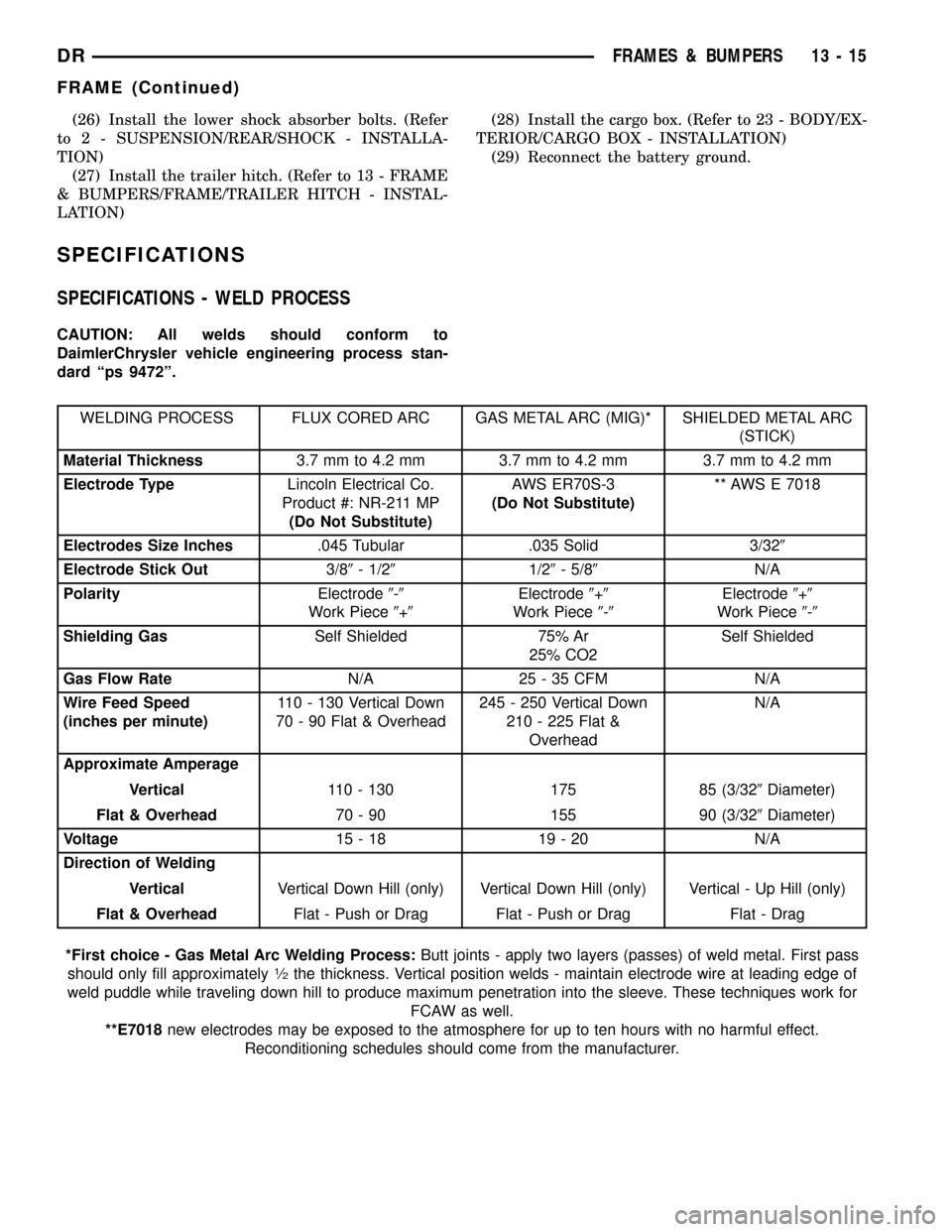
SPECIFICATIONS - WELD PROCESS
CAUTION: All welds should conform to
DaimlerChrysler vehicle engineering process stan-
dard ªps 9472º.
WELDING PROCESS FLUX CORED ARC GAS METAL ARC (MIG)* SHIELDED METAL ARC
(STICK)
Material Thickness3.7 mm to 4.2 mm 3.7 mm to 4.2 mm 3.7 mm to 4.2 mm
Electrode TypeLincoln Electrical Co.
Product #: NR-211 MP
(Do Not Substitute)AWS ER70S-3
(Do Not Substitute)** AWS E 7018
Electrodes Size Inches.045 Tubular .035 Solid 3/329
Electrode Stick Out3/89- 1/291/29- 5/89N/A
PolarityElectrode9-9
Work Piece9+9Electrode9+9
Work Piece9-9Electrode9+9
Work Piece9-9
Shielding GasSelf Shielded 75% Ar
25% CO2Self Shielded
Gas Flow RateN/A 25 - 35 CFM N/A
Wire Feed Speed
(inches per minute)110 - 130 Vertical Down
70 - 90 Flat & Overhead245 - 250 Vertical Down
210 - 225 Flat &
OverheadN/A
Approximate Amperage
Vertical110 - 130 175 85 (3/329Diameter)
Flat & Overhead70 - 90 155 90 (3/329Diameter)
Voltage15-18 19-20 N/A
Direction of Welding
VerticalVertical Down Hill (only) Vertical Down Hill (only) Vertical - Up Hill (only)
Flat & OverheadFlat - Push or Drag Flat - Push or Drag Flat - Drag
*First choice - Gas Metal Arc Welding Process:Butt joints - apply two layers (passes) of weld metal. First pass
should only fill approximately
1¤2the thickness. Vertical position welds - maintain electrode wire at leading edge of
weld puddle while traveling down hill to produce maximum penetration into the sleeve. These techniques work for
FCAW as well.
**E7018new electrodes may be exposed to the atmosphere for up to ten hours with no harmful effect.
Reconditioning schedules should come from the manufacturer.
DRFRAMES & BUMPERS 13 - 15
FRAME (Continued)
Page 1674 of 2627
SPECIFICATIONS
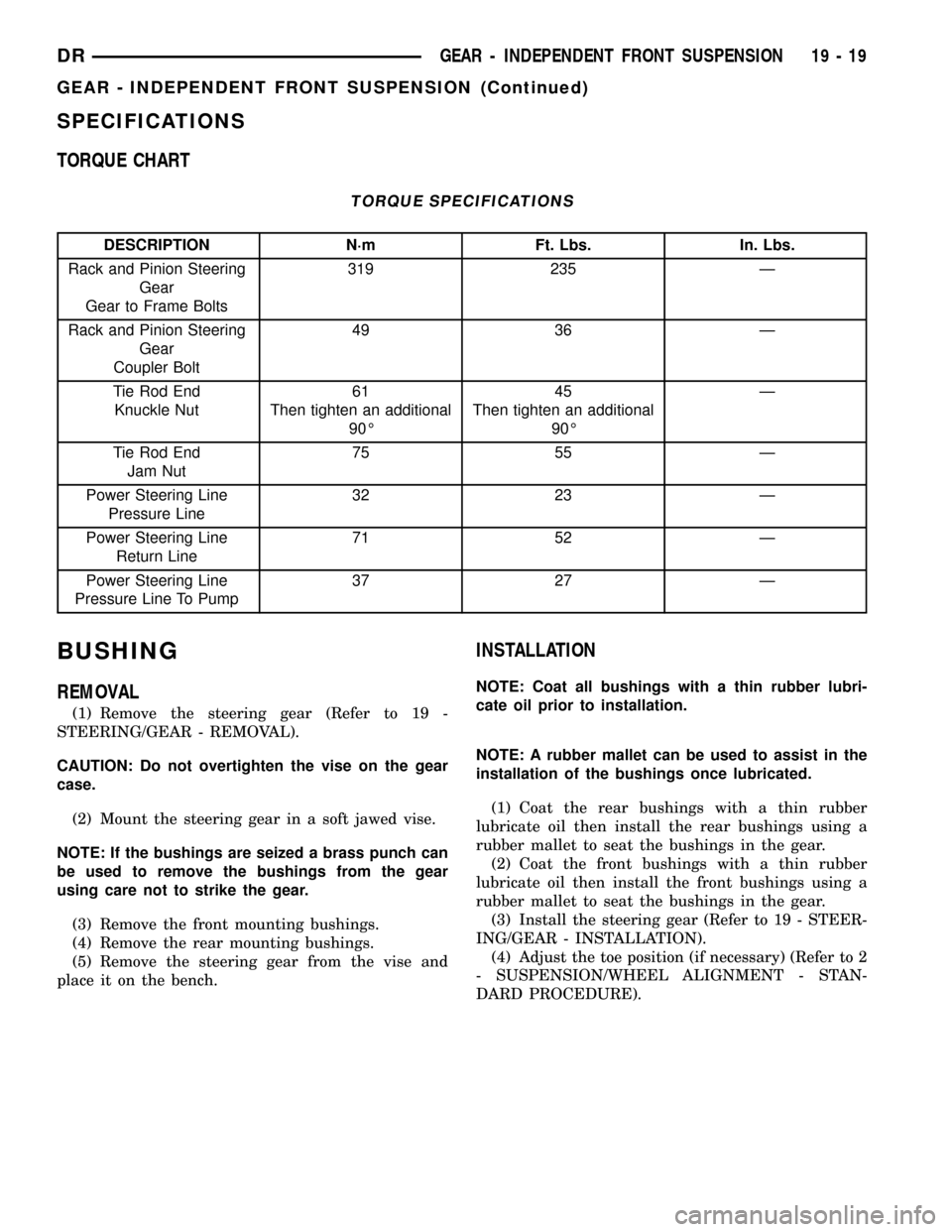
TORQUE CHART
TORQUE SPECIFICATIONS
DESCRIPTION N´m Ft. Lbs. In. Lbs.
Rack and Pinion Steering
Gear
Gear to Frame Bolts319 235 Ð
Rack and Pinion Steering
Gear
Coupler Bolt49 36 Ð
Tie Rod End
Knuckle Nut61
Then tighten an additional
90É45
Then tighten an additional
90ÉÐ
Tie Rod End
Jam Nut75 55 Ð
Power Steering Line
Pressure Line32 23 Ð
Power Steering Line
Return Line71 52 Ð
Power Steering Line
Pressure Line To Pump37 27 Ð
BUSHING
REMOVAL
(1) Remove the steering gear (Refer to 19 -
STEERING/GEAR - REMOVAL).
CAUTION: Do not overtighten the vise on the gear
case.
(2) Mount the steering gear in a soft jawed vise.
NOTE: If the bushings are seized a brass punch can
be used to remove the bushings from the gear
using care not to strike the gear.
(3) Remove the front mounting bushings.
(4) Remove the rear mounting bushings.
(5) Remove the steering gear from the vise and
place it on the bench.
INSTALLATION
NOTE: Coat all bushings with a thin rubber lubri-
cate oil prior to installation.
NOTE: A rubber mallet can be used to assist in the
installation of the bushings once lubricated.
(1) Coat the rear bushings with a thin rubber
lubricate oil then install the rear bushings using a
rubber mallet to seat the bushings in the gear.
(2) Coat the front bushings with a thin rubber
lubricate oil then install the front bushings using a
rubber mallet to seat the bushings in the gear.
(3) Install the steering gear (Refer to 19 - STEER-
ING/GEAR - INSTALLATION).
(4) Adjust the toe position (if necessary) (Refer to 2
- SUSPENSION/WHEEL ALIGNMENT - STAN-
DARD PROCEDURE).
DRGEAR - INDEPENDENT FRONT SUSPENSION 19 - 19
GEAR - INDEPENDENT FRONT SUSPENSION (Continued)
Page 1742 of 2627

INSTALLATION
NOTE: If a new transmission is being installed, use
all components supplied with the new transmission.
For example, if a new shift tower is supplied, do not
re-use the original shift tower.
(1) Clean transmission front housing mounting
surface.
(2) Apply light coat of Mopar high temperature
bearing grease or equivalent to contact surfaces (Fig.
126) of following components:
²release fork ball stud.
²release bearing slide surface.
²input shaft splines.
²release bearing bore.
²propeller shaft slip yoke.
(3) Support and secure transmission to jack.
(4) Raise and align transmission input shaft with
clutch disc, then slide transmission into place.
(5) Verify front housing is fully seated. Install
transmission bolts without washers and tighten bolts
into the engine to 41 N´m (30 ft. lbs.). Tighten the
bolts with washers into the transmission to 68 N´m
(50 ft. lbs.) (Fig. 127).(6) Install rear crossmember and tighten nuts to
102 N´m (75 ft. lbs.).
(7) Install transmission rear mounting bolts and
tighten to 68 N´m (50 ft. lbs.).
(8) Install front dust shield tighten bolt to 4.5 N´m
(40 in. lbs.). If cover was removed, install onto the
transmission and engine(Refer to 9 - ENGINE/EN-
GINE BLOCK/STRUCTURAL COVER - INSTALLA-
TION).
(9) Install structural dust cover and tighten the
bolts to 54 N´m (40 ft. lbs.).
(10) Install starter motor.
(11) Install suspension crossmember and tighten
nuts to 102 N´m (75 ft. lbs.).
(12) Connect transmission harnesses to clips on
case and connect switches.
(13) Install slave cylinder and tighten cylinder
nuts to 23 N´m (200 in. lbs.).
(14) Install transfer case and transfer case linkage
if equipped.
(15) Remove transmission jack.
(16) Install propeller shaft/shafts with reference
marks aligned.
(17) Install exhaust on the exhaust manifolds.
(18) Fill transmission with lubricant. Correct fill
level is to bottom edge of fill plug hole.
Fig. 126 LUBRICATION POINTS
1 - RELEASE FORK
2 - FORK BALL STUD
3 - BEARING SLIDE SURFACE
4 - SPLINE
5 - RELEASE BEAING
Fig. 127 TRANSMISSION
1 - BOLT WITHOUT WASHER
2 - BOLT WITH WASHER
DRMANUAL TRANSMISSION - NV3500 21 - 39
MANUAL TRANSMISSION - NV3500 (Continued)
Page 2589 of 2627

AIRBAG INDICATOR - OPERATION.......8J-18
AIRBAG ON/OFF SWITCH -
DESCRIPTION, PASSENGER............8O-42
AIRBAG ON/OFF SWITCH -
INSTALLATION, PASSENGER...........8O-44
AIRBAG ON/OFF SWITCH - OPERATION,
PASSENGER........................8O-43
AIRBAG ON/OFF SWITCH - REMOVAL,
PASSENGER........................8O-43
AJAR INDICATOR - DESCRIPTION, DOOR . . 8J-23
AJAR INDICATOR - OPERATION, DOOR . . . 8J-23
AJAR SWITCH - DESCRIPTION, DOOR....8L-27
AJAR SWITCH - OPERATION, DOOR......8L-27
ALIGNMENT - DESCRIPTION, WHEEL.......2-1
ALIGNMENT - OPERATION, WHEEL........2-2
ALIGNMENT LINK/COIL SUSPENSION -
STANDARD PROCEDURE.................2-5
ALIGNMENT, SPECIAL TOOLS - WHEEL.....2-7
ALIGNMENT, SPECIFICATIONS............2-6
ALUMINUM THREAD REPAIR -
STANDARD PROCEDURE........21-158,21-318
AMBIENT TEMP SENSOR - DESCRIPTION . 8M-10
AMBIENT TEMP SENSOR - OPERATION . . 8M-10
AMBIENT TEMPERATURE SENSOR -
DIAGNOSIS AND TESTING.............8M-10
AMBIENT TEMPERATURE SENSOR
CIRCUIT - DIAGNOSIS AND TESTING....8M-10
AMPLIFIER - DESCRIPTION.............8A-3
AMPLIFIER - INSTALLATION.............8A-4
AMPLIFIER - OPERATION...............8A-3
AMPLIFIER - REMOVAL................8A-3
ANCHOR - DESCRIPTION, CHILD
RESTRAINT.........................8O-15
ANCHOR - INSTALLATION, CHILD
RESTRAINT.........................8O-18
ANCHOR - OPERATION, CHILD
RESTRAINT.........................8O-17
ANCHOR - REMOVAL, CHILD RESTRAINT . 8O-17
ANCHOR & RIGHT OUTBOARD -
INSTALLATION, CENTER...............8O-50
ANCHOR & RIGHT OUTBOARD -
REMOVAL, CENTER...................8O-49
ANTENNA - NAVIGATION -
INSTALLATION.......................8A-6
ANTENNA - NAVIGATION - REMOVAL......8A-6
ANTENNA BODY & CABLE -
DESCRIPTION........................8A-4
ANTENNA BODY & CABLE -
INSTALLATION.......................8A-6
ANTENNA BODY & CABLE - OPERATION . . . 8A-4
ANTENNA BODY & CABLE - REMOVAL.....8A-6
ANTENNA BODY AND CABLE -
DIAGNOSIS AND TESTING..............8A-4
ANTENNA CABLE - INSTALLATION,
INSTRUMENT PANEL..................8A-7
ANTENNA CABLE - REMOVAL,
INSTRUMENT PANEL..................8A-7
ANTILOCK - DIAGNOSIS AND TESTING,
REAR WHEEL........................5-48
ANTILOCK BRAKE - DESCRIPTION,
CONTROLLER........................8E-3
ANTILOCK BRAKE - INSTALLATION,
CONTROLLER
........................8E-3
ANTILOCK BRAKE - OPERATION,
CONTROLLER
........................8E-3
ANTILOCK BRAKE - REMOVAL,
CONTROLLER
........................8E-3
A-PILLAR TRIM/GRAB HANDLE -
INSTALLATION
.......................23-63
A-PILLAR TRIM/GRAB HANDLE -
REMOVAL
..........................23-63
A-PILLAR WEATHERSTRIP RETAINER -
INSTALLATION
.......................23-91
A-PILLAR WEATHERSTRIP RETAINER -
REMOVAL
..........................23-91
AREA LEAKS - DIAGNOSIS AND
TESTING, REAR SEAL
........9-137,9-209,9-65
ARM / ADJUSTER ASSEMBLY -
DESCRIPTION, ROCKER
...............9-125
ARM / ADJUSTER ASSEMBLY -
INSTALLATION, ROCKER
...............9-126
ARM / ADJUSTER ASSEMBLY -
REMOVAL, ROCKER
..................9-126
ARM / ADJUSTER ASSY - CLEANING,
ROCKER
............................9-262
ARM / ADJUSTER ASSY - DESCRIPTION,
ROCKER
............................9-261ARM / ADJUSTER ASSY - INSPECTION,
ROCKER............................9-262
ARM / ADJUSTER ASSY -
INSTALLATION, ROCKER..........9-203,9-263
ARM / ADJUSTER ASSY - REMOVAL,
ROCKER......................9-203,9-261
ARM - DESCRIPTION, ROCKER......9-31,9-37
ARM - DESCRIPTION, WIPER...........8R-17
ARM - INSTALLATION, LOWER
SUSPENSION.........................2-38
ARM - INSTALLATION, PITMAN.........19-37
ARM - INSTALLATION, ROCKER..........9-31
ARM - INSTALLATION, UPPER CONTROL . . . 2-28
ARM - INSTALLATION, WIPER..........8R-18
ARM - OPERATION, WIPER............8R-18
ARM - REMOVAL, LOWER SUSPENSION . . . 2-38
ARM - REMOVAL, PITMAN.............19-36
ARM - REMOVAL, ROCKER..........9-31,9-37
ARM - REMOVAL, UPPER CONTROL......2-28
ARM - REMOVAL, WIPER..............8R-18
ARM BUSHINGS - 2WD (LD) -
INSTALLATION, LOWER CONTROL........2-15
ARM BUSHINGS - 2WD (LD) -
REMOVAL, LOWER CONTROL............2-13
ARM BUSHINGS - 4WD (LD) -
INSTALLATION, LOWER CONTROL........2-14
ARM BUSHINGS - 4WD (LD) -
REMOVAL, LOWER CONTROL............2-13
ARMREST / SEAT BACK - INSTALLATION,
CENTER.............................23-77
ARMREST / SEAT BACK - REMOVAL,
CENTER............................23-76
ASD AND FUEL PUMP RELAYS -
DIAGNOSIS AND TESTING...............8I-5
ASD SENSE - PCM INPUT - OPERATION....8I-5
ASH RECEIVER - INSTALLATION.........23-51
ASH RECEIVER - REMOVAL............23-50
AUDIO - DESCRIPTION.................8A-1
AUDIO - DIAGNOSIS AND TESTING.......8A-2
AUDIO - OPERATION...................8A-1
AUTOMATIC DAY / NIGHT MIRROR -
DESCRIPTION.......................8N-11
AUTOMATIC DAY / NIGHT MIRROR -
DIAGNOSIS AND TESTING.............8N-11
AUTOMATIC DAY / NIGHT MIRROR -
OPERATION.........................8N-11
AUTOMATIC DAY / NIGHT MIRROR -
REMOVAL..........................8N-12
AUTOMATIC LOCKING RETRACTOR -
DESCRIPTION.......................8O-14
AUTOMATIC LOCKING RETRACTOR -
OPERATION.........................8O-14
AUTOMATIC TRANSMISSION -
45RFE/545RFE - DESCRIPTION.........21-312
AUTOMATIC TRANSMISSION -
45RFE/545RFE - OPERATION...........21-313
AUTOMATIC TRANSMISSION - 48RE -
DESCRIPTION......................21-132
AUTOMATIC TRANSMISSION - 48RE -
OPERATION........................21-134
AUTOMATIC TRANSMISSION -
DIAGNOSIS AND TESTING......21-140,21-314
AUTOMATIC TRANSMISSION FLUID -
DESCRIPTION.........................0-4
AUTOMATIC TRANSMISSION FLUID -
OPERATION...........................0-5
AUXILIARY SPRING BUMPERS (3500) -
INSTALLATION........................2-43
AUXILIARY SPRING BUMPERS (3500) -
REMOVAL...........................2-43
AXLE - 10 1/2 AA - ADJUSTMENTS,
REAR..............................3-116
AXLE - 10 1/2 AA - DIAGNOSIS AND
TESTING, REAR......................3-112
AXLE - 10 1/2 AA - INSTALLATION,
REAR..............................3-116
AXLE - 10 1/2 AA - REMOVAL, REAR.....3-115
AXLE - 10 1/2 AA - SPECIAL TOOLS,
REAR..............................3-120
AXLE - 10 1/2 AA - SPECIFICATIONS,
REAR
..............................3-120
AXLE - 11 1/2 AA - ADJUSTMENTS,
REAR
..............................3-144
AXLE - 11 1/2 AA - DIAGNOSIS AND
TESTING, REAR
......................3-140
AXLE - 11 1/2 AA - INSTALLATION,
REAR
..............................3-144
AXLE - 11 1/2 AA - REMOVAL, REAR
.....3-143AXLE - 11 1/2 AA - SPECIAL TOOLS,
REAR..............................3-148
AXLE - 11 1/2 AA - SPECIFICATIONS,
REAR..............................3-148
AXLE - 9 1/4 - ADJUSTMENTS, REAR.....3-83
AXLE - 9 1/4 - DIAGNOSIS AND
TESTING, REAR.......................3-80
AXLE - 9 1/4 - INSTALLATION, REAR......3-83
AXLE - 9 1/4 - REMOVAL, REAR..........3-83
AXLE - 9 1/4 - SPECIAL TOOLS, REAR.....3-90
AXLE - 9 1/4 - SPECIFICATIONS, REAR....3-90
AXLE - 9 1/4 AA - ADJUSTMENTS,
FRONT..............................3-59
AXLE - 9 1/4 AA - DIAGNOSIS AND
TESTING, FRONT......................3-54
AXLE - 9 1/4 AA - INSTALLATION,
FRONT..............................3-58
AXLE - 9 1/4 AA - REMOVAL, FRONT......3-57
AXLE - 9 1/4 AA - SPECIAL TOOLS,
FRONT..............................3-64
AXLE - 9 1/4 AA - SPECIFICATIONS,
FRONT..............................3-63
AXLE - C205F - ADJUSTMENTS, FRONT....3-32
AXLE - C205F - DIAGNOSIS AND
TESTING, FRONT......................3-27
AXLE - C205F - INSTALLATION, FRONT....3-31
AXLE - C205F - REMOVAL, FRONT........3-31
AXLE - C205F - SPECIAL TOOLS, FRONT . . . 3-40
AXLE - C205F - SPECIFICATIONS, FRONT . . . 3-39
AXLE - DESCRIPTION.....................0-4
AXLE BEARINGS - INSTALLATION . . 3-125,3-153,
3-44,3-95
AXLE BEARINGS - REMOVAL . . 3-125,3-152,3-43,
3-95
AXLE SHAFT SEALS - INSTALLATION . 3-43,3-70,
3-94
AXLE SHAFT SEALS - REMOVAL . 3-43,3-69,3-94
AXLE SHAFTS - ASSEMBLY.............3-69
AXLE SHAFTS - DISASSEMBLY...........3-68
AXLE SHAFTS - INSTALLATION....3-124,3-152,
3-43,3-69,3-94
AXLE SHAFTS - REMOVAL....3-124,3-152,3-43,
3-67,3-93
BACK - INSTALLATION, CENTER
ARMREST / SEAT....................23-77
BACK - REAR - INSTALLATION, SEAT.....23-83
BACK - REAR - REMOVAL, SEAT........23-83
BACK - REMOVAL, CENTER ARMREST /
SEAT ..............................23-76
BACK CUSHION / COVER - FRONT -
INSTALLATION, SEAT.................23-82
BACK CUSHION / COVER - FRONT -
REMOVAL, SEAT.....................23-82
BACK CUSHION / COVER - REAR -
INSTALLATION, SEAT.................23-84
BACK CUSHION / COVER - REAR -
REMOVAL, SEAT.....................23-84
BACK HINGE - INSTALLATION, CENTER
SEAT ..............................23-79
BACK HINGE - REMOVAL, CENTER SEAT . . 23-78
BACK INERTIA HINGE COVER -
INSTALLATION, CENTER SEAT..........23-77
BACK INERTIA HINGE COVER -
REMOVAL, CENTER SEAT..............23-77
BACK LID - INSTALLATION, CENTER
SEAT ..............................23-79
BACK LID - REMOVAL, CENTER SEAT....23-79
BACK PANEL TRIM - INSTALLATION,
REAR CAB..........................23-69
BACK PANEL TRIM - REMOVAL, REAR
CAB
...............................23-68
BACK REAR - FOOTMANS LOOP
BRACKETS - INSTALLATION, SEAT
.......23-85
BACK REAR - FOOTMANS LOOP
BRACKETS - REMOVAL, SEAT
...........23-85
BACKLITE - INSTALLATION
.............23-86
BACKLITE - REMOVAL
.................23-86
BACKLITE VENT GLASS - INSTALLATION
. . 23-87
BACKLITE VENT GLASS - REMOVAL
......23-87
BACKUP LAMP SWITCH - DESCRIPTION
. . . 8L-8
BACKUP LAMP SWITCH - DIAGNOSIS
AND TESTING
........................8L-8
BACKUP LAMP SWITCH - OPERATION
.....8L-8
BALANCE - STANDARD PROCEDURE,
TIRE AND WHEEL
.....................22-4
BALANCE SHAFT - INSTALLATION
........9-80
BALANCE SHAFT - REMOVAL
............9-80
2 INDEXDR
Description Group-Page Description Group-Page Description Group-Page