Body DODGE RAM 1500 1998 2.G Workshop Manual
[x] Cancel search | Manufacturer: DODGE, Model Year: 1998, Model line: RAM 1500, Model: DODGE RAM 1500 1998 2.GPages: 2627
Page 2304 of 2627

(7) Drill 3 mm (0.125 in.) holes in the support
squares 13 mm (0.5 in.) from the edge in the center
of one side.
(8) Scuff the backside of the body panel around the
cutout hole with a scuff pad or sandpaper.
(9) Mix enough adhesive to cover one side of all
support squares.
(10) Apply adhesive to cover one side of all support
squares.
(11) Using number 8 sheet metal screws, secure
support squares to back side of body panel with
adhesive sandwiched between the panel and squares
(Fig. 9).
(12) Position patch in cutout against support
squares and adjust patch until the gap is equal along
all sides (Fig. 10).
(13) Drill 3 mm (0.125 in.) holes in the support
squares through the pre-drilled holes in the patch.
(14) Apply a coat of adhesive to the exposed ends
of the support squares (Fig. 11).
(15) Install screws to hold the patch to support
squares (Fig. 12). Tighten screws until patch surface
is flush with panel surface.
(16) Allow adhesive to cure, and remove all screws.
(17) Using a 125 mm (5 in.) 24 grit disc grinder,
grind a 50 mm (2 in.) to 75 mm (3 in.) wide and 2
mm (0.080 in.) deep path across the gaps around the
patch (Fig. 13). With compressed air, blow dust from
around patch.(18) Apply adhesive backed nylon mesh (dry wall
tape) over gaps around patch (Fig. 14).
(19) Mix enough adhesive to cover the entire patch
area.
(20) Apply adhesive over the mesh around patch,
and smooth epoxy with a wide spreader to reduce fin-
ish grinding. Use two to three layers of mesh and
adhesive to create a stronger repair (Fig. 15).
Fig. 9 SECURE SUPPORT SQUARES TO BODY
PANEL
1 - SUPPORT SQUARES
2 - SCREWS
3 - DAMAGED BODY PANEL
Fig. 10 POSITION PATCH IN CUTOUT AND ALIGN
1 - CUTOUT
2 - SUPPORT SQUARES
Fig. 11 APPLY ADHESIVE TO SUPPORT SQUARES
1 - APPLICATOR
2 - SUPPORT SQUARES
3 - ADHESIVE
DRBODY 23 - 9
BODY (Continued)
Page 2305 of 2627

PATCHED PANEL SURFACING
After patch panel is installed, the patch area can
be finished using the same methods as finishing
other types of body panels. If mesh material is
exposed in the patched area, grind surface down, and
apply a coat of high quality rigid plastic body filler.
Prime, block sand, and paint as required.
Fig. 12 INSTALL SCREWS
1 - PATCH
2 - GAP
Fig. 13 GRIND SURFACE
1 - PATCH
2 - GAP
3 - DISC GRINDER
Fig. 14 COVER GAPS WITH MESH
1 - GROUND DOWN AREA
2 - PATCH
3 - MESH
Fig. 15 COVER MESH WITH ADHESIVE
1 - ADHESIVE
2 - MESH
3 - PATCH
4 - SPREADER
23 - 10 BODYDR
BODY (Continued)
Page 2306 of 2627
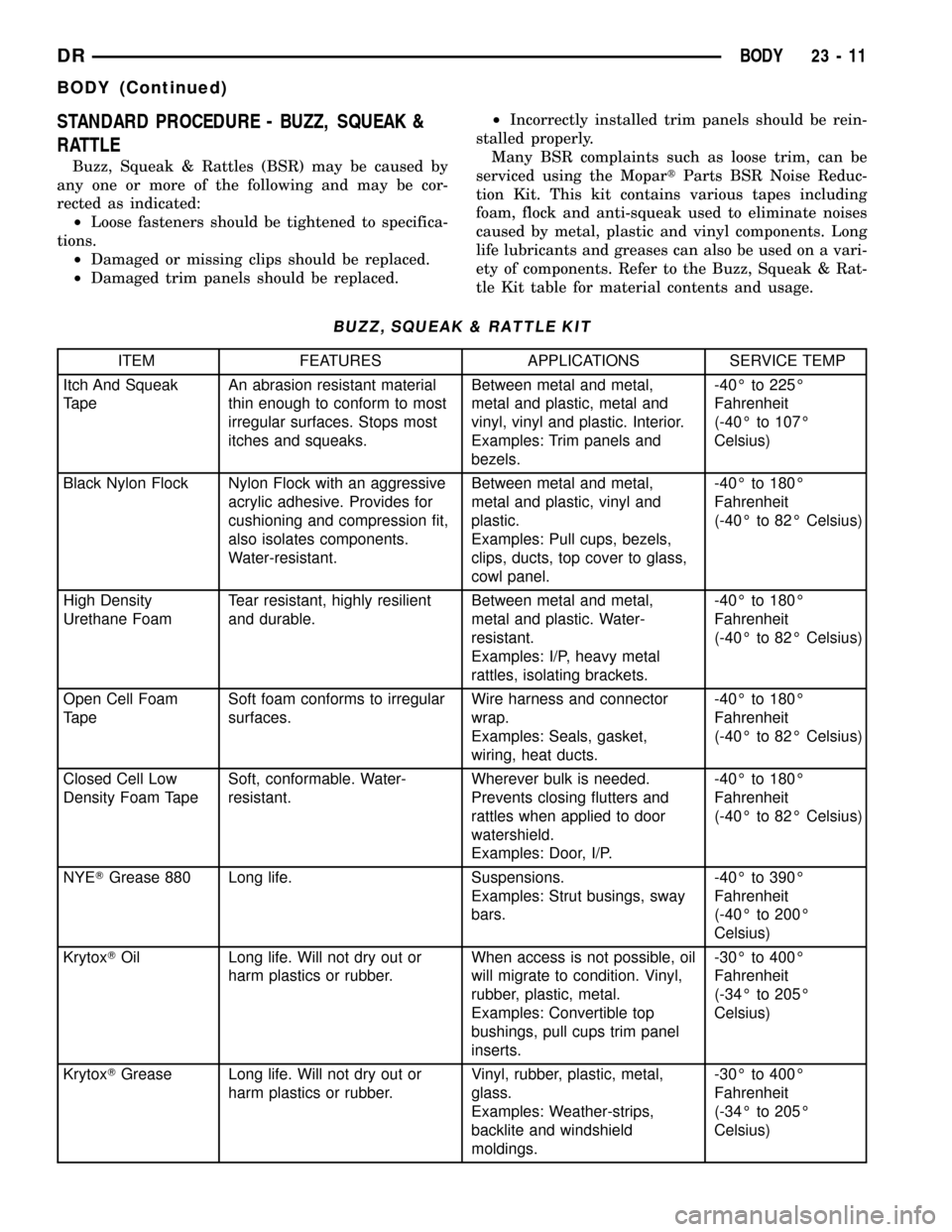
STANDARD PROCEDURE - BUZZ, SQUEAK &
RATTLE
Buzz, Squeak & Rattles (BSR) may be caused by
any one or more of the following and may be cor-
rected as indicated:
²Loose fasteners should be tightened to specifica-
tions.
²Damaged or missing clips should be replaced.
²Damaged trim panels should be replaced.²Incorrectly installed trim panels should be rein-
stalled properly.
Many BSR complaints such as loose trim, can be
serviced using the MopartParts BSR Noise Reduc-
tion Kit. This kit contains various tapes including
foam, flock and anti-squeak used to eliminate noises
caused by metal, plastic and vinyl components. Long
life lubricants and greases can also be used on a vari-
ety of components. Refer to the Buzz, Squeak & Rat-
tle Kit table for material contents and usage.
BUZZ, SQUEAK & RATTLE KIT
ITEM FEATURES APPLICATIONS SERVICE TEMP
Itch And Squeak
TapeAn abrasion resistant material
thin enough to conform to most
irregular surfaces. Stops most
itches and squeaks.Between metal and metal,
metal and plastic, metal and
vinyl, vinyl and plastic. Interior.
Examples: Trim panels and
bezels.-40É to 225É
Fahrenheit
(-40É to 107É
Celsius)
Black Nylon Flock Nylon Flock with an aggressive
acrylic adhesive. Provides for
cushioning and compression fit,
also isolates components.
Water-resistant.Between metal and metal,
metal and plastic, vinyl and
plastic.
Examples: Pull cups, bezels,
clips, ducts, top cover to glass,
cowl panel.-40É to 180É
Fahrenheit
(-40É to 82É Celsius)
High Density
Urethane FoamTear resistant, highly resilient
and durable.Between metal and metal,
metal and plastic. Water-
resistant.
Examples: I/P, heavy metal
rattles, isolating brackets.-40É to 180É
Fahrenheit
(-40É to 82É Celsius)
Open Cell Foam
TapeSoft foam conforms to irregular
surfaces.Wire harness and connector
wrap.
Examples: Seals, gasket,
wiring, heat ducts.-40É to 180É
Fahrenheit
(-40É to 82É Celsius)
Closed Cell Low
Density Foam TapeSoft, conformable. Water-
resistant.Wherever bulk is needed.
Prevents closing flutters and
rattles when applied to door
watershield.
Examples: Door, I/P.-40É to 180É
Fahrenheit
(-40É to 82É Celsius)
NYETGrease 880 Long life. Suspensions.
Examples: Strut busings, sway
bars.-40É to 390É
Fahrenheit
(-40É to 200É
Celsius)
KrytoxTOil Long life. Will not dry out or
harm plastics or rubber.When access is not possible, oil
will migrate to condition. Vinyl,
rubber, plastic, metal.
Examples: Convertible top
bushings, pull cups trim panel
inserts.-30É to 400É
Fahrenheit
(-34É to 205É
Celsius)
KrytoxTGrease Long life. Will not dry out or
harm plastics or rubber.Vinyl, rubber, plastic, metal,
glass.
Examples: Weather-strips,
backlite and windshield
moldings.-30É to 400É
Fahrenheit
(-34É to 205É
Celsius)
DRBODY 23 - 11
BODY (Continued)
Page 2307 of 2627

SPECIFICATIONS - TORQUE
TORQUE SPECIFICATIONS
Description N´m Ft. Lbs. In. Lbs.
A-pillar trim/grab handle bolts 6 Ð 55
Body Isolator/cab bolts 81 60 Ð
Cargo box bolts 108 80 Ð
Cargo box tie down/cleat bolts 34 25 Ð
Center seat assembly nuts*25 18 Ð
Center seat cushion/hinge bolts*20 15 Ð
Center seat back hinge to storage bin bolts*25 18 Ð
Center seat back free pivot hinge bolt*25 18 Ð
Center seat back inertia hinge pivot bolt*10 Ð 89
Center seat inertia hinge to seat back bolts*25 18 Ð
Fender bolts - front lower 9 Ð 80
Fender bolts - lower inside 17 13 Ð
Fender to hinge support bolts 11 8 Ð
Fender to upper fender rail bolts 9 Ð 80
Footmans loop bolts 12 9 Ð
Front center seat nuts*25 18 Ð
Front door glass lift plate nuts 10 Ð 89
Front door hinge to a-pillar nuts 28 21 Ð
Front door hinge to door nuts/bolts 28 21 Ð
Front door inside handle bolt 9 Ð 80
Front door latch adjustment screw 3 Ð 30
Front door latch assembly bolts 10 Ð 89
Front door latch striker bolts 28 21 Ð
Front door latch striker bolts 28 21 Ð
Front door regulator bolts 10 Ð 89
Front door regulator stabilizer nuts 10 Ð 89
Front door remote handle actuator nuts 10 Ð 89
Front door run channel screws 10 Ð 89
Front seat assembly front bolts*28 30 Ð
Front seat assembly rear bolts*40 30 Ð
Front seat track nuts*25 18 Ð
Fuel fill door bolts 9 Ð 80
Hood hinge to fender rail bolts 20 15 Ð
Hood latch bolts 11 8 Ð
Hood latch striker/safety catch bolts 11 8 Ð
Hood hinge to hood nuts 23 17 Ð
Instrument panel center bracket bolts 12 9 Ð
Instrument panel column support bolts 14 10 Ð
Instrument panel side mounting bolts 12 9 Ð
23 - 12 BODYDR
BODY (Continued)
Page 2308 of 2627
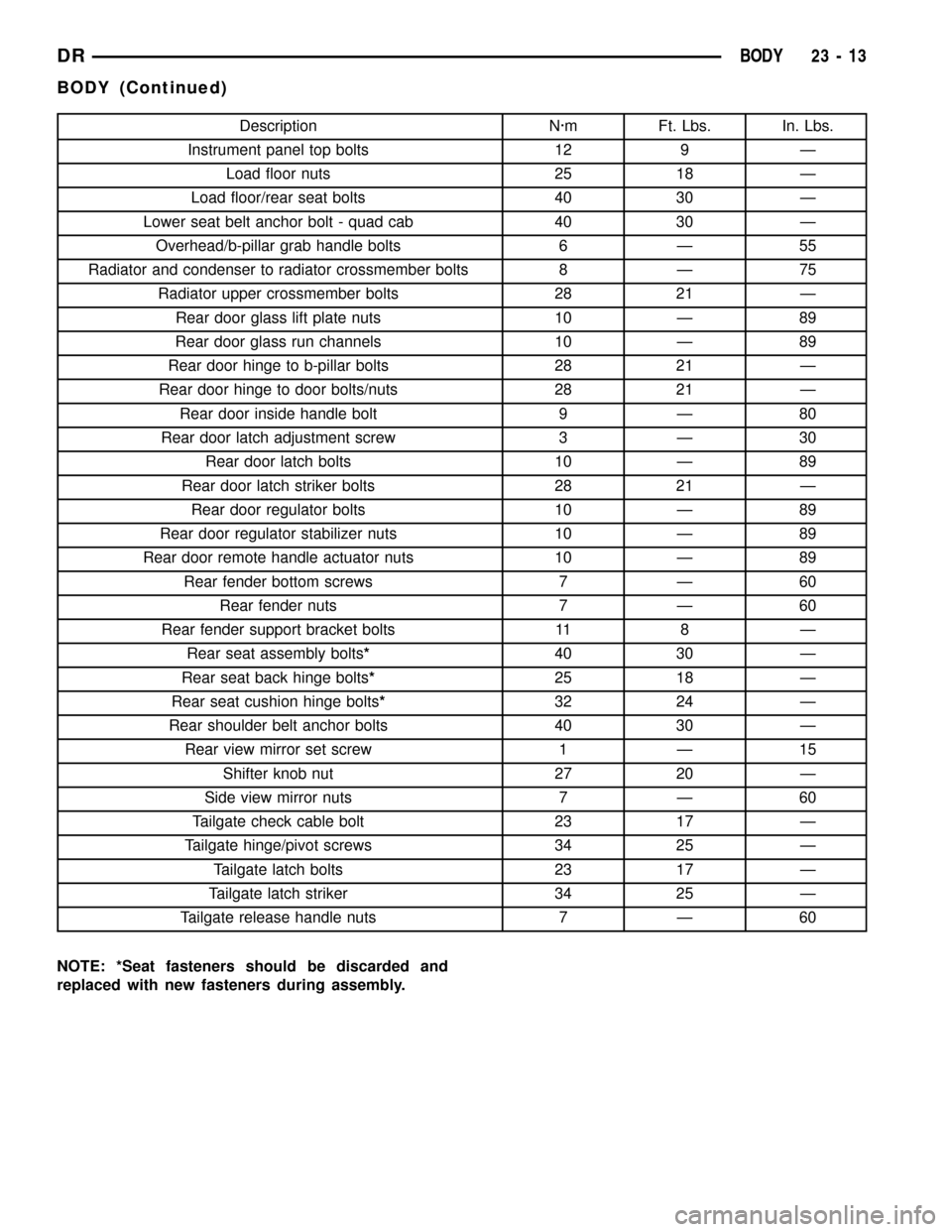
Description N´m Ft. Lbs. In. Lbs.
Instrument panel top bolts 12 9 Ð
Load floor nuts 25 18 Ð
Load floor/rear seat bolts 40 30 Ð
Lower seat belt anchor bolt - quad cab 40 30 Ð
Overhead/b-pillar grab handle bolts 6 Ð 55
Radiator and condenser to radiator crossmember bolts 8 Ð 75
Radiator upper crossmember bolts 28 21 Ð
Rear door glass lift plate nuts 10 Ð 89
Rear door glass run channels 10 Ð 89
Rear door hinge to b-pillar bolts 28 21 Ð
Rear door hinge to door bolts/nuts 28 21 Ð
Rear door inside handle bolt 9 Ð 80
Rear door latch adjustment screw 3 Ð 30
Rear door latch bolts 10 Ð 89
Rear door latch striker bolts 28 21 Ð
Rear door regulator bolts 10 Ð 89
Rear door regulator stabilizer nuts 10 Ð 89
Rear door remote handle actuator nuts 10 Ð 89
Rear fender bottom screws 7 Ð 60
Rear fender nuts 7 Ð 60
Rear fender support bracket bolts 11 8 Ð
Rear seat assembly bolts*40 30 Ð
Rear seat back hinge bolts*25 18 Ð
Rear seat cushion hinge bolts*32 24 Ð
Rear shoulder belt anchor bolts 40 30 Ð
Rear view mirror set screw 1 Ð 15
Shifter knob nut 27 20 Ð
Side view mirror nuts 7 Ð 60
Tailgate check cable bolt 23 17 Ð
Tailgate hinge/pivot screws 34 25 Ð
Tailgate latch bolts 23 17 Ð
Tailgate latch striker 34 25 Ð
Tailgate release handle nuts 7 Ð 60
NOTE: *Seat fasteners should be discarded and
replaced with new fasteners during assembly.
DRBODY 23 - 13
BODY (Continued)
Page 2309 of 2627

SPECIAL TOOLS
BODY
Trim Stick C-4755
Torx Bit Set C-4794-B
REMOVER, MOLDINGS C-4829-A
23 - 14 BODYDR
BODY (Continued)
Page 2311 of 2627

COVER
REMOVAL
(1) Open the tailgate.
(2) Remove the eight screws and remove tailgate
liner, if equipped.
(3) Remove the bolts and remove the cover. (Fig. 3)
INSTALLATION
(1) Install the cover and install the bolts and
tighten by hand.
(2) Install the liner and install the screws, if
equipped.
HINGE
REMOVAL
(1) Remove the tailgate. (Refer to 23 - BODY/
TAILGATE/TAILGATE - REMOVAL)
(2) Remove the two screws and remove the hinge/
pivot. (Fig. 4)
INSTALLATION
(1) Install the hinge/pivot and install the screws.
(2) Tighten the screws to 34 N´m (25 ft. lbs.).
(3) Install the tailgate. (Refer to 23 - BODY/TAIL-
GATE/TAILGATE - INSTALLATION)
LATCH
REMOVAL
(1) Remove the cover. (Refer to 23 - BODY/TAIL-
GATE/COVER - REMOVAL)
(2) Using a grease pencil or equivalent, mark the
actuator rod for installation.
(3) Disconnect the actuator rod at the control
assembly. (Fig. 3)
(4) Remove the latch bolt and the check cable bolt.
(Fig. 5)
(5) Remove the latch and actuator rod assembly.
INSTALLATION
(1) Install the latch and actuator rod assembly.
(2) Install the latch and the check cable bolts and
tighten to 23 N´m (17 ft. lbs.).
(3) Connect the actuator rod to the control assem-
bly line up the marks made during removal.
(4) Install the cover. (Refer to 23 - BODY/TAIL-
GATE/COVER - INSTALLATION)
LATCH STRIKER
REMOVAL
(1) Open tailgate.
(2) Using a grease pencil or equivalent, mark out-
line of striker on cargo box jamb to aid installation.
(3) Using a Torx drive wrench, remove striker and
washer from cargo box.
Fig. 3 TAILGATE ASSEMBLY
1 - LATCH ASSEMBLY
2 - CONTROL ASSEMBLY
3 - ACTUATOR ROD (2)
4 - COVER
5 - BOLTS (10)
Fig. 4 TAILGATE HINGE
1 - HINGE/PIVOT
2 - TAILGATE PILLAR
3 - CLIP/BUSHING
4 - BOLTS (2)
23 - 16 TAILGATEDR
Page 2312 of 2627

INSTALLATION
(1) Position striker and washer on jamb using
alignment outline as reference and install with Torx
drive wrench.
(2) Tighten the striker to 34 N´m (25 ft. lbs.).
RELEASE HANDLE/LATCH
REMOTE
REMOVAL
(1) Remove the tailgate cover. (Refer to 23 - BODY/
TAILGATE/COVER - REMOVAL)
(2) Using a grease pencil or equivalent, mark the
latch actuator rods for ease of installation.
(3) Disconnect the latch actuator rods. (Fig. 3)
(4) Remove the control assembly nuts and remove
the control assembly and the exterior handle. (Fig. 5)
INSTALLATION
(1) Install the handle and the control assembly.
(2) Install the nuts and tighten to 7 N´m (60 in.
lbs.).
(3) Connect the actuator rods using the marks
made during removal.
(4) Install the cover. (Refer to 23 - BODY/TAIL-
GATE/COVER - INSTALLATION)
TAILGATE
REMOVAL
(1) Open the tailgate.
(2) Disconnect the tailgate check cables (Fig. 6).
(Refer to 23 - BODY/TAILGATE/CHECK CABLE -
REMOVAL)
(3) Close tailgate until the notch in the right hand
collar aligns with the pivot pin.
(4) Slip tailgate hinge collar from pivot pins.
(5) Slide tailgate to the right and separate left
hand collar from the pivot pin.
(6) Separate tailgate from vehicle.
INSTALLATION
(1) Position tailgate collar on left hand pivot pin
and slide tailgate to the left.
(2) Raise tailgate until the notch in the right hand
collar aligns with the pivot pin.
(3) Connect the tailgate check cables. (Refer to 23 -
BODY/TAILGATE/CHECK CABLE - INSTALLA-
TION)
Fig. 5 LATCH HANDLE - LATCH
1 - EXTERIOR HANDLE
2 - CONTROL ASSEMBLY
3 - NUTS (2)
4 - TAILGATE
5-LATCH
6 - CHECK CABLE
7 - CHECK/LATCH BOLT
8 - LATCH BOLT
Fig. 6 TAILGATE ASSEMBLY
1 - LATCH STRIKER
2 - CHECK CABLE BOLT
3 - CHECK CABLE
4 - TAILGATE
5 - HINGE BUSHING
DRTAILGATE 23 - 17
LATCH STRIKER (Continued)
Page 2313 of 2627

DOOR - FRONT
TABLE OF CONTENTS
page page
DOOR
REMOVAL.............................18
INSTALLATION.........................18
ADJUSTMENTS
ADJUSTMENT........................19
DOOR GLASS
REMOVAL.............................20
INSTALLATION.........................20
EXTERIOR HANDLE
REMOVAL.............................20
INSTALLATION.........................21
GLASS RUN CHANNEL
REMOVAL.............................21
INSTALLATION.........................22
HINGE
REMOVAL.............................22
INSTALLATION.........................22
INSIDE HANDLE ACTUATOR
REMOVAL.............................22
INSTALLATION.........................22
LATCH
REMOVAL.............................23
INSTALLATION.........................23
ADJUSTMENTS
ADJUSTMENT........................23LATCH STRIKER
REMOVAL.............................23
INSTALLATION.........................23
ADJUSTMENTS
ADJUSTMENT........................24
LOCK CYLINDER
REMOVAL.............................24
INSTALLATION.........................24
TRIM PANEL
REMOVAL.............................24
INSTALLATION.........................24
WATERDAM
REMOVAL.............................25
INSTALLATION.........................25
WINDOW REGULATOR - POWER
REMOVAL.............................25
INSTALLATION.........................26
WINDOW REGULATOR - MANUAL
REMOVAL.............................26
INSTALLATION.........................27
SIDE VIEW MIRROR FLAG
REMOVAL.............................27
INSTALLATION.........................27
DOOR
REMOVAL
(1) Disconnect the door wire harness electrical con-
nector at the A-pillar. (Fig. 1)
(2) Using a grease pencil or equivalent, mark the
outline of the door hinges on the door to aid in instal-
lation.
(3) Support the door with a suitable lifting device.
NOTE: The epoxy bonded washers should not be
seperated from the hinge. If the washers are
removed the door may have to be re-adjusted.
(4) Remove the nuts and bolts attaching the door
hinges to the door.
INSTALLATION
(1) Support the door with a suitable lifting device
and install the door onto the hinges.
(2) Install the washers, if there were removed pre-
viously, nuts and tighten to 28 N´m (21 ft. lbs.).
(3) Connect the electrical connectors.
(4) Adjust the door as necessary. (Refer to 23 -
BODY/DOOR - FRONT/DOOR - ADJUSTMENTS)
23 - 18 DOOR - FRONTDR
Page 2314 of 2627

ADJUSTMENTS
ADJUSTMENT
NOTE: For vehicles with four doors, it is recom-
mended that you adjust the rear door before adjust-
ing the front door. (Refer to 23 - BODY/DOORS -
REAR/DOOR - ADJUSTMENTS)
²Door adjustment measurements should be
taken from stationary or welded body panels like
the roof, rocker or quarter panels.
²During adjustment procedures, it is recom-
mended that all the hinge fasteners be loosened
except for the upper most fasteners. Adjustments
can be made using the upper bolts to hold the door
with final torque of the fasteners occurring after
correct door positioning is achieved.
²A suitable body sealant should be used when
removing or moving the hinges.
FORE/AFT
NOTE: Fore/aft (lateral) door adjustment is done by
loosening the hinge to the hinge pillar fasteners
one hinge at a time and moving the door to the cor-
rect position.
(1) Support the door with a suitable lifting device.
(2)
Loosen the hinge to hinge pillar fasteners. (Refer
to 23 - BODY/DOOR - FRONT/HINGE - REMOVAL)
(3) Adjust the door to the correct position. (Refer
to 23 - BODY/BODY STRUCTURE/GAP AND
FLUSH - SPECIFICATIONS)(4) Tighten the hinge pillar fasteners to 28 N´m
(21 ft. lbs.).
UP/DOWN
NOTE: Up/down door adjustment is done by loosen-
ing either the hinge to the hinge pillar fasteners or
the hinge to door fasteners and moving the door to
the correct position.
NOTE: When adjustment of the door requires the
loosening of the door to hinge fasteners, it will be
necessary to separate the epoxy bonded washers
with a chisel or other suitable tool.
NOTE: When the up/down adjustments are done
correctly, the top of the door is positioned over
flush to the roof. (Refer to 23 - BODY/BODY STRUC-
TURE/GAP AND FLUSH - SPECIFICATIONS)
(1) Support the door with a suitable lifting device.
(2) Loosen the latch striker bolts. (Refer to 23 -
BODY/DOOR - FRONT/LATCH STRIKER -
REMOVAL)
(3) Loosen the hinge to door fasteners (Refer to 23
- BODY/DOOR - FRONT/DOOR - REMOVAL) or
loosen the hinge to hinge pillar fasteners (Refer to 23
- BODY/DOOR - FRONT/HINGE - REMOVAL).
(4) Adjust the door to the correct position. (Refer
to 23 - BODY/BODY STRUCTURE/GAP AND
FLUSH - SPECIFICATIONS)
(5) Tighten the hinge pillar fasteners or the door
to hinges fasteners to 28 N´m (21 ft. lbs.).
(6) Tighten the latch striker bolts. (Refer to 23 -
BODY/DOOR - FRONT/LATCH STRIKER - INSTAL-
LATION)
IN/OUT
NOTE: In/out door adjustment is done by loosening
the hinge to door fasteners one hinge at a time and
moving the door to the correct position.
NOTE: When adjustment of the door requires the
loosening of the door to hinge fasteners, it will be
necessary to separate the epoxy bonded washers
with a chisel or other suitable tool.
(1) Support the door with a suitable lifting device.
(2) Loosen the latch striker bolts. (Refer to 23 -
BODY/DOOR - FRONT/LATCH STRIKER -
REMOVAL)
(3) Loosen the hinge to door fasteners. (Refer to 23
- BODY/DOOR - FRONT/DOOR - REMOVAL)
Fig. 1 FRONT DOOR
1 - NUTS (2)
2 - UPPER HINGE
3 - STUDS
4 - FRONT DOOR
5 - WIRE HARNESS
6 - LOWER HINGE
7 - ELECTRICAL CONNECTORS (2)
8 - BOLTS (2)
DRDOOR - FRONT 23 - 19
DOOR (Continued)