coolant temperature DODGE RAM 1500 1998 2.G Repair Manual
[x] Cancel search | Manufacturer: DODGE, Model Year: 1998, Model line: RAM 1500, Model: DODGE RAM 1500 1998 2.GPages: 2627
Page 516 of 2627

- ELECTRICAL/ELECTRONIC CONTROL MOD-
ULES/COMMUNICATION - OPERATION).
The EMIC microprocessor smooths the input data
using algorithms to provide gauge readings that are
accurate, stable and responsive to operating condi-
tions. These algorithms are designed to provide
gauge readings during normal operation that are con-
sistent with customer expectations. However, when
abnormal conditions exist such as high coolant tem-
perature, the algorithm can drive the gauge pointer
to an extreme position and the microprocessor can
sound a chime through the on-board audible tone
generator to provide distinct visual and audible indi-
cations of a problem to the vehicle operator. The
instrument cluster circuitry may also produce audi-
ble warnings for other electronic modules in the vehi-
cle based upon electronic tone request messages
received over the PCI data bus. Each audible warn-ing is intended to provide the vehicle operator with
an audible alert to supplement a visual indication.
The EMIC circuitry operates on battery current
received through a fused B(+) fuse in the Integrated
Power Module (IPM) on a non-switched fused B(+)
circuit, and on battery current received through a
fused ignition switch output (run-start) fuse in the
IPM on a fused ignition switch output (run-start) cir-
cuit. This arrangement allows the EMIC to provide
some features regardless of the ignition switch posi-
tion, while other features will operate only with the
ignition switch in the On or Start positions. The
EMIC circuitry is grounded through a ground circuit
and take out of the instrument panel wire harness
with an eyelet terminal connector that is secured by
a ground screw to a ground location near the center
of the instrument panel structural support.
The EMIC also has a self-diagnostic actuator test
capability, which will test each of the PCI bus mes-
Fig. 4 Gauges & Indicators - Diesel Engine
1 - MALFUNCTION INDICATOR LAMP 14 - ENGINE TEMPERATURE GAUGE
2 - VOLTAGE GAUGE 15 - SECURITY INDICATOR
3 - LEFT TURN INDICATOR 16 - GEAR SELECTOR INDICATOR DISPLAY (INCLUDES
CRUISE & UPSHIFT INDICATORS)
4 - TACHOMETER 17 - WATER-IN-FUEL INDICATOR
5 - AIRBAG INDICATOR 18 - BRAKE INDICATOR
6 - HIGH BEAM INDICATOR 19 - WAIT-TO-START INDICATOR
7 - SEATBELT INDICATOR 20 - ODOMETER/TRIP ODOMETER DISPLAY (INCLUDES
ENGINE HOURS, WASHER FLUID, LAMP OUTAGE, TOW/HAUL
& SERVICE 4x4 INDICATORS)
8 - SPEEDOMETER 21 - ODOMETER/TRIP ODOMETER SWITCH BUTTON
9 - RIGHT TURN INDICATOR 22 - FUEL GAUGE
10 - OIL PRESSURE GAUGE 23 - LOW FUEL INDICATOR
11 - CARGO LAMP INDICATOR 24 - TRANSMISSION OVERTEMP INDICATOR
12 - DOOR AJAR INDICATOR 25 - CHECK GAUGES INDICATOR
13 - ABS INDICATOR
DRINSTRUMENT CLUSTER 8J - 7
INSTRUMENT CLUSTER (Continued)
Page 531 of 2627

²Engine Temperature High Message- Each
time the cluster receives a message from the PCM or
ECM indicating the engine coolant temperature of a
gasoline engine is about 122É C (252É F) or higher, or
of a diesel engine is about 112É C (233É F) or higher,
the check gauges indicator will be illuminated. The
indicator remains illuminated until the cluster
receives a message from the PCM or ECM indicating
that the engine coolant temperature of a gasoline
engine is below about 122É C (252É F), or of a diesel
engine is below about 112É C (233É F), or until the
ignition switch is turned to the Off position, which-
ever occurs first.
²Engine Oil Pressure Low Message- Each
time the cluster receives a message from the PCM or
ECM indicating the engine oil pressure is about 41
kPa (6 psi) or lower, the check gauges indicator will
be illuminated. The indicator remains illuminated
until the cluster receives a message from the PCM or
ECM indicating that the engine oil pressure is above
about 41 kPa (6 psi), or until the ignition switch is
turned to the Off position, whichever occurs first.
The cluster will only turn the indicator on in
response to an engine oil pressure low message if the
engine speed is greater than zero.
²System Voltage Low (Charge Fail) Message
- Each time the cluster receives a message from the
PCM or ECM indicating the electrical system voltage
is less than about 11.5 volts (charge fail condition),
the check gauges indicator will be illuminated. The
indicator remains illuminated until the cluster
receives a message from the PCM or ECM indicating
the electrical system voltage is greater than about
12.0 volts (but less than 16.0 volts), or until the igni-
tion switch is turned to the Off position, whichever
occurs first.
²System Voltage High Message- Each time
the cluster receives a message from the PCM or ECM
indicating the electrical system voltage is greater
than about 16.0 volts, the check gauges indicator will
be illuminated. The indicator remains illuminated
until the cluster receives a message from the PCM or
ECM indicating the electrical system voltage is less
than about 15.5 volts (but greater than 11.5 volts), or
until the ignition switch is turned to the Off position,
whichever occurs first.
²Actuator Test- Each time the cluster is put
through the actuator test, the check gauges indicator
will be turned on, then off again during the bulb
check portion of the test to confirm the functionality
of the LED and the cluster control circuitry.
On vehicles with a gasoline engine, the PCM con-
tinually monitors the engine temperature, oil pres-
sure, and electrical system voltage, then sends the
proper messages to the instrument cluster. On vehi-
cles with a diesel engine, the ECM continually mon-itors the engine temperature, oil pressure, and
electrical system voltage, then sends the proper mes-
sages to the instrument cluster. For further diagnosis
of the check gauges indicator or the instrument clus-
ter circuitry that controls the LED, (Refer to 8 -
ELECTRICAL/INSTRUMENT CLUSTER - DIAGNO-
SIS AND TESTING). For proper diagnosis of the
PCM, the ECM, the PCI data bus, or the electronic
message inputs to the instrument cluster that control
the check gauges indicator, a DRBIIItscan tool is
required. Refer to the appropriate diagnostic infor-
mation.
CRUISE INDICATOR
DESCRIPTION
A cruise indicator is standard equipment on all
instrument clusters (Fig. 13). However, on vehicles
not equipped with the optional speed control system,
this indicator is electronically disabled. The cruise
indicator consists of the word ªCRUISEº, which
appears in the lower portion of the gear selector indi-
cator Vacuum-Fluorescent Display (VFD) unit. The
VFD is soldered onto the cluster electronic circuit
board and is visible through a window with a smoked
clear lens located on the lower edge of the speedom-
eter gauge dial face of the cluster overlay. The dark
lens over the VFD prevents the indicator from being
clearly visible when it is not illuminated. The word
ªCRUISEº appears in a blue-green color and at the
same lighting level as the gear selector indicator
information when it is illuminated by the instrument
cluster electronic circuit board. The cruise indicator
is serviced as a unit with the VFD in the instrument
cluster.
OPERATION
The cruise indicator gives an indication to the vehi-
cle operator when the speed control system is turned
On, regardless of whether the speed control is
engaged. This indicator is controlled by the instru-
ment cluster circuit board based upon cluster pro-
gramming and electronic messages received by the
cluster from the Powertrain Control Module (PCM)
over the Programmable Communications Interface
(PCI) data bus. The cruise indicator is completely
controlled by the instrument cluster logic circuit, and
that logic will only allow this indicator to operate
when the instrument cluster receives a battery cur-
rent input on the fused ignition switch output (run-
start) circuit. Therefore, the indicator will always be
Fig. 13 Cruise Indicator
8J - 22 INSTRUMENT CLUSTERDR
CHECK GAUGES INDICATOR (Continued)
Page 533 of 2627

ENGINE TEMPERATURE
GAUGE
DESCRIPTION
An engine coolant temperature gauge is standard
equipment on all instrument clusters. The engine
coolant temperature gauge is located in the lower
right quadrant of the instrument cluster, below the
oil pressure gauge. The engine coolant temperature
gauge consists of a movable gauge needle or pointer
controlled by the instrument cluster circuitry and a
fixed 90 degree scale on the cluster overlay that
reads left-to-right from ªCº (or Cold) to ªHº (or Hot)
for gasoline engines. On vehicles with a diesel
engine, the scale reads from ª60ºÉ C to ª120ºÉ C in
markets where a metric instrument cluster is speci-
fied, or from ª140ºÉ F to ª245ºÉ F in all other mar-
kets. An International Control and Display Symbol
icon for ªEngine Coolant Temperatureº is located on
the cluster overlay, directly below the left end of the
gauge scale (Fig. 15). The engine coolant temperature
gauge graphics are black against a white field except
for two red graduations at the high end of the gauge
scale, making them clearly visible within the instru-
ment cluster in daylight. When illuminated from
behind by the panel lamps dimmer controlled cluster
illumination lighting with the exterior lamps turned
On, the black graphics appear blue and the red
graphics still appear red. The orange gauge needle is
internally illuminated. Gauge illumination is pro-
vided by replaceable incandescent bulb and bulb
holder units located on the instrument cluster elec-
tronic circuit board. The engine coolant temperature
gauge is serviced as a unit with the instrument clus-
ter.
OPERATION
The engine coolant temperature gauge gives an
indication to the vehicle operator of the engine cool-
ant temperature. This gauge is controlled by the
instrument cluster circuit board based upon cluster
programming and electronic messages received by
the cluster from the Powertrain Control Module
(PCM) on vehicles equipped with a gasoline engine,
or from the Engine Control Module (ECM) on vehi-
cles equipped with a diesel engine over the Program-
mable Communications Interface (PCI) data bus. The
engine coolant temperature gauge is an air core mag-
netic unit that receives battery current on the instru-
ment cluster electronic circuit board through the
fused ignition switch output (run-start) circuit when-ever the ignition switch is in the On or Start posi-
tions. The cluster is programmed to move the gauge
needle back to the low end of the scale after the igni-
tion switch is turned to the Off position. The instru-
ment cluster circuitry controls the gauge needle
position and provides the following features:
²Engine Temperature Message- Each time
the cluster receives a message from the PCM or ECM
indicating the engine coolant temperature is between
the low end of normal [about 54É C (130É F) for gas-
oline engines, or about 60É C (140É F) for diesel
engines] and the high end of normal [about 122É C
(252É F) for gasoline engines, or about 116É C (240É
F) for diesel engines], the gauge needle is moved to
the actual relative temperature position on the gauge
scale.
²Engine Temperature Low Message- Each
time the cluster receives a message from the PCM or
ECM indicating the engine coolant temperature is
below the low end of normal [about 54É C (130É F) for
gasoline engines, or about 60É C (140É F) for diesel
engines], the gauge needle is held at the graduation
on the far left end of the gauge scale. The gauge nee-
dle remains at the left end of the gauge scale until
the cluster receives a message from the PCM or ECM
indicating that the engine temperature is above
about 54É C (130É F) for gasoline engines, or about
60É C (140É F) for diesel engines, or until the ignition
switch is turned to the Off position, whichever occurs
first.
²Engine Temperature High Message- Each
time the cluster receives a message from the PCM or
ECM indicating the engine coolant temperature is
above about 122É C (252É F) for gasoline engines, or
about 116É C (240É F) for diesel engines, the gauge
needle is moved into the red zone at the far right end
of gauge scale, the check gauges indicator is illumi-
nated, and a single chime tone is sounded. The gauge
needle remains in the red zone and the check gauges
indicator remains illuminated until the cluster
receives a message from the PCM or ECM indicating
that the engine temperature is below about 122É C
(252É F) for gasoline engines, or about 116É C (240É
F) for diesel engines, or until the ignition switch is
turned to the Off position, whichever occurs first.
The chime tone feature will only repeat during the
same ignition cycle if the check gauges indicator is
cycled off and then on again by the appropriate
engine temperature messages from the PCM or ECM.
²Communication Error- If the cluster fails to
receive an engine temperature message, it will hold
the gauge needle at the last indication for about five
seconds or until the ignition switch is turned to the
Off position, whichever occurs first. After five sec-
onds, the cluster will move the gauge needle to the
low end of the gauge scale.
Fig. 15 Engine Coolant Temperature Icon
8J - 24 INSTRUMENT CLUSTERDR
Page 534 of 2627

²Actuator Test- Each time the cluster is put
through the actuator test, the engine coolant temper-
ature gauge needle will be swept to several calibra-
tion points on the gauge scale in a prescribed
sequence in order to confirm the functionality of the
gauge and the cluster control circuitry.
On vehicles with a gasoline engine, the PCM con-
tinually monitors the engine coolant temperature
sensor to determine the engine operating tempera-
ture. On vehicles with a diesel engine, the ECM con-
tinually monitors the engine coolant temperature
sensor to determine the engine operating tempera-
ture. The PCM or ECM then sends the proper engine
coolant temperature messages to the instrument
cluster. For further diagnosis of the engine coolant
temperature gauge or the instrument cluster cir-
cuitry that controls the gauge, (Refer to 8 - ELEC-
TRICAL/INSTRUMENT CLUSTER - DIAGNOSIS
AND TESTING). If the instrument cluster turns on
the check gauges indicator due to a high engine tem-
perature gauge reading, it may indicate that the
engine or the engine cooling system requires service.
For proper diagnosis of the engine coolant tempera-
ture sensor, the PCM, the ECM, the PCI data bus, or
the electronic message inputs to the instrument clus-
ter that control the engine coolant temperature
gauge, a DRBIIItscan tool is required. Refer to the
appropriate diagnostic information.
ETC INDICATOR
DESCRIPTION
An Electronic Throttle Control (ETC) indicator is
standard equipment on all gasoline engine instru-
ment clusters (Fig. 16). However, on vehicles not
equipped with the optional 5.7 liter gasoline engine,
this indicator is electronically disabled. The ETC
indicator is located on the right side of the instru-
ment cluster, to the right of the engine temperature
gauge. The ETC indicator consists of a stencil-like
cutout of the International Control and Display Sym-
bol icon for ªElectronic Throttle Controlº in the
opaque layer of the instrument cluster overlay. The
dark outer layer of the overlay prevents the indicator
from being clearly visible when it is not illuminated.
A red Light Emitting Diode (LED) behind the cutout
in the opaque layer of the overlay causes the icon to
appear in red through the translucent outer layer of
the overlay when the indicator is illuminated from
behind by the LED, which is soldered onto theinstrument cluster electronic circuit board. The ETC
indicator is serviced as a unit with the instrument
cluster.
OPERATION
The Electronic Throttle Control (ETC) indicator
gives an indication to the vehicle operator when the
ETC system is faulty or inoperative. The ETC indi-
cator is controlled by a transistor on the instrument
cluster circuit board based upon cluster programming
and electronic messages received by the cluster from
the Powertrain Control Module (PCM) over the Pro-
grammable Communications Interface (PCI) data
bus. The ETC indicator Light Emitting Diode (LED)
is completely controlled by the instrument cluster
logic circuit, and that logic will only allow this indi-
cator to operate when the instrument cluster receives
a battery current input on the fused ignition switch
output (run-start) circuit. Therefore, the LED will
always be off when the ignition switch is in any posi-
tion except On or Start. The LED only illuminates
when it is provided a path to ground by the instru-
ment cluster transistor. The instrument cluster will
turn on the ETC indicator for the following reasons:
²Bulb Test- Each time the ignition switch is
turned to the On position the ETC indicator is illu-
minated for about six seconds. The entire six second
bulb test is a function of the PCM.
²ETC Lamp-On Message- Each time the clus-
ter receives a lamp-on message from the PCM, the
ETC indicator will be illuminated. The indicator can
be flashed on and off, or illuminated solid, as dic-
tated by the PCM message. The indicator remains
illuminated solid or continues to flash for about
twelve seconds or until the cluster receives a lamp-off
message from the PCM, whichever is longer. If the
indicator is illuminated solid with the engine run-
ning the vehicle will usually remain drivable. If the
indicator is flashing with the engine running the
vehicle may require towing. A flashing indicator
means the ETC system requires immediate service.
²Communication Error- If the cluster receives
no ETC lamp messages for three consecutive seconds,
the ETC indicator is illuminated. The indicator
remains illuminated until the cluster receives a sin-
gle lamp-off message from the PCM.
²Actuator Test- Each time the cluster is put
through the actuator test, the ETC indicator will be
turned on, then off again during the bulb check por-
tion of the test to confirm the functionality of the
LED and the cluster control circuitry. The actuator
test illumination of the ETC indicator is a function of
the PCM.
The PCM continually monitors the ETC system cir-
cuits and sensors to decide whether the system is in
good operating condition. The PCM then sends the
Fig. 16 ETC Indicator
DRINSTRUMENT CLUSTER 8J - 25
ENGINE TEMPERATURE GAUGE (Continued)
Page 542 of 2627

the trip odometer reset switch button is pressed in
order to toggle to the engine hours display. The
engine hours will remain displayed for about thirty
seconds, until the engine speed message is greater
than zero, or until the ignition switch is turned to
the Off position, whichever occurs first.
²Trip Odometer Reset- When the trip odome-
ter reset switch button is pressed and held for longer
than about two seconds with the ignition switch in
the On or Start positions, the trip odometer will be
reset to 0.0 kilometers (miles). The VFD must be dis-
playing the trip odometer information in order for
the trip odometer information to be reset.
²Communication Error- If the cluster fails to
receive a distance message during normal operation,
it will hold and display the last data received until
the ignition switch is turned to the Off position. If
the cluster does not receive a distance message
within one second after the ignition switch is turned
to the On position, it will display the last distance
message stored in the cluster memory. If the cluster
is unable to display distance information due to an
error internal to the cluster, the VFD display will be
dashes.
²Actuator Test- Each time the cluster is put
through the actuator test, the odometer VFD will dis-
play all of its segments simultaneously during the
VFD portion of the test to confirm the functionality
of each of the VFD segments and the cluster control
circuitry.
The PCM continually monitors the vehicle speed
pulse information received from the vehicle speed
sensor and engine speed pulse information received
from the crankshaft position sensor, then sends the
proper distance and engine speed messages to the
instrument cluster. For further diagnosis of the
odometer/trip odometer or the instrument cluster cir-
cuitry that controls these functions, (Refer to 8 -
ELECTRICAL/INSTRUMENT CLUSTER - DIAGNO-
SIS AND TESTING). For proper diagnosis of the
vehicle speed sensor, the crankshaft position sensor,
the PCM, the PCI data bus, or the electronic message
inputs to the instrument cluster that control the
odometer/trip odometer, a DRBIIItscan tool is
required. Refer to the appropriate diagnostic infor-
mation.
OIL PRESSURE GAUGE
DESCRIPTION
An oil pressure gauge is standard equipment on all
instrument clusters. The oil pressure gauge is locatedin the upper right quadrant of the instrument clus-
ter, above the coolant temperature gauge. The oil
pressure gauge consists of a movable gauge needle or
pointer controlled by the instrument cluster circuitry
and a fixed 90 degree scale on the cluster overlay
that reads left-to-right from ªLº (or Low) to ªHº (or
High) for gasoline engines. On vehicles with a diesel
engine the scale reads from ª0º kPa to ª760º kPa in
markets where a metric instrument cluster is speci-
fied, or from ª0º psi to ª110º psi in all other markets.
An International Control and Display Symbol icon for
ªEngine Oilº is located on the cluster overlay, directly
below the left end of the gauge scale (Fig. 24). The oil
pressure gauge graphics are black against a white
field except for two red graduations at the low end of
the gauge scale, making them clearly visible within
the instrument cluster in daylight. When illuminated
from behind by the panel lamps dimmer controlled
cluster illumination lighting with the exterior lamps
turned On, the black graphics appear blue and the
red graphics still appear red. The orange gauge nee-
dle is internally illuminated. Gauge illumination is
provided by replaceable incandescent bulb and bulb
holder units located on the instrument cluster elec-
tronic circuit board. The oil pressure gauge is ser-
viced as a unit with the instrument cluster.
OPERATION
The oil pressure gauge gives an indication to the
vehicle operator of the engine oil pressure. This
gauge is controlled by the instrument cluster circuit
board based upon cluster programming and elec-
tronic messages received by the cluster from the
Powertrain Control Module (PCM) on vehicles with a
gasoline engine, or from the Engine Control Module
(ECM) on vehicles equipped with a diesel engine over
the Programmable Communications Interface (PCI)
data bus. The oil pressure gauge is an air core mag-
netic unit that receives battery current on the instru-
ment cluster electronic circuit board through the
fused ignition switch output (run-start) circuit when-
ever the ignition switch is in the On or Start posi-
tions. The cluster is programmed to move the gauge
needle back to the low end of the scale after the igni-
tion switch is turned to the Off position. The instru-
ment cluster circuitry controls the gauge needle
position and provides the following features:
²Engine Oil Pressure Message- The instru-
ment cluster circuitry restricts the oil pressure gauge
needle operation in order to provide readings that
are consistent with customer expectations. Each time
the cluster receives a message from the PCM or ECM
indicating the engine oil pressure is above about 41
kPa (6 psi) the cluster holds the gauge needle at a
point near the middle increment within the normal
range on the gauge scale.
Fig. 24 Engine Oil Icon
DRINSTRUMENT CLUSTER 8J - 33
ODOMETER (Continued)
Page 544 of 2627

reminder function, each time the cluster detects an
open circuit on the seat belt indicator driver circuit
(seatbelt switch open = seatbelt unbuckled) with the
ignition switch in the Start or On positions, the indi-
cator will be illuminated. In addition, if the driver
side front seat belt remains unbuckled about sixty
seconds after the conclusion of the seatbelt reminder
function with the vehicle speed greater than about 13
kilometers-per-hour (8 miles-per-hour), the seatbelt
indicator will begin to cycle between flashing on and
off for five seconds, then lighting solid for three sec-
onds. The seatbelt indicator will continue to cycle
between flashing and solid illumination for twelve
complete cycles, until the seat belt indicator driver
input to the cluster is closed to ground (seatbelt
switch closed = seatbelt buckled), or until the igni-
tion switch is turned to the Off position, whichever
occurs first.
²Driver Side Front Seatbelt Not Buckled -
Beltminder Inactive- Following the seatbelt
reminder function, each time the cluster detects an
open circuit on the seat belt indicator driver circuit
(seatbelt switch open = seatbelt unbuckled) with the
ignition switch in the Start or On positions, the indi-
cator will be illuminated. The seatbelt indicator
remains illuminated until the seat belt indicator
driver input to the cluster is closed to ground (seat-
belt switch closed = seatbelt buckled), or until the
ignition switch is turned to the Off position, which-
ever occurs first.
²Airbag Indicator Backup- If the instrument
cluster detects a fault in the airbag indicator circuit
it will send a message indicating the fault to the Air-
bag Control Module (ACM), store a Diagnostic Trou-
ble Code (DTC) in the cluster memory, then flash the
seatbelt indicator on and off. The cluster will con-
tinue to flash the seatbelt indicator until the airbag
indicator circuit fault is resolved, or until the ignition
switch is turned to the Off position, whichever occurs
first.
²Actuator Test- Each time the cluster is put
through the actuator test, the seatbelt indicator will
be turned on, then off again during the bulb check
portion of the test to confirm the functionality of the
LED and the cluster control circuitry.
The seatbelt switch is connected in series between
ground and the seat belt indicator driver input to the
instrument cluster. The seatbelt switch input to the
instrument cluster circuitry may be diagnosed using
conventional diagnostic tools and methods. For fur-
ther diagnosis of the seatbelt indicator or the instru-
ment cluster circuitry that controls the LED, (Refer
to 8 - ELECTRICAL/INSTRUMENT CLUSTER -
DIAGNOSIS AND TESTING).STANDARD PROCEDURE - ENHANCED
SEATBELT REMINDER PROGRAMMING
The seatbelt indicator also includes a programma-
ble enhanced seatbelt reminder or ªbeltminderº fea-
ture that is enabled when the vehicle is shipped from
the factory. This beltminder feature provides
extended and modified visual seatbelt indicator and
audible chime warning responses to an unbuckled
driver side front seat belt. The beltminder feature
may be disabled or enabled by the customer using
the programming sequence that follows, or by the
dealer using a DRBIIItscan tool. The following
sequence of events must occur within sixty (60) sec-
onds of the ignition switch being placed in the On
position in order for the programming to be com-
pleted successfully.
(1) With the ignition switch in any position except
On or Start, buckle the driver side front seat belt.
(2) Turn the ignition switch to the On position and
wait for the seatbelt indicator reminder function to
conclude (about six seconds).
(3) Unbuckle and buckle the driver side front seat
belt three or more times, ending with the belt buck-
led.
(4) Turn the ignition switch to any position except
On or Start to toggle the beltminder feature from its
current setting (from active to inactive, or from inac-
tive to active). A single chime tone will provide an
audible confirmation that the programming sequence
has been successfully completed.
SECURITY INDICATOR
DESCRIPTION
A security indicator is standard equipment on all
instrument clusters (Fig. 26). However, on vehicles
not equipped with the optional Vehicle Theft Security
System (VTSS), this indicator is electronically dis-
abled. The security indicator is located in the lower
right quadrant of the instrument cluster, between the
speedometer and the coolant temperature gauge. The
security indicator consists of a small round cutout in
the opaque layer of the instrument cluster overlay.
The dark outer layer of the overlay prevents the indi-
cator from being clearly visible when it is not illumi-
nated. A red Light Emitting Diode (LED) behind the
cutout in the opaque layer of the overlay causes the
indicator to appear in red through the translucent
outer layer of the overlay when it is illuminated from
Fig. 26 Security Indicator
DRINSTRUMENT CLUSTER 8J - 35
SEATBELT INDICATOR (Continued)
Page 744 of 2627

8W-02 COMPONENT INDEX
Component Page
A/C Compressor Clutch................. 8W-42
A/C Compressor Clutch Relay............ 8W-42
A/C Pressure Transducer................ 8W-42
A/C-Heater Control.................... 8W-42
Accelerator Pedal Position Sensor......... 8W-30
Adjustable Pedal Motor................. 8W-30
Adjustable Pedal Relay................. 8W-30
Adjustable Pedal Switch................ 8W-30
Airbag Control Module................. 8W-43
Airbag-Squibs........................ 8W-43
Airbag-Curtains....................... 8W-43
Airbag-Passenger On/Off Switch.......... 8W-43
Ambient Temperature Sensor............ 8W-49
Amplifier Audio....................... 8W-47
Ashtray Lamp........................ 8W-44
Auto Shut Down Relay................. 8W-30
Automatic Day/Night Mirror.......... 8W-49, 55
Auxiliary Battery..................... 8W-20
Backup Lamp Switch.................. 8W-51
Battery............................. 8W-20
Battery Temperature Sensor............. 8W-30
Blend Door Actuators.................. 8W-42
Blower Motor......................... 8W-42
Blower Motor Resistor Block............. 8W-42
Brake Fluid Level Switch............ 8W-34, 35
Brake Lamp Switch.................... 8W-33
Brake Transmission Shift Interlock
Solenoid........................... 8W-40
Camshaft Position Sensor............... 8W-30
Capacitor............................ 8W-30
Center High Mounted Stop Lamp-
Aftermarket........................ 8W-51
Center High Mounted Stop Lamp/Cargo
Lamp.......................... 8W-44, 51
Cigar Lighter Outlet................... 8W-41
Circuit Breaker....................... 8W-10
Clearance Lamps...................... 8W-50
Clockspring................. 8W-33, 41, 43, 47
Clutch Interlock Brake Switch........... 8W-21
Coil On Plugs........................ 8W-30
Compass/Mini-Trip Computer............ 8W-49
Condenser Fan....................... 8W-42
Condenser Fan Relay.................. 8W-42
Controller Antilock Brake............ 8W-34, 35
Crankshaft Position Sensor.............. 8W-30
Cylinder Lock Switch-Driver............. 8W-61
Data Link Connector................... 8W-18
Data Link Connector-Engine............. 8W-18
Dome Lamp....................... 8W-44, 49
Door Ajar Switches.................... 8W-40
Door Lock Motor/Ajar Switches........ 8W-40, 61
Door Lock Switch-Passenger............. 8W-61Component Page
Door Module................... 8W-60, 61, 62
EGR Solenoid........................ 8W-30
Electric Backlight..................... 8W-48
Electric Brake Provision................ 8W-54
Electronic Throttle Control Module........ 8W-30
Engine Control Module................. 8W-30
Engine Coolant Temperature Sensor....... 8W-30
Engine Oil Pressure Switch.............. 8W-30
EVAP/Purge Solenoid.................. 8W-30
Evaporator Temperature Sensor.......... 8W-42
Fender Lamps........................ 8W-51
Fog Lamp Relay...................... 8W-50
Fog Lamps.......................... 8W-50
Front Control Module.................. 8W-10
Fuel Control Actuator.................. 8W-30
Fuel Heater.......................... 8W-30
Fuel Heater Relay..................... 8W-30
Fuel Injector Packs.................... 8W-30
Fuel Injectors........................ 8W-30
Fuel Pump Module.................... 8W-30
Fuel Pump Motor..................... 8W-30
Fuel Pump Relay...................... 8W-30
Fuses............................ 8W-10, 33
Fusible Link......................... 8W-10
Generator........................... 8W-20
Glove Box Lamp And Switch............. 8W-44
Grounds............................ 8W-15
Hands Free Module.................... 8W-55
Headlamp Switch.................. 8W-40, 50
Headlamps.......................... 8W-50
Heated Mirror Relay................... 8W-62
Heated Seat Cushions.................. 8W-63
Horn Relay.......................... 8W-41
Horn Switch......................... 8W-41
Horn-High Note....................... 8W-41
Horn-Low Note....................... 8W-41
Idle Air Control Motor.................. 8W-30
Ignition Switch....................... 8W-10
Inlet Air Temperature Sensor............ 8W-30
Input Speed Sensor.................... 8W-31
Instrument Cluster.................... 8W-40
Intake Air Heater Relays............... 8W-30
Intake Air Temperature Sensor........... 8W-30
Intake Air Temperature/Manifold Absolute
Pressure Sensor..................... 8W-30
Integrated Power Module............... 8W-10
Knock Sensosr........................ 8W-30
License Lamps....................... 8W-51
Lift Pump Motor...................... 8W-30
Line Pressure Sensor................ 8W-30, 31
Lumbar Motors....................... 8W-63
Lumbar Switch....................... 8W-63
DR8W-02 COMPONENT INDEX 8W - 02 - 1
Page 832 of 2627

8W-30 FUEL/IGNITION SYSTEM
Component Page
A/C Compressor Clutch Relay............ 8W-30-9, 58
A/C Pressure Transducer......... 8W-30-23, 28, 29, 45
Accelerator Pedal Position Sensor . . . 8W-30-29, 47, 64, 65
Adjustable Pedal Motor................. 8W-30-61
Adjustable Pedal Relay.................. 8W-30-61
Adjustable Pedal Switch................. 8W-30-61
Ambient Temperature Sensor............. 8W-30-30
Auto Shut Down Relay................... 8W-30-4
Battery............................ 8W-30-52
Battery Temperature Sensor............ 8W-30-12, 56
Brake Lamp Switch............. 8W-30-8, 36, 57, 63
Camshaft Position Sensor........ 8W-30-10, 29, 45, 46
Capacitor........................... 8W-30-13
Clockspring..................... 8W-30-8, 36, 59
Coil On Plug No. 1.................. 8W-30-14, 39
Coil On Plug No. 2.................. 8W-30-15, 37
Coil On Plug No. 3.................. 8W-30-14, 39
Coil On Plug No. 4.................. 8W-30-15, 37
Coil On Plug No. 5.................. 8W-30-16, 39
Coil On Plug No. 6.................. 8W-30-13, 37
Coil On Plug No. 7.................. 8W-30-16, 39
Coil On Plug No. 8.................. 8W-30-13, 37
Condenser Fan Relay.................... 8W-30-9
Controller Antilock Brake............ 8W-30-6, 11, 57
Crankshaft Position Sensor............ 8W-30-10, 46
Data Link Connector............... 8W-30-9, 22, 55
Data Link Connector-Engine.............. 8W-30-51
EGR Solenoid................... 8W-30-28, 29, 32
Electronic Throttle Control Module.......... 8W-30-35
Engine Control Module....... 8W-30-42, 43, 44, 45, 46,
47, 48, 49, 50, 51, 52, 53, 54,
55, 56, 57, 58, 59, 60, 62, 63, 64, 65
Engine Coolant Temperature Sensor.... 8W-30-23, 41, 47
Engine Oil Pressure Switch.......... 8W-30-2, 53, 56
EVAP/Purge Solenoid................... 8W-30-12
Front Control Module................... 8W-30-61
Fuel Control Actuator................... 8W-30-50
Fuel Heater......................... 8W-30-60
Fuel Heater Relay..................... 8W-30-60
Fuel Injector No. 1.................. 8W-30-14, 40
Fuel Injector No. 2.................. 8W-30-15, 38
Fuel Injector No. 3.................. 8W-30-14, 40
Fuel Injector No. 4.................. 8W-30-15, 38
Fuel Injector No. 5.................. 8W-30-14, 40
Fuel Injector No. 6.................. 8W-30-15, 38
Fuel Injector No. 7.................. 8W-30-16, 40
Fuel Injector No. 8.................. 8W-30-13, 38
Fuel Injector Pack No. 1................. 8W-30-42
Fuel Injector Pack No. 2............ 8W-30-42, 43, 44
Fuel Injector Pack No. 3................. 8W-30-44
Fuel Pump Module................... 8W-30-3, 58
Fuel Pump Motor...................... 8W-30-48
Fuel Pump Relay....................... 8W-30-3
Fuse 2.............................. 8W-30-4
Fuse 5........................... 8W-30-25, 62
Fuse 12............................ 8W-30-60
Fuse 17............................. 8W-30-3
Fuse 19............................ 8W-30-52
Fuse 23............................. 8W-30-2Component Page
Fuse 36.......................... 8W-30-54, 61
Fuse 40............................ 8W-30-61
Fuse 49............................. 8W-30-4
Fuse 50..................... 8W-30-2, 55, 58, 62
Fusible Link......................... 8W-30-52
G104........................ 8W-30-3, 8, 25, 60
G105............................ 8W-30-56, 58
G107........... 8W-30-2, 7, 15, 18, 19, 20, 21, 30, 32
G114 .............................. 8W-30-53
G120............................ 8W-30-51, 60
G201............................... 8W-30-6
G202.............................. 8W-30-61
Generator......................... 8W-30-7, 51
Idle Air Control Motor................... 8W-30-9
Ignition Switch..................... 8W-30-6, 22
Inlet Air Temperature Sensor............. 8W-30-49
Input Speed Sensor.................... 8W-30-24
Instrument Cluster.................... 8W-30-30
Intake Air Heater Relay No. 1............. 8W-30-56
Intake Air Heater Relay No. 2............. 8W-30-56
Intake Air Temperature Sensor.......... 8W-30-23, 41
Intake Air Temperature/Manifold Absolute
Pressure Sensor..................... 8W-30-50
Integrated Power Module.... 8W-30-2, 3, 4, 9, 25, 52, 54,
55, 58, 60, 61, 62, 64
Knock Sensor........................ 8W-30-31
Knock Sensor-Left..................... 8W-30-33
Knock Sensor-Right.................... 8W-30-33
Lift Pump Motor...................... 8W-30-51
Line Pressure Sensor................... 8W-30-17
Manifold Absolute Pressure Sensor..... 8W-30-23, 29, 41
Natural Vacuum Leak Detection Assembly..... 8W-30-7
Output Speed Sensor................. 8W-30-24, 62
Oxygen Sensor 1/1 Upstream........... 8W-30-20, 21
Oxygen Sensor 1/2 Downstream......... 8W-30-18, 19
Oxygen Sensor 2/1 Upstream........... 8W-30-20, 21
Oxygen Sensor 2/2 Downstream......... 8W-30-18, 19
Oxygen Sensor Downstream Relay........... 8W-30-4
Power Steering Pressure Switch............ 8W-30-7
Powertrain Control Module....... 8W-30-2, 3, 4, 5, 6, 7,
8, 9, 10, 11, 12, 13, 14, 15, 16,
17, 18, 19, 20, 21, 22, 23, 24,
25, 26, 27, 28, 29, 30, 31, 32,
33, 35, 36, 37, 38, 39, 40, 41
PTCNo.1 ....................... 8W-30-3, 9, 58
Pto Switch........................... 8W-30-6
Speed Control Servo.................. 8W-30-8, 63
Speed Control Switch-Left............. 8W-30-36, 59
Speed Control Switch-Right............ 8W-30-36, 59
Starter Motor Relay.................. 8W-30-2, 64
Throttle Position Sensor................. 8W-30-17
Tow/Haul Overdrive Switch............. 8W-30-6, 64
Transmission Control Relay............ 8W-30-25, 62
Transmission Range Sensor............... 8W-30-64
Transmission Solenoid Assembly......... 8W-30-54, 62
Transmission Solenoid/TRS Assembly . 8W-30-5, 25, 26, 27
Vacuum Pump........................ 8W-30-58
Vistronic Fan Drive.................... 8W-30-54
Water In Fuel Sensor................ 8W-30-47, 48
DR8W-30 FUEL/IGNITION SYSTEM 8W - 30 - 1
Page 1051 of 2627

Component Page
C315............................. 8W-80-39
C316 (Heated Seats)................. 8W-80-39
C316............................. 8W-80-40
C319............................. 8W-80-40
C319............................. 8W-80-40
C320............................. 8W-80-40
C320............................. 8W-80-41
C322 (Except Heated Seats)........... 8W-80-41
C322............................. 8W-80-41
C323 (Except Heated Seats)........... 8W-80-42
C323 (Except Heated Seats)........... 8W-80-42
C323 (Heated Seats)................. 8W-80-42
C323 (Heated Seats)................. 8W-80-43
C327 (Dual Rear Wheels)............. 8W-80-43
C327 (Dual Rear Wheels)............. 8W-80-43
C328 (Dual Rear Wheels)............. 8W-80-43
C328 (Dual Rear Wheels)............. 8W-80-44
Camshaft Position Sensor (NGC)....... 8W-80-44
Camshaft Position Sensor (Diesel)...... 8W-80-44
Capacitor (3.7L/4.7L)................ 8W-80-44
Center High Mounted Stop Lamp/cargo
Lamp.......................... 8W-80-45
Cigar Lighter Outlet................. 8W-80-45
Clearance Lamp No. 1 (Heavy Duty).... 8W-80-45
Clearance Lamp No. 2 (Heavy Duty).... 8W-80-45
Clearance Lamp No. 3 (Heavy Duty).... 8W-80-46
Clearance Lamp No. 4 (Heavy Duty).... 8W-80-46
Clearance Lamp No. 5 (Heavy Duty).... 8W-80-46
Clockspring C1..................... 8W-80-46
Clockspring C2..................... 8W-80-47
Clockspring C3..................... 8W-80-47
Clockspring C4..................... 8W-80-47
Clutch Interlock Brake Switch......... 8W-80-47
Coil On Plug No. 1 (3.7L/4.7L)......... 8W-80-47
Coil On Plug No. 1 (5.7L)............. 8W-80-48
Coil On Plug No. 2 (3.7L/4.7L)......... 8W-80-48
Coil On Plug No. 2 (5.7L)............. 8W-80-48
Coil On Plug No. 3 (3.7L/4.7L)......... 8W-80-48
Coil On Plug No. 3 (5.7L)............. 8W-80-49
Coil On Plug No. 4 (3.7L/4.7L)......... 8W-80-49
Coil On Plug No. 4 (5.7L)............. 8W-80-49
Coil On Plug No. 5 (3.7L/4.7L)......... 8W-80-49
Coil On Plug No. 5 (5.7L)............. 8W-80-50
Coil On Plug No. 6 (3.7L/4.7L)......... 8W-80-50
Coil On Plug No. 6 (5.7L)............. 8W-80-50
Coil On Plug No. 7 (4.7L)............. 8W-80-50
Coil On Plug No. 7 (5.7L)............. 8W-80-51
Coil On Plug No. 8 (4.7L)............. 8W-80-51
Coil On Plug No. 8 (5.7L)............. 8W-80-51
Compass/Mini-Trip Computer (Except
Base).......................... 8W-80-51
Condenser Fan (NGC)............... 8W-80-52
Controller Anitlock Brake C1.......... 8W-80-52
Controller Antilock Brake C2 (ABS)..... 8W-80-52Component Page
Crankshaft Position Sensor (3.7L)...... 8W-80-52
Crankshaft Position Sensor (4.7L)...... 8W-80-53
Crankshaft Position Sensor (5.7L)...... 8W-80-53
Crankshaft Position Sensor (Diesel)..... 8W-80-53
Cylinder Lock Switch-Driver (Premium) . . 8W-80-53
Data Link Connector................ 8W-80-53
Data Link Connector-Engine (Diesel).... 8W-80-54
Dome Lamp....................... 8W-80-54
Door Ajar Switch-Driver.............. 8W-80-54
Door Ajar Switch-Left Rear........... 8W-80-54
Door Ajar Switch-Passenger........... 8W-80-55
Door Ajar Switch-Right Rear.......... 8W-80-55
Door Lock Motor/Ajar Switch-Driver.... 8W-80-55
Door Lock Motor/Ajar Switch-Left Rear . . 8W-80-55
Door Lock Motor/Ajar Switch-Passenger . 8W-80-56
Door Lock Motor/Ajar Switch-Right Rear . 8W-80-56
Door Lock Switch-Passenger........... 8W-80-56
Driver Blend Door Actuator (Dual Zone) . 8W-80-56
Driver Door Module C1.............. 8W-80-57
Driver Door Module C2.............. 8W-80-57
EGR Solenoid (4.7L/5.7L)............. 8W-80-57
Electric Brake Provision.............. 8W-80-58
Electric Throttle Control Module....... 8W-80-58
Engine Control Module C1 (Diesel)..... 8W-80-58
Engine Control Module C2 (Diesel)..... 8W-80-60
Engine Coolant Temperature Sensor
(Diesel)......................... 8W-80-61
Engine Coolant Temperature Sensor
(Gas)........................... 8W-80-61
Engine Oil Pressure Switch........... 8W-80-61
EVAP/Purge Solenoid (NGC).......... 8W-80-61
Evaporator Temperature Sensor........ 8W-80-62
Fender Lamp-Front Left (Dual Rear
Wheels)......................... 8W-80-62
Fender Lamp-Front Right (Dual Rear
Wheels)......................... 8W-80-62
Fender Lamp-Rear Left (Dual Rear
Wheels)......................... 8W-80-62
Fender Lamp-Rear Right (Dual Rear
Wheels)......................... 8W-80-62
Fog Lamp-Left..................... 8W-80-63
Fog Lamp-Right.................... 8W-80-63
Fuel Control Actuator (Diesel)......... 8W-80-63
Fuel Heater (Diesel)................. 8W-80-63
Fuel Injector No. 1 (Gas)............. 8W-80-63
Fuel Injector No. 2 (Gas)............. 8W-80-64
Fuel Injector No. 3 (Gas)............. 8W-80-64
Fuel Injector No. 4 (Gas)............. 8W-80-64
Fuel Injector No. 5 (Gas)............. 8W-80-64
Fuel Injector No. 6 (Gas)............. 8W-80-65
Fuel Injector No. 7 (Gas)............. 8W-80-65
Fuel Injector No. 8 (Gas)............. 8W-80-65
Fuel Injector Pack No. 1 (Diesel)....... 8W-80-65
Fuel Injector Pack No. 2 (Diesel)....... 8W-80-66
Fuel Injector Pack No. 3 (Diesel)....... 8W-80-66
8W - 80 - 2 8W-80 CONNECTOR PIN-OUTSDR
Page 1110 of 2627
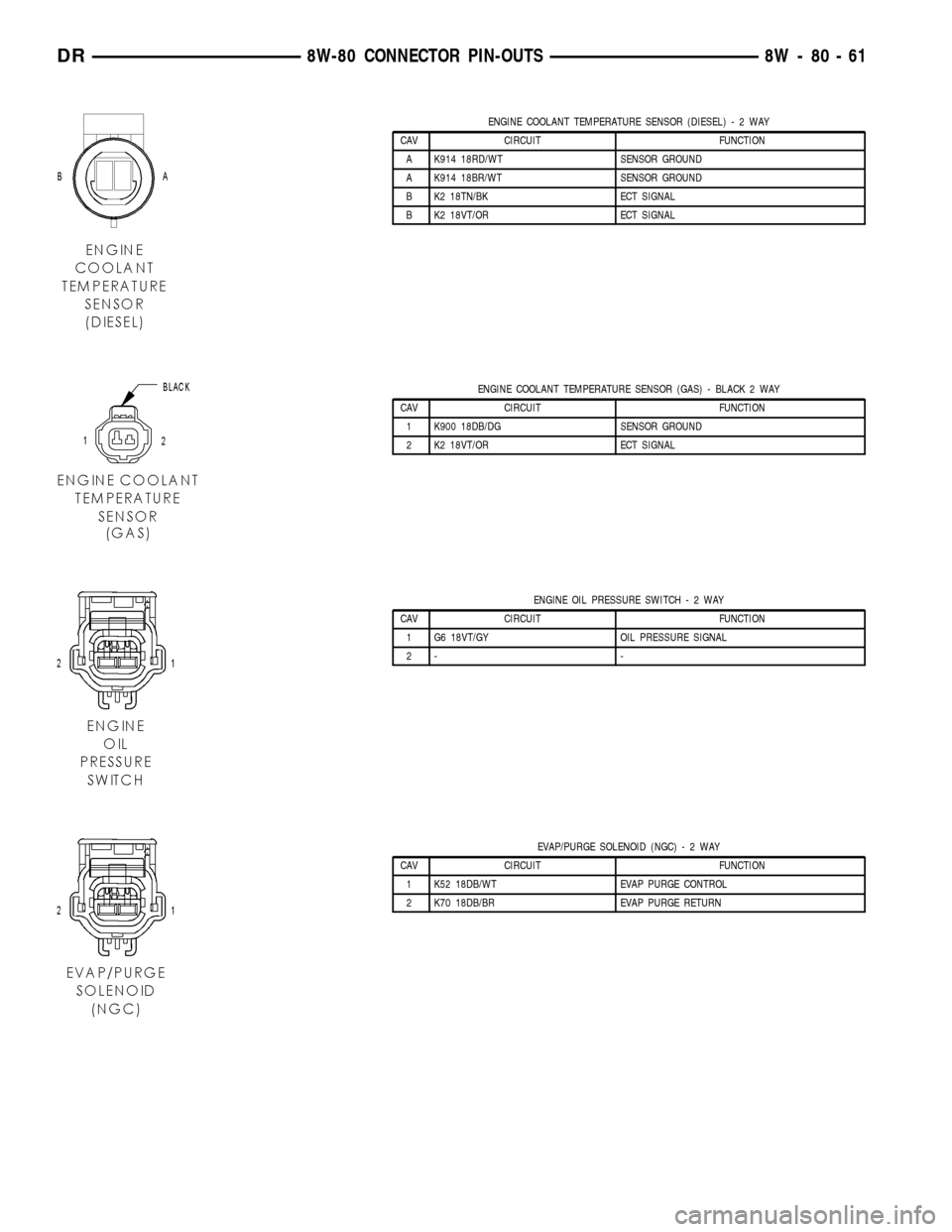
ENGINE COOLANT TEMPERATURE SENSOR (DIESEL)-2WAY
CAV CIRCUIT FUNCTION
A K914 18RD/WT SENSOR GROUND
A K914 18BR/WT SENSOR GROUND
B K2 18TN/BK ECT SIGNAL
B K2 18VT/OR ECT SIGNAL
ENGINE COOLANT TEMPERATURE SENSOR (GAS) - BLACK 2 WAY
CAV CIRCUIT FUNCTION
1 K900 18DB/DG SENSOR GROUND
2 K2 18VT/OR ECT SIGNAL
ENGINE OIL PRESSURE SWITCH-2WAY
CAV CIRCUIT FUNCTION
1 G6 18VT/GY OIL PRESSURE SIGNAL
2- -
EVAP/PURGE SOLENOID (NGC)-2WAY
CAV CIRCUIT FUNCTION
1 K52 18DB/WT EVAP PURGE CONTROL
2 K70 18DB/BR EVAP PURGE RETURN
DR8W-80 CONNECTOR PIN-OUTS 8W - 80 - 61