clock DODGE RAM 1999 Service Owner's Manual
[x] Cancel search | Manufacturer: DODGE, Model Year: 1999, Model line: RAM, Model: DODGE RAM 1999Pages: 1691, PDF Size: 40.34 MB
Page 372 of 1691
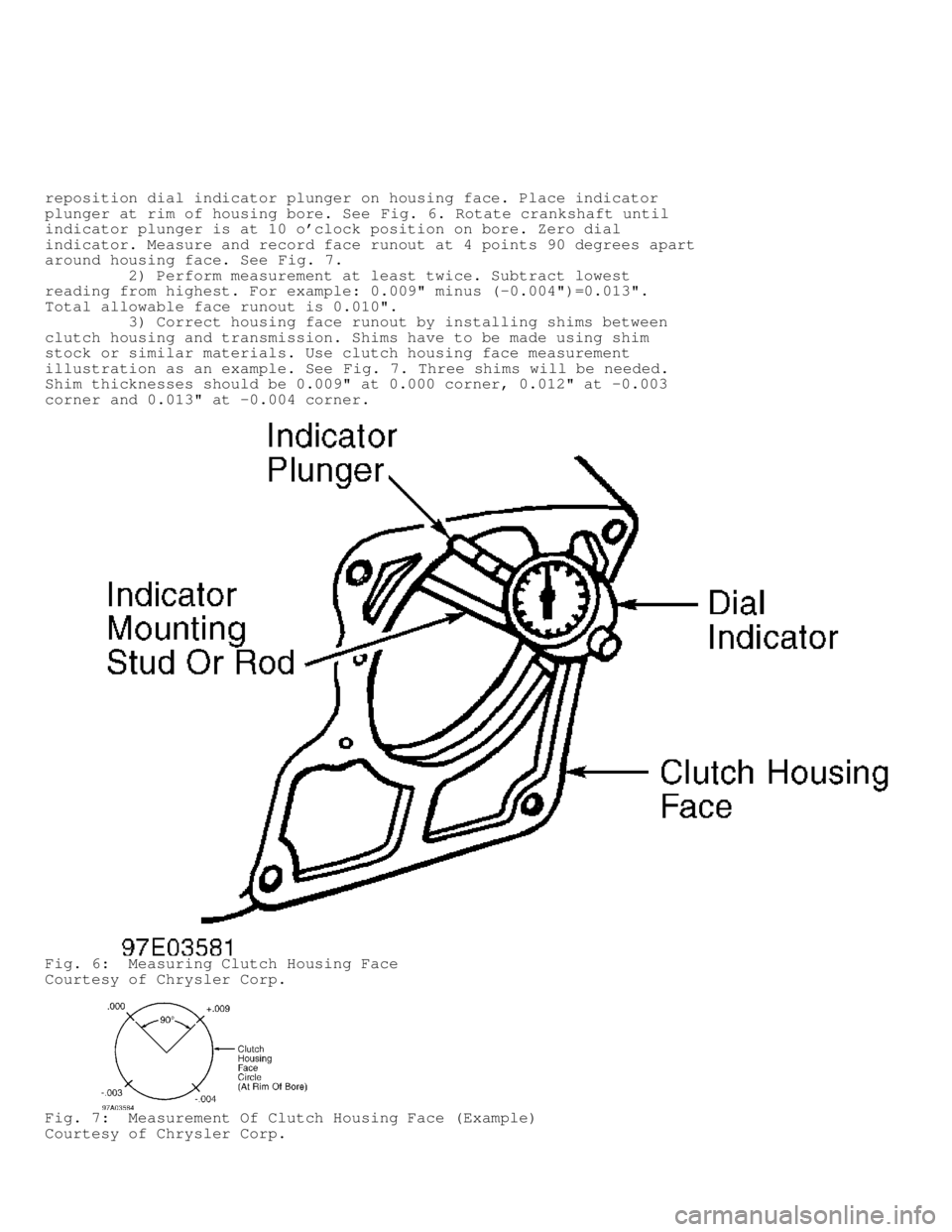
reposition dial indicator plunger on housing face. Place indicator
plunger at rim of housing bore. See Fig. 6. Rotate crankshaft until
indicator plunger is at 10 o'clock position on bore. Zero dial
indicator. Measure and record face runout at 4 points 90 degrees apart
around housing face. See Fig. 7.
2) Perform measurement at least twice. Subtract lowest
reading from highest. For example: 0.009" minus (-0.004")=0.013".
Total allowable face runout is 0.010".
3) Correct housing face runout by installing shims between
clutch housing and transmission. Shims have to be made using shim
stock or similar materials. Use clutch housing face measurement
illustration as an example. See Fig. 7. Three shims will be needed.
Shim thicknesses should be 0.009" at 0.000 corner, 0.012" at -0.003
corner and 0.013" at -0.004 corner.
Fig. 6: Measuring Clutch Housing Face
Courtesy of Chrysler Corp.
Fig. 7: Measurement Of Clutch Housing Face (Example)
Courtesy of Chrysler Corp.
Page 374 of 1691

Removal (AX15 & NV1500)
1) Shift gear selector into 1st or 3rd gear. Raise and
support vehicle. Disconnect necessary exhaust system components.
Remove "Y" pipe and position remaining pipes for working clearance.
Support transmission adjustable jackstand. Disconnect rear cushion and
mounting bracket from transmission or transfer case.
2) Remove rear crossmember. If transmission will be
disassembled for repair, drain transmission fluid. Disconnect
transmission shift linkage, speedometer cable, transfer case vacuum
lines and clutch hydraulic lines. Lower transmission/transfer case
assembly no more than 3" (76 mm). Reaching around transmission case,
unseat and lift shift lever dust boot. Press shift lever retainer
downward, turn retainer counterclockwise, and lift lever and retainer
out of shift tower.
3) Mark front and rear drive shaft and "U" joint for
reassembly reference. Disconnect and remove both drive shafts. Remove
crankshaft position sensor (AX15). Disconnect transmission/transfer
case assembly vent hoses. Remove slave cylinder from clutch housing.
Remove wire harness from clips on transmission case and transfer case.
4) Support transmission/transfer case assembly with
transmission jack. Secure assembly to jack with safety chains.
Reposition adjustable jackstand under engine. Remove clutch housing
brace rod. Remove clutch housing nuts and bolts. Remove
transmission/transfer case assembly.
Installation
To install, reverse removal procedure. Apply high-temperature
grease to release fork, lever, pivot ball stud and pilot bushing
located in end of crankshaft. Fill transmission with appropriate
fluid, if necessary. Tighten all nuts and bolts to specification. See
TORQUE SPECIFICATIONS table.
Removal (NV 3500)
1) Disconnect negative battery cable. Shift transmission to
Neutral. Open console lid and remove bolts attaching console to floor
pan. Lift cup holder bin and remove bolt attaching console to floor
pan. Lift rear of console and pull console rearward to separate from
shift bezel. Remove console from vehicle. Remove screws attaching
shift boot to floor pan and slide boot upward on lever extension.
2) Remove shift lever extension. Raise and support vehicle.
On 4WD models, remove skid plate, if equipped. Mark drive shaft and
axle yoke for alignment reference. Remove drive shaft. Remove exhaust
"Y" pipe. On 4WD models, disconnect and lower remaining exhaust pipes
for clearance as necessary. Disconnect speed sensor harness connector
and back-up light harness connector.
3) Support engine using adjustable jackstand. If transmission
is to be disassembled for repair, drain lubricant from transmission.
On 4WD models, disconnect transfer case shift linkage at transfer case
range lever and remove shift lever from transmission. Remove
bolts/nuts attaching transmission to rear mount.
4) Support transmission with a transmission jack. Secure
transmission with safety chains. Remove rear crossmember. On 4WD
models, support transfer case with transmission jack and secure
transfer case to jack with safety chains. Remove transfer case
attaching nuts and move transfer case rearward until input gear clears
transmission output shaft.
5) Lower transfer case assembly and remove it from under
vehicle. On 4WD models, remove clutch slave cylinder splash shield, if
equipped. Remove clutch slave cylinder and move aside for working
clearance. Remove starter. Remove transmission splash shield. Remove
transmission harness wires from clips on transmission shift cover.
6) Lower transmission slightly. Remove shift tower and lever
assembly. Remove transmission-to-engine attaching bolts. Slide
Page 378 of 1691
NOTE: Clutch release bearing is packed with grease. DO NOT use
cleaning solvent to clean release bearing.
Removal
1) Remove transmission and clutch housing. See TRANSMISSION
(DAKOTA) or TRANSMISSION (RAM PICKUP). Disconnect release bearing fr\
om
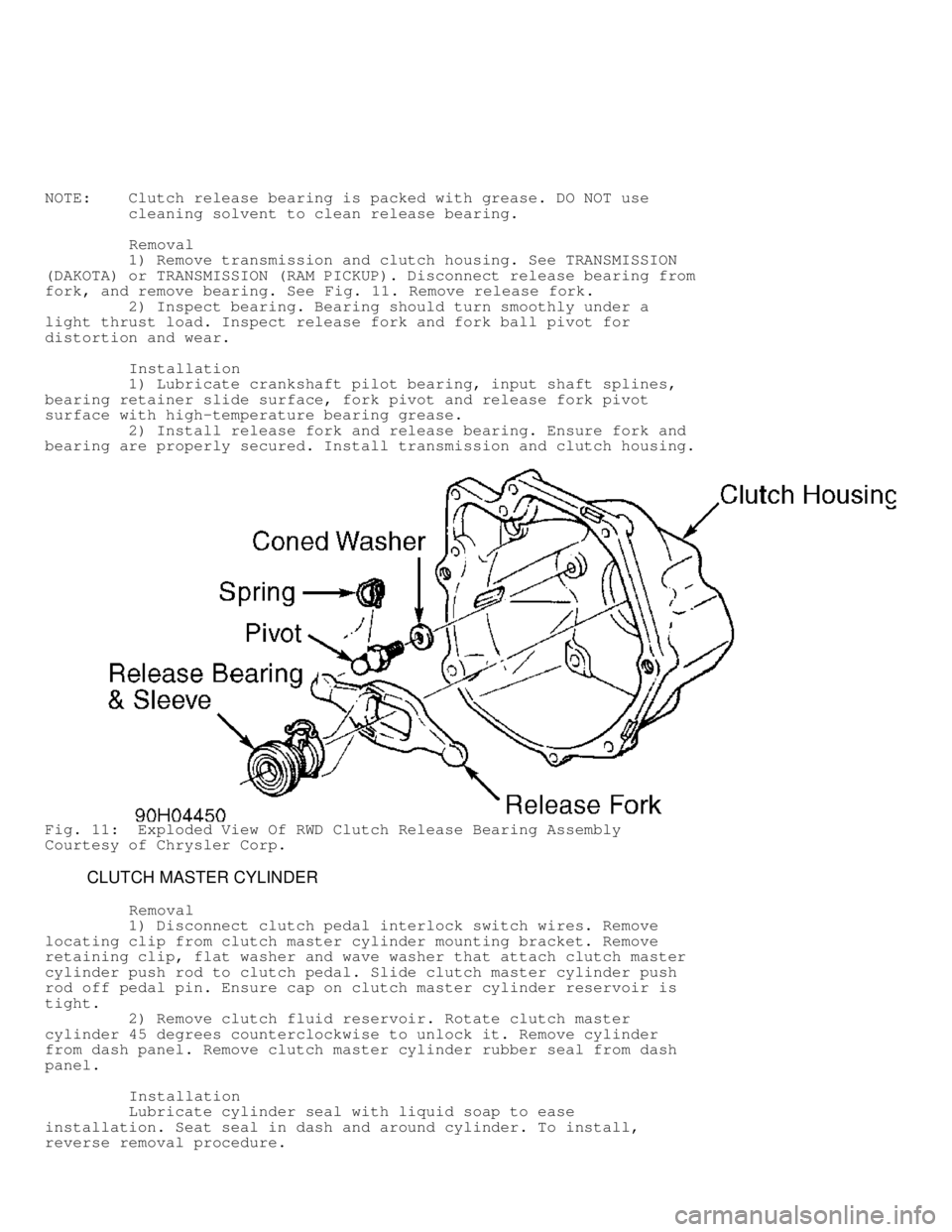
fork, and remove bearing. See Fig. 11. Remove release fork.
2) Inspect bearing. Bearing should turn smoothly under a
light thrust load. Inspect release fork and fork ball pivot for
distortion and wear.
Installation
1) Lubricate crankshaft pilot bearing, input shaft splines,
bearing retainer slide surface, fork pivot and release fork pivot
surface with high-temperature bearing grease.
2) Install release fork and release bearing. Ensure fork and
bearing are properly secured. Install transmission and clutch housing.
Fig. 11: Exploded View Of RWD Clutch Release Bearing Assembly
Courtesy of Chrysler Corp.
CLUTCH MASTER CYLINDER
Removal
1) Disconnect clutch pedal interlock switch wires. Remove
locating clip from clutch master cylinder mounting bracket. Remove
retaining clip, flat washer and wave washer that attach clutch master
cylinder push rod to clutch pedal. Slide clutch master cylinder push
rod off pedal pin. Ensure cap on clutch master cylinder reservoir is
tight.
2) Remove clutch fluid reservoir. Rotate clutch master
cylinder 45 degrees counterclockwise to unlock it. Remove cylinder
from dash panel. Remove clutch master cylinder rubber seal from dash
panel.
Installation
Lubricate cylinder seal with liquid soap to ease
installation. Seat seal in dash and around cylinder. To install,
reverse removal procedure.
Page 392 of 1691

No. 1 (Tan/Red wire). If resistance is less than 5 ohms, repair short
to ground. Perform TEST VER-4A under VERIFICATION TESTS. If resistance
is 5 ohms or more, go to next step.
10) Using an ohmmeter, check resistance between ground and
S/C vent solenoid control circuit at S/C servo connector terminal No.
2 (Light Green/Red wire). If resistance is less than 5 ohms, repair
short to ground. Perform TEST VER-4A under VERIFICATION TESTS. If
resistance is 5 ohms or more, go to next step.
11) Using an ohmmeter, measure resistance of S/C vacuum
solenoid control circuit between S/C servo connector terminal No. 1
and PCM connector C3, terminal No. 4 (Tan/Red wire). If resistance is
5 ohms or more, repair open circuit. Perform TEST VER-4A under
VERIFICATION TESTS. If resistance is less than 5 ohms, go to next
step.
12) Using an ohmmeter, check resistance of S/C vent solenoid
control circuit between S/C servo connector terminal No. 2 and PCM
connector C3, terminal No. 5 (Light Green/Red wire). If resistance is
5 ohms or more, repair open circuit. Perform TEST VER-4A under
VERIFICATION TESTS. If resistance is less than 5 ohms, replace S/C
servo. Perform TEST VER-4A under VERIFICATION TESTS.
13) Using an ohmmeter, check resistance between ground and
brake switch output circuit at S/C servo connector terminal No. 3
(Dark Blue/Red wire). If resistance is less than 5 ohms, repair short
to ground. Perform TEST VER-4A under VERIFICATION TESTS. If resistance
is 5 ohms or more, go to next step.
14) Reconnect PCM. Disconnect brake switch connector. Turn
ignition on. Turn S/C on. Using a 12-volt test light, probe S/C power
supply circuit at brake switch connector terminal No. 3 (Yellow/Red
wire). If test light is illuminated and bright, go to next step. If
test light is not illuminated or dim, go to step 17).
15) Turn ignition off. Using an ohmmeter, check resistance of
S/C brake switch output circuit between S/C servo connector terminal
No. 3 and brake switch connector terminal No. 4 (Dark Blue/Red wire).
If resistance is 5 ohms or more, repair open circuit. Perform TEST
VER-4A under VERIFICATION TESTS. If resistance is less than 5 ohms, go
to next step.
16) Check brake switch adjustment. See BRAKE SWITCH under
REMOVAL & INSTALLATION. Adjust as necessary. Perform TEST VER- 4A
under VERIFICATION TESTS. If brake switch adjustment is okay, replace
brake switch. Perform TEST VER-4A under VERIFICATION TESTS.
17) Turn ignition off. Disconnect PCM. Inspect connectors.
Clean or repair as necessary. Using an ohmmeter, measure resistance of
S/C power supply circuit between PCM connector C3, terminal No. 11 and
brake switch connector terminal No. 3 (Yellow/Red wire). If resistance\
is 5 ohms or more, repair open circuit. Perform TEST VER-4A under
VERIFICATION TESTS. If resistance is less than 5 ohms, replace PCM.
Perform TEST VER-4A under VERIFICATION TESTS.
FTC P1596: SPEED CONTROL SWITCH ALWAYS HIGH
FTC P1596 will set if an open circuit is detected in Speed
Control (S/C) switch circuit when ignition is on.
Possible Causes:
* Defective clockspring.
* S/C switch ground circuit open.
* Defective ON/OFF switch.
* Defective PCM.
* S/C switch signal circuit open or shorted to voltage.
NOTE: For component locations, see COMPONENT LOCATIONS. For
connector terminal identification, see CONNECTOR
Page 393 of 1691

IDENTIFICATION. For wiring diagram, see WIRING DIAGRAMS.
1) Turn ignition on. Using scan tool, read S/C inputs. While
observing display, press S/C ON/OFF switch several times and leave on.
If scan tool displays S/C switch OFF and ON, go to next step. If scan
tool does not display OFF and ON, go to step 3).
2) Using scan tool, measure S/C switch voltage. While
observing display, wiggle wiring between S/C switch and PCM. If
voltage was more than 4.9 volts at any time during wiggling, repair
wiring as necessary. Perform TEST VER-4A under VERIFICATION TESTS. If
voltage was 4.9 volts or less during wiggling, test is complete.
3) Turn ignition off. Disconnect S/C ON/OFF switch. Inspect
connector. Clean or repair as necessary. Using an ohmmeter, measure
resistance of S/C switch ground circuit. If resistance is 5 ohms or
more, repair open ground circuit. Perform TEST VER-4A under
VERIFICATION TESTS. If resistance is less than 5 ohms, go to next
step.
4) Turn ignition on. Using a voltmeter, measure voltage on
S/C switch signal circuit. If voltage is more than 6 volts, repair
short to voltage. Perform TEST VER-4A under VERIFICATION TESTS. If
voltage is 6 volts or less, go to next step.
5) Turn ignition off. Disconnect PCM. Inspect connectors.
Clean or repair as necessary. Using an ohmmeter, measure resistance of
S/C switch signal circuit between ON/OFF switch connector and PCM
connector C3, terminal No. 32 (White/Light Green wire on Ram Van & Ram
Wagon; Red/Light Green wire on all other models). If resistance is
less than 5 ohms, go to next step. If resistance is 5 ohms or more, go
to step 7).
6) Using an ohmmeter, measure resistance across ON/OFF
switch. Resistance should be 20,300-20,700 ohms. If resistance is not
as specified, replace ON/OFF switch. Perform TEST VER-4A under
VERIFICATION TESTS. If resistance is as specified, replace PCM.
Perform TEST VER-4A under VERIFICATION TESTS.
7) Disconnect clockspring 5-pin connector. Clockspring 5-pin
connector is located behind lower steering column shroud. Inspect
connectors. Clean or repair as necessary. Using an ohmmeter, measure
resistance of S/C switch signal circuit between PCM connector C3,
terminal No. 32 and clockspring connector (White/Light Green wire on
Ram Van and Ram Wagon; Red/Light Green wire on all other models). If
resistance is 5 ohms or more, repair open circuit. Perform TEST VER-4A
under VERIFICATION TESTS. If resistance is less than 5 ohms, replace
clockspring. See appropriate AIR BAG RESTRAINT SYSTEMS article.
Perform TEST VER-4A under VERIFICATION TESTS.
FTC P1597: SPEED CONTROL SWITCH ALWAYS LOW
FTC P1597 will set if Speed Control (S/C) switch voltage is
less than 0.39 volts for 2 minutes when ignition is on and battery
voltage is more than 10.4 volts.
Possible Causes:
* S/C ON/OFF switch defective.
* S/C RESUME/ACCEL switch defective.
* S/C switch signal circuit shorted to ground.
* Defective PCM.
* Defective clockspring.
NOTE: For component locations, see COMPONENT LOCATIONS. For
connector terminal identification, see CONNECTOR
IDENTIFICATION. For wiring diagram, see WIRING DIAGRAMS.
1) Turn ignition on. Using scan tool, read S/C switch
Page 394 of 1691

voltage. If voltage is less than one volt, go to next step. If voltage
is one volt or more, condition to set FTC is not present at this time.
Test is complete.
2) While observing scan tool, disconnect S/C ON/OFF switch.
If S/C switch voltage changes to 5 volts, replace S/C ON/OFF switch.
Perform TEST VER-4A under VERIFICATION TESTS. If voltage does not
change to 5 volts, go to next step.
3) While observing scan tool, disconnect S/C RESUME/ACCEL
switch. If S/C switch voltage changes to 5 volts, replace S/C
RESUME/ACCEL switch. Perform TEST VER-4A under VERIFICATION TESTS. If
voltage does not change to 5 volts, go to next step.
4) Turn ignition off. Ensure both S/C switches are still
disconnected. Using an ohmmeter, check resistance between S/C switch
connector terminals (S/C switch signal circuit and S/C switch ground
circuit). If resistance is less than 5 ohms, repair short circuit.
Perform TEST VER- 4A under VERIFICATION TESTS. If resistance is 5 ohms
or more, go to next step.
5) Disconnect clockspring 4-pin connector. Clockspring 4-pin
connector is located behind steering wheel. Inspect connector. Clean
or repair as necessary. Using an ohmmeter, check resistance between
ground and S/C switch signal circuit at clockspring connector (Dark
Green/Red wire on all models except Ram Van and Ram Wagon; wire color
is not available for Ram Van and Ram Wagon). If resistance is less
than 5 ohms, repair short to ground. Perform TEST VER-4A under
VERIFICATION TESTS. If resistance is 5 ohms or more, go to next step.
6) Disconnect PCM. Inspect connectors. Clean or repair as
necessary. Using an ohmmeter, check resistance between ground and S/C
switch signal circuit at either S/C switch connector (Dark Green/Red
wire on all models except Ram Van and Ram Wagon; wire color is not
available for Ram Van and Ram Wagon). If resistance is less than 5
ohms, repair short to ground. Perform TEST VER-4A under VERIFICATION
TESTS. If resistance is 5 ohms or more, replace PCM. Perform TEST VER-
4A under VERIFICATION TESTS.
FTC P1683: SPEED CONTROL POWER RELAY CIRCUIT
FTC P1683 will set if Speed Control (S/C) power supply
circuit is open or shorted when S/C is turned on.
Possible Causes:
* Brake switch out of adjustment.
* S/C brake switch output circuit open or shorted.
* Defective S/C servo.
* Defective brake switch.
* S/C vacuum or vent solenoid control circuits open or
shorted.
* Defective PCM.
* Ground circuit open.
* S/C power supply circuit open.
NOTE: For component locations, see COMPONENT LOCATIONS. For
connector terminal identification, see CONNECTOR
IDENTIFICATION. For wiring diagram, see WIRING DIAGRAMS.
NOTE: Ensure brake pedal is not depressed during the following
steps.
1) Turn ignition off. Disconnect S/C servo connector. Inspect
connector. Clean or repair as necessary. Turn ignition on. Using scan
tool, actuate S/C relay. Using a 12-volt test light, probe S/C brake
switch output circuit at S/C servo connector terminal No. 3 (Dark
Blue/Red wire). If test light is illuminated and bright, go to next
Page 399 of 1691

* Signal circuit open or shorted.
* S/C ON/OFF switch defective.
* S/C RESUME/ACCEL switch defective.
* Defective PCM.
* Defective clockspring.
1) Turn ignition on. Using scan tool, read S/C switch
voltage. If voltage is more than 4 volts, go to next step. If voltage
is 4 volts or less, go to step 4).
2) Turn ignition off. Disconnect S/C ON/OFF switch. Inspect
connector. Clean or repair as necessary. Connect a jumper wire between
ground and S/C switch signal circuit at S/C ON/OFF switch connector
(Dark Green/Red wire on all models except Ram Van and Ram Wagon; wire
color is not available for Ram Van and Ram Wagon). Turn ignition on.
Using scan tool, read S/C switch voltage. If voltage is less than one
volt, replace S/C ON/OFF switch. Perform TEST VER-4A under
VERIFICATION TESTS. If voltage is one volt or more, go to next step.
3) Using a voltmeter, measure voltage on S/C switch signal
circuit. If voltage is less than 4 volts, repair high resistance in
S/C switch signal circuit. Perform TEST VER-4A under VERIFICATION
TESTS. If voltage is more than 6 volts, repair short to voltage.
Perform TEST VER-4A under VERIFICATION TESTS. If voltage is 4-6 volts,
replace PCM. Perform TEST VER-4A under VERIFICATION TESTS.
4) Turn ignition off. Disconnect S/C ON/OFF switch.
Disconnect PCM. Inspect connectors. Clean or repair as necessary.
Using an ohmmeter, measure resistance between ground and S/C switch
signal circuit at PCM connector C3, terminal No. 32 (White/Light Green
wire on Ram Van & Ram Wagon; Red/Light Green wire on all other
models). If resistance is less than 5 ohms, repair short to ground.
Perform TEST VER-4A under VERIFICATION TESTS. If resistance is 5 ohms
or more, go to next step.
5) Reconnect PCM. Ensure S/C ON/OFF switch is still
disconnected. Turn ignition on. Using scan tool, read S/C switch
voltage. If voltage is more than 4 volts, replace ON/OFF switch.
Perform TEST VER-4A under VERIFICATION TESTS. If voltage is 4 volts or
less, go to next step.
6) Disconnect RESUME/ACCEL switch. Using scan tool, read S/C
switch voltage. If voltage is more than 4 volts, replace RESUME/ACCEL
switch. Perform TEST VER-4A under VERIFICATION TESTS. If voltage is 4
volts or less, go to next step.
7) Disconnect clockspring connector located behind lower
steering column shroud. Inspect connector. Clean or repair as
necessary. Using scan tool, read S/C switch voltage. If voltage is
more than 4 volts, replace clockspring. See AIR BAG RESTRAINT SYSTEMS
- TRUCKS article. Perform TEST VER-4A under VERIFICATION TESTS. If
voltage is 4 volts or less, test is complete.
NTC-4: SPEED CONTROL RESUME/ACCEL SWITCH
Possible Causes:
* Ground circuit open.
* RESUME/ACCEL switch defective.
* Signal circuit open.
1) Turn ignition off. Disconnect RESUME/ACCEL switch. Inspect
connectors. Clean or repair as necessary. Connect a jumper wire
between ground and S/C switch signal circuit at RESUME/ACCEL switch
connector (Dark Green/Red wire on all models except Ram Van and Ram
Wagon; wire color is not available for Ram Van and Ram Wagon). Turn
ignition on. Using scan tool, read S/C switch voltage. If voltage is
less than one volt, replace RESUME/ACCEL switch. Perform TEST VER-4A
Page 402 of 1691

Fully depress brake pedal and rotate brake switch
counterclockwise approximately 30 degrees. Remove brake switch from
bracket. Depress lock tabs holding brake switch mounting bracket and
separate harness connector from brake switch.
Installation
1) Before installing brake switch, reset adjustable plunger
by pulling on plunger head until plunger reaches end of travel.
Connect harness connector to brake switch. Depress brake pedal and
insert brake switch into keyed hole in mounting bracket. Rotate brake
switch clockwise into locked position.
2) Gently pull back on brake pedal until pedal will go no
further. This causes the brake switch plunger to ratchet backward to
the correct position. No further adjustment is required.
SPEED CONTROL SERVO
Removal (Except Ram Van & Ram Wagon)
1) Disconnect negative battery cable. Disconnect electrical
connector and vacuum hose from servo. Using finger pressure only, push
servo cable connector from throttle body bellcrank pin. DO NOT pull
cable connector perpendicular to bellcrank.
2) Remove 2 servo cable mounting nuts. Pull servo cable
sleeve away from mounting bracket to expose cable retaining clip.
Remove retaining clip. Remove servo.
Removal (Ram Van & Ram Wagon)
1) Disconnect negative battery cable. Remove engine cover.
Remove air cleaner assembly. Using finger pressure only, push servo
cable connector from throttle body bellcrank pin. DO NOT pull cable
connector perpendicular to bellcrank.
2) Remove right headlight assembly. Disconnect vacuum hose
and electrical connector at servo. Remove 2 servo mounting bracket
bolts. Remove 2 servo cable mounting nuts. Pull servo cable sleeve
away from mounting bracket to expose cable retaining clip. Remove
retaining clip. Remove servo.
Installation (All Models)
With throttle in full open position, align hole in speed
control cable sleeve with hole in servo pin. Install retaining clip.
To complete installation, reverse removal procedure. Tighten mounting
bolts/nuts to 75 INCH lbs. (8.5 N.m).
SPEED CONTROL SWITCHES
Removal & Installation
Turn ignition off. Disconnect negative battery cable. Wait 2
minutes for air bag system to discharge reserve voltage. Remove 2
screws holding air bag assembly to steering column. Separate air bag
assembly from steering column and disconnect air bag, horn and speed
control switch connectors. Remove screws securing speed control switch
to air bag assembly. Separate speed control switch from air bag
assembly. To install, reverse removal procedure.
WIRING DIAGRAMS
Page 630 of 1691

TROUBLE SHOOTING
NOTE: To trouble shoot mechanical engine components, see
appropriate table in TROUBLE SHOOTING article in GENERAL
INFORMATION.
REMOVAL & INSTALLATION
CAUTION: When battery is disconnected, vehicle computer and memory
systems may lose memory data. Driveability problems may exist
until computer systems have completed a relearn cycle. See
COMPUTER RELEARN PROCEDURES article in GENERAL INFORMATION
before disconnecting battery.
NOTE: For installation reference, label all electrical connectors,
vacuum hoses and fuel lines before removal. Also place mating
marks on engine hood and other major assemblies before
removal.
FUEL PRESSURE RELEASE
CAUTION: Fuel system is under pressure. Pressure must be released
before servicing fuel system components.
Gasoline
1) Disconnect negative battery cable. Loosen fuel tank cap to
release tank pressure. Press on filler tube flap to relieve any
additional tank pressure.
NOTE: Fuel filler tube has spring-loaded flap located below fuel
fill cap to serve as secondary seal if fuel fill cap is not
tightened. It is part of EVAP monitor system when vehicle is
equipped with leak detection pump (LDP). Vehicle may be
equipped with flap installed into fuel filler tube even if
vehicle is NOT equipped with LDP and EVAP monitor system.
2) Remove fuel pump relay from Power Distribution Center
(PDC). For location of relay, refer to label on underside of PDC
cover. Start and run engine until it stalls. Attempt restarting engine
until it will no longer run.
3) Unplug connector from an injector. Attach one end of a
jumper wire (18 gauge or smaller) with alligator clips to either
injector terminal. Connect other end of jumper wire to positive side
of battery. Connect one end of a second jumper wire to remaining
injector terminal.
WARNING: Powering an injector for more than a few seconds will
permanently damage injector.
4) Touch other end of second jumper wire to negative terminal
of battery for no more than a few seconds. Place a rag below fuel
line. Disconnect quick-connect fitting at fuel rail. See FUEL LINE
DISCONNECT FITTINGS. Return fuel pump relay to PDC.
Compressed Natural Gas Fuel Tube Purging (5.2L)
1) Close control valve (clockwise) on all fuel cylinders.
Open manual shutoff valve (open when handle is parallel to fuel
tubes).
2) Start and operate engine until it runs out of fuel.
Attempt 3 more engine starts. If check valve or fuel fill receptacle
Page 631 of 1691

is to be serviced, slowly loosen inlet side of fuel fill tube fitting
at check valve. It is normal for approximately 25 psi of residual
natural gas pressure to flow from loosened fitting. At this point, all
fuel tubes are purged of natural gas between fuel cylinders and
engine. It is now okay to open fuel system.
WARNING: Fuel cylinders still contain high-pressure fuel.
Compressed Natural Gas Fuel Cylinder Purging (5.2L)
1) Open manual shutoff valve. Open only fuel control valve(s)\
(counterclockwise) on fuel cylinder(s) to be serviced. Close all oth\
er
control valve(s) (clockwise) on fuel cylinder(s) not being service\
d.
2) Start and operate engine until it runs out of fuel.
Attempt 3 more engine starts. At this point, all fuel tubes and opened
cylinders are purged of natural gas between fuel cylinders and engine.
It is now okay to open fuel system.
WARNING: Fuel cylinders not being serviced still contain high-pressure
fuel.
FUEL LINE DISCONNECT FITTINGS
Removal & Installation (Tab Type Fitting)
1) Release fuel pressure. See FUEL PRESSURE RELEASE.
Disconnect negative battery cable. Ensure area around fuel line and
disconnect fitting is clean. Place shop towel around fuel line.
2) On 2-tab connectors, squeeze retainer tabs together and
pull fuel tube/quick-connect fitting assembly off of fuel tube nipple.
On single-tab connectors, use screwdriver to pry up pull tab. See
Fig. 1 . Raise pull tab until it separates from quick-connect fitting.
Discard old pull tab. Disconnect quick-connect fitting from fuel line.
CAUTION: DO NOT install a quick-connect fitting without retainer being
either in fuel tube or already in quick-connect fitting.
After installing fuel line in disconnect fitting, pull on
fuel line and disconnect fitting to ensure fuel line is
locked in place.
3) To install, coat fuel tube nipple with clean 30W engine
oil. Insert quick-connect fitting into fuel tube until stop on fuel
tube rests against back of quick-connect fitting.
4) On single-tab connectors, obtain NEW pull tab. Push tab
down until it locks into quick-connect fitting. On 2-tab connectors,
firmly pull on fuel tube and fitting to ensure retainer and quick-
connect fitting are locked.
Removal & Installation (Retainer Type Fitting)
1) Release fuel pressure. See FUEL PRESSURE RELEASE.
Disconnect negative battery cable. Ensure area around fuel line and
disconnect fitting is clean. Place shop towel around fuel line.
2) Pull backward on disconnect fitting while depressing
plastic ring into disconnect fitting. See Fig. 2. Separate fuel line
from disconnect fitting.
NOTE: Plastic retainer ring must be pressed squarely into fitting
body. If retainer is cocked during removal, it may be
difficult to disconnect fitting. Use open-end wrench on
shoulder of plastic retainer to ease disconnection.
3) To install, ensure plastic ring is in outward position
(away from disconnect fitting). If plastic ring is in inward position
(toward disconnect fitting), disconnect fitting must be replaced.
4) Lubricate end of fuel line with 30W engine oil. Insert