clock DODGE RAM 1999 Service User Guide
[x] Cancel search | Manufacturer: DODGE, Model Year: 1999, Model line: RAM, Model: DODGE RAM 1999Pages: 1691, PDF Size: 40.34 MB
Page 174 of 1691
protective cover is fitted to front of air bag module bearing the SRS
air bag logo. Air bag module contains air bag cushion, inflator and
supporting components. Air bag module is a sealed unit and is not
serviceable. The module inflator assembly produces nitrogen gas to
fill air bag cushion when a small amount of current from ACM is
applied to the ignitor assembly. Gas pressure builds and discharges
from inflator through a diffuser and screen assembly, forcing steering
wheel cover to burst along its seams until air bag is fully inflated.
Once air bag cushion is fully inflated, gas escapes from bag through
vents, away from driver.
Passenger-Side
Air bag module is mounted to instrument panel mounting
bracket. Module is covered by a protective door bearing the SRS air
bag logo. When supplied an electrical signal, inflator will discharge
argon gas directly into air bag. When air bag inflates, protective
door will pivot aside allowing air bag to deploy.
AIR BAG CONTROL MODULE (ACM)
ACM is located under instrument panel, on transmission
tunnel. Impact sensor, energy reserve capacitor and On-Board
Diagnostics (OBD) are an integral part of ACM. ACM monitors critical
input and output circuits within air bag system, ensuring they are
operating correctly. Some circuits are tested continuously; others are
checked only under certain conditions. ACM provides information about
air bag system through AIR BAG warning light and Data Link Connector
(DLC). When diagnostic trouble code (fault message) is stored, AIR B\
AG
warning light will be activated for 12 seconds or more.
DATA LINK CONNECTOR (DLC)
DLC is located under left side of instrument panel, left of
steering column. DLC is used to access SRS on-board diagnostics.
CLOCKSPRING
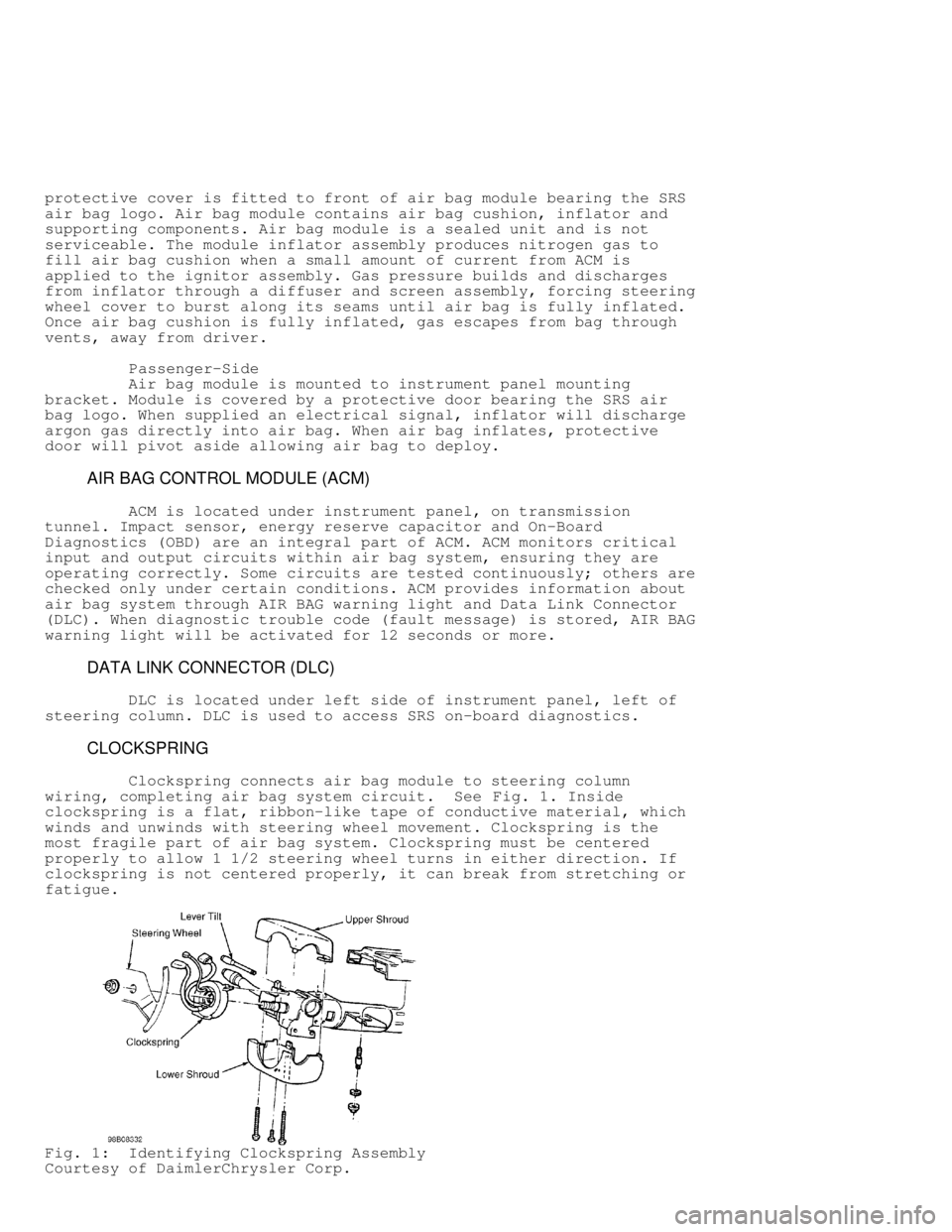
Clockspring connects air bag module to steering column
wiring, completing air bag system circuit. See Fig. 1. Inside
clockspring is a flat, ribbon-like tape of conductive material, which
winds and unwinds with steering wheel movement. Clockspring is the
most fragile part of air bag system. Clockspring must be centered
properly to allow 1 1/2 steering wheel turns in either direction. If
clockspring is not centered properly, it can break from stretching or
fatigue.
Fig. 1: Identifying Clockspring Assembly
Courtesy of DaimlerChrysler Corp.
Page 177 of 1691

WARNING: Vehicle interior will contain sodium hydroxide powder, a
by-product of air bag deployment. Since this powder can
irritate skin, eyes, nose, or throat, be sure to wear
safety glasses, rubber gloves and long-sleeved shirt
during clean-up.
1) Begin clean-up by putting tape over air bag exhaust vent,
so no additional powder will escape into vehicle interior. Remove air
bag modules. Use a vacuum cleaner to remove any residual powder from
vehicle interior. To avoid kneeling or sitting on a non-cleaned area,
clean from outside vehicle and work your way inside.
2) Remove any residual powder from A/C-heater outlets. Turn
blower motor to low for a few minutes and exit vehicle. Turn blower
off. Vacuum any additional powder expelled from plenum. Vacuum
interior a second time to recover all powder.
DEPLOYED AIR BAG
Dispose of deployed air bag module as any other part. No
special disposal procedure is required.
UNDEPLOYED AIR BAG
NOTE: Information on passenger-side air bag deployment is not
available from manufacturer.
Procedure 1: In-Vehicle Deployment (Driver-Side Air Bag)
1) Use this procedure if scrapping a vehicle with an
undeployed air bag. This procedure assumes that air bag wiring is
intact.
2) Disconnect and shield negative battery cable. Disconnect
2-pin clockspring at base of steering column. Cut 2-pin clockspring
connector of at clockspring side of harness.
3) Strip 1" (25 mm) of insulation from wire ends. Make a
harness consisting of 2 wires 20 feet or longer. Connect 20-foot wires
to clockspring harness. Ensure there are no loose parts in passenger
compartment and no one is within 20 feet of vehicle.
4) Staying at least 20 feet away from vehicle, connect other
2 ends of 20 foot wires to terminals of a 12-volt battery. When
deployment is achieved, loud bang will be heard and air bag will
inflate. After air bag module deploys, let module cool and dust settle
before approaching. If air bag fails to deploy, go to PROCEDURE 2.
Procedure 2: Remote Deployment (Driver-Side Air Bag)
1) Use this procedure if scrapping a vehicle with a live air
bag, but a problem in electrical system prevent deployment with air
bag still installed in vehicle. Also use this procedure if PROCEDURE 1
was unsuccessful.
WARNING: Perform remote deployment outdoors. Never attempt to deploy
air bag module inside a building, within 20 feet of
personnel, or with air bag trim cover face down.
2) Before proceeding, see SERVICE PRECAUTIONS. Disable air
bag system. See DISABLING & ACTIVATING AIR BAG SYSTEM . Remove air bag
module. See DRIVER-SIDE AIR BAG MODULE under REMOVAL & INSTALLATION.
3) cut pigtail wiring harness between clockspring and air bag
as close to clockspring housing as possible. Reconnect other end of
pigtail harness back into air bag module.
4) Strip 1" (25 mm) of insulation from cut ends of harness.
Place air bag module face (trim cover) up. Connect two 20-foot wires
to end of harness wires. Move 20 feet away. Connect other end of 200-
Page 180 of 1691

CAUTION: When removing a deployed air bag, wear eye protection, rubber
gloves and a long-sleeve shirt. Powder residue from air bag
deployment may irritate skin and eyes.
CAUTION: Before removing steering wheel, position front wheels in
straight-ahead position and lock steering column by removing
ignition key. Failure to do so could damage clockspring or
cause clockspring to be off-centered. DO NOT hammer on
steering wheel during removal, or collapsible column could be
damaged.
Removal
1) Before proceeding, see SERVICE PRECAUTIONS. Disable air
bag system. See DISABLING & ACTIVATING AIR BAG SYSTEM . Air bag module
is mounted on face of steering wheel. Ensure wheels are pointed
straight-ahead and steering wheel is locked.
2) Remove air bag module-to-steering wheel screws from back
side of steering wheel. Lift air bag module and disconnect electrical
connectors from rear of module.
Installation
Connect air bag, cruise control and horn harness connectors
to rear of air bag module. Secure module to steering wheel. Tighten
air bag module-to-steering wheel screws to specification. See
TORQUE SPECIFICATIONS . DO NOT connect negative battery cable at this
time. Go to SYSTEM OPERATION CHECK .
PASSENGER-SIDE AIR BAG MODULE
Removal
1) Before proceeding, see SERVICE PRECAUTIONS. Disable air
bag system. See DISABLING & ACTIVATING AIR BAG SYSTEM .
2) Open glove box. Holding glove box door, push center of
glove box bin towards front of vehicle. Flex glove box bin far enough
so glove box stops will clear sides of instrument panel opening. Roll
glove box down until stop bumpers are beyond sides of instrument panel
opening. Release bin. Lift bottom of glove box upward to disengage
hinge hooks form hinge pins.
3) Remove 3 screws securing instrument panel glove box
opening upper trim strip to instrument panel glove box opening upper
reinforcement, then remove trim strip. Remove 4 screws that secure 2
plastic support brackets of passenger-side air bag door panel outlet
housing to glove box opening upper reinforcement.
4) Reach through and above glove box opening to access and
disconnect air bag module harness connector. Remove 2 screws securing
passenger-side air bag module front bracket to instrument panel
structural support. Remove 3 screws securing passenger-side air bag
module rear bracket to glove box opening upper reinforcement.
5) Using trim stick, gently pry passenger-side air bag door
(starting at lower left edge) away from instrument panel top cover.
Remove air bag module, air bag door and panel outlet housing and
barrel assembly from instrument panel as a unit.
Installation
To install, reverse removal procedure. Ensure air bag door is
securely attached to instrument panel. Ensure air bag harness
connector latches fully engaged. DO NOT connect negative battery cable
at this time. Go to SYSTEM OPERATION CHECK .
CLOCKSPRING
CAUTION: Failure to position wheels in the straight-ahead position
with steering wheel locked when removing steering wheel could
Page 181 of 1691

damage clockspring and/or require clockspring to be
readjusted.
NOTE: Clockspring is self-centering and will automatically lock in
the centered position when steering wheel is removed.
Adjustment is only required if centering position is
disturbed.
Removal
1) Before proceeding, see SERVICE PRECAUTIONS. Disable air
bag system. See DISABLING & ACTIVATING AIR BAG SYSTEM .
2) Clockspring is located behind steering wheel. See Fig. 1.
Ensure front wheels are in straight-ahead position. Lock steering
wheel. Remove air bag module. See AIR BAG MODULE.
3) Remove steering wheel nut. Using appropriate steering
wheel puller, remove steering wheel. When steering wheel is removed,
self-centering clockspring will automatically lock in place. Remove
upper and lower steering column shrouds to gain access to clockspring
wiring.
4) Remove knee bolster (if equipped). Disconnect Yellow 2-wa\
y
clockspring harness connector between clockspring and instrument panel
wiring harness, at base of steering column. See Fig. 13. Remove
clockspring by releasing 2 tabs on side of clockspring. Clockspring
cannot be repaired and must be replaced if faulty.
Installation
1) Snap clockspring onto steering column. If clockspring
centering adjustment is disturbed, adjust clockspring before
installing steering wheel. See CLOCKSPRING CENTERING under
ADJUSTMENTS. Connect clockspring wiring connectors. Install steering
column covers. Install knee bolster (if removed).
2) Position steering wheel on steering column. Ensure flats
on steering wheel hub fit formations on inside of clockspring. Pull
clockspring, cruise control switch (if equipped) and horn wires
through lower large holes and upper small holes in steering wheel.
3) Install steering wheel retaining nut and tighten to 45 ft.
lbs. (61 N.m). Connect horn and cruise control wires (if equipped).
Connect clockspring wire to air bag module. To ensure complete
connector connection, latching arms must be visible on top of
connector housing. DO NOT connect negative battery cable at this time.
Go to SYSTEM OPERATION CHECK .
PASSENGER AIR BAG DISARM (PAD) SWITCH
Removal & Installation
1) Before proceeding, see SERVICE PRECAUTIONS. Disable air
bag system. See DISABLING & ACTIVATING AIR BAG SYSTEM .
2) If vehicle is equipped with automatic transmission, turn
ignition switch to UNLOCK position, set parking brake and place
transmission selector lever in LOW position. Tilt steering column to
lowest position (if equipped). Using trim stick, gently pry around
perimeter of cluster bezel and remove bezel.
3) Open glove box. Holding glove box door, push center of
glove box bin towards front of vehicle. Flex glove box bin far enough
so glove box stops will clear sides of instrument panel opening. Roll
glove box down until stop bumpers are beyond sides of instrument panel
opening. Release bin. Lift bottom of glove box upward to disengage
hinge hooks form hinge pins.
4) Reach through glove box opening to access and disconnect 2
passenger-side air bag disarm switch harness connectors. Connectors
are attached to bracket located on inboard glove box opening
reinforcement. See Fig. 4. Remove 3 screws retaining passenger-side
air bag disarm switch bezel to instrument panel.
Page 183 of 1691
CLOCKSPRING CENTERING
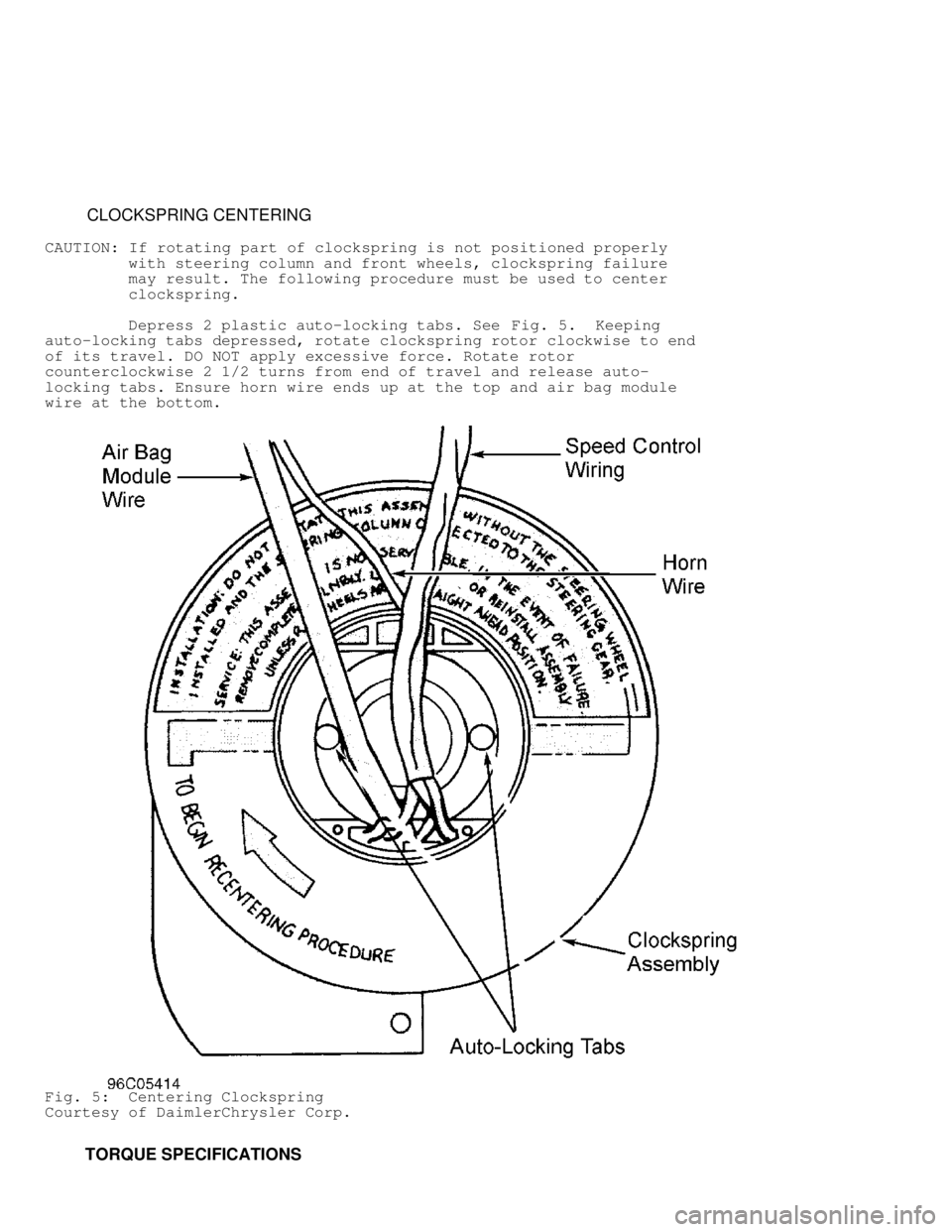
CAUTION: If rotating part of clockspring is not positioned properly
with steering column and front wheels, clockspring failure
may result. The following procedure must be used to center
clockspring.
Depress 2 plastic auto-locking tabs. See Fig. 5. Keeping
auto-locking tabs depressed, rotate clockspring rotor clockwise to end
of its travel. DO NOT apply excessive force. Rotate rotor
counterclockwise 2 1/2 turns from end of travel and release auto-
locking tabs. Ensure horn wire ends up at the top and air bag module
wire at the bottom.
Fig. 5: Centering Clockspring
Courtesy of DaimlerChrysler Corp.
TORQUE SPECIFICATIONS
Page 190 of 1691
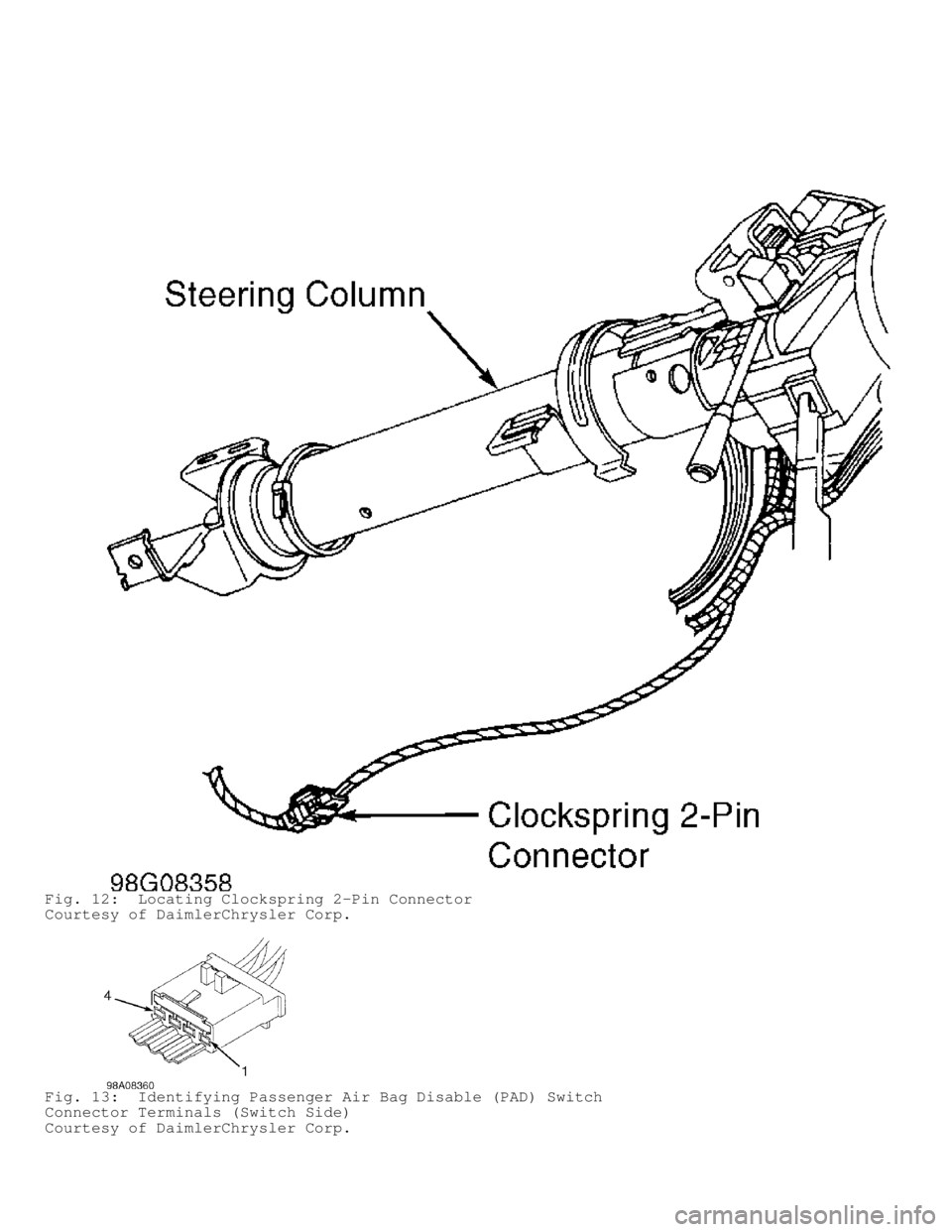
Fig. 12: Locating Clockspring 2-Pin Connector
Courtesy of DaimlerChrysler Corp.
Fig. 13: Identifying Passenger Air Bag Disable (PAD) Switch
Connector Terminals (Switch Side)
Courtesy of DaimlerChrysler Corp.
Page 194 of 1691
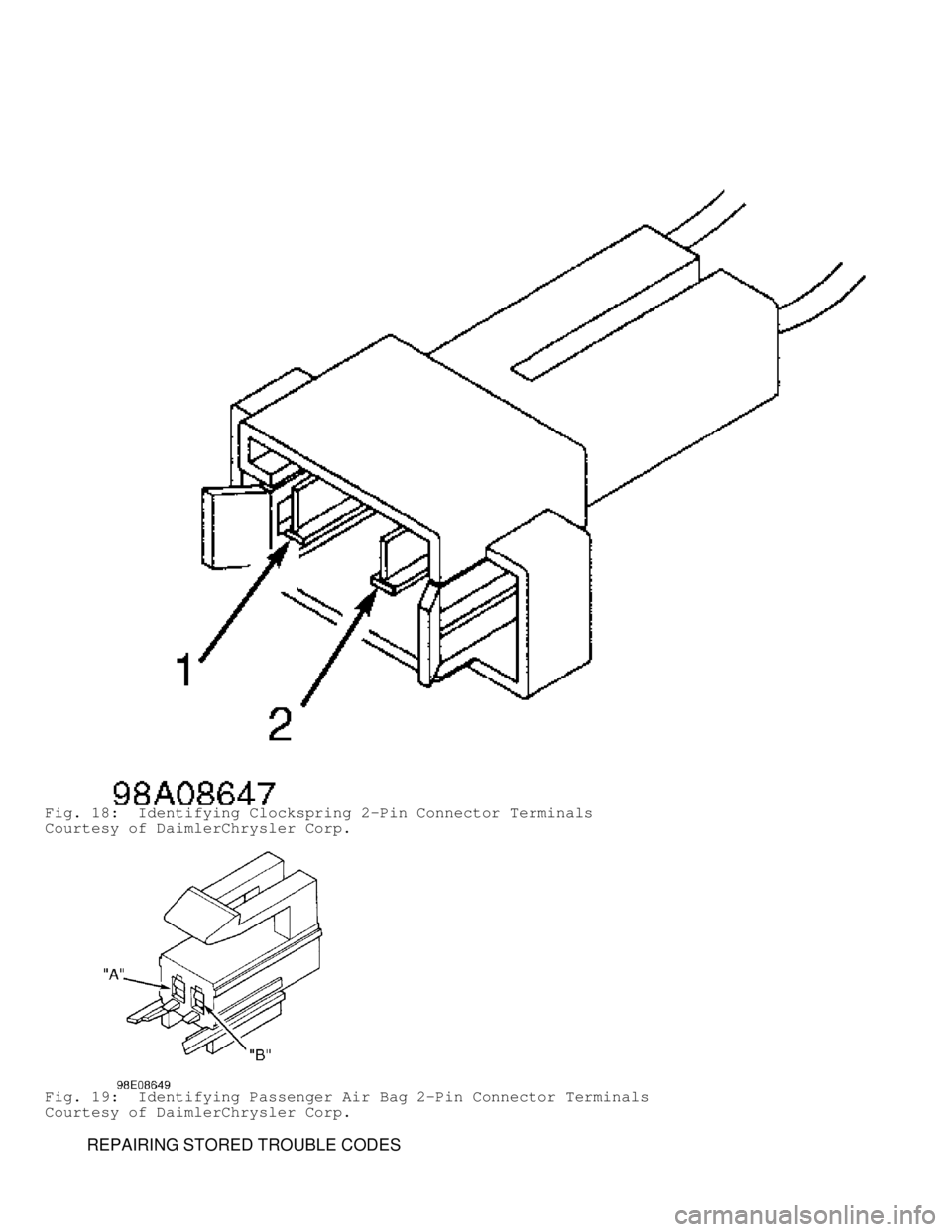
Fig. 18: Identifying Clockspring 2-Pin Connector Terminals
Courtesy of DaimlerChrysler Corp.
Fig. 19: Identifying Passenger Air Bag 2-Pin Connector Terminals
Courtesy of DaimlerChrysler Corp.
REPAIRING STORED TROUBLE CODES
Page 196 of 1691

it to ensure it is in good condition. Always focus on circuit
being tested. Dirt, water and corrosion, are most common
problems in connectors. Due to manufacturer changes in wire
colors, use terminal identification whenever possible.
1) Disconnect battery and wait 2 minutes before proceeding.
Disconnect driver-side air bag module squib connector. Connect a
jumper wire between driver-side air bag (squib) 2-pin connector
terminal No. 1 (Black/Light Blue wire) and terminal No. 2 (Dark
Green/Light Blue wire). Turn ignition on (engine off). Reconnect
battery. Using DRB, read active codes. If DRB displays DRIVER SQUIB
CIRCUIT SHORTED, replace driver-side air bag module. If not, go to
next step.
2) Disconnect clockspring 2-pin connector. Connect a jumper
wire between clockspring 2-pin connector terminals No. 1 (Black/Light
Blue wire) and No. 2 (Dark Green/Light Blue wire). Using DRB, read
active codes. If DRB displays DRIVER SQUIB CIRCUIT SHORTED, replace
clockspring. If not, go to next step.
3) Disconnect battery and wait 2 minutes before proceeding.
Remove jumper wires. Disconnect ACM connector. ACM is located under
instrument panel, on transmission tunnel. Using an ohmmeter, check
resistance between ACM connector terminal No. 6 (Dark Green/Light Blue
wire) and clockspring 2-pin connector terminal No. 2 (Dark Green/Light\
Blue wire). If resistance is less than 5 ohms, go to next step. If
resistance is more than 5 ohms, repair open or high resistance in Dark
Green/Light Blue wire.
4) Check resistance between ACM connector terminal No. 5
(Black/Light Blue wire) and clockspring 2-pin connector terminal No. 1\
(Black/Light Blue wire). If resistance is less than 5 ohms, go to next\
step. If resistance is more than 5 ohms, repair open or high
resistance in Black/Light Blue wire.
5) If there are no potential causes for this DTC remaining,
ACM is assumed to be defective. Replace ACM. See
AIR BAG CONTROL MODULE (ACM) under REMOVAL & INSTALLATION.
DRIVER SQUIB CIRCUIT SHORTED
NOTE: Perform AIR BAG VERIFICATION TEST after
all repairs. Each time a connector is disconnected, inspect
it to ensure it is in good condition. Always focus on circuit
being tested. Dirt, water and corrosion, are most common
problems in connectors. Due to manufacturer changes in wire
colors, use terminal identification whenever possible.
1) Disconnect battery and wait 2 minutes before proceeding.
Ensure driver-side air bag module connector is completely connected
before disconnecting it. If driver-side air bag module connector is
not completely connected, reconnect it. If driver-side air bag
connector is completely connected, go to next step.
2) Disconnect driver-side air bag module. Turn ignition on
(engine off). Reconnect battery. Using DRB, read active codes. If DRB
displays DRIVER SQUIB CIRCUIT OPEN, replace driver-side air bag
module. If not, go to next step.
3) Disconnect clockspring 2-pin connector. Using DRB, read
active codes. If DRB displays DRIVER SQUIB CIRCUIT OPEN, replace
clockspring. If not, go to next step.
4) Turn ignition off, disconnect battery and wait 2 minutes
before proceeding. Disconnect passenger-side air bag module connector.
Using an ohmmeter, check resistance between clockspring 2-pin
connector terminal No. 1 (Black/Light Blue wire) and passenger-side
air bag 2-pin connector terminal "A" (Black/Yellow wire). If
resistance is less than 5 ohms, repair short between Black/Light Blue
wire and Black/Yellow wire. If resistance is more than 5 ohms, go to
Page 197 of 1691
 Using an ohmmeter, check resistance between clockspring 2-
pin connector terminals No. 1 (Black/Light Blue wire) and No. 2 (Dark\
Green/Light Blue wire). If resistance is less")
next step.
5) Using an ohmmeter, check resistance between clockspring 2-
pin connector terminals No. 1 (Black/Light Blue wire) and No. 2 (Dark\
Green/Light Blue wire). If resistance is less than 5 ohms, repair
short between Dark Green/Light Blue wire and Black/Light Blue wire. If
resistance is more than 5 ohms, go to next step.
6) If there are no potential causes for this DTC remaining,
ACM is assumed to be defective. Replace ACM. See
AIR BAG CONTROL MODULE (ACM) under REMOVAL & INSTALLATION.
DRIVER SQUIB CIRCUIT SHORTED TO BATTERY
NOTE: Perform AIR BAG VERIFICATION TEST after
all repairs. Each time a connector is disconnected, inspect
it to ensure it is in good condition. Always focus on circuit
being tested. Dirt, water and corrosion, are most common
problems in connectors. Due to manufacturer changes in wire
colors, use terminal identification whenever possible.
1) Disconnect battery and wait 2 minutes before proceeding.
Disconnect driver-side air bag module. Turn ignition on and reconnect
battery. Using DRB, read active codes. If DRB does not display DRIVER
SQUIB CIRCUIT SHORTED TO VOLTAGE, replace driver-side air bag module.
If DRB displays DRIVER SQUIB CIRCUIT SHORTED TO VOLTAGE, go to next
step.
2) Disconnect clockspring 2-pin connector. Using DRB, read
active codes. If DRB does not display DRIVER SQUIB CIRCUIT SHORTED TO
VOLTAGE, replace clockspring. If DRB displays DRIVER SQUIB CIRCUIT
SHORTED TO VOLTAGE, go to next step.
3) Disconnect battery and wait 2 minutes before proceeding.
Disconnect ACM 23-pin connector. Using a voltmeter, check voltage
between ground and clockspring connector terminals No. 1 (Black/Light
Blue wire) and No. 2 (Dark Green/Light Blue wire). If voltage is more\
than 5 volts on either circuit, repair short to voltage in Dark
Green/Light Blue wire or Black/Light Blue wire. If voltage is less
than 5 volts on either circuit, go to next step.
4) If there are no potential causes for this DTC remaining,
ACM is assumed to be defective. Replace ACM. See
AIR BAG CONTROL MODULE (ACM) under REMOVAL & INSTALLATION.
DRIVER SQUIB CIRCUIT SHORTED TO GROUND
NOTE: Perform AIR BAG VERIFICATION TEST after
all repairs. Each time a connector is disconnected, inspect
it to ensure it is in good condition. Always focus on circuit
being tested. Dirt, water and corrosion, are most common
problems in connectors. Due to manufacturer changes in wire
colors, use terminal identification whenever possible.
1) Disconnect battery and wait 2 minutes before proceeding.
Disconnect driver-side air bag module. Turn ignition on (engine off)
and reconnect battery. Using DRB, read active codes. If DRB does not
display DRIVER SQUIB CIRCUIT SHORTED TO GROUND, replace driver-side
air bag module. If DRB displays DRIVER SQUIB CIRCUIT SHORTED TO
GROUND, go to next step.
2) Disconnect clockspring 2-pin connector. Using DRB, read
active codes. If DRB does not display DRIVER SQUIB CIRCUIT SHORTED TO
GROUND, replace clockspring. If DRB displays DRIVER SQUIB CIRCUIT
SHORTED TO GROUND, go to next step.
3) Disconnect battery and wait 2 minutes before proceeding.
Disconnect ACM 23-pin connector. Using an ohmmeter, check resistance
between ground and clockspring connector terminals No. 1 (Black/Light
Blue wire) and No. 2 (Dark Green/Light Blue wire). If resistance is
Page 201 of 1691
 and No. 3 (Black/Yellow wire). If resistance is more than 5 ohm\
s
on either circuit, replace PAD switch. If resistance is less than 5
ohms on either circuit, go to next step.
5) Using")
wire) and No. 3 (Black/Yellow wire). If resistance is more than 5 ohm\
s
on either circuit, replace PAD switch. If resistance is less than 5
ohms on either circuit, go to next step.
5) Using an ohmmeter, check resistance between ACM connector
terminal No. 7 (Brown/Yellow wire) and PAD switch 4-pin connector
(harness side) terminal No. 4 (Dark Green/Yellow wire). If resistanc\
e
is more than 5 ohms, repair open or high resistance in Brown/Yellow
wire. If resistance is less than 5 ohms, go to next step.
6) Using an ohmmeter, check resistance between ACM connector
terminal No. 8 (Violet/Yellow wire) and PAD switch 4-pin connector
(harness side) terminal No. 3 (Black/Yellow wire). If resistance is
more than 5 ohms, repair open or high resistance in Violet/Yellow
wire. If resistance is less than 5 ohms, go to next step.
7) If there are no potential causes for this DTC remaining,
ACM is assumed to be defective. Replace ACM. See
AIR BAG CONTROL MODULE (ACM) under REMOVAL & INSTALLATION.
PASSENGER SQUIB CIRCUIT SHORTED
NOTE: Perform AIR BAG VERIFICATION TEST after
all repairs. Each time a connector is disconnected, inspect
it to ensure it is in good condition. Always focus on circuit
being tested. Dirt, water and corrosion, are most common
problems in connectors. Due to manufacturer changes in wire
colors, use terminal identification whenever possible.
1) Turn ignition off. Turn PAD switch to the ON position.
Turn ignition on (engine off). Using DRB, read active codes. If DRB
displays PASSENGER SIDE SQUIB SHORTED DTC, go to next step. If DRB
does not display PASSENGER SIDE SQUIB SHORTED DTC, go to appropriate
diagnostic test.
2) Turn ignition off. Disconnect battery and wait 2 minutes
before proceeding. Disconnect passenger-side air bag module connector.
Disconnect clockspring connector. Go to next step.
3) Using an ohmmeter, check resistance between Passenger-side
air bag 2-pin connector terminal "B" (Dark Green/Yellow wire) and
clockspring 2-pin connector terminal No. 1 (Black/Light Blue wire). If\
resistance is less than 5 ohms, repair short between Dark Green/Yellow
wire and Black/Light Blue wire. If resistance is more than 5 ohms, go
to next step.
4) Using an ohmmeter, check resistance between passenger-side
air bag module 2-pin connector terminal "A" (Black/Yellow wire) and
clockspring 2-pin connector terminal No. 2 (Dark Green/Light Blue
wire). If resistance is less than 5 ohms, repair short between
Black/Yellow wire and Dark Green/Light Blue wire. If resistance is
more than 5 ohms, go to next step.
5) Using an ohmmeter, check resistance between passenger-side
air bag clockspring 2-pin connector terminals. If resistance is less
than 5 ohms, go to next step. If resistance is more than 5 ohms,
replace passenger-side air bag module.
6) Disconnect PAD switch 4-pin connector. Using an ohmmeter,
check resistance between passenger-side air bag module 4-pin connector
(harness side) terminals "A" (Black/Yellow wire) and "B" (Dark
Green/Yellow wire). If resistance is less than 5 ohms, repair short
between Dark Green/Yellow wire Black/Yellow wire. If resistance is
more than 5 ohms, go to next step.
7) Using an ohmmeter, check resistance between PAD switch 4-
pin connector (harness side) terminals No. 1 (Brown/Yellow wire) and\
No. 2 (Violet/Yellow wire). If resistance is less than 5 ohms in
either circuit, repair short between Brown/Yellow wire and
Violet/Yellow wire. If resistance is more than 5 ohms, go to next
step.
8) If there are no potential causes for this DTC remaining,