bulb DODGE RAM 1999 Service Owner's Guide
[x] Cancel search | Manufacturer: DODGE, Model Year: 1999, Model line: RAM, Model: DODGE RAM 1999Pages: 1691, PDF Size: 40.34 MB
Page 1387 of 1691

FUEL DELIVERY
Fuel Filter/Water Separator
1) A restricted fuel filter/water separator may cause engine
starting problems, prevent engine from accelerating, low power or
White exhaust smoke.
2) When ignition is first turned on, WATER-IN-FUEL (WIF)
warning light should come on for 2 seconds to perform bulb and wiring
circuit test and then go off. WATER-IN-FUEL (WIF) warning light is
located on instrument panel, just below tachometer.
3) If WATER-IN-FUEL (WIF) warning light stays on, water
should be drained from fuel filter/water separator. To drain water
from fuel filter/water separator, ensure engine is not running. Place
drain pan below drain tube at fuel filter/water separator.
4) Rotate handle on drain valve forward, toward front of
vehicle to DRAIN position. Drain valve is located near top of fuel
filter/water separator.
5) If no water exists and a clean flow of diesel fuel exists,
rotate handle on drain valve back to CLOSE position. Go to next step.
If water exists, allow water to drain until clean flow of diesel fuel
exists. Rotate handle on drain valve back to CLOSE position. Go to
next step.
6) Verify fuel filter/water separator has been serviced
according to proper service schedule. See SERVICE & ADJUSTMENT
SPECIFICATIONS - TRUCKS article. Ensure pre-filter was cleaned when
fuel filter/water separator was serviced. Pre-filter is located at
bottom of fuel heater on driver's side of engine. No other testing
information is available from manufacturer.
Fuel Heater
1) Malfunctioning fuel heater may cause excessive wax build-
up in fuel filter/water separator during cold ambient temperatures.
Wax build-up may cause hard starting, prevent engine from
accelerating, low power, or Blue or White smoke.
2) Disconnect electrical connector at fuel heater. Fuel
heater is located in top of fuel filter housing. Using ohmmeter, check
resistance between electrical terminals on fuel heater.
3) Resistance should be about one ohm when fuel is cold, and
about 1000 ohms when fuel is warm. Replace fuel heater if resistance
is not within specification.
NOTE: Fuel heater receives battery voltage from fuel heater relay.
Fuel heater relay is located in Power Distribution Center
(PDC), next to left battery. Refer to PDC lid for relay
location. For testing of fuel heater relay, see RELAYS under
RELAYS & SOLENOIDS. Consult wiring diagram for wiring circuit
testing. See appropriate wiring diagram in WIRING DIAGRAMS
article.
Fuel Transfer Pump Preliminary Inspection
1) Check for restricted or leaking fuel supply line to fuel
transfer pump or fuel return line located on driver's side of engine.
Repair fuel supply line or fuel return line if restricted or leaking.
2) Check for fuel leaking from weep hole on housing of fuel
transfer pump. Replace fuel transfer pump if fuel is leaking from weep
hole. Check fuel transfer pump for output pressure, pressure drop,
supply restriction, and air leaks.
NOTE: Separate pressure tests are necessary because transfer pump
operates at 2 pressure cycles, depending on whether engine is
running or cranking.
Page 1469 of 1691
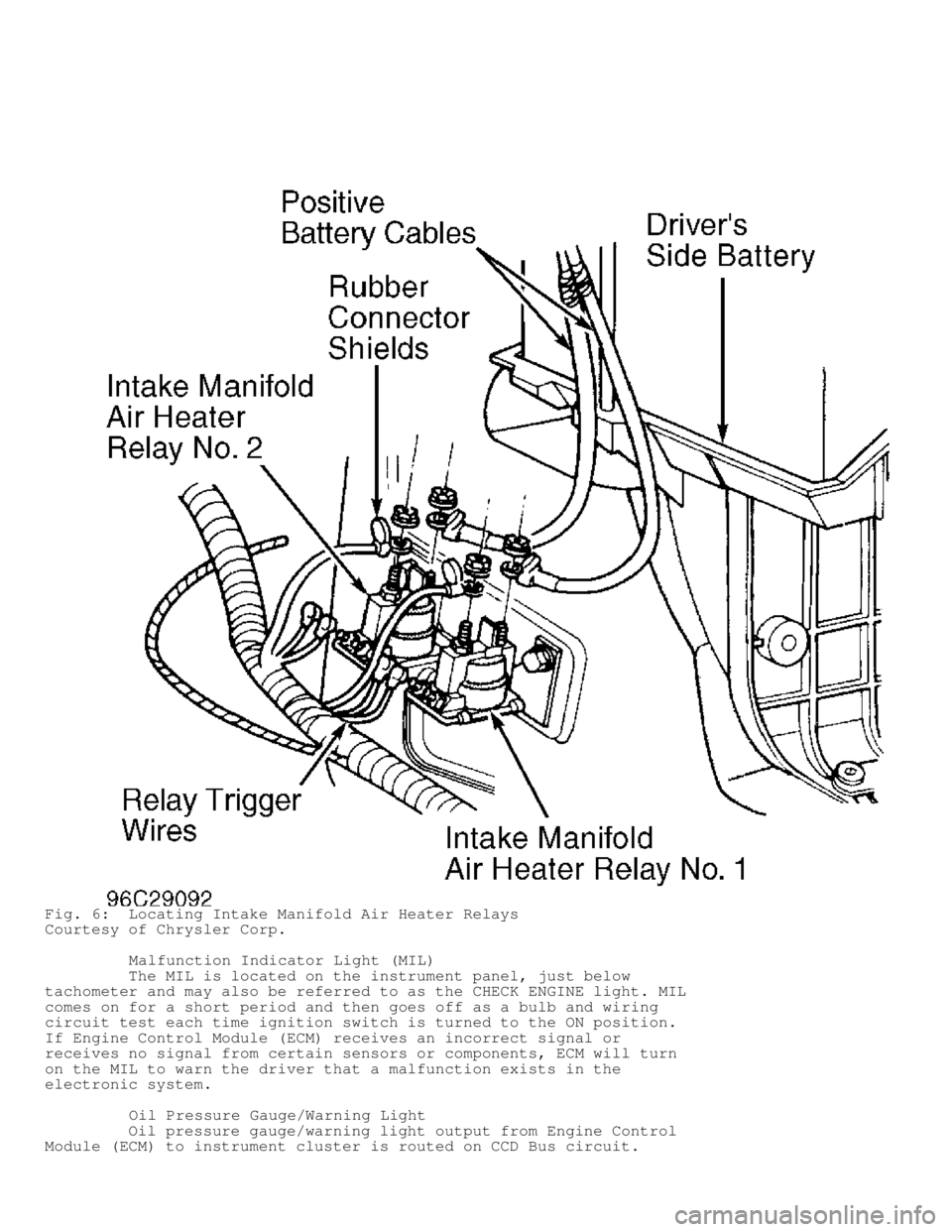
Fig. 6: Locating Intake Manifold Air Heater Relays
Courtesy of Chrysler Corp.
Malfunction Indicator Light (MIL)
The MIL is located on the instrument panel, just below
tachometer and may also be referred to as the CHECK ENGINE light. MIL
comes on for a short period and then goes off as a bulb and wiring
circuit test each time ignition switch is turned to the ON position.
If Engine Control Module (ECM) receives an incorrect signal or
receives no signal from certain sensors or components, ECM will turn
on the MIL to warn the driver that a malfunction exists in the
electronic system.
Oil Pressure Gauge/Warning Light
Oil pressure gauge/warning light output from Engine Control
Module (ECM) to instrument cluster is routed on CCD Bus circuit.
Page 1470 of 1691

WAIT-TO-START Warning Light
WAIT-TO-START warning light is located on instrument panel,
just below the speedometer. WAIT-TO-START warning light will come on
for a short period and then go off as a bulb and wiring circuit test
each time ignition switch is turned to the ON position. If Engine
Control Module (ECM) determines intake manifold air temperature is
less than 59
F (15C) by input signal received from intake manifold
air temperature sensor, ECM delivers output signal to operate WAIT-TO-
START warning light and intake manifold air heater for a preheat
cycle.
WAIT-TO-START warning light will remain on until intake
manifold air heater preheat cycle is complete. WAIT-TO-START warning
light will flash on and off if intake manifold air temperature sensor
signal to ECM is not within a specified value and Diagnostic Trouble
Code (FTC) will be stored in ECM memory.
WATER-IN-FUEL Warning Light
WATER-IN-FUEL warning light is located on instrument panel,
just below tachometer. WATER-IN-FUEL warning light will come on for a
short period and then go off as a bulb and wiring circuit test each
time ignition switch is turned to the ON position. If Engine Control
Module (ECM) determines water exists in fuel/water separator by input
signal from Water-In-Fuel (WIF) sensor, ECM will deliver output signal\
to turn on the WATER-IN-FUEL warning light.
ECM/PCM OUTPUT SIGNALS
A/C Clutch Relay
The Engine Control Module (ECM) controls A/C compressor
operation by controlling ground circuit for A/C clutch relay. ECM de-
energizes A/C clutch relay if engine coolant temperature is more than
257
F (125C). The A/C clutch relay is located in power distribution
center at driver's side front corner of engine compartment, near the
battery.
Automatic Shutdown (ASD) Relay
The Engine Control Module (ECM) controls ASD operation by
controlling ground circuit for ASD relay. ASD provides voltage to
operate generator field control for charging system. ASD relay is
located in power distribution center at driver's side front corner of
engine compartment, near the battery. Automatic Shutdown (ASD) relay
may also be referred to as Auto Shutdown (ASD) relay.
CCD Bus
These circuits are connected between Engine Control Module
(ECM) and Powertrain Control Module (PCM) to allow communication
between modules.
Cruise Control System
Engine Control Module (ECM) regulates cruise control system
operation by controlling vacuum at cruise control servo. Vacuum is
controlled by use of vacuum and vent solenoids in cruise control
servo.
Data Link Connector
Engine Control Module (ECM) provides output information at
Data Link Connector (DLC) when using scan tool to perform various
tests on the ECM and electronic control system. Data link connector is
a 16-pin connector located at lower edge of driver's side of
instrument panel, just above the accelerator pedal.
5-Volt Sensor Supply Output
Powertrain Control Module (PCM) supplies a 5-volt reference
Page 1471 of 1691

signal to the transmission solenoid assembly for transmission
temperature sensor.
Generator Field
Engine Control Module (ECM) provides output signals to
generator field for regulating charging system voltage at 12.9-15.0
volts. ECM contains an internal electronic voltage regulator for
controlling the charging system voltage.
Generator Light
If Engine Control Module (ECM) senses a low charging system
condition, generator light on instrument panel (if equipped) will be
turned on. Generator light may also come on momentarily at low idle
speed when all accessories are on.
Malfunction Indicator Light (MIL)
The MIL is located on the instrument panel, just below
tachometer and may also be referred to as the CHECK ENGINE light. MIL
comes on for a short period and then goes off as a bulb and wiring
circuit test each time ignition switch is turned to the ON position.
If Engine Control Module (ECM) receives an incorrect signal or
receives no signal from certain sensors or components, ECM will turn
on the MIL to warn the driver that a malfunction exists in the
electronic system.
Overdrive Indicator Light (A/T Models)
Engine Control Module (ECM) delivers output signal to operate\
transmission overdrive indicator (O/D OFF) light in accordance with
position of the transmission overdrive switch. If overdrive is turned
off with transmission overdrive switch, transmission overdrive
indicator light will be turned on. Transmission overdrive indicator
light is located on instrument panel, just below the speedometer.
Tachometer
Engine Control Module (ECM) delivers output signal to operate\
tachometer on instrument panel to indicate engine RPM.
Transmission Overdrive Solenoid (A/T Models)
Engine Control Module (ECM) delivers output signal to
transmission overdrive solenoid for controlling transmission overdrive
shifts. Transmission overdrive solenoid is located on transmission
valve body.
Transmission Relay (A/T Models)
Transmission relay may be referred to as transmission control
relay or transmission 12-volt supply relay. Transmission relay ground
circuit is controlled by the Engine Control Module (ECM). When ground
circuit is completed, transmission relay supplies voltage to solenoid
assembly on the transmission. Transmission relay is located in power
distribution center at driver's side front corner of engine
compartment, near the battery.
Transmission Temperature Warning Light (A/T Models With
Heavy-Duty Transmission)
Engine Control Module (ECM) delivers output signal to turn on\
transmission temperature warning light if transmission fluid
temperature is determined to be greater than 280
F (138C) by the
transmission temperature sensor. Transmission temperature warning
light is located on instrument panel, just below the tachometer.
Transmission Torque Converter Clutch Solenoid (A/T Models)
Engine Control Module (ECM) delivers an output signal to
operate transmission torque converter clutch solenoid for torque
Page 1474 of 1691

using DLC and a scan tool. The DLC also provides a means to
communicate with various vehicle control modules, check system
operating conditions and to operate various system components.
MALFUNCTION INDICATOR LIGHT (MIL)
The MIL is located on the instrument panel, just below
tachometer and may also be referred to as the CHECK ENGINE light. MIL
comes on for a short period and then goes off as a bulb and wiring
circuit test each time ignition switch is turned to the ON position.
If Engine Control Module (ECM) receives an incorrect signal or
receives no signal from certain sensors or components, ECM will turn
on the MIL to warn the driver that a malfunction exists in the
electronic system.
MISCELLANEOUS CONTROLS
TRANSMISSION
Transmission Overdrive Solenoid (A/T Models)
Engine Control Module (ECM) operates transmission overdrive
solenoid for controlling transmission overdrive shifts. Transmission
overdrive solenoid is located on transmission valve body.
Transmission Torque Converter Clutch Solenoid (A/T Models)
Engine Control Module (ECM) operates transmission torque
converter clutch solenoid for torque converter lock-up. ECM uses
various input signals such as transmission temperature, output shaft
speed, central module timer, engine speed, APPS and brake switch
position to determine operation of transmission torque converter
clutch solenoid. Torque converter clutch solenoid is located on
transmission valve body.
Page 1485 of 1691

Crankcase Ventilation (PCV) system, but does not use a vacuum
controlled valve. See POSITIVE CRANKCASE VENTILATION (PCV).
EVAPORATIVE (EVAP) EMISSIONS SYSTEM
This system stores fuel vapors from fuel tank, preventing
vapors from reaching the atmosphere. As fuel evaporates inside fuel
tank, vapors are routed through vent hoses to charcoal canister where
they are stored until engine is started.
Evaporative Canister Purge Control Solenoid (EVAP-CPCS)
Charcoal canister purging is controlled by PCM through an
EVAP-CPCS. During engine warm-up and for a short period after hot
restarts, PCM energizes EVAP-CPCS, interrupting engine vacuum signal
to charcoal canister.
After engine reaches a predetermined operating temperature
and PCM internal timer has expired, PCM will de-energize EVAP-CPCS,
allowing engine vacuum to purge charcoal canister. EVAP-CPCS will also
be de-energized during certain idle conditions so PCM can update fuel
delivery calibration.
POSITIVE CRANKCASE VENTILATION (PCV)
PCV system uses a vacuum operated valve. A closed engine
crankcase breather/filter, with a hose connecting it to air filter
housing, provides source of air for system. Crankcase blow-by gases
are removed from crankcase through PCV valve with manifold vacuum.
These gases are introduced into incoming air/fuel mixture and become
part of the calibrated mixture.
A non-vacuum operated Crankcase Ventilation (CCV) system is
used on some engines, see CRANKCASE VENTILATION (CCV) SYSTEM.
SELF-DIAGNOSTIC SYSTEM
The PCM monitors several different circuits of engine control
system. If a problem is sensed with a monitored circuit, PCM will
store a Diagnostic Trouble Code (FTC) to aid technician in diagnosis
of system. The Malfunction Indicator Light (MIL), or a scan tool can
be used to read DTCs. For additional information, see SELF-DIAGNOSTICS
- JEEP, TRUCKS & RWD VANS article.
MALFUNCTION INDICATOR LIGHT
Malfunction Indicator Light (MIL) comes on and remains on for\
3 seconds as a bulb test each time ignition switch is turned to ON
position. If PCM receives an incorrect signal or receives no signal
from battery voltage input, charging system, ECT sensor, MAP sensor or
TP sensor, MIL will come on. MIL will also come on if certain
emission-related faults exist. This warns driver that PCM is in limp-
in mode and immediate repairs are necessary. See LIMP-IN MODE under
MISCELLANEOUS CONTROLS. MIL can also be used to display Diagnostic
Trouble Codes (DTCs). For additional information, see SELF-DIAGNOSTICS\
- JEEP, TRUCKS & RWD VANS article.
SERIAL COMMUNICATIONS INTERFACE (SCI)
SCI circuit is used by PCM to send data to and receive data
and sensor activation signals from scan tool. Scan tool uses signals
sent on SCI to display fault messages or Diagnostic Trouble Codes
(DTCs), sensor voltages and device states (On/Off). Scan tool uses S\
CI
to send solenoid and switch activation commands to PCM so that devices
and circuits can be tested. SCI is also used to write SRI mileage to