lock DODGE RAM 2001 Service Repair Manual
[x] Cancel search | Manufacturer: DODGE, Model Year: 2001, Model line: RAM, Model: DODGE RAM 2001Pages: 2889, PDF Size: 68.07 MB
Page 1192 of 2889
(3) Using the transmission jack, lower the trans-
mission and support cushion onto the crossmember
(Fig. 49).
(4) Install the support cushion bolts and tighten to
41 N´m (30 ft. lbs.) torque.
(5) Remove the transmission jack.
(6) Lower the vehicle.
LUBRICATION
DESCRIPTION
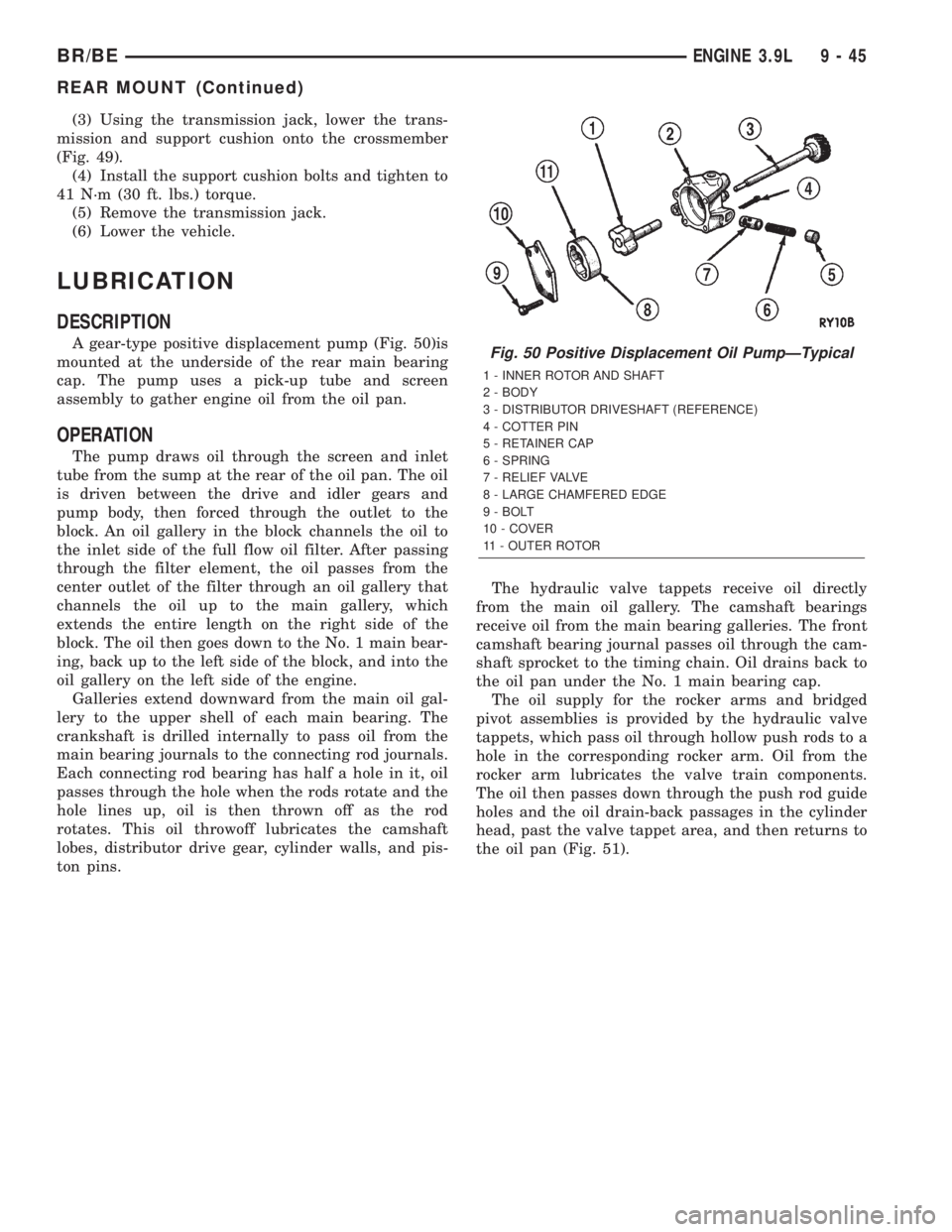
A gear-type positive displacement pump (Fig. 50)is
mounted at the underside of the rear main bearing
cap. The pump uses a pick-up tube and screen
assembly to gather engine oil from the oil pan.
OPERATION
The pump draws oil through the screen and inlet
tube from the sump at the rear of the oil pan. The oil
is driven between the drive and idler gears and
pump body, then forced through the outlet to the
block. An oil gallery in the block channels the oil to
the inlet side of the full flow oil filter. After passing
through the filter element, the oil passes from the
center outlet of the filter through an oil gallery that
channels the oil up to the main gallery, which
extends the entire length on the right side of the
block. The oil then goes down to the No. 1 main bear-
ing, back up to the left side of the block, and into the
oil gallery on the left side of the engine.
Galleries extend downward from the main oil gal-
lery to the upper shell of each main bearing. The
crankshaft is drilled internally to pass oil from the
main bearing journals to the connecting rod journals.
Each connecting rod bearing has half a hole in it, oil
passes through the hole when the rods rotate and the
hole lines up, oil is then thrown off as the rod
rotates. This oil throwoff lubricates the camshaft
lobes, distributor drive gear, cylinder walls, and pis-
ton pins.The hydraulic valve tappets receive oil directly
from the main oil gallery. The camshaft bearings
receive oil from the main bearing galleries. The front
camshaft bearing journal passes oil through the cam-
shaft sprocket to the timing chain. Oil drains back to
the oil pan under the No. 1 main bearing cap.
The oil supply for the rocker arms and bridged
pivot assemblies is provided by the hydraulic valve
tappets, which pass oil through hollow push rods to a
hole in the corresponding rocker arm. Oil from the
rocker arm lubricates the valve train components.
The oil then passes down through the push rod guide
holes and the oil drain-back passages in the cylinder
head, past the valve tappet area, and then returns to
the oil pan (Fig. 51).
Fig. 50 Positive Displacement Oil PumpÐTypical
1 - INNER ROTOR AND SHAFT
2 - BODY
3 - DISTRIBUTOR DRIVESHAFT (REFERENCE)
4 - COTTER PIN
5 - RETAINER CAP
6 - SPRING
7 - RELIEF VALVE
8 - LARGE CHAMFERED EDGE
9 - BOLT
10 - COVER
11 - OUTER ROTOR
BR/BEENGINE 3.9L 9 - 45
REAR MOUNT (Continued)
Page 1195 of 2889
(6) Add oil only if level is below the ADD mark on
dipstick.
ENGINE OIL CHANGE:
Change engine oil at mileage and time intervals
described in the Maintenance Schedule. This infor-
mation can be found in the owner's manual.
TO CHANGE ENGINE OIL
Run engine until achieving normal operating tem-
perature.
(1) Position the vehicle on a level surface and turn
engine off.
(2) Hoist vehicle.
(3) Remove oil fill cap.
(4) Place a suitable drain pan under crankcase
drain.
(5) Remove drain plug from crankcase and allow
oil to drain into pan. Inspect drain plug threads for
stretching or other damage. Replace drain plug and
gasket if damaged.
(6) Install drain plug in crankcase.
(7) Change oil filter (Refer to 9 - ENGINE/LUBRI-
CATION/OIL FILTER - REMOVAL).
(8) Lower vehicle and fill crankcase with specified
type (Refer to LUBRICATION & MAINTENANCE/
FLUID TYPES - DESCRIPTION) and amount of
engine oil (Refer to LUBRICATION & MAINTE-
NANCE - SPECIFICATIONS).
(9) Install oil fill cap.
(10) Start engine and inspect for leaks.
(11) Stop engine and inspect oil level.
OIL FILTER
REMOVAL
All engines are equipped with a high quality full-
flow, disposable type oil filter. DaimlerChrysler Cor-
poration recommends a Mopartor equivalent oil
filter be used.
(1) Position a drain pan under the oil filter.
(2) Using a suitable oil filter wrench loosen filter.
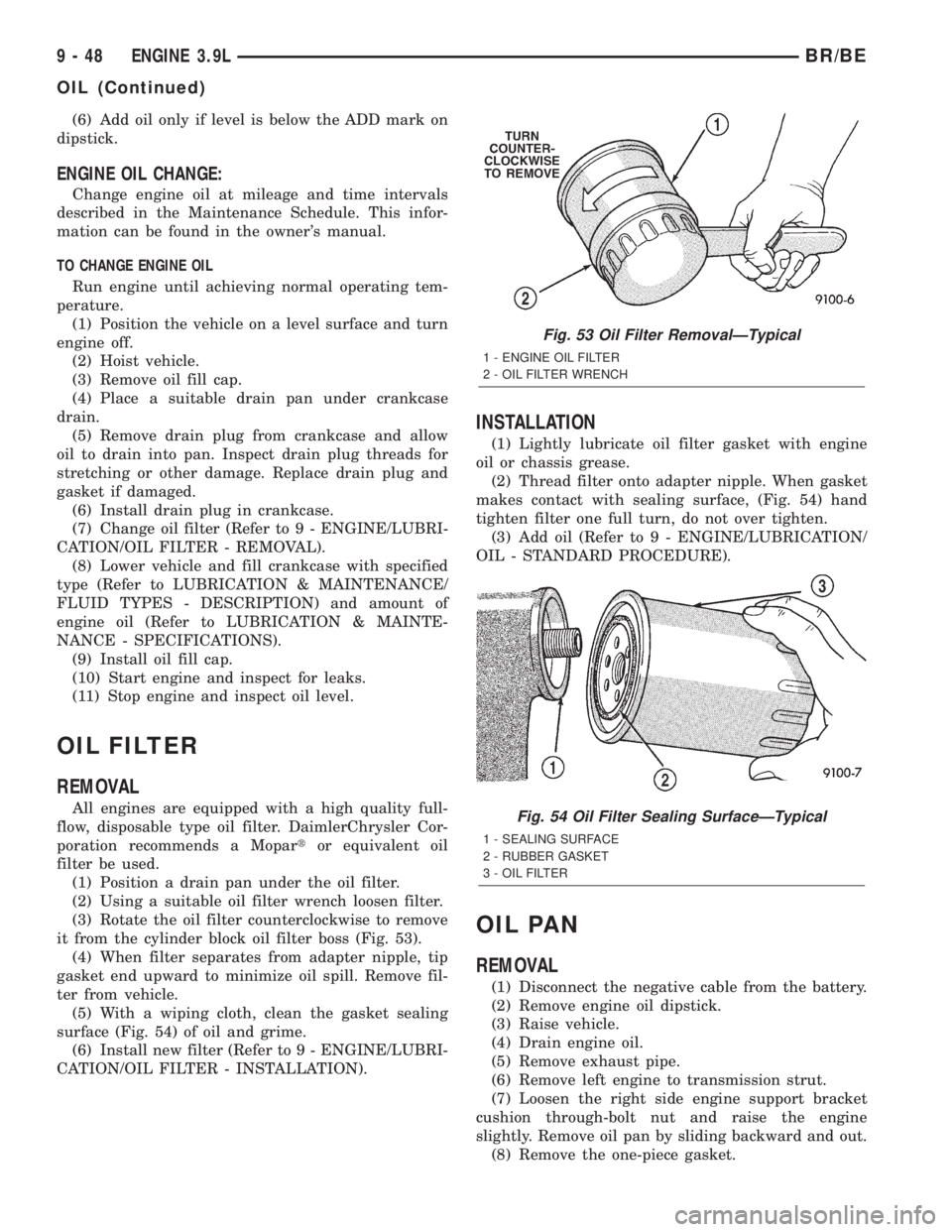
(3) Rotate the oil filter counterclockwise to remove
it from the cylinder block oil filter boss (Fig. 53).
(4) When filter separates from adapter nipple, tip
gasket end upward to minimize oil spill. Remove fil-
ter from vehicle.
(5) With a wiping cloth, clean the gasket sealing
surface (Fig. 54) of oil and grime.
(6) Install new filter (Refer to 9 - ENGINE/LUBRI-
CATION/OIL FILTER - INSTALLATION).
INSTALLATION
(1) Lightly lubricate oil filter gasket with engine
oil or chassis grease.
(2) Thread filter onto adapter nipple. When gasket
makes contact with sealing surface, (Fig. 54) hand
tighten filter one full turn, do not over tighten.
(3) Add oil (Refer to 9 - ENGINE/LUBRICATION/
OIL - STANDARD PROCEDURE).
OIL PAN
REMOVAL
(1) Disconnect the negative cable from the battery.
(2) Remove engine oil dipstick.
(3) Raise vehicle.
(4) Drain engine oil.
(5) Remove exhaust pipe.
(6) Remove left engine to transmission strut.
(7) Loosen the right side engine support bracket
cushion through-bolt nut and raise the engine
slightly. Remove oil pan by sliding backward and out.
(8) Remove the one-piece gasket.
Fig. 53 Oil Filter RemovalÐTypical
1 - ENGINE OIL FILTER
2 - OIL FILTER WRENCH
Fig. 54 Oil Filter Sealing SurfaceÐTypical
1 - SEALING SURFACE
2 - RUBBER GASKET
3 - OIL FILTER
9 - 48 ENGINE 3.9LBR/BE
OIL (Continued)
Page 1196 of 2889
CLEANING
Clean the block and pan gasket surfaces.
Trim or remove excess sealant film in the rear
main cap oil pan gasket groove.DO NOT remove
the sealant inside the rear main cap slots.
If present, trim excess sealant from inside the
engine.
Clean oil pan in solvent and wipe dry with a clean
cloth.
Clean oil screen and pipe thoroughly in clean sol-
vent. Inspect condition of screen.
INSPECTION
Inspect oil drain plug and plug hole for stripped or
damaged threads. Repair as necessary.
Inspect oil pan mounting flange for bends or distor-
tion. Straighten flange, if necessary.
INSTALLATION
(1) Clean the block and pan gasket surfaces.
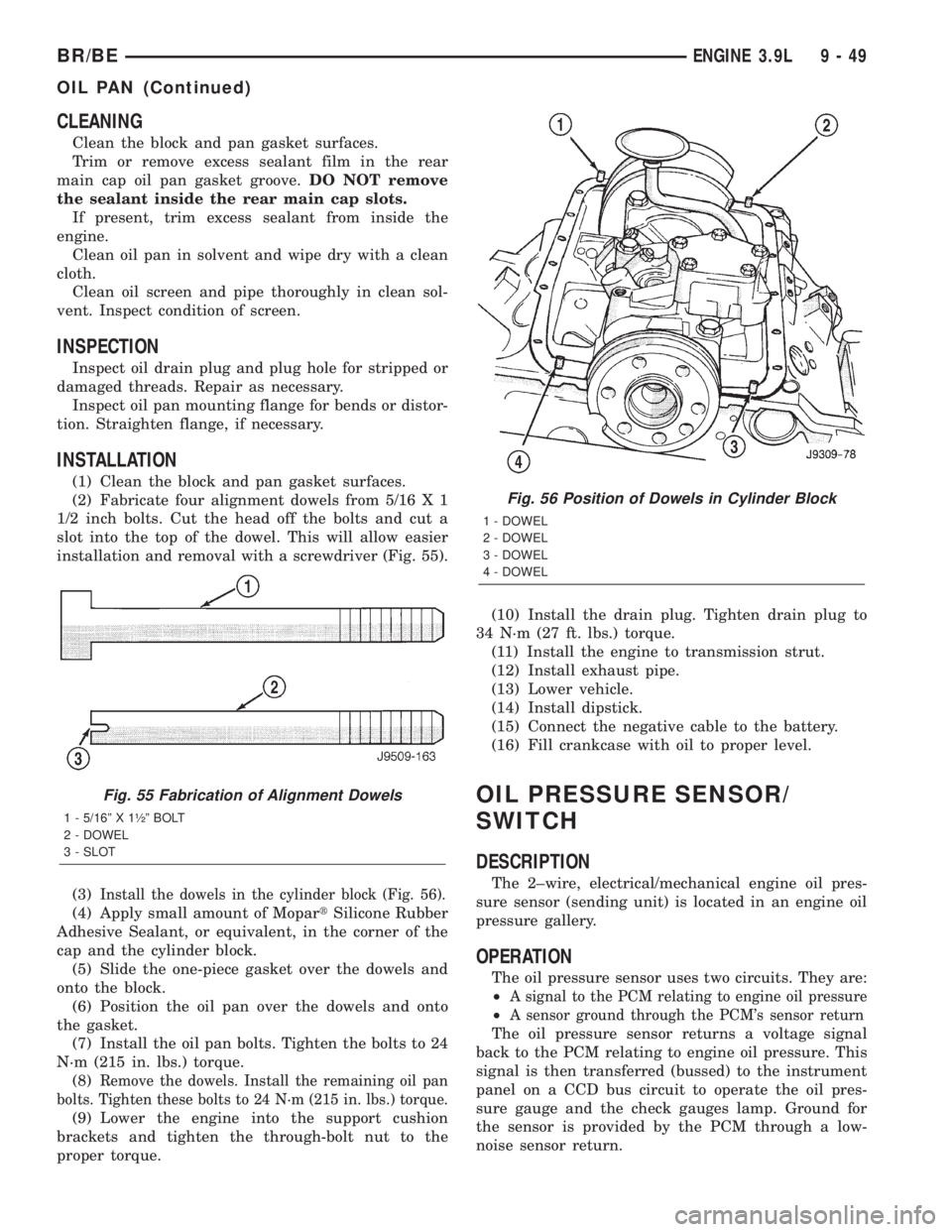
(2) Fabricate four alignment dowels from 5/16 X 1
1/2 inch bolts. Cut the head off the bolts and cut a
slot into the top of the dowel. This will allow easier
installation and removal with a screwdriver (Fig. 55).
(3)
Install the dowels in the cylinder block (Fig. 56).
(4) Apply small amount of MopartSilicone Rubber
Adhesive Sealant, or equivalent, in the corner of the
cap and the cylinder block.
(5) Slide the one-piece gasket over the dowels and
onto the block.
(6) Position the oil pan over the dowels and onto
the gasket.
(7) Install the oil pan bolts. Tighten the bolts to 24
N´m (215 in. lbs.) torque.
(8)
Remove the dowels. Install the remaining oil pan
bolts. Tighten these bolts to 24 N´m (215 in. lbs.) torque.
(9) Lower the engine into the support cushion
brackets and tighten the through-bolt nut to the
proper torque.(10) Install the drain plug. Tighten drain plug to
34 N´m (27 ft. lbs.) torque.
(11) Install the engine to transmission strut.
(12) Install exhaust pipe.
(13) Lower vehicle.
(14) Install dipstick.
(15) Connect the negative cable to the battery.
(16) Fill crankcase with oil to proper level.
OIL PRESSURE SENSOR/
SWITCH
DESCRIPTION
The 2±wire, electrical/mechanical engine oil pres-
sure sensor (sending unit) is located in an engine oil
pressure gallery.
OPERATION
The oil pressure sensor uses two circuits. They are:
²
A signal to the PCM relating to engine oil pressure
²A sensor ground through the PCM's sensor return
The oil pressure sensor returns a voltage signal
back to the PCM relating to engine oil pressure. This
signal is then transferred (bussed) to the instrument
panel on a CCD bus circuit to operate the oil pres-
sure gauge and the check gauges lamp. Ground for
the sensor is provided by the PCM through a low-
noise sensor return.
Fig. 55 Fabrication of Alignment Dowels
1 - 5/16º X 1óº BOLT
2 - DOWEL
3 - SLOT
Fig. 56 Position of Dowels in Cylinder Block
1 - DOWEL
2 - DOWEL
3 - DOWEL
4 - DOWEL
BR/BEENGINE 3.9L 9 - 49
OIL PAN (Continued)
Page 1200 of 2889
DIAGNOSIS AND TESTINGÐINTAKE
MANIFOLD LEAKAGE
An intake manifold air leak is characterized by
lower than normal manifold vacuum. Also, one or
more cylinders may not be functioning.
WARNING: USE EXTREME CAUTION WHEN THE
ENGINE IS OPERATING. DO NOT STAND IN A
DIRECT LINE WITH THE FAN. DO NOT PUT YOUR
HANDS NEAR THE PULLEYS, BELTS, OR THE FAN.
DO NOT WEAR LOOSE CLOTHING.
(1) Start the engine.
(2) Spray a small stream of water at the suspected
leak area.
(3) If a change in RPMs, the area of the suspected
leak has been found.
(4) Repair as required.
REMOVAL
(1) Disconnect the negative cable from the battery.
(2) Drain the cooling system (Refer to 7 - COOL-
ING - STANDARD PROCEDURE).
(3) Remove the A/C compressor (Refer to 24 -
HEATING & AIR CONDITIONING/PLUMBING/A/C
COMPRESSOR - REMOVAL).
(4) Remove the generator (Refer to 8 - ELECTRI-
CAL/CHARGING/GENERATOR - REMOVAL).
(5) Remove the accessory drive bracket.
(6) Remove the air cleaner.
(7) Perform the Fuel System Pressure release pro-
cedure (Refer to 14 - FUEL SYSTEM/FUEL DELIV-
ERY - STANDARD PROCEDURE). Disconnect the
fuel lines (Refer to 14 - FUEL SYSTEM/FUEL
DELIVERY/QUICK CONNECT FITTING - STAN-
DARD PROCEDURE).
(8) Disconnect the accelerator linkage (Refer to 14
- FUEL SYSTEM/FUEL INJECTION/THROTTLE
CONTROL CABLE - REMOVAL) and if so equipped,
the speed control and transmission kickdown cables.
(9) Remove the return spring.
(10) Remove the distributor cap and wires.
(11) Disconnect the coil wires.
(12) Disconnect the heat indicator sending unit
wire.
(13) Disconnect the heater hoses and bypass hose.
(14) Remove the closed crankcase ventilation and
evaporation control systems.
(15) Remove intake manifold bolts.
(16) Lift the intake manifold and throttle body out
of the engine compartment as an assembly.
(17) Remove and discard the flange side gaskets
and the front and rear cross-over gaskets.(18) Remove the throttle body (Refer to 14 - FUEL
SYSTEM/FUEL INJECTION/THROTTLE BODY -
REMOVAL).
(19) If required, remove the plenum pan and gas-
ket. Discard gasket.
CLEANING
Clean manifold in solvent and blow dry with com-
pressed air.
Clean cylinder block front and rear gasket surfaces
using a suitable solvent.
The plenum pan rail must be clean and dry (free of
all foreign material).
INSPECTION
Inspect manifold for cracks.
Inspect mating surfaces of manifold for flatness
with a straightedge.
INSTALLATION
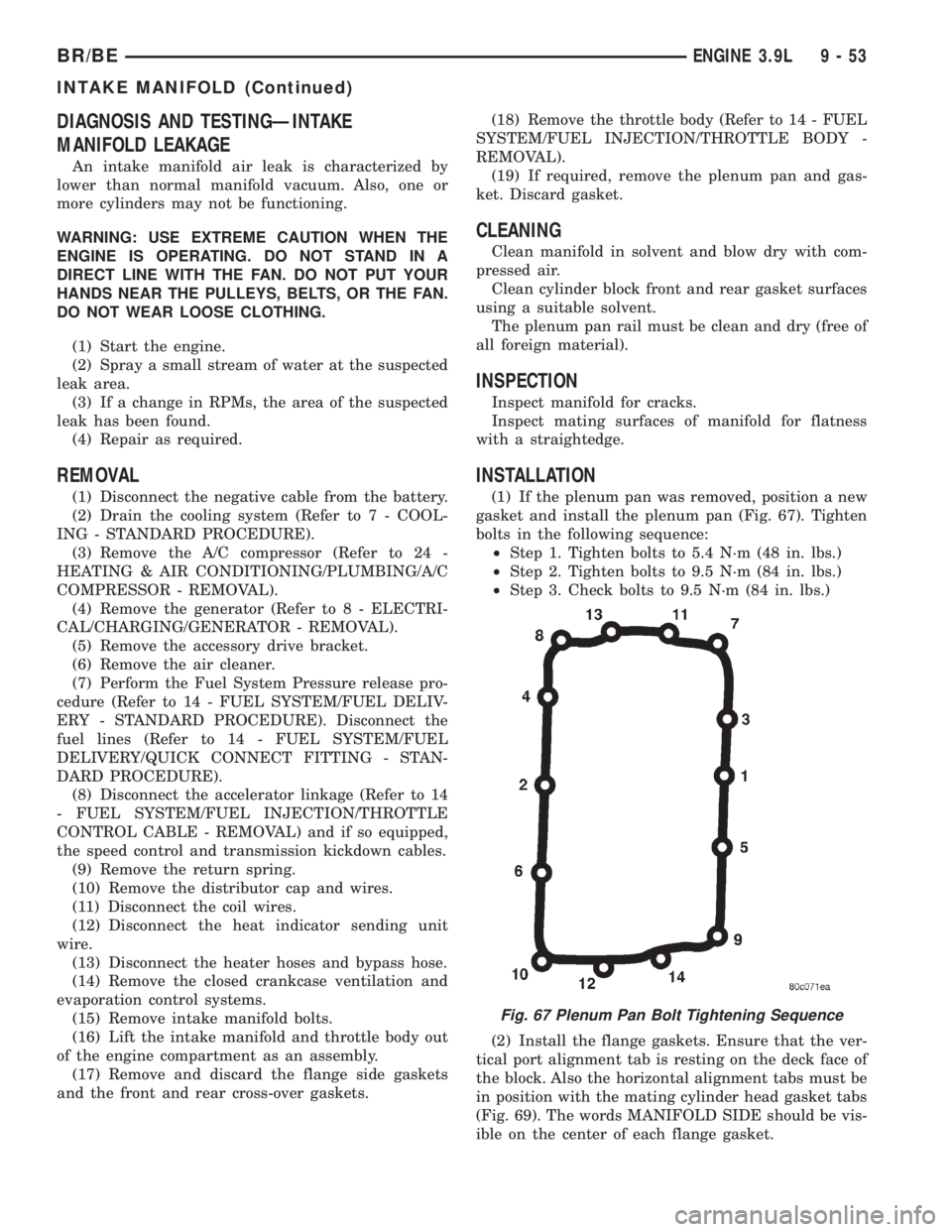
(1) If the plenum pan was removed, position a new
gasket and install the plenum pan (Fig. 67). Tighten
bolts in the following sequence:
²Step 1. Tighten bolts to 5.4 N´m (48 in. lbs.)
²Step 2. Tighten bolts to 9.5 N´m (84 in. lbs.)
²Step 3. Check bolts to 9.5 N´m (84 in. lbs.)
(2) Install the flange gaskets. Ensure that the ver-
tical port alignment tab is resting on the deck face of
the block. Also the horizontal alignment tabs must be
in position with the mating cylinder head gasket tabs
(Fig. 69). The words MANIFOLD SIDE should be vis-
ible on the center of each flange gasket.
Fig. 67 Plenum Pan Bolt Tightening Sequence
BR/BEENGINE 3.9L 9 - 53
INTAKE MANIFOLD (Continued)
Page 1201 of 2889
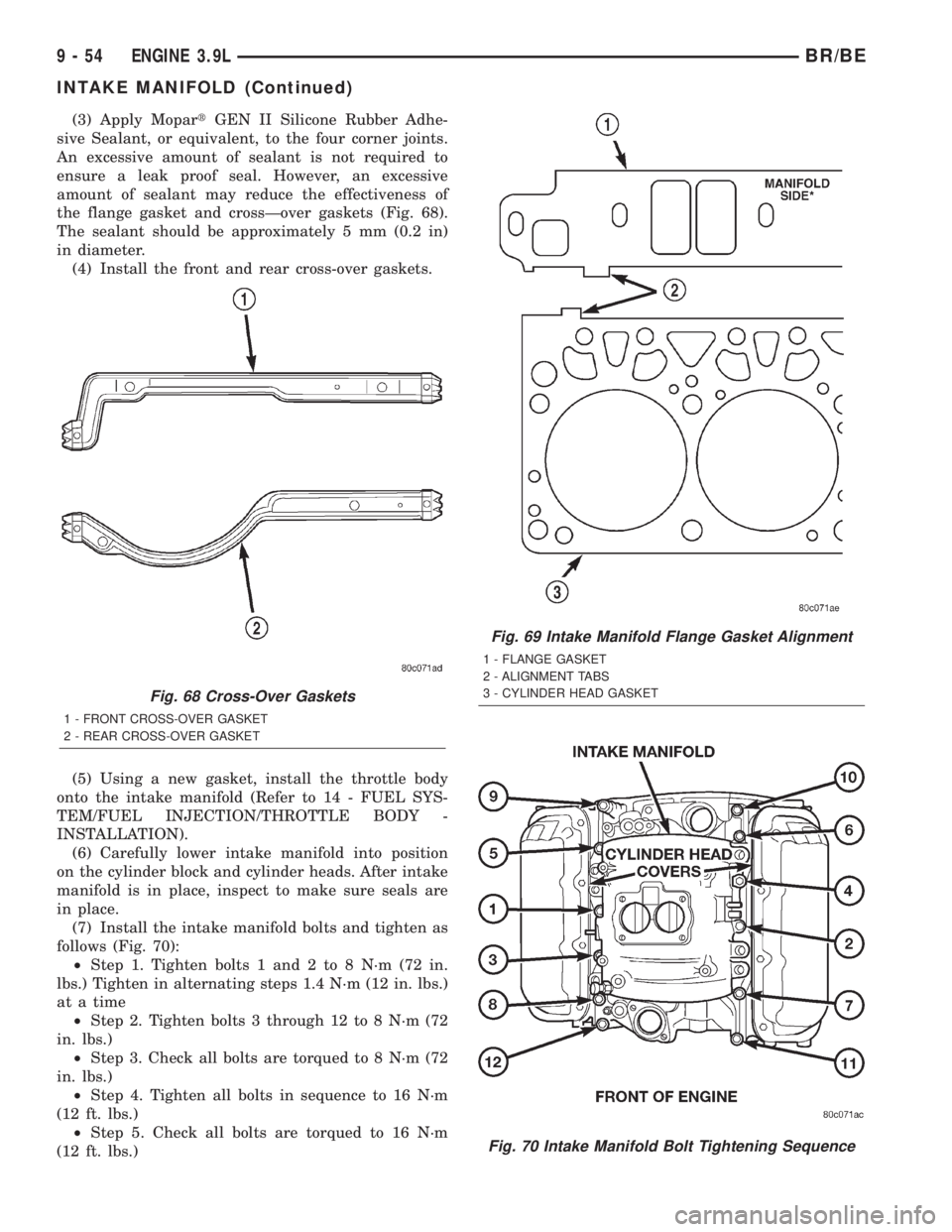
(3) Apply MopartGEN II Silicone Rubber Adhe-
sive Sealant, or equivalent, to the four corner joints.
An excessive amount of sealant is not required to
ensure a leak proof seal. However, an excessive
amount of sealant may reduce the effectiveness of
the flange gasket and crossÐover gaskets (Fig. 68).
The sealant should be approximately 5 mm (0.2 in)
in diameter.
(4) Install the front and rear cross-over gaskets.
(5) Using a new gasket, install the throttle body
onto the intake manifold (Refer to 14 - FUEL SYS-
TEM/FUEL INJECTION/THROTTLE BODY -
INSTALLATION).
(6) Carefully lower intake manifold into position
on the cylinder block and cylinder heads. After intake
manifold is in place, inspect to make sure seals are
in place.
(7) Install the intake manifold bolts and tighten as
follows (Fig. 70):
²Step 1. Tighten bolts 1 and 2 to 8 N´m (72 in.
lbs.) Tighten in alternating steps 1.4 N´m (12 in. lbs.)
at a time
²Step 2. Tighten bolts 3 through 12 to 8 N´m (72
in. lbs.)
²Step 3. Check all bolts are torqued to 8 N´m (72
in. lbs.)
²Step 4. Tighten all bolts in sequence to 16 N´m
(12 ft. lbs.)
²Step 5. Check all bolts are torqued to 16 N´m
(12 ft. lbs.)
Fig. 68 Cross-Over Gaskets
1 - FRONT CROSS-OVER GASKET
2 - REAR CROSS-OVER GASKET
Fig. 69 Intake Manifold Flange Gasket Alignment
1 - FLANGE GASKET
2 - ALIGNMENT TABS
3 - CYLINDER HEAD GASKET
Fig. 70 Intake Manifold Bolt Tightening Sequence
9 - 54 ENGINE 3.9LBR/BE
INTAKE MANIFOLD (Continued)
Page 1203 of 2889
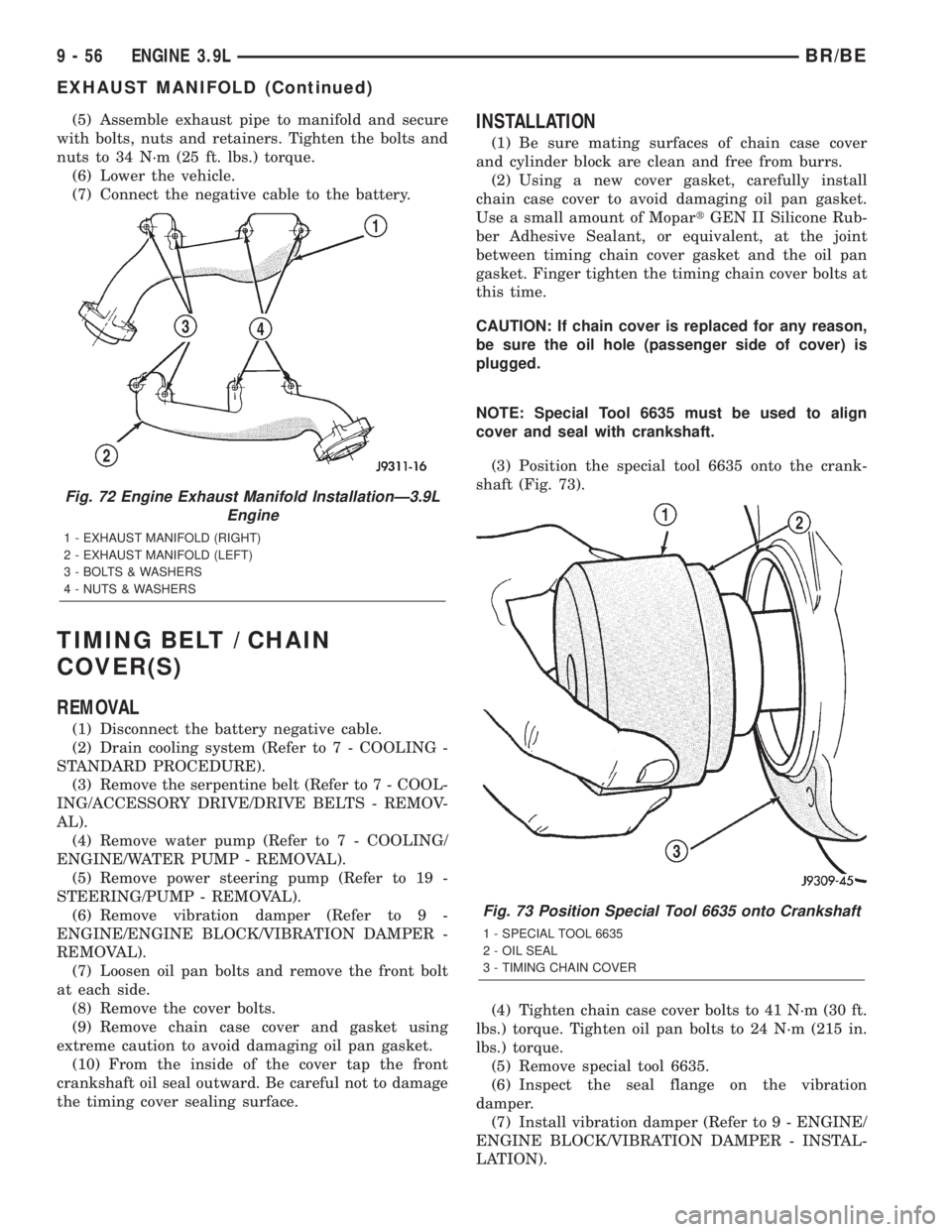
(5) Assemble exhaust pipe to manifold and secure
with bolts, nuts and retainers. Tighten the bolts and
nuts to 34 N´m (25 ft. lbs.) torque.
(6) Lower the vehicle.
(7) Connect the negative cable to the battery.
TIMING BELT / CHAIN
COVER(S)
REMOVAL
(1) Disconnect the battery negative cable.
(2) Drain cooling system (Refer to 7 - COOLING -
STANDARD PROCEDURE).
(3) Remove the serpentine belt (Refer to 7 - COOL-
ING/ACCESSORY DRIVE/DRIVE BELTS - REMOV-
AL).
(4) Remove water pump (Refer to 7 - COOLING/
ENGINE/WATER PUMP - REMOVAL).
(5) Remove power steering pump (Refer to 19 -
STEERING/PUMP - REMOVAL).
(6) Remove vibration damper (Refer to 9 -
ENGINE/ENGINE BLOCK/VIBRATION DAMPER -
REMOVAL).
(7) Loosen oil pan bolts and remove the front bolt
at each side.
(8) Remove the cover bolts.
(9) Remove chain case cover and gasket using
extreme caution to avoid damaging oil pan gasket.
(10) From the inside of the cover tap the front
crankshaft oil seal outward. Be careful not to damage
the timing cover sealing surface.
INSTALLATION
(1) Be sure mating surfaces of chain case cover
and cylinder block are clean and free from burrs.
(2) Using a new cover gasket, carefully install
chain case cover to avoid damaging oil pan gasket.
Use a small amount of MopartGEN II Silicone Rub-
ber Adhesive Sealant, or equivalent, at the joint
between timing chain cover gasket and the oil pan
gasket. Finger tighten the timing chain cover bolts at
this time.
CAUTION: If chain cover is replaced for any reason,
be sure the oil hole (passenger side of cover) is
plugged.
NOTE: Special Tool 6635 must be used to align
cover and seal with crankshaft.
(3) Position the special tool 6635 onto the crank-
shaft (Fig. 73).
(4) Tighten chain case cover bolts to 41 N´m (30 ft.
lbs.) torque. Tighten oil pan bolts to 24 N´m (215 in.
lbs.) torque.
(5) Remove special tool 6635.
(6) Inspect the seal flange on the vibration
damper.
(7) Install vibration damper (Refer to 9 - ENGINE/
ENGINE BLOCK/VIBRATION DAMPER - INSTAL-
LATION).
Fig. 72 Engine Exhaust Manifold InstallationÐ3.9L
Engine
1 - EXHAUST MANIFOLD (RIGHT)
2 - EXHAUST MANIFOLD (LEFT)
3 - BOLTS & WASHERS
4 - NUTS & WASHERS
Fig. 73 Position Special Tool 6635 onto Crankshaft
1 - SPECIAL TOOL 6635
2 - OIL SEAL
3 - TIMING CHAIN COVER
9 - 56 ENGINE 3.9LBR/BE
EXHAUST MANIFOLD (Continued)
Page 1204 of 2889
(8) Install water pump (Refer to 7 - COOLING/EN-
GINE/WATER PUMP - INSTALLATION).
(9) Install power steering pump (Refer to 19 -
STEERING/PUMP - INSTALLATION).
(10) Install the serpentine belt (Refer to 7 - COOL-
ING/ACCESSORY DRIVE/DRIVE BELTS - INSTAL-
LATION).
(11) Install the cooling system fan (Refer to 7 -
COOLING/ENGINE/FAN DRIVE VISCOUS
CLUTCH - INSTALLATION).
(12) Position the fan shroud and install the bolts.
Tighten the bolts to 11 N´m (95 in. lbs.) torque.
(13) Fill cooling system (Refer to 7 - COOLING -
STANDARD PROCEDURE).
(14) Connect the negative cable to the battery.
TIMING BELT/CHAIN
TENSIONER
DESCRIPTION
The timing chain tensioner is a stamped steel con-
stant tension mechanical design. It is mounted to the
front of the engine, behind the timing chain drive.
OPERATION
The timing chain tension is maintained by routing
the timing chain through the tensioner assembly. A
nylon covered spring steel arm presses on the timing
chain maintaining the correct chain tension.
TIMING BELT/CHAIN AND
SPROCKETS
REMOVAL
(1) Disconnect battery negative cable.
(2) Drain cooling system (Refer to 7 - COOLING -
STANDARD PROCEDURE).
(3) Remove timing chain cover (Refer to 9 -
ENGINE/VALVE TIMING/TIMING BELT / CHAIN
COVER(S) - REMOVAL).
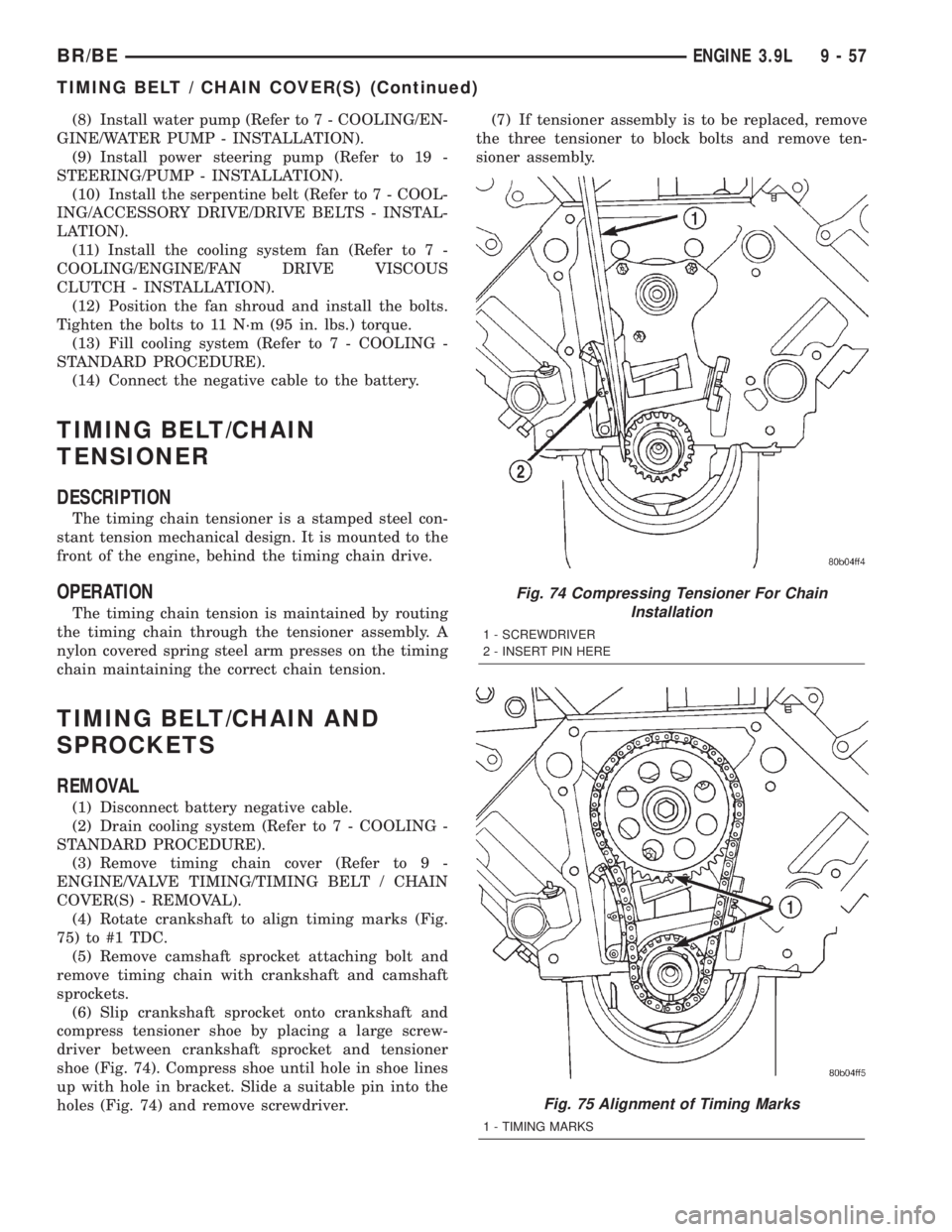
(4) Rotate crankshaft to align timing marks (Fig.
75) to #1 TDC.
(5) Remove camshaft sprocket attaching bolt and
remove timing chain with crankshaft and camshaft
sprockets.
(6) Slip crankshaft sprocket onto crankshaft and
compress tensioner shoe by placing a large screw-
driver between crankshaft sprocket and tensioner
shoe (Fig. 74). Compress shoe until hole in shoe lines
up with hole in bracket. Slide a suitable pin into the
holes (Fig. 74) and remove screwdriver.(7) If tensioner assembly is to be replaced, remove
the three tensioner to block bolts and remove ten-
sioner assembly.
Fig. 74 Compressing Tensioner For Chain
Installation
1 - SCREWDRIVER
2 - INSERT PIN HERE
Fig. 75 Alignment of Timing Marks
1 - TIMING MARKS
BR/BEENGINE 3.9L 9 - 57
TIMING BELT / CHAIN COVER(S) (Continued)
Page 1205 of 2889
INSPECTIONÐMEASURING TIMING CHAIN
STRETCH
NOTE: Timing chain tensioner must be removed for
this operation.
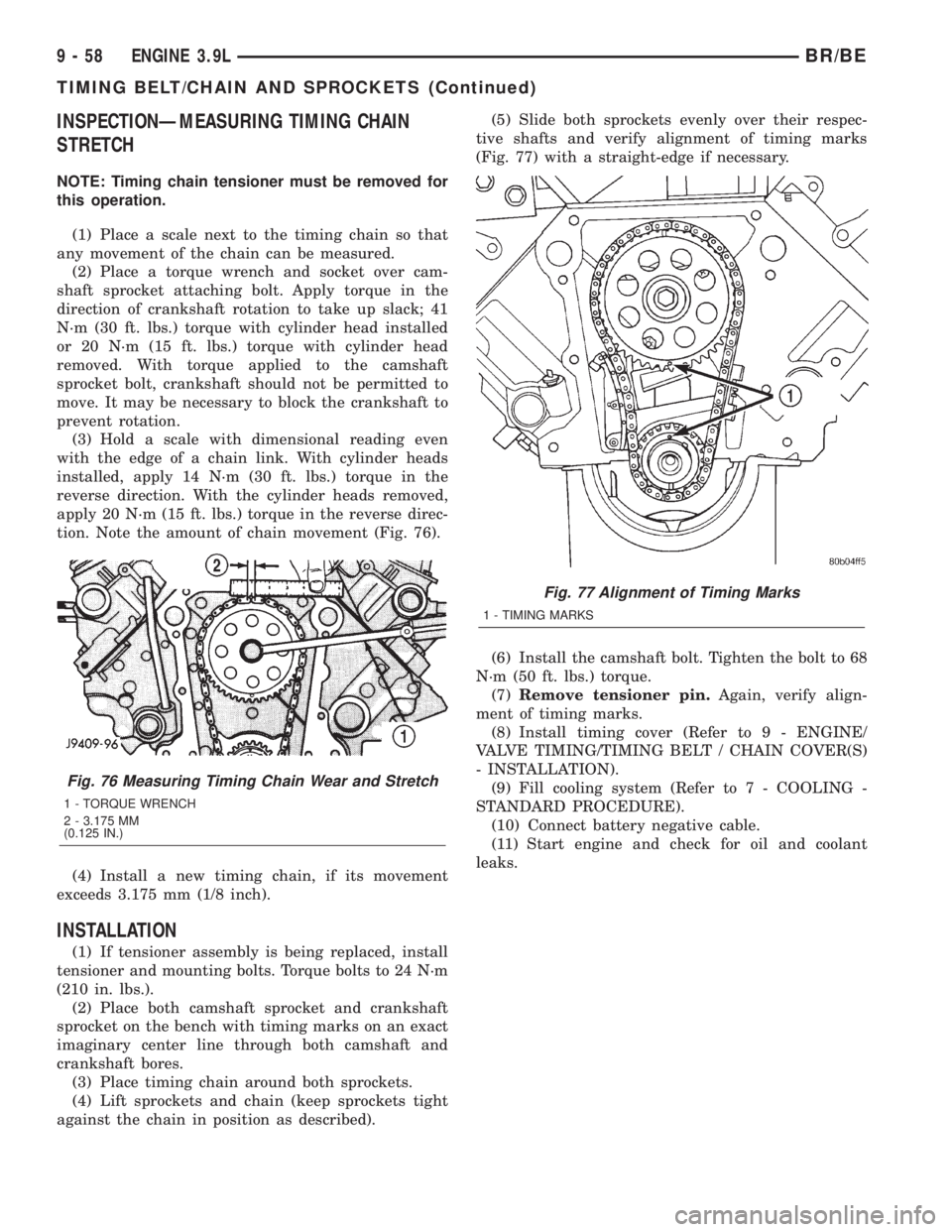
(1) Place a scale next to the timing chain so that
any movement of the chain can be measured.
(2) Place a torque wrench and socket over cam-
shaft sprocket attaching bolt. Apply torque in the
direction of crankshaft rotation to take up slack; 41
N´m (30 ft. lbs.) torque with cylinder head installed
or 20 N´m (15 ft. lbs.) torque with cylinder head
removed. With torque applied to the camshaft
sprocket bolt, crankshaft should not be permitted to
move. It may be necessary to block the crankshaft to
prevent rotation.
(3) Hold a scale with dimensional reading even
with the edge of a chain link. With cylinder heads
installed, apply 14 N´m (30 ft. lbs.) torque in the
reverse direction. With the cylinder heads removed,
apply 20 N´m (15 ft. lbs.) torque in the reverse direc-
tion. Note the amount of chain movement (Fig. 76).
(4) Install a new timing chain, if its movement
exceeds 3.175 mm (1/8 inch).
INSTALLATION
(1) If tensioner assembly is being replaced, install
tensioner and mounting bolts. Torque bolts to 24 N´m
(210 in. lbs.).
(2) Place both camshaft sprocket and crankshaft
sprocket on the bench with timing marks on an exact
imaginary center line through both camshaft and
crankshaft bores.
(3) Place timing chain around both sprockets.
(4) Lift sprockets and chain (keep sprockets tight
against the chain in position as described).(5) Slide both sprockets evenly over their respec-
tive shafts and verify alignment of timing marks
(Fig. 77) with a straight-edge if necessary.
(6) Install the camshaft bolt. Tighten the bolt to 68
N´m (50 ft. lbs.) torque.
(7)Remove tensioner pin.Again, verify align-
ment of timing marks.
(8) Install timing cover (Refer to 9 - ENGINE/
VALVE TIMING/TIMING BELT / CHAIN COVER(S)
- INSTALLATION).
(9) Fill cooling system (Refer to 7 - COOLING -
STANDARD PROCEDURE).
(10) Connect battery negative cable.
(11) Start engine and check for oil and coolant
leaks.
Fig. 76 Measuring Timing Chain Wear and Stretch
1 - TORQUE WRENCH
2 - 3.175 MM
(0.125 IN.)
Fig. 77 Alignment of Timing Marks
1 - TIMING MARKS
9 - 58 ENGINE 3.9LBR/BE
TIMING BELT/CHAIN AND SPROCKETS (Continued)
Page 1206 of 2889
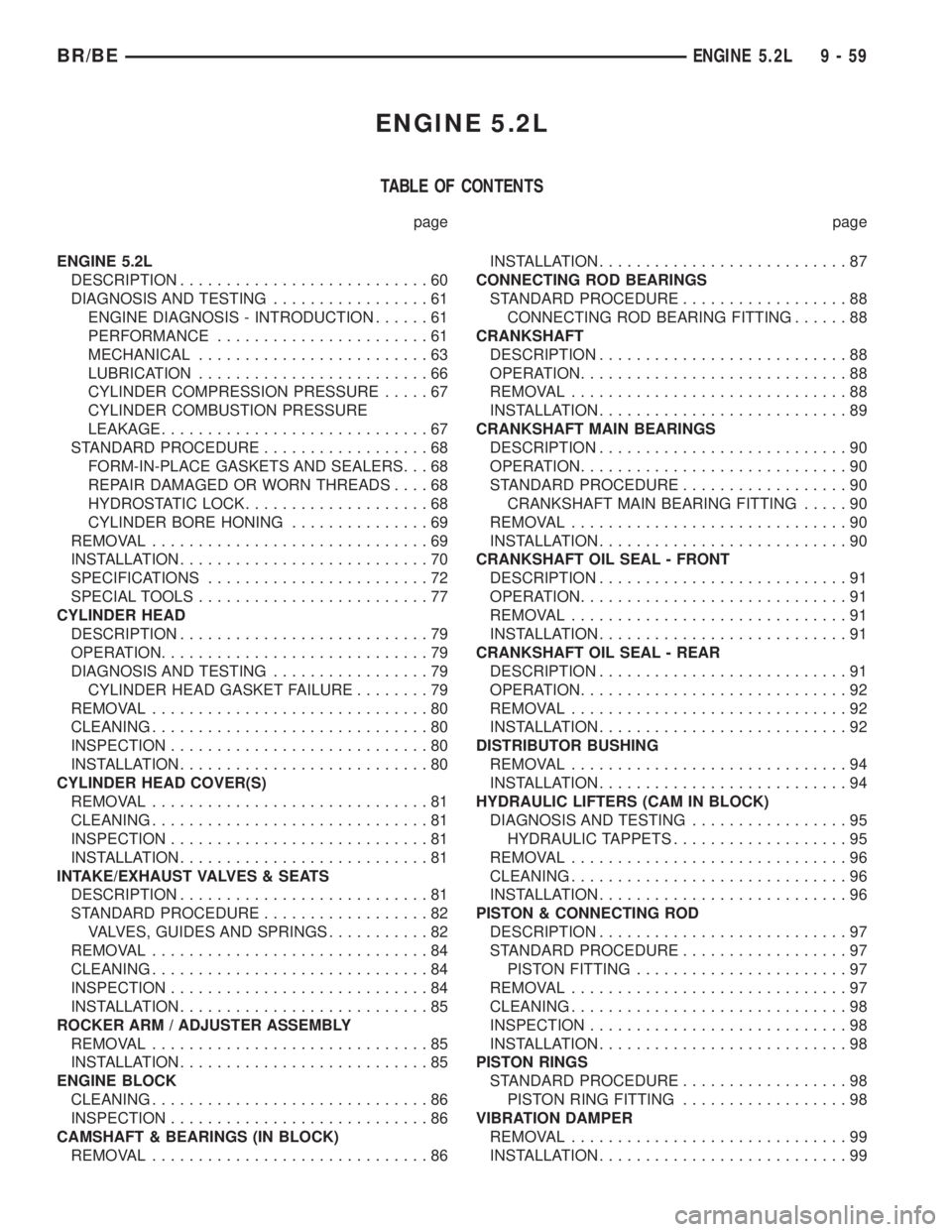
ENGINE 5.2L
TABLE OF CONTENTS
page page
ENGINE 5.2L
DESCRIPTION...........................60
DIAGNOSIS AND TESTING.................61
ENGINE DIAGNOSIS - INTRODUCTION......61
PERFORMANCE.......................61
MECHANICAL.........................63
LUBRICATION.........................66
CYLINDER COMPRESSION PRESSURE.....67
CYLINDER COMBUSTION PRESSURE
LEAKAGE.............................67
STANDARD PROCEDURE..................68
FORM-IN-PLACE GASKETS AND SEALERS. . . 68
REPAIR DAMAGED OR WORN THREADS....68
HYDROSTATIC LOCK....................68
CYLINDER BORE HONING...............69
REMOVAL..............................69
INSTALLATION...........................70
SPECIFICATIONS........................72
SPECIAL TOOLS.........................77
CYLINDER HEAD
DESCRIPTION...........................79
OPERATION.............................79
DIAGNOSIS AND TESTING.................79
CYLINDER HEAD GASKET FAILURE........79
REMOVAL..............................80
CLEANING..............................80
INSPECTION............................80
INSTALLATION...........................80
CYLINDER HEAD COVER(S)
REMOVAL..............................81
CLEANING..............................81
INSPECTION............................81
INSTALLATION...........................81
INTAKE/EXHAUST VALVES & SEATS
DESCRIPTION...........................81
STANDARD PROCEDURE..................82
VALVES, GUIDES AND SPRINGS...........82
REMOVAL..............................84
CLEANING..............................84
INSPECTION............................84
INSTALLATION...........................85
ROCKER ARM / ADJUSTER ASSEMBLY
REMOVAL..............................85
INSTALLATION...........................85
ENGINE BLOCK
CLEANING..............................86
INSPECTION............................86
CAMSHAFT & BEARINGS (IN BLOCK)
REMOVAL..............................86INSTALLATION...........................87
CONNECTING ROD BEARINGS
STANDARD PROCEDURE..................88
CONNECTING ROD BEARING FITTING......88
CRANKSHAFT
DESCRIPTION...........................88
OPERATION.............................88
REMOVAL..............................88
INSTALLATION...........................89
CRANKSHAFT MAIN BEARINGS
DESCRIPTION...........................90
OPERATION.............................90
STANDARD PROCEDURE..................90
CRANKSHAFT MAIN BEARING FITTING.....90
REMOVAL..............................90
INSTALLATION...........................90
CRANKSHAFT OIL SEAL - FRONT
DESCRIPTION...........................91
OPERATION.............................91
REMOVAL..............................91
INSTALLATION...........................91
CRANKSHAFT OIL SEAL - REAR
DESCRIPTION...........................91
OPERATION.............................92
REMOVAL..............................92
INSTALLATION...........................92
DISTRIBUTOR BUSHING
REMOVAL..............................94
INSTALLATION...........................94
HYDRAULIC LIFTERS (CAM IN BLOCK)
DIAGNOSIS AND TESTING.................95
HYDRAULIC TAPPETS...................95
REMOVAL..............................96
CLEANING..............................96
INSTALLATION...........................96
PISTON & CONNECTING ROD
DESCRIPTION...........................97
STANDARD PROCEDURE..................97
PISTON FITTING.......................97
REMOVAL..............................97
CLEANING..............................98
INSPECTION............................98
INSTALLATION...........................98
PISTON RINGS
STANDARD PROCEDURE..................98
PISTON RING FITTING..................98
VIBRATION DAMPER
REMOVAL..............................99
INSTALLATION...........................99
BR/BEENGINE 5.2L 9 - 59
Page 1207 of 2889
FRONT MOUNT
REMOVAL.............................100
INSTALLATION..........................100
REAR MOUNT
REMOVAL.............................101
INSTALLATION..........................101
LUBRICATION
DESCRIPTION..........................102
OPERATION............................102
DIAGNOSIS AND TESTING................104
ENGINE OIL LEAKS....................104
ENGINE OIL PRESSURE................104
OIL
STANDARD PROCEDURE.................104
ENGINE OIL..........................104
OIL FILTER
REMOVAL.............................105
INSTALLATION..........................105
OIL PAN
REMOVAL.............................105
CLEANING.............................106
INSPECTION...........................106
INSTALLATION..........................106
OIL PUMP
REMOVAL.............................107
DISASSEMBLY..........................107INSPECTION...........................107
ASSEMBLY............................109
INSTALLATION..........................109
INTAKE MANIFOLD
DESCRIPTION..........................109
OPERATION............................109
DIAGNOSIS AND TESTING................110
INTAKE MANIFOLD LEAKAGE............110
REMOVAL.............................110
CLEANING.............................110
INSPECTION...........................110
INSTALLATION..........................111
EXHAUST MANIFOLD
DESCRIPTION..........................112
OPERATION............................112
REMOVAL.............................112
CLEANING.............................112
INSPECTION...........................112
INSTALLATION..........................113
TIMING BELT / CHAIN COVER(S)
REMOVAL.............................113
INSTALLATION..........................113
TIMING BELT/CHAIN AND SPROCKETS
REMOVAL.............................114
INSPECTION...........................114
INSTALLATION..........................115
ENGINE 5.2L
DESCRIPTION
The 5.2 Liter (318 CID) eight-cylinder engine is a
V-Type lightweight, single cam, overhead valve
engine with hydraulic roller tappets. This engine is
designed for unleaded fuel.
Engine lubrication system consists of a rotor type
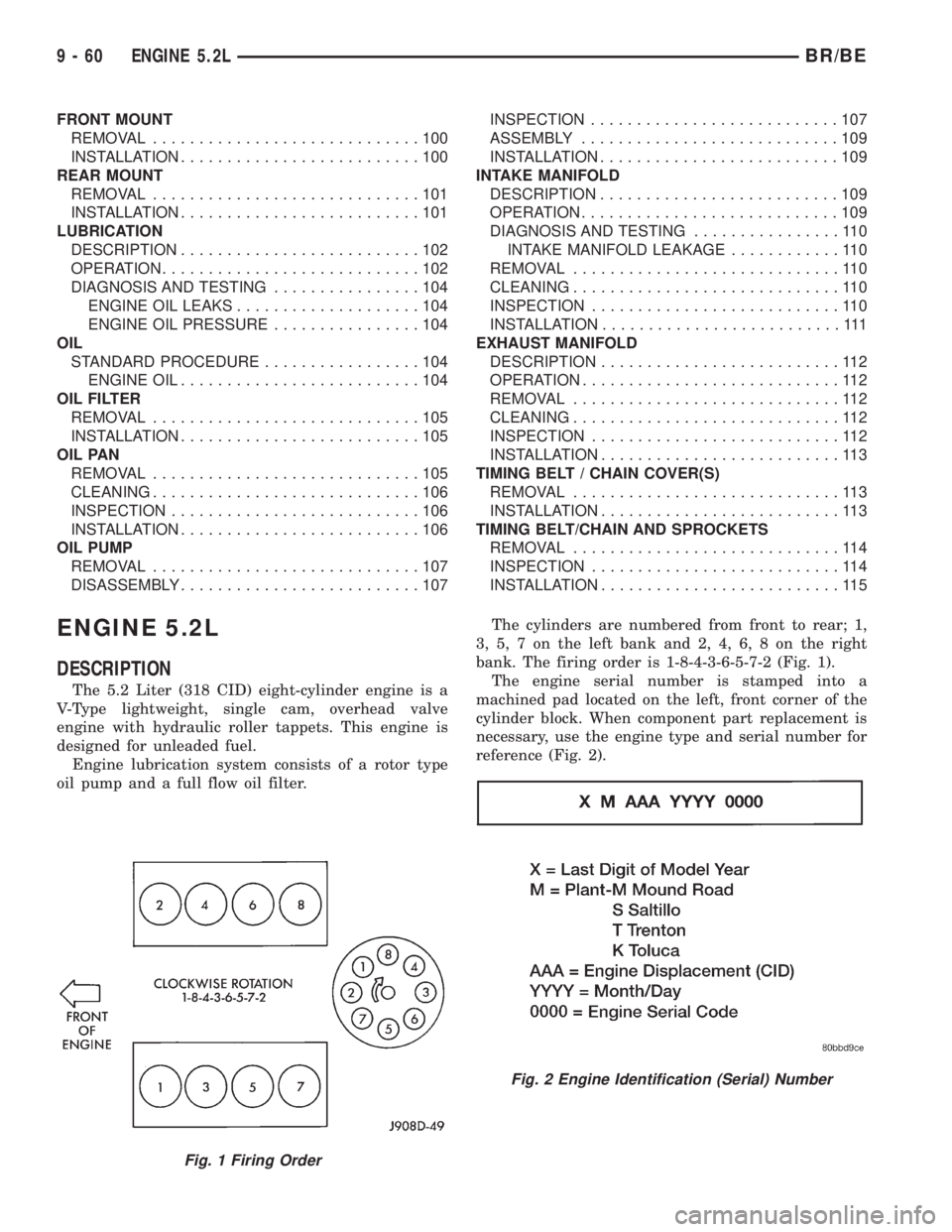
oil pump and a full flow oil filter.The cylinders are numbered from front to rear; 1,
3, 5, 7 on the left bank and 2, 4, 6, 8 on the right
bank. The firing order is 1-8-4-3-6-5-7-2 (Fig. 1).
The engine serial number is stamped into a
machined pad located on the left, front corner of the
cylinder block. When component part replacement is
necessary, use the engine type and serial number for
reference (Fig. 2).
Fig. 1 Firing Order
Fig. 2 Engine Identification (Serial) Number
9 - 60 ENGINE 5.2LBR/BE