Engine DODGE RAM 2003 Service Repair Manual
[x] Cancel search | Manufacturer: DODGE, Model Year: 2003, Model line: RAM, Model: DODGE RAM 2003Pages: 2895, PDF Size: 83.15 MB
Page 2845 of 2895
REMOVAL
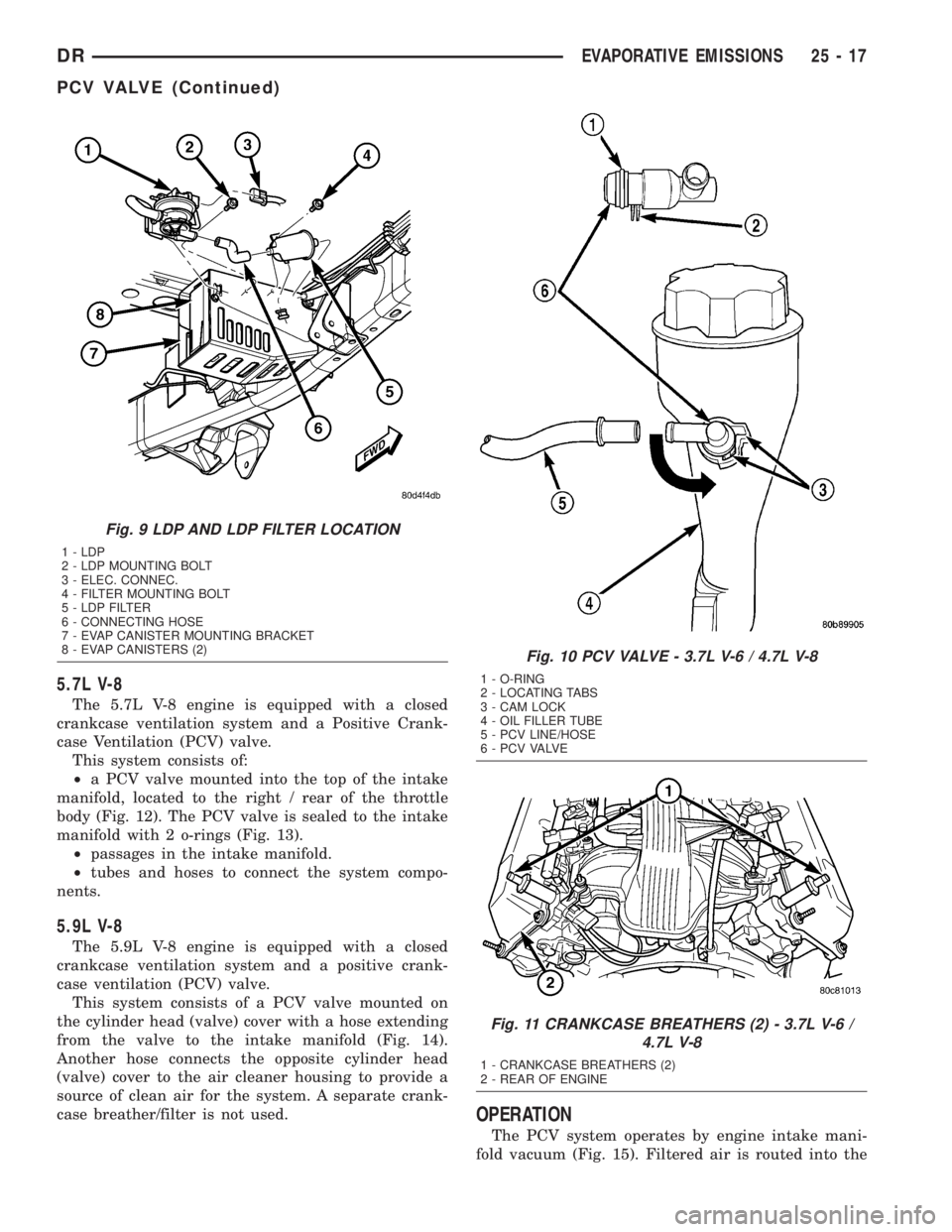
The Leak Detection Pump (LDP) and LDP filter
are attached to the front of the EVAP canister
mounting bracket (Fig. 9). This is located near the
front of the fuel tank. The LDP and LDP filter are
replaced (serviced) as one unit.
(1) Raise and support vehicle.
(2) Carefully remove hose at LDP filter.
(3) Remove LDP filter mounting bolt and remove
from vehicle.
(4) Carefully remove vapor/vacuum lines at LDP.
(5) Disconnect electrical connector at LDP.
(6) Remove LDP mounting bolt and remove LDP
from vehicle.
INSTALLATION
The LDP and LDP filter are attached to the front
of the EVAP canister mounting bracket. The LDP
and LDP filter are replaced (serviced) as one unit.
(1) Install LDP to mounting bracket. Refer to
Torque Specifications.
(2) Install LDP filter to mounting bracket. Refer to
Torque Specifications.
(3) Carefully install vapor/vacuum lines to LDP,
and install hose to LDP filter.The vapor/vacuum
lines and hoses must be firmly connected.
Check the vapor/vacuum lines at the LDP, LDPfilter and EVAP canister purge solenoid for
damage or leaks. If a leak is present, a Diagnos-
tic Trouble Code (DTC) may be set.
(4) Connect electrical connector to LDP.
PCV VALVE
DESCRIPTION
3.7L V-6 / 4.7L V-8
The 3.7L V-6 and 4.7L V-8 engines are equipped
with a closed crankcase ventilation system and a
Positive Crankcase Ventilation (PCV) valve.
This system consists of:
²a PCV valve mounted to the oil filler housing
(Fig. 10). The PCV valve is sealed to the oil filler
housing with an o-ring.
²the air cleaner housing
²two interconnected breathers threaded into the
rear of each cylinder head (Fig. 11).
²tubes and hoses to connect the system compo-
nents.
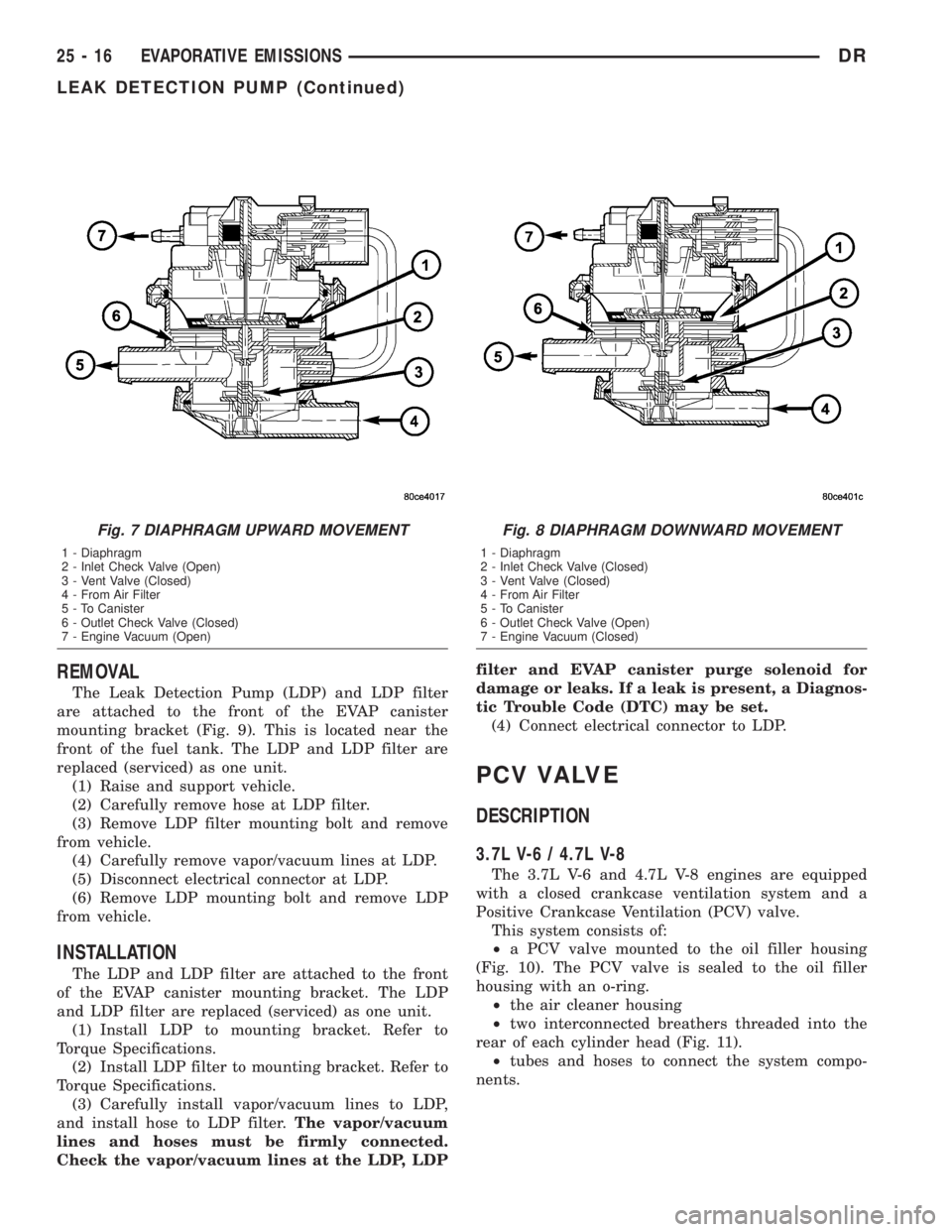
Fig. 7 DIAPHRAGM UPWARD MOVEMENT
1 - Diaphragm
2 - Inlet Check Valve (Open)
3 - Vent Valve (Closed)
4 - From Air Filter
5 - To Canister
6 - Outlet Check Valve (Closed)
7 - Engine Vacuum (Open)
Fig. 8 DIAPHRAGM DOWNWARD MOVEMENT
1 - Diaphragm
2 - Inlet Check Valve (Closed)
3 - Vent Valve (Closed)
4 - From Air Filter
5 - To Canister
6 - Outlet Check Valve (Open)
7 - Engine Vacuum (Closed)
25 - 16 EVAPORATIVE EMISSIONSDR
LEAK DETECTION PUMP (Continued)
Page 2846 of 2895
5.7L V-8
The 5.7L V-8 engine is equipped with a closed
crankcase ventilation system and a Positive Crank-
case Ventilation (PCV) valve.
This system consists of:
²a PCV valve mounted into the top of the intake
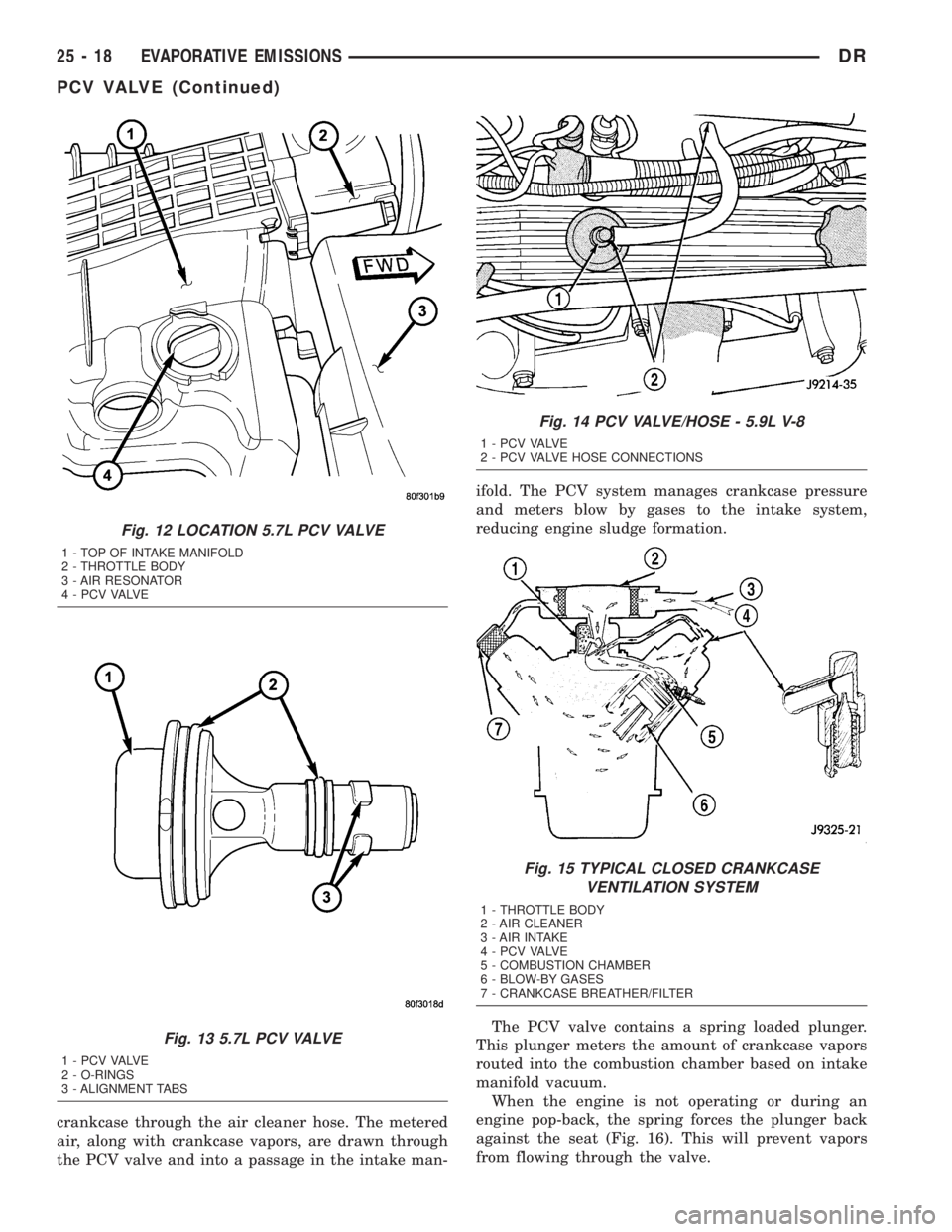
manifold, located to the right / rear of the throttle
body (Fig. 12). The PCV valve is sealed to the intake
manifold with 2 o-rings (Fig. 13).
²passages in the intake manifold.
²tubes and hoses to connect the system compo-
nents.
5.9L V-8
The 5.9L V-8 engine is equipped with a closed
crankcase ventilation system and a positive crank-
case ventilation (PCV) valve.
This system consists of a PCV valve mounted on
the cylinder head (valve) cover with a hose extending
from the valve to the intake manifold (Fig. 14).
Another hose connects the opposite cylinder head
(valve) cover to the air cleaner housing to provide a
source of clean air for the system. A separate crank-
case breather/filter is not used.
OPERATION
The PCV system operates by engine intake mani-
fold vacuum (Fig. 15). Filtered air is routed into the
Fig. 9 LDP AND LDP FILTER LOCATION
1 - LDP
2 - LDP MOUNTING BOLT
3 - ELEC. CONNEC.
4 - FILTER MOUNTING BOLT
5 - LDP FILTER
6 - CONNECTING HOSE
7 - EVAP CANISTER MOUNTING BRACKET
8 - EVAP CANISTERS (2)
Fig. 10 PCV VALVE - 3.7L V-6 / 4.7L V-8
1 - O-RING
2 - LOCATING TABS
3 - CAM LOCK
4 - OIL FILLER TUBE
5 - PCV LINE/HOSE
6 - P C V VA LV E
Fig. 11 CRANKCASE BREATHERS (2) - 3.7L V-6 /
4.7L V-8
1 - CRANKCASE BREATHERS (2)
2 - REAR OF ENGINE
DREVAPORATIVE EMISSIONS 25 - 17
PCV VALVE (Continued)
Page 2847 of 2895
crankcase through the air cleaner hose. The metered
air, along with crankcase vapors, are drawn through
the PCV valve and into a passage in the intake man-ifold. The PCV system manages crankcase pressure
and meters blow by gases to the intake system,
reducing engine sludge formation.
The PCV valve contains a spring loaded plunger.
This plunger meters the amount of crankcase vapors
routed into the combustion chamber based on intake
manifold vacuum.
When the engine is not operating or during an
engine pop-back, the spring forces the plunger back
against the seat (Fig. 16). This will prevent vapors
from flowing through the valve.
Fig. 12 LOCATION 5.7L PCV VALVE
1 - TOP OF INTAKE MANIFOLD
2 - THROTTLE BODY
3 - AIR RESONATOR
4 - P C V VA LV E
Fig. 13 5.7L PCV VALVE
1 - P C V VA LV E
2 - O-RINGS
3 - ALIGNMENT TABS
Fig. 14 PCV VALVE/HOSE - 5.9L V-8
1 - P C V VA LV E
2 - PCV VALVE HOSE CONNECTIONS
Fig. 15 TYPICAL CLOSED CRANKCASE
VENTILATION SYSTEM
1 - THROTTLE BODY
2 - AIR CLEANER
3 - AIR INTAKE
4 - P C V VA LV E
5 - COMBUSTION CHAMBER
6 - BLOW-BY GASES
7 - CRANKCASE BREATHER/FILTER
25 - 18 EVAPORATIVE EMISSIONSDR
PCV VALVE (Continued)
Page 2848 of 2895
During periods of high manifold vacuum, such as
idle or cruising speeds, vacuum is sufficient to com-
pletely compress spring. It will then pull the plunger
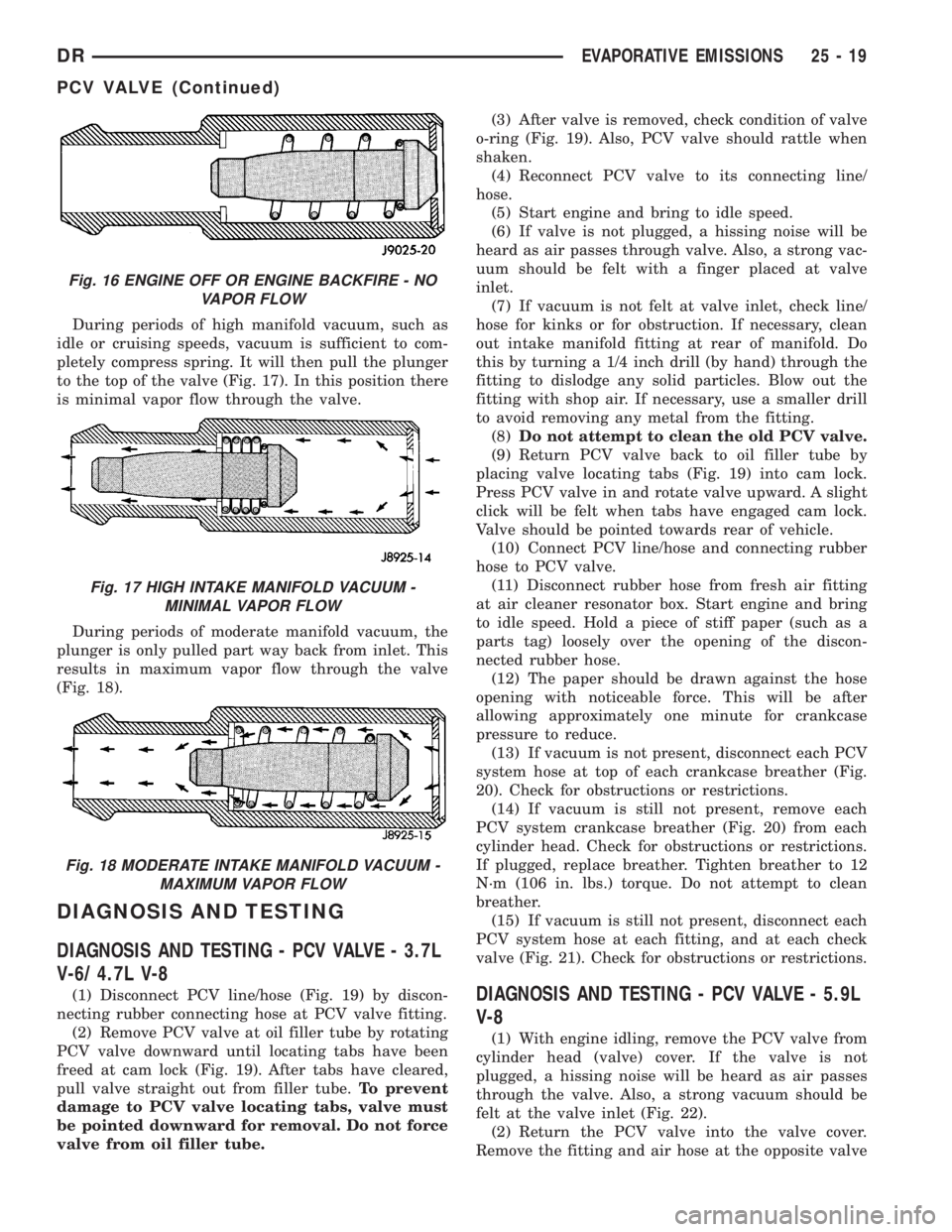
to the top of the valve (Fig. 17). In this position there
is minimal vapor flow through the valve.
During periods of moderate manifold vacuum, the
plunger is only pulled part way back from inlet. This
results in maximum vapor flow through the valve
(Fig. 18).
DIAGNOSIS AND TESTING
DIAGNOSIS AND TESTING - PCV VALVE - 3.7L
V-6/ 4.7L V-8
(1) Disconnect PCV line/hose (Fig. 19) by discon-
necting rubber connecting hose at PCV valve fitting.
(2) Remove PCV valve at oil filler tube by rotating
PCV valve downward until locating tabs have been
freed at cam lock (Fig. 19). After tabs have cleared,
pull valve straight out from filler tube.To prevent
damage to PCV valve locating tabs, valve must
be pointed downward for removal. Do not force
valve from oil filler tube.(3) After valve is removed, check condition of valve
o-ring (Fig. 19). Also, PCV valve should rattle when
shaken.
(4) Reconnect PCV valve to its connecting line/
hose.
(5) Start engine and bring to idle speed.
(6) If valve is not plugged, a hissing noise will be
heard as air passes through valve. Also, a strong vac-
uum should be felt with a finger placed at valve
inlet.
(7) If vacuum is not felt at valve inlet, check line/
hose for kinks or for obstruction. If necessary, clean
out intake manifold fitting at rear of manifold. Do
this by turning a 1/4 inch drill (by hand) through the
fitting to dislodge any solid particles. Blow out the
fitting with shop air. If necessary, use a smaller drill
to avoid removing any metal from the fitting.
(8)Do not attempt to clean the old PCV valve.
(9) Return PCV valve back to oil filler tube by
placing valve locating tabs (Fig. 19) into cam lock.
Press PCV valve in and rotate valve upward. A slight
click will be felt when tabs have engaged cam lock.
Valve should be pointed towards rear of vehicle.
(10) Connect PCV line/hose and connecting rubber
hose to PCV valve.
(11) Disconnect rubber hose from fresh air fitting
at air cleaner resonator box. Start engine and bring
to idle speed. Hold a piece of stiff paper (such as a
parts tag) loosely over the opening of the discon-
nected rubber hose.
(12) The paper should be drawn against the hose
opening with noticeable force. This will be after
allowing approximately one minute for crankcase
pressure to reduce.
(13) If vacuum is not present, disconnect each PCV
system hose at top of each crankcase breather (Fig.
20). Check for obstructions or restrictions.
(14) If vacuum is still not present, remove each
PCV system crankcase breather (Fig. 20) from each
cylinder head. Check for obstructions or restrictions.
If plugged, replace breather. Tighten breather to 12
N´m (106 in. lbs.) torque. Do not attempt to clean
breather.
(15) If vacuum is still not present, disconnect each
PCV system hose at each fitting, and at each check
valve (Fig. 21). Check for obstructions or restrictions.DIAGNOSIS AND TESTING - PCV VALVE - 5.9L
V-8
(1) With engine idling, remove the PCV valve from
cylinder head (valve) cover. If the valve is not
plugged, a hissing noise will be heard as air passes
through the valve. Also, a strong vacuum should be
felt at the valve inlet (Fig. 22).
(2) Return the PCV valve into the valve cover.
Remove the fitting and air hose at the opposite valve
Fig. 16 ENGINE OFF OR ENGINE BACKFIRE - NO
VAPOR FLOW
Fig. 17 HIGH INTAKE MANIFOLD VACUUM -
MINIMAL VAPOR FLOW
Fig. 18 MODERATE INTAKE MANIFOLD VACUUM -
MAXIMUM VAPOR FLOW
DREVAPORATIVE EMISSIONS 25 - 19
PCV VALVE (Continued)
Page 2849 of 2895
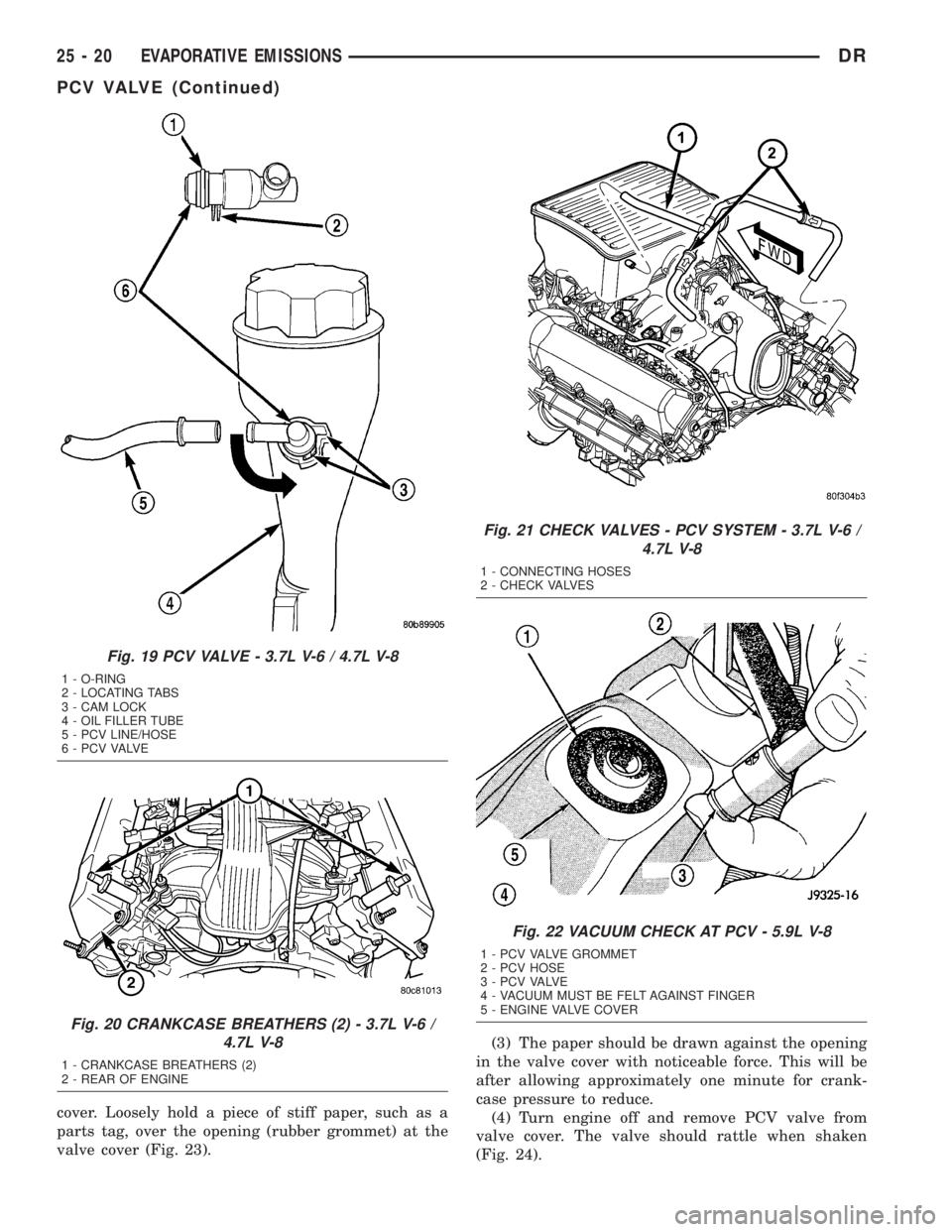
cover. Loosely hold a piece of stiff paper, such as a
parts tag, over the opening (rubber grommet) at the
valve cover (Fig. 23).(3) The paper should be drawn against the opening
in the valve cover with noticeable force. This will be
after allowing approximately one minute for crank-
case pressure to reduce.
(4) Turn engine off and remove PCV valve from
valve cover. The valve should rattle when shaken
(Fig. 24).
Fig. 19 PCV VALVE - 3.7L V-6 / 4.7L V-8
1 - O-RING
2 - LOCATING TABS
3 - CAM LOCK
4 - OIL FILLER TUBE
5 - PCV LINE/HOSE
6 - P C V VA LV E
Fig. 20 CRANKCASE BREATHERS (2) - 3.7L V-6 /
4.7L V-8
1 - CRANKCASE BREATHERS (2)
2 - REAR OF ENGINE
Fig. 21 CHECK VALVES - PCV SYSTEM - 3.7L V-6 /
4.7L V-8
1 - CONNECTING HOSES
2 - CHECK VALVES
Fig. 22 VACUUM CHECK AT PCV - 5.9L V-8
1 - PCV VALVE GROMMET
2 - PCV HOSE
3 - P C V VA LV E
4 - VACUUM MUST BE FELT AGAINST FINGER
5 - ENGINE VALVE COVER
25 - 20 EVAPORATIVE EMISSIONSDR
PCV VALVE (Continued)
Page 2851 of 2895
tabs, valve must be pointed downward for
removal. Do not force valve from oil filler tube.
(3) After valve is removed, check condition of valve
o-ring (Fig. 25).
5.7L V-8
The PCV valve is mounted into the top of the
intake manifold, located to the right / rear of the
throttle body (Fig. 12). The PCV valve is sealed to
the intake manifold with 2 o-rings (Fig. 13).
(1) Remove PCV valve by rotating counter-clock-
wise 90 degrees until locating tabs have been freed.
After tabs have cleared, pull valve straight up from
intake manifold.
(2) After valve is removed, check condition of 2
valve o-rings.
INSTALLATION
3.7L V6 / 4.7L V-8
The PCV valve is located on the oil filler tube. Two
locating tabs are located on the side of the valve.
These 2 tabs fit into a cam lock in the oil filler tube.
An o-ring seals the valve to the filler tube.
(1) Return PCV valve back to oil filler tube by
placing valve locating tabs into cam lock. Press PCV
valve in and rotate valve upward. A slight click will
be felt when tabs have engaged cam lock. Valve
should be pointed towards rear of vehicle.
(2) Connect PCV line/hose and rubber hose to PCV
valve.
5.7L V-8
(1) Clean out intake manifold opening.
(2) Check condition of 2 o-rings on PCV valve.
(3) Apply engine oil to 2 o-rings.
(4) Place PCV valve into intake manifold and
rotate 90 degrees clockwise for installation.
VACUUM LINES
DESCRIPTION
A vacuum schematic for emission related items can
be found on the vehicles VECI label. Refer to Vehicle
Emission Control Information (VECI) Label for label
location.
VAPOR CANISTER
DESCRIPTION
Two, maintenance free, EVAP canisters are used.
Both canisters are mounted into a two-piece support
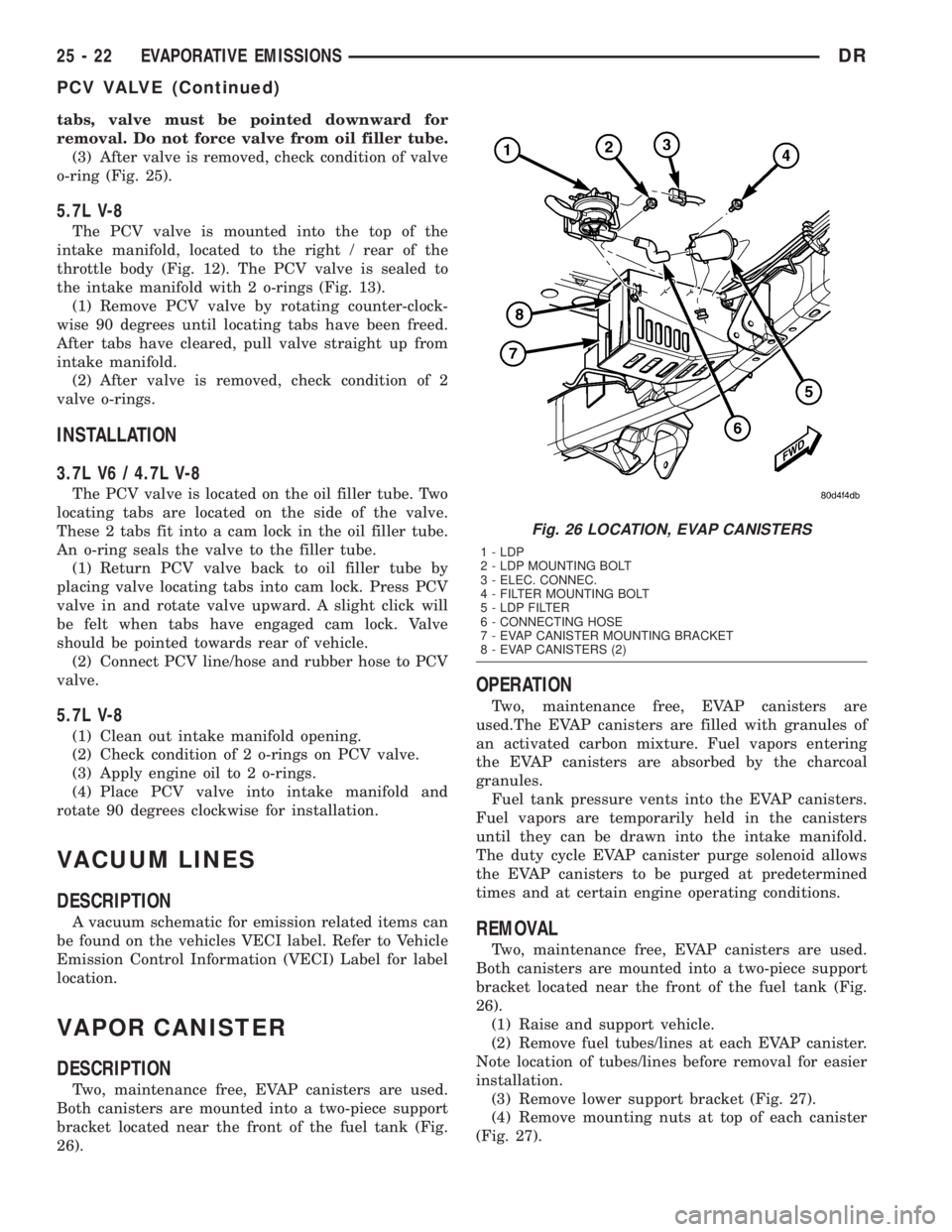
bracket located near the front of the fuel tank (Fig.
26).
OPERATION
Two, maintenance free, EVAP canisters are
used.The EVAP canisters are filled with granules of
an activated carbon mixture. Fuel vapors entering
the EVAP canisters are absorbed by the charcoal
granules.
Fuel tank pressure vents into the EVAP canisters.
Fuel vapors are temporarily held in the canisters
until they can be drawn into the intake manifold.
The duty cycle EVAP canister purge solenoid allows
the EVAP canisters to be purged at predetermined
times and at certain engine operating conditions.
REMOVAL
Two, maintenance free, EVAP canisters are used.
Both canisters are mounted into a two-piece support
bracket located near the front of the fuel tank (Fig.
26).
(1) Raise and support vehicle.
(2) Remove fuel tubes/lines at each EVAP canister.
Note location of tubes/lines before removal for easier
installation.
(3) Remove lower support bracket (Fig. 27).
(4) Remove mounting nuts at top of each canister
(Fig. 27).
Fig. 26 LOCATION, EVAP CANISTERS
1 - LDP
2 - LDP MOUNTING BOLT
3 - ELEC. CONNEC.
4 - FILTER MOUNTING BOLT
5 - LDP FILTER
6 - CONNECTING HOSE
7 - EVAP CANISTER MOUNTING BRACKET
8 - EVAP CANISTERS (2)
25 - 22 EVAPORATIVE EMISSIONSDR
PCV VALVE (Continued)
Page 2852 of 2895
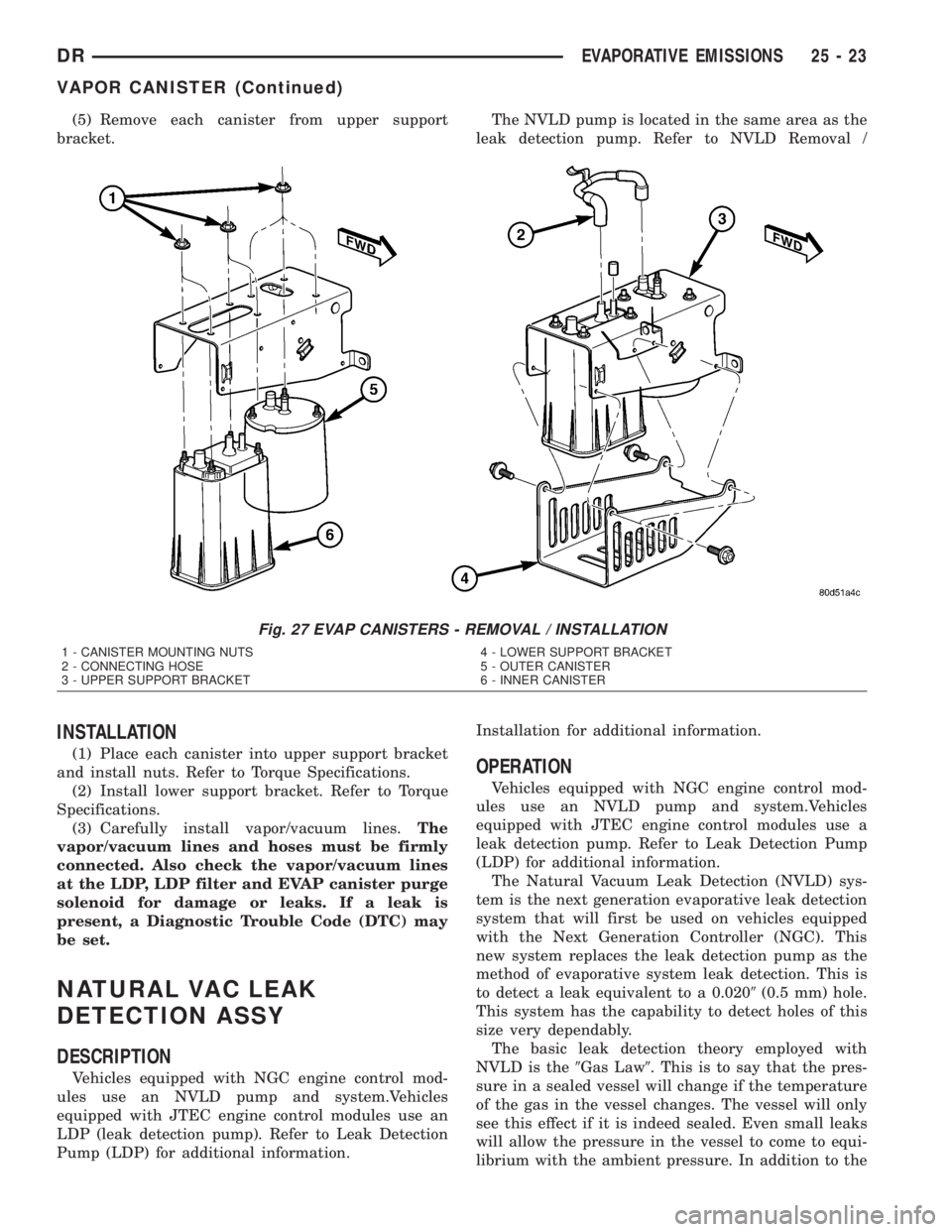
(5) Remove each canister from upper support
bracket.
INSTALLATION
(1) Place each canister into upper support bracket
and install nuts. Refer to Torque Specifications.
(2) Install lower support bracket. Refer to Torque
Specifications.
(3) Carefully install vapor/vacuum lines.The
vapor/vacuum lines and hoses must be firmly
connected. Also check the vapor/vacuum lines
at the LDP, LDP filter and EVAP canister purge
solenoid for damage or leaks. If a leak is
present, a Diagnostic Trouble Code (DTC) may
be set.
NATURAL VAC LEAK
DETECTION ASSY
DESCRIPTION
Vehicles equipped with NGC engine control mod-
ules use an NVLD pump and system.Vehicles
equipped with JTEC engine control modules use an
LDP (leak detection pump). Refer to Leak Detection
Pump (LDP) for additional information.The NVLD pump is located in the same area as the
leak detection pump. Refer to NVLD Removal /
Installation for additional information.
OPERATION
Vehicles equipped with NGC engine control mod-
ules use an NVLD pump and system.Vehicles
equipped with JTEC engine control modules use a
leak detection pump. Refer to Leak Detection Pump
(LDP) for additional information.
The Natural Vacuum Leak Detection (NVLD) sys-
tem is the next generation evaporative leak detection
system that will first be used on vehicles equipped
with the Next Generation Controller (NGC). This
new system replaces the leak detection pump as the
method of evaporative system leak detection. This is
to detect a leak equivalent to a 0.0209(0.5 mm) hole.
This system has the capability to detect holes of this
size very dependably.
The basic leak detection theory employed with
NVLD is the9Gas Law9. This is to say that the pres-
sure in a sealed vessel will change if the temperature
of the gas in the vessel changes. The vessel will only
see this effect if it is indeed sealed. Even small leaks
will allow the pressure in the vessel to come to equi-
librium with the ambient pressure. In addition to the
Fig. 27 EVAP CANISTERS - REMOVAL / INSTALLATION
1 - CANISTER MOUNTING NUTS
2 - CONNECTING HOSE
3 - UPPER SUPPORT BRACKET4 - LOWER SUPPORT BRACKET
5 - OUTER CANISTER
6 - INNER CANISTER
DREVAPORATIVE EMISSIONS 25 - 23
VAPOR CANISTER (Continued)
Page 2853 of 2895
detection of very small leaks, this system has the
capability of detecting medium as well as large evap-
orative system leaks.
A vent valve seals the canister vent during engine
off conditions. If the vapor system has a leak of less
than the failure threshold, the evaporative system
will be pulled into a vacuum, either due to the cool
down from operating temperature or diurnal ambient
temperature cycling. The diurnal effect is considered
one of the primary contributors to the leak determi-
nation by this diagnostic. When the vacuum in the
system exceeds about 19H2O (0.25 KPA), a vacuum
switch closes. The switch closure sends a signal to
the NGC. The NGC, via appropriate logic strategies,
utilizes the switch signal, or lack thereof, to make a
determination of whether a leak is present.
The NVLD device is designed with a normally open
vacuum switch, a normally closed solenoid, and a
seal, which is actuated by both the solenoid and a
diaphragm. The NVLD is located on the atmospheric
vent side of the canister. The NVLD assembly may
be mounted on top of the canister outlet, or in-line
between the canister and atmospheric vent filter. The
normally open vacuum switch will close with about 19
H2O (0.25 KPA) vacuum in the evaporative system.
The diaphragm actuates the switch. This is above the
opening point of the fuel inlet check valve in the fill
tube so cap off leaks can be detected. Submerged fill
systems must have recirculation lines that do not
have the in-line normally closed check valve that pro-
tects the system from failed nozzle liquid ingestion,
in order to detect cap off conditions.
The normally closed valve in the NVLD is intended
to maintain the seal on the evaporative system dur-
ing the engine off condition. If vacuum in the evapo-
rative system exceeds 39to 69H2O (0.75 to 1.5 KPA),
the valve will be pulled off the seat, opening the seal.
This will protect the system from excessive vacuum
as well as allowing sufficient purge flow in the event
that the solenoid was to become inoperative.
The solenoid actuates the valve to unseal the can-
ister vent while the engine is running. It also will be
used to close the vent during the medium and large
leak tests and during the purge flow check. This sole-
noid requires initial 1.5 amps of current to pull the
valve open but after 100 ms. will be duty cycled down
to an average of about 150 mA for the remainder of
the drive cycle.
Another feature in the device is a diaphragm that
will open the seal in the NVLD with pressure in the
evaporative system. The device will9blow off9at
about 0.59H2O (0.12 KPA) pressure to permit the
venting of vapors during refueling. An added benefit
to this is that it will also allow the tank to9breathe9
during increasing temperatures, thus limiting the
pressure in the tank to this low level. This is benefi-cial because the induced vacuum during a subse-
quent declining temperature will achieve the switch
closed (pass threshold) sooner than if the tank had to
decay from a built up pressure.
The device itself has 3 wires: Switch sense, sole-
noid driver and ground. It also includes a resistor to
protect the switch from a short to battery or a short
to ground. The NGC utilizes a high-side driver to
energize and duty-cycle the solenoid.
REMOVAL
The NVLD pump and filter are attached to the
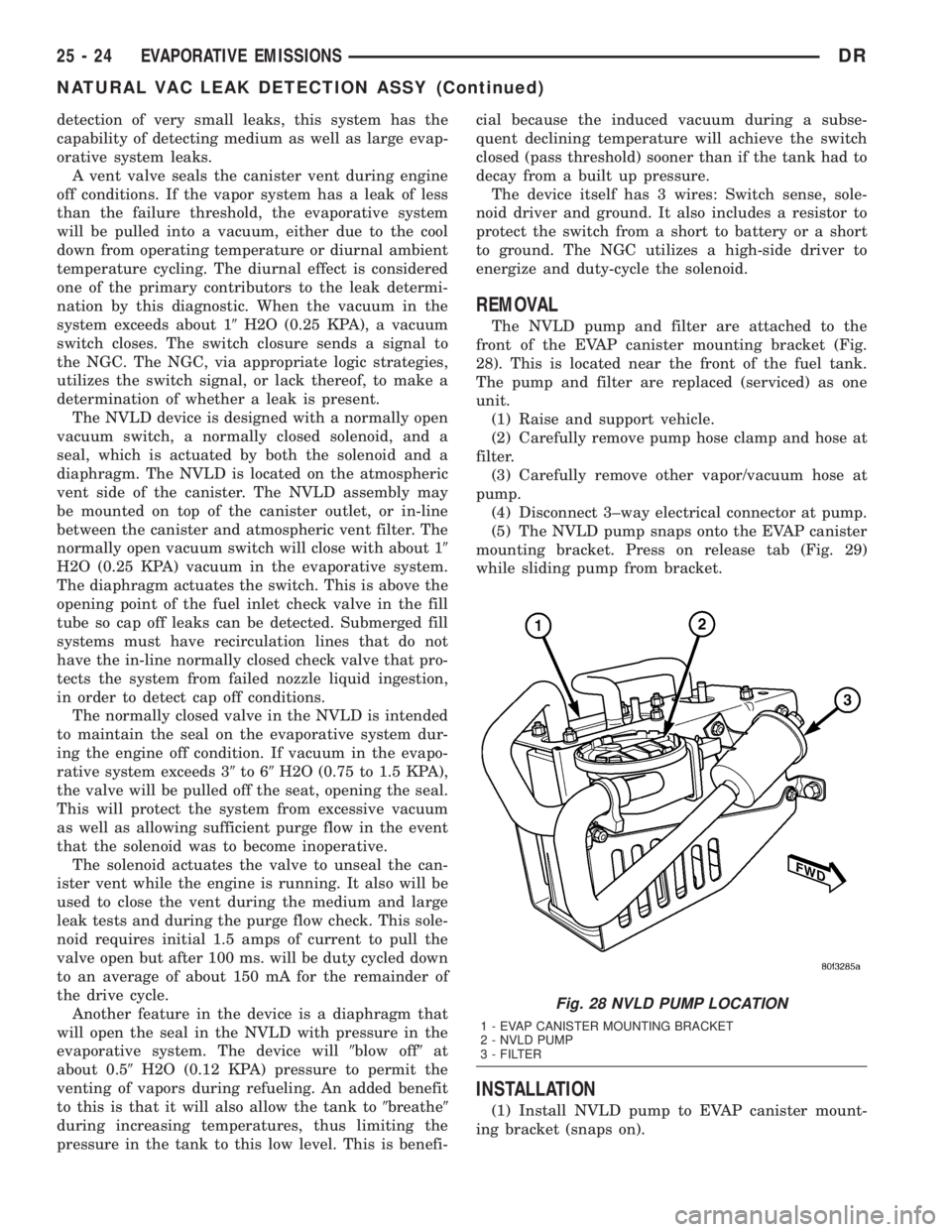
front of the EVAP canister mounting bracket (Fig.
28). This is located near the front of the fuel tank.
The pump and filter are replaced (serviced) as one
unit.
(1) Raise and support vehicle.
(2) Carefully remove pump hose clamp and hose at
filter.
(3) Carefully remove other vapor/vacuum hose at
pump.
(4) Disconnect 3±way electrical connector at pump.
(5) The NVLD pump snaps onto the EVAP canister
mounting bracket. Press on release tab (Fig. 29)
while sliding pump from bracket.
INSTALLATION
(1) Install NVLD pump to EVAP canister mount-
ing bracket (snaps on).
Fig. 28 NVLD PUMP LOCATION
1 - EVAP CANISTER MOUNTING BRACKET
2 - NVLD PUMP
3 - FILTER
25 - 24 EVAPORATIVE EMISSIONSDR
NATURAL VAC LEAK DETECTION ASSY (Continued)
Page 2859 of 2895
BIN - INSTALLATION, STORAGE.........23-62
BIN - INSTALLATION, UNDER SEAT
STORAGE...........................23-81
BIN - REMOVAL, STORAGE.............23-62
BIN - REMOVAL, UNDER SEAT STORAGE . . 23-81
BIN COVERING - INSTALLATION, UNDER
SEAT STORAGE......................23-81
BIN COVERING - REMOVAL, UNDER
SEAT STORAGE......................23-81
BIN LATCH - INSTALLATION, UNDER
SEAT STORAGE......................23-81
BIN LATCH - REMOVAL, UNDER SEAT
STORAGE...........................23-81
BLADE - DESCRIPTION, WIPER.........8R-19
BLADE - INSTALLATION, WIPER.........8R-20
BLADE - OPERATION, WIPER...........8R-19
BLADE - REMOVAL, WIPER............8R-19
BLEEDING - STANDARD PROCEDURE......5-27
BLEEDING - STANDARD PROCEDURE,
ABS BRAKE..........................5-40
BLEEDING - STANDARD PROCEDURE,
MANUAL.............................5-5
BLEEDING - STANDARD PROCEDURE,
MASTER CYLINDER...................5-20
BLEEDING - STANDARD PROCEDURE,
PRESSURE...........................5-5
BLEND DOOR - INSTALLATION..........24-25
BLEND DOOR - REMOVAL.............24-24
BLEND DOOR ACTUATOR -
DESCRIPTION.......................24-16
BLEND DOOR ACTUATOR -
INSTALLATION.......................24-17
BLEND DOOR ACTUATOR - OPERATION . . . 24-16
BLEND DOOR ACTUATOR - REMOVAL....24-17
BLOCK - CLEANING, ENGINE . 9-127,9-200,9-249,
9-38,9-380
BLOCK - DESCRIPTION, BLOWER
MOTOR RESISTOR...................24-17
BLOCK - DESCRIPTION, ENGINE.....9-126,9-37
BLOCK - INSPECTION, ENGINE....9-127,9-200,
9-249,9-38,9-380
BLOCK - INSTALLATION, BLOWER
MOTOR RESISTOR...................24-18
BLOCK - INSTALLATION, BRAKE
JUNCTION...........................5-19
BLOCK - OPERATION, BLOWER MOTOR
RESISTOR..........................24-17
BLOCK - REMOVAL, BLOWER MOTOR
RESISTOR..........................24-18
BLOCK - REMOVAL, BRAKE JUNCTION....5-19
BLOCK HEATER - 5.9L DIESEL -
DESCRIPTION, ENGINE.................7-43
BLOCK HEATER - 5.9L DIESEL -
INSTALLATION, ENGINE................7-44
BLOCK HEATER - 5.9L DIESEL -
OPERATION, ENGINE...................7-43
BLOCK HEATER - 5.9L DIESEL -
REMOVAL, ENGINE....................7-43
BLOCK HEATER - DESCRIPTION, ENGINE . . . 7-42
BLOCK HEATER - DIAGNOSIS AND
TESTING, ENGINE.....................7-42
BLOCK HEATER - INSTALLATION,
ENGINE.............................7-43
BLOCK HEATER - OPERATION, ENGINE....7-42
BLOCK HEATER - REMOVAL, ENGINE......7-43
BLOCK REFACING - STANDARD
PROCEDURE, CYLINDER
...............9-312
BLOWER MOTOR - DESCRIPTION
.......24-25
BLOWER MOTOR - DIAGNOSIS AND
TESTING
...........................24-26
BLOWER MOTOR - INSTALLATION
.......24-26
BLOWER MOTOR - OPERATION
.........24-25
BLOWER MOTOR - REMOVAL
...........24-26
BLOWER MOTOR RESISTOR -
DIAGNOSIS AND TESTING
.............24-18
BLOWER MOTOR RESISTOR BLOCK -
DESCRIPTION
.......................24-17
BLOWER MOTOR RESISTOR BLOCK -
INSTALLATION
.......................24-18
BLOWER MOTOR RESISTOR BLOCK -
OPERATION
.........................24-17
BLOWER MOTOR RESISTOR BLOCK -
REMOVAL
..........................24-18
BLOWER MOTOR SWITCH -
DESCRIPTION
.......................24-18
BLOWER MOTOR SWITCH - DIAGNOSIS
AND TESTING
.......................24-18BLOWER MOTOR SWITCH -
INSTALLATION.......................24-19
BLOWER MOTOR SWITCH - OPERATION . . 24-18
BLOWER MOTOR SWITCH - REMOVAL . . . 24-19
BODY - ADJUSTMENTS, VALVE . . 21-308,21-487
BODY - ASSEMBLY, VALVE......21-299,21-477,
21-590
BODY & CABLE - DESCRIPTION,
ANTENNA...........................8A-4
BODY & CABLE - INSTALLATION,
ANTENNA...........................8A-6
BODY & CABLE - OPERATION, ANTENNA . . . 8A-4
BODY & CABLE - REMOVAL, ANTENNA....8A-6
BODY - CLEANING, VALVE......21-298,21-476,
21-588
BODY - DESCRIPTION, THROTTLE.......14-45
BODY - DESCRIPTION, VALVE . . . 21-267,21-445,
21-584
BODY - DISASSEMBLY, VALVE . . . 21-287,21-465,
21-586
BODY - INSPECTION, VALVE....21-298,21-476,
21-588
BODY - INSTALLATION, THROTTLE.......14-47
BODY - INSTALLATION, VALVE . . . 21-307,21-486,
21-590
BODY - OPERATION, THROTTLE.........14-45
BODY - OPERATION, VALVE.....21-272,21-450,
21-585
BODY - REMOVAL, THROTTLE..........14-45
BODY - REMOVAL, VALVE . 21-286,21-464,21-585
BODY AND CABLE - DIAGNOSIS AND
TESTING, ANTENNA...................8A-4
BODY CODE PLATE - DESCRIPTION.....Intro.-4
BODY ISOLATORS - INSTALLATION......23-37
BODY ISOLATORS - REMOVAL..........23-36
BODY LUBRICATION - STANDARD
PROCEDURE.........................23-3
BODY OPENING DIMENSIONS -
SPECIFICATIONS.....................23-99
BODY PANEL REPAIR - STANDARD
PROCEDURE, PLASTIC.................23-3
BODY SIDE MOLDINGS - INSTALLATION . . 23-36
BODY SIDE MOLDINGS - REMOVAL......23-36
BODY, SPECIAL TOOLS................23-14
BODY VENT - INSTALLATION...........23-72
BODY VENT - REMOVAL...............23-72
BOOST PRESSURE - DIAGNOSIS AND
TESTING, TURBOCHARGER.............11-10
BOOSTER - DESCRIPTION, POWER
BRAKE..............................5-25
BOOSTER - DIAGNOSIS AND TESTING,
HYDRAULIC..........................5-25
BOOSTER - DIAGNOSIS AND TESTING,
MASTER CYLINDER/POWER.............5-20
BOOSTER - INSTALLATION, HYDRO-
BOOST BRAKE........................5-27
BOOSTER - INSTALLATION, POWER
BRAKE..............................5-25
BOOSTER - OPERATION, POWER BRAKE . . . 5-25
BOOSTER - REMOVAL, HYDRO-BOOST
BRAKE..............................5-27
BOOSTER - REMOVAL, POWER BRAKE....5-25
BOOT - INSTALLATION, 4WD FLOOR
SHIFT..............................23-64
BOOT - INSTALLATION, EXTENSION
HOUSING SEAL AND DUST......21-652,21-716
BOOT - REMOVAL, 4WD FLOOR SHIFT....23-63
BOOT - REMOVAL, EXTENSION HOUSING
SEAL AND DUST..............21-652,21-716
BORE - DE-GLAZE - STANDARD
PROCEDURE, CYLINDER...............9-313
BORE HONING - STANDARD
PROCEDURE, CYLINDER . 9-126,9-233,9-360,9-37
BORE REPAIR - STANDARD
PROCEDURE, CAM...................9-315
BORE REPAIR - STANDARD
PROCEDURE, CYLINDER...............9-313
BOX - INSTALLATION, CARGO..........23-37
BOX - INSTALLATION, GLOVE...........23-53
BOX - REMOVAL, CARGO..............23-37
BOX - REMOVAL, GLOVE..............23-53
BOX - TIE DOWN - INSTALLATION,
CARGO
............................23-37
BOX - TIE DOWN - REMOVAL, CARGO
....23-37
BOX LAMP/SWITCH - INSTALLATION,
GLOVE
.............................8L-25
BOX LAMP/SWITCH - REMOVAL, GLOVE
. . 8L-25
BOX LATCH - INSTALLATION, GLOVE
.....23-53BOX LATCH - REMOVAL, GLOVE.........23-53
B-PILLAR GRAB HANDLE -
INSTALLATION.......................23-69
B-PILLAR GRAB HANDLE - REMOVAL....23-69
B-PILLAR LOWER TRIM - INSTALLATION . . 23-65
B-PILLAR LOWER TRIM - REMOVAL.....23-64
B-PILLAR UPPER TRIM - INSTALLATION . . 23-65
B-PILLAR UPPER TRIM - REMOVAL......23-65
BRACKET - INSTALLATION, REARVIEW
MIRROR SUPPORT...................23-71
BRACKET - INSTALLATION, STEERING
COLUMN OPENING SUPPORT...........23-62
BRACKET - REMOVAL, STEERING
COLUMN OPENING SUPPORT...........23-61
BRACKETS - INSTALLATION, SEAT BACK
REAR - FOOTMANS LOOP..............23-85
BRACKETS - REMOVAL, SEAT BACK
REAR - FOOTMANS LOOP..............23-85
BRAKE - CLEANING, REAR DRUM IN
HAT ................................5-33
BRAKE - DESCRIPTION, CONTROLLER
ANTILOCK...........................8E-3
BRAKE - DESCRIPTION, PARKING........5-30
BRAKE - INSPECTION, REAR DRUM IN
HAT ................................5-33
BRAKE - INSTALLATION, CONTROLLER
ANTILOCK...........................8E-3
BRAKE - OPERATION, CONTROLLER
ANTILOCK...........................8E-3
BRAKE - OPERATION, PARKING..........5-30
BRAKE - REMOVAL, CONTROLLER
ANTILOCK...........................8E-3
BRAKE BLEEDING - STANDARD
PROCEDURE, ABS.....................5-40
BRAKE BOOSTER - DESCRIPTION,
POWER.............................5-25
BRAKE BOOSTER - INSTALLATION,
HYDRO-BOOST.......................5-27
BRAKE BOOSTER - INSTALLATION,
POWER.............................5-25
BRAKE BOOSTER - OPERATION, POWER . . . 5-25
BRAKE BOOSTER - REMOVAL,
HYDRO-BOOST.......................5-27
BRAKE BOOSTER - REMOVAL, POWER....5-25
BRAKE CABLE - INSTALLATION, FRONT
PARKING............................5-32
BRAKE CABLE - INSTALLATION, REAR
PARK...............................5-32
BRAKE CABLE - REMOVAL, FRONT
PARKING............................5-31
BRAKE CABLE - REMOVAL, REAR PARK . . . 5-31
BRAKE CALIPER ADAPTER MOUNT -
INSTALLATION, DISC...................5-17
BRAKE CALIPERS - DESCRIPTION, DISC . . . 5-11
BRAKE CALIPERS - OPERATION, DISC.....5-12
BRAKE FLUID CONTAMINATION -
DIAGNOSIS AND TESTING..............5-18
BRAKE FLUID LEVEL - STANDARD
PROCEDURE.........................5-18
BRAKE FLUID, SPECIFICATIONS..........5-18
BRAKE HOSE - INSTALLATION, FRONT......5-9
BRAKE HOSE - INSTALLATION, REAR.......5-9
BRAKE HOSE - REMOVAL, REAR..........5-8
BRAKE INDICATOR - DESCRIPTION,
BRAKE/PARK........................8J-18
BRAKE INDICATOR - DIAGNOSIS AND
TESTING...........................8J-19
BRAKE INDICATOR - OPERATION,
BRAKE/PARK........................8J-19
BRAKE JUNCTION BLOCK -
INSTALLATION........................5-19
BRAKE JUNCTION BLOCK - REMOVAL.....5-19
BRAKE LAMP - INSTALLATION...........8L-8
BRAKE LAMP - REMOVAL...............8L-8
BRAKE LAMP SWITCH - DESCRIPTION....8L-8
BRAKE LAMP SWITCH - DIAGNOSIS
AND TESTING........................8L-9
BRAKE LAMP SWITCH - INSTALLATION . . . 8L-10
BRAKE LAMP SWITCH - OPERATION......8L-8
BRAKE LAMP SWITCH - REMOVAL.......8L-9
BRAKE PADS/SHOES - INSTALLATION.....5-10
BRAKE PADS/SHOES - REMOVAL
.........5-10
BRAKE PROPORTIONING -
DESCRIPTION, ELECTRONIC VARIABLE
....5-43
BRAKE PROPORTIONING - OPERATION,
ELECTRONIC VARIABLE
................5-43
BRAKE SHOES - ADJUSTMENT, PARKING
. . 5-34
BRAKE, SPECIFICATIONS - BASE
..........5-7
4 INDEXDR
Description Group-Page Description Group-Page Description Group-Page
Page 2860 of 2895
BRAKE SYSTEM - DIAGNOSIS AND
TESTING, BASE........................5-2
BRAKE TRANSMISSION SHIFT
INTERLOCK - ADJUSTMENTS . . . 21-195,21-376,
21-540
BRAKE TRANSMISSION SHIFT
INTERLOCK - DIAGNOSIS AND
TESTING..............21-195,21-375,21-540
BRAKE TRANSMISSION SHIFT
INTERLOCK SYSTEM - DESCRIPTION . . . 21-194,
21-375,21-540
BRAKE TRANSMISSION SHIFT
INTERLOCK SYSTEM - OPERATION.....21-194,
21-375,21-540
BRAKE/PARK BRAKE INDICATOR -
DESCRIPTION.......................8J-18
BRAKE/PARK BRAKE INDICATOR -
OPERATION.........................8J-19
BRAKES - ABS - DESCRIPTION...........5-39
BRAKES - ABS - OPERATION............5-39
BRAKES, SPECIAL TOOLS - BASE.........5-5
BREAK-IN - STANDARD PROCEDURE,
A/C COMPRESSOR CLUTCH............24-10
BREATHER - INSTALLATION,
CRANKCASE........................9-292
BREATHER - REMOVAL, CRANKCASE.....9-291
BUCKLE - INSTALLATION, FRONT
OUTBOARD SEAT BELT................8O-34
BUCKLE - REMOVAL, FRONT OUTBOARD
SEAT BELT .........................8O-33
BUILT-IN INDICATOR TEST - STANDARD
PROCEDURE........................8F-10
BUMPER - INSTALLATION, FRONT........13-2
BUMPER - INSTALLATION, JOUNCE.......2-40
BUMPER - INSTALLATION, REAR.........13-4
BUMPER - REMOVAL, FRONT............13-2
BUMPER - REMOVAL, JOUNCE...........2-40
BUMPER - REMOVAL, REAR.............13-4
BUMPERS (3500) - INSTALLATION,
AUXILIARY SPRING....................2-40
BUMPERS (3500) - REMOVAL,
AUXILIARY SPRING....................2-40
BURNT FLUID - DIAGNOSIS AND
TESTING, CAUSES OF....21-201,21-381,21-541
BUSHING - INSTALLATION.............19-18
BUSHING - INSTALLATION,
DISTRIBUTOR.......................9-258
BUSHING - INSTALLATION, EXTENSION
HOUSING..........................21-200
BUSHING - INSTALLATION, TORSION
BAR CROSS MEMBER..................2-14
BUSHING - REMOVAL.................19-18
BUSHING - REMOVAL, DISTRIBUTOR.....9-258
BUSHING - REMOVAL, EXTENSION
HOUSING..........................21-200
BUSHING - REMOVAL, TORSION BAR
CROSSMEMBER......................2-12
BUSHING AND SEAL - INSTALLATION,
EXTENSION HOUSING..........21-616,21-682
BUSHING AND SEAL - REMOVAL,
EXTENSION HOUSING..........21-616,21-682
BUSHINGS - 2WD (LD) - INSTALLATION,
LOWER CONTROL ARM................2-14
BUSHINGS - 2WD (LD) - REMOVAL,
LOWER CONTROL ARM................2-12
BUSHINGS - 4WD (LD) - INSTALLATION,
LOWER CONTROL ARM
................2-13
BUSHINGS - 4WD (LD) - REMOVAL,
LOWER CONTROL ARM
................2-12
BUSHINGS - INSTALLATION
.............2-39
BUSHINGS - REMOVAL
.................2-39
BUZZ, SQUEAK & RATTLE - STANDARD
PROCEDURE
........................23-11
BYPASS - DESCRIPTION, WATER PUMP
. . . 7-64
BYPASS - OPERATION, WATER PUMP
.....7-65
BYPASS HOSE WITH AIR CONDITIONING
- INSTALLATION, WATER PUMP
..........7-70
BYPASS HOSE WITH AIR CONDITIONING
- REMOVAL, WATER PUMP
..............7-68
BYPASS HOSE WITHOUT AIR
CONDITIONING - INSTALLATION,
WATER PUMP
........................7-70
BYPASS HOSE WITHOUT AIR
CONDITIONING - REMOVAL, WATER
PUMP
..............................7-69
C205F - ADJUSTMENTS, FRONT AXLE
.....3-21
C205F - DESCRIPTION, FRONT AXLE
......3-18C205F - DIAGNOSIS AND TESTING,
FRONT AXLE.........................3-18
C205F - INSTALLATION, FRONT AXLE.....3-21
C205F - OPERATION, FRONT AXLE........3-18
C205F - REMOVAL, FRONT AXLE.........3-21
C205F - SPECIAL TOOLS, FRONT AXLE....3-30
C205F - SPECIFICATIONS, FRONT AXLE....3-29
CAB - INSTALLATION, QUAD...........8O-32
CAB - INSTALLATION, STANDARD.......8O-31
CAB - REMOVAL, QUAD...............8O-29
CAB - REMOVAL, STANDARD...........8O-28
CAB BACK PANEL TRIM -
INSTALLATION, REAR.................23-70
CAB BACK PANEL TRIM - REMOVAL,
REAR..............................23-70
CAB CLEARANCE LAMP - INSTALLATION . . 8L-10
CAB CLEARANCE LAMP - REMOVAL.....8L-10
CABLE - ADJUSTMENTS, THROTTLE
VALVE ......................21-255,21-432
CABLE - DESCRIPTION.................8P-3
CABLE - DESCRIPTION, ANTENNA BODY . . . 8A-4
CABLE - DESCRIPTION, SPARK PLUG.....8I-33
CABLE - DESCRIPTION, THROTTLE
VALVE ......................21-254,21-432
CABLE - DIAGNOSIS AND TESTING,
ANTENNA BODY......................8A-4
CABLE - DIAGNOSIS AND TESTING,
GEARSHIFT............21-209,21-389,21-544
CABLE - INSTALLATION..................8P-6
CABLE - INSTALLATION, ANTENNA BODY . . 8A-6
CABLE - INSTALLATION, CHECK.........23-15
CABLE - INSTALLATION, FRONT
PARKING BRAKE......................5-32
CABLE - INSTALLATION, GEARSHIFT....21-210,
21-390,21-545
CABLE - INSTALLATION, INSTRUMENT
PANEL ANTENNA......................8A-7
CABLE - INSTALLATION, LEFT REAR......5-33
CABLE - INSTALLATION, REAR PARK
BRAKE..............................5-32
CABLE - INSTALLATION, RIGHT REAR.....5-32
CABLE - INSTALLATION, SPARK PLUG....8I-35
CABLE - INSTALLATION, THROTTLE
CONTROL.....................14-51,14-96
CABLE - OPERATION...................8P-3
CABLE - OPERATION, ANTENNA BODY.....8A-4
CABLE - OPERATION, SPARK PLUG.......8I-33
CABLE - REMOVAL....................8P-3
CABLE - REMOVAL, ANTENNA BODY......8A-6
CABLE - REMOVAL, CHECK.............23-15
CABLE - REMOVAL, FRONT PARKING
BRAKE..............................5-31
CABLE - REMOVAL, GEARSHIFT . 21-209,21-389,
21-544
CABLE - REMOVAL, INSTRUMENT PANEL
ANTENNA...........................8A-6
CABLE - REMOVAL, LEFT REAR..........5-32
CABLE - REMOVAL, REAR PARK BRAKE . . . 5-31
CABLE - REMOVAL, RIGHT REAR.........5-31
CABLE - REMOVAL, SPARK PLUG........8I-34
CABLE - REMOVAL, THROTTLE
CONTROL.....................14-49,14-94
CABLE, ADJUSTMENTS - GEARSHIFT . . . 21-211,
21-391,21-546
CABLE ORDER, 8.0L V-10 ENGINE -
SPARK PLUG.........................8I-5
CABLE RESISTANCE, SPECIFICATIONS -
SPARK PLUG.........................8I-5
CABLE ROUTING, 5.7L V-8 ENGINE -
FIRING ORDER........................8I-4
CABLE/HANDLE ASSEMBLY -
INSTALLATION, LATCH RELEASE........23-47
CABLE/HANDLE ASSEMBLY - REMOVAL,
LATCH RELEASE.....................23-47
CABLES - DESCRIPTION, BATTERY.......8F-14
CABLES - DIAGNOSIS AND TESTING,
BATTERY...........................8F-15
CABLES - DIAGNOSIS AND TESTING,
SPARK PLUG........................8I-33
CABLES - INSTALLATION, BATTERY......8F-17
CABLES - OPERATION, BATTERY........8F-14
CABLES - REMOVAL, BATTERY
..........8F-16
CALIBRATION - STANDARD PROCEDURE,
COMPASS
...........................8M-3
CALIPER ADAPTER MOUNT -
INSTALLATION, DISC BRAKE
............5-17
CALIPERS - DESCRIPTION, DISC BRAKE
. . . 5-11
CALIPERS - OPERATION, DISC BRAKE
.....5-12CAM BORE REPAIR - STANDARD
PROCEDURE........................9-315
CAMBER AND CASTER ADJUSTMENT -
STANDARD PROCEDURE.................2-4
CAMBER, CASTER AND TOE
ADJUSTMENT - STANDARD
PROCEDURE..........................2-4
CAM/OVERDRIVE PISTON RETAINER -
ASSEMBLY, OVERRUNNING CLUTCH....21-239,
21-416
CAM/OVERDRIVE PISTON RETAINER -
CLEANING, OVERRUNNING CLUTCH....21-238,
21-416
CAM/OVERDRIVE PISTON RETAINER -
DESCRIPTION, OVERRUNNING CLUTCH . 21-237,
21-415
CAM/OVERDRIVE PISTON RETAINER -
DISASSEMBLY, OVERRUNNING
CLUTCH.....................21-238,21-415
CAM/OVERDRIVE PISTON RETAINER -
INSPECTION, OVERRUNNING CLUTCH . . 21-238,
21-416
CAM/OVERDRIVE PISTON RETAINER -
OPERATION, OVERRUNNING CLUTCH . . . 21-237,
21-415
CAMSHAFT - INSTALLATION . 9-201,9-250,9-320,
9-381
CAMSHAFT - REMOVAL.....9-200,9-250,9-317,
9-380
CAMSHAFT BEARINGS - INSTALLATION . . 9-320,
9-381
CAMSHAFT BEARINGS - REMOVAL . 9-317,9-380
CAMSHAFT CORE HOLE PLUG -
INSTALLATION.......................9-201
CAMSHAFT CORE HOLE PLUG -
REMOVAL............................9-200
CAMSHAFT POSITION SENSOR -
DESCRIPTION.......................14-82
CAMSHAFT POSITION SENSOR -
DESCRIPTION.........................8I-8
CAMSHAFT POSITION SENSOR -
INSTALLATION.......................14-83
CAMSHAFT POSITION SENSOR -
INSTALLATION.......................8I-14
CAMSHAFT POSITION SENSOR -
OPERATION.........................14-82
CAMSHAFT POSITION SENSOR -
OPERATION..........................8I-8
CAMSHAFT POSITION SENSOR -
REMOVAL..........................14-83
CAMSHAFT POSITION SENSOR -
REMOVAL...........................8I-11
CAMSHAFT(S) - DESCRIPTION.......9-24,9-34
CAMSHAFT(S) - INSTALLATION......9-25,9-35
CAMSHAFT(S) - LEFT - DESCRIPTION....9-113
CAMSHAFT(S) - LEFT - INSTALLATION....9-114
CAMSHAFT(S) - LEFT - REMOVAL.......9-113
CAMSHAFT(S) - REMOVAL..........9-24,9-34
CAMSHAFT(S) - RIGHT - DESCRIPTION . . . 9-117
CAMSHAFT(S) - RIGHT - INSTALLATION . . 9-118
CAMSHAFT(S) - RIGHT - REMOVAL......9-117
CANISTER - DESCRIPTION, VAPOR......25-22
CANISTER - INSTALLATION, VAPOR......25-23
CANISTER - OPERATION, VAPOR........25-22
CANISTER - REMOVAL, VAPOR..........25-22
CAP - 5.9L V-8 - DIAGNOSIS AND
TESTING, DISTRIBUTOR...............8I-18
CAP - DESCRIPTION, FUEL FILLER.......25-13
CAP - DESCRIPTION, RADIATOR
PRESSURE..........................7-60
CAP - DIAGNOSIS AND TESTING,
RADIATOR...........................7-61
CAP - OPERATION, FUEL FILLER........25-13
CAP - OPERATION, RADIATOR
PRESSURE..........................7-61
CAPACITIES, SPECIFICATIONS - FLUID......0-5
CAPACITOR - DESCRIPTION, IGNITION
COIL...............................8I-33
CAPACITOR - INSTALLATION, IGNITION
COIL...............................8I-33
CAPACITOR - OPERATION, IGNITION
COIL
...............................8I-33
CAPACITOR - REMOVAL, IGNITION COIL
. . . 8I-33
CAPACITY - SPECIFICATIONS, CHARGE
. . . 24-35
CAP-TO-FILLER NECK SEAL -
DIAGNOSIS AND TESTING, RADIATOR
.....7-61
CARDAN UNIVERSAL JOINTS -
ASSEMBLY, SINGLE
.....................3-9
DRINDEX 5
Description Group-Page Description Group-Page Description Group-Page