Front hub assembly DODGE RAM 2003 Service Owner's Guide
[x] Cancel search | Manufacturer: DODGE, Model Year: 2003, Model line: RAM, Model: DODGE RAM 2003Pages: 2895, PDF Size: 83.15 MB
Page 1882 of 2895
The driver selects a particular gear by moving the
shift lever to the desired gear position. This move-
ment moves the internal transmission shift compo-
nents to begin the shift sequence. As the shift lever
moves the selected shift rail, the shift fork attached
to that rail begins to move. The fork is positioned in
a groove in the outer circumference of the synchro-
nizer sleeve. As the shift fork moves the synchronizer
sleeve, the synchronizer begins to speed-up or slow
down the selected gear (depending on whether the
driver is up-shifting or down-shifting). The synchro-
nizer does this by having the synchronizer hub
splined to the mainshaft, or the countershaft in some
cases, and moving the blocker ring into contact with
the gear's friction cone. As the blocker ring and fric-
tion cone come together, the gear speed is brought up
or down to the speed of the synchronizer. As the two
speeds match, the splines on the inside of the syn-
chronizer sleeve become aligned with the teeth on
the blocker ring and the friction cone and eventually
will slide over the teeth, locking the gear to the
mainshaft, or countershaft, through the synchronizer.
DIAGNOSIS AND TESTING
LOW LUBRICANT LEVEL
A low transmission lubricant level is generally the
result of a leak, inadequate lubricant fill or an incor-
rect lubricant level check. A correct lubricant level
check can only be made when the vehicle is level.
Also allow the lubricant to settle for a minute or so
before checking. These recommendations will ensure
an accurate check and avoid an underfill or overfill
condition. Always check the lubricant level after any
addition of fluid to avoid an incorrect lubricant level
condition.
Leaks can occur at the mating surfaces of the gear
case, adaptor or extension housing, or from the front/
rear seals. A suspected leak could also be the result
of an overfill condition. Leaks at the rear of the
extension or adapter housing will be from the hous-
ing oil seals. Leaks at component mating surfaces
will probably be the result of inadequate sealer, gaps
in the sealer, incorrect bolt tightening or use of a
non-recommended sealer. A leak at the front of the
transmission will be from either the front bearing
retainer or retainer seal. Lubricant may be seen drip-
ping from the clutch housing after extended opera-
tion. If the leak is severe, it may also contaminate
the clutch disc causing the disc to slip, grab and or
chatter.
HARD SHIFTING
Hard shifting is usually caused by a low lubricant
level, improper or contaminated lubricants. The con-
sequence of using non-recommended lubricants isnoise, excessive wear, internal bind and hard shift-
ing. Substantial lubricant leaks can result in gear,
shift rail, synchro, and bearing damage. If a leak
goes undetected for an extended period, the first indi-
cations of component damage are usually hard shift-
ing and noise.
Component damage, incorrect clutch adjustment or
damaged clutch pressure plate or disc are additional
probable causes of increased shift effort. Incorrect
adjustment or a worn/damaged pressure plate or disc
can cause incorrect release. If clutch problem is
advanced, gear clash during shifts can result. Worn
or damaged synchro rings can cause gear clash when
shifting into any forward gear. In some new or
rebuilt transmissions, new synchro rings may tend to
stick slightly causing hard or noisy shifts. In most
cases this condition will decline as the rings wear-in.
TRANSMISSION NOISE
Most manual transmissions make some noise dur-
ing normal operation. Rotating gears generate a mild
whine that is audible, but generally only at extreme
speeds. Severe highly audible transmission noise is
generally the initial indicator of a lubricant problem.
Insufficient, improper or contaminated lubricant
will promote rapid wear of gears, synchros, shift
rails, forks and bearings. The overheating caused by
a lubricant problem, can also lead to gear breakage.
REMOVAL
(1) Shift transmission into Neutral.
(2) Remove shift boot screws from floorpan and
slide boot upward on the shift lever.
(3) Remove shift lever extension from shift tower
and lever assembly.
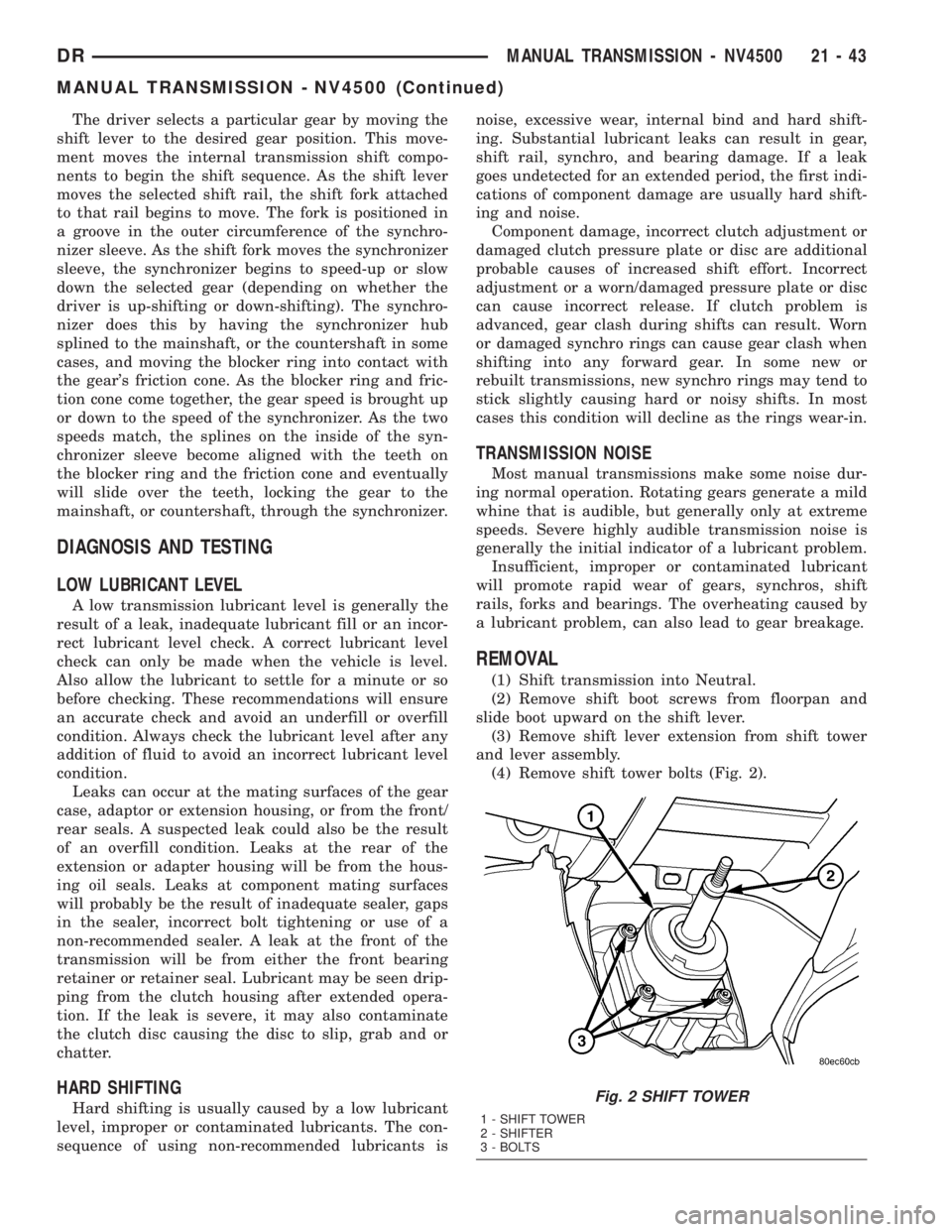
(4) Remove shift tower bolts (Fig. 2).
Fig. 2 SHIFT TOWER
1 - SHIFT TOWER
2 - SHIFTER
3 - BOLTS
DRMANUAL TRANSMISSION - NV4500 21 - 43
MANUAL TRANSMISSION - NV4500 (Continued)
Page 1893 of 2895
GEAR CASE
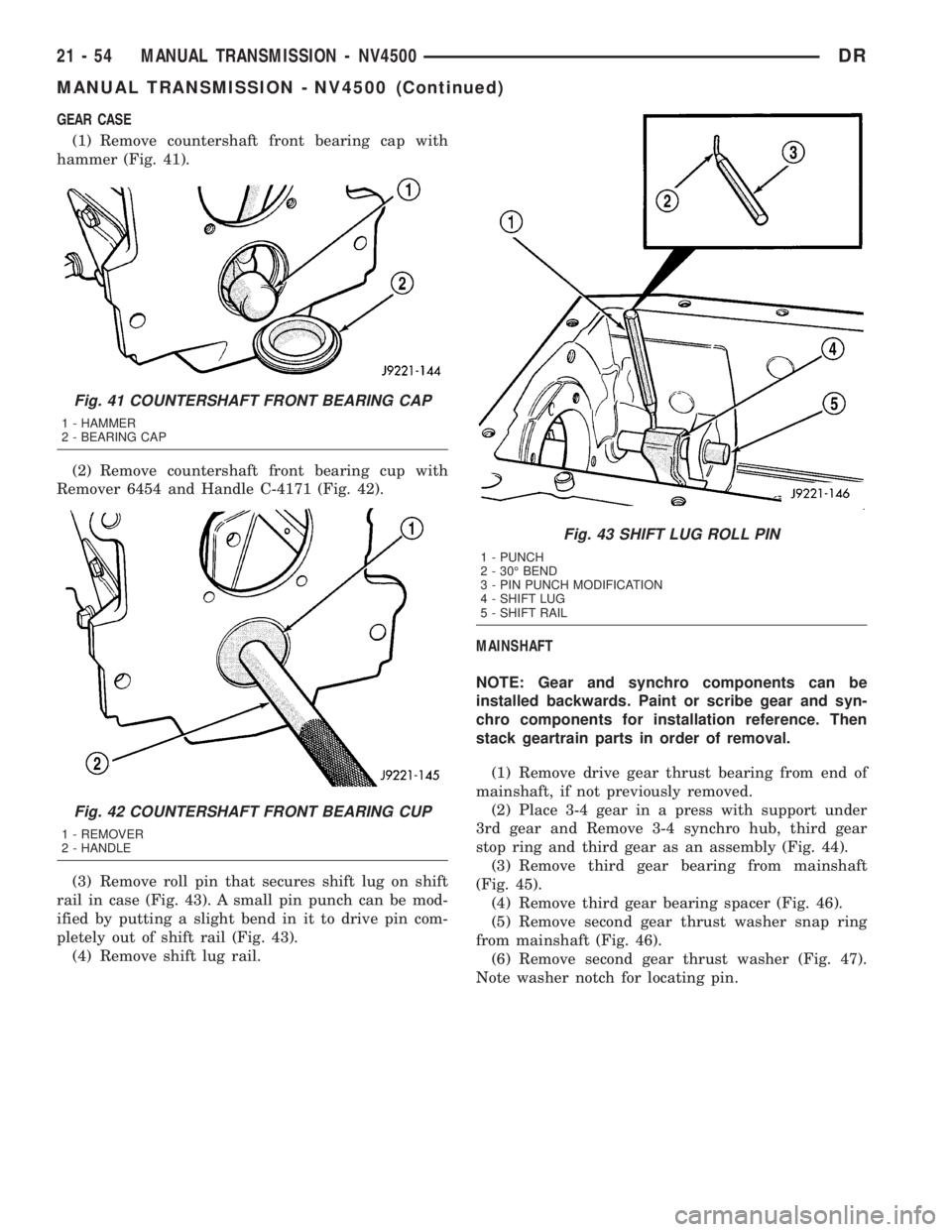
(1) Remove countershaft front bearing cap with
hammer (Fig. 41).
(2) Remove countershaft front bearing cup with
Remover 6454 and Handle C-4171 (Fig. 42).
(3) Remove roll pin that secures shift lug on shift
rail in case (Fig. 43). A small pin punch can be mod-
ified by putting a slight bend in it to drive pin com-
pletely out of shift rail (Fig. 43).
(4) Remove shift lug rail.MAINSHAFT
NOTE: Gear and synchro components can be
installed backwards. Paint or scribe gear and syn-
chro components for installation reference. Then
stack geartrain parts in order of removal.
(1) Remove drive gear thrust bearing from end of
mainshaft, if not previously removed.
(2) Place 3-4 gear in a press with support under
3rd gear and Remove 3-4 synchro hub, third gear
stop ring and third gear as an assembly (Fig. 44).
(3) Remove third gear bearing from mainshaft
(Fig. 45).
(4) Remove third gear bearing spacer (Fig. 46).
(5) Remove second gear thrust washer snap ring
from mainshaft (Fig. 46).
(6) Remove second gear thrust washer (Fig. 47).
Note washer notch for locating pin.
Fig. 41 COUNTERSHAFT FRONT BEARING CAP
1 - HAMMER
2 - BEARING CAP
Fig. 42 COUNTERSHAFT FRONT BEARING CUP
1 - REMOVER
2 - HANDLE
Fig. 43 SHIFT LUG ROLL PIN
1 - PUNCH
2 - 30É BEND
3 - PIN PUNCH MODIFICATION
4 - SHIFT LUG
5 - SHIFT RAIL
21 - 54 MANUAL TRANSMISSION - NV4500DR
MANUAL TRANSMISSION - NV4500 (Continued)
Page 1896 of 2895
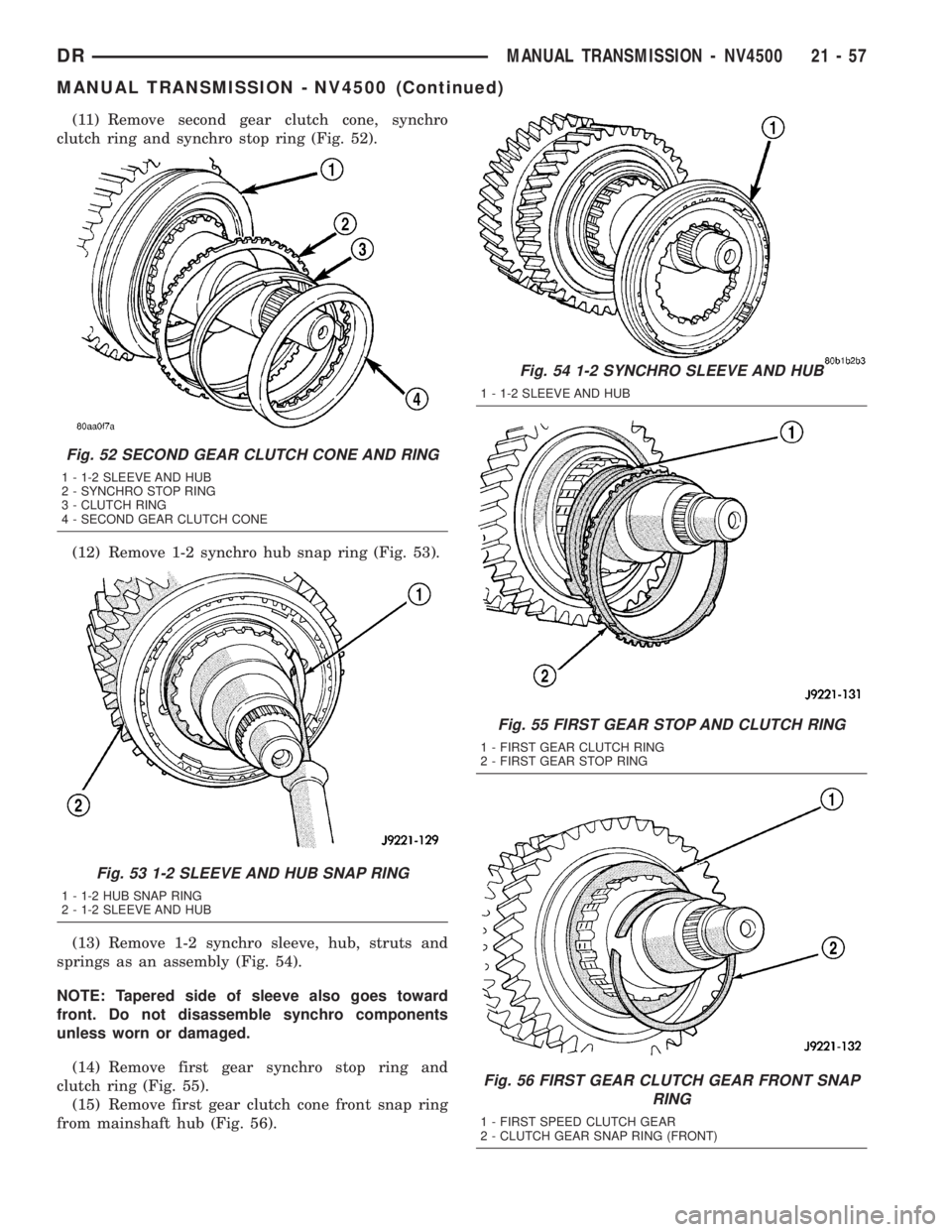
(11) Remove second gear clutch cone, synchro
clutch ring and synchro stop ring (Fig. 52).
(12) Remove 1-2 synchro hub snap ring (Fig. 53).
(13) Remove 1-2 synchro sleeve, hub, struts and
springs as an assembly (Fig. 54).
NOTE: Tapered side of sleeve also goes toward
front. Do not disassemble synchro components
unless worn or damaged.
(14) Remove first gear synchro stop ring and
clutch ring (Fig. 55).
(15) Remove first gear clutch cone front snap ring
from mainshaft hub (Fig. 56).
Fig. 52 SECOND GEAR CLUTCH CONE AND RING
1 - 1-2 SLEEVE AND HUB
2 - SYNCHRO STOP RING
3 - CLUTCH RING
4 - SECOND GEAR CLUTCH CONE
Fig. 53 1-2 SLEEVE AND HUB SNAP RING
1 - 1-2 HUB SNAP RING
2 - 1-2 SLEEVE AND HUB
Fig. 54 1-2 SYNCHRO SLEEVE AND HUB
1 - 1-2 SLEEVE AND HUB
Fig. 55 FIRST GEAR STOP AND CLUTCH RING
1 - FIRST GEAR CLUTCH RING
2 - FIRST GEAR STOP RING
Fig. 56 FIRST GEAR CLUTCH GEAR FRONT SNAP
RING
1 - FIRST SPEED CLUTCH GEAR
2 - CLUTCH GEAR SNAP RING (FRONT)
DRMANUAL TRANSMISSION - NV4500 21 - 57
MANUAL TRANSMISSION - NV4500 (Continued)
Page 1903 of 2895
(6) Install countershaft rear bearing plate (Fig.
74).
NOTE: Verify plate is seated in reverse idler shaft
notch and end play shims are still in position
before installing bolts.
(7) Apply 1-2 drops Mopar Loc N' Seal or equiva-
lent to threads of rear bearing plate bolts. Then
install and tighten bearing plate bolts to 23 N´m (200
in. lbs.).
SHIFT LUG AND RAIL
(1) Lubricate shift lug and rail with CastroltSyn-
torq or equivalent.
(2) Insert shift lug rail part way into case.
(3) Install shift lug on rail.
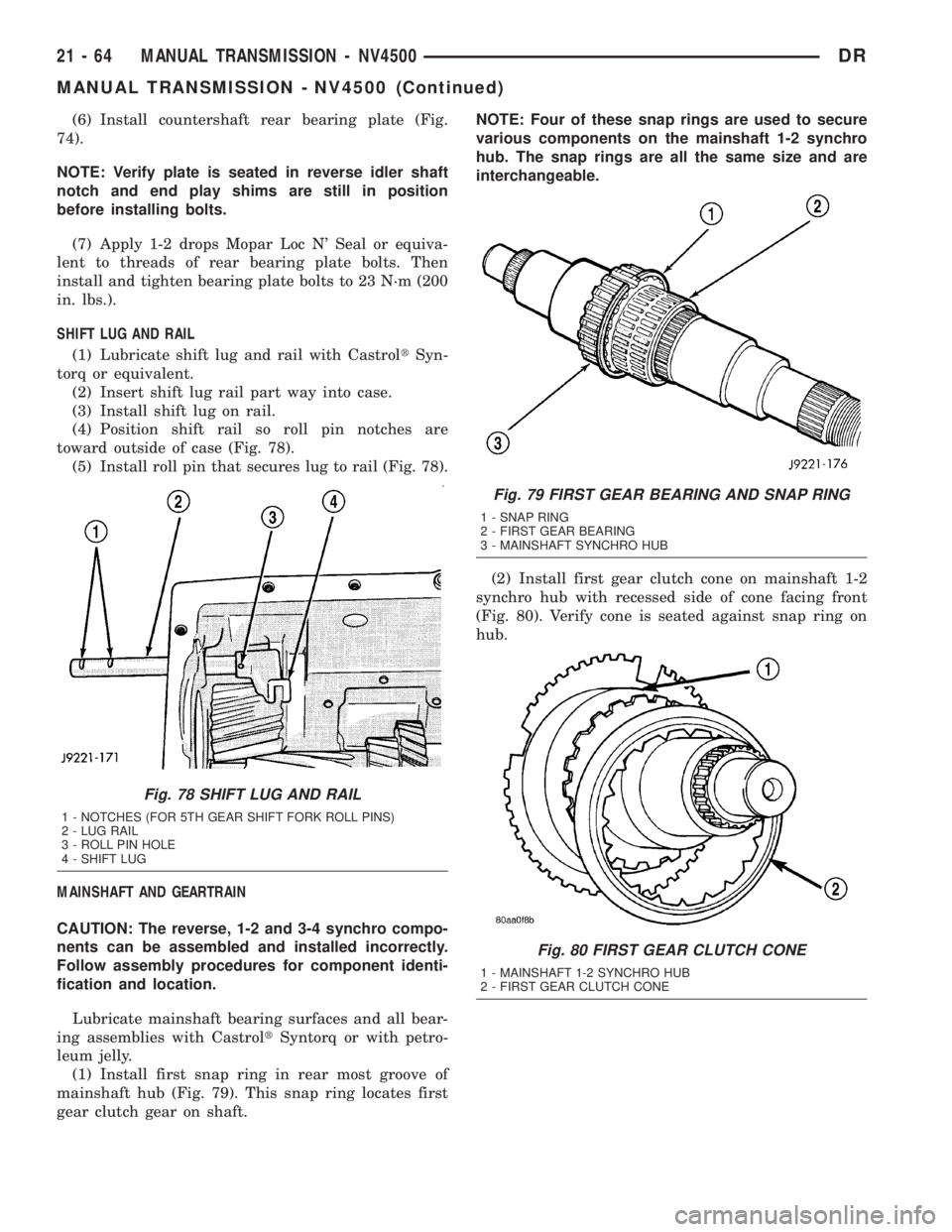
(4) Position shift rail so roll pin notches are
toward outside of case (Fig. 78).
(5) Install roll pin that secures lug to rail (Fig. 78).
MAINSHAFT AND GEARTRAIN
CAUTION: The reverse, 1-2 and 3-4 synchro compo-
nents can be assembled and installed incorrectly.
Follow assembly procedures for component identi-
fication and location.
Lubricate mainshaft bearing surfaces and all bear-
ing assemblies with CastroltSyntorq or with petro-
leum jelly.
(1) Install first snap ring in rear most groove of
mainshaft hub (Fig. 79). This snap ring locates first
gear clutch gear on shaft.NOTE: Four of these snap rings are used to secure
various components on the mainshaft 1-2 synchro
hub. The snap rings are all the same size and are
interchangeable.
(2) Install first gear clutch cone on mainshaft 1-2
synchro hub with recessed side of cone facing front
(Fig. 80). Verify cone is seated against snap ring on
hub.
Fig. 78 SHIFT LUG AND RAIL
1 - NOTCHES (FOR 5TH GEAR SHIFT FORK ROLL PINS)
2 - LUG RAIL
3 - ROLL PIN HOLE
4 - SHIFT LUG
Fig. 79 FIRST GEAR BEARING AND SNAP RING
1 - SNAP RING
2 - FIRST GEAR BEARING
3 - MAINSHAFT SYNCHRO HUB
Fig. 80 FIRST GEAR CLUTCH CONE
1 - MAINSHAFT 1-2 SYNCHRO HUB
2 - FIRST GEAR CLUTCH CONE
21 - 64 MANUAL TRANSMISSION - NV4500DR
MANUAL TRANSMISSION - NV4500 (Continued)
Page 1908 of 2895
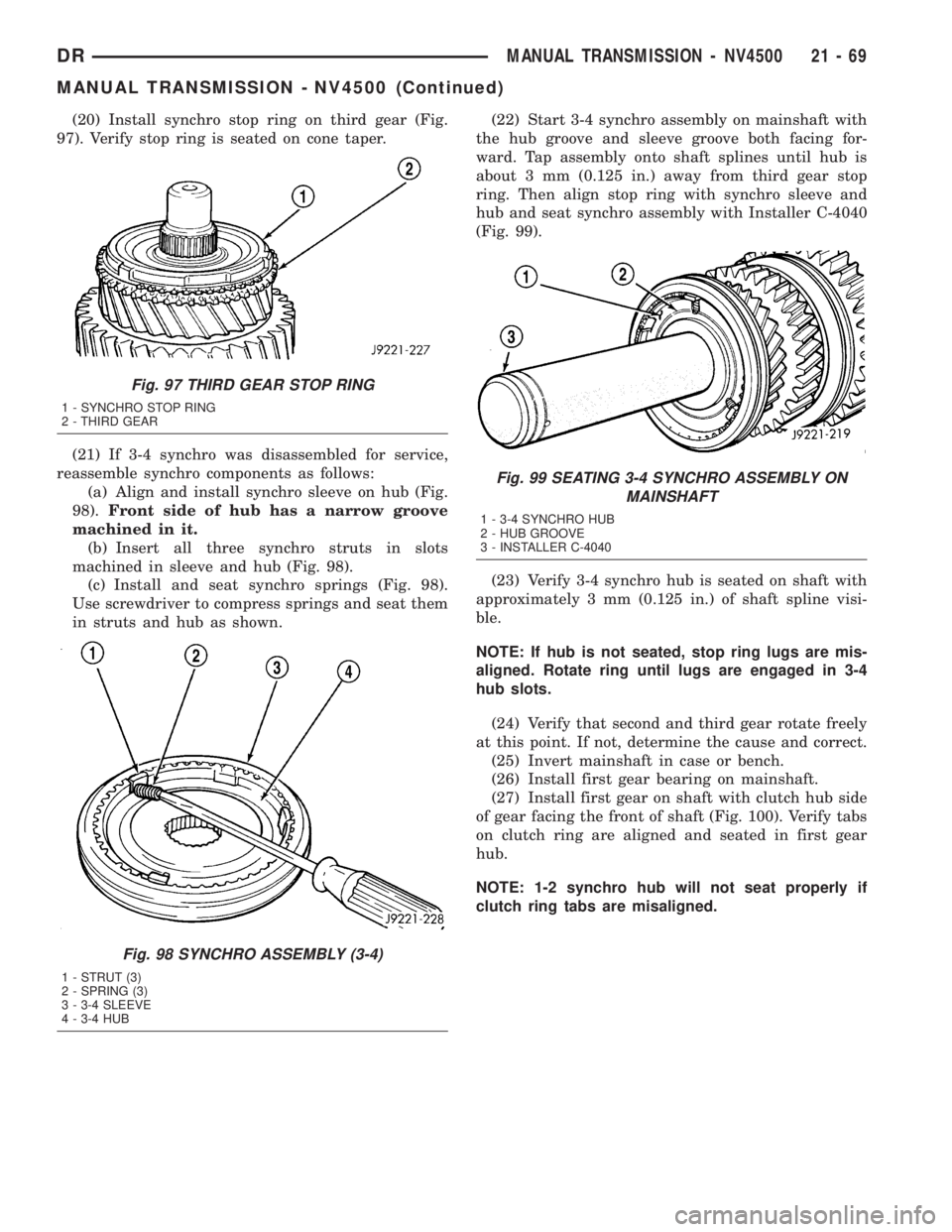
(20) Install synchro stop ring on third gear (Fig.
97). Verify stop ring is seated on cone taper.
(21) If 3-4 synchro was disassembled for service,
reassemble synchro components as follows:
(a) Align and install synchro sleeve on hub (Fig.
98).Front side of hub has a narrow groove
machined in it.
(b) Insert all three synchro struts in slots
machined in sleeve and hub (Fig. 98).
(c) Install and seat synchro springs (Fig. 98).
Use screwdriver to compress springs and seat them
in struts and hub as shown.(22) Start 3-4 synchro assembly on mainshaft with
the hub groove and sleeve groove both facing for-
ward. Tap assembly onto shaft splines until hub is
about 3 mm (0.125 in.) away from third gear stop
ring. Then align stop ring with synchro sleeve and
hub and seat synchro assembly with Installer C-4040
(Fig. 99).
(23) Verify 3-4 synchro hub is seated on shaft with
approximately 3 mm (0.125 in.) of shaft spline visi-
ble.
NOTE: If hub is not seated, stop ring lugs are mis-
aligned. Rotate ring until lugs are engaged in 3-4
hub slots.
(24) Verify that second and third gear rotate freely
at this point. If not, determine the cause and correct.
(25) Invert mainshaft in case or bench.
(26) Install first gear bearing on mainshaft.
(27) Install first gear on shaft with clutch hub side
of gear facing the front of shaft (Fig. 100). Verify tabs
on clutch ring are aligned and seated in first gear
hub.
NOTE: 1-2 synchro hub will not seat properly if
clutch ring tabs are misaligned.
Fig. 97 THIRD GEAR STOP RING
1 - SYNCHRO STOP RING
2 - THIRD GEAR
Fig. 98 SYNCHRO ASSEMBLY (3-4)
1 - STRUT (3)
2 - SPRING (3)
3 - 3-4 SLEEVE
4 - 3-4 HUB
Fig. 99 SEATING 3-4 SYNCHRO ASSEMBLY ON
MAINSHAFT
1 - 3-4 SYNCHRO HUB
2 - HUB GROOVE
3 - INSTALLER C-4040
DRMANUAL TRANSMISSION - NV4500 21 - 69
MANUAL TRANSMISSION - NV4500 (Continued)
Page 1910 of 2895
(e) Install second and third struts in same man-
ner as described in step (d).
(f) Work sleeve upward on hub until struts are
centered and seated in sleeve. Sleeve should be in
neutral position after seating struts.
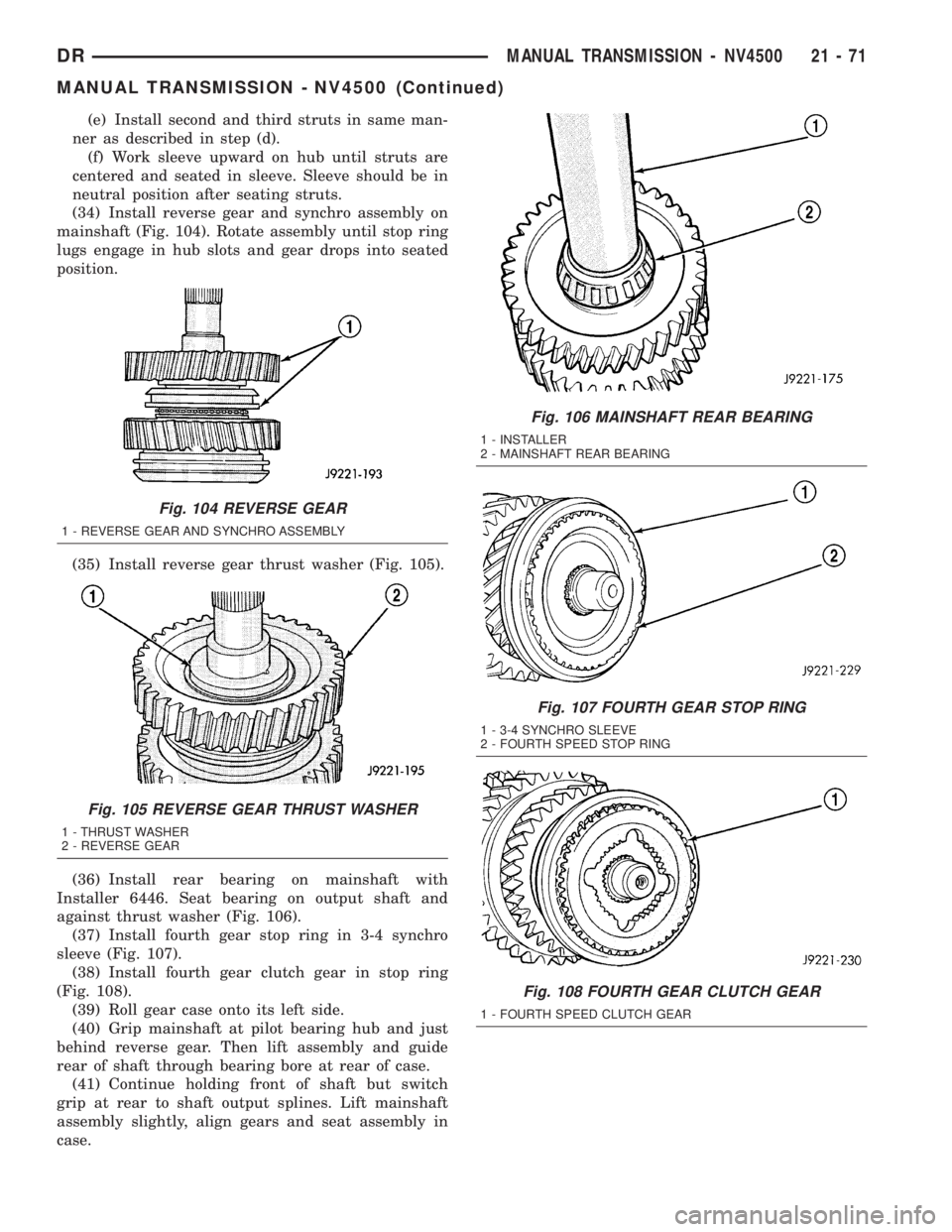
(34) Install reverse gear and synchro assembly on
mainshaft (Fig. 104). Rotate assembly until stop ring
lugs engage in hub slots and gear drops into seated
position.
(35) Install reverse gear thrust washer (Fig. 105).
(36) Install rear bearing on mainshaft with
Installer 6446. Seat bearing on output shaft and
against thrust washer (Fig. 106).
(37) Install fourth gear stop ring in 3-4 synchro
sleeve (Fig. 107).
(38) Install fourth gear clutch gear in stop ring
(Fig. 108).
(39) Roll gear case onto its left side.
(40) Grip mainshaft at pilot bearing hub and just
behind reverse gear. Then lift assembly and guide
rear of shaft through bearing bore at rear of case.
(41) Continue holding front of shaft but switch
grip at rear to shaft output splines. Lift mainshaft
assembly slightly, align gears and seat assembly in
case.
Fig. 104 REVERSE GEAR
1 - REVERSE GEAR AND SYNCHRO ASSEMBLY
Fig. 105 REVERSE GEAR THRUST WASHER
1 - THRUST WASHER
2 - REVERSE GEAR
Fig. 106 MAINSHAFT REAR BEARING
1 - INSTALLER
2 - MAINSHAFT REAR BEARING
Fig. 107 FOURTH GEAR STOP RING
1 - 3-4 SYNCHRO SLEEVE
2 - FOURTH SPEED STOP RING
Fig. 108 FOURTH GEAR CLUTCH GEAR
1 - FOURTH SPEED CLUTCH GEAR
DRMANUAL TRANSMISSION - NV4500 21 - 71
MANUAL TRANSMISSION - NV4500 (Continued)
Page 2001 of 2895
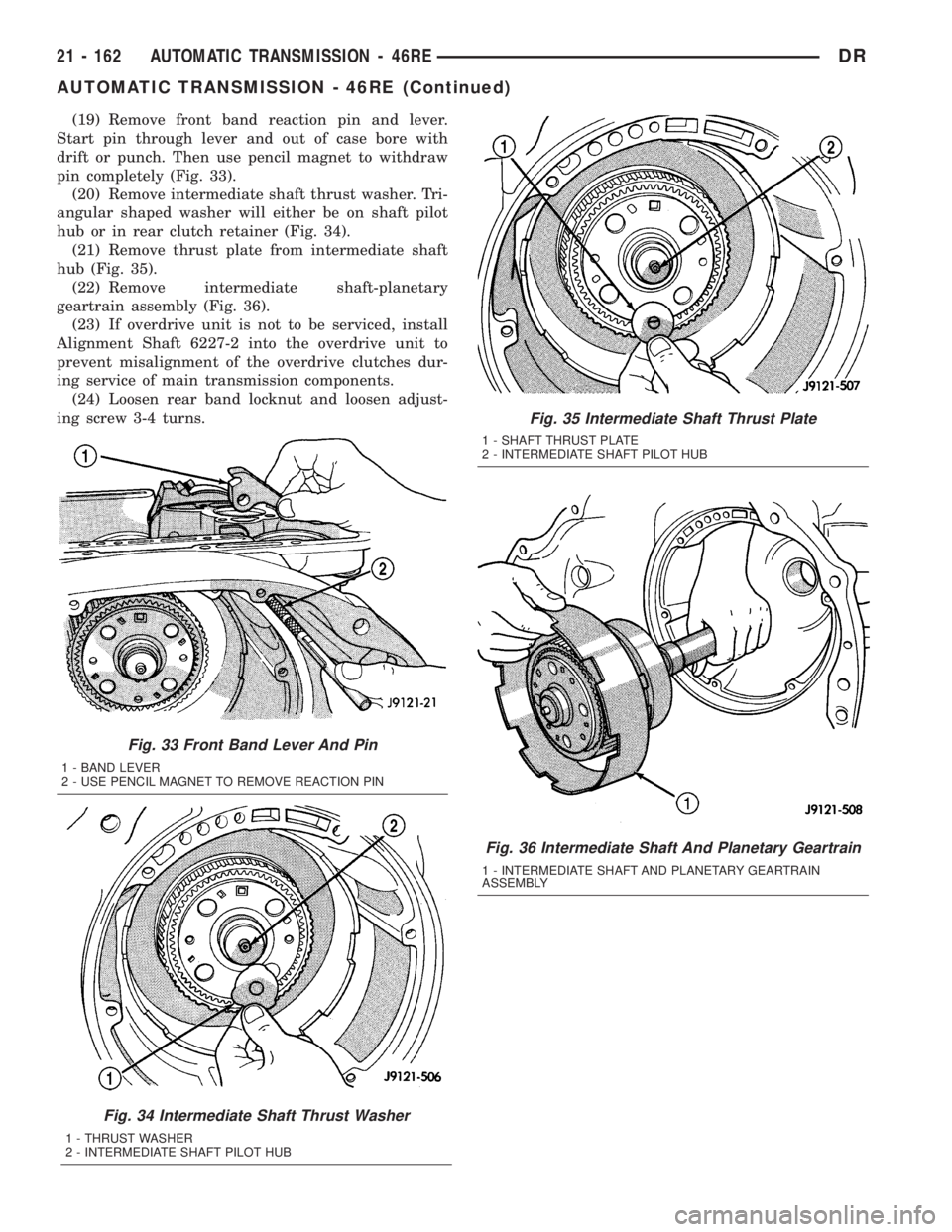
(19) Remove front band reaction pin and lever.
Start pin through lever and out of case bore with
drift or punch. Then use pencil magnet to withdraw
pin completely (Fig. 33).
(20) Remove intermediate shaft thrust washer. Tri-
angular shaped washer will either be on shaft pilot
hub or in rear clutch retainer (Fig. 34).
(21) Remove thrust plate from intermediate shaft
hub (Fig. 35).
(22) Remove intermediate shaft-planetary
geartrain assembly (Fig. 36).
(23) If overdrive unit is not to be serviced, install
Alignment Shaft 6227-2 into the overdrive unit to
prevent misalignment of the overdrive clutches dur-
ing service of main transmission components.
(24) Loosen rear band locknut and loosen adjust-
ing screw 3-4 turns.
Fig. 33 Front Band Lever And Pin
1 - BAND LEVER
2 - USE PENCIL MAGNET TO REMOVE REACTION PIN
Fig. 34 Intermediate Shaft Thrust Washer
1 - THRUST WASHER
2 - INTERMEDIATE SHAFT PILOT HUB
Fig. 35 Intermediate Shaft Thrust Plate
1 - SHAFT THRUST PLATE
2 - INTERMEDIATE SHAFT PILOT HUB
Fig. 36 Intermediate Shaft And Planetary Geartrain
1 - INTERMEDIATE SHAFT AND PLANETARY GEARTRAIN
ASSEMBLY
21 - 162 AUTOMATIC TRANSMISSION - 46REDR
AUTOMATIC TRANSMISSION - 46RE (Continued)
Page 2007 of 2895
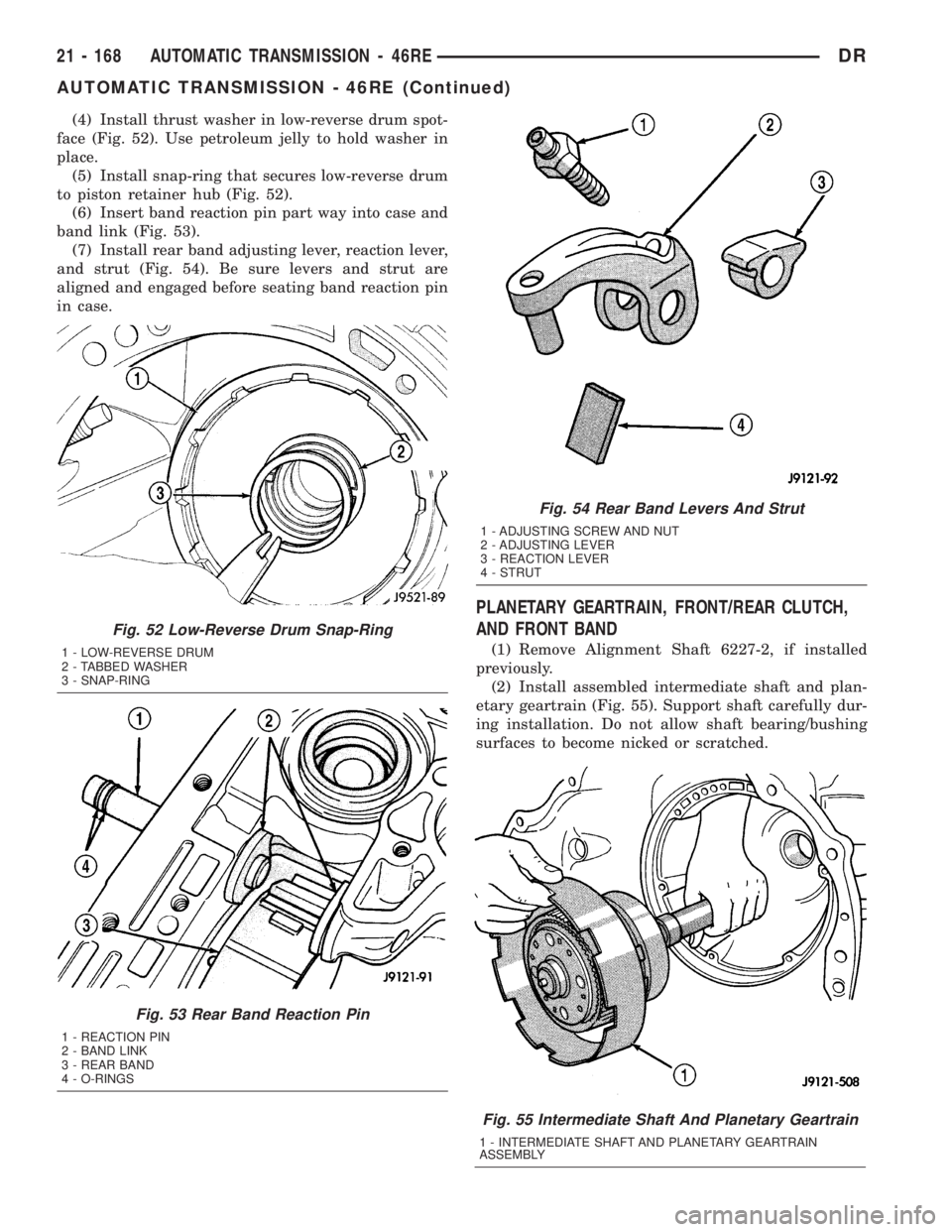
(4) Install thrust washer in low-reverse drum spot-
face (Fig. 52). Use petroleum jelly to hold washer in
place.
(5) Install snap-ring that secures low-reverse drum
to piston retainer hub (Fig. 52).
(6) Insert band reaction pin part way into case and
band link (Fig. 53).
(7) Install rear band adjusting lever, reaction lever,
and strut (Fig. 54). Be sure levers and strut are
aligned and engaged before seating band reaction pin
in case.
PLANETARY GEARTRAIN, FRONT/REAR CLUTCH,
AND FRONT BAND
(1) Remove Alignment Shaft 6227-2, if installed
previously.
(2) Install assembled intermediate shaft and plan-
etary geartrain (Fig. 55). Support shaft carefully dur-
ing installation. Do not allow shaft bearing/bushing
surfaces to become nicked or scratched.
Fig. 55 Intermediate Shaft And Planetary Geartrain
1 - INTERMEDIATE SHAFT AND PLANETARY GEARTRAIN
ASSEMBLY
Fig. 52 Low-Reverse Drum Snap-Ring
1 - LOW-REVERSE DRUM
2 - TABBED WASHER
3 - SNAP-RING
Fig. 53 Rear Band Reaction Pin
1 - REACTION PIN
2 - BAND LINK
3 - REAR BAND
4 - O-RINGS
Fig. 54 Rear Band Levers And Strut
1 - ADJUSTING SCREW AND NUT
2 - ADJUSTING LEVER
3 - REACTION LEVER
4 - STRUT
21 - 168 AUTOMATIC TRANSMISSION - 46REDR
AUTOMATIC TRANSMISSION - 46RE (Continued)
Page 2008 of 2895
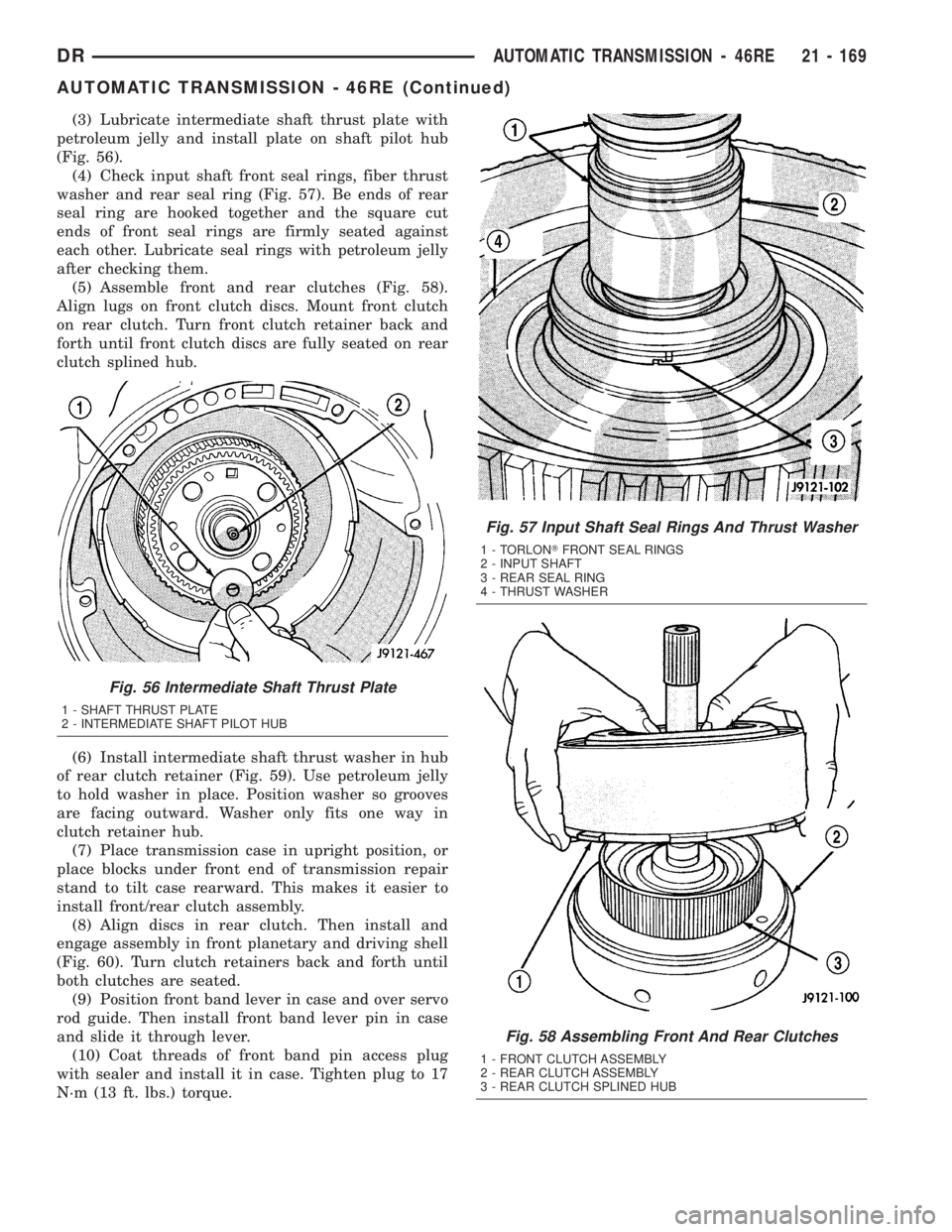
(3) Lubricate intermediate shaft thrust plate with
petroleum jelly and install plate on shaft pilot hub
(Fig. 56).
(4) Check input shaft front seal rings, fiber thrust
washer and rear seal ring (Fig. 57). Be ends of rear
seal ring are hooked together and the square cut
ends of front seal rings are firmly seated against
each other. Lubricate seal rings with petroleum jelly
after checking them.
(5) Assemble front and rear clutches (Fig. 58).
Align lugs on front clutch discs. Mount front clutch
on rear clutch. Turn front clutch retainer back and
forth until front clutch discs are fully seated on rear
clutch splined hub.
(6) Install intermediate shaft thrust washer in hub
of rear clutch retainer (Fig. 59). Use petroleum jelly
to hold washer in place. Position washer so grooves
are facing outward. Washer only fits one way in
clutch retainer hub.
(7) Place transmission case in upright position, or
place blocks under front end of transmission repair
stand to tilt case rearward. This makes it easier to
install front/rear clutch assembly.
(8) Align discs in rear clutch. Then install and
engage assembly in front planetary and driving shell
(Fig. 60). Turn clutch retainers back and forth until
both clutches are seated.
(9) Position front band lever in case and over servo
rod guide. Then install front band lever pin in case
and slide it through lever.
(10) Coat threads of front band pin access plug
with sealer and install it in case. Tighten plug to 17
N´m (13 ft. lbs.) torque.
Fig. 56 Intermediate Shaft Thrust Plate
1 - SHAFT THRUST PLATE
2 - INTERMEDIATE SHAFT PILOT HUB
Fig. 57 Input Shaft Seal Rings And Thrust Washer
1 - TORLONTFRONT SEAL RINGS
2 - INPUT SHAFT
3 - REAR SEAL RING
4 - THRUST WASHER
Fig. 58 Assembling Front And Rear Clutches
1 - FRONT CLUTCH ASSEMBLY
2 - REAR CLUTCH ASSEMBLY
3 - REAR CLUTCH SPLINED HUB
DRAUTOMATIC TRANSMISSION - 46RE 21 - 169
AUTOMATIC TRANSMISSION - 46RE (Continued)
Page 2009 of 2895
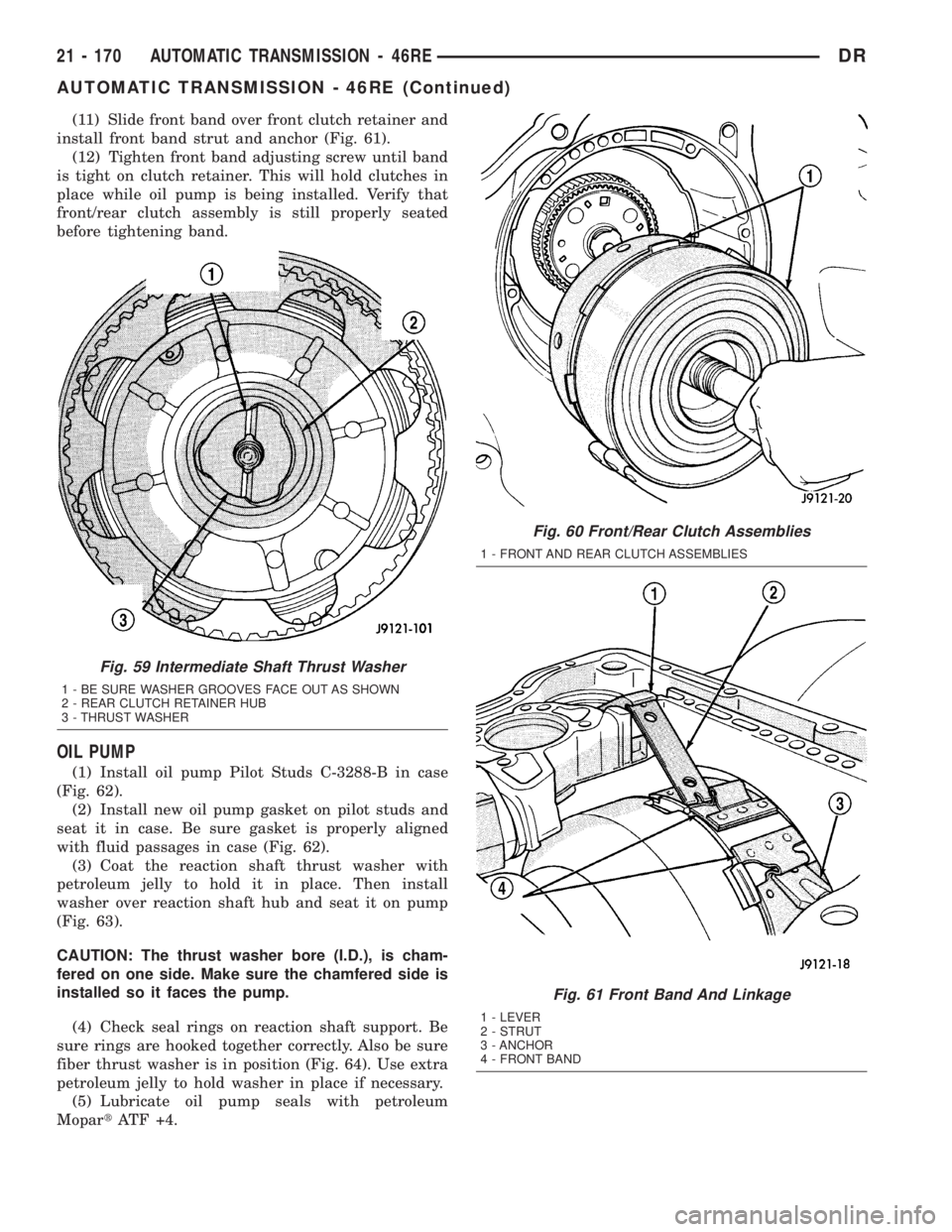
(11) Slide front band over front clutch retainer and
install front band strut and anchor (Fig. 61).
(12) Tighten front band adjusting screw until band
is tight on clutch retainer. This will hold clutches in
place while oil pump is being installed. Verify that
front/rear clutch assembly is still properly seated
before tightening band.
OIL PUMP
(1) Install oil pump Pilot Studs C-3288-B in case
(Fig. 62).
(2) Install new oil pump gasket on pilot studs and
seat it in case. Be sure gasket is properly aligned
with fluid passages in case (Fig. 62).
(3) Coat the reaction shaft thrust washer with
petroleum jelly to hold it in place. Then install
washer over reaction shaft hub and seat it on pump
(Fig. 63).
CAUTION: The thrust washer bore (I.D.), is cham-
fered on one side. Make sure the chamfered side is
installed so it faces the pump.
(4) Check seal rings on reaction shaft support. Be
sure rings are hooked together correctly. Also be sure
fiber thrust washer is in position (Fig. 64). Use extra
petroleum jelly to hold washer in place if necessary.
(5) Lubricate oil pump seals with petroleum
MopartATF +4.
Fig. 59 Intermediate Shaft Thrust Washer
1 - BE SURE WASHER GROOVES FACE OUT AS SHOWN
2 - REAR CLUTCH RETAINER HUB
3 - THRUST WASHER
Fig. 60 Front/Rear Clutch Assemblies
1 - FRONT AND REAR CLUTCH ASSEMBLIES
Fig. 61 Front Band And Linkage
1 - LEVER
2 - STRUT
3 - ANCHOR
4 - FRONT BAND
21 - 170 AUTOMATIC TRANSMISSION - 46REDR
AUTOMATIC TRANSMISSION - 46RE (Continued)