lock DODGE RAM 2003 Service Repair Manual
[x] Cancel search | Manufacturer: DODGE, Model Year: 2003, Model line: RAM, Model: DODGE RAM 2003Pages: 2895, PDF Size: 83.15 MB
Page 1832 of 2895
DIAGNOSIS AND TESTING - PUMP LEAKAGE
The pump is serviced as an assembly and should
not be disassembled. The plastic pump reservoir and
the reservoir o-rings can be replaced.
Check for leaks in the following areas:
²Pump shaft seal behind the pulley
²Pump to reservoir O-ring
²Reservoir cap
²Pressure and return lines
²Flow control valve fitting
STANDARD PROCEDURE
STANDARD PROCEDURE - POWER STEERING
PUMP - INITIAL OPERATION
WARNING: THE FLUID LEVEL SHOULD BE
CHECKED WITH ENGINE OFF TO PREVENT INJURY
FROM MOVING COMPONENTS.
CAUTION: MOPARTATF+4 is to be used in the
power steering system. No other power steering or
automatic transmission fluid is to be used in the
system. Damage may result to the power steering
pump and system if any other fluid is used, and do
not overfill.
Wipe filler cap clean, then check the fluid level.
The dipstick should indicateCOLDwhen the fluid is
at normal temperature.(1) Turn steering wheel all the way to the left
(2) Fill the pump fluid reservoir to the proper level
and let the fluid settle for at least two (2) minutes.
(3) Raise the front wheels off the ground.
(4) Slowly turn the steering wheel lock-to-lock 20
times with the engine off while checking the fluid
level.
NOTE: For vehicles with long return lines or oil
coolers turn wheel 40 times.
(5) Start the engine. With the engine idling main-
tain the fluid level.
(6) Lower the front wheels and let the engine idle
for two minutes.
(7) Turn the steering wheel in both direction and
verify power assist and quiet operation of the pump.
If the fluid is extremely foamy or milky looking,
allow the vehicle to stand a few minutes and repeat
the procedure.
CAUTION: Do not run a vehicle with foamy fluid for
an extended period. This may cause pump damage.
STANDARD PROCEDURE - FLUSHING POWER
STEERING SYSTEM
Flushing is required when the power steering/hy-
draulic booster system fluid has become contami-
nated. Contaminated fluid in the steering/booster
system can cause seal deterioration and affect steer-
ing gear/booster spool valve operation.
(1) Raise the front end of the vehicle off the
ground until the wheels are free to turn.
(2) Remove the return line from the pump.
NOTE: If vehicle is equipped with a hydraulic
booster remove both return lines from the pump.
(3) Plug the return line port/ports at the pump.
(4) Position the return line/lines into a large con-
tainer to catch the fluid.
(5) While an assistant is filling the pump reservoir
start the engine.
(6) With the engine running at idle turn the wheel
back and forth.
NOTE: Do not contact or hold the wheel against the
steering stops.
(7) Run a quart of fluid through the system then
stop the engine and install the return line/lines.
(8) Fill the system with fluid and perform Steering
Pump Initial Operation, (Refer to 19 - STEERING/
PUMP - STANDARD PROCEDURE).
(9) Start the engine and run it for fifteen minutes
then stop the engine.
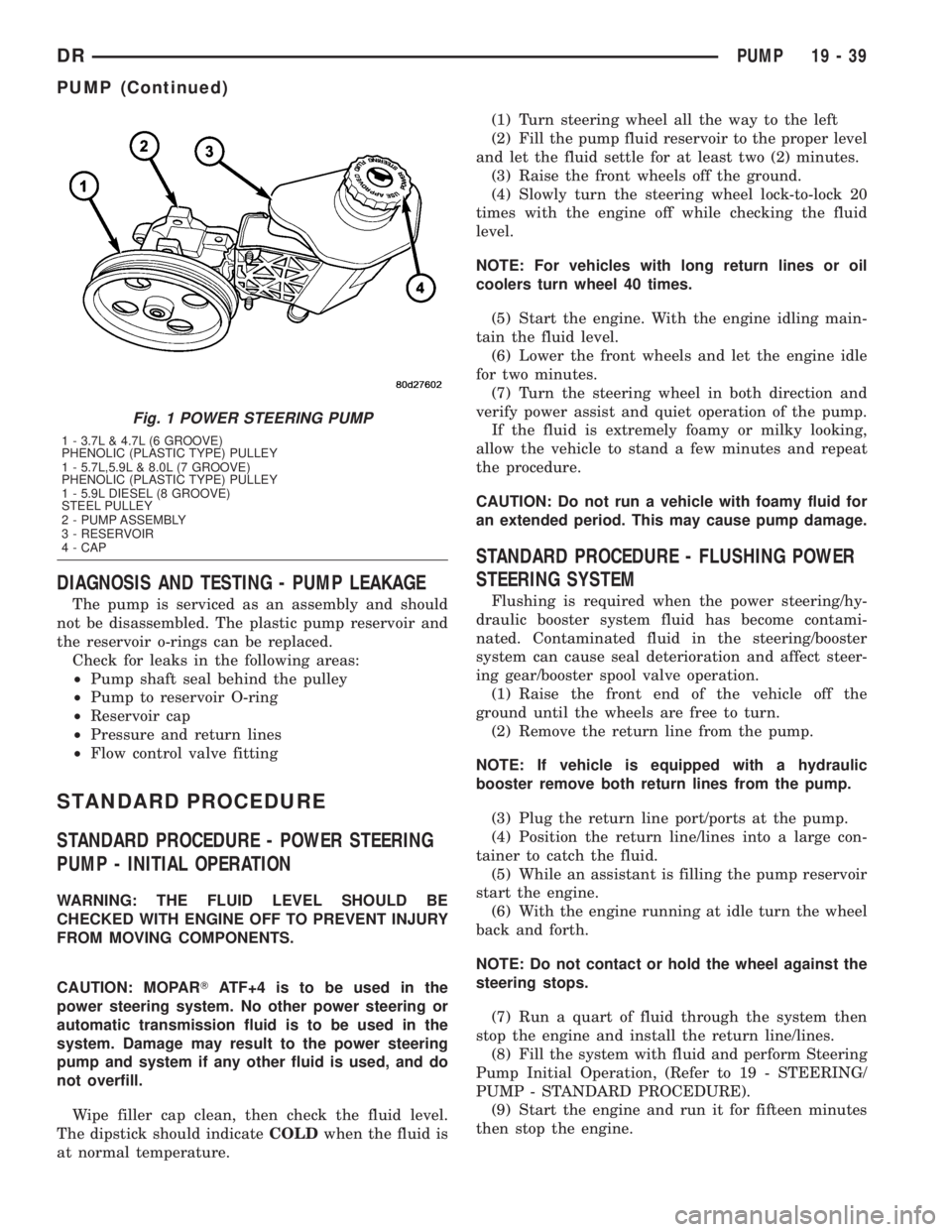
Fig. 1 POWER STEERING PUMP
1 - 3.7L & 4.7L (6 GROOVE)
PHENOLIC (PLASTIC TYPE) PULLEY
1 - 5.7L,5.9L & 8.0L (7 GROOVE)
PHENOLIC (PLASTIC TYPE) PULLEY
1 - 5.9L DIESEL (8 GROOVE)
STEEL PULLEY
2 - PUMP ASSEMBLY
3 - RESERVOIR
4 - CAP
DRPUMP 19 - 39
PUMP (Continued)
Page 1833 of 2895
(10) Remove the return line/lines from the pump
and plug the pump port/ports.
(11) Pour fresh fluid into the reservoir and check
the draining fluid for contamination. If the fluid is
still contaminated, then flush the system again.
(12) Install the return line/lines and perform
Steering Pump Initial Operation, (Refer to 19 -
STEERING/PUMP - STANDARD PROCEDURE).
REMOVAL
REMOVAL - GAS
(1) Drain and siphon the power steering fluid from
the reservoir.
(2) Remove the serpentine belt.
CAUTION: Do not remove the fitting on the pump
that the high pressure hose screws into. The fitting
may come loose unless it is backed up using
another wrench. If the fitting does come loose, it
must be retightened before continuing. (57 - 67Nm,
40 - 50 lbft) If this fitting comes out of the pump
body, the internal spring and valve parts will fall out
of the pump and they cannot be reinstalled prop-
erly. If this occurs the pump needs to be replaced
with a new pump.
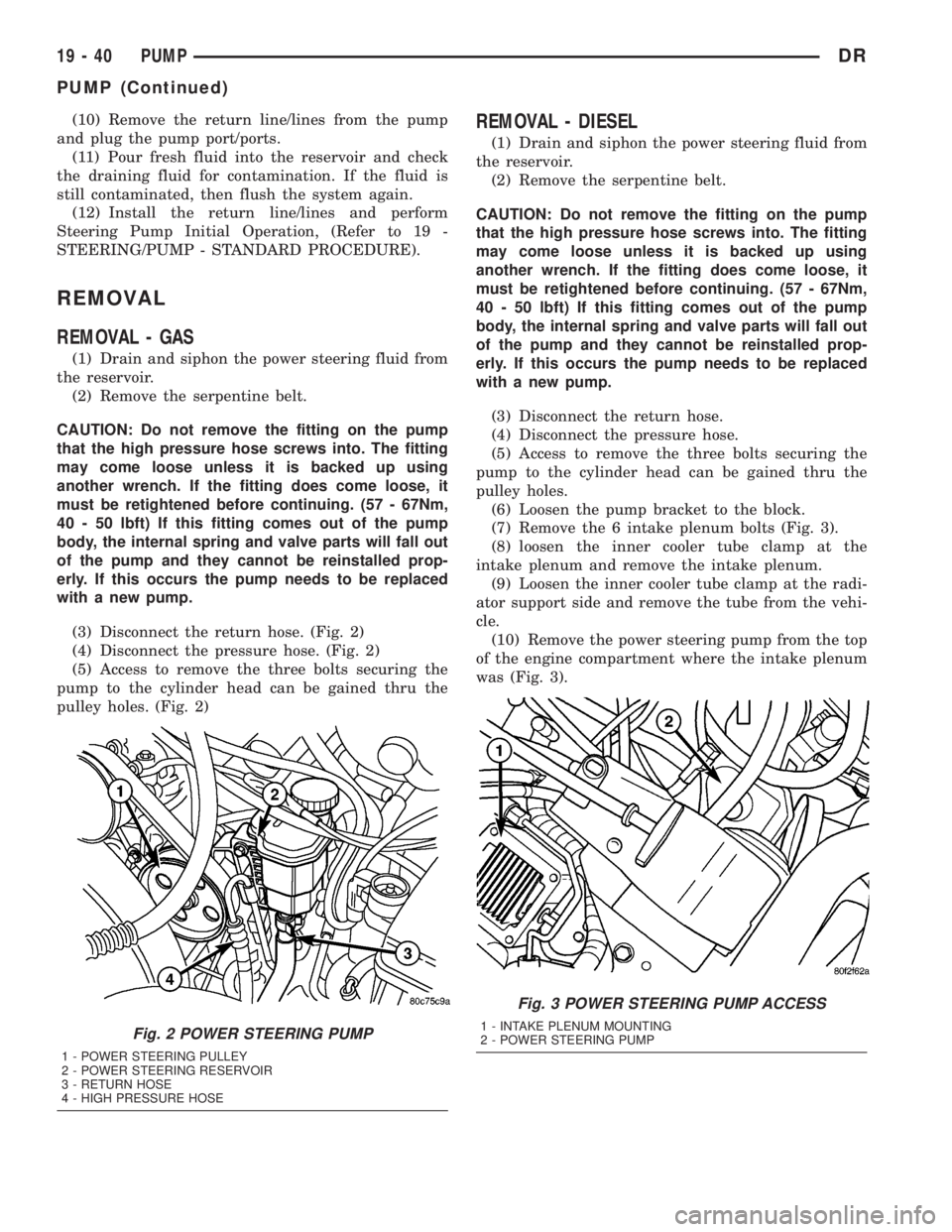
(3) Disconnect the return hose. (Fig. 2)
(4) Disconnect the pressure hose. (Fig. 2)
(5) Access to remove the three bolts securing the
pump to the cylinder head can be gained thru the
pulley holes. (Fig. 2)
REMOVAL - DIESEL
(1) Drain and siphon the power steering fluid from
the reservoir.
(2) Remove the serpentine belt.
CAUTION: Do not remove the fitting on the pump
that the high pressure hose screws into. The fitting
may come loose unless it is backed up using
another wrench. If the fitting does come loose, it
must be retightened before continuing. (57 - 67Nm,
40 - 50 lbft) If this fitting comes out of the pump
body, the internal spring and valve parts will fall out
of the pump and they cannot be reinstalled prop-
erly. If this occurs the pump needs to be replaced
with a new pump.
(3) Disconnect the return hose.
(4) Disconnect the pressure hose.
(5) Access to remove the three bolts securing the
pump to the cylinder head can be gained thru the
pulley holes.
(6) Loosen the pump bracket to the block.
(7) Remove the 6 intake plenum bolts (Fig. 3).
(8) loosen the inner cooler tube clamp at the
intake plenum and remove the intake plenum.
(9) Loosen the inner cooler tube clamp at the radi-
ator support side and remove the tube from the vehi-
cle.
(10) Remove the power steering pump from the top
of the engine compartment where the intake plenum
was (Fig. 3).
Fig. 2 POWER STEERING PUMP
1 - POWER STEERING PULLEY
2 - POWER STEERING RESERVOIR
3 - RETURN HOSE
4 - HIGH PRESSURE HOSE
Fig. 3 POWER STEERING PUMP ACCESS
1 - INTAKE PLENUM MOUNTING
2 - POWER STEERING PUMP
19 - 40 PUMPDR
PUMP (Continued)
Page 1834 of 2895
INSTALLATION
INSTALLATION - GAS
(1) Align the pump with the mounting holes in the
left cylinder head.
(2) Install 3 pump mounting bolts through the pul-
ley access holes. Tighten the bolts to 28 N´m (21 ft.
lbs.).
(3) Reconnect the pressure line and return hose to
the pump and reservoir. Tighten the pressure line to
37 N´m (27 ft. lbs.).
(4) Install the serpentine drive belt, (Refer to 7 -
COOLING/ACCESSORY DRIVE/DRIVE BELTS -
INSTALLATION).
(5) Fill the power steering pump, (Refer to 19 -
STEERING/PUMP - STANDARD PROCEDURE).
INSTALLATION - DIESEL
(1) Set the power steering pump in place in the
engine compartment from the top (Fig. 3).
(2) Install the inner cooler tube.
(3) Tighten the inner cooler tube clamp at the
radiator support side.
(4) Install the 6 intake plenum bolts (Fig. 3).
(5) Tighten the inner cooler tube clamp at the
intake plenum.
(6) Install 3 pump mounting bolts through the pul-
ley access holes. Tighten the bolts to 28 N´m (21 ft.
lbs.).
(7) Tighten the pump bracket to the block.
(8) Reconnect the pressure line and return hose to
the pump and reservoir. Tighten the pressure line to
37 N´m (27 ft. lbs.).
(9) Install the serpentine drive belt, (Refer to 7 -
COOLING/ACCESSORY DRIVE/DRIVE BELTS -
INSTALLATION).
(10) Fill the power steering pump, (Refer to 19 -
STEERING/PUMP - STANDARD PROCEDURE).
SPECIFICATIONS
TORQUE CHART
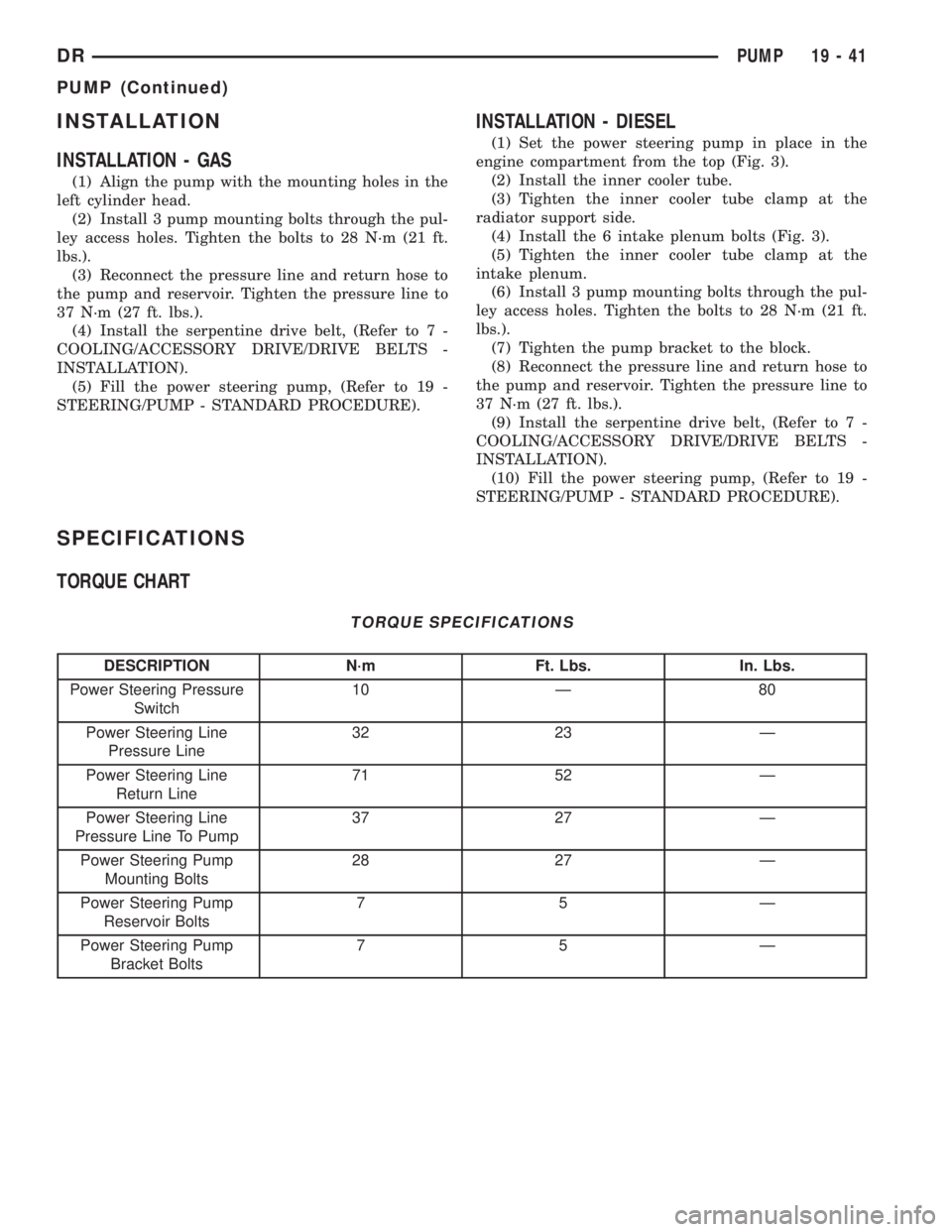
TORQUE SPECIFICATIONS
DESCRIPTION N´m Ft. Lbs. In. Lbs.
Power Steering Pressure
Switch10 Ð 80
Power Steering Line
Pressure Line32 23 Ð
Power Steering Line
Return Line71 52 Ð
Power Steering Line
Pressure Line To Pump37 27 Ð
Power Steering Pump
Mounting Bolts28 27 Ð
Power Steering Pump
Reservoir Bolts75Ð
Power Steering Pump
Bracket Bolts75Ð
DRPUMP 19 - 41
PUMP (Continued)
Page 1840 of 2895
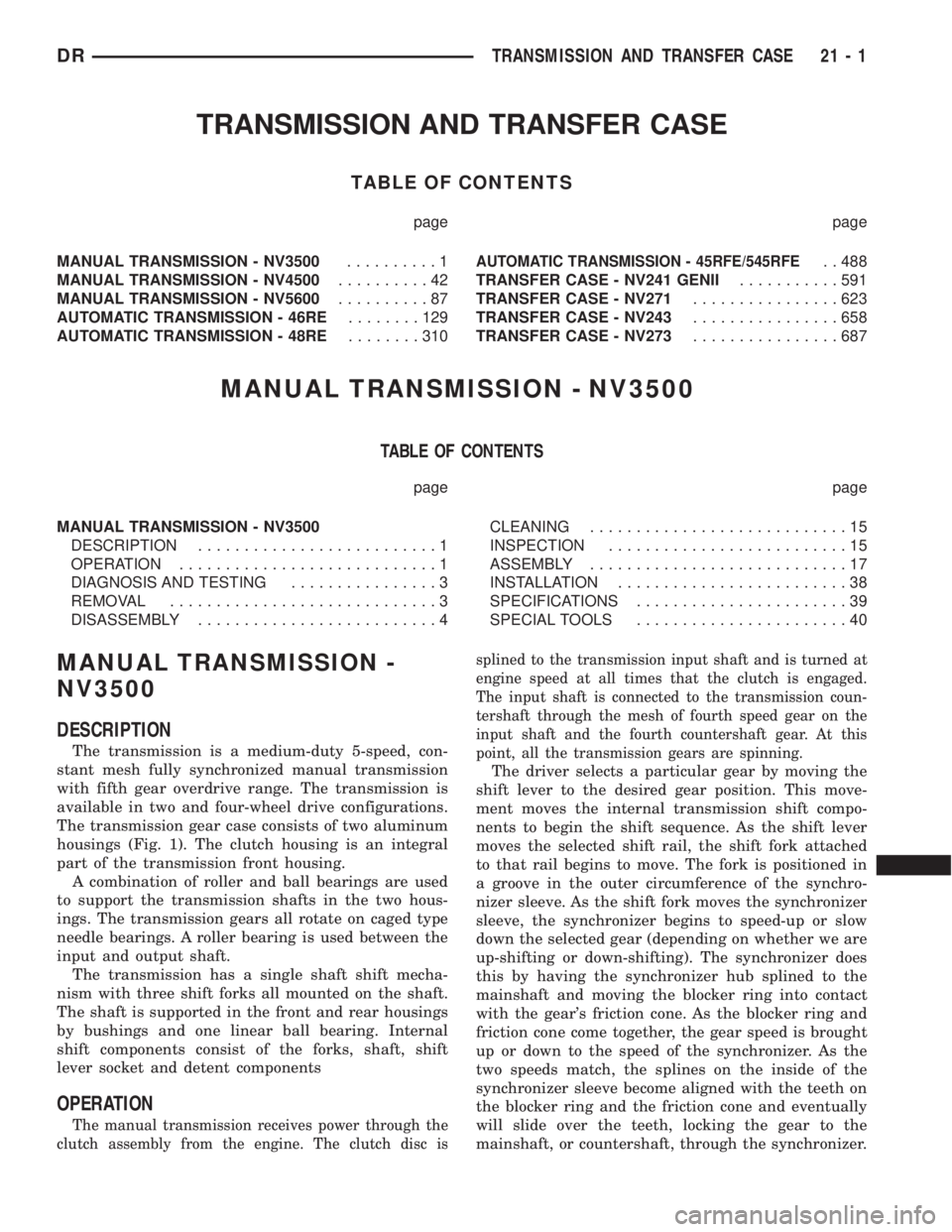
TRANSMISSION AND TRANSFER CASE
TABLE OF CONTENTS
page page
MANUAL TRANSMISSION - NV3500..........1
MANUAL TRANSMISSION - NV4500..........42
MANUAL TRANSMISSION - NV5600..........87
AUTOMATIC TRANSMISSION - 46RE........129
AUTOMATIC TRANSMISSION - 48RE........310
AUTOMATIC TRANSMISSION - 45RFE/545RFE. . 488
TRANSFER CASE - NV241 GENII...........591
TRANSFER CASE - NV271................623
TRANSFER CASE - NV243................658
TRANSFER CASE - NV273................687
MANUAL TRANSMISSION - NV3500
TABLE OF CONTENTS
page page
MANUAL TRANSMISSION - NV3500
DESCRIPTION..........................1
OPERATION............................1
DIAGNOSIS AND TESTING................3
REMOVAL.............................3
DISASSEMBLY..........................4CLEANING............................15
INSPECTION..........................15
ASSEMBLY............................17
INSTALLATION.........................38
SPECIFICATIONS.......................39
SPECIAL TOOLS.......................40
MANUAL TRANSMISSION -
NV3500
DESCRIPTION
The transmission is a medium-duty 5-speed, con-
stant mesh fully synchronized manual transmission
with fifth gear overdrive range. The transmission is
available in two and four-wheel drive configurations.
The transmission gear case consists of two aluminum
housings (Fig. 1). The clutch housing is an integral
part of the transmission front housing.
A combination of roller and ball bearings are used
to support the transmission shafts in the two hous-
ings. The transmission gears all rotate on caged type
needle bearings. A roller bearing is used between the
input and output shaft.
The transmission has a single shaft shift mecha-
nism with three shift forks all mounted on the shaft.
The shaft is supported in the front and rear housings
by bushings and one linear ball bearing. Internal
shift components consist of the forks, shaft, shift
lever socket and detent components
OPERATION
The manual transmission receives power through the
clutch assembly from the engine. The clutch disc issplined to the transmission input shaft and is turned at
engine speed at all times that the clutch is engaged.
The input shaft is connected to the transmission coun-
tershaft through the mesh of fourth speed gear on the
input shaft and the fourth countershaft gear. At this
point, all the transmission gears are spinning.
The driver selects a particular gear by moving the
shift lever to the desired gear position. This move-
ment moves the internal transmission shift compo-
nents to begin the shift sequence. As the shift lever
moves the selected shift rail, the shift fork attached
to that rail begins to move. The fork is positioned in
a groove in the outer circumference of the synchro-
nizer sleeve. As the shift fork moves the synchronizer
sleeve, the synchronizer begins to speed-up or slow
down the selected gear (depending on whether we are
up-shifting or down-shifting). The synchronizer does
this by having the synchronizer hub splined to the
mainshaft and moving the blocker ring into contact
with the gear's friction cone. As the blocker ring and
friction cone come together, the gear speed is brought
up or down to the speed of the synchronizer. As the
two speeds match, the splines on the inside of the
synchronizer sleeve become aligned with the teeth on
the blocker ring and the friction cone and eventually
will slide over the teeth, locking the gear to the
mainshaft, or countershaft, through the synchronizer.
DRTRANSMISSION AND TRANSFER CASE 21 - 1
Page 1843 of 2895
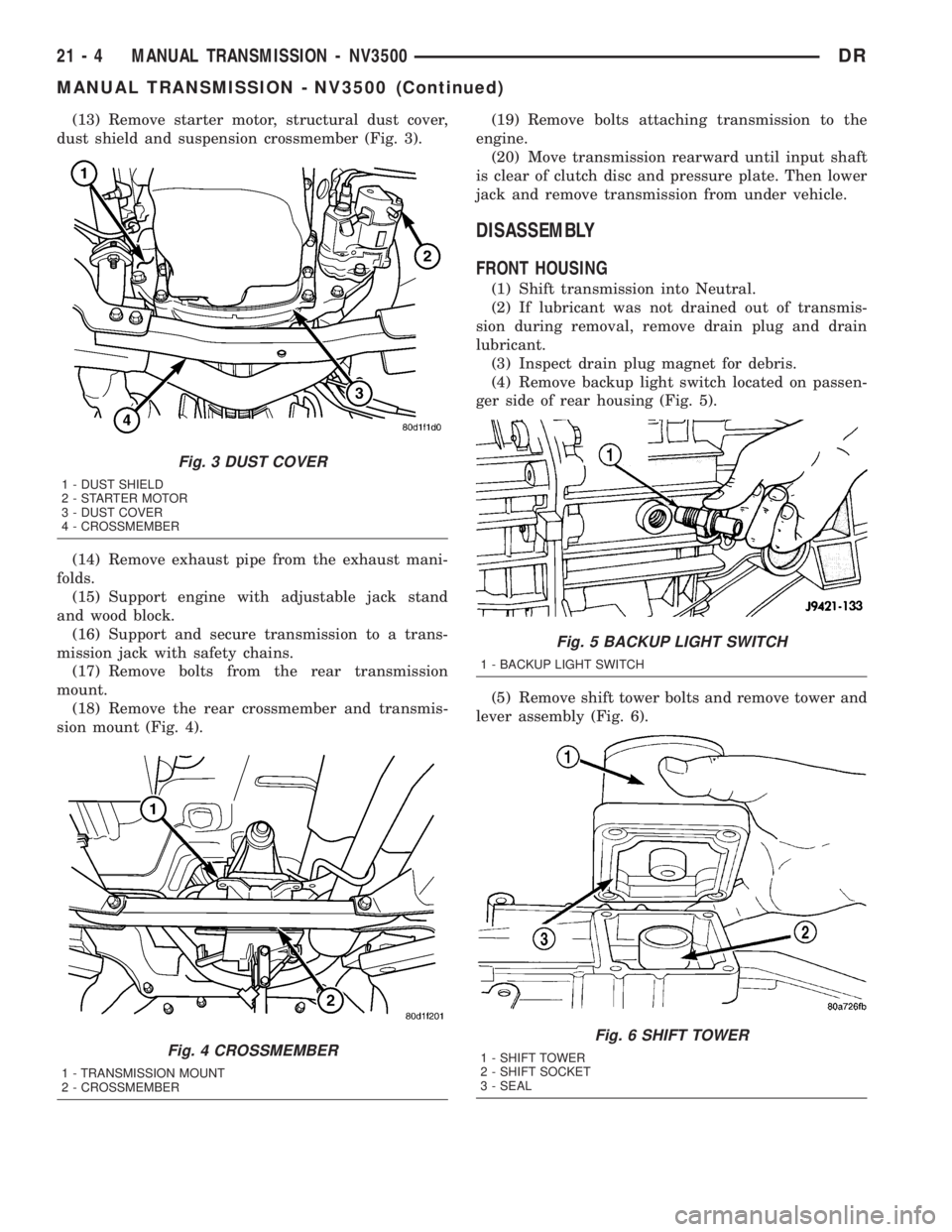
(13) Remove starter motor, structural dust cover,
dust shield and suspension crossmember (Fig. 3).
(14) Remove exhaust pipe from the exhaust mani-
folds.
(15) Support engine with adjustable jack stand
and wood block.
(16) Support and secure transmission to a trans-
mission jack with safety chains.
(17) Remove bolts from the rear transmission
mount.
(18) Remove the rear crossmember and transmis-
sion mount (Fig. 4).(19) Remove bolts attaching transmission to the
engine.
(20) Move transmission rearward until input shaft
is clear of clutch disc and pressure plate. Then lower
jack and remove transmission from under vehicle.
DISASSEMBLY
FRONT HOUSING
(1) Shift transmission into Neutral.
(2) If lubricant was not drained out of transmis-
sion during removal, remove drain plug and drain
lubricant.
(3) Inspect drain plug magnet for debris.
(4) Remove backup light switch located on passen-
ger side of rear housing (Fig. 5).
(5) Remove shift tower bolts and remove tower and
lever assembly (Fig. 6).
Fig. 3 DUST COVER
1 - DUST SHIELD
2 - STARTER MOTOR
3 - DUST COVER
4 - CROSSMEMBER
Fig. 4 CROSSMEMBER
1 - TRANSMISSION MOUNT
2 - CROSSMEMBER
Fig. 5 BACKUP LIGHT SWITCH
1 - BACKUP LIGHT SWITCH
Fig. 6 SHIFT TOWER
1 - SHIFT TOWER
2 - SHIFT SOCKET
3 - SEAL
21 - 4 MANUAL TRANSMISSION - NV3500DR
MANUAL TRANSMISSION - NV3500 (Continued)
Page 1844 of 2895
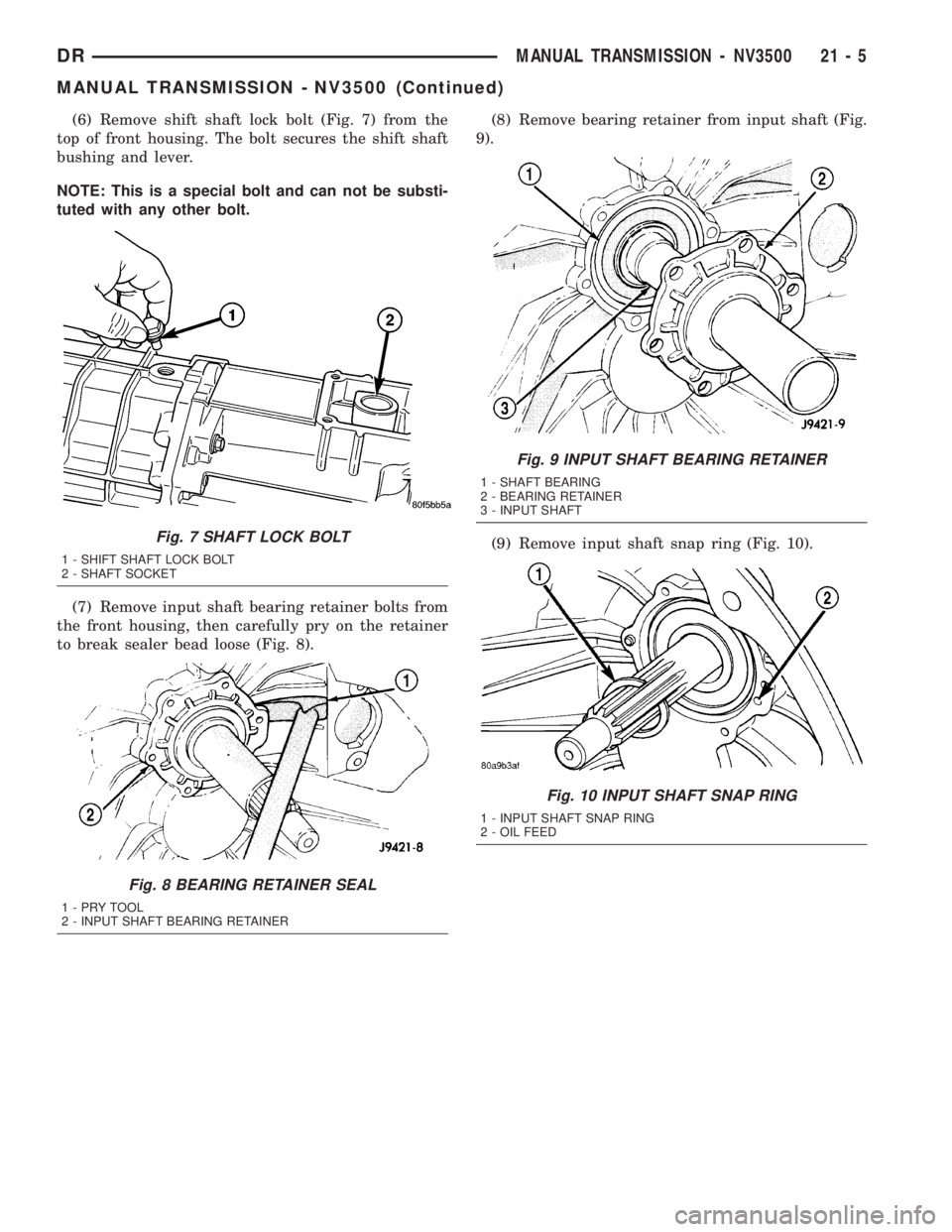
(6) Remove shift shaft lock bolt (Fig. 7) from the
top of front housing. The bolt secures the shift shaft
bushing and lever.
NOTE: This is a special bolt and can not be substi-
tuted with any other bolt.
(7) Remove input shaft bearing retainer bolts from
the front housing, then carefully pry on the retainer
to break sealer bead loose (Fig. 8).(8) Remove bearing retainer from input shaft (Fig.
9).
(9) Remove input shaft snap ring (Fig. 10).
Fig. 7 SHAFT LOCK BOLT
1 - SHIFT SHAFT LOCK BOLT
2 - SHAFT SOCKET
Fig. 8 BEARING RETAINER SEAL
1-PRYTOOL
2 - INPUT SHAFT BEARING RETAINER
Fig. 9 INPUT SHAFT BEARING RETAINER
1 - SHAFT BEARING
2 - BEARING RETAINER
3 - INPUT SHAFT
Fig. 10 INPUT SHAFT SNAP RING
1 - INPUT SHAFT SNAP RING
2 - OIL FEED
DRMANUAL TRANSMISSION - NV3500 21 - 5
MANUAL TRANSMISSION - NV3500 (Continued)
Page 1854 of 2895
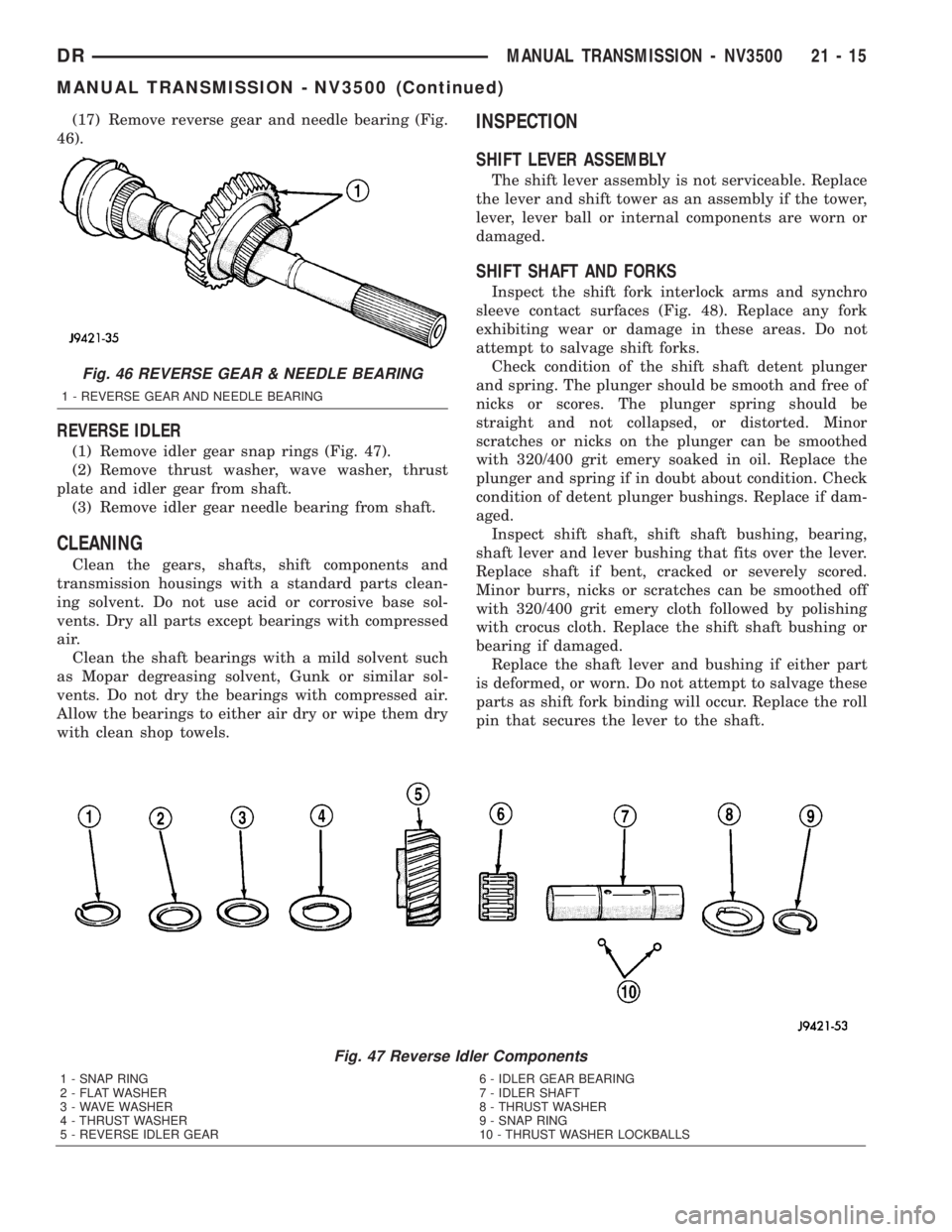
(17) Remove reverse gear and needle bearing (Fig.
46).
REVERSE IDLER
(1) Remove idler gear snap rings (Fig. 47).
(2) Remove thrust washer, wave washer, thrust
plate and idler gear from shaft.
(3) Remove idler gear needle bearing from shaft.
CLEANING
Clean the gears, shafts, shift components and
transmission housings with a standard parts clean-
ing solvent. Do not use acid or corrosive base sol-
vents. Dry all parts except bearings with compressed
air.
Clean the shaft bearings with a mild solvent such
as Mopar degreasing solvent, Gunk or similar sol-
vents. Do not dry the bearings with compressed air.
Allow the bearings to either air dry or wipe them dry
with clean shop towels.
INSPECTION
SHIFT LEVER ASSEMBLY
The shift lever assembly is not serviceable. Replace
the lever and shift tower as an assembly if the tower,
lever, lever ball or internal components are worn or
damaged.
SHIFT SHAFT AND FORKS
Inspect the shift fork interlock arms and synchro
sleeve contact surfaces (Fig. 48). Replace any fork
exhibiting wear or damage in these areas. Do not
attempt to salvage shift forks.
Check condition of the shift shaft detent plunger
and spring. The plunger should be smooth and free of
nicks or scores. The plunger spring should be
straight and not collapsed, or distorted. Minor
scratches or nicks on the plunger can be smoothed
with 320/400 grit emery soaked in oil. Replace the
plunger and spring if in doubt about condition. Check
condition of detent plunger bushings. Replace if dam-
aged.
Inspect shift shaft, shift shaft bushing, bearing,
shaft lever and lever bushing that fits over the lever.
Replace shaft if bent, cracked or severely scored.
Minor burrs, nicks or scratches can be smoothed off
with 320/400 grit emery cloth followed by polishing
with crocus cloth. Replace the shift shaft bushing or
bearing if damaged.
Replace the shaft lever and bushing if either part
is deformed, or worn. Do not attempt to salvage these
parts as shift fork binding will occur. Replace the roll
pin that secures the lever to the shaft.
Fig. 47 Reverse Idler Components
1 - SNAP RING
2 - FLAT WASHER
3 - WAVE WASHER
4 - THRUST WASHER
5 - REVERSE IDLER GEAR6 - IDLER GEAR BEARING
7 - IDLER SHAFT
8 - THRUST WASHER
9 - SNAP RING
10 - THRUST WASHER LOCKBALLS
Fig. 46 REVERSE GEAR & NEEDLE BEARING
1 - REVERSE GEAR AND NEEDLE BEARING
DRMANUAL TRANSMISSION - NV3500 21 - 15
MANUAL TRANSMISSION - NV3500 (Continued)
Page 1857 of 2895
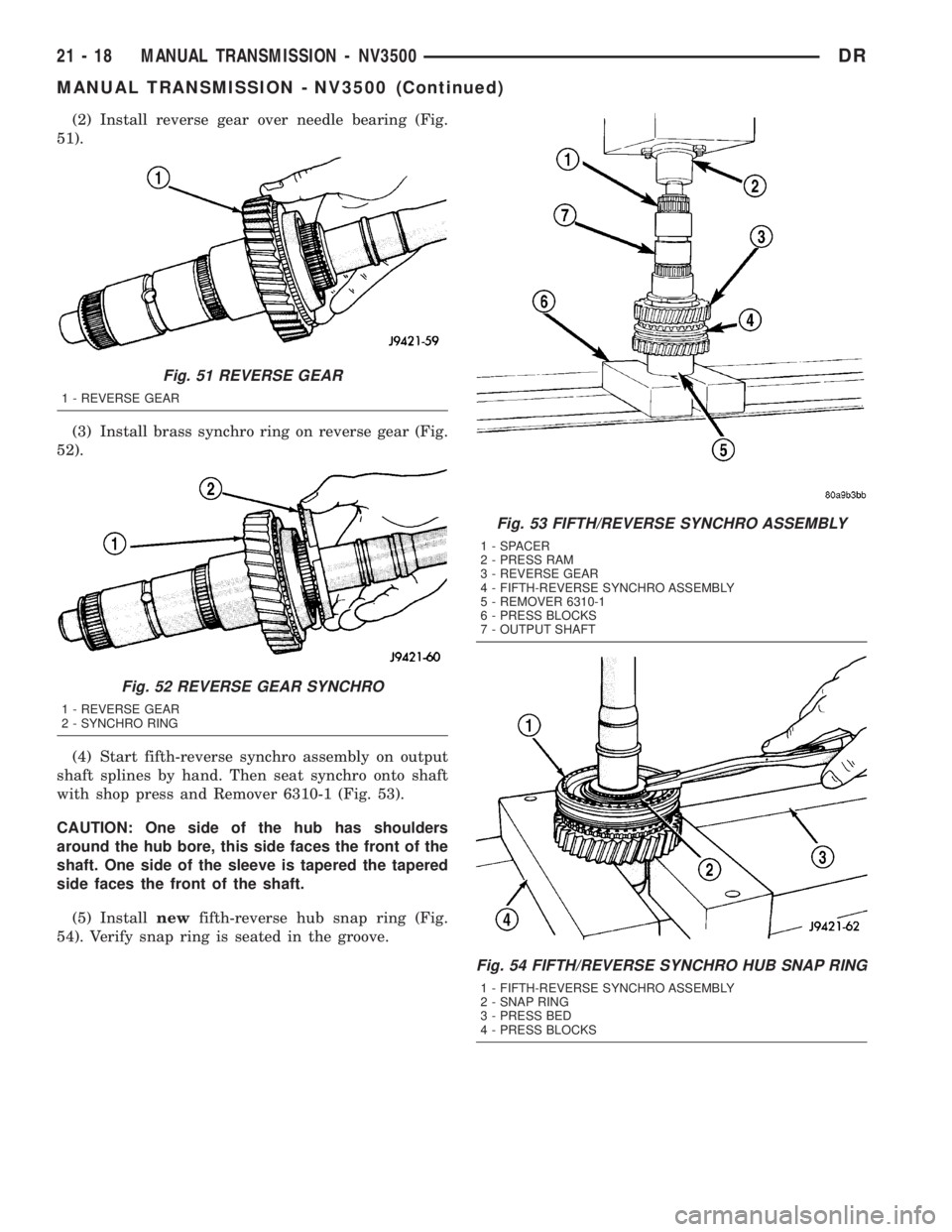
(2) Install reverse gear over needle bearing (Fig.
51).
(3) Install brass synchro ring on reverse gear (Fig.
52).
(4) Start fifth-reverse synchro assembly on output
shaft splines by hand. Then seat synchro onto shaft
with shop press and Remover 6310-1 (Fig. 53).
CAUTION: One side of the hub has shoulders
around the hub bore, this side faces the front of the
shaft. One side of the sleeve is tapered the tapered
side faces the front of the shaft.
(5) Installnewfifth-reverse hub snap ring (Fig.
54). Verify snap ring is seated in the groove.
Fig. 51 REVERSE GEAR
1 - REVERSE GEAR
Fig. 52 REVERSE GEAR SYNCHRO
1 - REVERSE GEAR
2 - SYNCHRO RING
Fig. 53 FIFTH/REVERSE SYNCHRO ASSEMBLY
1 - SPACER
2 - PRESS RAM
3 - REVERSE GEAR
4 - FIFTH-REVERSE SYNCHRO ASSEMBLY
5 - REMOVER 6310-1
6 - PRESS BLOCKS
7 - OUTPUT SHAFT
Fig. 54 FIFTH/REVERSE SYNCHRO HUB SNAP RING
1 - FIFTH-REVERSE SYNCHRO ASSEMBLY
2 - SNAP RING
3 - PRESS BED
4 - PRESS BLOCKS
21 - 18 MANUAL TRANSMISSION - NV3500DR
MANUAL TRANSMISSION - NV3500 (Continued)
Page 1858 of 2895
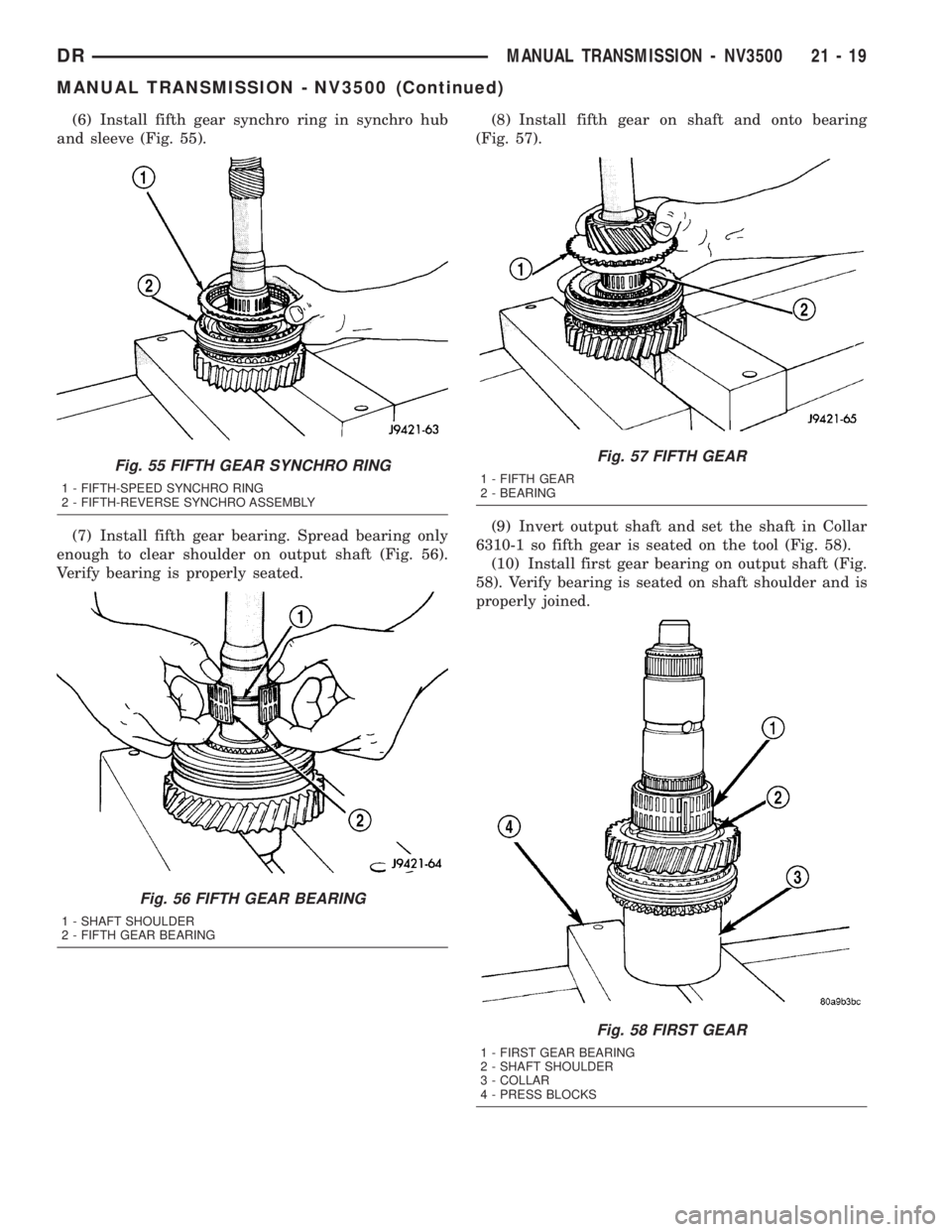
(6) Install fifth gear synchro ring in synchro hub
and sleeve (Fig. 55).
(7) Install fifth gear bearing. Spread bearing only
enough to clear shoulder on output shaft (Fig. 56).
Verify bearing is properly seated.(8) Install fifth gear on shaft and onto bearing
(Fig. 57).
(9) Invert output shaft and set the shaft in Collar
6310-1 so fifth gear is seated on the tool (Fig. 58).
(10) Install first gear bearing on output shaft (Fig.
58). Verify bearing is seated on shaft shoulder and is
properly joined.
Fig. 55 FIFTH GEAR SYNCHRO RING
1 - FIFTH-SPEED SYNCHRO RING
2 - FIFTH-REVERSE SYNCHRO ASSEMBLY
Fig. 56 FIFTH GEAR BEARING
1 - SHAFT SHOULDER
2 - FIFTH GEAR BEARING
Fig. 57 FIFTH GEAR
1 - FIFTH GEAR
2 - BEARING
Fig. 58 FIRST GEAR
1 - FIRST GEAR BEARING
2 - SHAFT SHOULDER
3 - COLLAR
4 - PRESS BLOCKS
DRMANUAL TRANSMISSION - NV3500 21 - 19
MANUAL TRANSMISSION - NV3500 (Continued)
Page 1863 of 2895
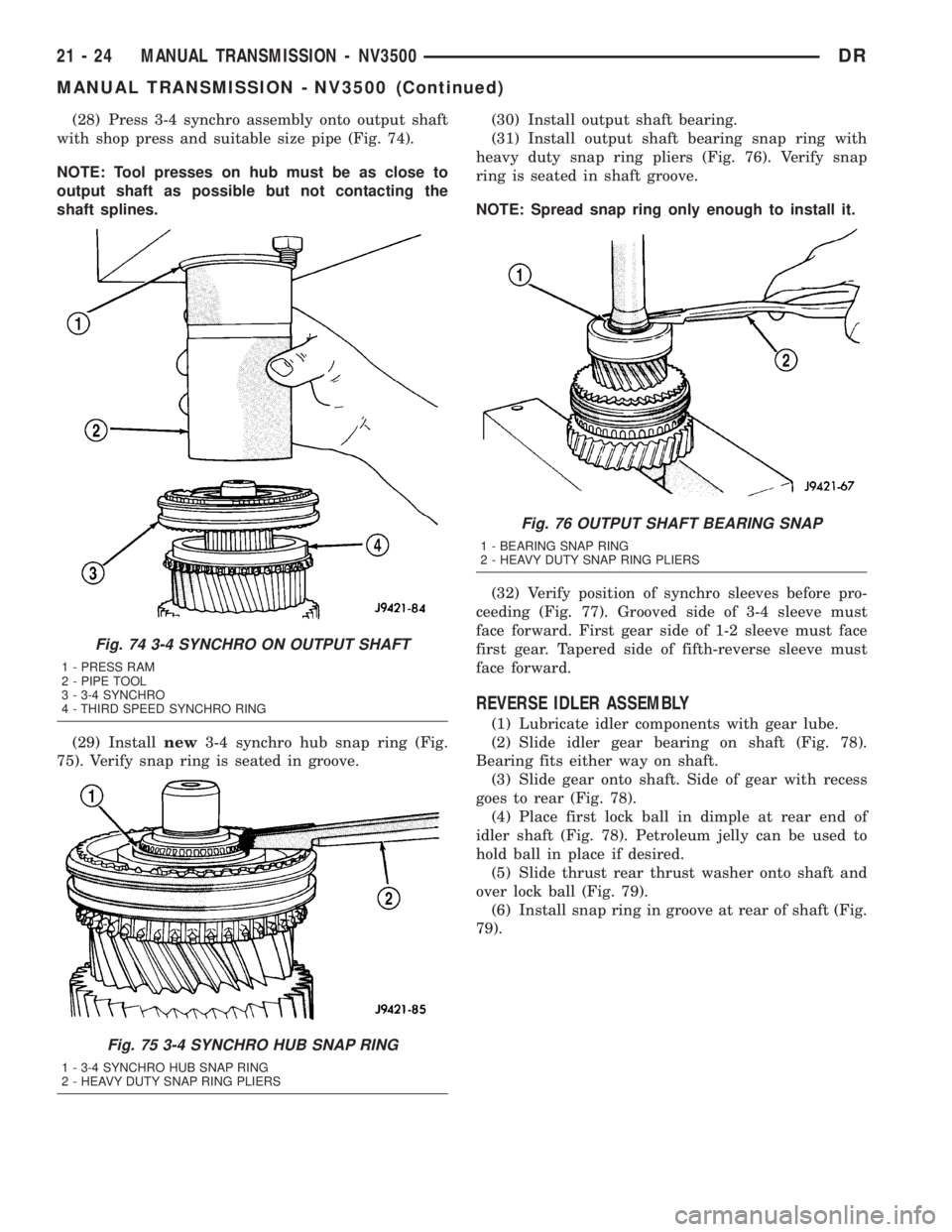
(28) Press 3-4 synchro assembly onto output shaft
with shop press and suitable size pipe (Fig. 74).
NOTE: Tool presses on hub must be as close to
output shaft as possible but not contacting the
shaft splines.
(29) Installnew3-4 synchro hub snap ring (Fig.
75). Verify snap ring is seated in groove.(30) Install output shaft bearing.
(31) Install output shaft bearing snap ring with
heavy duty snap ring pliers (Fig. 76). Verify snap
ring is seated in shaft groove.
NOTE: Spread snap ring only enough to install it.
(32) Verify position of synchro sleeves before pro-
ceeding (Fig. 77). Grooved side of 3-4 sleeve must
face forward. First gear side of 1-2 sleeve must face
first gear. Tapered side of fifth-reverse sleeve must
face forward.
REVERSE IDLER ASSEMBLY
(1) Lubricate idler components with gear lube.
(2) Slide idler gear bearing on shaft (Fig. 78).
Bearing fits either way on shaft.
(3) Slide gear onto shaft. Side of gear with recess
goes to rear (Fig. 78).
(4) Place first lock ball in dimple at rear end of
idler shaft (Fig. 78). Petroleum jelly can be used to
hold ball in place if desired.
(5) Slide thrust rear thrust washer onto shaft and
over lock ball (Fig. 79).
(6) Install snap ring in groove at rear of shaft (Fig.
79).
Fig. 74 3-4 SYNCHRO ON OUTPUT SHAFT
1 - PRESS RAM
2 - PIPE TOOL
3 - 3-4 SYNCHRO
4 - THIRD SPEED SYNCHRO RING
Fig. 75 3-4 SYNCHRO HUB SNAP RING
1 - 3-4 SYNCHRO HUB SNAP RING
2 - HEAVY DUTY SNAP RING PLIERS
Fig. 76 OUTPUT SHAFT BEARING SNAP
1 - BEARING SNAP RING
2 - HEAVY DUTY SNAP RING PLIERS
21 - 24 MANUAL TRANSMISSION - NV3500DR
MANUAL TRANSMISSION - NV3500 (Continued)