maintenance DODGE RAM 2500 DIESEL 2004 3.G Owner's Manual
[x] Cancel search | Manufacturer: DODGE, Model Year: 2004, Model line: RAM 2500 DIESEL, Model: DODGE RAM 2500 DIESEL 2004 3.GPages: 426, PDF Size: 7.22 MB
Page 336 of 426
WARNING!
Do not use alcohol or gasoline as a fuel blending
agent. They can be unstable under certain conditions
and be hazardous or explosive when mixed with
diesel fuel.
NOTE:Due to lack of lubricants in alcohol or gasoline,
the use of these fuels can cause damage to the fuel
system. Hence, use of these fuels will void the warranty
on the engine.
NOTE:As sufficient testing as not been completed,
organically blended diesel fuels (e.g. biodiesel, ethanol,
and methanol blends) are not recommended or approved
for use with your Cummins Diesel equipped Dodge Ram
Truck.NOTE:In addition, commercially available fuel addi-
tives are not necessary for the proper operation of your
Cummins Diesel equipped Dodge Ram Truck.
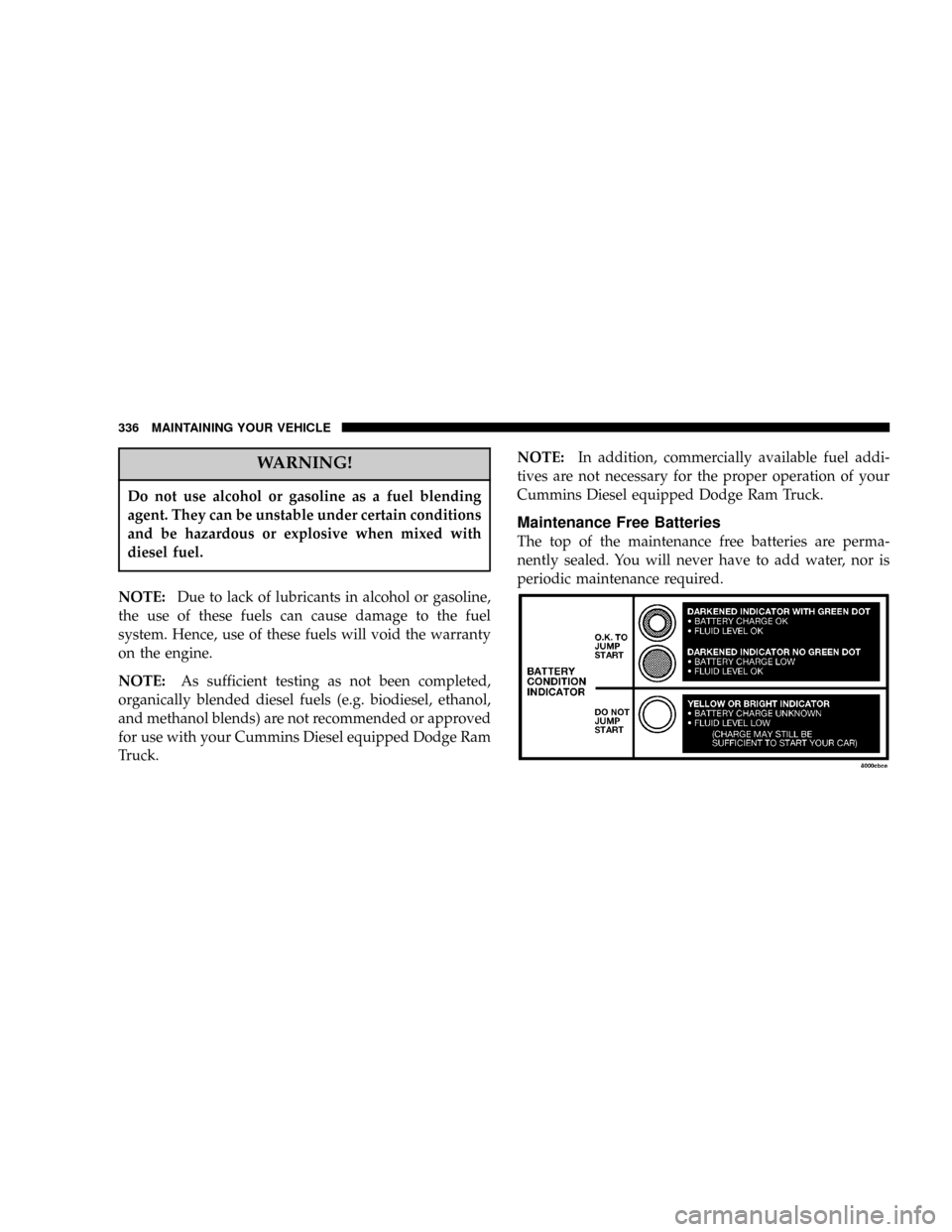
Maintenance Free Batteries
The top of the maintenance free batteries are perma-
nently sealed. You will never have to add water, nor is
periodic maintenance required.
336 MAINTAINING YOUR VEHICLE
Page 338 of 426
Battery Blanket Usage
A battery loses 60% of its cranking power as the battery
temperature decreases to 0ÉF (-18É). For the same de-
crease in temperature, the engine requires twice as much
power to crank at the same RPM. The use of 120 VAC
powered battery blankets will greatly increase starting
capability at low temperatures. Suitable battery blankets
are available from your authorized Mopartdealer.
Air Conditioner Maintenance
For best possible performance, your air conditioner
should be checked and serviced by an Authorized Dealer
at the start of each warm season. This service should
include cleaning of the condenser fins and a performance
test. Drive belt tension should also be checked at this
time.
WARNING!
²Use only refrigerants and compressor lubricants
approved by the manufacturer for your air condi-
tioning system. Some unapproved refrigerants are
flammable and can explode, injuring you. Other
unapproved refrigerants or lubricants can cause
the system to fail, requiring costly repairs.
²The air conditioning system contains refrigerant
under high pressure. To avoid risk of personal
injury or damage to the system, adding refrigerant
or any repair requiring lines to be disconnected
should be done by an experienced repairman.
338 MAINTAINING YOUR VEHICLE
Page 343 of 426

Cooling System
Cooling System Maintenance
At the intervals shown in the Maintenance Schedules
Section of the manual, the system should be drained,
flushed and filled.
Inspection
Coolant protection checks should be made every 12
months (prior to the onset of freezing weather, where
applicable). If coolant is dirty or rusty in appearance, the
system should be drained, flushed and refilled with fresh
coolant as specified.
Inspect the entire cooling system for leaks. Check the face
of the radiator for any accumulation of bugs, leaves, or
other foreign matter. If dirty, clean the radiator core with
a garden hose. With the engine OFF, gently spray water
from the back of the radiator core. Check coolant bottle
tube for condition and tightness of connections at coolant
bottle and radiator.Check the coolant pressure cap and coolant bottle for
proper vacuum sealing. With the engine at normal oper-
ating temperature, note the level of the coolant in the
coolant bottle. Without removing the pressure cap (with
the engine off), drain a small amount of coolant from the
radiator drain cock. If the coolant level in the coolant
bottle drops, the system is sealing properly.
Extremely cold ambient temperature may require the
addition of a ªwinter frontº for effective operation of the
cab heating/cooling system. Make certain that a percent-
age of the radiator is exposed for adequate air flow
through the charge air cooler and automatic transmission
oil cooler. The percentage of opening must be increased
with the increasing ambient air temperature and/or
engine load. If the cooling fan can be heard cycling
frequently, increase the size of the opening in the winter
front.
MAINTAINING YOUR VEHICLE 343
7
Page 344 of 426
Coolant bottle level check
The coolant reserve system provides a quick visual
method of determining that the coolant level is adequate.
With the engine idling, and warmed to the normal
operating temperature, the level of the coolant on the
coolant bottle should be between the fluid level marks.
Check the coolant level whenever the hood is raised.
The radiator normally remains completely full, so there is
no longer a need to remove the coolant pressure cap
except for checking coolant freeze point or replacement
with new antifreeze coolant.
WARNING!
Never add coolant to the radiator when the engine is
overheated. Do not loosen or remove pressure cap to
cool overheated engine! The coolant is under pres-
sure and severe scalding could result.
Drain, Flush And Refill
At intervals shown on the Maintenance Schedules, the
system should be drained, flushed and refilled. Refer to
your dealer or consult a service manual for proper
procedures.
Adding Coolant
When adding coolant or refilling system, a 50% solution
of ethylene glycol antifreeze coolant in water should be
used. Higher concentrations (not to exceed 65%) are
required if temperatures below -34 ÉF (-37 ÉC) are antici-
pated. Use only high purity water such as distilled or
deionized water when mixing the water/antifreeze solu-
tion. The use of lower quality water will reduce the
amount of corrosion protection in the engine cooling
system. Please note that it is the owner's responsibility to
maintain the proper level of protection against freezing
according to the temperatures occurring in the area
where the vehicle is operated.
344 MAINTAINING YOUR VEHICLE
Page 351 of 426

Clutch Hydraulic System
The clutch hydraulic system is a sealed maintenance-free
system. In the event of leakage or other malfunction, the
system must be replaced.
Propeller Shaft Universal Joints
Cross Type (No fittings) ÐRelubrication of this type of
universal joint is not required. The seals should be
inspected for external leaks or damage. If external leaks
or damage is evident, the universal joint should be
replaced.
Rear Axle And 4x4 Front Driving Axle Fluid Level
For Model 9.25 Front Axles and 10.5º/11.5º Rear Axles
refer to Recommended Fluids, Lubricants and Genuine
Parts for the correct lubricant type. For normal service,
periodic fluid level checks are not required. When the
vehicle is serviced for other reasons, the exterior surfaces
of the axle assembly should be inspected.When checking the fluid level, the vehicle should be in a
level position. The fluid level should be 1/4º 1/4º (6.4
mm 6.4 mm) below the fill hole on the 9.25º Front Axle.
The fluid level should be 3/4º 1/4º (19 mm 6.4 mm)
below the fill hole on all 10.5º and 1/4º 1/4º (6.4 mm
6.4 mm) on 11.5º Rear Axles.
Drain And Refill
Vehicles operated in normal service do not have regularly
scheduled oil changes. If fluid has become contaminated
with water or subjected to severe service, follow the
recommended change intervals in Maintenance Schedule
ªBº in Section 8 of this manual.
Lubricant Selection
Refer to Recommended Fluids, Lubricants and Genuine
Parts for the correct lubricant type.
NOTE:The presence of water in the gear lubricant will
result in corrosion and possible failure of differential
components. Operation of the vehicle in water, as may be
MAINTAINING YOUR VEHICLE 351
7
Page 354 of 426
6. Wipe the dipstick clean and reinsert until seated.
Remove dipstick and note reading.
a. If the fluid is hot, the reading should be in the
crosshatched area marked ªOKº.
b. If the fluid is warm, the reading should be between
the two holes. If the fluid level indicates low, add
sufficient fluid to bring to the proper level.
Fluid is added through the dipstick tube.
NOTE:To prevent dirt and water from entering the
transmission after checking or replenishing fluid, make
certain that the dipstick cap is properly seated.
Selection Of Lubricant
Refer to Recommended Fluids, Lubricants and Genuine
Parts for the correct lubricant type. It is important that the
transmission fluid be maintained at the prescribed level
using the recommended fluid.
CAUTION!
Using a transmission fluid other than the manufac-
turers recommended fluid may cause deterioration
in transmission shift quality and/or torque converter
shudder. Using a transmission fluid other than the
manufacturers recommended fluid will result in
more frequent fluid and filter changes. Refer to
Recommended Fluids, Lubricants and Genuine Parts
for correct fluid type.
Automatic Transmission Fluid and Filter Change
To obtain best performance and long life for automatic
transmissions, the manufacturer recommends that they
be given regular maintenance service by an Authorized
Dodge Dealer or Service Center. It is important that the
transmission be adjusted periodically, the fluid main-
tained at the correct level, and that it be drained and
refilled as specified.
354 MAINTAINING YOUR VEHICLE
Page 355 of 426

It is important that proper lubricant is used in the
transmission. Refer to Recommended Fluids, Lubricants
and Genuine Parts for the correct lubricant type. A band
adjustment and filter change should be made at the time
of the oil change.
The fluid and filter should be changed and the bands
adjusted as specified in the Maintenance Schedule (Sec-
tion 8). Vehicles having severe usage should follow
Maintenance Schedule ªBº of the Maintenance Schedule
(Section 8).
Severe usage consists of:
²Off-the-highway operation;
²Trailer towing;
²Snow plow operation;
²Prolonged operation with heavy loading, especially in
hot weather.NOTE:If the transmission is disassembled for any
reason, the fluid and filter should be changed, and the
bands adjusted.
Special Additives
The manufacturer recommends against the addition of
any additives to the transmission. Exception to this
policy is the use of special dyes to aid in detecting fluid
leaks. The use of transmission sealers should be avoided,
since they may adversely affect seals.
Front Wheel Bearings
Front wheel bearings for all Dodge Ram Trucks are
sealed-for-life. They do not require greasing or seal
replacement. In some instances, these bearings will
ªpurgeº excess grease and the bearing housing will look
slightly wet. This is normal.
²Periodic inspection for excess play is recommended.
MAINTAINING YOUR VEHICLE 355
7
Page 357 of 426

Noise Control System Required Maintenance &
Warranty
For 3500 Two-Wheel Drive and Four-Wheel Drive mod-
els over 10,000 lbs. (4 535 kg) Gross Vehicle Weight
Rating.
All vehicles built over 10,000 lbs. (4 535 kg) Gross Vehicle
Weight Rating and manufactured for sale and use in the
United States are required to comply with the Federal
Government's Exterior Noise Regulations. These vehicles
can be identified by the Noise Emission Control Label
located in the operator's compartment.
Required Maintenance For Noise Control Systems
The following maintenance services must be performed
every 6 months or 6,000 miles (9 600 km), whichever
comes first, to assure proper operation of the noise
control systems. In addition, inspection and service
should be performed anytime a malfunction is observed
MAINTAINING YOUR VEHICLE 357
7
Page 358 of 426

or suspected. Proper maintenance of the entire vehicle
will help the effectiveness of the noise control systems.
Exhaust System
Inspect the entire exhaust system for leaks and damaged
parts. Devices such as hangers, clamps, and U-bolts
should be tight and in good condition. Damaged compo-
nents, burned or blown out mufflers, burned or rusted
out exhaust pipes should be replaced according to the
procedures and specifications outlined in the appropriate
service manual.
Air Cleaner Assembly
Inspect air cleaner housing for proper assembly and fit.
Make certain that the air cleaner is properly positioned
and that the cover is tight. Check all hoses leading to the
cleaner for tightness. The air filter element must also be
clean and serviced according to the instructions outlined
in the Maintenance Schedule Section of this manual.Tampering With Noise Control System Prohibited
Federal law prohibits the following acts or the causing
thereof: (1) the removal or rendering inoperative by any
person, other than for purposes of maintenance, repair, or
replacement, of any device or element of design incorpo-
rated into any new vehicle for the purpose of noise
control prior to its sale or delivery to the ultimate
purchaser or while it is in use, or (2) the use of the vehicle
after such device or element of design has been removed
or rendered inoperative by any person.
Among those acts presumed to constitute tampering are
the acts listed below.
358 MAINTAINING YOUR VEHICLE
Page 360 of 426
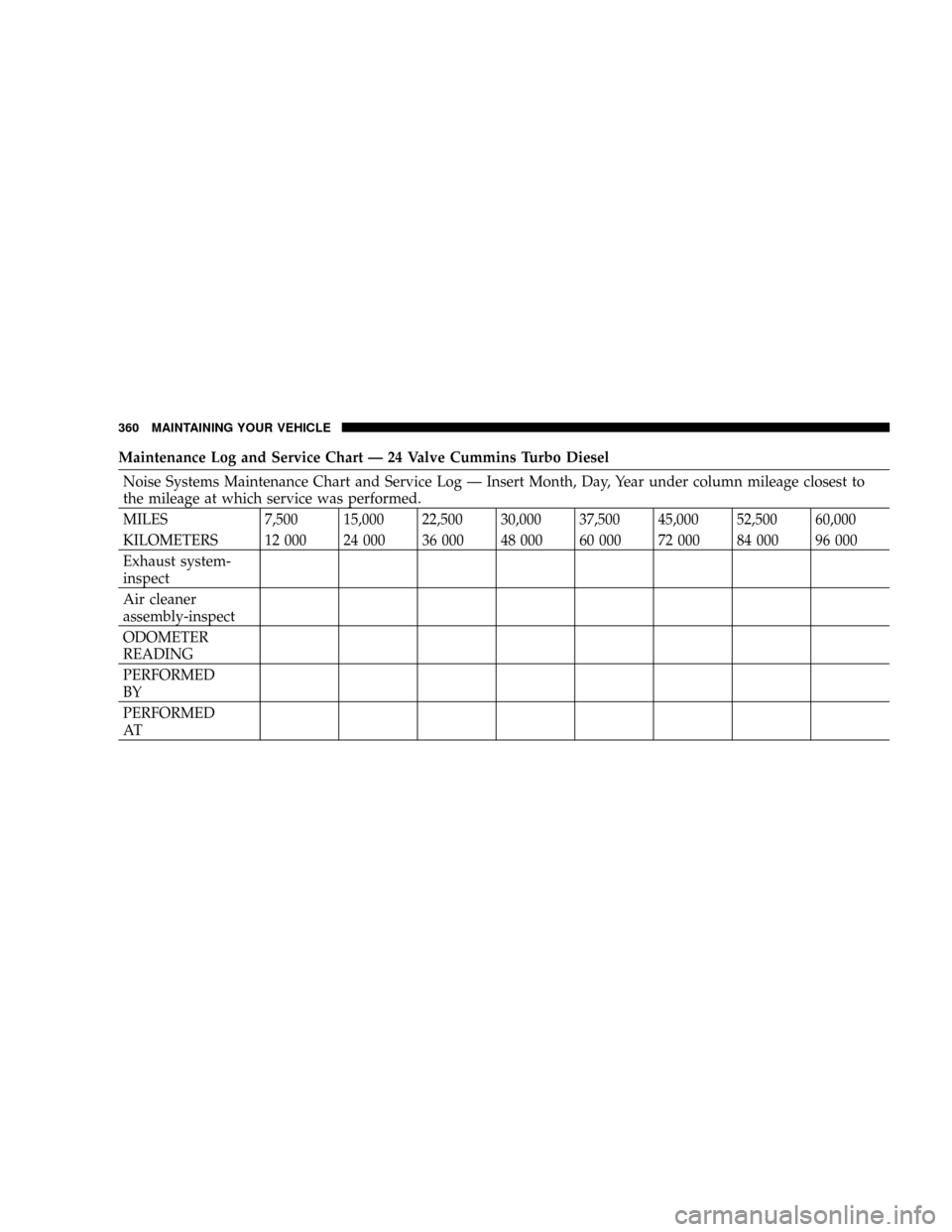
Maintenance Log and Service Chart Ð 24 Valve Cummins Turbo Diesel
Noise Systems Maintenance Chart and Service Log Ð Insert Month, Day, Year under column mileage closest to
the mileage at which service was performed.
MILES 7,500 15,000 22,500 30,000 37,500 45,000 52,500 60,000
KILOMETERS 12 000 24 000 36 000 48 000 60 000 72 000 84 000 96 000
Exhaust system-
inspect
Air cleaner
assembly-inspect
ODOMETER
READING
PERFORMED
BY
PERFORMED
AT
360 MAINTAINING YOUR VEHICLE