light DODGE RAM 2500 DIESEL 2008 3.G User Guide
[x] Cancel search | Manufacturer: DODGE, Model Year: 2008, Model line: RAM 2500 DIESEL, Model: DODGE RAM 2500 DIESEL 2008 3.GPages: 527, PDF Size: 8.88 MB
Page 48 of 527
Enhanced Seat Belt Reminder System (BeltAlertT)
If the driver's seat belt has not been buckled within 60
seconds of starting the vehicle and if the vehicle speed is
greater than 5 mph (8 km/h), the Enhanced Warning
System (BeltAlertt) will alert the driver to buckle the seat
belt. The driver should also instruct all other occupants to
buckle their seat belts. If the driver unbuckles the seat
belt while the vehicle is in motion an immediate chime
will be heard and, the Enhanced Warning System
(BeltAlertt) will continue to chime and flash the Seat Belt
Warning Light for 96 seconds or until the driver's seat
belt is buckled. The Enhanced Warning System
(BeltAlertt) will be reactivated if the ignition is cycled,
driver's seat belt is unbuckled for more than 10 seconds
and the vehicle speed is greater than 5 mph (8 km/h).
The Enhanced Warning System (BeltAlertt) can be en-
abled or disabled by your authorized dealer or by
following these steps:NOTE:The following steps must occur within the first
60 seconds of the ignition switch being turned to the ON
or START position. The manufacturer does not recom-
mend deactivating the Enhanced Warning System
(BeltAlertt).
1. With all doors closed and the ignition switch in any
position except On or Start, buckle the driver's seat belt.
2. Turn the ignition switch to the ON position and wait
for the Seat Belt Warning Light to turn off.
3. Within 60 seconds of turning the ignition switch to the
ON position, unbuckle and then re-buckle the driver's
seat belt at least three times within 10 seconds, ending
with the seat belt buckled.
4. Turn the ignition switch to the LOCK position. A
single chime will sound to signify that you have success-
fully completed the programming.
46 THINGS TO KNOW BEFORE STARTING YOUR VEHICLE
Page 49 of 527
The Enhanced Warning System (BeltAlertt) can be reac-
tivated by repeating this procedure.
NOTE:Although the Enhanced Warning System
(BeltAlertt) has been deactivated, the Seat Belt Warning
Light will continue to illuminate while the driver's seat
belt remains unbuckled.
Seat Belts and Pregnant Women
We recommend that pregnant women use seat belts
throughout their pregnancies. Keeping the mother safe is
the best way to keep the baby safe.
Pregnant women should wear the lap part of the belt
across the thighs and as snug against the hips as possible.
Keep the belt low so that it does not come across the
abdomen. That way the strong bones of the hips will take
the force if there is a collision.
Seat Belt Extender
If a seat belt is too short, even when fully extended, your
authorized dealer can provide you with a seat belt
extender. This extender should be used only if the
existing belt is not long enough. When it is not required,
remove the extender and store it.
WARNING!
Using a seat belt extender when not needed can
increase the risk of injury in a collision. Only use the
seat belt extender when the lap belt is not long
enough when it is worn low and snug, and in the
recommended seating positions. Remove and store
the extender when not needed.
THINGS TO KNOW BEFORE STARTING YOUR VEHICLE 47
2
Page 53 of 527
WARNING!
²Relying on the airbags alone could lead to more
severe injuries in a collision. The airbags work
with your seat belt to restrain you properly. In
some collisions the airbags won't deploy at all.
Always wear your seat belts even though you have
airbags.
²Being too close to the steering wheel or instrument
panel during airbag deployment could cause seri-
ous injury. Airbags need room to inflate. Sit back,
comfortably extending your arms to reach the
steering wheel or instrument panel.
²If the vehicle has window bags, they also need
room to inflate. Do not lean against the door or
window. Sit upright in the center of the seat.
Airbag System Components
The airbag system consists of the following:
²Occupant Restraint Controller
²Side Remote Acceleration Sensors (if equipped)
²Airbag Warning Light
²Driver Airbag
²Passenger Airbag
²Window Bags above Side Windows (if equipped)
²Steering Wheel and Column
²Instrument Panel
²Interconnecting Wiring
²Knee Impact Bolsters
²Front Acceleration Sensors (1500 Vehicles Only)
THINGS TO KNOW BEFORE STARTING YOUR VEHICLE 51
2
Page 54 of 527
²Driver and Front Passenger Seat Belt Pretensioners (if
equipped)
²Driver Seat Track Position Sensor (if equipped)
²Passenger Side Frontal Airbag ON/OFF Switch (2500/
3500 Regular Cab Vehicles Only)
²Passenger Airbag Disable (PAD) Indicator Light
(2500/3500 Regular Cab Vehicles Only)
How the Airbag System Works
²
TheOccupant Restraint Controller (ORC)determines
if a frontal collision is severe enough to require the
airbags to inflate. The front airbag inflators are de-
signed to provide different rates of airbag inflation
from information provided by the ORC. The ORC will
not detect rollover or rear collisions.The ORC also monitors the readiness of the electronic
parts of the system whenever the ignition switch is in
the START or RUN positions. These include all of the
items listed above except the steering wheel and
column, and knee bolsters. If the key is in the OFF
position, in the ACC position, or not in the ignition,
the airbags are not on and will not inflate.
Also, the ORC turns on the AIRBAG warn-
ing light in the instrument panel for six to
eight seconds for a self-check when the
ignition is first turned on. After the self-
check, the AIRBAG warning light will turn off. If the
ORC detects a malfunction in any part of the system, it
turns on the AIRBAG warning light either momen-
tarily or continuously. A single chime will sound if the
light comes on again after initial start up.
52 THINGS TO KNOW BEFORE STARTING YOUR VEHICLE
Page 55 of 527
WARNING!
Ignoring the AIRBAG warning light in your instru-
ment panel could mean you won't have the airbags to
protect you in a collision. If the light does not come
on, stays on after you start the vehicle, or if it comes
on as you drive, have the airbag system checked right
away.
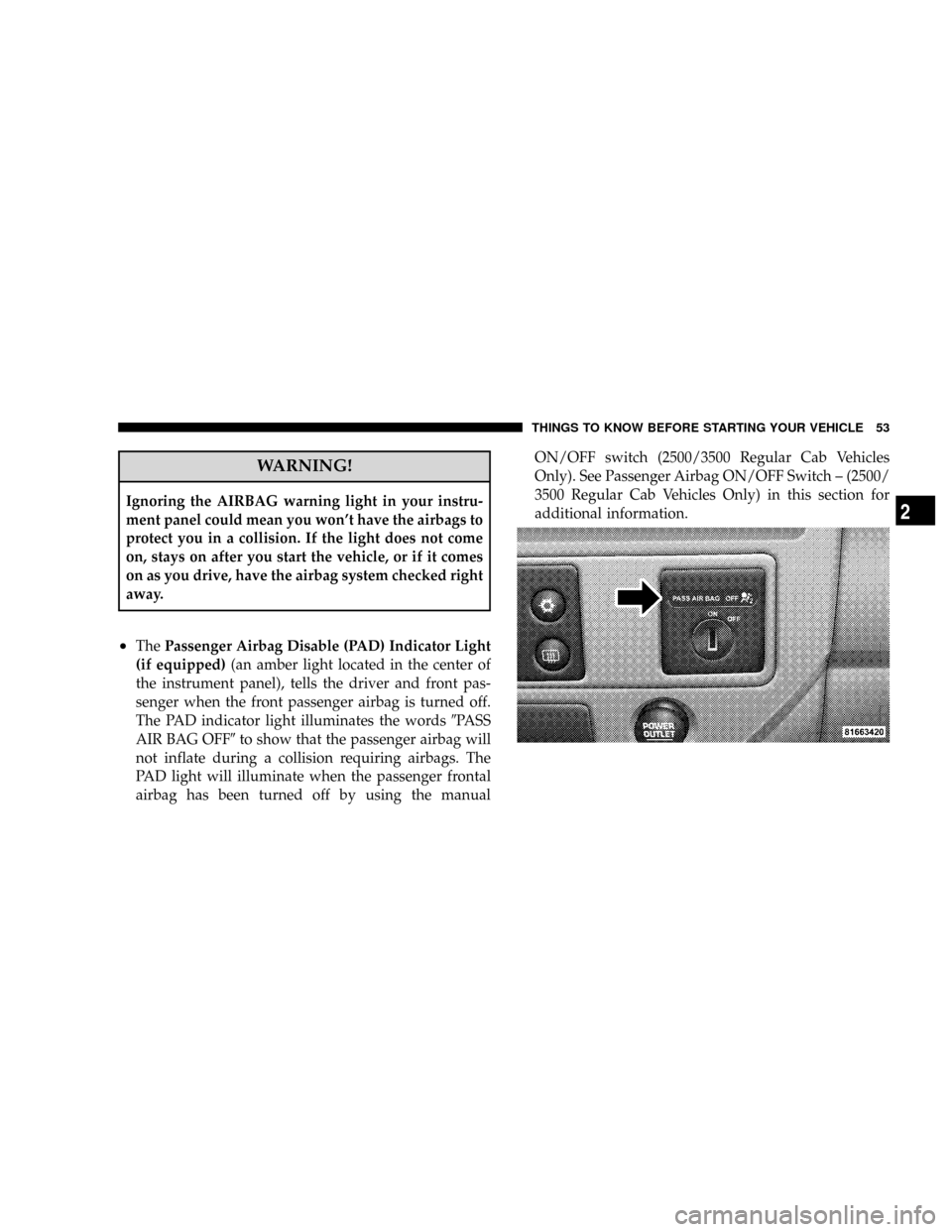
²ThePassenger Airbag Disable (PAD) Indicator Light
(if equipped)(an amber light located in the center of
the instrument panel), tells the driver and front pas-
senger when the front passenger airbag is turned off.
The PAD indicator light illuminates the words9PASS
AIR BAG OFF9to show that the passenger airbag will
not inflate during a collision requiring airbags. The
PAD light will illuminate when the passenger frontal
airbag has been turned off by using the manualON/OFF switch (2500/3500 Regular Cab Vehicles
Only). See Passenger Airbag ON/OFF Switch ± (2500/
3500 Regular Cab Vehicles Only) in this section for
additional information.
THINGS TO KNOW BEFORE STARTING YOUR VEHICLE 53
2
Page 58 of 527
WARNING!
Whenever an airbag is turned off, even a lap/
shoulder belted passenger may hit their head, neck,
or chest on the dashboard (instrument panel) or
windshield in a crash. This may result in serious
injury or death.
To Shut Off the Passenger Airbag (2500/3500 Regular
Cab Vehicles Only)
Place the ignition key in the Passenger Airbag ON/OFF
Switch, push the key in and turn clockwise, and remove
the key from the switch. This will shut off the passenger
side airbag. The OFF light near the switch will illuminate
when the ignition switch is turned to the ON position.To Turn On the Passenger Airbag (2500/3500 Regular
Cab Vehicles Only)
Place the ignition key in the Passenger Airbag ON/OFF
Switch, push the key in and turn counterclockwise, and
remove the key from the switch. This will turn ON the
passenger airbag. The OFF light near the switch will be
off when the ignition switch is turned to the ON position.
If A Deployment Occurs
The airbag system is designed to deploy the airbags
when the impact sensors detect a moderate-to-severe
frontal collision, to help restrain the driver and front
passenger, and then immediately deflate.
NOTE:A frontal collision that is not severe enough to
need airbag protection will not activate the system. This
does not mean something is wrong with the airbag
system.
56 THINGS TO KNOW BEFORE STARTING YOUR VEHICLE
Page 60 of 527
Maintaining Your Airbag System
WARNING!
²Modifications to any part of the airbag system
could cause it to fail when you need it. You could
be injured if the airbag system is not there to
protect you. Do not modify the components or
wiring, including adding any kind of badges or
stickers to the steering wheel hub trim cover or the
upper right side of the instrument panel. Do not
modify the front bumper, vehicle body structure,
or add aftermarket side steps or running boards.
²You need proper knee impact protection in a
collision. Do not mount or locate any aftermarket
equipment on or behind the knee bolsters.
²It is dangerous to try to repair any part of the
airbag system yourself. Be sure to tell anyone who
works on your vehicle that it has an airbag system.NOTE:
Perchlorate Material ± special handling may ap-
ply, see www.dtsc.ca.gov/hazardouswaste/perchlorate
Enhanced Accident Response System
If the airbags deploy after an impact and the electrical
system remains functional, vehicles equipped with
power door locks will unlock automatically. In addition,
approximately five seconds after the vehicle has stopped
moving, the interior lights will light until the ignition
switch is turned off.
Airbag Light
You will want to have the airbags ready to
inflate for your protection in an impact. While
the airbag system is designed to be mainte-
nance free, if any of the following occurs, have
an authorized dealer service the system promptly:
²The airbag light does not come on or flickers during
the six to eight seconds when the ignition switch is
first turned ON.
58 THINGS TO KNOW BEFORE STARTING YOUR VEHICLE
Page 61 of 527
²The light remains on or flickers after the six to eight-
second interval.
²The light flickers or comes on and remains on while
driving.
NOTE:If the speedometer, tachometer or any engine-
related gauges are not working, the airbag control mod-
ule may also be disabled. The airbags may not be ready
to inflate for your protection. Promptly check fuse block
for blown fuses. Refer to the label located on the inside of
the fuse block cover for the proper airbag fuses. See your
authorized dealer if the fuse is good.
Event Data Recorder (EDR)
In the event of an accident, your vehicle is designed to
record up to five seconds of specific vehicle data param-
eters (see the following list) in an event data recorder
prior to the moment of airbag deployment and up to a
quarter-second of high-speed deceleration data duringand/or after airbag deployment. EDR data are ONLY
recorded if an airbag deploys and are otherwise unavail-
able.
NOTE:Under certain circumstances, EDR data may not
be recorded (e.g., loss of battery power).
In conjunction with other data gathered during a com-
plete accident investigation, the electronic data may be
used by DaimlerChrysler Corporation and others to learn
more about the possible causes of crashes and associated
injuries in order to assess and improve vehicle perfor-
mance. In addition to crash investigations initiated by
DaimlerChrysler Corporation, such investigations may
be requested by customers, insurance carriers, govern-
ment officials, and professional crash researchers, such as
those associated with universities, and with hospital and
insurance organizations.
THINGS TO KNOW BEFORE STARTING YOUR VEHICLE 59
2
Page 76 of 527
²Make sure that the child is upright in the seat.
²The lap portion should be low on the hips and as snug
as possible.
²Check belt fit periodically. A child's squirming or
slouching can move the belt out of position.
If the shoulder belt contacts the face or neck, move the
child closer to the center of the vehicle. Never allow a
child to put the shoulder belt under an arm or behind
their back.
Transporting Pets
Airbags deploying in the front seat could harm your pet.
An unrestrained pet will be thrown about and possibly
injured, or injure a passenger during panic braking or in
a collision. Pets should be restrained in the rear seat in
pet harnesses or pet carriers that are secured by seat belts.
NEW ENGINE BREAK-IN
Your Cumminst24-Valve Turbo Diesel engine does not
require a break-in period due to its construction. Normal
operation is allowed, provided the following recommen-
dations are followed:
NOTE:Light duty operation such as light trailer towing
or no load operation will extend the time before the
engine is at full efficiency. Reduced fuel economy and
power may be seen at this time.
²Warm up the engine before placing it under load.
²Do not operate the engine at idle for prolonged
periods.
²Use the appropriate transmission gear to prevent
engine lugging.
²Observe vehicle oil pressure and temperature indica-
tors.
74 THINGS TO KNOW BEFORE STARTING YOUR VEHICLE
Page 78 of 527
Lock Your Vehicle
Always remove the key from the ignition and lock all
doors when leaving the vehicle unattended, even in your
own driveway or garage. Try to park your vehicle in a
well-lighted area and never invite theft by leaving ar-
ticles of value exposed.
Exhaust Gas
WARNING!
Exhaust gases contain carbon monoxide, a potentially
toxic gas that, by itself, is colorless and odorless. To
avoid inhaling these gases, the following precautions
should be observed:
²Do not run the engine in a closed garage or in confined
areas any longer than needed to move your vehicle in
or out of the area.
²If it is necessary to sit in a parked vehicle with the
engine running for more than a short period, adjust
your climate control system to force outside air into
the vehicle. Set the blower at high speed and the
controls in any position except OFF or MAX A/C.
²The best protection against carbon monoxide entry
into the vehicle body is a properly maintained engine
exhaust system.
Be aware of changes in the sound of the exhaust system,
exhaust fumes detected inside the vehicle, or damage to
the underside or rear of the vehicle. Have a competent
authorized mechanic inspect the complete exhaust sys-
tem and adjacent body areas for broken, damaged,
deteriorated or mispositioned parts. Open seams or loose
connections could permit exhaust fumes to seep into the
passenger compartment. In addition, inspect the exhaust
system each time the vehicle is raised for lubrication or
oil change. Replace or adjust as required.
76 THINGS TO KNOW BEFORE STARTING YOUR VEHICLE