coolant DODGE RAM 2500 DIESEL 2008 3.G Owner's Manual
[x] Cancel search | Manufacturer: DODGE, Model Year: 2008, Model line: RAM 2500 DIESEL, Model: DODGE RAM 2500 DIESEL 2008 3.GPages: 527, PDF Size: 8.88 MB
Page 439 of 527
Coolant bottle level check
The coolant reserve system provides a quick visual
method of determining that the coolant level is adequate.
With the engine idling and warmed to the normal
operating temperature, the level of the coolant on the
coolant bottle should be between the fluid level marks.
Check the coolant level whenever the hood is raised.
The radiator normally remains completely full, so there is
no longer a need to remove the coolant pressure cap
except for checking coolant freeze point or replacement
with new antifreeze coolant.WARNING!
Never add coolant to the radiator when the engine is
overheated. Do not loosen or remove pressure cap to
cool overheated engine! The coolant is under pres-
sure and severe scalding could result.
Cooling System Ð Drain, Flush and Refill
At the intervals shown on the Maintenance Schedules,
the system should be drained, flushed and refilled. See
you authorized dealer for service.
MAINTAINING YOUR VEHICLE 437
7
Page 440 of 527
CAUTION!
The manufacturer highly recommends that all cool-
ing system service, maintenance, and repairs be per-
formed by your local authorized dealer.
If the solution is dirty or contains a considerable amount
of sediment, clean and flush with a reliable cooling
system cleaner. Follow with a thorough rinsing to remove
all deposits and chemicals. Properly dispose of old
antifreeze solution.
Selection Of Coolant
Use only the manufacturer's recommended coolant; for
correct coolant type, refer to ªEngine Coolantº under
ªFluids, Lubricants and Genuine Partsº in this section.
CAUTION!
²Mixing of coolants other than specified HOAT
engine coolants may result in engine damage and
may decrease corrosion protection. If a non-HOAT
coolant is introduced into the cooling system in an
emergency, it should be replaced with the speci-
fied coolant as soon as possible.
²Do not use plain water alone or alcohol-base
engine coolant (antifreeze) products. Do not use
additional rust inhibitors or antirust products, as
they may not be compatible with the radiator
engine coolant and may plug the radiator.
²This vehicle has not been designed for use with
Propylene Glycol based coolants. Use of Propy-
lene Glycol based coolants is not recommended.
438 MAINTAINING YOUR VEHICLE
Page 441 of 527
Adding Coolant
Your vehicle has been built with an improved engine
coolant that allows extended maintenance intervals. This
coolant can be used up to 5 Years or 100,000 miles (160
000 km) before replacement. To prevent reducing this
extended maintenance period, it is important that you
use the same coolant throughout the life of your vehicle.
Please review these recommendations for using Hybrid
Organic Additive Technology (HOAT) coolant. When
adding coolant:
²The manufacturer recommends using Mopart
Antifreeze/Coolant 5 Year/100,000 Mile Formula
HOAT (Hybrid Organic Additive Technology).
²Mix a minimum solution of 50% HOAT engine coolant
and distilled water. Use higher concentrations (not to
exceed 70%) if temperatures below -34ÉF (-37ÉC) are
anticipated.
²Use only high purity water such as distilled or deion-
ized water when mixing the water/engine coolant
solution. The use of lower quality water will reduce
the amount of corrosion protection in the engine
cooling system.
Please note that it is the owner's responsibility to main-
tain the proper level of protection against freezing ac-
cording to the temperatures occurring in the area where
the vehicle is operated.
NOTE:Mixing coolant types will decrease the life of the
engine coolant and will require more frequent coolant
changes.
Cooling System Pressure Cap
The cap must be fully tightened to prevent loss of coolant
and to ensure that coolant will return to the radiator from
the coolant recovery bottle.
MAINTAINING YOUR VEHICLE 439
7
Page 442 of 527
The cap should be inspected and cleaned if there is any
accumulation of foreign material on the sealing surfaces.
WARNING!
²The warning words ªDO NOT OPEN HOTº on
the cooling system pressure cap are a safety pre-
caution. Never add coolant when the engine is
overheated. Do not loosen or remove the cap to
cool an overheated engine. Heat causes pressure to
build up in the cooling system. To prevent scald-
ing or injury, do not remove the pressure cap while
the system is hot or under pressure.
²Do not use a pressure cap other than the one
specified for your vehicle. Personal injury or en-
gine damage may result.
Disposal Of Used Engine Coolant
Used ethylene glycol based engine coolant is a regulated
substance requiring proper disposal. Check with your
local authorities to determine the disposal rules for your
community. Do not store ethylene glycol-based engine
coolant in open containers or allow it to remain in
puddles on the ground. Prevent ingestion by animals and
children. If ingested by a child, contact a physician
immediately. Clean up any ground spills immediately.
Coolant Level
The coolant bottle provides a quick visual method for
determining that the coolant level is adequate. With the
engine cold, the level of the coolant in the coolant
recovery bottle should be between the ranges indicated
on the bottle.
440 MAINTAINING YOUR VEHICLE
Page 443 of 527
The radiator normally remains completely full, so there is
no need to remove the radiator cap unless checking for
coolant freeze point or replacing coolant. Advise your
service attendant of this. As long as the engine operating
temperature is satisfactory, the coolant bottle need only
be checked once a month.
When additional coolant is needed to maintain the
proper level, it should be added to the coolant bottle. Do
not overfill.
Points To Remember
NOTE:When the vehicle is stopped after a few miles (a
few kilometers) of operation, you may observe vapor
coming from the front of the engine compartment. This is
normally a result of moisture from rain, snow, or high
humidity accumulating on the radiator and being vapor-
ized when the thermostat opens, allowing hot coolant to
enter the radiator.If an examination of your engine compartment shows no
evidence of radiator or hose leaks, the vehicle may be
safely driven. The vapor will soon dissipate.
²Do not overfill the coolant recovery bottle.
²Check coolant freeze point in the radiator and in the
coolant recovery bottle. If antifreeze needs to be
added, contents of coolant recovery bottle must also be
protected against freezing.
²If frequent coolant additions are required, or if the
level in the coolant recovery bottle does not drop when
the engine cools, the cooling system should be pres-
sure tested for leaks.
²Maintain coolant concentration at 50% HOAT engine
coolant (minimum) and distilled water for proper
corrosion protection of your engine which contains
aluminum components.
MAINTAINING YOUR VEHICLE 441
7
Page 444 of 527
²Make sure that the radiator and coolant recovery
bottle overflow hoses are not kinked or obstructed.
²Keep the front of the radiator clean. If your vehicle is
equipped with air conditioning, keep the front of the
condenser clean also.
²Do not change the thermostat for summer or winter
operation. If replacement is ever necessary, install
ONLY the correct type thermostat. Other designs may
result in unsatisfactory coolant performance, poor gas
mileage, and increased emissions.
Fan
Inspection
Check the fan for cracks and bent or broken blades. If any
of these conditions exist, you must replace the fan. Make
sure it is securely mounted.NOTE:This service procedure must be performed by a
trained service technician. Make arrangements with your
authorized dealer for this inspection.
Charge Air Cooler (Inter-Cooler)
The charge air cooler is positioned between the radiator
and the air conditioner condenser. Air enters the engine
through the air cleaner and passes through the turbo-
charger where it is pressurized. This pressurized air
rapidly reaches high temperature. The air is then directed
through a hose to the charge air cooler and through
another hose to the intake manifold of the engine. The air
entering the engine has been cooled by about 50 to 100
degrees Fahrenheit. This cooling process enables more
efficient burning of fuel resulting in fewer emissions.
442 MAINTAINING YOUR VEHICLE
Page 482 of 527
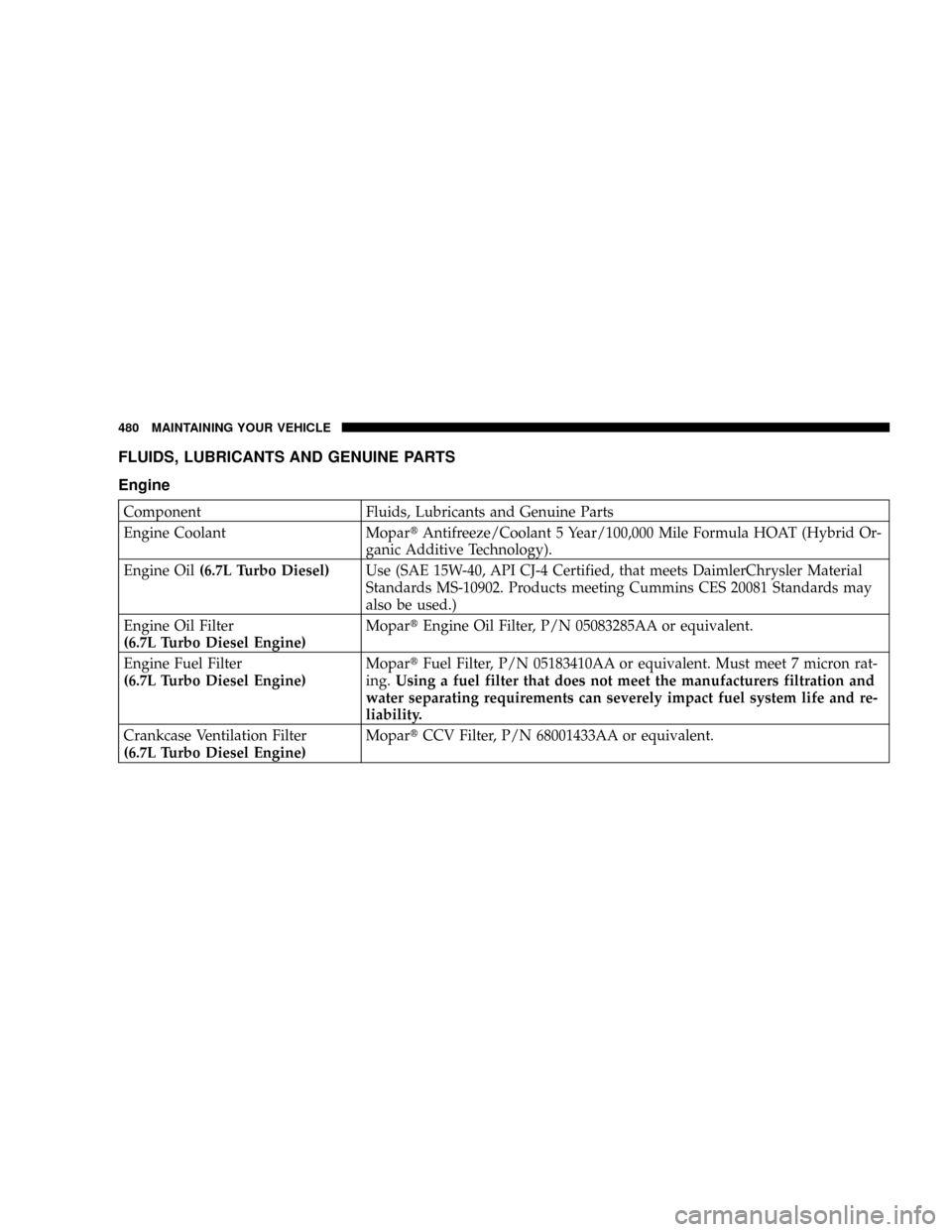
FLUIDS, LUBRICANTS AND GENUINE PARTS
Engine
Component Fluids, Lubricants and Genuine Parts
Engine Coolant MopartAntifreeze/Coolant 5 Year/100,000 Mile Formula HOAT (Hybrid Or-
ganic Additive Technology).
Engine Oil(6.7L Turbo Diesel)Use (SAE 15W-40, API CJ-4 Certified, that meets DaimlerChrysler Material
Standards MS-10902. Products meeting Cummins CES 20081 Standards may
also be used.)
Engine Oil Filter
(6.7L Turbo Diesel Engine)MopartEngine Oil Filter, P/N 05083285AA or equivalent.
Engine Fuel Filter
(6.7L Turbo Diesel Engine)MopartFuel Filter, P/N 05183410AA or equivalent. Must meet 7 micron rat-
ing.Using a fuel filter that does not meet the manufacturers filtration and
water separating requirements can severely impact fuel system life and re-
liability.
Crankcase Ventilation Filter
(6.7L Turbo Diesel Engine)MopartCCV Filter, P/N 68001433AA or equivalent.
480 MAINTAINING YOUR VEHICLE
Page 487 of 527
take some washer fluid and apply it to a cloth or towel
and wipe clean the wiper blades, this will help blade
performance.
Once a Month
²Check tire pressure and look for unusual wear or
damage.
²Inspect the batteries and clean and tighten the termi-
nals as required.
²Check the fluid levels of coolant reservoir, brake
master cylinder, and transmission and transfer case (if
equipped), add as needed.
²Check all lights and all other electrical items for correct
operation.
²Drain water from the fuel filter.
²Check Filter MinderŸ (If Equipped). Replace air
cleaner filter element if necessary.At Each Oil Change
²Change the engine oil filter.
²Inspect the exhaust system.
²Inspect the brake hoses.
²Inspect the U-Joints (if equipped) and front suspension
components.
²Check the automatic transmission fluid level.
²Check the manual transmission fluid level.
²Check the coolant level, hoses, and clamps.
²Lubricate outer tie rod ends (4X4) models only.
²Lubricate Front Drive Shaft Fitting (4X4).
Inspection and service should also be performed anytime
a malfunction is observed or suspected. Retain all re-
ceipts.
MAINTENANCE SCHEDULES 485
8
M
A
I
N
T
E
N
A
N
C
E
S
C
H
E
D
U
L
E
S
Page 490 of 527
![DODGE RAM 2500 DIESEL 2008 3.G Owners Manual (Miles) (45,000) (52,500) (60,000) (67,500) (75,000)
Kilometers 72 000 84 000 97 000 109 000 121 000
[Months] [36] [42] [48] [54] [60]
Change engine oil and engine oil filter. X X X X X
Lubricate Fron](/img/12/5493/w960_5493-489.png "DODGE RAM 2500 DIESEL 2008 3.G Owners Manual (Miles) (45,000) (52,500) (60,000) (67,500) (75,000)
Kilometers 72 000 84 000 97 000 109 000 121 000
[Months] [36] [42] [48] [54] [60]
Change engine oil and engine oil filter. X X X X X
Lubricate Fron")
(Miles) (45,000) (52,500) (60,000) (67,500) (75,000)
Kilometers 72 000 84 000 97 000 109 000 121 000
[Months] [36] [42] [48] [54] [60]
Change engine oil and engine oil filter. X X X X X
Lubricate Front Drive Shaft Fitting (4X4). X X X X X
Rotate tires. X X X X X
Lubricate outer tie rod ends. X X X X X
Change the transfer case fluid (4X4). X
Change front and rear axle fluid (4X4). X X X
Change the automatic transmission fluid & filter if
using your vehicle for any of the following: police,
taxi, fleet or frequent trailer towing.X
Change manual transmission fluid. X
Flush and replace engine coolant at 60 months, if
not replaced at 100,000 miles (160 000 km).***X
Inspect drive belt, replace as necessary. X X
Replace fuel filter element. X X X
488 MAINTENANCE SCHEDULES
8
M
A
I
N
T
E
N
A
N
C
E
S
C
H
E
D
U
L
E
S
Page 492 of 527
![DODGE RAM 2500 DIESEL 2008 3.G Owners Manual (Miles) (82,500) (90,000) (97,500) (100,000) (105,000)
Kilometers 133 000 145 000 157 000 160 000 169 000
[Months] [66] [72] [78] [84]
Change engine oil and engine oil filter. X X X X
Lubricate Front](/img/12/5493/w960_5493-491.png "DODGE RAM 2500 DIESEL 2008 3.G Owners Manual (Miles) (82,500) (90,000) (97,500) (100,000) (105,000)
Kilometers 133 000 145 000 157 000 160 000 169 000
[Months] [66] [72] [78] [84]
Change engine oil and engine oil filter. X X X X
Lubricate Front")
(Miles) (82,500) (90,000) (97,500) (100,000) (105,000)
Kilometers 133 000 145 000 157 000 160 000 169 000
[Months] [66] [72] [78] [84]
Change engine oil and engine oil filter. X X X X
Lubricate Front Drive Shaft Fitting (4X4). X X X X
Rotate tires. X X X X
Lubricate outer tie rod ends. X X X X
Flush and replace engine coolant, if not replaced at
60 mos.***X
Inspect the transfer case fluid (4X4). X
Change front and rear axle fluid (4X4). X X
Inspect drive belt, replace as required.* X X
Replace fuel filter element. X X
Inspect front wheel bearings. X
Inspect brake linings. X X
Inspect and adjust parking brake if necessary. X X
490 MAINTENANCE SCHEDULES
8
M
A
I
N
T
E
N
A
N
C
E
S
C
H
E
D
U
L
E
S