warning DODGE RAM 2500 GAS 2008 3.G Owners Manual
[x] Cancel search | Manufacturer: DODGE, Model Year: 2008, Model line: RAM 2500 GAS, Model: DODGE RAM 2500 GAS 2008 3.GPages: 554, PDF Size: 9.93 MB
Page 404 of 554
CAUTION!
Using 1500 Model vehicles for snowplow applica-
tions can cause damage to the vehicle.
NOTE:Before installation of a snowplow, it is highly
recommended that the owner/installer obtain and follow
the recommendations contained within the current
Dodge BODY BUILDER'S GUIDE. See your authorized
dealer, installer or snowplow manufacturer for this infor-
mation. There are unique electrical systems that must be
connected to properly assure operator safety, and to
prevent overloading vehicle systems.
WARNING!
Attaching a snowplow to this vehicle could adversely
affect performance of the airbag system in an acci-
dent. Do not expect that the airbag will perform as
described earlier in this manual
CAUTION!
The ªLamp Outº indicator could illuminate if exte-
rior lamps are not properly installed.
402 STARTING AND OPERATING
Page 410 of 554
CAUTION!
Damage to the automatic transmission may occur if
the transmission is shifted into PARK with the trans-
fer case in NEUTRAL and the engine running. With
the transfer case in NEUTRAL ensure that the engine
is OFF prior to shifting the transmission into PARK.
Returning to Normal Operation Ð Manual Shift
Transfer Case
Use the following procedure to prepare your vehicle for
normal usage:
1. Bring the vehicle to a complete stop.
2. Apply the parking brake.
3. Shut OFF the engine.
4. Depress the brake pedal.5. Shift automatic transmission to NEUTRAL, or depress
the clutch on manual transmissions.
6. Shift transfer case lever to desired position.
7. Shift automatic transmission into PARK.
WARNING!
You or others could be injured if you leave the
vehicle unattended with the transfer case in the
NEUTRAL position without first fully engaging the
parking brake. The transfer case NEUTRAL position
disengages both the front and rear driveshafts from
the powertrain and will allow the vehicle to move,
regardless of the transmission position. The parking
brake should always be applied when the driver is
not in the vehicle.
408 STARTING AND OPERATING
Page 414 of 554
NOTE:Steps 1 through 5 are requirements that must be
met prior to depressing the transfer case Neutral (N)
button, and must continue to be met until one second
elapses and the shift has been completed. If any of these
requirements (with the exception of step 3 - key ON) are
not met prior to depressing the Neutral (N) button, or are
no longer met during the one second time, then all of the
mode position indicator lights will flash continuously
until all requirements are met, or until the Neutral (N)
button is released.
NOTE:The ignition key must be ON for a transfer case
shift to take place and for the position indicator lights to
be operable. If the key is not ON, the shift will not take
place and no position indicator lights will be on or
flashing.NOTE:Flashing Neutral position indicator light indi-
cates that shift requirements have not been met.
WARNING!
You or others could be injured if you leave the
vehicle unattended with the transfer case in the
NEUTRAL position without first fully engaging the
parking brake. The transfer case NEUTRAL position
disengages both the front and rear driveshafts from
the powertrain and will allow the vehicle to move
despite the transmission position. The parking brake
should always be applied when the driver is not in
the vehicle.
412 STARTING AND OPERATING
Page 417 of 554
WHAT TO DO IN EMERGENCIES
CONTENTS
mHazard Warning Flasher..................416
mJacking And Tire Changing................417
NJack Location........................417
NReinstalling The Scissors-Type Jack And Tools
(1500 Models)........................419
mJacking Instructions.....................422
NRemoving The Spare Tire................422
NTire Changing Procedure................423mHoisting.............................434
mJump-Starting Procedures.................434
mFreeing A Stuck Vehicle..................437
mEmergency Tow Hooks Ð If Equipped........438
mTowing A Disabled Vehicle................439
N4-Wheel Drive Vehicles.................439
N2±Wheel Drive Vehicles.................439
6
Page 418 of 554
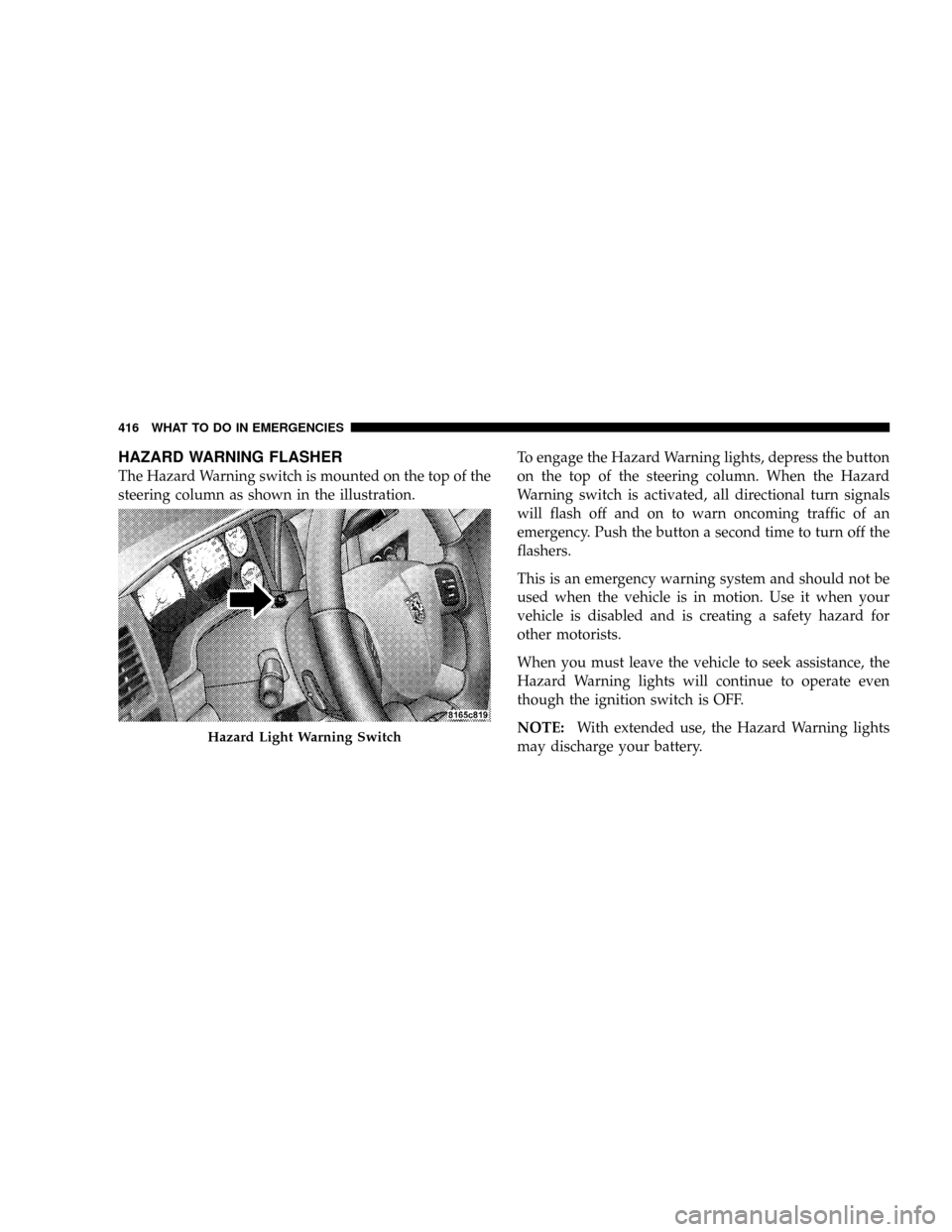
HAZARD WARNING FLASHER
The Hazard Warning switch is mounted on the top of the
steering column as shown in the illustration.To engage the Hazard Warning lights, depress the button
on the top of the steering column. When the Hazard
Warning switch is activated, all directional turn signals
will flash off and on to warn oncoming traffic of an
emergency. Push the button a second time to turn off the
flashers.
This is an emergency warning system and should not be
used when the vehicle is in motion. Use it when your
vehicle is disabled and is creating a safety hazard for
other motorists.
When you must leave the vehicle to seek assistance, the
Hazard Warning lights will continue to operate even
though the ignition switch is OFF.
NOTE:With extended use, the Hazard Warning lights
may discharge your battery.
Hazard Light Warning Switch
416 WHAT TO DO IN EMERGENCIES
Page 419 of 554
JACKING AND TIRE CHANGING
WARNING!
²Being under a jacked-up vehicle is dangerous. The
vehicle could slip off the jack and fall on you. You
could be crushed. Never put any part of your body
under a vehicle that is on a jack. Never start or run
the engine while the vehicle is on a jack. If you need
to get under a raised vehicle, take it to an authorized
service center where it can be raised on a lift.
²The jack is designed to use as a tool for changing
tires only. The jack should not be used to lift the
vehicle for service purposes. The vehicle should
be jacked on a firm level surface only. Avoid ice or
slippery areas.
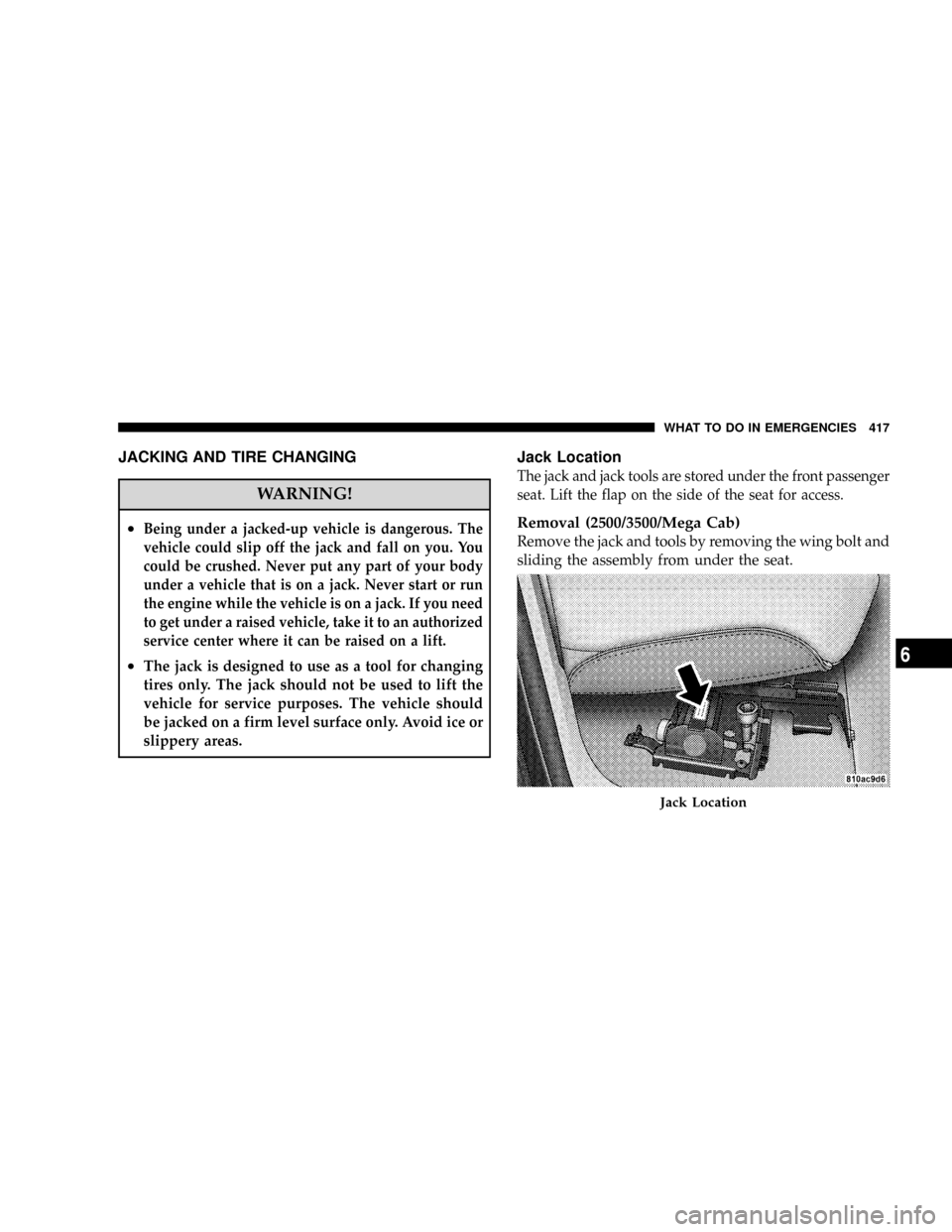
Jack Location
The jack and jack tools are stored under the front passenger
seat. Lift the flap on the side of the seat for access.
Removal (2500/3500/Mega Cab)
Remove the jack and tools by removing the wing bolt and
sliding the assembly from under the seat.
Jack Location
WHAT TO DO IN EMERGENCIES 417
6
Page 421 of 554
WARNING!
After using the jack and tools, always reinstall them
in the original carrier and location. While driving
you may experience abrupt stopping, rapid accelera-
tion, or sharp turns. A loose jack, tools, bracket or
other objects in the vehicle may move around with
force, resulting in serious injury.
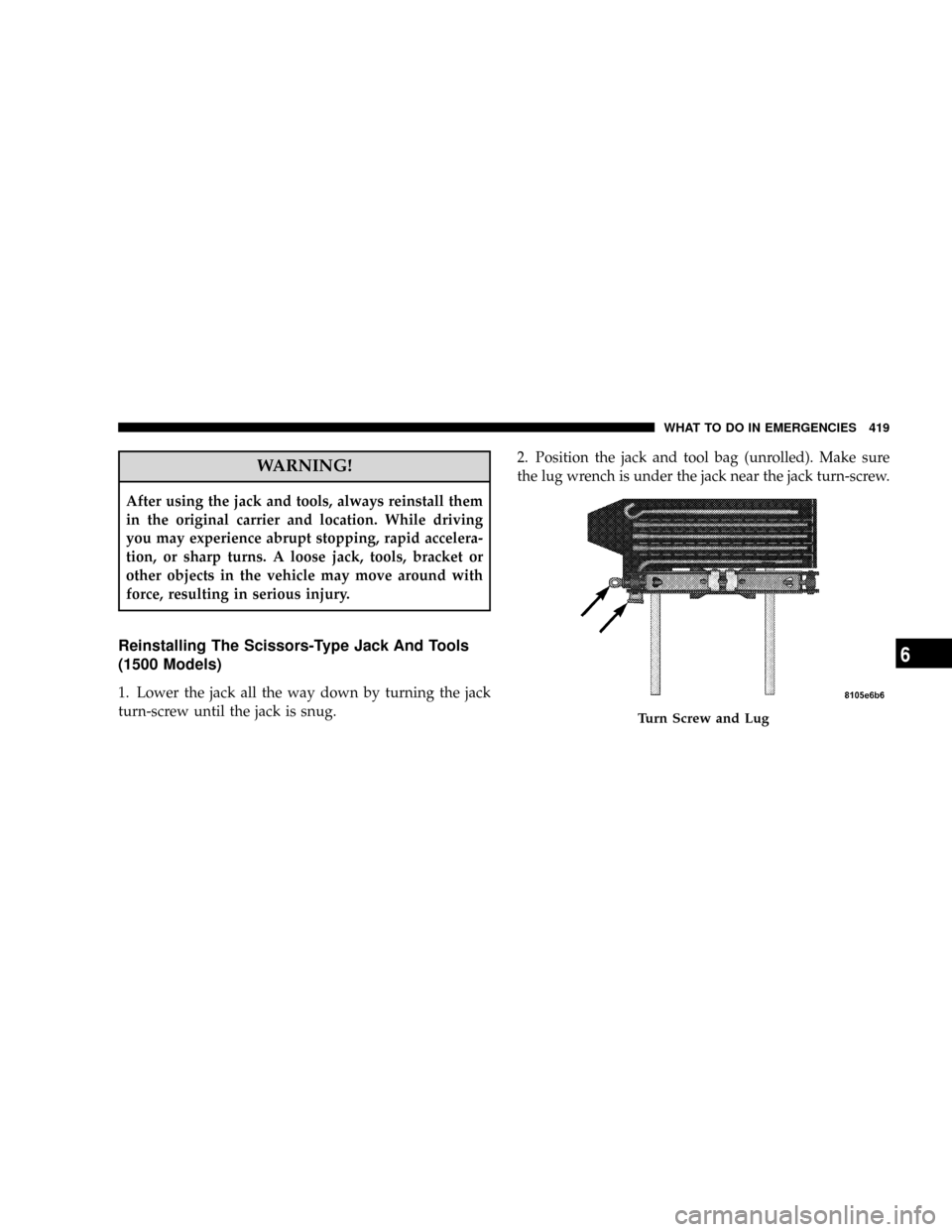
Reinstalling The Scissors-Type Jack And Tools
(1500 Models)
1. Lower the jack all the way down by turning the jack
turn-screw until the jack is snug.2. Position the jack and tool bag (unrolled). Make sure
the lug wrench is under the jack near the jack turn-screw.
Turn Screw and Lug
WHAT TO DO IN EMERGENCIES 419
6
Page 425 of 554
Tire Changing Procedure
WARNING!
Getting under a jacked-up vehicle is dangerous. The
vehicle could slip off the jack and fall on you. You
could be crushed. Never get any part of your body
under a vehicle that is on a jack. Never start or run
the engine while the vehicle is on a jack. If you need
to get under a raised vehicle, take it to an authorized
service center where it can be raised on a lift.
Do not raise this vehicle using a bumper jack. The jack is
designed as a tool for changing tires on this vehicle only.
It is not recommended that the jack be used for service
purposes or to lift more than one wheel at a time.
Preparations
Park the vehicle on a firm level surface, avoiding ice or
slippery areas. Set the parking brake and place the gear
selector in PARK (automatic transmission) or REVERSE
(manual transmission). On four-wheel drive vehicles,
shift the transfer case to the 4L position.
WARNING!
Do not attempt to change a tire on the side of the
vehicle close to moving traffic. Pull far enough off
the road to avoid the danger of being hit when
operating the jack or changing the wheel.
²Turn on the Hazard Warning Flasher.
WHAT TO DO IN EMERGENCIES 423
6
Page 426 of 554
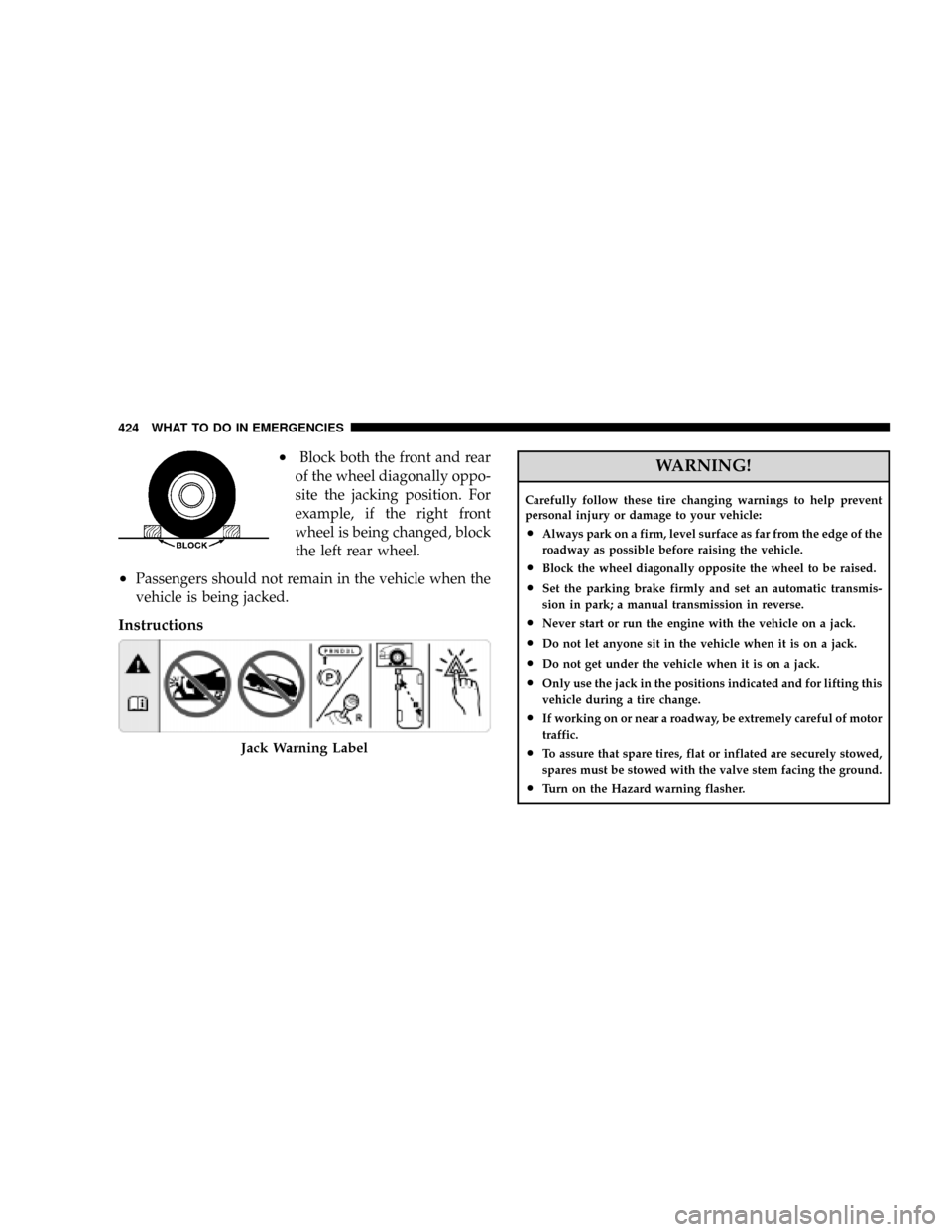
²Block both the front and rear
of the wheel diagonally oppo-
site the jacking position. For
example, if the right front
wheel is being changed, block
the left rear wheel.
²Passengers should not remain in the vehicle when the
vehicle is being jacked.
Instructions
WARNING!
Carefully follow these tire changing warnings to help prevent
personal injury or damage to your vehicle:
²Always park on a firm, level surface as far from the edge of the
roadway as possible before raising the vehicle.
²Block the wheel diagonally opposite the wheel to be raised.
²Set the parking brake firmly and set an automatic transmis-
sion in park; a manual transmission in reverse.
²Never start or run the engine with the vehicle on a jack.
²Do not let anyone sit in the vehicle when it is on a jack.
²Do not get under the vehicle when it is on a jack.
²Only use the jack in the positions indicated and for lifting this
vehicle during a tire change.
²If working on or near a roadway, be extremely careful of motor
traffic.
²To assure that spare tires, flat or inflated are securely stowed,
spares must be stowed with the valve stem facing the ground.
²Turn on the Hazard warning flasher.
Jack Warning Label
424 WHAT TO DO IN EMERGENCIES
Page 430 of 554
²Connect the jack tube extension and wheel wrench.
Before raising the wheel off the ground, make sure
that the jack will not damage surrounding truck
parts and adjust the jack position as required.
NOTE:If the 2500/3500 bottle jack will not lower by
turning the dial (thumbwheel) by hand, it may be neces-
sary to use the jack drive tube in order to lower the jack.
4. By rotating the wheel wrench clockwise, raise the
vehicle until the wheel just clears the surface.
WARNING!
Raising the vehicle higher than necessary can make
the vehicle unstable and cause an accident. It could
slip off the jack and hurt someone near it. Raise the
vehicle only enough to remove the tire.5. Remove the wheel nuts and pull the wheel off. Install
the spare wheel and wheel nuts with the cone shaped end
of the nuts toward the wheel on 1500/2500/3500 single
rear-wheel (SRW) models. On 3500 dual rear-wheel mod-
els (DRW) the lug nuts are a two-piece assembly with a
flat face. Lightly tighten the nuts. To avoid risk of forcing
the vehicle off the jack, do not fully tighten the nuts until
the vehicle has been lowered.
6. Using the wheel wrench, finish tightening the nuts
using a crisscross pattern. Correct nut tightness is 135 ft
lbs (183 N´m) torque for 1500/2500/3500 single-rear
wheel (SRW) models, and 145 ft lbs (197 N´m) for 3500
dual rear-wheel models. If in doubt about the correct
tightness, have them checked with a torque wrench by
your authorized dealer or at a service station.
428 WHAT TO DO IN EMERGENCIES