warning DODGE RAM 2500 GAS 2008 3.G Owners Manual
[x] Cancel search | Manufacturer: DODGE, Model Year: 2008, Model line: RAM 2500 GAS, Model: DODGE RAM 2500 GAS 2008 3.GPages: 554, PDF Size: 9.93 MB
Page 431 of 554
WARNING!
A loose tire or jack thrown forward in a collision or
hard stop could injure someone in the vehicle. Al-
ways stow the jack parts and the extra tire and wheel
in the places provided.
7. Install wheel center cap and remove wheel blocks. Do
not install chrome or aluminum wheel center caps on the
spare wheel. This may result in cap damage.
8. Lower the jack to its fully closed position. If the bottle
jack will not lower by turning the dial (thumbwheel) by
hand, it may be necessary to use the jack drive tube in
order to lower the jack. Stow the replaced tire, jack, and
tools as previously described.
9. Adjust the tire pressure when possible.NOTE:Do not oil wheel studs. For chrome wheels, do
not substitute with chrome plated wheel nuts.Hub Caps/Wheel Covers
The hub caps must be removed before raising the vehicle
off the ground.
For 2500/3500 single rear-wheel (SRW) models, use the
blade on the end of the lug wrench to pry the hub cap off.
Insert the blade end into the pryoff notch and carefully
pop off the hub cap with a back-and-forth motion.
On 3500 models with dual rear wheels (DRW), you must
first remove the hub caps. The jack handle driver has a
hook at one end that will fit in the pry off notch of the
rear hub caps. Position the hook and pull out on the
ratchet firmly. The hub cap should pop off. The wheel
skins can now be removed. For the front hub cap on 3500
models use the blade on the end of the lug wrench to pry
the caps off. The wheel skin can now be removed.
WHAT TO DO IN EMERGENCIES 429
6
Page 435 of 554
tightened to recommended torque. Tighten the nuts to
final torque in increments. Progress around the bolt
circle, tightening the nut opposite to the nut just previ-
ously tightened until final torque is achieved. Recom-
mended torques are shown in the following chart.
Disc
WheelsType Nut Stud Size Torque
Ft. Lbs.Torque
Newton
Meters
Cone 9/16-18 120-150 160-200
Flanged 9/16-18 130-160 190-220
To Stow The Flat Or Spare
NOTE: 1500 Regular and Quad Cabtvehicles
equipped with aluminum wheels cannot be stored under
the vehicle because the wheel retainer will not fit through
the wheel pilot hole. Secure the (flat) tire in the bed of the
truck.Have the (flat) tire repaired or replaced immedi-
ately.
WARNING!
A loose tire thrown forward in a collision or hard stop
could injure the occupants in the vehicle. Have the
deflated (flat) tire repaired or replaced immediately.
Turn the wheel so that the valve stem is down. Slide the
wheel retainer through the center of the wheel and
position it properly across the wheel opening.
For convenience in checking the spare tire inflation, stow
with the valve stem toward the rear of the vehicle.
Attach the wheel wrench to the extension tube. Rotate the
winch mechanism until the wheel is drawn into place
against the underside of the vehicle. Continue to rotate
until you feel the winch mechanism slip, or click three or
four times. It cannot be overtightened. Push against the
tire several times to be sure it is firmly in place.
WHAT TO DO IN EMERGENCIES 433
6
Page 437 of 554
WARNING!
Battery fluid is a corrosive acid solution; do not allow
battery fluid to contact eyes, skin or clothing. Don't
lean over battery when attaching clamps or allow the
clamps to touch each other. If acid splashes in eyes or
on skin, flush contaminated area immediately with
large quantities of water.
A battery generates hydrogen gas which is flam-
mable and explosive. Keep flame or spark away from
the vent holes.
Do not use a booster battery or any other booster
source that has a greater than 12-volt system, i.e., do
not use a 24-volt power source.
1. Remove all metal jewelry such as watch bands or
bracelets which might make an unintended electrical
contact.2. Park the booster vehicle within cable reach but with-
out letting the vehicles touch. Set the parking brake on
both vehicles, place the automatic transmission in PARK
or the manual transmission in NEUTRAL, and turn the
ignition OFF.
3. Turn off the heater, radio, and all unnecessary electri-
cal loads.
4. Connect one end of a jumper cable to the positive
terminal of the booster battery. Connect the other end of
the same cable to the positive terminal of the discharged
battery.
WARNING!
Do not permit vehicles to touch each other as this
could establish a ground connection and personal
injury could result.
WHAT TO DO IN EMERGENCIES 435
6
Page 438 of 554
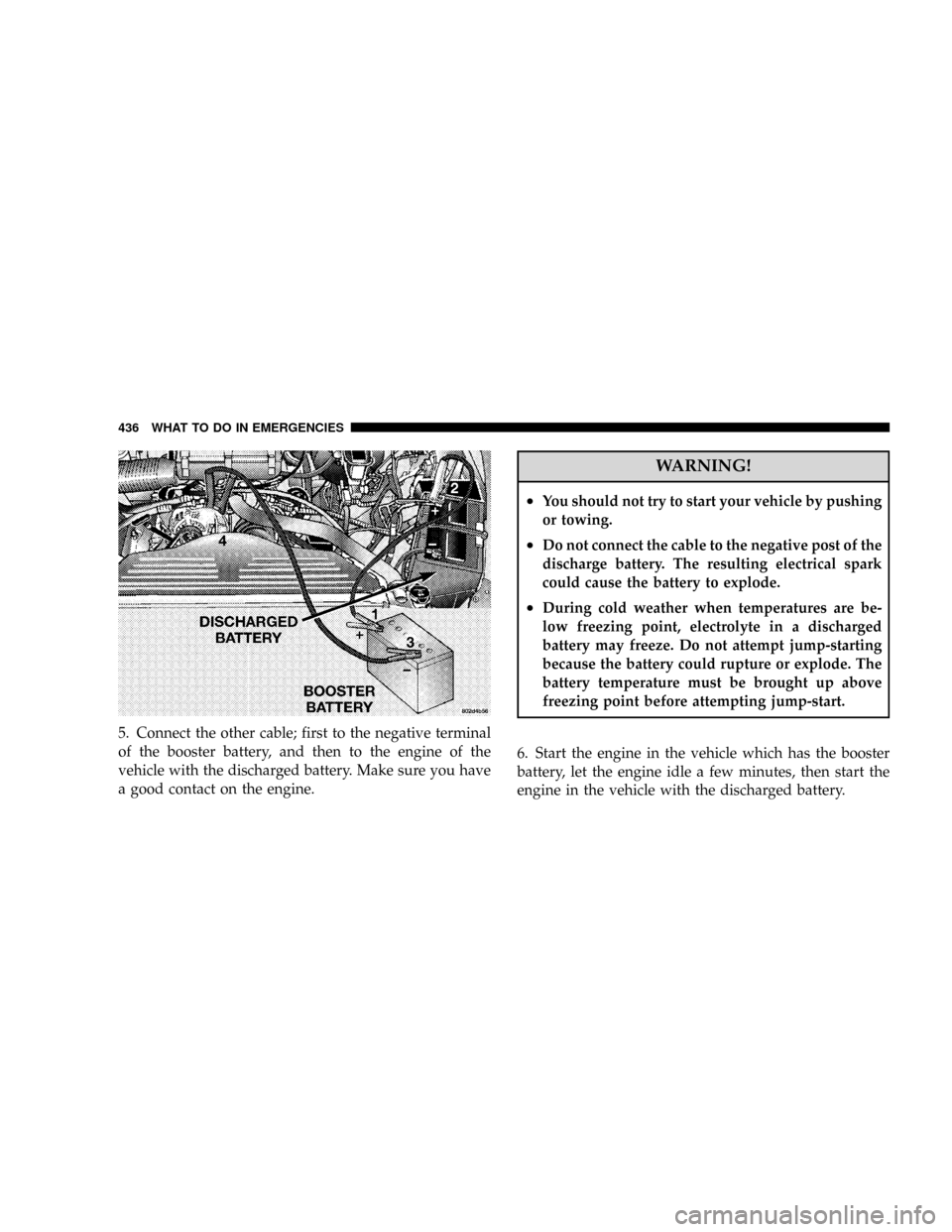
5. Connect the other cable; first to the negative terminal
of the booster battery, and then to the engine of the
vehicle with the discharged battery. Make sure you have
a good contact on the engine.
WARNING!
²You should not try to start your vehicle by pushing
or towing.
²Do not connect the cable to the negative post of the
discharge battery. The resulting electrical spark
could cause the battery to explode.
²During cold weather when temperatures are be-
low freezing point, electrolyte in a discharged
battery may freeze. Do not attempt jump-starting
because the battery could rupture or explode. The
battery temperature must be brought up above
freezing point before attempting jump-start.
6. Start the engine in the vehicle which has the booster
battery, let the engine idle a few minutes, then start the
engine in the vehicle with the discharged battery.
436 WHAT TO DO IN EMERGENCIES
Page 439 of 554
7. When removing the jumper cables, reverse the above
sequence exactly. Be careful of the moving belts and fan.
WARNING!
Any procedure other than above could result in:
1. Personal injury caused by electrolyte squirting out
the battery vent;
2. Personal injury or property damage due to battery
explosion;
3. Damage to charging system of booster vehicle or
of immobilized vehicle.
FREEING A STUCK VEHICLE
If the vehicle becomes stuck in snow, sand, or mud, it can
often be moved by a rocking motion. Move the gear
selector rhythmically between DRIVE and REVERSE
(automatic transmissions) or between 1st and REVERSE
(manual transmissions), while applying slight pressure to
the accelerator.
In general, the least amount of accelerator pedal pressure
to maintain the rocking motion without spinning the
wheels or racing the engine, is most effective. Racing the
engine or spinning the wheels, due to the frustration of
not freeing the vehicle, may lead to transmission over-
heating and failure. Allow the engine to idle with the
transmission selector in NEUTRAL for at least one
minute after every five rocking-motion cycles. This will
minimize overheating and reduce the risk of transmis-
sion failure during prolonged efforts to free a stuck
vehicle.
WHAT TO DO IN EMERGENCIES 437
6
Page 440 of 554
EMERGENCY TOW HOOKS Ð IF EQUIPPED
Your vehicle may be equipped with emergency tow
hooks.
NOTE:For off-road recovery, it is recommended to use
both of the front tow hooks to minimize the risk of
damage to the vehicle.
WARNING!
Chains are not recommended for freeing a stuck
vehicle. Chains may break, causing serious injury or
death.
WARNING!
Stand clear of vehicles when pulling with tow hooks.
Tow straps and chains may break, causing serious
injury.
CAUTION!
Tow hooks are for emergency use only, to rescue a
vehicle stranded off-road. Do not use tow hooks for
tow truck hookup or highway towing. You could
damage your vehicle.
438 WHAT TO DO IN EMERGENCIES
Page 452 of 554
AUTHORIZED DEALER SERVICE
Your authorized dealer has the qualified service person-
nel, special tools and equipment to perform all service
operations in an expert manner. Service manuals are
available which include detailed service information for
your vehicle. Refer to these manuals before attempting
any procedure yourself.
NOTE:Intentional tampering with emissions control
systems can result in civil penalties being assessed
against you.
WARNING!
You can be badly injured working on or around a
motor vehicle. Do only that service work for which you
have the knowledge and the proper equipment. If you
have any doubt about your ability to perform a service
job, take your vehicle to a competent mechanic.
MAINTENANCE PROCEDURES
The pages that follow contain therequiredmaintenance
services determined by the engineers who designed your
vehicle.
Besides the maintenance items for which there are fixed
maintenance intervals, there are other items that should
operate satisfactorily without periodic maintenance.
However, if a malfunction of these items does occur, it
could adversely affect the engine or vehicle performance.
These items should be inspected if a malfunction is
observed or suspected.
450 MAINTAINING YOUR VEHICLE
Page 457 of 554
Engine Air Cleaner Filter
Follow the Maintenance Schedule for recommended En-
gine Air Cleaner Filter change intervals.
WARNING!
The air induction system (air cleaner, hoses, etc.) can
provide a measure of protection in the case of engine
backfire. Do not remove the air induction system (air
cleaner, hoses, etc.) unless such removal is necessary
for repair or maintenance. Make sure that no one is
near the engine compartment before starting the
vehicle with the air induction system (air cleaner,
hoses, etc.) removed. Failure to do so can result in
serious personal injury.
Engine Fuel Filter
A plugged fuel filter can cause stalling, limit the speed at
which a vehicle can be driven or cause hard starting.
Should an excessive amount of dirt accumulate in the
fuel tank, frequent filter replacement may be necessary.
Catalytic Converter
The catalytic converter requires the use of unleaded fuel
only. Leaded gasoline will destroy the effectiveness of the
catalyst as an emission control device.
Under normal operating conditions, the catalytic con-
verter will not require maintenance. However, it is im-
portant to keep the engine properly tuned to assure
proper catalyst operation and prevent possible catalyst
damage.
MAINTAINING YOUR VEHICLE 455
7
Page 458 of 554
CAUTION!
Damage to the catalytic converter can result if your
vehicle is not kept in proper operating condition. In
the event of engine malfunction, particularly involv-
ing engine misfire or other apparent loss of perfor-
mance, have your vehicle serviced promptly. Contin-
ued operation of your vehicle with a severe
malfunction could cause the converter to overheat,
resulting in possible damage to the converter and the
vehicle.
NOTE:Intentional tampering with emissions control
systems can result in civil penalties being assessed
against you.
WARNING!
A hot exhaust system can start a fire if you park over
materials that can burn. Such materials might be
grass or leaves coming into contact with your exhaust
system. Do not park or operate your vehicle in areas
where your exhaust system can contact anything that
can burn.
In unusual situations involving grossly malfunctioning
engine operation, a scorching odor may indicate severe
and abnormal catalyst overheating. If this occurs, the
vehicle should be stopped, the engine shut off and the
vehicle allowed to cool. Thereafter, service, including a
tune-up to manufacturer's specifications, should be ob-
tained immediately.
456 MAINTAINING YOUR VEHICLE
Page 460 of 554
WARNING!
²Battery fluid is a corrosive acid solution and can
burn or even blind you. Don't allow battery fluid
to contact your eyes, skin or clothing. Don't lean
over a battery when attaching clamps. If acid
splashes in eyes or on skin, flush the area imme-
diately with large amounts of water.
²Battery gas is flammable and explosive. Keep
flame or sparks away from the battery. Don't use a
booster battery or any other booster source with an
output greater than 12 volts. Don't allow cable
clamps to touch each other.
²Battery posts, terminals and related accessories
contain lead and lead compounds. Wash hands
after handling.
CAUTION!
²It is essential when replacing the cables on the
battery that the positive cable is attached to the
positive post and the negative cable is attached to
the negative post. Battery posts are marked (+)
positive and (-) negative and identified on the
battery case.
²If a ªfast chargerº is used while the battery is in
the vehicle, disconnect both vehicle battery cables
before connecting the charger to the battery. Do
not use a ªfast chargerº to provide starting voltage.
458 MAINTAINING YOUR VEHICLE