ECU DODGE RAM 2500 GAS 2008 3.G User Guide
[x] Cancel search | Manufacturer: DODGE, Model Year: 2008, Model line: RAM 2500 GAS, Model: DODGE RAM 2500 GAS 2008 3.GPages: 554, PDF Size: 9.93 MB
Page 30 of 554
WARNING!
²For personal security and safety in the event of an
accident, lock the vehicle doors when you drive as
well as when you park and leave the vehicle.
²Never leave children alone in a vehicle. Leaving
unattended children in a vehicle is dangerous for a
number of reasons. A child or others could be
seriously or fatally injured. Don't leave the key in
the ignition. A child could operate power win-
dows, other controls, or move the vehicle.
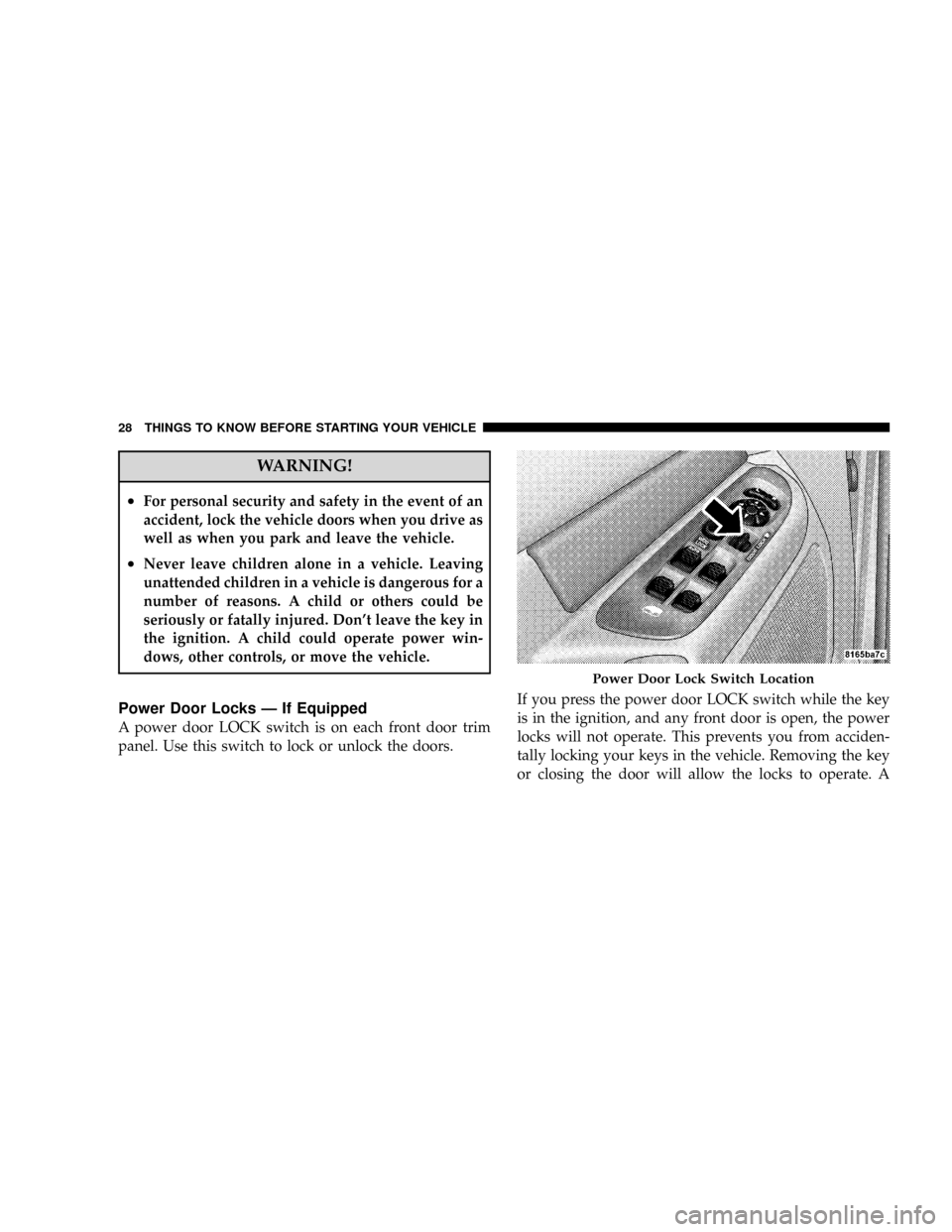
Power Door Locks Ð If Equipped
A power door LOCK switch is on each front door trim
panel. Use this switch to lock or unlock the doors.If you press the power door LOCK switch while the key
is in the ignition, and any front door is open, the power
locks will not operate. This prevents you from acciden-
tally locking your keys in the vehicle. Removing the key
or closing the door will allow the locks to operate. A
Power Door Lock Switch Location
28 THINGS TO KNOW BEFORE STARTING YOUR VEHICLE
Page 52 of 554
Here are some simple steps you can follow to minimize
the risk of harm from a deploying airbag.
1. Children 12 years and under should always ride
buckled up in a rear seat in an appropriate child restraint.
Infants in rear-facing child restraints shouldNEVERride
in the front seat of a vehicle with a passenger front airbag,
unless the airbag is turned off(2500/3500 Regular Cab
Vehicles Only). An airbag deployment can cause severe
injury or death to infants in that position. See the
Passenger Airbag ON/OFF Switch section.
You should read the instructions provided with your
child restraint to make sure that you are using it properly.2. If your vehicle does not have a rear seat, see the
Passenger Airbag ON/OFF Switch section.
3. Children that are not big enough to properly wear the
vehicle seat belt (see section on Child Restraints) should
be secured in the rear seat in child restraints or belt-
positioning booster seats. Older children who do not use
child restraints or belt-positioning booster seats, should
ride properly buckled up in the rear seat. Never allow
children to slide the shoulder belt behind them or under
their arm.
4. All occupants should use their lap and shoulder belts
properly.
50 THINGS TO KNOW BEFORE STARTING YOUR VEHICLE
Page 64 of 554
²Brake status (service and parking brakes)
²Accelerator status (including vehicle speed)
²Engine control status (including engine speed)
²Transmission gear selection
²Cruise control status
²Traction/stability control status
²Tire pressure monitoring system (TPMS) status (if
equipped)
Child Restraint
Everyone in your vehicle needs to be buckled up all the
time Ð babies and children, too. Every state in the United
States and all Canadian provinces require that small
children ride in proper restraint systems. This is the law,
and you can be prosecuted for ignoring it.Children 12 years and younger should ride properly
buckled up in a rear seat, if available. According to crash
statistics, children are safer when properly restrained in
the rear seats rather than in the front.
WARNING!
In a collision, an unrestrained child, even a tiny baby,
can become a missile inside the vehicle. The force
required to hold even an infant on your lap can
become so great that you could not hold the child, no
matter how strong you are. The child and others
could be badly injured. Any child riding in your
vehicle should be in a proper restraint for the child's
size.
62 THINGS TO KNOW BEFORE STARTING YOUR VEHICLE
Page 68 of 554
²If the belt still can't be tightened, or if pulling and
pushing on the restraint loosens the belt, disconnect
the latch plate from the buckle, turn the latch plate
around, and insert the latch plate into the buckle
again. If you still can't make the child restraint secure,
try a different seating position.
²Buckle the child into the seat according to the child
restraint manufacturer's directions.
²When your child restraint is not in use, secure it in the
vehicle with the seat belt or remove it from the vehicle.
Do not leave it loose in the vehicle. In a sudden stop or
collision, it could strike the occupants or seatbacks and
cause serious personal injury.
WARNING!
Improper installation can lead to failure of an infant
or child restraint. It could come loose in a collision.
The child could be badly injured or killed. Follow
the manufacturer's directions exactly when installing
an infant or child restraint.
Lower Anchors and Tether for CHildren (LATCH)
Each vehicle is equipped with the child restraint anchor-
age system called LATCH, which stands for Lower
Anchors and Tether for CHildren. LATCH child restraint
anchorage systems are installed in the 2500/3500 Regular
Cab passenger seat position and the Quad Cabtrear seat
outboard positions. LATCH-equipped seating positions
feature both lower anchor bars, located at the back of the
66 THINGS TO KNOW BEFORE STARTING YOUR VEHICLE
Page 73 of 554
WARNING!
Improper installation of a child restraint to the
LATCH anchorages can lead to failure of an infant or
child restraint. The child could be badly injured or
killed. Follow the manufacturer's directions exactly
when installing an infant or child restraint.
Child Restraint Tether Anchor
Child restraints having tether straps and hooks for con-
nection to tether anchors have been available for some
time. In fact, many child restraint manufacturers will
provide add-on tether strap kits for their older products.
Regular Cab models of Ram Pickups have two tether
anchorages, one each behind the front center and right
seats. Quad Cabtmodels have three anchorages, one
behind each of the rear seats.
WARNING!
An incorrectly anchored tether strap could lead to
seat failure and injury to the child. In a collision, the
seat could come loose and allow the child to crash
into the inside of the vehicle or other passengers, or
even be thrown from the vehicle. Use only the anchor
positions directly behind the child seat to secure a
child restraint top tether strap. Follow the instruc-
tions below. See your authorized dealer for help, if
necessary.
Tether Anchorage Points at the Right and Center
Front Seat (Regular Cab - All Seats)
1. Place the child restraint on the seat and adjust the
tether strap so that it will reach over the seatback under
the head restraint to the tether anchor directly behind the
seat.
THINGS TO KNOW BEFORE STARTING YOUR VEHICLE 71
2
Page 78 of 554
²The lap portion should be low on the hips and as snug
as possible.
²Check belt fit periodically. A child's squirming or
slouching can move the belt out of position.
If the shoulder belt contacts the face or neck, move the
child closer to the center of the vehicle. Never allow a
child to put the shoulder belt under an arm or behind
their back.
Transporting Pets
Airbags deploying in the front seat could harm your pet.
An unrestrained pet will be thrown about and possibly
injured, or injure a passenger during panic braking or in
a collision. Pets should be restrained in the rear seat in
pet harnesses or pet carriers that are secured by seat belts.
ENGINE BREAK-IN RECOMMENDATIONS
A long break-in period is not required for the engine in
your new vehicle. Drive moderately during the first 300
miles (500 km). After the initial 60 mi (100 km), speeds up
to 50 or 55 mph (80 or 90 km/h) are desirable. While
cruising, brief full-throttle acceleration, within the limits
of local traffic laws, contributes to a good break-in.
Avoid wide-open throttle acceleration in low gear.
The engine oil installed in the engine at the factory is a
high-quality, energy-conserving type lubricant. Oil
changes should be consistent with the anticipated cli-
matic conditions under which vehicle operation will
occur. The recommended viscosity and quality grades are
discussed in Section 7 under Maintenance Procedures,
Engine Oil.
NON-DETERGENT OR STRAIGHT MINERAL OILS
MUST NEVER BE USED.
76 THINGS TO KNOW BEFORE STARTING YOUR VEHICLE
Page 86 of 554
NAutomatic Compass Calibration...........154
NManual Compass Calibration.............154
NRecalibrating The Compass..............154
NOutside Temperature...................156
mGarage Door Opener Ð If Equipped.........156
NProgramming HomeLinkt...............158
NGate Operator/Canadian Programming.....161
NUsing HomeLinkt.....................162
NReprogramming A Single HomeLinktButton . 162
NSecurity............................162
NTroubleshooting Tips...................162
NGeneral Information...................163mPower Sunroof Ð If Equipped.............163
NOpen Sunroof - Express Mode............164
NClosing Sunroof - Express...............164
NPinch Protect Feature...................165
NPinch Protect Override.................165
NVenting Sunroof - Express...............165
NSunshade Operation...................165
NWind Buffeting.......................166
NSunroof Maintenance...................166
NSunroof Fully Closed...................166
mElectrical Power Outlets..................166
mCigar Lighter And Ash Receiver............168
84 UNDERSTANDING THE FEATURES OF YOUR VEHICLE
Page 130 of 554
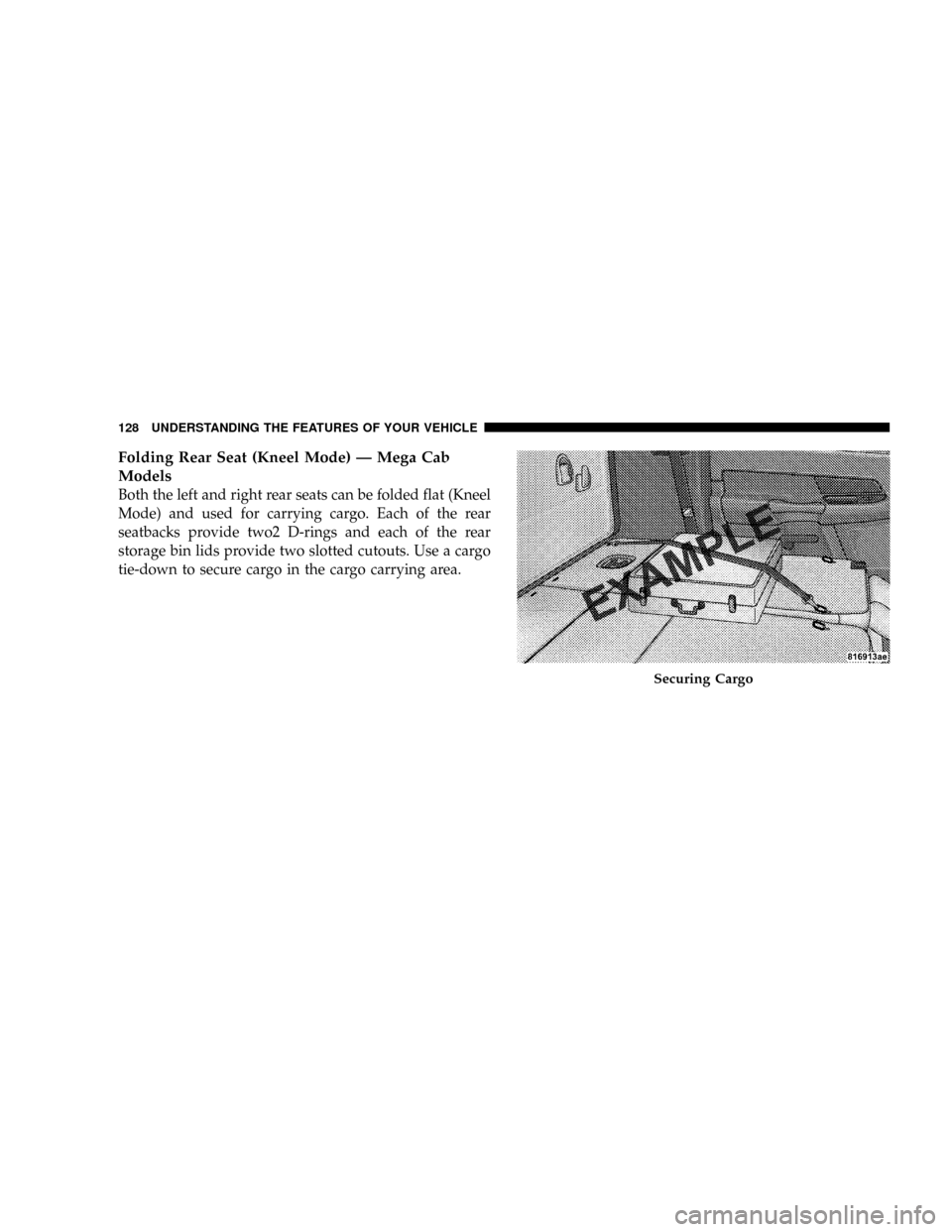
Folding Rear Seat (Kneel Mode) Ð Mega Cab
Models
Both the left and right rear seats can be folded flat (Kneel
Mode) and used for carrying cargo. Each of the rear
seatbacks provide two2 D-rings and each of the rear
storage bin lids provide two slotted cutouts. Use a cargo
tie-down to secure cargo in the cargo carrying area.
Securing Cargo
128 UNDERSTANDING THE FEATURES OF YOUR VEHICLE
Page 131 of 554
WARNING!
²It is extremely dangerous to ride in a cargo area,
inside or outside of a vehicle. In a collision, people
riding in these areas are more likely to be seri-
ously injured or killed.
²Do not allow people to ride in any area of your
vehicle that is not equipped with seats and seat
belts.
²Be sure everyone in your vehicle is in a seat and
using a seat belt properly.
WARNING!
Cargo must be securely tied down before driving
your vehicle. Improperly secured cargo can fly
around in a sudden stop and strike someone in the
vehicle, causing serious injury or possible death.
Secure cargo with a cargo tie-down using the
D-Rings provided on the back of the seats and the
slotted cutouts in the rear storage bin lid.
NOTE:The rear seat will drop and move forward in
Kneel Mode.
UNDERSTANDING THE FEATURES OF YOUR VEHICLE 129
3
Page 133 of 554
WARNING!
Be certain that the seatback is securely locked into
position. If the seatback in not securely locked into
position the seat will not provide the proper stability
for child seats and/or passengers. An improperly
latched seat could cause serious injury.
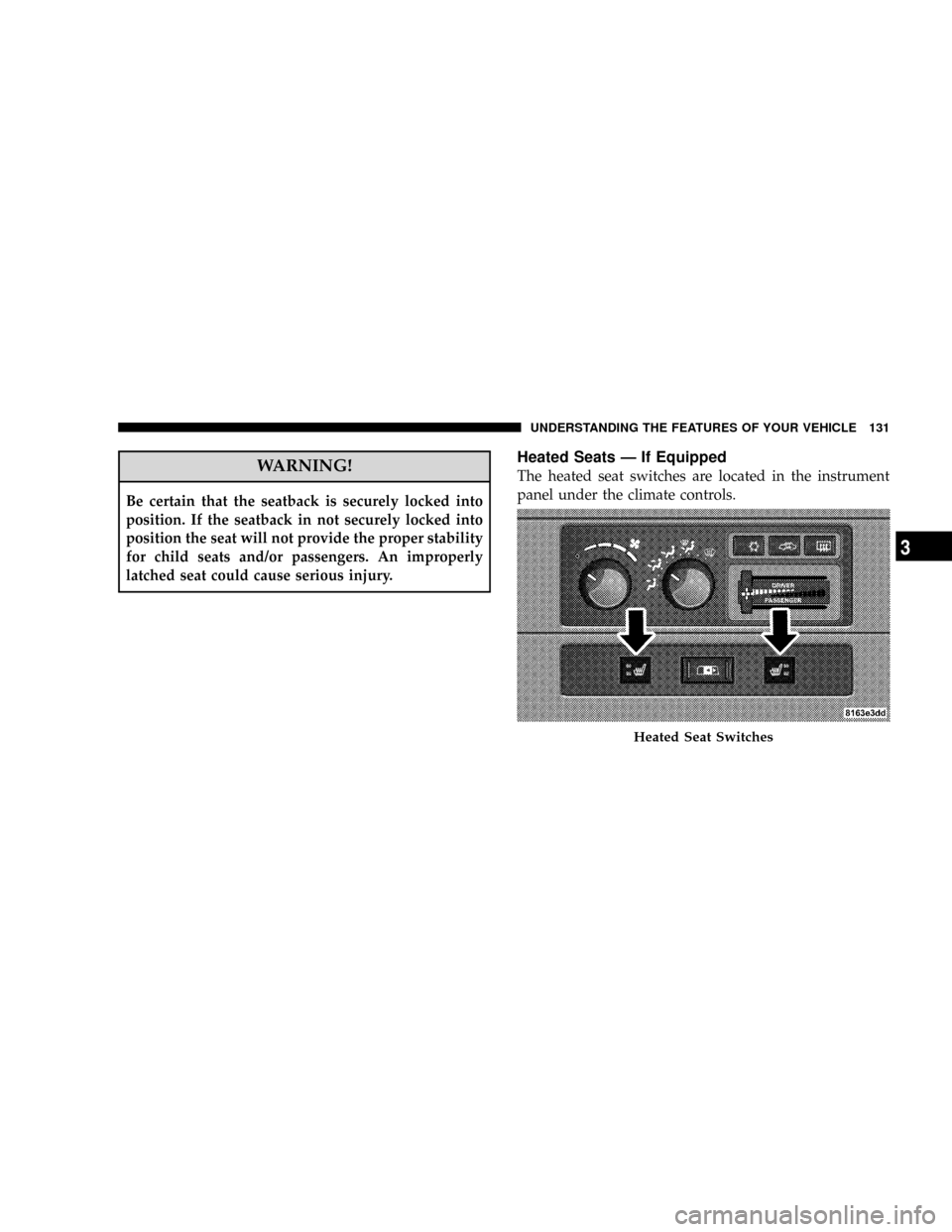
Heated Seats Ð If Equipped
The heated seat switches are located in the instrument
panel under the climate controls.
Heated Seat Switches
UNDERSTANDING THE FEATURES OF YOUR VEHICLE 131
3