engine DODGE RAM 3500 DIESEL 2008 3.G Owners Manual
[x] Cancel search | Manufacturer: DODGE, Model Year: 2008, Model line: RAM 3500 DIESEL, Model: DODGE RAM 3500 DIESEL 2008 3.GPages: 527, PDF Size: 8.88 MB
Page 443 of 527
The radiator normally remains completely full, so there is
no need to remove the radiator cap unless checking for
coolant freeze point or replacing coolant. Advise your
service attendant of this. As long as the engine operating
temperature is satisfactory, the coolant bottle need only
be checked once a month.
When additional coolant is needed to maintain the
proper level, it should be added to the coolant bottle. Do
not overfill.
Points To Remember
NOTE:When the vehicle is stopped after a few miles (a
few kilometers) of operation, you may observe vapor
coming from the front of the engine compartment. This is
normally a result of moisture from rain, snow, or high
humidity accumulating on the radiator and being vapor-
ized when the thermostat opens, allowing hot coolant to
enter the radiator.If an examination of your engine compartment shows no
evidence of radiator or hose leaks, the vehicle may be
safely driven. The vapor will soon dissipate.
²Do not overfill the coolant recovery bottle.
²Check coolant freeze point in the radiator and in the
coolant recovery bottle. If antifreeze needs to be
added, contents of coolant recovery bottle must also be
protected against freezing.
²If frequent coolant additions are required, or if the
level in the coolant recovery bottle does not drop when
the engine cools, the cooling system should be pres-
sure tested for leaks.
²Maintain coolant concentration at 50% HOAT engine
coolant (minimum) and distilled water for proper
corrosion protection of your engine which contains
aluminum components.
MAINTAINING YOUR VEHICLE 441
7
Page 444 of 527
²Make sure that the radiator and coolant recovery
bottle overflow hoses are not kinked or obstructed.
²Keep the front of the radiator clean. If your vehicle is
equipped with air conditioning, keep the front of the
condenser clean also.
²Do not change the thermostat for summer or winter
operation. If replacement is ever necessary, install
ONLY the correct type thermostat. Other designs may
result in unsatisfactory coolant performance, poor gas
mileage, and increased emissions.
Fan
Inspection
Check the fan for cracks and bent or broken blades. If any
of these conditions exist, you must replace the fan. Make
sure it is securely mounted.NOTE:This service procedure must be performed by a
trained service technician. Make arrangements with your
authorized dealer for this inspection.
Charge Air Cooler (Inter-Cooler)
The charge air cooler is positioned between the radiator
and the air conditioner condenser. Air enters the engine
through the air cleaner and passes through the turbo-
charger where it is pressurized. This pressurized air
rapidly reaches high temperature. The air is then directed
through a hose to the charge air cooler and through
another hose to the intake manifold of the engine. The air
entering the engine has been cooled by about 50 to 100
degrees Fahrenheit. This cooling process enables more
efficient burning of fuel resulting in fewer emissions.
442 MAINTAINING YOUR VEHICLE
Page 445 of 527
To guarantee optimum performance of the system, keep
the surfaces of the charge air cooler, condenser and
radiator clean and free of debris. Periodically check the
hoses leading to and from the charge air cooler for cracks
or loose clamps resulting in loss of pressure and reduced
engine performance.
Hoses And Vacuum/Vapor Harnesses
Inspect surfaces of hoses and nylon tubing for evidence
of heat and mechanical damage. Hard or soft spots,
brittle rubber, cracking, tears, cuts, abrasions, and exces-
sive swelling indicate deterioration of the rubber.
Pay particular attention to those hoses nearest to high
heat sources such as the exhaust manifold. Inspect hose
routing to be sure hoses do not come in contact with any
heat source or moving component that may cause heat
damage or mechanical wear.Insure nylon tubing in these areas has not melted or
collapsed.
Inspect all hose connections such as clamps and cou-
plings to make sure they are secure and no leaks are
present.
Components should be replaced immediately if there is
any evidence of wear or damage that could cause failure.
Brake System
Power Disc Brakes (Front and Rear)
Disc brakes do not require adjustment; however, several
hard stops during the break-in period are recommended
to seat the linings and wear off any foreign material.
MAINTAINING YOUR VEHICLE 443
7
Page 447 of 527
WARNING!
Overfilling the brake fluid reservoir can result in
spilling brake fluid on hot engine parts and the
brake fluid catching fire.
Use only brake fluid that has been in a tightly closed
container to avoid contamination from foreign matter or
moisture.
CAUTION!
Do not allow a petroleum-base fluid to contaminate
the brake fluid. Seal damage and loss of brake
performance may result.
Brake Hoses
Inspection should be performed whenever the brake
system is serviced or at intervals specified. Inspect hy-
draulic brake hoses for surface cracking, scuffing or worn
spots. If there is any evidence of cracking, scuffing, or
worn spots, the hose should be replaced immediately!
Eventual deterioration of the hose can take place with
possible burst failure.
Clutch Linkage
If the clutch pedal linkage begins to squeak or grunt, the
clutch pedal pivot bushings should be lubricated. Refer
to Fluids, Lubricants and Genuine Parts for the correct
lubricant type. Multipurpose Grease, NLGI Grade 2 E.P.
Clutch Hydraulic System
The clutch hydraulic system is a sealed maintenance-free
system. In the event of leakage or other malfunction, the
system must be replaced.
MAINTAINING YOUR VEHICLE 445
7
Page 450 of 527
CAUTION!
Using a transmission fluid other than the manufac-
turers recommended fluid may cause deterioration in
transmission shift quality and/or torque converter
shudder. Using a transmission fluid other than the
manufacturers recommended fluid will result in
more frequent fluid and filter changes. Refer to
Fluids, Lubricants and Genuine Parts for correct
fluid type.
Fluid Level Check
If equipped with a dipstick, use the following procedure.
If your vehicle has a capped dipstick tube, it is sealed and
should not be tampered with. Your authorized dealer has
the proper tools to ensure that the fluid level is set
properly. The fluid level should be checked when theengine is fully warmed up and the fluid in the transmis-
sion is at normal operating temperature. Operation of the
transmission with an improper fluid level will greatly
reduce the life of the transmission and of the fluid. Check
the fluid level whenever the vehicle is serviced.
Procedure For Checking Fluid Level
To properly check the automatic transmission fluid level,
the following procedure must be used:
1. Operate the engine at idle speed and normal operating
temperature.
2. The vehicle must be on level ground.
3. Fully apply the parking brake and press the brake
pedal.
4. Place the gear selector momentarily in each gear
position ending with the lever in PARK.
448 MAINTAINING YOUR VEHICLE
Page 452 of 527
Automatic Transmission Fluid and Filter Change
To obtain best performance and long life for automatic
transmissions, the manufacturer recommends that they
be given regular maintenance service by an authorized
dealer or Service Center. It is important that the trans-
mission fluid is maintained at the correct level, and that
it is drained and refilled as specified.
Use only manufacturer 's recommended transmission
fluid; for correct fluid type, refer to ªAutomatic Trans-
missionº under ªFluids, Lubricants and Genuine Partsº
in this section. It is important that the transmission fluid
be maintained at the prescribed level using the recom-
mended fluid..
The fluid and filter(s) should be changed as specified in
the Maintenance Schedule (Section 8).
NOTE:If the transmission is disassembled for any
reason, the fluid and filter should be changed.
Special Additives
Automatic Transmission Fluid (ATF) is an engineered
product and its performance may be impaired by supple-
mental additives. Therefore, do not add any fluid addi-
tives to the transmission. The only exception to this
policy is the use of special dyes to aid in detecting fluid
leaks. In addition, avoid using transmission sealers as
they may adversely affect seals.
Front Wheel Bearings
Front wheel bearings for your vehicle are sealed-for-life.
They do not require greasing or seal replacement. In
some instances, these bearings will ªpurgeº excess grease
and the bearing housing will look slightly wet. This is
normal.
²Periodic inspection for excess play is recommended.
²If a bearing assembly is accidentally separated when
servicing the brake rotors, it should be replaced.
450 MAINTAINING YOUR VEHICLE
Page 455 of 527
Among those acts presumed to constitute tampering are
the acts listed below.
²AIR CLEANER
þRemoval of the air cleaner.
þRemoval of the air cleaner filter element from the air
cleaner housing.
þRemoval of the air ducting.
²EXHAUST SYSTEM
þRemoval or rendering inoperative exhaust system
components, including the muffler or tailpipe.
²ENGINE COOLING SYSTEM
þRemoval or rendering inoperative the fan clutch.
þRemoval of the fan shroud.
Noise Emission Warranty
The manufacturer warrants that this vehicle as manufac-
tured by the manufacturer, was designed, built and
equipped to conform at the time it left the manufacturer's
control with all applicable U.S. EPA Noise Control Regu-
lations.
This warranty covers this vehicle as designed, built and
equipped by the manufacturer, and is not limited to any
particular part, component or system of the vehicle
manufactured by the manufacturer. Defects in design,
assembly or in any part, component or system of the
vehicle as manufactured by the manufacturer, which, at
the time it left the manufacturer's control, caused noise
emissions to exceed Federal standards, are covered by
this warranty for the life of the vehicle.
MAINTAINING YOUR VEHICLE 453
7
Page 456 of 527
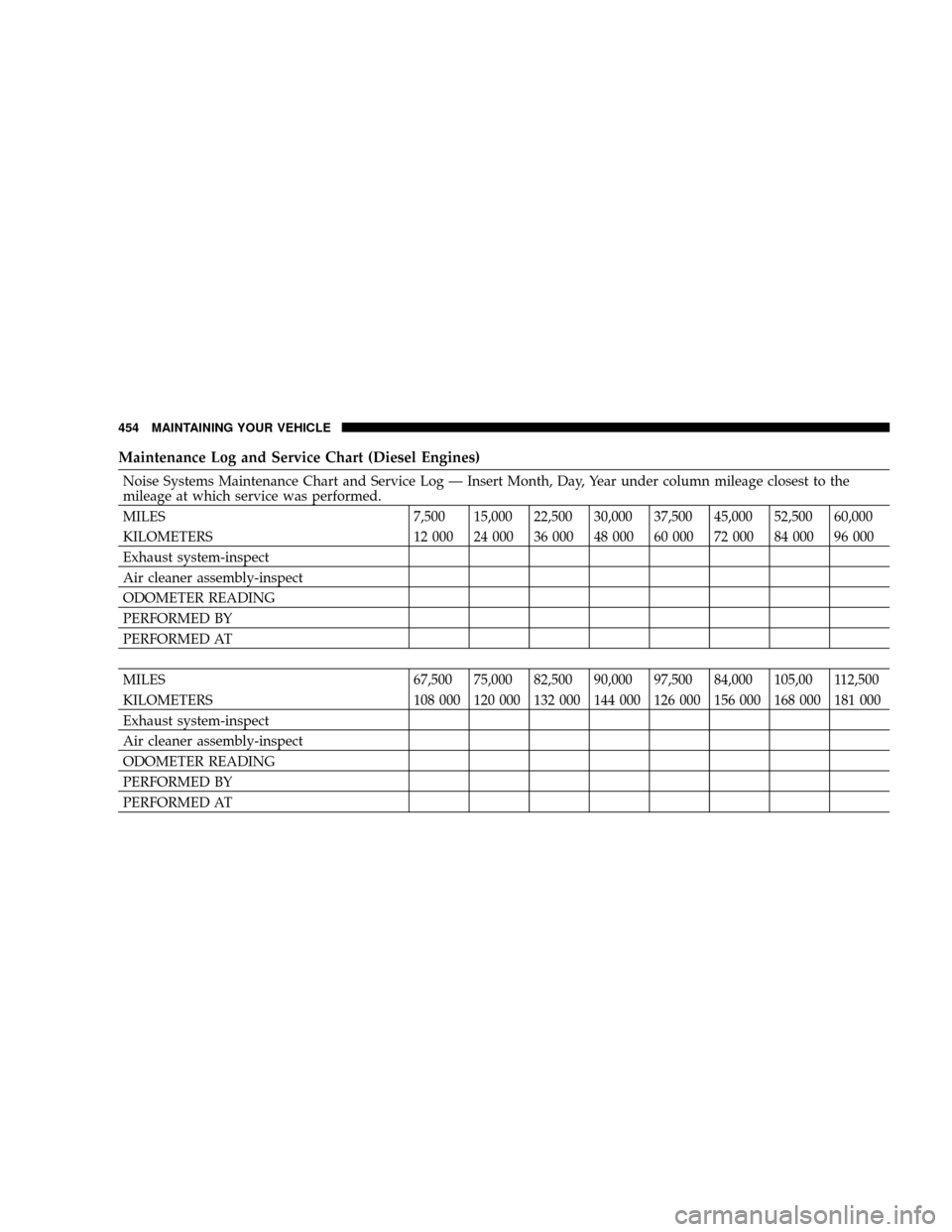
Maintenance Log and Service Chart (Diesel Engines)
Noise Systems Maintenance Chart and Service Log Ð Insert Month, Day, Year under column mileage closest to the
mileage at which service was performed.
MILES 7,500 15,000 22,500 30,000 37,500 45,000 52,500 60,000
KILOMETERS 12 000 24 000 36 000 48 000 60 000 72 000 84 000 96 000
Exhaust system-inspect
Air cleaner assembly-inspect
ODOMETER READING
PERFORMED BY
PERFORMED AT
MILES 67,500 75,000 82,500 90,000 97,500 84,000 105,00 112,500
KILOMETERS 108 000 120 000 132 000 144 000 126 000 156 000 168 000 181 000
Exhaust system-inspect
Air cleaner assembly-inspect
ODOMETER READING
PERFORMED BY
PERFORMED AT
454 MAINTAINING YOUR VEHICLE
Page 461 of 527
1. Clean with a wet soft rag. A mild soap solution may be
used, but do not use high alcohol content or abrasive
cleaners. If soap is used, wipe clean with a clean damp
rag.
2. Dry with a soft tissue.
Seat Belt Maintenance
Do not bleach, dye or clean the belts with chemical
solvents or abrasive cleaners. This will weaken the fabric.
Sun damage can also weaken the fabric.
If the belts need cleaning, use a mild soap solution or
lukewarm water. Do not remove the belts from the car to
wash them.
Replace the belts if they appear frayed or worn or if the
buckles do not work properly.
Dry with a soft tissue.
FUSES (INTEGRATED POWER MODULE)
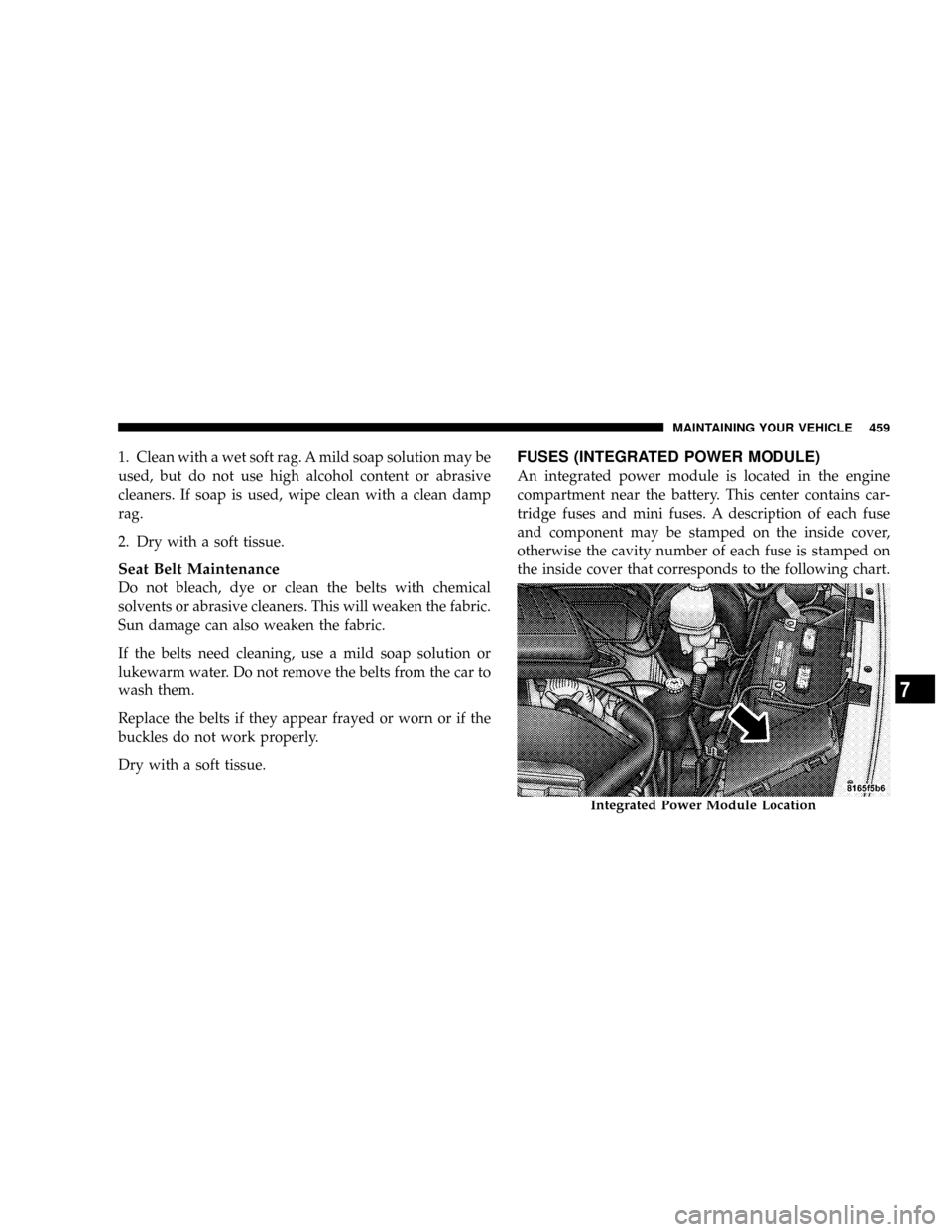
An integrated power module is located in the engine
compartment near the battery. This center contains car-
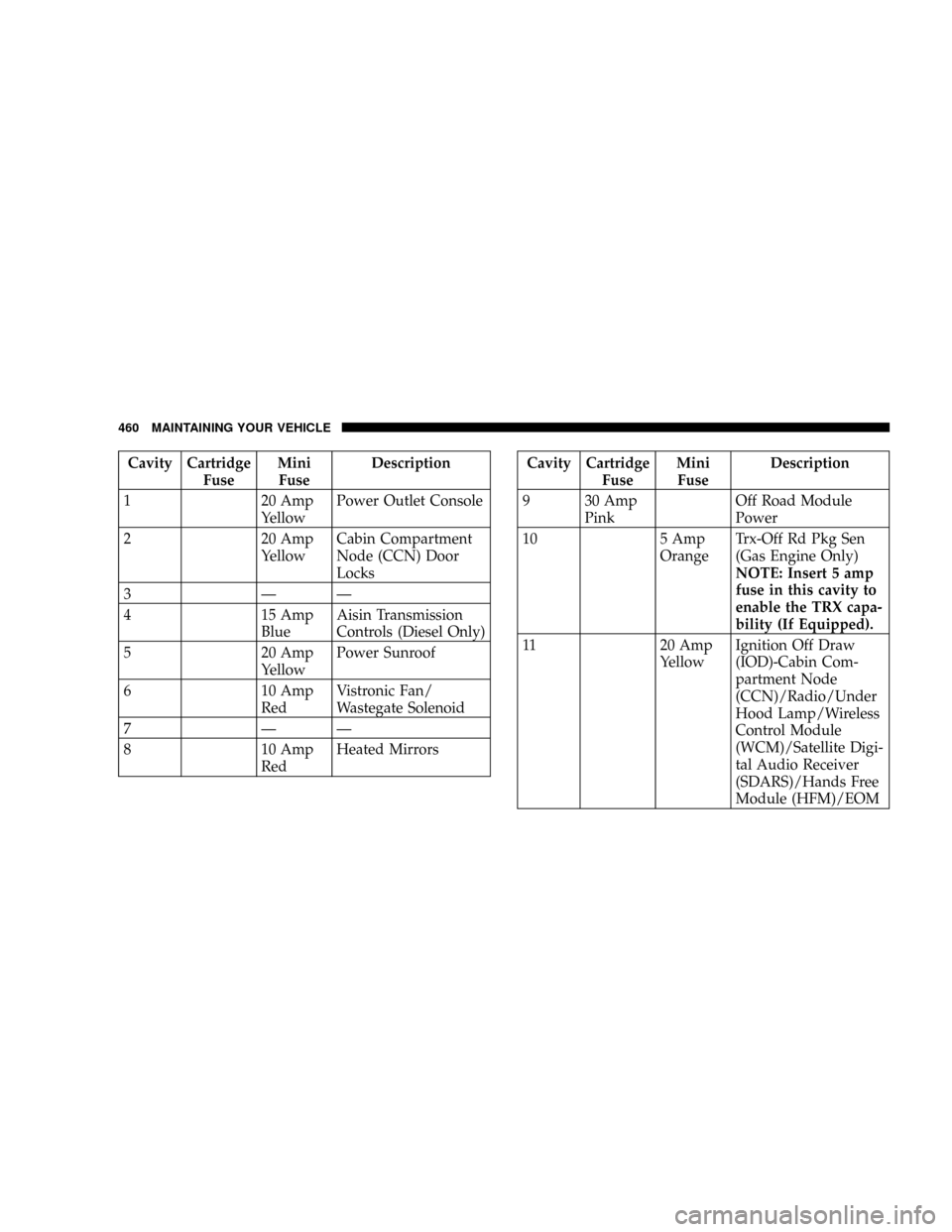
tridge fuses and mini fuses. A description of each fuse
and component may be stamped on the inside cover,
otherwise the cavity number of each fuse is stamped on
the inside cover that corresponds to the following chart.
Integrated Power Module Location
MAINTAINING YOUR VEHICLE 459
7
Page 462 of 527
Cavity Cartridge
FuseMini
FuseDescription
1 20 Amp
YellowPower Outlet Console
2 20 Amp
YellowCabin Compartment
Node (CCN) Door
Locks
3ÐÐ
4 15 Amp
BlueAisin Transmission
Controls (Diesel Only)
5 20 Amp
YellowPower Sunroof
6 10 Amp
RedVistronic Fan/
Wastegate Solenoid
7ÐÐ
8 10 Amp
RedHeated MirrorsCavity Cartridge
FuseMini
FuseDescription
9 30 Amp
PinkOff Road Module
Power
10 5 Amp
OrangeTrx-Off Rd Pkg Sen
(Gas Engine Only)
NOTE: Insert 5 amp
fuse in this cavity to
enable the TRX capa-
bility (If Equipped).
11 20 Amp
YellowIgnition Off Draw
(IOD)-Cabin Com-
partment Node
(CCN)/Radio/Under
Hood Lamp/Wireless
Control Module
(WCM)/Satellite Digi-
tal Audio Receiver
(SDARS)/Hands Free
Module (HFM)/EOM
460 MAINTAINING YOUR VEHICLE