engine oil DODGE RAM 3500 DIESEL 2008 3.G Owner's Manual
[x] Cancel search | Manufacturer: DODGE, Model Year: 2008, Model line: RAM 3500 DIESEL, Model: DODGE RAM 3500 DIESEL 2008 3.GPages: 527, PDF Size: 8.88 MB
Page 407 of 527
MAINTAINING YOUR VEHICLE
CONTENTS
mEngine Compartment Ð 6.7L Diesel Engine....408
mOnboard Diagnostic System (OBD II).........409
mReplacement Parts......................409
mEngine Data Plate......................410
mAuthorized Dealer Service................410
mService Information.....................410
mMaintenance Procedures..................412
NEngine Oil..........................413
NDrive Belt...........................418NEngine Air Cleaner Filter (6.7L Diesel
Engines)............................419
NDraining Fuel/Water Separator Filter (6.7L
Diesel Engine).......................422
NIntervention Regeneration Strategy ± EVIC
Message Process Flow (Catalyst Full Message)
(6.7L Diesel Engines Only)...............425
NMaintenance Free Batteries...............428
NAir Conditioner Maintenance.............430
NPower Steering Ð Fluid Check............431
7
Page 414 of 527
WARNING!
To maintain your vehicle safely and avoid personal injury, follow these
guidelines:
²Never spray or pour diesel fuel, flammable liquid or starting fluids
(ether) into the air cleaner assembly, air intake piping or turbocharger
inlet in an attempt to start the vehicle, unintended engine acceleration
may occur.
²Do not use alcohol or gasoline as a fuel blending agent. They can be
unstable under certain conditions and be hazardous or explosive
when mixed with diesel fuel.
²If an engine has been operating and the coolant is hot, allow the
engine to cool before you slowly loosen the filler cap and relieve the
pressure from the cooling system.
²To avoid burns, remember that the engine components will stay hot
after the engine is shut off.
²Do not use gasoline or other flammable materials to clean parts.
Always use approved cleaning solvents.
²Relieve all pressure in the fuel, oil and cooling systems before any
lines, fittings or related items are removed or disconnected. Be alert
for possible pressure when disconnecting any device from a system
that utilizes pressure. Do not check for pressure leaks with your hand.
High pressure oil or fuel can cause personal injury.
²Important: All maintenance other than that listed in this manual, as
well as some procedures listed here, MUST be performed by your
authorized dealer. Your authorized dealer has been trained and has
the necessary parts to maintain your engine.
WARNING!
Do not open the high pressure fuel system with the
engine running. Engine operation causes high fuel
pressure. High pressure fuel spray can cause serious
injury or death.
MAINTENANCE PROCEDURES
The pages that follow contain therequiredmaintenance
services determined by the engineers who designed your
vehicle.
Besides the maintenance items for which there are fixed
maintenance intervals, there are other items that should
operate satisfactorily without periodic maintenance.
However, if a malfunction of these items does occur, it
could adversely affect the engine or vehicle performance.
These items should be inspected if a malfunction is
observed or suspected.
412 MAINTAINING YOUR VEHICLE
Page 415 of 527
Engine Oil
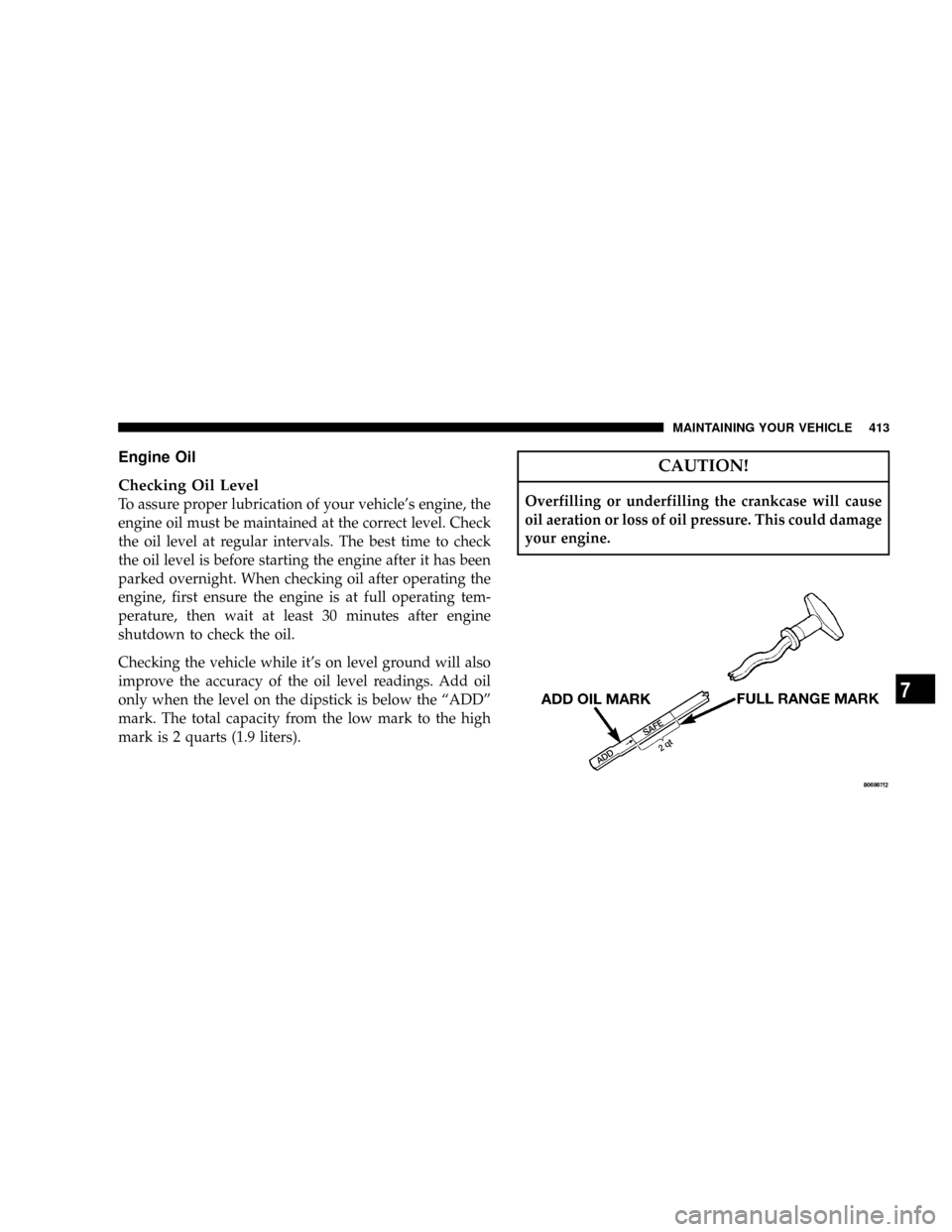
Checking Oil Level
To assure proper lubrication of your vehicle's engine, the
engine oil must be maintained at the correct level. Check
the oil level at regular intervals. The best time to check
the oil level is before starting the engine after it has been
parked overnight. When checking oil after operating the
engine, first ensure the engine is at full operating tem-
perature, then wait at least 30 minutes after engine
shutdown to check the oil.
Checking the vehicle while it's on level ground will also
improve the accuracy of the oil level readings. Add oil
only when the level on the dipstick is below the ªADDº
mark. The total capacity from the low mark to the high
mark is 2 quarts (1.9 liters).
CAUTION!
Overfilling or underfilling the crankcase will cause
oil aeration or loss of oil pressure. This could damage
your engine.
MAINTAINING YOUR VEHICLE 413
7
Page 416 of 527

Never operate the engine with oil level below the ªADDº
mark or above the upper ªSAFEº mark.
Change Engine Oil (6.7L Diesel Engine)
Follow the 6.7L Diesel Maintenance Schedule for recom-
mended engine oil change intervals.
Engine Oil Selection (6.7L Diesel Engines)
For best performance and maximum protection under all
types of operating conditions, the manufacturer only
recommends engine oils that are API CJ-4 certified and
meet the requirements of DaimlerChrysler. Use Mopart
or an equivalent oil meeting DaimlerChrysler Material
Standards MS-10902. Products meeting CumminstCES
20081 may also be used. The identification of these
engine oils are typically located on the back of the oil
container.
American Petroleum Institute (API) Engine Oil
Identification Symbol
This symbol means that the oil has
been certified by the American Petro-
leum Institute (API). The manufacture
only recommends API CJ-4 certified
engine oils.
Oils with a high ash content may produce deposits on
valves that can progress to guttering and valve burning.
A maximum sulfated ash content of 1.00 mass % is
recommended for all oil used in the engine.
The same oil change interval is to be followed for
synthetic oil as for petroleum based oil. Also, synthetic oil
must meet the same performance specifications as petro-
leum oil.
414 MAINTAINING YOUR VEHICLE
Page 417 of 527

Engine Oil Viscosity (SAE Grade)
Use SAE 15W-40 Engine Oil that meets
DaimlerChrysler Materials Standard MS-10902 and the
API CJ-4 engine oil category.
Engine oil not designated by the DaimlerChrysler or
CumminstMaterial Standards and API CJ-4 should not
be used, engine and exhaust system durability may be
compromised. For lower temperature operation SAE
5W-40 engine oils may be used. These oils must meet the
same requirements as stated previously. The engine oil
filler cap also shows the recommended engine oil viscos-
ity for your engine. For information on engine oil filler
cap location, refer to the ªEngine Compartmentº illustra-
tion in this section.
Synthetic Engine Oils
You may use synthetic engine oils provided the recom-
mended oil quality requirements are met, and the recom-
mended maintenance intervals for oil and filter changes
are followed.
Materials Added to Engine Oil
The manufacturer strongly recommends against the ad-
dition of any additives (other than leak detection dyes or
lube odorants) to the engine oil. Engine oil is an engi-
neered product and it's performance may be impaired by
supplemental additives.
NOTE:The manufacturer offers a lube odorant (Mopart
Diesel Fresh) for diesel engines crankcases. The lube
odorant is recommended by the manufacturer to reduce
the sulfur smell that may occur during engine idling.
MAINTAINING YOUR VEHICLE 415
7
Page 418 of 527
Engine Oil Filter
Refer to Fluids, Lubricants and Genuine Parts for the
correct part number. The engine oil filter should be
changed ateveryengine oil change.
Engine Oil And Filter Ð Change
Operate the engine until the coolant temperature reaches
140ÉF (60ÉC). Shut the engine OFF. Remove the oil drain
plug.
Use a container that can hold at least 12 quarts (11.3
Liters) to hold the used oil.
Always check the condition of the used oil. This can give
you an indication of some engine problems that might
exist.
²Thin, black oil indicates fuel dilution.
²Milky discoloration indicates coolant dilution.Clean the area around the oil filter base. Remove the filter
from the underside of the vehicle using a cap style oil
filter wrench.
Clean the gasket surface of the filter mount. The filter
gasket can stick on the filter mount. Make sure it is
removed.
Change the engine oil filter with every engine oil change.
Only a high quality Mopartfilter should be used to
assure most efficient service.
CAUTION!
The filtering medium of other aftermarket filters
may disintegrate. Debris from failed filters may plug
the piston oil cooling nozzles, resulting in scuffed
pistons and engine failure.
416 MAINTAINING YOUR VEHICLE
Page 419 of 527

CAUTION!
Fill the oil filter element with clean oil before instal-
lation. Use the same type oil that will be used in the
engine. When filling the oil filter, prevent foreign
material from falling into the filter. Severe engine
damage may occur.
Apply a light film of lubricating oil to the sealing surface
of the filter gasket before installing the filter.
CAUTION!
Overtightening may distort the threads or damage
the filter element seal.Install the filter as specified by the filter manufacturer.
Turn the filter 3/4 to one full turn after making contact
with the gasket.
Check the condition of the threads and sealing surface on
the oil pan and drain plug.
Install the drain plug and sealing washer and tighten to
37 ft-lbs. (50 N´m).
Use only high-quality multi-grade lubricating oil in your
CumminstDiesel Engine. Choose the correct oil for your
operating conditions as outlined in the Selection of
Engine Oil.
CumminstTurbo Diesel
Fill the engine with the correct grade of new oil. The
engine capacity is 11 quarts (10.4 liters) in the crankcase
and 1 quart (.95 liter) in the lubricating oil filter.
MAINTAINING YOUR VEHICLE 417
7
Page 420 of 527

Start the engine and operate it at idle for several minutes.
Check for leaks at the lubricating oil filter and oil pan
drain plug.
Run the engine until it has reached operating tempera-
ture, stop the engine. Wait approximately 15 minutes to
let the oil in the upper parts of the engine drain back to
the pan. Check the oil level again.
Add oil as necessary to bring the level to the ªSAFEº
mark on the dipstick.
Disposing Of Used Engine Oil And Filter
Care should be taken in disposing of used engine oil and
oil filters from your vehicle. Used oil and oil filters,
indiscriminately discarded, can present a problem to the
environment. Contact your authorized dealer, service
station, or governmental agency for advice on how and
where used oil and oil filters can be safely discarded in
your area.
Drive Belt
Inspection
Check the belt for intersecting cracks.
²Transverse (across the belt width) cracks are accept-
able.
²Longitudinal (direction of belt length) cracks that
intersect with transverse cracks are NOT acceptable.
Replace the belt if it has unacceptable cracks, is frayed or
has pieces of material missing.
The engine speed sensor, located near the damper, should
be inspected for damage if a belt is frayed.
418 MAINTAINING YOUR VEHICLE
Page 422 of 527

If the vehicle experiences a sudden loss of engine power
when being driven in heavy snow, rain or when plowing
snow, and the EVIC message center states SERVICE AIR
FILTER or the Filter MinderŸ (if equipped) is showing a
plugged filter, then visually inspect the air filter for
snow/ice build up or extreme water saturation. If the air
filter is not damaged, remove all snow/ice and reinstall
air filter. If the air filter is damaged, replace filter element.
NOTE:The air filter housing contains a Mass Air Flow
sensor. This sensor is critical to proper engine operation
and component longevity. Any damage or modification
to this sensor could result in major engine and/or
exhaust aftertreatment damage. This includes the use of
non-approved air filters. Use only Mopartapproved air
filters or equivalent.A visual inspection of the air cleaner filter element is
never recommended under normal circumstances. A
badly restricted element may appear clean while a soiled
element may be quite effective in filtering particles
without restricting air flow. Rely on the Engine Control
Module or the Filter MinderŸ (if equipped), to deter-
mine when a filter change is necessary.
420 MAINTAINING YOUR VEHICLE
Page 433 of 527
NOTE:Use only manufacturer approved A/C System
Sealers, Stop Leak Products, Seal Conditioners, Compres-
sor Oil, or Refrigerants.
Refrigerant Recovery and Recycling
R-134a Air Conditioning Refrigerant is a hydrofluorocar-
bon (HFC) that is endorsed by the Environmental Pro-
tection Agency and is an ozone-saving product. How-
ever, the manufacturer recommends that air conditioning
service be performed by dealers or other service facilities
using recovery and recycling equipment.
Power Steering Ð Fluid Check
Checking the power steering fluid level at a defined
service interval is not required. The fluid should only be
checked if a leak is suspected, abnormal noises are
apparent, and/or the system is not functioning as antici-
pated. Coordinate inspection efforts through a certified
DaimlerChrysler Dealership.
WARNING!
Fluid level should be checked on a level surface and
with the engine off to prevent injury from moving
parts and to ensure accurate fluid level reading. Do
not overfill. Use only manufacturer recommended
power steering fluid.
If necessary, add fluid to restore to the proper indicated
level. With a clean cloth, wipe any spilled fluid from all
surfaces. Refer to Fluids, Lubricants, and Genuine Parts
for correct fluid type.
Front Suspension Ball Joints
The ball joints originally supplied with the vehicle are
permanently lubricated at the factory and do not require
service. The ball joints and seals should be inspected
whenever the vehicle is serviced for other reasons.
MAINTAINING YOUR VEHICLE 431
7