engine oil DODGE RAM 3500 DIESEL 2008 3.G User Guide
[x] Cancel search | Manufacturer: DODGE, Model Year: 2008, Model line: RAM 3500 DIESEL, Model: DODGE RAM 3500 DIESEL 2008 3.GPages: 527, PDF Size: 8.88 MB
Page 272 of 527
CAUTION!
If WATER IN FUEL indicator light remains on DO
NOT START engine before you drain water from the
fuel filter to avoid engine damage. Refer to ªDrain-
ing Fuel/Water Separator Filter (6.7L Diesel Engine)º
under ªMaintenance Proceduresº in Section 7.
4. Turn the ignition key to START and crank the engine.
Do not press the accelerator during starting.
CAUTION!
Do not crank engine for more than 15 seconds at a
time as starter motor damage may result. Turn key to
OFF and wait at least two minutes before trying
again.5. When the engine starts, release the key.
6. Check to see that there is oil pressure.
7. Release the parking brake.
Starting Procedure ± Engine Manifold Air
Temperature Below 66ÉF (19ÉC)
NOTE:The temperature displayed on the overhead
console (if equipped) does not necessarily reflect the
engine manifold air temperature. When certain engine
temperatures fall below 66ÉF (19ÉC) the lights will remain
on indicating the intake manifold heater system is active.
270 STARTING AND OPERATING
Page 273 of 527
Follow the steps in the Normal Starting Procedure ex-
cept:
CAUTION!
Do not crank engine for more than 15 seconds at a
time or starter motor damage may result. Turn key to
OFF and wait at least two minutes for starter to cool
before repeating start procedure.
²The WAIT TO START light will remain on for a period
of time (length of time depends on engine tempera-
ture).
²After the WAIT TO START light goes off, turn the
ignition key to START. Do not press the accelerator
during starting.
²After engine start-up, check to see that there is oil
pressure.
²Allow the engine to idle about three minutes until
the manifold heaters have completed the post-heat
cycle.
²Release the parking brake and drive.
NOTE:Engine idle speed will automatically increase to
1000 RPM at low coolant temperatures to improve engine
warm-up.
NOTE:If the engine stalls or if the ignition switch is left
ON for more than two minutes after the WAIT TO START
light goes out, reset the grid heaters by turning the
ignition switch to OFF for at least five seconds and then
back ON. Repeat steps 3 through 7 of the normal starting
procedure.
STARTING AND OPERATING 271
5
Page 276 of 527
Starting Fluids
WARNING!
STARTING FLUIDS or flammable liquids are
NEVER TO BE USED in the CumminstDiesel (see
Warning label). Never pour diesel fuel, flammable
liquid, starting fluids (ether) into the air cleaner
canister, air intake piping, or turbocharger inlet in an
attempt to start the vehicle. This could result in a
flash fire and explosion causing serious personal
injury and engine damage.
The engine is equipped with an automatic electric air
preheating system. If the instructions in this manual are
followed, the engine should start in all conditions.
WARNING!
Do not leave children or animals inside parked
vehicles in hot weather. Interior heat build up may
cause serious injury or death.
NORMAL OPERATION (DIESEL ENGINE)
Observe the following when the engine is operating.
²All message center lights are off.
²Check Engine Lamp is off.
²Engine Oil Pressure is above 10 psi (69 kPa) at idle.
²Low Oil Pressure light is off.
274 STARTING AND OPERATING
Page 279 of 527
Block Heater Usage
A.Temperatures below 0ÉF (-18ÉC)
²Block Heater Required for 15W-40
²Block Heater Recommended for 5W-40
B.Temperatures below - 20ÉF (-29ÉC)
²Block Heater Required for 5W-40
Winter Front Usage
If a winter front or cold weather cover is to be used, a
percentage of the total grille opening area must be left
uncovered to provide sufficient air flow to the charge air
cooler and automatic transmission oil cooler. The per-
centage of opening must be increased with the increasing
ambient air temperature and/or engine load. If the
cooling fan can be heard cycling frequently, increase the
size of the opening in the winter front. A suitable cold
weather cover is available from your Mopartdealer.
Battery Blanket Usage
A battery loses 60% of its cranking power as the battery
temperature decreases to 0ÉF (-18É). For the same de-
crease in temperature, the engine requires twice as much
power to crank at the same RPM. The use of 120 VAC
powered battery blankets will greatly increase starting
capability at low temperatures. Suitable battery blankets
are available from your authorized Mopartdealer.
Arctic Operation
Where there are no provisions to keep the engine warm
when it is operating in ambient temperatures consistently
below (-10ÉF/-23ÉC), use 5W-40syntheticengine oil and
fuel that meets the requirements in Section 7, ªMainte-
nance Procedures,º Engine Oil Selection.
Engine Warm-Up
Avoid full throttle operation when the engine is cold.
When starting a cold engine, bring the engine up to
operating speed slowly to allow the oil pressure to
stabilize as the engine warms up.
STARTING AND OPERATING 277
5
Page 280 of 527
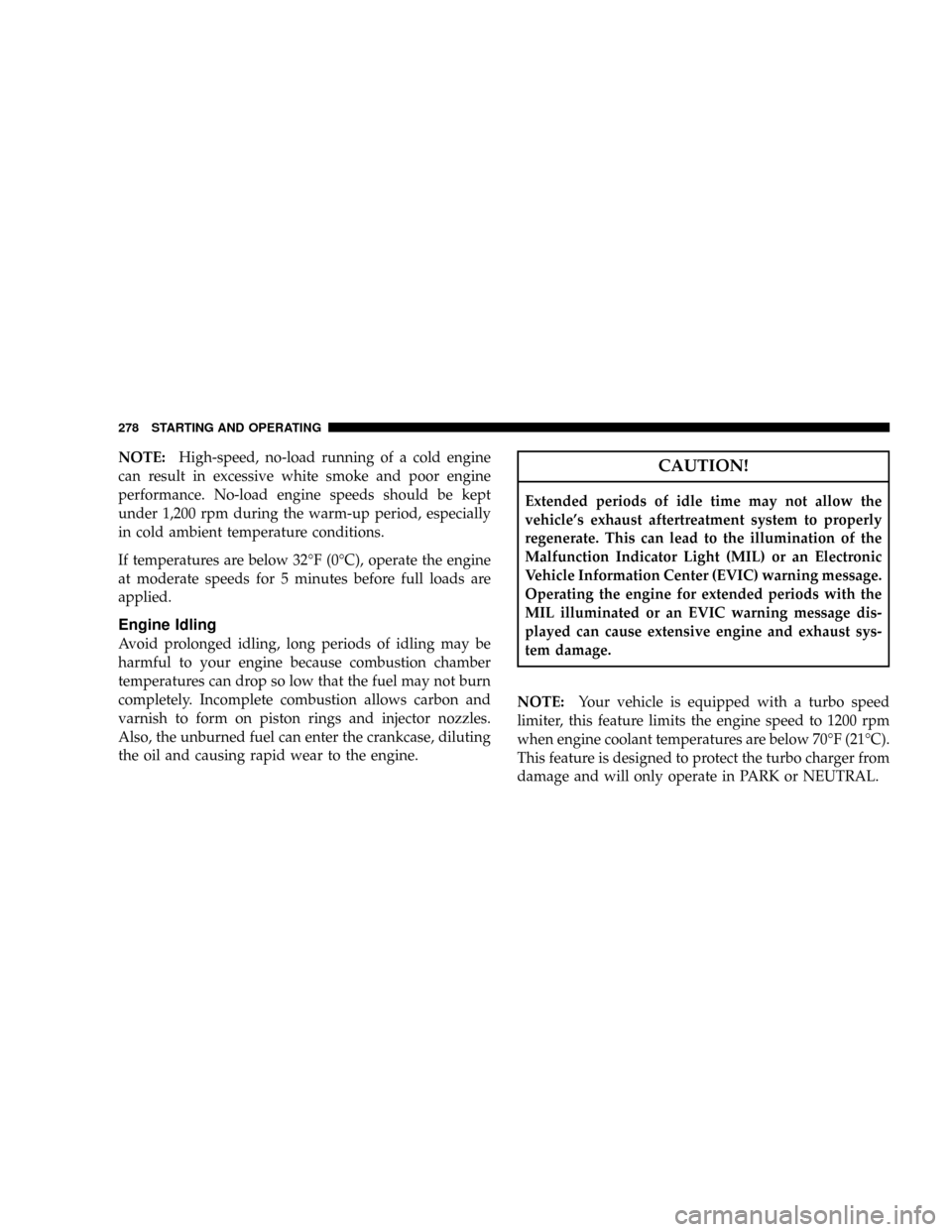
NOTE:High-speed, no-load running of a cold engine
can result in excessive white smoke and poor engine
performance. No-load engine speeds should be kept
under 1,200 rpm during the warm-up period, especially
in cold ambient temperature conditions.
If temperatures are below 32ÉF (0ÉC), operate the engine
at moderate speeds for 5 minutes before full loads are
applied.
Engine Idling
Avoid prolonged idling, long periods of idling may be
harmful to your engine because combustion chamber
temperatures can drop so low that the fuel may not burn
completely. Incomplete combustion allows carbon and
varnish to form on piston rings and injector nozzles.
Also, the unburned fuel can enter the crankcase, diluting
the oil and causing rapid wear to the engine.
CAUTION!
Extended periods of idle time may not allow the
vehicle's exhaust aftertreatment system to properly
regenerate. This can lead to the illumination of the
Malfunction Indicator Light (MIL) or an Electronic
Vehicle Information Center (EVIC) warning message.
Operating the engine for extended periods with the
MIL illuminated or an EVIC warning message dis-
played can cause extensive engine and exhaust sys-
tem damage.
NOTE:Your vehicle is equipped with a turbo speed
limiter, this feature limits the engine speed to 1200 rpm
when engine coolant temperatures are below 70ÉF (21ÉC).
This feature is designed to protect the turbo charger from
damage and will only operate in PARK or NEUTRAL.
278 STARTING AND OPERATING
Page 282 of 527
Stopping The Engine
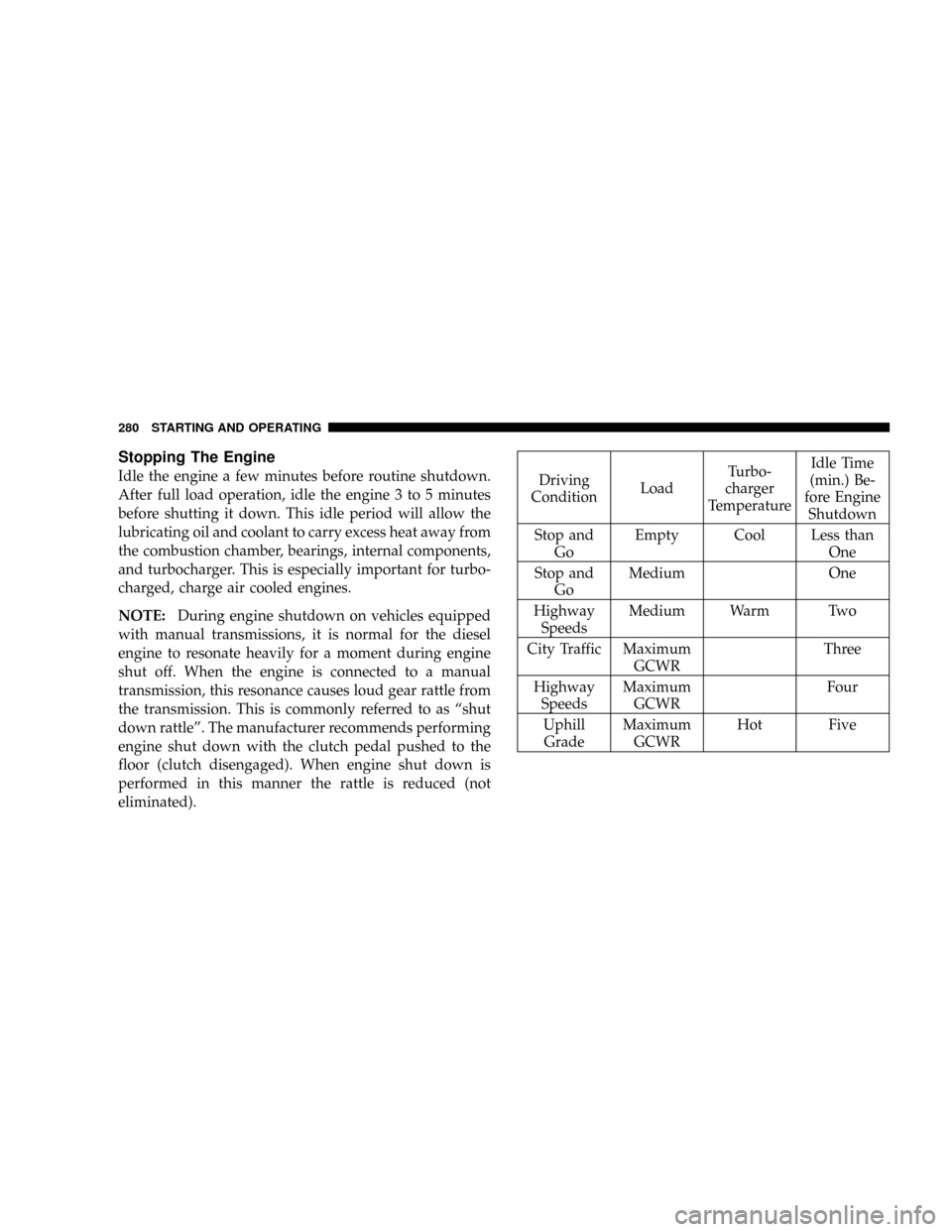
Idle the engine a few minutes before routine shutdown.
After full load operation, idle the engine 3 to 5 minutes
before shutting it down. This idle period will allow the
lubricating oil and coolant to carry excess heat away from
the combustion chamber, bearings, internal components,
and turbocharger. This is especially important for turbo-
charged, charge air cooled engines.
NOTE:During engine shutdown on vehicles equipped
with manual transmissions, it is normal for the diesel
engine to resonate heavily for a moment during engine
shut off. When the engine is connected to a manual
transmission, this resonance causes loud gear rattle from
the transmission. This is commonly referred to as ªshut
down rattleº. The manufacturer recommends performing
engine shut down with the clutch pedal pushed to the
floor (clutch disengaged). When engine shut down is
performed in this manner the rattle is reduced (not
eliminated).Driving
ConditionLoadTurbo-
charger
TemperatureIdle Time
(min.) Be-
fore Engine
Shutdown
Stop and
GoEmpty Cool Less than
One
Stop and
GoMedium One
Highway
SpeedsMedium Warm Two
City Traffic Maximum
GCWRThree
Highway
SpeedsMaximum
GCWRFour
Uphill
GradeMaximum
GCWRHot Five
280 STARTING AND OPERATING
Page 283 of 527
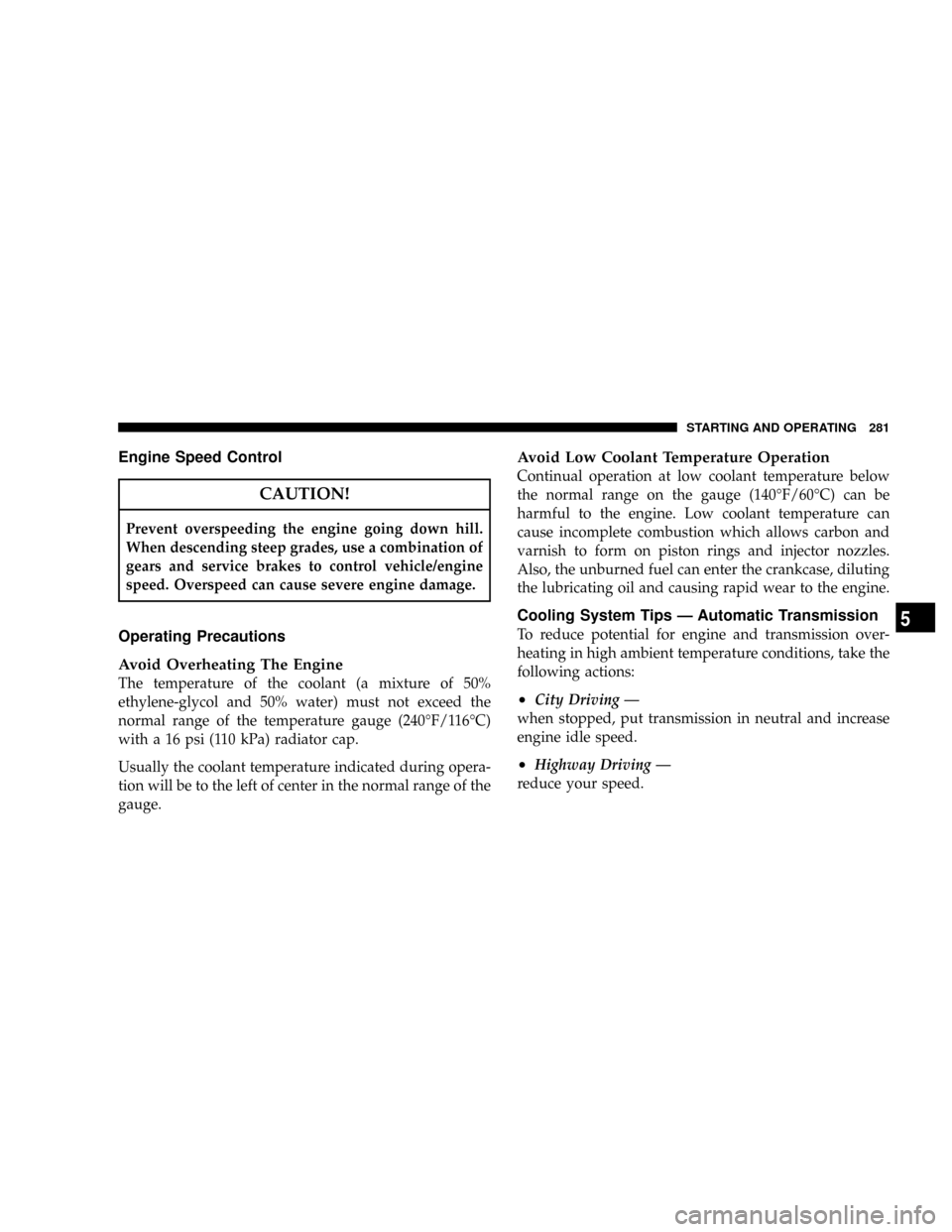
Engine Speed Control
CAUTION!
Prevent overspeeding the engine going down hill.
When descending steep grades, use a combination of
gears and service brakes to control vehicle/engine
speed. Overspeed can cause severe engine damage.
Operating Precautions
Avoid Overheating The Engine
The temperature of the coolant (a mixture of 50%
ethylene-glycol and 50% water) must not exceed the
normal range of the temperature gauge (240ÉF/116ÉC)
with a 16 psi (110 kPa) radiator cap.
Usually the coolant temperature indicated during opera-
tion will be to the left of center in the normal range of the
gauge.
Avoid Low Coolant Temperature Operation
Continual operation at low coolant temperature below
the normal range on the gauge (140ÉF/60ÉC) can be
harmful to the engine. Low coolant temperature can
cause incomplete combustion which allows carbon and
varnish to form on piston rings and injector nozzles.
Also, the unburned fuel can enter the crankcase, diluting
the lubricating oil and causing rapid wear to the engine.
Cooling System Tips Ð Automatic Transmission
To reduce potential for engine and transmission over-
heating in high ambient temperature conditions, take the
following actions:
²City Driving Ð
when stopped, put transmission in neutral and increase
engine idle speed.
²Highway Driving Ð
reduce your speed.
STARTING AND OPERATING 281
5
Page 284 of 527
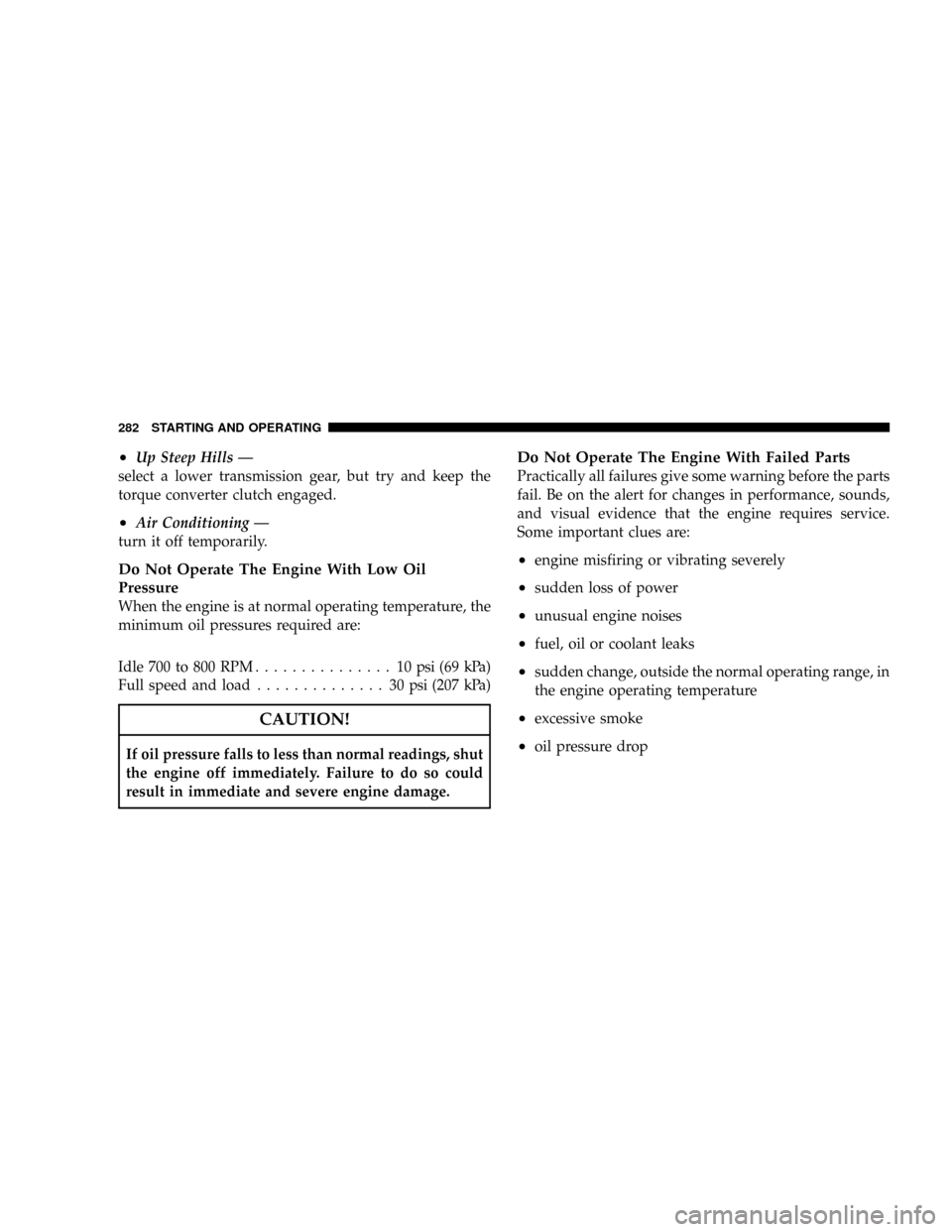
²Up Steep Hills Ð
select a lower transmission gear, but try and keep the
torque converter clutch engaged.
²Air Conditioning Ð
turn it off temporarily.
Do Not Operate The Engine With Low Oil
Pressure
When the engine is at normal operating temperature, the
minimum oil pressures required are:
Idle 700 to 800 RPM............... 10psi(69kPa)
Full speed and load.............. 30psi(207 kPa)
CAUTION!
If oil pressure falls to less than normal readings, shut
the engine off immediately. Failure to do so could
result in immediate and severe engine damage.
Do Not Operate The Engine With Failed Parts
Practically all failures give some warning before the parts
fail. Be on the alert for changes in performance, sounds,
and visual evidence that the engine requires service.
Some important clues are:
²engine misfiring or vibrating severely
²sudden loss of power
²unusual engine noises
²fuel, oil or coolant leaks
²sudden change, outside the normal operating range, in
the engine operating temperature
²excessive smoke
²oil pressure drop
282 STARTING AND OPERATING
Page 310 of 527

Shallow Standing Water
Although your vehicle is capable of driving through
shallow standing water, consider the following Caution
and Warning before doing so.
CAUTION!
²Always check the depth of the standing water
before driving through it. Never drive through
standing water that is deeper than the bottom of
the tire rims mounted on the vehicle.
²Determine the condition of the road or the path
that is under water, and if there are any obstacles
in the way, before driving through the standing
water.
²Do not exceed 5 mph (8 km/h) when driving
through standing water. This will minimize wave
effects.
CAUTION!
²Driving through standing water may cause dam-
age to your vehicle's drivetrain components. Al-
ways inspect your vehicle's fluids (i.e., engine oil,
transmission, axle, etc.) for signs of contamination
(i.e., fluid that is milky or foamy in appearance)
after driving through standing water. Do not con-
tinue to operate the vehicle if any fluid appears
contaminated, as this may result in further dam-
age. Such damage is not covered by the New
Vehicle Limited Warranty.
²Getting water inside your vehicle's engine can
cause it to lock up and stall out, and cause serious
internal damage to the engine. Such damage is not
covered by the New Vehicle Limited Warranty.
308 STARTING AND OPERATING
Page 349 of 527

Light will turn OFF, as long as no tire pressure is below
the low-pressure warning limit in any of the four active
road tires. The vehicle may need to be driven for up to 10
minutes above 15 mph (25 km/h) in order for the TPMS
to receive this information.
General Information
This device complies with part 15 of the FCC rules and
RSS 210 of Industry Canada. Operation is subject to the
following conditions:
²This device may not cause harmful interference.
²This device must accept any interference received,
including interference that may cause undesired op-
eration.
The tire pressure sensors are covered under one of the
following licenses:
United States.....................KR5S120123
Canada........................2671-S120123
ENGINE RUNAWAY
WARNING!
In case of engine runaway due to flammable fumes
from gasoline spills or turbocharger oil leaks being
sucked into the engine, do the following to help
avoid personal injury and/or vehicle damage:
1. Shut off engine ignition switch.
2. Using a CO
2or dry chemical type fire extin-
guisher, direct the spray from the fire extinguisher
into the grille on the passenger side so that the spray
enters the engine air intake.
The inlet for the engine air intake is located behind
the passenger side headlamp and receives air
through the grille.
STARTING AND OPERATING 347
5