engine DODGE RAM 3500 DIESEL 2008 3.G Service Manual
[x] Cancel search | Manufacturer: DODGE, Model Year: 2008, Model line: RAM 3500 DIESEL, Model: DODGE RAM 3500 DIESEL 2008 3.GPages: 527, PDF Size: 8.88 MB
Page 267 of 527
NTire Identification Number (TIN)..........319
NTire Loading And Tire Pressure...........320
mTires Ð General Information...............324
NTire Pressure.........................324
NTire Inflation Pressures.................325
NRadial Ply Tires......................327
NCompact Spare Tire Ð If Equipped.........328
NLimited-Use Spare Ð If Equipped.........328
NTire Spinning........................329
NTread Wear Indicators..................330
NLife Of Tire.........................330
NReplacement Tires.....................331
NAlignment And Balance.................332mSupplemental Tire Pressure Information Ð If
Equipped............................333
mTire Chains...........................333
mSnow Tires...........................335
mTire Rotation Recommendations............335
NDual Rear Wheels.....................337
mTire Pressure Monitor System (TPMS) Ð
If Equipped...........................338
NTire Pressure Monitor System (TPMS) ªLight
Loadº Reset Switch Description ±
If Equipped.........................341
NTire Pressure Monitor System Components . . . 344
NGeneral Information...................347
mEngine Runaway.......................347
STARTING AND OPERATING 265
5
Page 268 of 527
mFuel Requirements......................348
NFuel Requirements (6.7L Diesel Engines).....348
mAdding Fuel (Diesel Engines)..............349
NFuel Filler Cap (Gas Cap)...............350
NBulk Fuel Storage.....................351
mVehicle Loading........................352
NCertification Label.....................352
mTrailer Towing.........................356
NCommon Towing Definitions.............356
NTrailer Hitch Classification...............360
NTrailer Towing Weights (Maximum Trailer
Weight Ratings)......................361NTrailer And Tongue Weight..............361
NTowing Requirements..................362
NTowing Tips.........................368
NTrailer Towing Mirrors Ð If Equipped......370
mSnowplow............................371
NBefore Plowing.......................372
NSnowplow Prep Package Model Availability . . 372
NOver The Road Operation With Snowplow
Attached...........................373
NMethods For Removing Snow............373
NOperating Tips.......................373
NGeneral Maintenance...................374
266 STARTING AND OPERATING
Page 270 of 527
STARTING PROCEDURES ± DIESEL ENGINES
Before starting your vehicle, adjust your seat, adjust both
inside and outside mirrors, and fasten your seat belts.
The starter should not be operated for more than 15-
second intervals. Waiting a few minutes between such
intervals will protect the starter from overheating.
WARNING!
Be sure to turn off the engine and remove the key
from the ignition switch if you want to rest or sleep
in your vehicle. Accidents can be caused by inadvert-
ently moving the shift lever or by pressing the
accelerator pedal. This may cause excessive heat in
the exhaust system, resulting in overheating and
vehicle fire which may cause serious or fatal injuries.
WARNING!
Do not leave children or animals inside parked
vehicles in hot weather. Interior heat build up may
cause serious injury or death.
Automatic Transmission ± If Equipped
Start the engine with the shift lever in NEUTRAL or
PARK position. Apply the brake before shifting to any
driving range.
The CumminstDiesel engine is equipped with several
features designed to assist cold weather starting and
operation:
²The engine block heater is a resistance heater installed
in the water jacket of the engine just above and behind
the oil filter. It requires a 110±115 volt AC electrical
outlet with a grounded, three-wire extension cord.
268 STARTING AND OPERATING
Page 271 of 527
NOTE:The engine block heater cord is a factory in-
stalled option. If your vehicle is not equipped, heater
cords are available from your authorized Mopartdealer.
²A 12±volt heater built into the fuel filter housing aids
in preventing fuel gelling. It is controlled by a built-in
thermostat.
²A heated intake air system both improves engine
starting and reduces the amount of white smoke
generated by a warming engine.
Manual Transmission ± If Equipped
Apply the parking brake, place the shift lever in NEU-
TRAL and depress the clutch pedal to the floor before
starting the vehicle. This vehicle is equipped with a
clutch interlocking ignition system. It will not start unless
the clutch is fully depressed.
Normal Starting Procedure ± Engine Manifold Air
Temperature Above 66ÉF (19ÉC)
Observe the instrument panel cluster lights when starting
the engine.
1. Always apply the parking brake.
2. Shift into PARK for an automatic transmission. For
vehicles equipped with manual transmissions, fully de-
press and hold the clutch pedal and shift into NEUTRAL.
3. Turn the ignition key to the ON position and watch the
instrument panel cluster lights.
STARTING AND OPERATING 269
5
Page 272 of 527
CAUTION!
If WATER IN FUEL indicator light remains on DO
NOT START engine before you drain water from the
fuel filter to avoid engine damage. Refer to ªDrain-
ing Fuel/Water Separator Filter (6.7L Diesel Engine)º
under ªMaintenance Proceduresº in Section 7.
4. Turn the ignition key to START and crank the engine.
Do not press the accelerator during starting.
CAUTION!
Do not crank engine for more than 15 seconds at a
time as starter motor damage may result. Turn key to
OFF and wait at least two minutes before trying
again.5. When the engine starts, release the key.
6. Check to see that there is oil pressure.
7. Release the parking brake.
Starting Procedure ± Engine Manifold Air
Temperature Below 66ÉF (19ÉC)
NOTE:The temperature displayed on the overhead
console (if equipped) does not necessarily reflect the
engine manifold air temperature. When certain engine
temperatures fall below 66ÉF (19ÉC) the lights will remain
on indicating the intake manifold heater system is active.
270 STARTING AND OPERATING
Page 273 of 527
Follow the steps in the Normal Starting Procedure ex-
cept:
CAUTION!
Do not crank engine for more than 15 seconds at a
time or starter motor damage may result. Turn key to
OFF and wait at least two minutes for starter to cool
before repeating start procedure.
²The WAIT TO START light will remain on for a period
of time (length of time depends on engine tempera-
ture).
²After the WAIT TO START light goes off, turn the
ignition key to START. Do not press the accelerator
during starting.
²After engine start-up, check to see that there is oil
pressure.
²Allow the engine to idle about three minutes until
the manifold heaters have completed the post-heat
cycle.
²Release the parking brake and drive.
NOTE:Engine idle speed will automatically increase to
1000 RPM at low coolant temperatures to improve engine
warm-up.
NOTE:If the engine stalls or if the ignition switch is left
ON for more than two minutes after the WAIT TO START
light goes out, reset the grid heaters by turning the
ignition switch to OFF for at least five seconds and then
back ON. Repeat steps 3 through 7 of the normal starting
procedure.
STARTING AND OPERATING 271
5
Page 274 of 527
For Extremely Cold Weather Starting Ð Engine
Manifold Air Temperature Below 0ÉF (-18ÉC)
In extremely cold weather below 0ÉF (-18ÉC) it may be
beneficial to cycle the manifold heaters twice before
attempting to start the engine. This can be accomplished
by turning the ignition OFF for at least five seconds and
then back ON after the WAIT TO START light has gone
off, but before the engine is started. However, repeated
cycling of the manifold heaters will result in damage to
the heater elements or reduced battery voltage.
Proceed by following the steps in the Normal Starting
Procedure.
NOTE: If multiple pre-heat cycles are used before
starting, additional engine run time may be required to
maintain battery state of charge at a satisfactory level.
²If the engine stalls after the initial start, the ignition
must be turned to the OFF position for at least five
seconds and then to the ON position to recycle the
manifold heaters.
NOTE:Excessive white smoke and poor engine perfor-
mance will result if manifold heaters are not recycled.
²Heat generated by the manifold heaters dissipates
rapidly in a cold engine. If more than two minutes
pass between the time the WAIT TO START light goes
OFF and the engine is started, recycle the manifold
heaters by turning the ignition OFF for at least five
seconds and then back ON.
²If the vehicle is driven and vehicle speed exceeds 19
mph (31 km/h) before the manifold heater post-heat
(after start) cycle is complete, the manifold heaters will
shut off.
272 STARTING AND OPERATING
Page 275 of 527
²If the engine is started before the WAIT TO START
light turns off, the preheat cycle will turn off.
²If the engine is cranked for more than 10 seconds, the
post-heat cycle will turn off.
NOTE:Engine idle speed will automatically increase to
1000 RPM at low coolant temperatures to improve engine
warm-up.
NOTE:When a diesel engine is allowed to run out of
fuel or the fuel gels at low temperatures, air is pulled into
the fuel system.
You may try priming as described below:
1. Add a substantial quantity of fuel to the tank (5 to 10
gal) (19 to 38 L) or eliminate the gelled fuel condition.
2. Crank the engine for one to two seconds. If the engine
does not start, then turn the ignition back to the RUN
position (do not turn the ignition back to the OFFposition). The electric fuel transfer pump will continue to
run and purge air from the system for about 20 seconds.
After 20 seconds, attempt to start the engine again.
3. Start the engine using the Normal Starting Procedure.
4. Repeat the procedure if the engine does not start.
WARNING!
Do not open the high pressure fuel system when
cranking the engine or with the engine running.
Engine operation causes high fuel pressure. High
pressure fuel spray can cause serious injury or death.
NOTE:The engine may run rough until the air is forced
from all the fuel lines.
STARTING AND OPERATING 273
5
Page 276 of 527
Starting Fluids
WARNING!
STARTING FLUIDS or flammable liquids are
NEVER TO BE USED in the CumminstDiesel (see
Warning label). Never pour diesel fuel, flammable
liquid, starting fluids (ether) into the air cleaner
canister, air intake piping, or turbocharger inlet in an
attempt to start the vehicle. This could result in a
flash fire and explosion causing serious personal
injury and engine damage.
The engine is equipped with an automatic electric air
preheating system. If the instructions in this manual are
followed, the engine should start in all conditions.
WARNING!
Do not leave children or animals inside parked
vehicles in hot weather. Interior heat build up may
cause serious injury or death.
NORMAL OPERATION (DIESEL ENGINE)
Observe the following when the engine is operating.
²All message center lights are off.
²Check Engine Lamp is off.
²Engine Oil Pressure is above 10 psi (69 kPa) at idle.
²Low Oil Pressure light is off.
274 STARTING AND OPERATING
Page 277 of 527
²Voltmeter Operation:
1. The voltmeter may show a gauge fluctuation if
certain engine temperatures are below 66ÉF (19ÉC).
This cycling operation is caused by the post-heat cycle
of the intake manifold heater system. The number of
cycles and the length of the cycling operation is
controlled by the engine control module. Post-heat
operation can run for several minutes, and then the
electrical system and voltmeter needle will stabilize.
2. The cycling action will cause temporary dimming of
the headlamps, interior lamps, and also a noticeable
reduction in blower motor speed.
Cold Weather Precautions
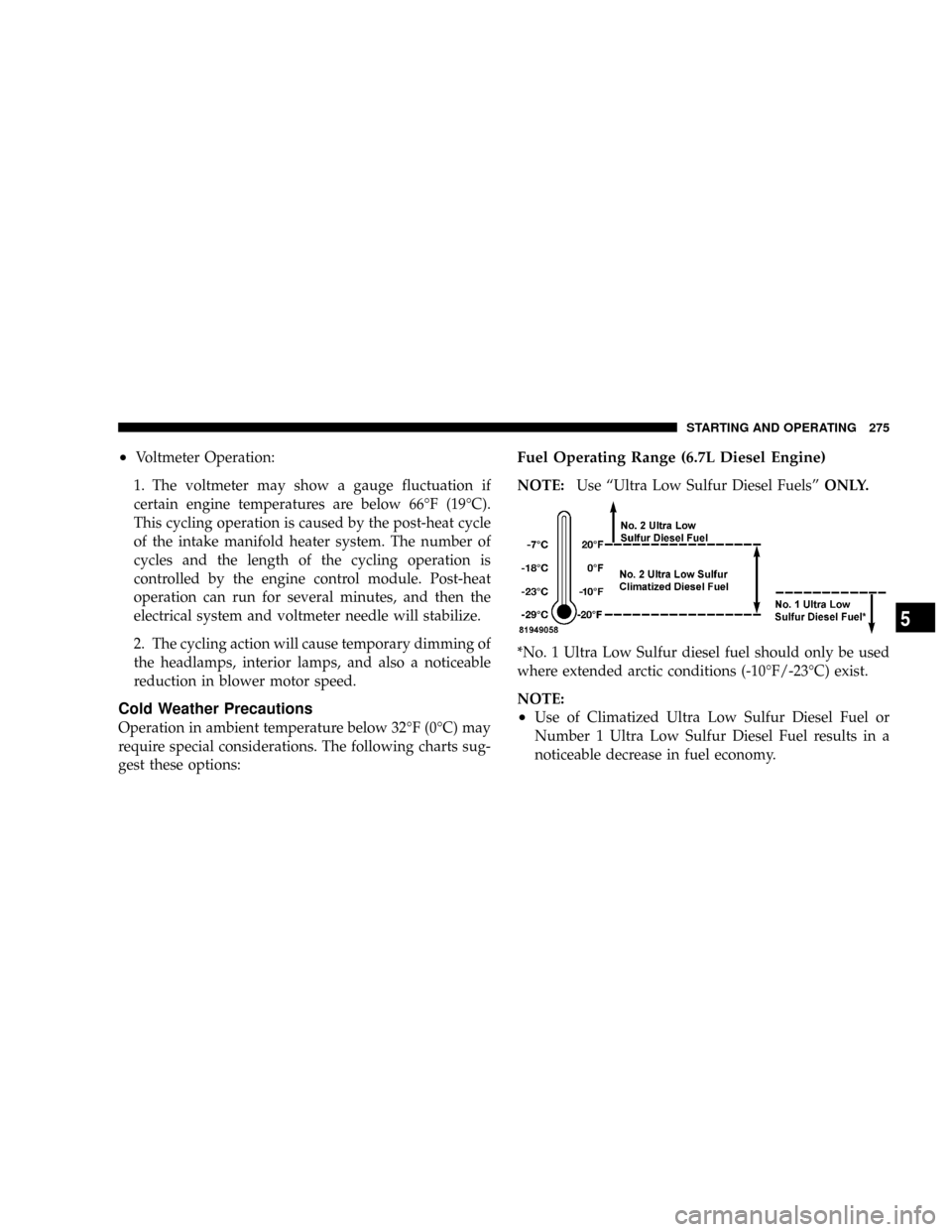
Operation in ambient temperature below 32ÉF (0ÉC) may
require special considerations. The following charts sug-
gest these options:
Fuel Operating Range (6.7L Diesel Engine)
NOTE:Use ªUltra Low Sulfur Diesel FuelsºONLY.
*No. 1 Ultra Low Sulfur diesel fuel should only be used
where extended arctic conditions (-10ÉF/-23ÉC) exist.
NOTE:
²Use of Climatized Ultra Low Sulfur Diesel Fuel or
Number 1 Ultra Low Sulfur Diesel Fuel results in a
noticeable decrease in fuel economy.
STARTING AND OPERATING 275
5