light DODGE RAM 3500 DIESEL 2009 4.G Owners Manual
[x] Cancel search | Manufacturer: DODGE, Model Year: 2009, Model line: RAM 3500 DIESEL, Model: DODGE RAM 3500 DIESEL 2009 4.GPages: 532, PDF Size: 9.37 MB
Page 295 of 532
CAUTION!
Winching or rocking the vehicle off hard objects
increases the risk of underbody damage.Hill ClimbingHill climbing requires good judgment and a good under-
standing of your abilities and your vehicle’s limitations.
Hills can cause serious problems. Some are just too steep
to climb and should not be attempted. You should always
feel confident with the vehicle and your abilities. You
should always climb hills straight up and down. Never
attempt to climb a hill on an angle.•
Before Climbing A Steep Hill– As you approach a
hill consider its grade or steepness. Determine if it is
too steep. Look to see what the traction is on the hill
side trail. Is the trail straight up and down? What is on
top and the other side? Are there ruts, rocks, branches
or other obstacles on the path? Can you safely recover the vehicle if something goes wrong? If everything
looks good and you feel confident, then change trans-
mission into a lower gear, shift the transfer case into 4L
(Low) and proceed with caution. You should use first
gear and 4L (Low Range) for very steep hills.
•
Driving Up Hill
– Once you have determined your
ability to proceed and have shifted into the appropri-
ate gear, line your vehicle up for the straightest
possible run. Accelerate with an easy constant throttle
and apply more power as you start up the hill. Do not
race forward into a steep grade, the abrupt change of
grade could cause you to lose control. If the front end
begins to bounce, ease off the throttle slightly to bring
all four tires back on the ground. As you approach the
crest of the hill ease off the throttle and slowly proceed
over the top. If the wheels start to slip as you approach
the crest of a hill, ease off the accelerator and maintain
headway by turning the steering wheel no more than
a14turn quickly back and forth. This will provide a
STARTING AND OPERATING 293
5
Page 297 of 532
sure the surface has good traction with firm and stable
soils. If possible transverse the incline at an angle
heading slightly up or down.
WARNING!
Driving across an incline increases the risk of a
rollover, which may result in severe injury.•
If You Stall Or Begin To Lose Headway– If you stall
or begin to lose headway while climbing a steep hill,
allow your vehicle to come to a stop and immediately
apply the brake. Restart the engine and shift into
REVERSE. Back slowly down the hill allowing the
compression braking of the engine and transmission to
help regulate your speed. If the brakes are required to
control vehicle speed, apply them lightly and avoid
locking or skidding the tires.
WARNING!
If the engine stalls or you lose headway or cannot
make it to the top of a steep hill or grade, never
attempt to turn around. To do so may result in
tipping and rolling the vehicle, which may result in
severe injury. Always back carefully straight down a
hill in REVERSE. Never back down a hill in NEU-
TRAL using only the vehicle brakes. Never drive
diagonally across a hill, always drive straight up or
down.Driving Through WaterExtreme care should be taken crossing any type of water.
Water crossings should be avoided if possible and only
be attempted when necessary, in a safe responsible
manner. You should only drive through areas which are
designated and approved. You should tread lightly and
avoid damage to the environment. You should know
STARTING AND OPERATING 295
5
Page 298 of 532
your vehicle’s abilities and be able to recover it if
something goes wrong. You should never stop or shut a
vehicle off when crossing deep water unless you ingested
water into the engine air intake. If the engine stalls do not
attempt to restart it. Determine if it has ingested water
first. The key to any crossing is low and slow. You want
to use 1st gear in 4L (Low Range) and proceed very
slowly with a constant slow speed (3-5 mph [5–8 km/h]
maximum) and light throttle. Keep the vehicle moving;
do not try to accelerate through the crossing. After
crossing any water higher than the bottom of the axle
differentials, you should inspect all of the vehicle fluids
for signs of water ingestion.
CAUTION!
Water ingestion into the axles, transmission, transfer
case, engine or vehicle interior can occur if you drive
too fast or through too deep of water. Water can cause
permanent damage to engine, driveline or other
vehicle components and your brakes will be less
effective once wet and/or muddy•
Before You Cross Any Type Of Water– As you
approach any type of water you need to determine if
you can cross it safely and responsibly. If necessary, get
out and walk through the water or probe it with a
stick. You need to be sure of its depth, approach angle,
current and bottom condition. Be careful of murky or
muddy waters, check for hidden obstacles. Make sure
you will not be intruding on any wildlife and you can
recover the vehicle if necessary. The key to a safe
296 STARTING AND OPERATING
Page 300 of 532
downstream out of control if the water is deep enough
to push on the large surface area of the vehicle’s body.
Before you proceed determine the speed of the current,
the water’s depth, approach angle, bottom condition
and if there are any obstacles, then cross at an angle
heading slightly upstream using the low and slow
technique.
WARNING!
Never drive through fast moving deep water. It can
push your vehicle downstream, sweeping it out of
control. This could put you and your passengers at
risk of injury or drowning.Airing Down For Off-Road DrivingRunning lower tire pressure off-road can improve your
ride comfort and vehicle traction. Reducing the tire air
pressure allows the tire to bulge slightly, improving its
surface area for better flotation and ability to mold orform to the ground contour. Different terrain, tires, and
vehicles require different tire pressure. Hard surfaces like
rock and heavier vehicles require higher pressures than
softer surfaces such as sand and lighter vehicles. You will
need to experiment to determine what is right for your
situation. It is easier and faster to let air out than it is to
replace it so, start high and lower it as required. Remem-
ber you must return the tires to normal air pressure
before driving on road or at highway conditions. Be sure
you have a way to return the tires to their normal on road
air pressure.
CAUTION!
Reduced tire pressure increases the risk of tire dam-
age and may cause tire unseating with total loss of air
pressure. To reduce the risk of tire unseating, while at
a reduced tire pressure, drive at slower speeds and
avoid sharp turns or abrupt maneuvers.
298 STARTING AND OPERATING
Page 301 of 532
Vehicle RecoveryIf you drive off-road, you may encounter a situation
where you will need to recover your vehicle. Vehicle
recovery should always be given consideration before
attempting a questionable obstacle. You should never go
off-road driving without the ability to recover your
vehicle from a situation. Having another vehicle with
you usually works best for most situations. The first
thing to do is assess the situation. Why are you stuck?
Are you hung up on something? Would it be easier to go
forward or to go backward? Can you still move the
vehicle? Is there an anchor point to winch to? Are you
alone or do you have another vehicle to help? Is there
high risk of vehicle damage during the recovery process?
Answering these questions will help you determine the
best method of recovery. If you can still move the vehicle
slightly and the only issue is slick ground, then rock
cycling your vehicle would be the first choice. If you have
ample room, an additional vehicle and there is low risk ofvehicle impingement on the surroundings, then using a
tow strap to the vehicle tow hooks would be fast and
easy. If the vehicle is severely hung up or in a situation
where great care needs to be taken during the recovery,
then nothing can do the job better than a winch. If you are
severely hung up on something you should jack the
vehicle up and stack something under the wheels to
allow the vehicle to roll off the object without causing
further damage. This should be tried before attempting
any recovery method.
CAUTION!
Pulling the vehicle off an obstacle, without first
clearing the object, may result in additional under-
body damage.•
Rock Cycling Your Vehicle
– Rock cycling your ve-
hicle is one of the easiest, fastest and most commonly
used methods. This simply involves shifting your
STARTING AND OPERATING 299
5
Page 303 of 532
straps together using a 1
12inch hard wood dowel.
This will keep the straps from becoming knotted and is
safer than using a clevis pin if the strap breaks. Next
have the tow vehicle backup, leaving two to three feet
worth of slack in the strap. Then the tow vehicle, using
light throttle, should accelerate tightening the strap
providing the pulling force needed to free the vehicle.
The vehicle being recovered should assist in the recov-
ery, at the time of the snap, by slowly spinning the tires
in the same direction as the pulling vehicle. After the
vehicle becomes free, the driver of the previously
stuck vehicle should signal they are free and should
hit their brakes stopping both vehicles. The driver of
the pulling vehicle should let off the throttle without
using the brakes, once signaled by the other driver.
This sequence is important to avoid having the recov-
ered vehicle hit the pulling vehicle.
WARNING!
Never use tow straps with end hooks or link two
straps with a clevis pin. These heavy metal objects
could become projectiles if a strap breaks, which
could cause severe injury. Never leave more than two
or three feet of slack in the strap. More slack than this
greatly increases the risk of injury and vehicle dam-
age. Always keep everyone at least 30 feet away from
a strapping or winching situation.•
Winching (Refer to “Winch Operation” for addi-
tional information) – Winching is most commonly
used in the following situations: there is no support
vehicle available, a high controlled force is required to
recover the vehicle, there is a high risk of environmen-
tal or vehicle damage, or where nothing else seems to
work. A winch can deliver a high pulling force with a
great deal of control. It allows you to walk the vehicle
STARTING AND OPERATING 301
5
Page 304 of 532
out of the situation in a slow controlled manner. This
control works well for avoiding further vehicle dam-
age. Once you decide it is time to use the winch look
for a good anchor point. It needs to be strong enough
to hold more than the vehicle’s weight and provide a
direction of pull as straight as possible. Use block and
tackle if necessary to improve the angle of pull or
increase the winch’s pulling force. If the anchor point
is a tree use a strap around its base and hook the cable
to the strap. If it is another vehicle, then place that
vehicle in PARK and block the front tires. If you cannot
find an anchor point within reach try using your spare
tire by burying it. Once you have determined an
anchor point hook up the cable, ensuring there are a
least five wraps of cable left on the drum, and place a
floor mat or something else over the strung out cable.
Placing something over the strung out cable helps
keep the cable on the ground if it breaks. Next, place
the vehicle in 1st gear and apply a very light throttle asyou power the winch in. Be careful not to allow slack
in the cable as you recover the vehicle. Do not try to
guide the cable into the drum. If it starts to bunch up
on one end, let it. You can re-spool the cable after-
wards. Never use a winch cable as a tow strap and
always stand back while winching.
WARNING!
Winch cables are under high tension when in use and
can become a projectile if they fail. Never stand over
or straddle the winch cable. Never jerk or overload
the winch cable. Never stand in front of the vehicle
while winching. Failure to follow these instructions
can result in serious or fatal injury.After Driving Off-RoadOff-road operation puts more stress on your vehicle than
does most on-road driving. After driving off-road, it is
always a good idea to check for damage.
302 STARTING AND OPERATING
Page 306 of 532
LIMITED-SLIP DIFFERENTIAL – IF EQUIPPEDThe limited-slip differential provides additional traction
on snow, ice, mud, sand and gravel, particularly when
there is a difference between the traction characteristics
of the surface under the right and left rear wheels. During
normal driving and cornering, the limited-slip unit per-
forms similarly to a conventional differential. On slip-
pery surfaces, however, the differential delivers more of
the driving effort to the rear wheel having the better
traction.
The limited-slip differential is especially helpful during
slippery driving conditions. With both rear wheels on a
slippery surface, a slight application of the accelerator
will supply maximum traction. When starting with only
one rear wheel on an excessively slippery surface, slight
momentary application of the parking brake may be
necessary to gain maximum traction.
WARNING!
On vehicles equipped with a limited-slip differential
never run the engine with one rear wheel off the
ground since the vehicle may drive through the rear
wheel remaining on the ground. You could lose
control of the vehicle.
Care should be taken to avoid sudden accelerations when
both rear wheels are on a slippery surface. This could
cause both rear wheels to spin, and allow the vehicle to
slide sideways on the crowned surface of a road or in a
turn.DRIVING ON SLIPPERY SURFACESWhen driving on wet or slushy roads, it is possible for a
wedge of water to build up between the tire and road
surface. This is known as hydroplaning and may cause
partial or complete loss of vehicle control and stopping
304 STARTING AND OPERATING
Page 309 of 532
WARNING!
•
Driving through standing water limits your vehi-
cle’s traction capabilities. Do not exceed 5 mph
(8 km/h) when driving through standing water.
•
Driving through standing water limits your vehi-
cle’s braking capabilities, which increases stop-
ping distances. Therefore, after driving through
standing water, drive slowly and lightly press on
the brake pedal several times to dry the brakes.
•
Getting water inside your vehicle’s engine can
cause it to lock up and stall out, and leave you
stranded.
•
Failure to follow these warnings may result in
injuries that are serious or fatal to you, your
passengers, and others around you.
DRIVING OFF-ROAD — RAM TRUCK ONLYCare should be taken when attempting to climb steep
hills or driving diagonally across a hill or slope. If natural
obstacles force you to travel diagonally up or down a hill,
choose a mild angle and keep as little side tilt as possible.
Keep the vehicle moving and make turns slowly and
cautiously.
If you must back down a hill, back straight down using
REVERSE gear. Never back down in NEUTRAL, or
diagonally across the hill.
When driving over sand, mud, and other soft terrain,
shift to low gear and drive steadily. Apply the accelerator
slowly to avoid spinning the wheels.
DO NOT REDUCE the tire pressures for this type of
driving.
STARTING AND OPERATING 307
5
Page 324 of 532
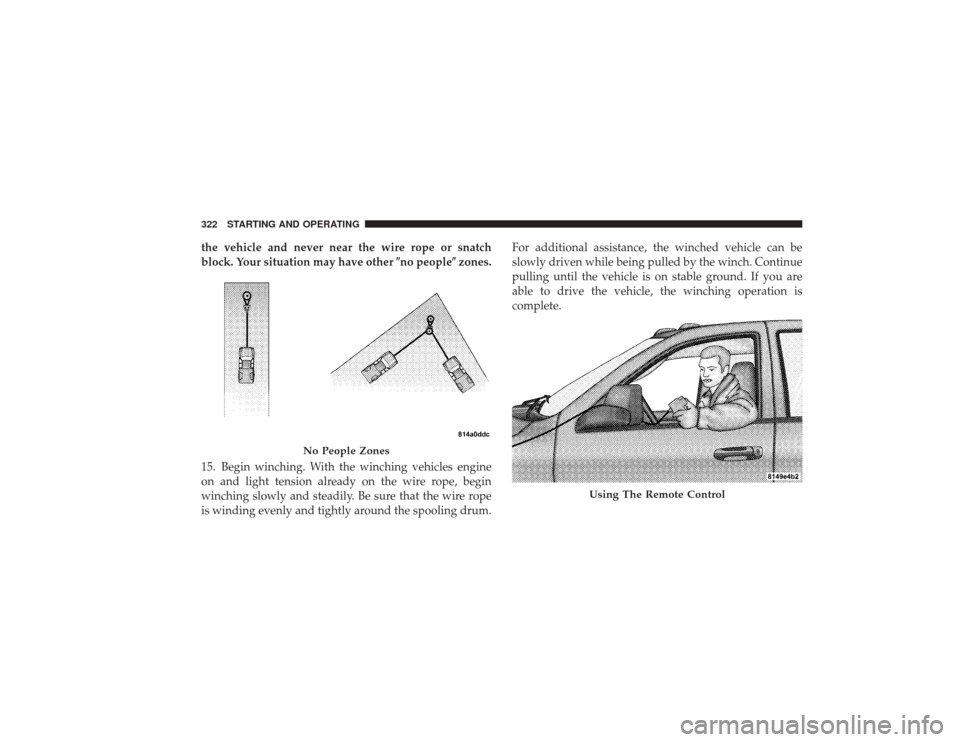
the vehicle and never near the wire rope or snatch
block. Your situation may have other\bno people\bzones.
15. Begin winching. With the winching vehicles engine
on and light tension already on the wire rope, begin
winching slowly and steadily. Be sure that the wire rope
is winding evenly and tightly around the spooling drum. For additional assistance, the winched vehicle can be
slowly driven while being pulled by the winch. Continue
pulling until the vehicle is on stable ground. If you are
able to drive the vehicle, the winching operation is
complete.
No People Zones
Using The Remote Control
322 STARTING AND OPERATING