light DODGE RAM 3500 GAS 2008 3.G Owners Manual
[x] Cancel search | Manufacturer: DODGE, Model Year: 2008, Model line: RAM 3500 GAS, Model: DODGE RAM 3500 GAS 2008 3.GPages: 554, PDF Size: 9.93 MB
Page 339 of 554
ESP/BAS Warning Lamp and ESP/TCS Indicator
Light
The malfunction indicator for the ESP is combined with
the BAS indicator. The yellow ªESP/BAS Warning
Lampº and the yellow ªESP/TCS Indicator Lightº in the
instrument cluster both come on when the ignition
switch is turned to the ON position. They should both go
out with the engine running. If the ªESP/BAS Warning
Lampº comes on continuously with the engine running,
a malfunction has been detected in either the ESP or BAS
system, or both. If this light remains on after several
ignition cycles, and the vehicle has been driven several
miles/kilometers at speeds greater than 30 mph (48
km/h), see your authorized dealer as soon as possible to
have the problem diagnosed and corrected.
NOTE:
²The ªESP Indicator Lightº and the ªESP/BAS Warning
Lampº come on momentarily each time the ignition
switch is turned ON.
²Each time the ignition is turned ON, the ESP System
will be ON even if it was turned off previously.
²The ESP Control System will make buzzing or clicking
sounds when it is active. This is normal. The sounds
will stop when ESP becomes inactive following the
maneuver that caused the ESP activation.
TSC (Trailer Sway Control)
The TSC system uses sensors in the vehicle to recognize
an excessively swaying trailer and will take the appro-
priate actions to attempt to stop the sway. The system
may reduce engine power and apply the brake of the
appropriate wheel(s) to counteract the sway of the trailer.
TSC will become active automatically once an excessively
swaying trailer is recognized. No driver action is re-
quired. Note that TSC cannot stop all trailers from
swaying. Always use caution when towing a trailer and
follow the trailer tongue weight recommendations. Refer
to ªTrailer Towingº in Section 5 of this manual for more
STARTING AND OPERATING 337
5
Page 340 of 554
information on towing a trailer with your vehicle. When
TSC is functioning, the ªESP/TCS Indicator Lightº will
flash, the engine power may be reduced and you may
feel the brakes being applied to individual wheels to
attempt to stop the trailer from swaying. TSC is disabled
when the ESP system is in the Partial Off or Full Off
modes.
TSC is only active in the default ªESP Onº mode. TSC can
be disabled by pressing the ESP Off button and entering
ªESP Partial Offº mode. It is not active in the ªESP Partial
Offº or ªESP Offº modes. Please refer to the ESP portion
of this section for an explanation of the different ESP
operating modes.WARNING!
If TSC activates while driving, slow the vehicle
down, stop at the nearest safe location, and adjust the
trailer load to eliminate trailer sway.
MULTI-DISPLACEMENT SYSTEM (MDS) Ð 5.7L
ENGINE ONLY
This feature offers improved fuel economy by shutting
off four of the engine's eight cylinders during light load
and cruise conditions. The system is automatic with no
driver inputs or additional driving skills required.
NOTE:The MDS system may take some time to return
to full functionality after a battery disconnect.
338 STARTING AND OPERATING
Page 341 of 554
TIRE SAFETY INFORMATION
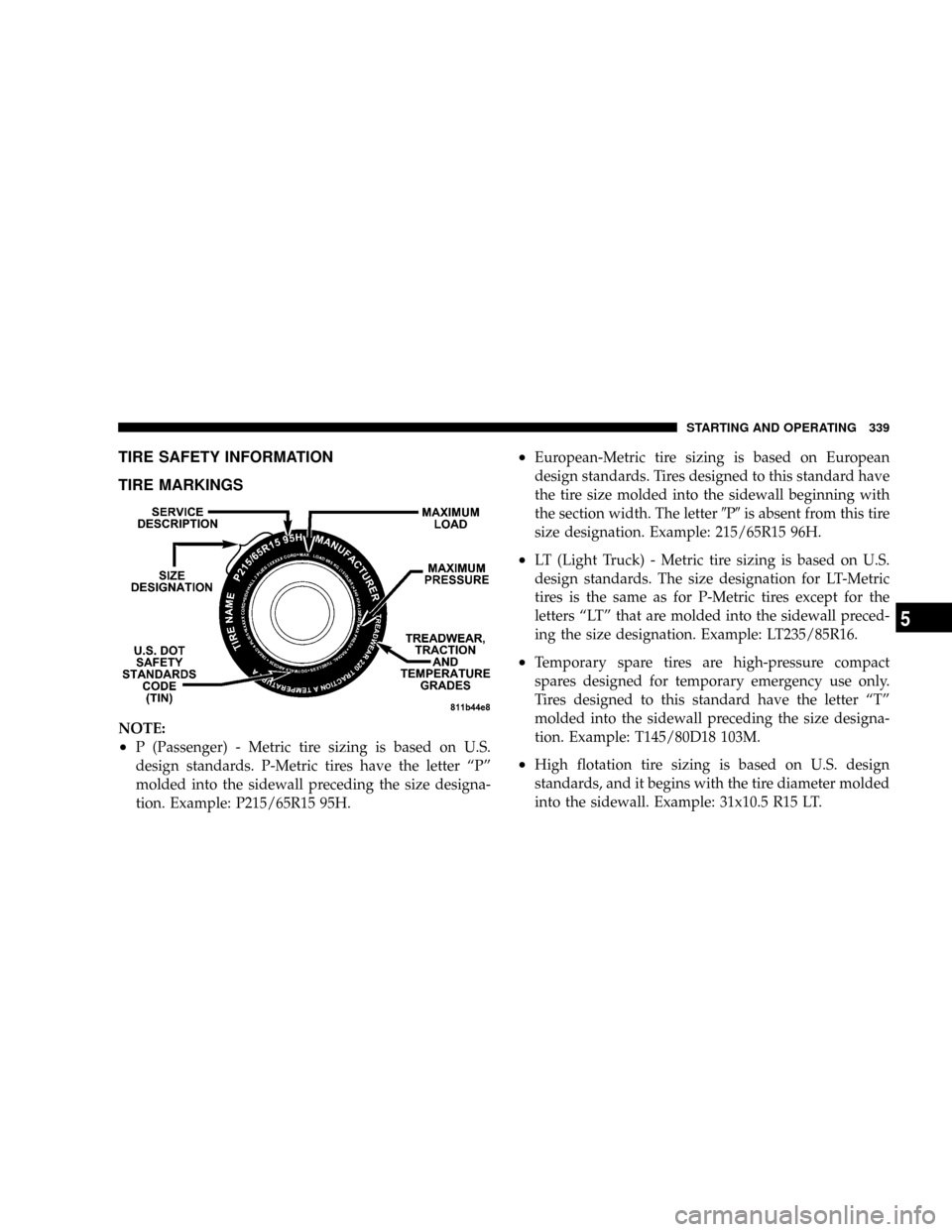
TIRE MARKINGS
NOTE:
²P (Passenger) - Metric tire sizing is based on U.S.
design standards. P-Metric tires have the letter ªPº
molded into the sidewall preceding the size designa-
tion. Example: P215/65R15 95H.
²European-Metric tire sizing is based on European
design standards. Tires designed to this standard have
the tire size molded into the sidewall beginning with
the section width. The letter9P9is absent from this tire
size designation. Example: 215/65R15 96H.
²LT (Light Truck) - Metric tire sizing is based on U.S.
design standards. The size designation for LT-Metric
tires is the same as for P-Metric tires except for the
letters ªLTº that are molded into the sidewall preced-
ing the size designation. Example: LT235/85R16.
²Temporary spare tires are high-pressure compact
spares designed for temporary emergency use only.
Tires designed to this standard have the letter ªTº
molded into the sidewall preceding the size designa-
tion. Example: T145/80D18 103M.
²High flotation tire sizing is based on U.S. design
standards, and it begins with the tire diameter molded
into the sidewall. Example: 31x10.5 R15 LT.
STARTING AND OPERATING 339
5
Page 342 of 554
Tire Sizing Chart
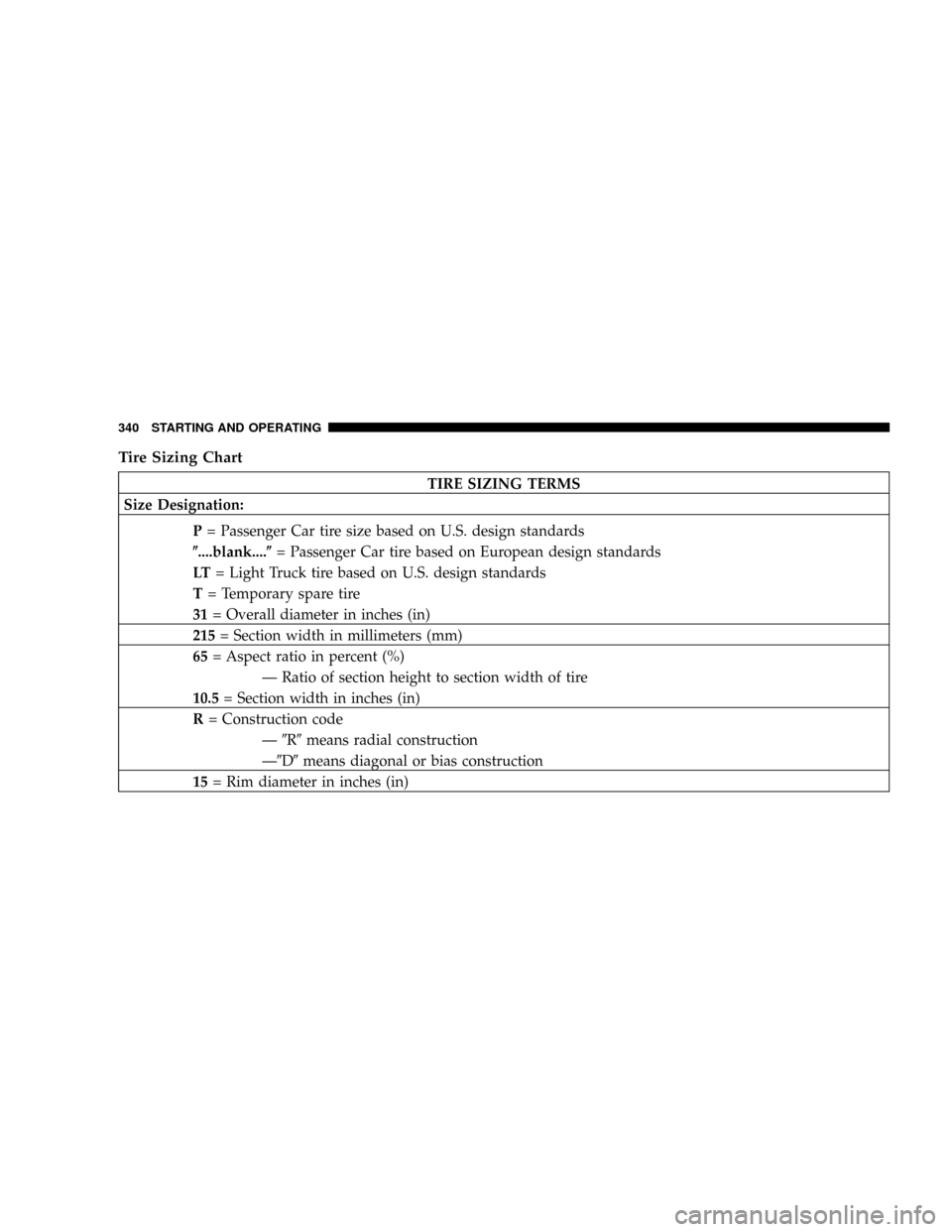
TIRE SIZING TERMS
Size Designation:
P= Passenger Car tire size based on U.S. design standards
(....blank....(= Passenger Car tire based on European design standards
LT= Light Truck tire based on U.S. design standards
T= Temporary spare tire
31= Overall diameter in inches (in)
215= Section width in millimeters (mm)
65= Aspect ratio in percent (%)
Ð Ratio of section height to section width of tire
10.5= Section width in inches (in)
R= Construction code
Ð9R9means radial construction
Ð9D9means diagonal or bias construction
15= Rim diameter in inches (in)
340 STARTING AND OPERATING
Page 343 of 554
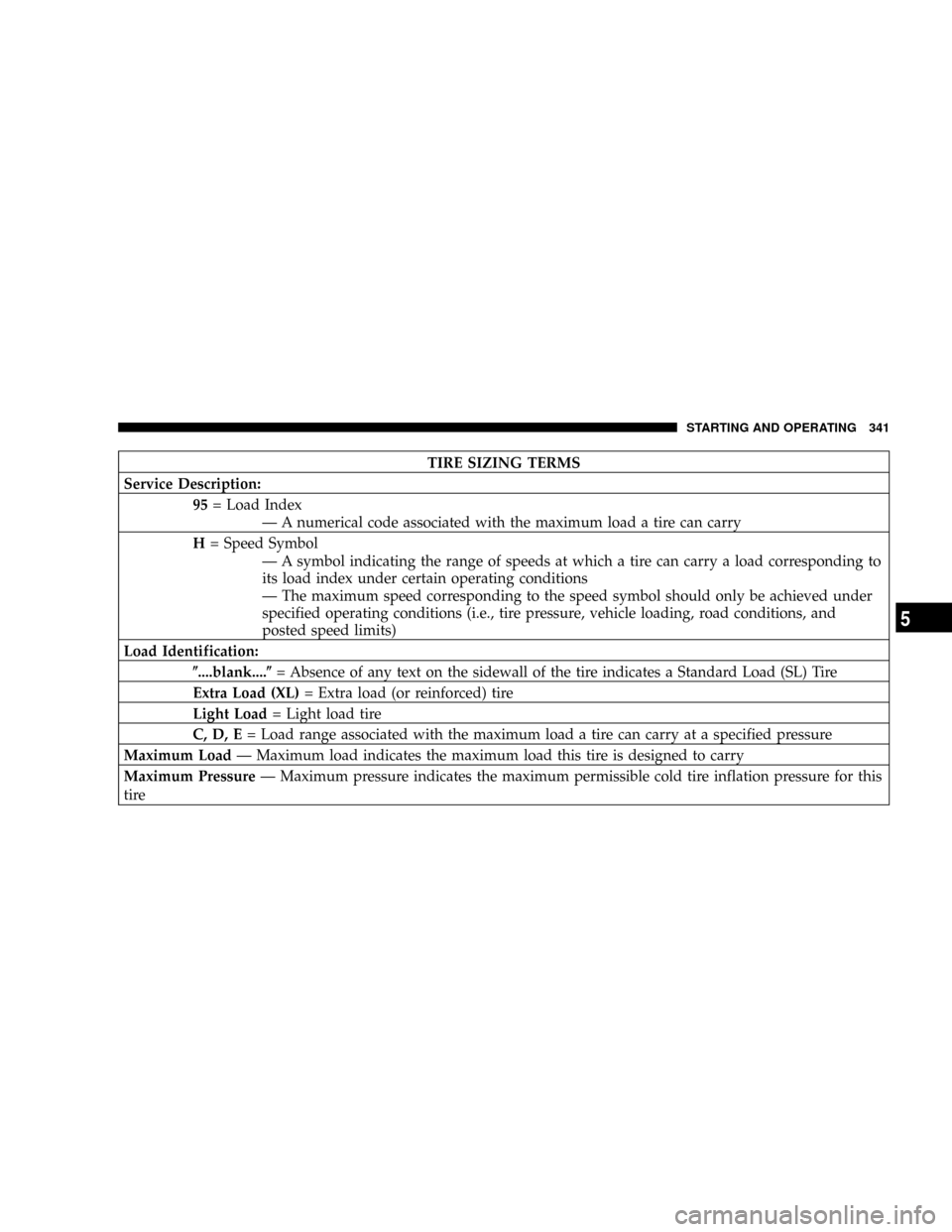
TIRE SIZING TERMS
Service Description:
95= Load Index
Ð A numerical code associated with the maximum load a tire can carry
H= Speed Symbol
Ð A symbol indicating the range of speeds at which a tire can carry a load corresponding to
its load index under certain operating conditions
Ð The maximum speed corresponding to the speed symbol should only be achieved under
specified operating conditions (i.e., tire pressure, vehicle loading, road conditions, and
posted speed limits)
Load Identification:
(....blank....(= Absence of any text on the sidewall of the tire indicates a Standard Load (SL) Tire
Extra Load (XL)= Extra load (or reinforced) tire
Light Load= Light load tire
C, D, E= Load range associated with the maximum load a tire can carry at a specified pressure
Maximum LoadÐ Maximum load indicates the maximum load this tire is designed to carry
Maximum PressureÐ Maximum pressure indicates the maximum permissible cold tire inflation pressure for this
tire
STARTING AND OPERATING 341
5
Page 356 of 554
These indicators are molded into the bottom of the tread
grooves. They will appear as bands when the tread depth
becomes 1/16 in (2 mm). When the tread is worn to the
tread wear indicators, the tire should be replaced.
Many states have laws requiring tire replacement at this
point.
Life of Tire
The service life of a tire is dependent upon varying
factors including, but not limited to:
²Driving style
²Tire pressure
²Distance driven
WARNING!
Tires and the spare tire should be replaced after six
years, regardless of the remaining tread. Failure to
follow this warning can result in sudden tire failure.
You could lose control and have an accident resulting
in serious injury or death.
Keep dismounted tires in a cool, dry place with as little
exposure to light as possible. Protect tires from contact
with oil, grease, and gasoline.
354 STARTING AND OPERATING
Page 359 of 554
![DODGE RAM 3500 GAS 2008 3.G Owners Manual SUPPLEMENTAL TIRE PRESSURE INFORMATION
Ð IF EQUIPPED
A light load vehicle condition is defined as two passen-
gers [150 lbs (68 kg) each] plus 200 lbs (91 kg) of cargo.
Cold tire inflation pressures](/img/12/5497/w960_5497-358.png "DODGE RAM 3500 GAS 2008 3.G Owners Manual SUPPLEMENTAL TIRE PRESSURE INFORMATION
Ð IF EQUIPPED
A light load vehicle condition is defined as two passen-
gers [150 lbs (68 kg) each] plus 200 lbs (91 kg) of cargo.
Cold tire inflation pressures")
SUPPLEMENTAL TIRE PRESSURE INFORMATION
Ð IF EQUIPPED
A light load vehicle condition is defined as two passen-
gers [150 lbs (68 kg) each] plus 200 lbs (91 kg) of cargo.
Cold tire inflation pressures for a lightly loaded vehicle
will be found on the face of the driver's door.
TIRE CHAINS
Use ªClass Sº chains on 1500 model Trucks, or other
traction aids that meet SAE Type ªSº specifications.
Use ªClass Uº chains on 2500/3500 model Trucks, or
other traction aids that meet SAE Type ªUº specifica-
tions.
NOTE:Chains must be the proper size for the vehicle,
as recommended by the chain manufacturer.
CAUTION!
To avoid damage to your vehicle, tires or chains, observe the
following precautions:
²Because of limited chain clearance between tires and other
suspension components, it is important that only chains in
good condition are used. Broken chains can cause serious
vehicle damage. Stop the vehicle immediately if noise occurs
that could suggest chain breakage. Remove the damaged parts
of the chain before further use.
²Install chains as tightly as possible and then retighten after
driving about 0.5 mile (0.8 km).
²Do not exceed 45 mph (72 km/h).
²Drive cautiously and avoid severe turns and large bumps,
especially with a loaded vehicle.
²Do not install tire chains on front wheels of 4x2 vehicles.
²Do not drive for a prolonged period on dry pavement.
²Observe the tire chain manufacturer's instructions on method
of installation, operating speed, and conditions for usage.
Always use the lower suggested operating speed of the chain
manufacturer if different than the speed recommended by the
manufacturer.
STARTING AND OPERATING 357
5
Page 364 of 554
TIRE PRESSURE MONITOR SYSTEM (TPMS) Ð IF
EQUIPPED
The Tire Pressure Monitoring System (TPMS) will warn
the driver of a low tire pressure based on the vehicle
recommended cold tire inflation placard pressure. The
placard pressure is defined on the Tire and Loading
Information label. The Tire and Loading Information
label is located on the drivers side B-pillar. Vehicles
equipped to be operated in either the ªmax load inflation
pressureº condition described on the Tire and Loading
Information label or the alternative ªlight load inflation
pressureº condition described on the Supplemental Tire
Pressure Information label, may also be equipped with a
reset switch to choose the appropriate TPMS low pres-
sure warning threshold levels based upon the vehicle
load condition. The Supplemental Tire Pressure Informa-
tion label is located on the rear face of the driver door.
Operation of the ªLight Loadº reset switch is described
later in this manual section.The tire pressure will vary with temperature by approxi-
mately 1 psi (6.9 kPa) for every 12ÉF (6.5ÉC). This means
that when the outside temperature decreases, the tire
pressure will decrease. Tire pressure should always be set
based on cold inflation tire pressure. This is defined as
the tire pressure after a vehicle has not been driven for
more than 3 hours, or driven less than 1 mile after a 3
hour period. For information on how to properly inflate
the vehicle's tires, refer to ºTire Pressureº under ªTires ±
General Informationº in this section. The tire pressure
will also increase as the vehicle is driven - this is normal
and there should be no adjustment for this increased
pressure.
The TPM System will warn the driver of a low tire
pressure if the tire pressure falls below the low pressure
warning threshold for any reason, including low tem-
perature effects, or natural pressure loss through the tire.
362 STARTING AND OPERATING
Page 366 of 554
CAUTION!
After inspecting or adjusting the tire pressure always
reinstall the valve stem cap. This will prevent mois-
ture and dirt from entering the valve stem, which
could damage the Tire Pressure Monitoring Sensor.
NOTE:
²The TPMS is not intended to replace normal tire care
and maintenance, nor to provide warning of a tire
failure or condition.
²The TPMS should not be used as a tire pressure gauge
while adjusting your tire pressure.
²Driving on a significantly under-inflated tire causes
the tire to overheat and can lead to tire failure.
Under-inflation also reduces fuel efficiency and tire
tread life, and may affect the vehicle's handling and
stopping ability.
²The TPMS is not a substitute for proper tire mainte-
nance, and it is the driver 's responsibility to maintain
correct tire pressure, even if under-inflation has not
reached the level to trigger illumination of the ªTire
Pressure Monitoring Telltale Light.º
²Seasonal temperature changes will affect tire pressure,
and the TPM system will monitor the actual tire
pressure in the tire.
364 STARTING AND OPERATING
Page 367 of 554
Tire Pressure Monitor System (TPMS) ªLight
Loadº Reset Switch Description ± If Equipped
WARNING!
Never operate your vehicle with the TPMS and tire
pressures set to the Light Load Inflation Pressure
settings if carrying more than two occupants (150 lbs
each) plus 200 pounds of cargo. The vehicle ªLight
Load Definitionº is found in the Supplemental Tire
Pressure Information Label which is located on the
rear face of the driver door. Failure to do so may
cause you to lose control resulting in an accident,
causing serious or fatal injury.The TPMS ªLight Loadº reset switch will allow the driver
to switch between the max load inflation pressure (cold)
low pressure warning threshold and the light load infla-
tion pressure (cold) low pressure warning threshold
depending on the vehicle's load condition. The Tire and
Loading Information label defines the recommended
front and rear cold tire inflation pressures for the vehicle
when operating in the Max Load condition. A Supple-
mental Tire Pressure Information label is also available
defining Light Load tire inflation pressures when oper-
ating in the Light Load condition. When the ªLight Loadº
reset switch LED is ON, the TPMS is using the light load
inflation pressure (cold) low inflation warning thresh-
olds.
STARTING AND OPERATING 365
5