towing DODGE RAM 3500 GAS 2008 3.G User Guide
[x] Cancel search | Manufacturer: DODGE, Model Year: 2008, Model line: RAM 3500 GAS, Model: DODGE RAM 3500 GAS 2008 3.GPages: 554, PDF Size: 9.93 MB
Page 209 of 554
27. Transmission Oil Temperature Warning Light
(Automatic Transmissions Only)
This light indicates that there is excessive trans-
mission fluid temperature that might occur
with severe usage such as trailer towing. It may
also occur when operating the vehicle in a high
torque converter slip condition, such as 4-wheel-drive
operation (e.g., snow plowing, off- road operation). If this
light comes on, stop the vehicle and run the engine at idle
or faster, with the transmission in NEUTRAL until the
light goes off.
28. Odometer/Trip Odometer Button
Press this button to toggle between the odometer and the
trip odometer display. Holding the button in resets the
trip odometer reading when in trip mode.
29. Fuel Gauge
Shows level of fuel in tank when ignition switch is in the
ON position.30. Low Fuel Warning Light
When the fuel level drops to 1/16 tank, the fuel
symbol will light and a single chime will sound.
NOTE:If your vehicle is equipped with an overhead
console module (CMTC), it is possible for DTE to display
ªLO FUELº before the low fuel warning light turns on in
the instrument cluster. This could occur because the low
fuel warning is set to a specified fuel tank volume and
DTE is an estimated distance calculation based on vehicle
fuel economy and remaining fuel tank volume.
Vehicle fuel tank volumes are as follows:
²26 gal (98 L) - 1500 short box models
²34 gal (128 L) - 1500/2500/3500 short box models
²35 gal (132 L) - 1500/2500/3500 long box models
UNDERSTANDING YOUR INSTRUMENT PANEL 207
4
Page 271 of 554
Window Fogging
Windows will fog on the inside when the humidity inside
the vehicle is high. This often occurs in mild or cool
temperatures when it's rainy or humid. In most cases
turning on the air conditioning (pressing the snowflake
button) will clear the fog. Adjust the temperature control,
air direction and blower speed to maintain comfort.
As the temperature gets colder it may be necessary to
direct air onto the windshield by using MIX Mode
position on the control. Adjust the temperature control
and blower speed to maintain comfort. Higher blower
speeds will reduce fogging. Interior fogging on the
windshield can be quickly removed by selecting the
defrost mode.
Regular cleaning of the inside of the windows with a
non-filming cleaning solution (vinegar and water works
very well) will help prevent contaminates (cigarettesmoke, perfumes, etc.) from sticking to the windows.
Contaminates increase the rate of window fogging.
Summer Operation
Air conditioned vehicles must be protected with a high
quality antifreeze coolant during summer to provide
proper corrosion protection and to raise the boiling point
of the coolant for protection against overheating. A 50 %
concentration is recommended. For proper coolant type,
refer to ªRecommended Fluids and Genuine Partsº in
Section 7.
When using the air conditioner in extremely heavy traffic
in hot weather, especially when towing a trailer, addi-
tional engine cooling may be required. If this situation is
encountered, operate the transmission in a lower gear to
increase engine RPM, coolant flow and fan speed. When
stopped in heavy traffic, it may be necessary to shift into
NEUTRAL and depress the accelerator slightly for fast
idle operation to increase coolant flow and fan speed.
UNDERSTANDING YOUR INSTRUMENT PANEL 269
4
Page 278 of 554
mFuel Requirements......................371
NReformulated Gasoline.................372
NGasoline/Oxygenate Blends..............373
NMMT In Gasoline.....................373
NMaterials Added To Fuel................374
NFuel System Cautions..................374
NCarbon Monoxide Warnings..............375
mAdding Fuel..........................375
NAdding Fuel (Gas Engines)..............375
mFlexible Fuel Ð If Equipped...............377
NE-85 General Information................377
NEthanol Fuel (E-85)....................379
NFuel Requirements....................379NSelection Of Engine Oil For Flexible Fuel
Vehicles (E-85) And Gasoline Vehicles.......380
NStarting............................380
NCruising Range.......................380
NReplacement Parts.....................381
mVehicle Loading........................381
NCertification Label.....................381
mTrailer Towing.........................385
NCommon Towing Definitions.............385
NTrailer Hitch Classification...............389
NTrailer Towing Weights
(Maximum Trailer Weight Ratings).........390
NTrailer And Tongue Weight..............390
NTowing Requirements..................392
276 STARTING AND OPERATING
Page 279 of 554
NTowing Tips.........................398
NTrailer Towing Mirrors Ð If Equipped......400
mSnowplow............................401
N1500 Models (Light Duty)...............401
NBefore Plowing.......................403
NSnowplow Model Prep Package Availability . . 403
NOver The Road Operation With Snowplow
Attached...........................404
NMethods For Removing Snow............404NOperating Tips.......................404
NGeneral Maintenance...................405
mRecreational Towing (Behind Motorhome, Etc.) . . 406
NRecreational Towing ±
2-Wheel Drive Models..................406
NRecreational Towing ±
4-Wheel Drive Models..................406
mEquipment Identification Plate.............413
STARTING AND OPERATING 277
5
Page 289 of 554
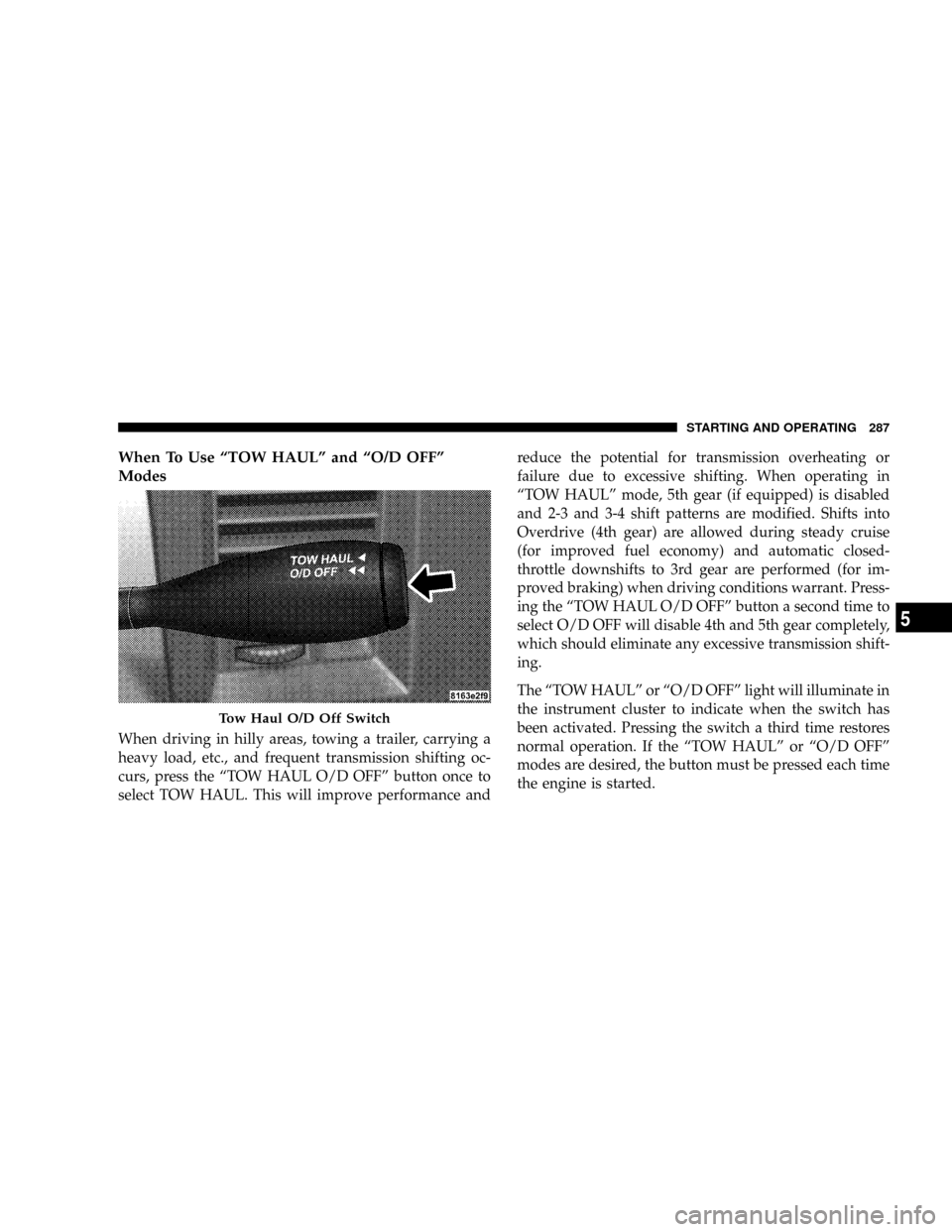
When To Use ªTOW HAULº and ªO/D OFFº
Modes
When driving in hilly areas, towing a trailer, carrying a
heavy load, etc., and frequent transmission shifting oc-
curs, press the ªTOW HAUL O/D OFFº button once to
select TOW HAUL. This will improve performance andreduce the potential for transmission overheating or
failure due to excessive shifting. When operating in
ªTOW HAULº mode, 5th gear (if equipped) is disabled
and 2-3 and 3-4 shift patterns are modified. Shifts into
Overdrive (4th gear) are allowed during steady cruise
(for improved fuel economy) and automatic closed-
throttle downshifts to 3rd gear are performed (for im-
proved braking) when driving conditions warrant. Press-
ing the ªTOW HAUL O/D OFFº button a second time to
select O/D OFF will disable 4th and 5th gear completely,
which should eliminate any excessive transmission shift-
ing.
The ªTOW HAULº or ªO/D OFFº light will illuminate in
the instrument cluster to indicate when the switch has
been activated. Pressing the switch a third time restores
normal operation. If the ªTOW HAULº or ªO/D OFFº
modes are desired, the button must be pressed each time
the engine is started.
Tow Haul O/D Off Switch
STARTING AND OPERATING 287
5
Page 292 of 554

Fully depress the clutch pedal before shifting gears. As
you release the clutch pedal, lightly depress the accelera-
tor pedal.
2500 and 3500 models are equipped with the G56 manual
transmission. This transmission has a ªcreeperº 1st gear
which should be used to start from a standing position
when carrying a payload or towing a trailer. Damage to
the clutch can result from starting in 2nd or 3rd gear with
a loaded vehicle. An unloaded vehicle may be launched
in 2nd gear. Use each gear in numerical order ± do not
skip a gear.Recommended Vehicle Shift Speeds
To utilize your manual transmission efficiently for both
fuel economy and performance, it should be upshifted as
listed in recommended shift speed chart. Shift at the
vehicle speeds listed for acceleration. When heavily
loaded or pulling a trailer these recommended up-shift
speeds may not apply.
Maximum Recommended Up-shift Speeds
En-
gineModel L to 2 2 to 3 3 to 4 4 to 5 5 to 6
5.7L2500/
350015
mph
(24
km/h)25
mph
(40
km/h)40
mph
(64
km/h)45
mph
(72
km/h)50
mph
(81
km/h)
290 STARTING AND OPERATING
Page 298 of 554

WARNING!
You or others could be injured if you leave the
vehicle unattended with the transfer case in the
NEUTRAL position without first fully engaging the
parking brake. The transfer case NEUTRAL position
disengages both the front and rear driveshafts from
the powertrain and will allow the vehicle to move
regardless of the transmission position. The parking
brake should always be applied when the driver is
not in the vehicle.
For additional information on the appropriate use of each
transfer case mode position see the information below:
2H
Rear Wheel Drive High Range - Normal street and
highway driving. Dry hard surfaced roads.
4H
4-Wheel Drive High Range - Locks the front and rear
driveshafts together. Forces the front and rear wheels to
rotate at the same speed. Additional traction for loose,
slippery road surfaces only.
N
NEUTRAL - Disengages both the front and rear drive-
shafts from the powertrain. To be used for flat towing
behind another vehicle. See Recreational Towing for
more information.
4L
4-Wheel Drive Low Range - Low speed 4-wheel drive.
Locks the front and rear driveshafts together. Forces the
front and rear wheels to rotate at the same speed.
Additional traction and maximum pulling power for
loose, slippery road surfaces only. Do not exceed 25 mph
(40 km/h).
296 STARTING AND OPERATING
Page 302 of 554
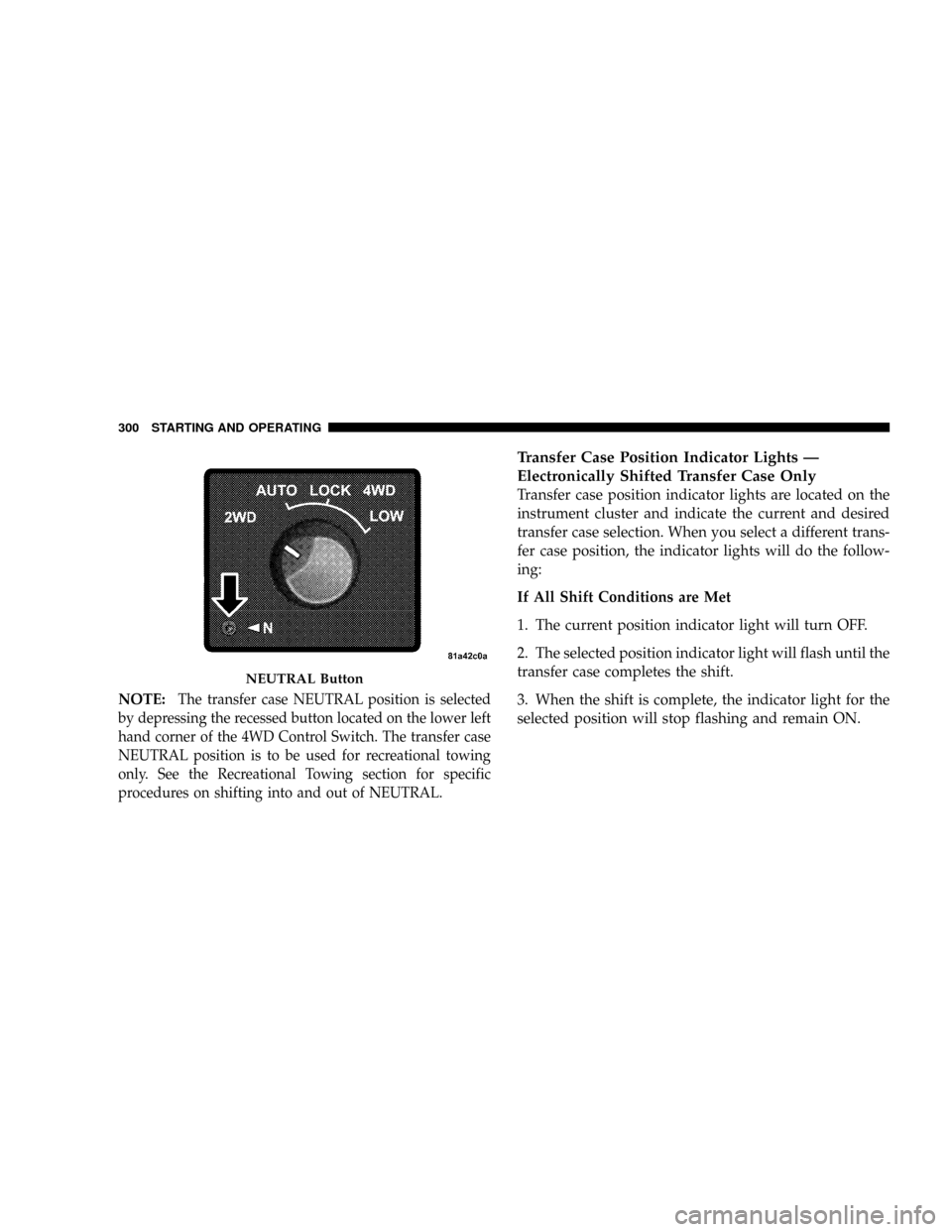
NOTE:The transfer case NEUTRAL position is selected
by depressing the recessed button located on the lower left
hand corner of the 4WD Control Switch. The transfer case
NEUTRAL position is to be used for recreational towing
only. See the Recreational Towing section for specific
procedures on shifting into and out of NEUTRAL.
Transfer Case Position Indicator Lights Ð
Electronically Shifted Transfer Case Only
Transfer case position indicator lights are located on the
instrument cluster and indicate the current and desired
transfer case selection. When you select a different trans-
fer case position, the indicator lights will do the follow-
ing:
If All Shift Conditions are Met
1. The current position indicator light will turn OFF.
2. The selected position indicator light will flash until the
transfer case completes the shift.
3. When the shift is complete, the indicator light for the
selected position will stop flashing and remain ON.
NEUTRAL Button
300 STARTING AND OPERATING
Page 305 of 554

For additional information on the appropriate use of each
transfer case mode position see the information below:
2WD
Rear-Wheel Drive High Range - Normal street and
highway driving. Dry hard surfaced roads.
4WD AUTO
Automatic 4±wheel drive sends power to the rear wheels.
4±wheel drive will be automatically engaged when the
vehicle senses a loss of traction. Additional traction for
varying road conditions.
4WD LOCK
4-Wheel Drive Lock Range - Locks the front and rear
driveshafts together. Forces the front and rear wheels to
rotate at the same speed. Additional traction for loose,
slippery road surfaces only.4WD LOW
4-Wheel Drive Low Range - Low speed 4-wheel drive.
Locks the front and rear driveshafts together. Forces the
front and rear wheels to rotate at the same speed.
Additional traction and maximum pulling power for
loose, slippery road surfaces only. Do not exceed 25 mph
(40 km/h).
N
NEUTRAL - Disengages both the front and rear drive-
shafts from the powertrain. To be used for flat towing
behind another vehicle. See Recreational Towing for
more information.
STARTING AND OPERATING 303
5
Page 309 of 554

This Electronically Shifted transfer case provides four
mode positions: 2 (rear)-wheel drive high range, 4-wheel
drive lock range, 4-wheel drive low range, and NEUTRAL.
The Electronically Shifted transfer case is designed to be
driven in the 2-wheel drive position (2WD) for normal
street and highway conditions (dry, hard surfaced roads).
When additional traction is required, the transfer case
4WD LOCK and 4WD LOW positions can be used to lock
the front and rear driveshafts together and force the front
and rear wheels to rotate at the same speed. This is
accomplished by rotating the 4WD Control Switch to the
desired position - see Shifting Procedure section for
specific shifting instructions. The 4WD LOCK and 4WD
LOW positions are designed for loose, slippery road
surfaces only. Driving in the 4WD LOCK and 4WD LOW
positions on dry hard surfaced roads may cause in-
creased tire wear and damage to the driveline compo-
nents.NOTE:The transfer case NEUTRAL position is selected
by depressing the recessed button located on the lower
left hand corner of the 4WD Control Switch. The transfer
case NEUTRAL position is to be used for recreational
towing only. Refer to ªRecreational Towingº in this
section.
STARTING AND OPERATING 307
5