engine DODGE RAM 5500 CHASSIS CAB 2008 3.G Owners Manual
[x] Cancel search | Manufacturer: DODGE, Model Year: 2008, Model line: RAM 5500 CHASSIS CAB, Model: DODGE RAM 5500 CHASSIS CAB 2008 3.GPages: 528, PDF Size: 7.84 MB
Page 306 of 528

CAUTION!
²Always check the depth of the standing water before
driving through it. Never drive through standing water
that is deeper than the bottom of the tire rims mounted
on the vehicle.
²Determine the condition of the road or the path that is
under water and if there are any obstacles in the way
before driving through the standing water.
²Do not exceed 5 mph (8 km/h) when driving through
standing water. This will minimize wave effects.
²Driving through standing water may cause damage to
your vehicle's drivetrain components. Always inspect
your vehicle's fluids (i.e. engine oil, transmission, axle,
etc.) for signs of contamination (i.e. fluid that is milky or
foamy in appearance) after driving through standing
water. Do not continue to operate the vehicle if any fluid
appears contaminated, as this may result in further
damage. Such damage is not covered by the new vehicle
limited warranty.
²Getting water inside your vehicle's engine can cause it to
lockup and stall out and cause serious internal damage to
the engine. Such damage is not covered by the new
vehicle limited warranty.
WARNING!
²Driving through standing water limits your vehi-
cle's traction capabilities. Do not exceed 5 mph (8
km/h) when driving through standing water.
²Driving through standing water limits your vehi-
cle's braking capabilities, which increases stop-
ping distances. Therefore, after driving through
standing water, drive slowly and lightly press on
the brake pedal several times to dry the brakes.
²Getting water inside your vehicle's engine can
cause it to lockup and stall out and leave you
stranded.
²Failure to follow these warnings may result in
injuries that are serious or fatal to you, your
passengers, and others around you.
306 STARTING AND OPERATING
Page 309 of 528
WARNING!
²Always fully apply the parking brake when leav-
ing your vehicle, or it may roll and cause damage
or injury. Also be certain to leave an automatic
transmission in Park, a manual transmission in
Reverse or First gear. Failure to do so may allow
the vehicle to roll and cause damage or injury.
²Never leave children alone in a vehicle. Leaving
children in a vehicle unattended is dangerous for a
number of reasons. A child or others could be
seriously or fatally injured. Don't leave the keys in
the ignition. A child could operate power win-
dows, other controls, or move the vehicle.
²Be sure the parking brake is fully disengaged
before driving, failure to do so can lead to brake
problems due to excessive heating of the rear
brakes.When parking on a hill, turn the front wheels toward the
curb on a downhill grade and away from the curb on an
uphill grade.
The parking brake should always be applied whenever
the driver is not in the vehicle.
BRAKE SYSTEM
If power assist is lost for any reason (for example,
repeated brake applications with the engine off), the
brakes will still function. However, you will experience a
substantial increase in braking effort to stop the vehicle.
If either the front or rear hydraulic systems lose normal
capability, the remaining system will still function with
some loss of overall braking effectiveness. This will be
evident by increased pedal travel during application,
greater pedal force required to slow or stop, and activa-
tion of the BRAKE warning lamp and the ABS lamp (if
equipped) during brake use.
STARTING AND OPERATING 309
5
Page 337 of 528
ENGINE RUNAWAY
WARNING!
In case of engine runaway due to flammable fumes
from gasoline spills or turbocharger oil leaks being
sucked into the engine do the following to help avoid
personal injury and/or vehicle damage:
1. Shut off engine ignition switch.
2. Using a CO
2or dry chemical type fire extin-
guisher, direct the spray from the fire extinguisher
into the grille on the passenger side so that the spray
enters the engine air intake.
The inlet for the engine air intake is located behind
the passenger side headlamp and receives air
through the grille
FUEL REQUIREMENTS
Fuel Requirements (5.7L Gas Engines)
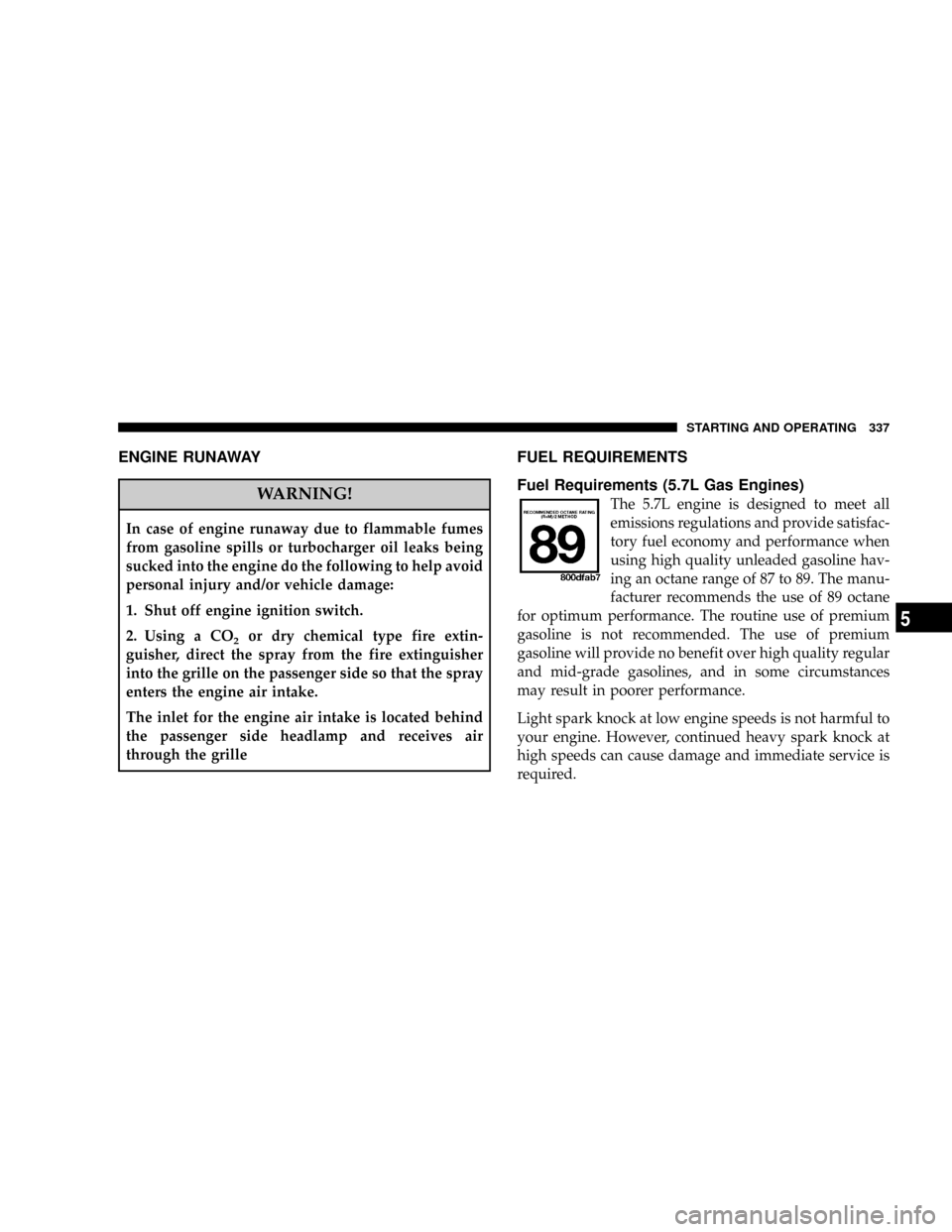
The 5.7L engine is designed to meet all
emissions regulations and provide satisfac-
tory fuel economy and performance when
using high quality unleaded gasoline hav-
ing an octane range of 87 to 89. The manu-
facturer recommends the use of 89 octane
for optimum performance. The routine use of premium
gasoline is not recommended. The use of premium
gasoline will provide no benefit over high quality regular
and mid-grade gasolines, and in some circumstances
may result in poorer performance.
Light spark knock at low engine speeds is not harmful to
your engine. However, continued heavy spark knock at
high speeds can cause damage and immediate service is
required.
STARTING AND OPERATING 337
5
Page 338 of 528

Poor quality gasoline can cause problems such as hard
starting, stalling and hesitations. If you experience these
symptoms, try another brand of ªregularº gasoline be-
fore considering service for the vehicle.
Over 40 auto manufacturers world-wide have issued and
endorsed consistent gasoline specifications (the World-
wide Fuel Charter, WWFC) to define fuel properties
necessary to deliver enhanced emissions, performance
and durability for your vehicle. We recommend the use
of gasolines that meet the WWFC specifications if they
are available.
Reformulated Gasoline
Many areas of the country require the use of cleaner
burning gasoline referred to as ªReformulated Gasoline.º
Reformulated gasolines contain oxygenates, and are spe-
cifically blended to reduce vehicle emissions and im-
prove air quality.We strongly support the use of reformulated gasolines.
Properly blended reformulated gasolines will provide
excellent performance and durability for the engine and
fuel system components.
Gasoline/Oxygenate Blends
Some fuel suppliers blend unleaded gasoline with oxy-
genates such as 10% ethanol, MTBE and ETBE. Oxygen-
ates are required in some areas of the country during the
winter months to reduce carbon monoxide emissions.
Fuels blended with these oxygenates may be used in
your vehicle.
CAUTION!
DO NOT use gasolines containing Methanol or E85
Ethanol. Use of these blends may result in starting
and driveability problems and may damage critical
fuel system components.
338 STARTING AND OPERATING
Page 340 of 528

²The use of leaded gas is prohibited by Federal law.
Using leaded gasoline can impair engine performance,
damage the emission control system.
²An out-of-tune engine, or certain fuel or ignition
malfunctions, can cause the catalytic converter to
overheat. If you notice a pungent burning odor or
some light smoke, your engine may be out of tune or
malfunctioning and may require immediate service.
Contact your dealer for service assistance.
²When pulling a heavy load or driving a fully loaded
vehicle when the humidity is low and the temperature
is high, use a premium unleaded fuel to help prevent
spark knock. If spark knock persists, lighten the load,
or engine piston damage may result.
²The use of fuel additives which are now being sold as
octane enhancers is not recommended. Many of these
products contain high concentrations of methanol.Fuel system damage or vehicle performance problems
resulting from the use of such fuels or additives is not
the responsibility of the manufacturer.
NOTE:Intentional tampering with emissions control
systems can result in civil penalties being assessed
against you.
Carbon Monoxide Warnings
WARNING!
Carbon monoxide (CO) in exhaust gases is deadly.
Follow the precautions below to prevent carbon
monoxide poisoning:
²Do not inhale exhaust gases. They contain carbon
monoxide, a colorless and odorless gas which can kill.
Never run the engine in a closed area, such as a
garage, and never sit in a parked vehicle with the
340 STARTING AND OPERATING
Page 341 of 528

engine running for an extended period. If the vehicle is
stopped in an open area with the engine running for
more than a short period, adjust the ventilation system
to force fresh, outside air into the vehicle.
²Guard against carbon monoxide with proper mainte-
nance. Have the exhaust system inspected every time
the vehicle is raised. Have any abnormal conditions
repaired promptly. Until repaired, drive with all side
windows fully open.
²Keep the liftgate closed when driving your vehicle to
prevent carbon monoxide and other poisonous ex-
haust gases from entering the vehicle.
Fuel Requirements (6.7L Diesel Engines)
Use good quality diesel fuel from a reputable supplier in
your vehicle. Federal law requires that you must fuel this
vehicle with Ultra Low Sulfur Highway Diesel fuel (15
ppm Sulfur maximum) and prohibits the use of Low
Sulfur Highway Diesel fuel (500 ppm Sulfur maximum)to avoid damage to the emissions control system. For
most year-round service, No. 2 diesel fuel meeting ASTM
specification D-975 Grade S15 will provide good perfor-
mance. If the vehicle is exposed to extreme cold (below
20ÉF or -7ÉC), or is required to operate at colder-than-
normal conditions for prolonged periods, use climatized
No. 2 diesel fuel or dilute the No. 2 diesel fuel with 50%
No. 1 diesel fuel. This will provide better protection from
fuel gelling or wax-plugging of the fuel filters.
WARNING!
Do not use alcohol or gasoline as a fuel blending
agent. They can be unstable under certain conditions
and hazardous or explosive when mixed with diesel
fuel.
STARTING AND OPERATING 341
5
Page 342 of 528

Diesel fuel is seldom completely free of water. To prevent
fuel system trouble, drain the accumulated water from
thefuel/water separator using the fuel/water separator
drain provided. If you buy good quality fuel and follow
the cold weather advice above, fuel conditioners should
not be required in your vehicle. If available in your area,
a high cetane ªpremiumº diesel fuel may offer improved
cold-starting and warm-up performance.
Fuel Specifications
The Cummins Turbocharged, Charge Air Cooled, Diesel
engine has been developed to take advantage of the high
energy content and generally lower cost No. 2 Ultra Low
Sulfur diesel fuel or No. 2 Ultra Low Sulfur climatized
diesel fuels. Experience has shown that it also operates
on No. 1 Ultra Low Sulfur diesel fuels or other fuels
within specification.NOTE:A maximum blend of 5% biodiesel meeting
ASTM specification D-6751 may be used with your
Cummins Diesel equipped vehicle.
NOTE:In addition, commercially available fuel addi-
tives are not necessary for the proper operation of your
Cummins Diesel equipped vehicle.
NOTE:No. 1 Ultra Low Sulfur diesel fuel should only
be used where extended arctic conditions (-10ÉF or -23ÉC)
exist.
342 STARTING AND OPERATING
Page 343 of 528

ADDING FUEL
Adding Fuel (Gas Engines)
CAUTION!
Damage to the fuel system or emission control sys-
tem could result from using an improper fuel tank
filler tube cap (gas cap). A poorly fitting cap could let
impurities into the fuel system. Also a poorly fitted
after-market cap can cause the MIL (Malfunction
Indicator Light) to illuminate, due to fuel vapors
escaping from the system.
CAUTION!
A poorly fitting gas cap may cause the Malfunction
Indicator Light to turn on.
CAUTION!
To avoid fuel spillage and overfilling, do not ªtop
offº the fuel tank after filling.
NOTE:When the fuel nozzle ªclicksº or shuts off, the
fuel tank is full.
WARNING!
²Never have any smoking materials lit in or near
the vehicle when the gas cap is removed or the
tank filled.
²Never add fuel to the vehicle when the engine is
running. This is in violation of most state and
federal fire regulations and will cause the Mal-
function Indicator Light to turn on.
STARTING AND OPERATING 343
5
Page 345 of 528

Adding Fuel (Diesel Engines)
CAUTION!
To avoid fuel spillage and overfilling, do not ªtop
offº the fuel tank after filling.
NOTE:
²When the fuel nozzle ªclicksº or shuts off, the fuel
tank is full.
²Tighten the gas cap until you hear a ªclickingº sound.
This is an indication that the gas cap is properly
tightened.
²Make sure that the gas cap is tightened each time the
vehicle is refueled.
WARNING!
A fire may result if fuel is pumped into a portable
container that is on a truck bed. You could be burned.
Always place fuel containers on the ground while
filling.
Fuel Filler Cap (Gas Cap)
If the gas cap is lost or damaged, be sure the replacement
cap is for use with this vehicle.
CAUTION!
Damage to the fuel system or emission control sys-
tem could result from using an improper fuel tank
filler tube cap (gas cap). A poorly fitting cap could let
impurities into the fuel system.
STARTING AND OPERATING 345
5
Page 346 of 528

WARNING!
²Never have any smoking materials lit in or near
the vehicle when the gas cap is removed or the
tank filled.
²Never add fuel to the vehicle when the engine is
running.
Avoid Using Contaminated Fuel
Fuel that is contaminated by water or dirt can cause
severe damage to the engine fuel system. Proper main-
tenance of the engine fuel filter and fuel tank is essential.
(See Section 7 for Maintenance Procedures).
NOTE:Climatized Ultra Low Sulfur diesel fuel is a
blend of Number 2 Ultra Low Sulfur and Number 1 Ultra
Low Sulfur Diesel fuel which reduces the temperature at
which wax crystals form in the fuel.
Bulk Fuel Storage
If you store quantities of fuel, good maintenance of the
stored fuel is also essential. Fuel contaminated with
water will promote the growth of ªmicrobes.º These
microbes form ªslimeº that will clog fuel filters and lines.
Drain condensation from the supply tank and change the
line filter on a regular basis.
NOTE:When a diesel engine is allowed to run out of
fuel, air is pulled into the fuel system.
You may try priming as described below. However, if the
engine will not start, refer to the fuel priming procedure
in the Service Manual or have the vehicle towed to an
authorized Dodge dealer.
346 STARTING AND OPERATING