wheel DODGE RAM 5500 CHASSIS CAB 2008 3.G Owner's Manual
[x] Cancel search | Manufacturer: DODGE, Model Year: 2008, Model line: RAM 5500 CHASSIS CAB, Model: DODGE RAM 5500 CHASSIS CAB 2008 3.GPages: 528, PDF Size: 7.84 MB
Page 249 of 528

NStationary Mode......................302
NMobile Mode........................303
NPower Take Off ± Aftermarket Installation....304
mDriving On Slippery Surfaces..............304
mDriving Through Water..................305
NFlowing/Rising Water..................305
NShallow Standing Water.................305
mDriving Off-Road.......................307
mParking Brake.........................308
mBrake System..........................309
NBrake Noise.........................310
NFour-Wheel Anti-Lock Brake System........310
mPower Steering........................312mTire Safety Information...................313
NTire Markings........................313
NTire Identification Number (TIN)..........317
NTire Loading And Tire Pressure...........318
mTires Ð General Information...............322
NTire Pressure.........................322
NTire Inflation Pressures.................323
NRadial-Ply Tires......................328
NLimited Use Spare Ð If Equipped.........329
NTire Spinning........................329
NTread Wear Indicators..................330
NLife Of Tire.........................331
NReplacement Tires.....................331
STARTING AND OPERATING 249
5
Page 250 of 528

NAlignment And Balance.................332
mSupplemental Tire Pressure Information Ð If
Equipped............................333
mTire Chains...........................333
mSnow Tires...........................334
mTire Rotation Recommendations............335
NDual Rear Wheels.....................336
mEngine Runaway.......................337
mFuel Requirements......................337
NFuel Requirements (5.7L Gas Engines).......337
NFuel Requirements (6.7L Diesel Engines).....341
mAdding Fuel..........................343
NAdding Fuel (Gas Engines)..............343NAdding Fuel (Diesel Engines).............345
mVehicle Loading........................347
NCertification Label.....................347
mTrailer Towing.........................351
NCommon Towing Definitions.............351
NTrailer Hitch Classification...............355
NTrailer Towing Weights (Maximum Trailer
Weight Ratings)......................356
NTrailer And Tongue Weight..............356
NTowing Requirements..................357
NTowing Tips.........................362
NTrailer Towing Mirrors Ð If Equipped......364
mSnowplow............................365
250 STARTING AND OPERATING
Page 251 of 528

NBefore Plowing.......................366
NSnowplow Prep Package Model Availability . . 366
NOver The Road Operation With Snowplow
Attached...........................367
NMethods For Removing Snow............367
NOperating Tips.......................368
NGeneral Maintenance...................368mRecreational Towing
(Behind Motorhome, Etc.).................369
NRecreational Towing ± 2 Wheel Drive
Models............................369
NRecreational Towing ± 4 Wheel Drive
Models............................369
STARTING AND OPERATING 251
5
Page 271 of 528

WARNING!
Do not use the Exhaust Brake feature when driving
in icy or slippery conditions as the increased engine
braking can cause the rear wheels to slide and the
vehicle to swing around with the possible loss of
vehicle control, which may cause an accident possi-
bly resulting in personal injury or death.
Exhaust Brake Switch
STARTING AND OPERATING 271
5
Page 274 of 528

lever out of park (P) position (Brake Interlock System). To
drive, move the selector lever from Park or Neutral to the
desired drive position. Pull the selector lever toward you
when shifting into Reverse, Second, First or Park, or
when shifting out of Park.
Gear Ranges
DO NOT race the engine when shifting from Park or
Neutral position into another gear range.
ªPº Park
This gear position supplements the parking brake by
locking the transmission. The engine can be started in
this range. Never use Park while the vehicle is in motion.
Apply the parking brake when leaving the vehicle in this
range. Always apply parking brake first, then place the
selector in Park position. On 4-wheel drive vehicles be
sure that the transfer case is in a drive position!
WARNING!
Never use Park position on an automatic transmis-
sion as a substitute for the parking brake. Always
apply parking brake fully when parked to guard
against vehicle movement and possible injury or
damage.
WARNING!
Your vehicle could move and injure you and others if
it is not completely in P (Park). Check by trying to
move the gearshift lever back and forth without first
pulling it toward you after you have set it in P. Make
sure it is in Park before leaving the vehicle.
274 STARTING AND OPERATING
Page 280 of 528

ªPº Park
This gear position supplements the parking brake by
locking the transmission. The engine can be started in
this range. Never use Park while the vehicle is in motion.
Apply the parking brake when leaving the vehicle in this
range. Always apply parking brake first, then place the
selector in Park position. On 4-wheel drive vehicles be
sure that the transfer case is in a drive position!
WARNING!
Never use Park position on an automatic transmis-
sion as a substitute for the parking brake. Always
apply parking brake fully when parked to guard
against vehicle movement and possible injury or
damage.
WARNING!
Your vehicle could move and injure you and others if
it is not completely in P (Park). Check by trying to
move the gearshift lever back and forth without first
pulling it toward you after you have set it in P. Make
sure it is in Park before leaving the vehicle.
280 STARTING AND OPERATING
Page 284 of 528

reduce the potential for transmission overheating or
failure due to excessive shifting. When operating in
ªTOW HAULº mode, 6th gear (if equipped) is disabled
and 2-3 and 3-4 and 4±5 shift patterns are modified. Shifts
into Overdrive (5th gear) are allowed during steady
cruise (for improved fuel economy). Pressing the ªTOW
HAUL O/D OFFº button a second time to select O/D
OFF will disable 5th and 6th gear completely, which
should eliminate any excessive transmission shifting.
The ªTOW HAULº or ªO/D OFFº light will illuminate in
the instrument cluster to indicate when the switch has
been activated. Pressing the switch a third time restores
normal operation. If the ªTOW HAULº or ªO/D OFFº
modes are desired, the button must be pressed each time
the engine is started.WARNING!
Do not use the Tow/Haul feature when driving in icy
or slippery conditions as the increased engine brak-
ing can cause the rear wheels to slide and the vehicle
to swing around with the possible loss of vehicle
control, which may cause an accident possibly result-
ing in personal injury or death.
When To Lock Out Overdrive
When driving in hilly areas, towing a trailer, carrying a
heavy load, etc., and frequent 6±5±6 or 5±4±5 transmis-
sion shifting occurs, press the ªTOW/HAULº button.
This will improve performance and reduce the potential
for transmission overheating or failure due to excessive
shifting.
284 STARTING AND OPERATING
Page 289 of 528
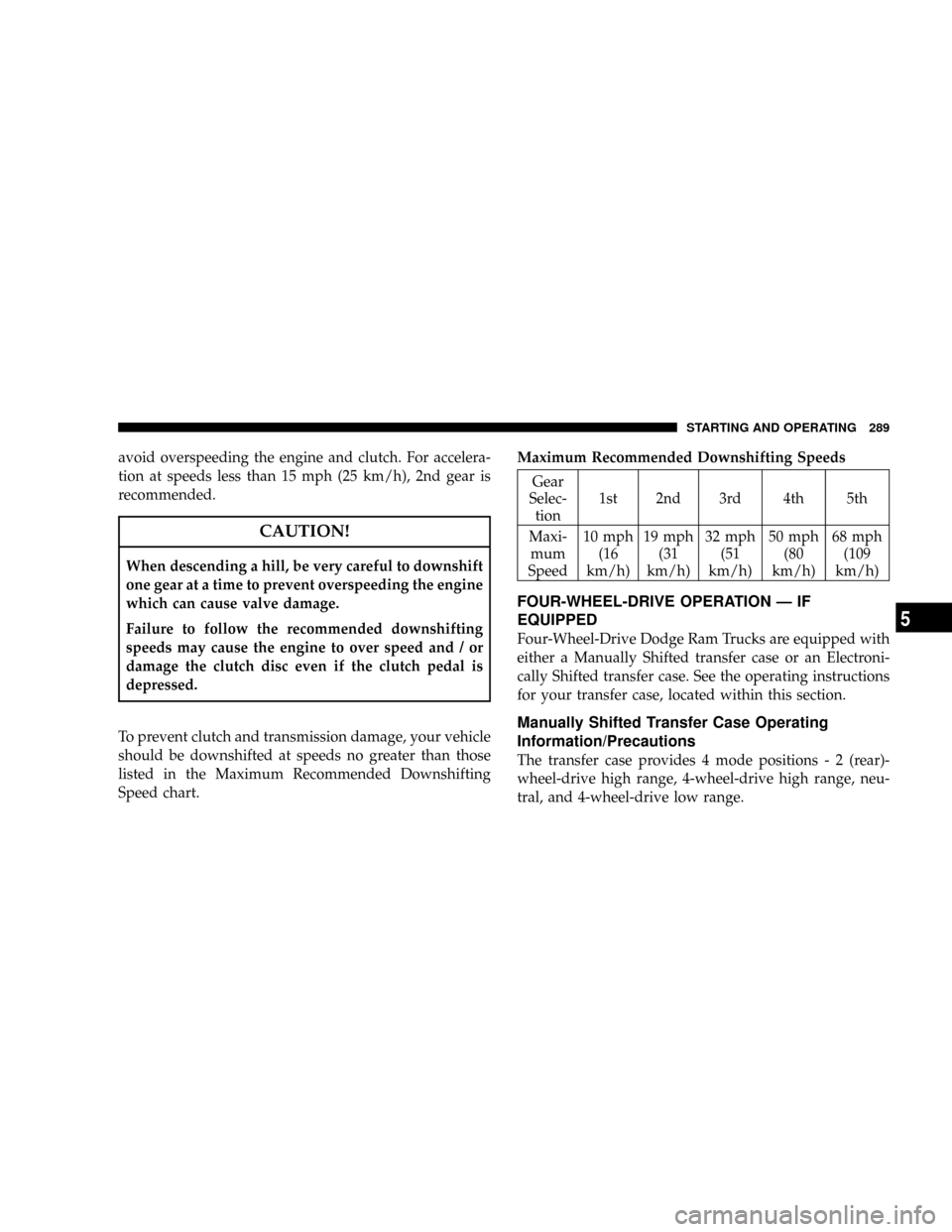
avoid overspeeding the engine and clutch. For accelera-
tion at speeds less than 15 mph (25 km/h), 2nd gear is
recommended.
CAUTION!
When descending a hill, be very careful to downshift
one gear at a time to prevent overspeeding the engine
which can cause valve damage.
Failure to follow the recommended downshifting
speeds may cause the engine to over speed and / or
damage the clutch disc even if the clutch pedal is
depressed.
To prevent clutch and transmission damage, your vehicle
should be downshifted at speeds no greater than those
listed in the Maximum Recommended Downshifting
Speed chart.Maximum Recommended Downshifting Speeds
Gear
Selec-
tion1st 2nd 3rd 4th 5th
Maxi-
mum
Speed10 mph
(16
km/h)19 mph
(31
km/h)32 mph
(51
km/h)50 mph
(80
km/h)68 mph
(109
km/h)
FOUR-WHEEL-DRIVE OPERATION Ð IF
EQUIPPED
Four-Wheel-Drive Dodge Ram Trucks are equipped with
either a Manually Shifted transfer case or an Electroni-
cally Shifted transfer case. See the operating instructions
for your transfer case, located within this section.
Manually Shifted Transfer Case Operating
Information/Precautions
The transfer case provides 4 mode positions-2(rear)-
wheel-drive high range, 4-wheel-drive high range, neu-
tral, and 4-wheel-drive low range.
STARTING AND OPERATING 289
5
Page 290 of 528

This transfer case is intended to be driven in the 2-wheel-
drive position (2H) for normal street and highway con-
ditions such as dry hard surfaced roads.
When additional traction is required the transfer case 4H
and 4L positions can be used to lock the front and rear
driveshafts together and force the front and rear wheels
to rotate at the same speed. This is accomplished by
simply moving the shift lever to the desired positions.
The 4H and 4L positions are intended for loose, slippery
road surfaces only. Driving in the 4H and 4L positions on
dry hard surfaced roads may cause increased tire wear
and damage to the driveline components.
The 4-wheel-drive light (4WD), located in the instrument
cluster, alerts the driver that the vehicle is in 4-wheel
drive and that the front and rear driveshafts are locked
together. This light illuminates when the transfer case is
shifted to either the 4H or 4L positions. There is no light
for the 2H or N (Neutral) positions.When operating your vehicle in 4L, the engine speed is
approximately three times that of the 2H or 4H positions
at a given road speed. Take care not to overspeed the
engine and do not exceed 25 mph (40 km/h).
Proper operation of 4-wheel-drive vehicles depends on
tires of equal size, type and circumference on each wheel.
Any difference will adversely affect shifting and can
cause damage to the transfer case.
NOTE:Do not attempt to make a shift while only the
front or rear wheels are spinning. The transfer case is not
equipped with a synchronizer and therefore the front and
rear driveshaft speeds must be equal for the shift to take
place. Shifting while only the front or rear wheels are
spinning can cause damage to the transfer case.
Because 4-wheel drive provides improved traction, there
is a tendency to exceed safe turning and stopping speeds.
Do not go faster than road conditions permit.
290 STARTING AND OPERATING
Page 291 of 528

NOTE:Delayed shifts out of four-wheel drive may be
experienced due to uneven tire wear, low or uneven tire
pressures, excessive vehicle loading, or cold tempera-
tures.
WARNING!
You or others could be injured if you leave the
vehicle unattended with the transfer case in the
Neutral (N) position without first fully engaging the
parking brake. The transfer case Neutral (N) position
disengages both the front and rear driveshafts from
the powertrain and will allow the vehicle to move
regardless of the transmission position. The parking
brake should always be applied when the driver is
not in the vehicle.For additional information on the appropriate use of each
transfer case mode position see the information below:
2H
Rear Wheel Drive High Range - Normal street and
highway driving. Dry hard surfaced roads.
4H
4-Wheel-Drive High Range - Locks the front and rear
driveshafts together. Forces the front and rear wheels to
rotate at the same speed. Additional traction for loose,
slippery road surfaces only.
N
Neutral - Disengages both the front and rear driveshafts
from the powertrain. To be used for flat towing behind
another vehicle. See Recreational Towing for more infor-
mation.
STARTING AND OPERATING 291
5