service DODGE RAM 5500 CHASSIS CAB 2008 3.G Repair Manual
[x] Cancel search | Manufacturer: DODGE, Model Year: 2008, Model line: RAM 5500 CHASSIS CAB, Model: DODGE RAM 5500 CHASSIS CAB 2008 3.GPages: 528, PDF Size: 7.84 MB
Page 440 of 528

Hoses And Vacuum/Vapor Harnesses
Inspect surfaces of hoses and nylon tubing for evidence
of heat and mechanical damage. Hard or soft spots,
brittle rubber, cracking, tears, cuts, abrasions, and exces-
sive swelling indicate deterioration of the rubber.
Pay particular attention to those hoses nearest to high
heat sources such as the exhaust manifold. Inspect hose
routing to be sure hoses do not come in contact with any
heat source or moving component which may cause heat
damage or mechanical wear.
Insure nylon tubing in these areas has not melted or
collapsed.
Inspect all hose connections such as clamps and cou-
plings to make sure they are secure and no leaks are
present.
Components should be replaced immediately if there is
any evidence of wear or damage that could cause failure.
Fuel System Connections
Electronic Fuel Injection high pressure fuel systems are
designed with tubes and special connects, connections
and clamps which have unique material characteristics to
provide adequate sealing and resist attack by deterio-
rated gasoline.
You are urged to use only the manufactures-specified
tubes, connections and clamps, or their equivalent in
material and specification, in any fuel system servicing.
Brake System
Power Disc Brakes (Front and Rear)
Disc brakes do not require adjustment; however, several
hard stops during the break-in period are recommended
to seat the linings and wear off any foreign material.
Brake And Power Steering Hoses
When the vehicle is serviced for scheduled maintenance,
inspect surface of hoses and nylon tubing for evidence of
440 MAINTAINING YOUR VEHICLE
Page 441 of 528
heat and mechanical damage. Hard and brittle rubber,
cracking, tears, cuts, abrasion, and excessive swelling
indicate deterioration of the rubber. Particular attention
should be made to examining those hose surfaces nearest
to high heat sources, such as the exhaust manifold.
Insure nylon tubing in these areas has not melted or
collapsed.
Inspect all hose connections such as clamps and cou-
plings to make sure they are secure and no leaks are
present.
NOTE:Often, fluid such as oil, power steering fluid,
and brake fluid are used during assembly plant opera-
tions to facilitate the assembly of hoses to couplings.
Therefore, oil wetness at the hose-coupling area is not
necessarily an indication of leakage. Actual dripping of
hot fluid when systems are under pressure (during
vehicle operation), should be noted before hose is re-
placed based on leakage.NOTE:Inspection of brake hoses should be performed
whenever the brake system is serviced and every engine
oil change. Inspect hydraulic brake hoses for surface
cracking, scuffing, or worn spots. If there is any evidence
of cracking, scuffing, or worn spots, the hose should be
replaced immediately! Eventual deterioration of the hose
can take place resulting in a possibility of a burst failure.
WARNING!
Worn brake hoses can burst and cause brake failure.
You could have an accident. If you see any signs of
cracking, scuffing, or worn spots, have the brake
hoses replaced immediately.
MAINTAINING YOUR VEHICLE 441
7
Page 442 of 528
Brake Master Cylinder ± Brake Fluid Level Check
The fluid level of the master cylinder should be checked
when performing under the hood service, or immedi-
ately if the brake system warning lamp indicates system
failure.
The brake master cylinder has a translucent plastic
reservoir. On the outboard side of the reservoir, there is a
ªMAXº mark and an ªMINº mark (3500 vehicles only)
and a ªFULLº and ªADDº mark (4500/5500 vehicles
only). The fluid level must be kept within these two
marks. Do not add fluid above the full mark because
leakage may occur at the cap.
With disc brakes the fluid level can be expected to fall as
the brake linings wear. However, an unexpected drop in
fluid level may be caused by a leak and a system check
should be conducted.
Refer to Fluids, Lubricants and Genuine Parts for the
correct Fluid type.WARNING!
Use of a brake fluid that may have a lower initial
boiling point, or unidentified as to specification, may
result in sudden brake failure during hard prolonged
braking. You could have an accident.
WARNING!
Overfilling the brake fluid reservoir can result in
spilling brake fluid on hot engine parts and the
brake fluid catching fire.
Use only brake fluid that has been in a tightly closed
container to avoid contamination from foreign matter or
moisture.
442 MAINTAINING YOUR VEHICLE
Page 443 of 528
CAUTION!
Do not allow a petroleum-base fluid to contaminate
the brake fluid. Seal damage and loss of brake
performance may result.
Clutch Hydraulic System
The clutch hydraulic system is a sealed maintenance-free
system. In the event of leakage or other malfunction, the
system must be replaced.
Clutch Linkage
If the clutch pedal linkage begins to squeak or grunt, the
clutch pedal pivot bushings should be lubricated. Refer
to Fluids, Lubricants and Genuine Parts for the correct
lubricant type. Multipurpose Grease, NLGI Grade 2 E.P.
Rear Axle And 4x4 Front Driving Axle Fluid Level
For Models with 9.25 Front Axles and 11.5º Rear Axles
refer to Fluids, Lubricants and Genuine Parts for the
correct lubricant type. For normal service, periodic fluid
level checks are not required. When the vehicle is ser-
viced for other reasons, the exterior surfaces of the axle
assembly should be inspected.
When checking the fluid level (3500 only), the vehicle
should be in a level position. The fluid level should be
1/4º 1/4º (6.4 mm 6.4 mm) below the fill hole on the
front axle. The fluid level should be 1/4º 1/4º (6.4 mm
6.4 mm) below the fill hole on the rear axle.
When checking the fluid level (4500/5500 only), the
vehicle should be in a level position. The fluid level
should be 1/4º 1/4º (6.4 mm 6.4 mm) below the fill
hole on the front axle. The fluid level should be level with
the bottom of the fill hole on the rear axle.
MAINTAINING YOUR VEHICLE 443
7
Page 444 of 528

Drain And Refill
On 3500 vehicles the differential cover must be removed
to drain the axle fluid.
On 4500/5500 vehicles remove the lower bolt to drain the
axle fluid.Follow the appropriate Maintenance Schedule for recom-
mended front and rear axle fluid change intervals.
Lubricant Selection
Refer to Fluids, Lubricants and Genuine Parts for the
correct lubricant type.
NOTE:The presence of water in the gear lubricant will
result in corrosion and possible failure of differential
components. Operation of the vehicle in water, as may be
encountered in some off-highway types of service, will
require draining and refilling the axle to avoid damage.
Limited-Slip Differentials DO NOT REQUIREany
limited slip oil additive (friction modifiers).
NOTE:Slight noise and mild shuddering may be evi-
dent while turning a vehicle with limited slip differential
on concrete or dry pavement. These conditions should be
considered normal operation of the limited slip differen-
tial.
1 Ð 4500/5500 Rear Axle Fluid Fill Plug
2 Ð 4500/5500 Rear Axle Fluid Drain Plug 444 MAINTAINING YOUR VEHICLE
Page 450 of 528

between the two cold (lower) holes on the dipstick with
the fluid at approximately 70É F ± 85É F (20É C ± 30É C). If
the fluid level is correctly established at room tempera-
ture, it should be between the HOT (upper) reference
holes when the transmission reaches 160É F - 175É F (70É
C ± 82É C). Remember it is best to check the level at the
normal operating temperature.
CAUTION!
Be aware that if the fluid temperature is below 50É F
(10É C), it may not register on the dipstick. Do not add
fluid until the temperature is elevated enough to
produce an accurate reading. Never use any ATF
other than MopartAS68RCŸ Automatic Transmis-
sion Fluid.
8. Check for leaks. Release the Parking Brake.NOTE:To prevent dirt and water from entering the
transmission after checking or replenishing fluid, make
certain that the dipstick cap is properly reseated. It is
normal for the dipstick cap to spring back slightly from
its fully seated positions, as long as its seal remains
engaged in the dipstick tube.
Automatic Transmission Fluid and Filter Change
To obtain best performance and long life for automatic
transmissions, the manufacturer recommends that they
be given regular maintenance service by an Authorized
Dodge Dealer or Service Center. It is important that the
transmission fluid is maintained at the correct level, and
that it be drained and refilled as specified.
It is important that proper lubricant is used in the
transmission. Refer to Fluids, Lubricants and Genuine
Parts for the correct lubricant type. A filter change should
be made at the time of the oil change.
450 MAINTAINING YOUR VEHICLE
Page 452 of 528

All vehicles built over 10,000 lbs. (4 535 kg) Gross Vehicle
Weight Rating and manufactured for sale and use in the
United States are required to comply with the Federal
Government's Exterior Noise Regulations. These vehicles
can be identified by the Noise Emission Control Label
located in the operator's compartment.Required Maintenance For Noise Control Systems
The following maintenance services must be performed
every 6 months or 6,000 miles (9 600 km) whichever
comes first, to assure proper operation of the noise
control systems. In addition, inspection and service
should be performed anytime a malfunction is observed
or suspected. Proper maintenance of the entire vehicle
will help the effectiveness of the noise control systems.
Exhaust System
Inspect the entire exhaust system for leaks and damaged
parts. Devices such as hangers, clamps, and U-bolts
should be tight and in good condition. Damaged compo-
nents, burned or blown out mufflers, burned or rusted
out exhaust pipes should be replaced according to the
procedures and specifications outlined in the appropriate
service manual.
452 MAINTAINING YOUR VEHICLE
Page 453 of 528

Air Cleaner Assembly
Inspect air cleaner housing for proper assembly and fit.
Make certain that the air cleaner is properly positioned
and that the cover is tight. Check all hoses leading to the
air cleaner for tightness. The air filter element must also
be clean and serviced according to the instructions out-
lined in the Maintenance Schedule Section of this
manual.
Tampering With Noise Control System Prohibited
Federal law prohibits the following acts or the causing
thereof: (1) the removal or rendering inoperative by any
person, other than for purposes of maintenance, repair, or
replacement, of any device or element of design incorpo-
rated into any new vehicle for the purpose of noise
control prior to its sale or delivery to the ultimate
purchaser or while it is in use, or (2) the use of the vehicle
after such device or element of design has been removed
or rendered inoperative by any person.Among those acts presumed to constitute tampering are
the acts listed below.
²AIR CLEANER
þRemoval of the air cleaner.
þRemoval of the air cleaner filter element from the air
cleaner housing.
þRemoval of the air ducting.
²EXHAUST SYSTEM
þRemoval or rendering inoperative exhaust system
components including the muffler or tailpipe.
²ENGINE COOLING SYSTEM
þRemoval or rendering inoperative the fan clutch.
þRemoval of the fan shroud.
MAINTAINING YOUR VEHICLE 453
7
Page 455 of 528
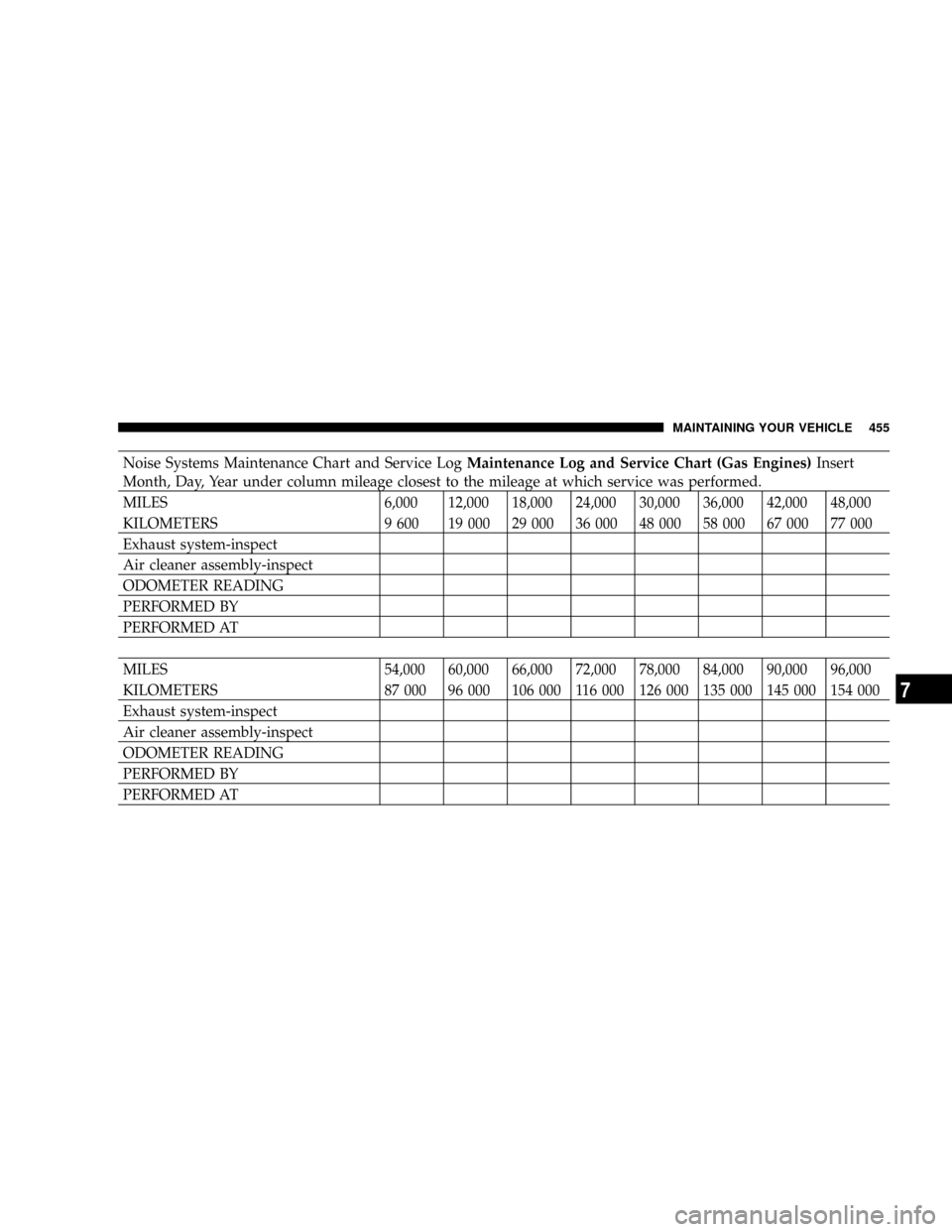
Noise Systems Maintenance Chart and Service LogMaintenance Log and Service Chart (Gas Engines)Insert
Month, Day, Year under column mileage closest to the mileage at which service was performed.
MILES 6,000 12,000 18,000 24,000 30,000 36,000 42,000 48,000
KILOMETERS 9 600 19 000 29 000 36 000 48 000 58 000 67 000 77 000
Exhaust system-inspect
Air cleaner assembly-inspect
ODOMETER READING
PERFORMED BY
PERFORMED AT
MILES 54,000 60,000 66,000 72,000 78,000 84,000 90,000 96,000
KILOMETERS 87 000 96 000 106 000 116 000 126 000 135 000 145 000 154 000
Exhaust system-inspect
Air cleaner assembly-inspect
ODOMETER READING
PERFORMED BY
PERFORMED AT
MAINTAINING YOUR VEHICLE 455
7
Page 456 of 528
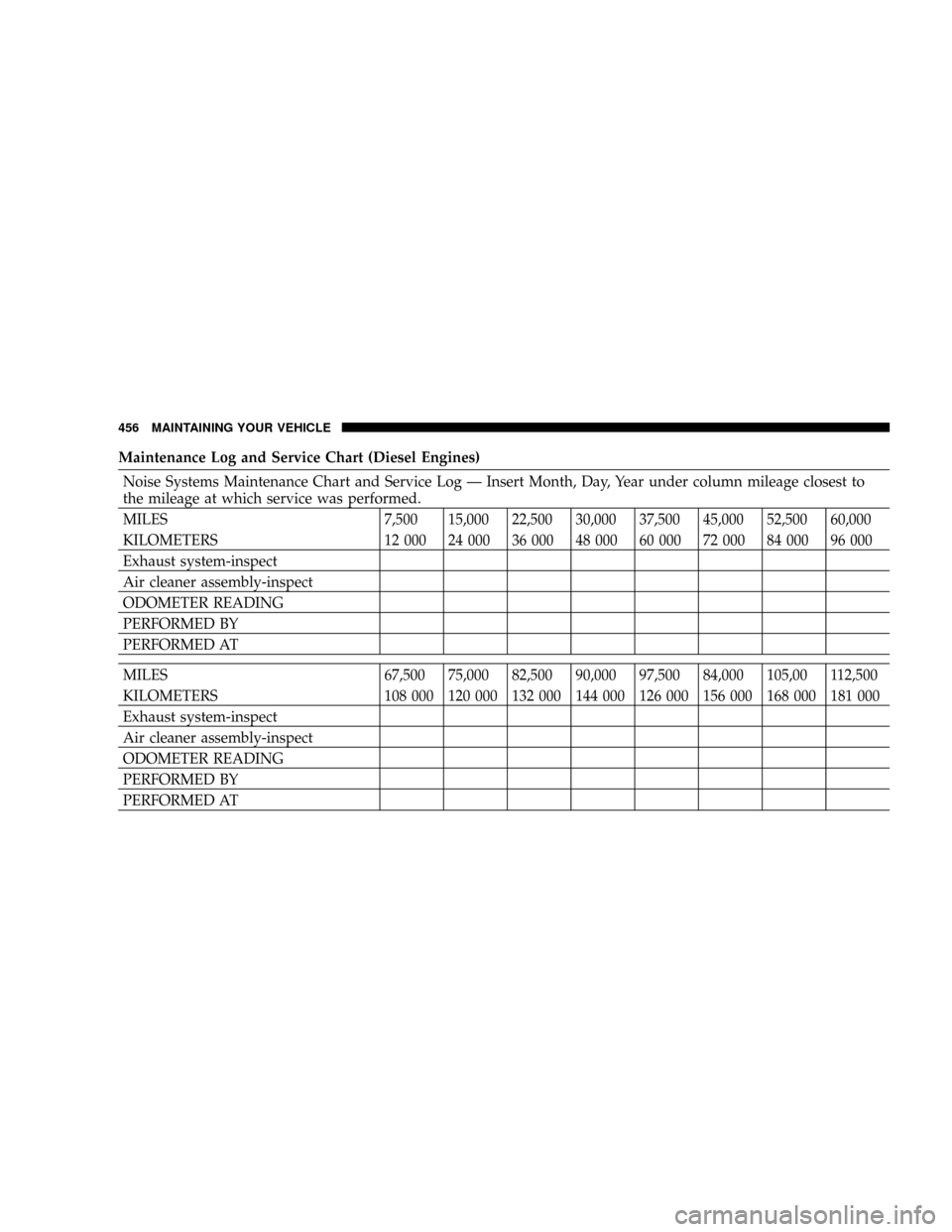
Maintenance Log and Service Chart (Diesel Engines)
Noise Systems Maintenance Chart and Service Log Ð Insert Month, Day, Year under column mileage closest to
the mileage at which service was performed.
MILES 7,500 15,000 22,500 30,000 37,500 45,000 52,500 60,000
KILOMETERS 12 000 24 000 36 000 48 000 60 000 72 000 84 000 96 000
Exhaust system-inspect
Air cleaner assembly-inspect
ODOMETER READING
PERFORMED BY
PERFORMED AT
MILES 67,500 75,000 82,500 90,000 97,500 84,000 105,00 112,500
KILOMETERS 108 000 120 000 132 000 144 000 126 000 156 000 168 000 181 000
Exhaust system-inspect
Air cleaner assembly-inspect
ODOMETER READING
PERFORMED BY
PERFORMED AT
456 MAINTAINING YOUR VEHICLE