light DODGE RAM SRT-10 2006 Service Repair Manual
[x] Cancel search | Manufacturer: DODGE, Model Year: 2006, Model line: RAM SRT-10, Model: DODGE RAM SRT-10 2006Pages: 5267, PDF Size: 68.7 MB
Page 451 of 5267
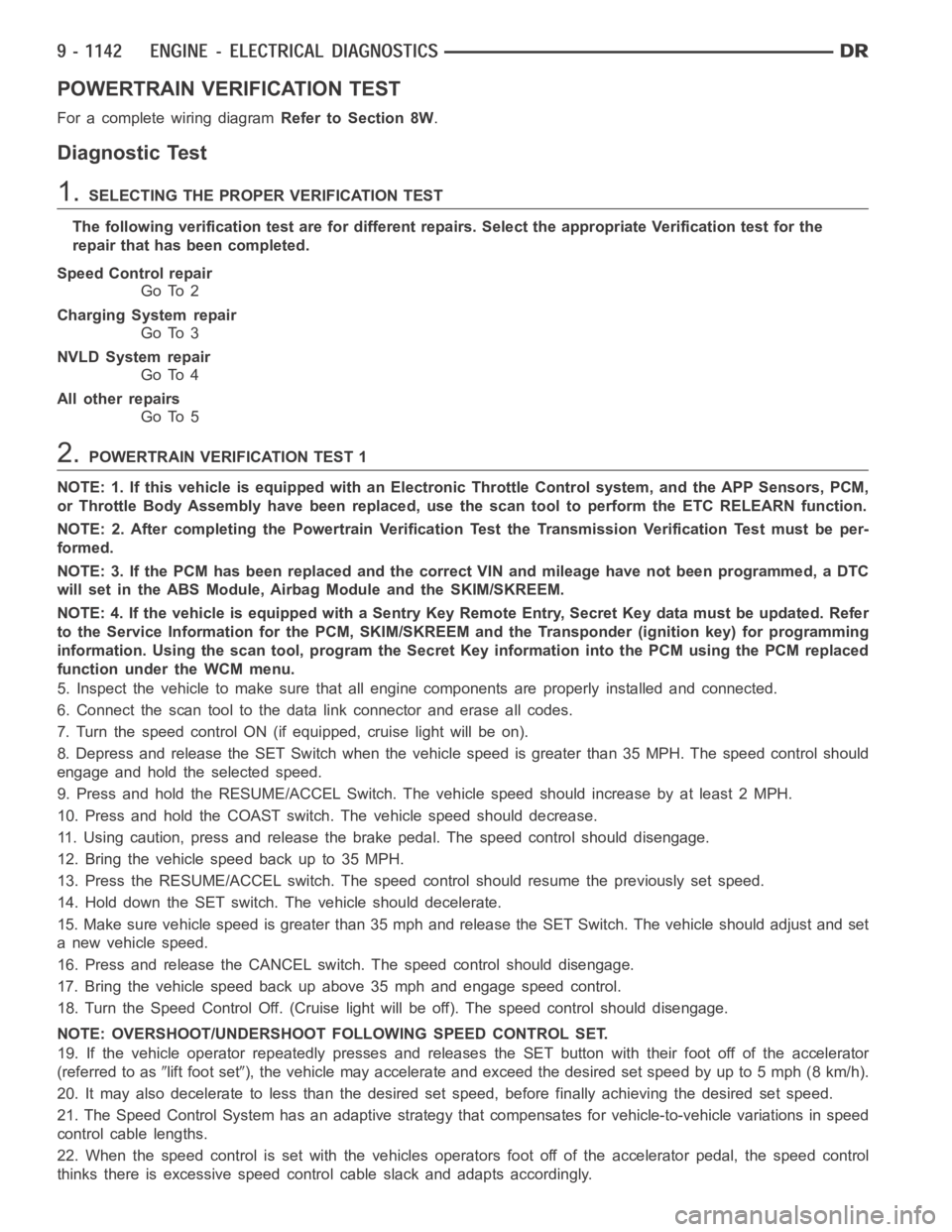
POWERTRAIN VERIFICATION TEST
For a complete wiring diagramRefer to Section 8W.
Diagnostic Test
1.SELECTING THE PROPER VERIFICATION TEST
The following verification test are for different repairs. Select the appropriate Verification test for the
repair that has been completed.
Speed Control repair
Go To 2
Charging System repair
Go To 3
NVLD System repair
Go To 4
All other repairs
Go To 5
2.POWERTRAIN VERIFICATION TEST 1
NOTE: 1. If this vehicle is equipped with an Electronic Throttle Control system, and the APP Sensors, PCM,
or Throttle Body Assembly have been replaced, use the scan tool to perform the ETC RELEARN function.
NOTE: 2. After completing the Powertrain Verification Test the Transmission Verification Test must be per-
formed.
NOTE: 3. If the PCM has been replaced and the correct VIN and mileage have notbeen programmed, a DTC
will set in the ABS Module, Airbag Module and the SKIM/SKREEM.
NOTE: 4. If the vehicle is equipped with a Sentry Key Remote Entry, Secret Key data must be updated. Refer
to the Service Information for the PCM, SKIM/SKREEM and the Transponder (ignition key) for programming
information. Using the scan tool, program the Secret Key information intothe PCM using the PCM replaced
function under the WCM menu.
5. Inspect the vehicle to make sure that all engine components are properlyinstalled and connected.
6. Connect the scan tool to the data link connector and erase all codes.
7. Turn the speed control ON (if equipped, cruise light will be on).
8. Depress and release the SET Switch when the vehicle speed is greater than35 MPH. The speed control should
engage and hold the selected speed.
9. Press and hold the RESUME/ACCEL Switch. The vehicle speed should increase by at least 2 MPH.
10. Press and hold the COAST switch. The vehicle speed should decrease.
11. Using caution, press and release the brake pedal. The speed control should disengage.
12. Bring the vehicle speed back up to 35 MPH.
13. Press the RESUME/ACCEL switch. The speed control should resume the previously set speed.
14. Hold down the SET switch. The vehicle should decelerate.
15. Make sure vehicle speed is greater than 35 mph and release the SET Switch. The vehicle should adjust and set
a new vehicle speed.
16. Press and release the CANCEL switch. The speed control should disengage.
17. Bring the vehicle speed back up above 35 mph and engage speed control.
18. Turn the Speed Control Off. (Cruise light will be off). The speed control should disengage.
NOTE: OVERSHOOT/UNDERSHOOT FOLLOWING SPEED CONTROL SET.
19. If the vehicle operator repeatedly presses and releases the SET buttonwith their foot off of the accelerator
(referred to as
lift foot set), the vehicle may accelerate and exceed the desired set speed by up to 5 mph (8km/h).
20. It may also decelerate to less than the desired set speed, before finally achieving the desired set speed.
21. The Speed Control System has an adaptive strategy that compensates forvehicle-to-vehicle variations in speed
control cable lengths.
22. When the speed control is set with the vehicles operators foot off of theaccelerator pedal, the speed control
thinks there is excessive speed control cable slack and adapts accordingly.
Page 455 of 5267
page page
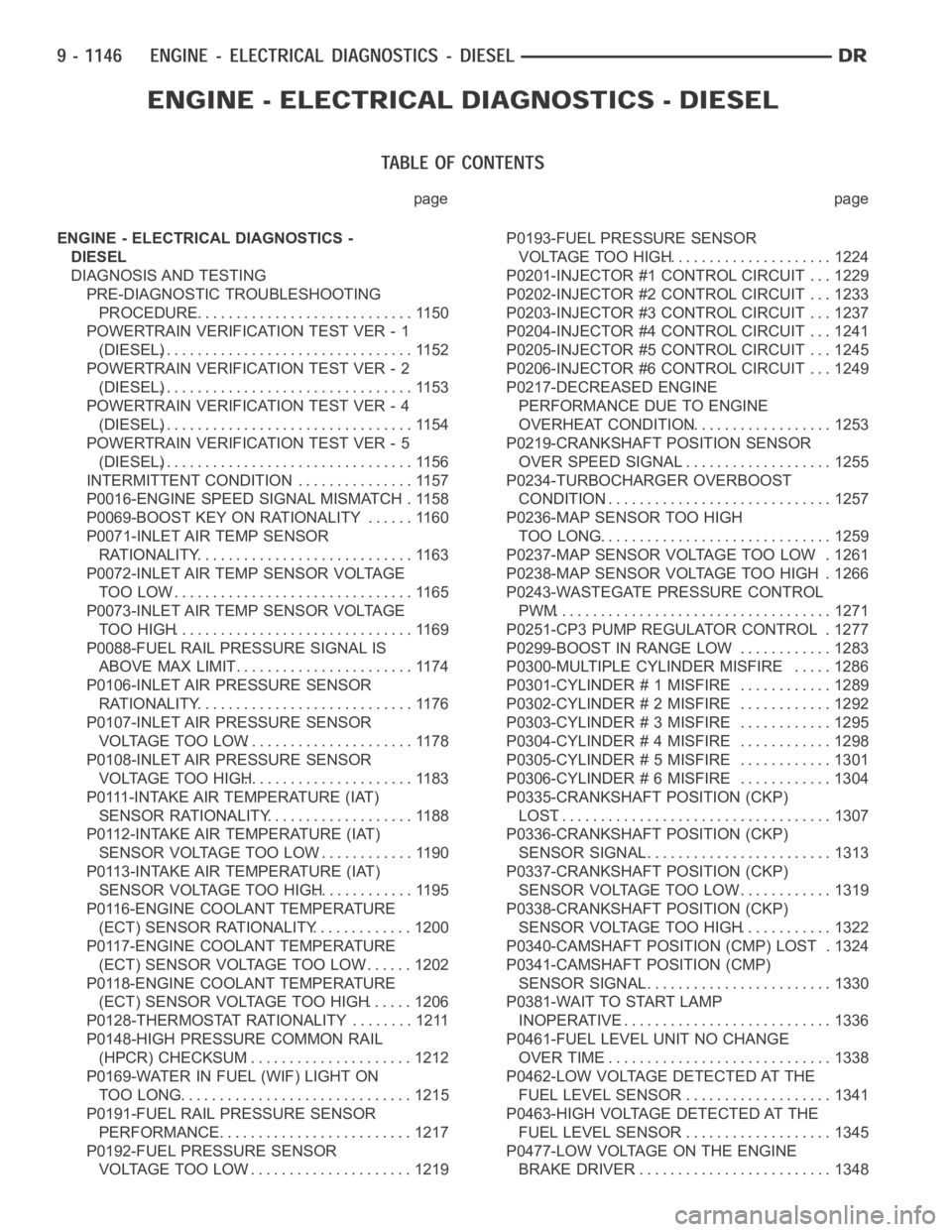
ENGINE - ELECTRICAL DIAGNOSTICS -
DIESEL
DIAGNOSIS AND TESTING
PRE-DIAGNOSTIC TROUBLESHOOTING
PROCEDURE............................. 1150
POWERTRAIN VERIFICATION TEST VER - 1
(DIESEL)................................. 1152
POWERTRAIN VERIFICATION TEST VER - 2
(DIESEL)................................. 1153
POWERTRAIN VERIFICATION TEST VER - 4
(DIESEL)................................. 1154
POWERTRAIN VERIFICATION TEST VER - 5
(DIESEL)................................. 1156
INTERMITTENT CONDITION ............... 1157
P0016-ENGINE SPEED SIGNAL MISMATCH . 1158
P0069-BOOST KEY ON RATIONALITY ...... 1160
P0071-INLET AIR TEMP SENSOR
RATIONALITY............................ 1163
P0072-INLET AIR TEMP SENSOR VOLTAGE
TOO LOW................................ 1165
P0073-INLET AIR TEMP SENSOR VOLTAGE
TOO HIGH............................... 1169
P0088-FUEL RAIL PRESSURE SIGNAL IS
ABOVE MAX LIMIT........................ 1174
P0106-INLET AIR PRESSURE SENSOR
RATIONALITY............................ 1176
P0107-INLET AIR PRESSURE SENSOR
VOLTAGE TOO LOW...................... 1178
P0108-INLET AIR PRESSURE SENSOR
VOLTAGE TOO HIGH...................... 1183
P0111-INTAKE AIR TEMPERATURE (IAT)
SENSOR RATIONALITY................... 1188
P0112-INTAKE AIR TEMPERATURE (IAT)
SENSOR VOLTAGE TOO LOW............. 1190
P0113-INTAKE AIR TEMPERATURE (IAT)
SENSOR VOLTAGE TOO HIGH............. 1195
P0116-ENGINE COOLANT TEMPERATURE
(ECT) SENSOR RATIONALITY............. 1200
P0117-ENGINE COOLANT TEMPERATURE
(ECT) SENSOR VOLTAGE TOO LOW....... 1202
P0118-ENGINE COOLANT TEMPERATURE
(ECT) SENSOR VOLTAGE TOO HIGH...... 1206
P0128-THERMOSTAT RATIONALITY ........ 1211
P0148-HIGH PRESSURE COMMON RAIL
(HPCR) CHECKSUM...................... 1212
P0169-WATER IN FUEL (WIF) LIGHT ON
TOO LONG............................... 1215
P0191-FUEL RAIL PRESSURE SENSOR
PERFORMANCE.......................... 1217
P0192-FUEL PRESSURE SENSOR
VOLTAGE TOO LOW...................... 1219P0193-FUEL PRESSURE SENSOR
VOLTAGE TOO HIGH...................... 1224
P0201-INJECTOR #1 CONTROL CIRCUIT . . . 1229
P0202-INJECTOR #2 CONTROL CIRCUIT . . . 1233
P0203-INJECTOR #3 CONTROL CIRCUIT . . . 1237
P0204-INJECTOR #4 CONTROL CIRCUIT . . . 1241
P0205-INJECTOR #5 CONTROL CIRCUIT . . . 1245
P0206-INJECTOR #6 CONTROL CIRCUIT . . . 1249
P0217-DECREASED ENGINE
PERFORMANCE DUE TO ENGINE
OVERHEAT CONDITION................... 1253
P0219-CRANKSHAFT POSITION SENSOR
OVER SPEED SIGNAL.................... 1255
P0234-TURBOCHARGER OVERBOOST
CONDITION.............................. 1257
P0236-MAP SENSOR TOO HIGH
TOO LONG............................... 1259
P0237-MAP SENSOR VOLTAGE TOO LOW . 1261
P0238-MAP SENSOR VOLTAGE TOO HIGH . 1266
P0243-WASTEGATE PRESSURE CONTROL
PWM.................................... 1271
P0251-CP3 PUMP REGULATOR CONTROL . 1277
P0299-BOOST IN RANGE LOW ............ 1283
P0300-MULTIPLE CYLINDER MISFIRE ..... 1286
P0301-CYLINDER # 1 MISFIRE ............ 1289
P0302-CYLINDER # 2 MISFIRE ............ 1292
P0303-CYLINDER # 3 MISFIRE ............ 1295
P0304-CYLINDER # 4 MISFIRE ............ 1298
P0305-CYLINDER # 5 MISFIRE ............ 1301
P0306-CYLINDER # 6 MISFIRE ............ 1304
P0335-CRANKSHAFT POSITION (CKP)
LOST.................................... 1307
P0336-CRANKSHAFT POSITION (CKP)
SENSOR SIGNAL......................... 1313
P0337-CRANKSHAFT POSITION (CKP)
SENSOR VOLTAGE TOO LOW............. 1319
P0338-CRANKSHAFT POSITION (CKP)
SENSOR VOLTAGE TOO HIGH............ 1322
P0340-CAMSHAFT POSITION (CMP) LOST . 1324
P0341-CAMSHAFT POSITION (CMP)
SENSOR SIGNAL......................... 1330
P0381-WAIT TO START LAMP
INOPERATIVE............................ 1336
P0461-FUEL LEVEL UNIT NO CHANGE
OVER TIME.............................. 1338
P0462-LOW VOLTAGE DETECTED AT THE
FUEL LEVEL SENSOR.................... 1341
P0463-HIGH VOLTAGE DETECTED AT THE
FUEL LEVEL SENSOR.................... 1345
P0477-LOW VOLTAGE ON THE ENGINE
BRAKE DRIVER.......................... 1348
Page 463 of 5267
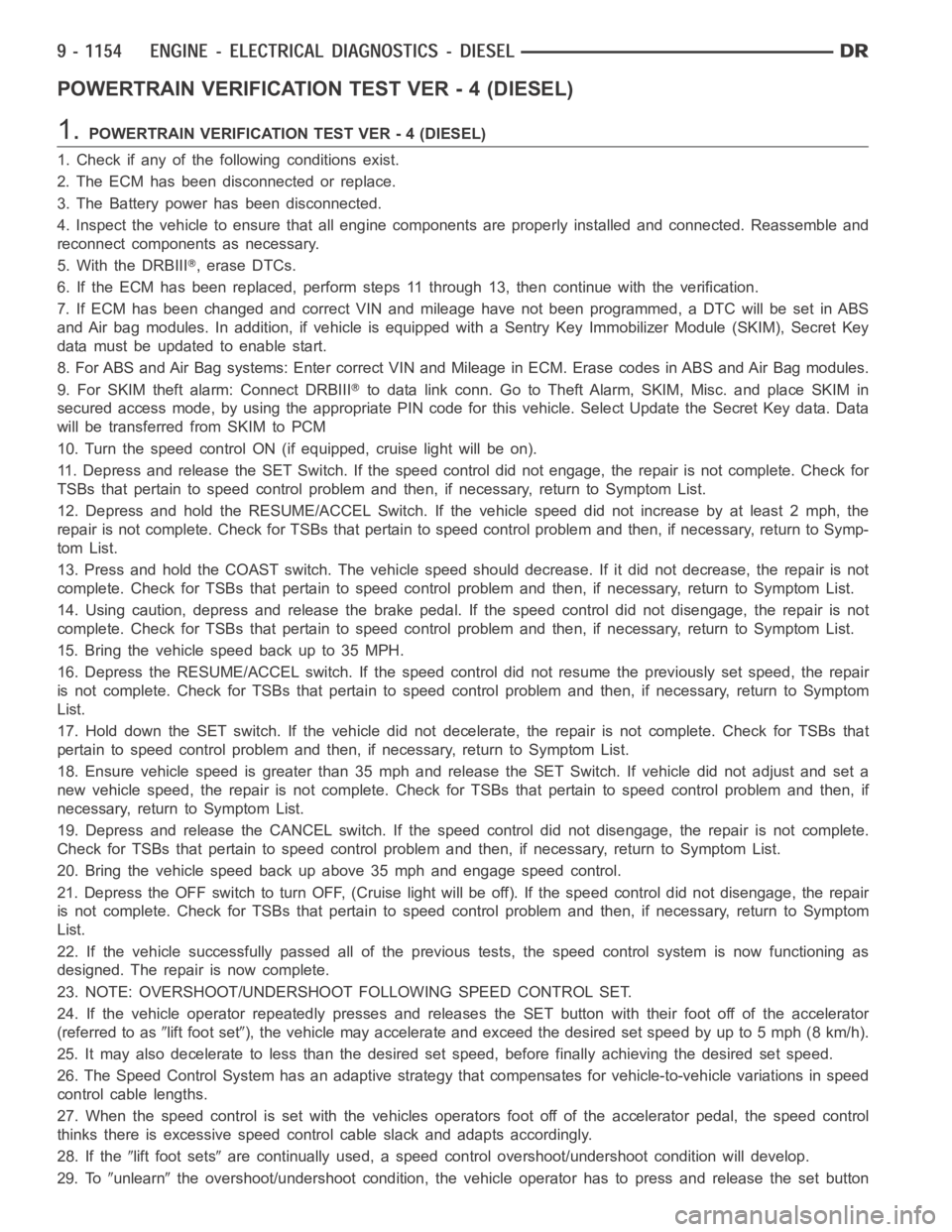
POWERTRAIN VERIFICATION TEST VER - 4 (DIESEL)
1.POWERTRAIN VERIFICATION TEST VER - 4 (DIESEL)
1. Check if any of the following conditions exist.
2. The ECM has been disconnected or replace.
3. The Battery power has been disconnected.
4. Inspect the vehicle to ensure that all engine components are properly installed and connected. Reassemble and
reconnect components as necessary.
5. With the DRBIII
,eraseDTCs.
6. If the ECM has been replaced, perform steps 11 through 13, then continue with the verification.
7. If ECM has been changed and correct VIN and mileage have not been programmed, a DTC will be set in ABS
and Air bag modules. In addition, if vehicle is equipped with a Sentry Key Immobilizer Module (SKIM), Secret Key
data must be updated to enable start.
8. For ABS and Air Bag systems: Enter correct VIN and Mileage in ECM. Erase codes in ABS and Air Bag modules.
9. For SKIM theft alarm: Connect DRBIII
to data link conn. Go to Theft Alarm, SKIM, Misc. and place SKIM in
secured access mode, by using the appropriate PIN code for this vehicle. Select Update the Secret Key data. Data
will be transferred from SKIM to PCM
10. Turn the speed control ON (if equipped, cruise light will be on).
11. Depress and release the SET Switch. If the speed control did not engage,the repair is not complete. Check for
TSBs that pertain to speed control problem and then, if necessary, return to Symptom List.
12. Depress and hold the RESUME/ACCEL Switch. If the vehicle speed did not increase by at least 2 mph, the
repair is not complete. Check for TSBs that pertain to speed control problem and then, if necessary, return to Symp-
tom List.
13. Press and hold the COAST switch. The vehicle speed should decrease. If it did not decrease, the repair is not
complete. Check for TSBs that pertain to speed control problem and then, ifnecessary, return to Symptom List.
14. Using caution, depress and release the brake pedal. If the speed control did not disengage, the repair is not
complete. Check for TSBs that pertain to speed control problem and then, ifnecessary, return to Symptom List.
15. Bring the vehicle speed back up to 35 MPH.
16. Depress the RESUME/ACCEL switch. If the speed control did not resume the previously set speed, the repair
is not complete. Check for TSBs that pertain to speed control problem and then, if necessary, return to Symptom
List.
17. Hold down the SET switch. If the vehicle did not decelerate, the repair is not complete. Check for TSBs that
pertain to speed control problem and then, if necessary, return to SymptomList.
18. Ensure vehicle speed is greater than 35 mph and release the SET Switch. If vehicle did not adjust and set a
new vehicle speed, the repair is not complete. Check for TSBs that pertain to speed control problem and then, if
necessary, return to Symptom List.
19. Depress and release the CANCEL switch. If the speed control did not disengage, the repair is not complete.
Check for TSBs that pertain to speed control problem and then, if necessary, return to Symptom List.
20. Bring the vehicle speed back up above 35 mph and engage speed control.
21. Depress the OFF switch to turn OFF, (Cruise light will be off). If the speed control did not disengage, the repair
is not complete. Check for TSBs that pertain to speed control problem and then, if necessary, return to Symptom
List.
22. If the vehicle successfully passed all of the previous tests, the speedcontrol system is now functioning as
designed. The repair is now complete.
23. NOTE: OVERSHOOT/UNDERSHOOT FOLLOWING SPEED CONTROL SET.
24. If the vehicle operator repeatedly presses and releases the SET buttonwith their foot off of the accelerator
(referred to as
lift foot set), the vehicle may accelerate and exceed the desired set speed by up to 5 mph (8km/h).
25. It may also decelerate to less than the desired set speed, before finally achieving the desired set speed.
26. The Speed Control System has an adaptive strategy that compensates forvehicle-to-vehicle variations in speed
control cable lengths.
27. When the speed control is set with the vehicles operators foot off of theaccelerator pedal, the speed control
thinks there is excessive speed control cable slack and adapts accordingly.
28. If the
lift foot setsare continually used, a speed control overshoot/undershoot condition will develop.
29. To
unlearnthe overshoot/undershoot condition, the vehicle operator has to press and release the set button
Page 484 of 5267
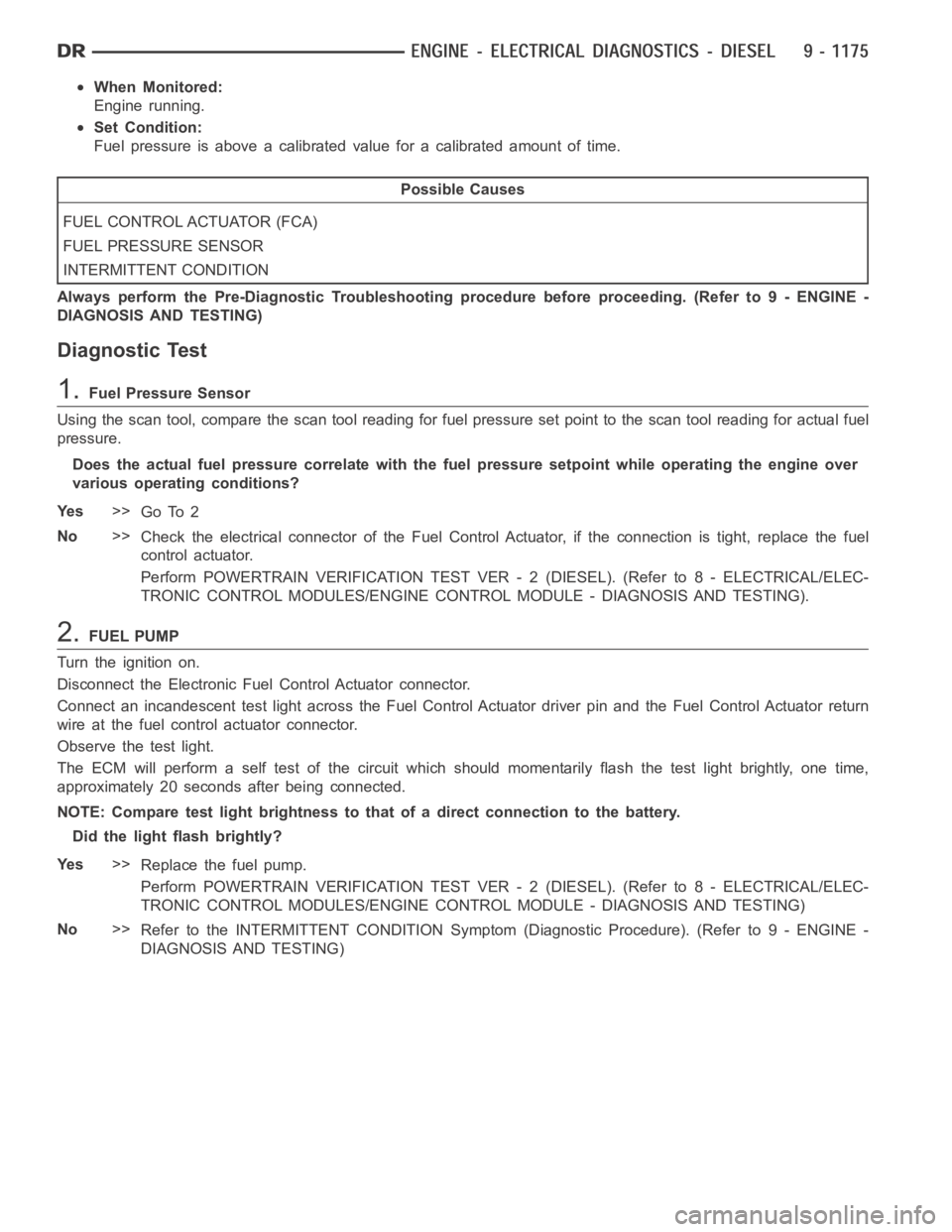
When Monitored:
Engine running.
Set Condition:
Fuel pressure is above a calibrated value for a calibrated amount of time.
Possible Causes
FUEL CONTROL ACTUATOR (FCA)
FUEL PRESSURE SENSOR
INTERMITTENT CONDITION
Always perform the Pre-Diagnostic Troubleshooting procedure before proceeding. (Refer to 9 - ENGINE -
DIAGNOSIS AND TESTING)
Diagnostic Test
1.Fuel Pressure Sensor
Using the scan tool, compare the scan tool reading for fuel pressure set point to the scan tool reading for actual fuel
pressure.
Does the actual fuel pressure correlate with the fuel pressure setpoint while operating the engine over
various operating conditions?
Ye s>>
Go To 2
No>>
Check the electrical connector of the Fuel Control Actuator, if the connection is tight, replace the fuel
control actuator.
Perform POWERTRAIN VERIFICATION TEST VER - 2 (DIESEL). (Refer to 8 - ELECTRICAL/ELEC-
TRONIC CONTROL MODULES/ENGINE CONTROL MODULE - DIAGNOSIS AND TESTING).
2.FUEL PUMP
Turn the ignition on.
Disconnect the Electronic Fuel Control Actuator connector.
Connect an incandescent test light across the Fuel Control Actuator driver pin and the Fuel Control Actuator return
wire at the fuel control actuator connector.
Observe the test light.
The ECM will perform a self test of the circuit which should momentarily flash the test light brightly, one time,
approximately 20 seconds after being connected.
NOTE: Compare test light brightness to that of a direct connection to the battery.
Did the light flash brightly?
Ye s>>
Replace the fuel pump.
Perform POWERTRAIN VERIFICATION TEST VER - 2 (DIESEL). (Refer to 8 - ELECTRICAL/ELEC-
TRONIC CONTROL MODULES/ENGINE CONTROL MODULE - DIAGNOSIS AND TESTING)
No>>
Refer to the INTERMITTENT CONDITION Symptom (Diagnostic Procedure). (Refer to 9 - ENGINE -
DIAGNOSIS AND TESTING)
Page 486 of 5267
When Monitored:
When the ignition is on.
Set Condition:
The Inlet air pressure is above a calibrated threshold.
Possible Causes
INLET AIR PRESSURE SENSOR
INTERMITTENT CONDITION
TROUBLESHOOT OTHER DTC’S FIRST
Always perform the Pre-Diagnostic Troubleshooting procedure before proceeding. (Refer to 9 - ENGINE -
DIAGNOSIS AND TESTING)
Diagnostic Test
1.TROUBLESHOOT OTHER DTC’s FIRST
Using the Scan tool, check for additional DTC’s.
Do you have any other air pressure related DTC’s?
Ye s>>
Troubleshoot other DTC’s First.
Perform POWERTRAIN VERIFICATION TEST VER - 1 (DIESEL). (Refer to 8 - ELECTRICAL/ELEC-
TRONIC CONTROL MODULES/ENGINE CONTROL MODULE - DIAGNOSIS AND TESTING)
No>>
Go To 2
2.INLET AIR PRESSURE SENSOR
Using the scan tool, monitor the Inlet air pressure sensor values.
Do the readings on the scan tool fluctuate slightly?
No>>
Replace the Inlet Air Temperature/ Pressure sensor.
Perform POWERTRAIN VERIFICATION TEST VER - 1 (DIESEL). (Refer to 8 - ELECTRICAL/ELEC-
TRONIC CONTROL MODULES/ENGINE CONTROL MODULE - DIAGNOSIS AND TESTING)
Ye s>>
Refer to the INTERMITTENT CONDITIONSymptom (Diagnostic Procedure).
Perform POWERTRAIN VERIFICATION TEST VER - 1 (DIESEL). (Refer to 8 - ELECTRICAL/ELEC-
TRONIC CONTROL MODULES/ENGINE CONTROL MODULE - DIAGNOSIS AND TESTING)
Page 524 of 5267
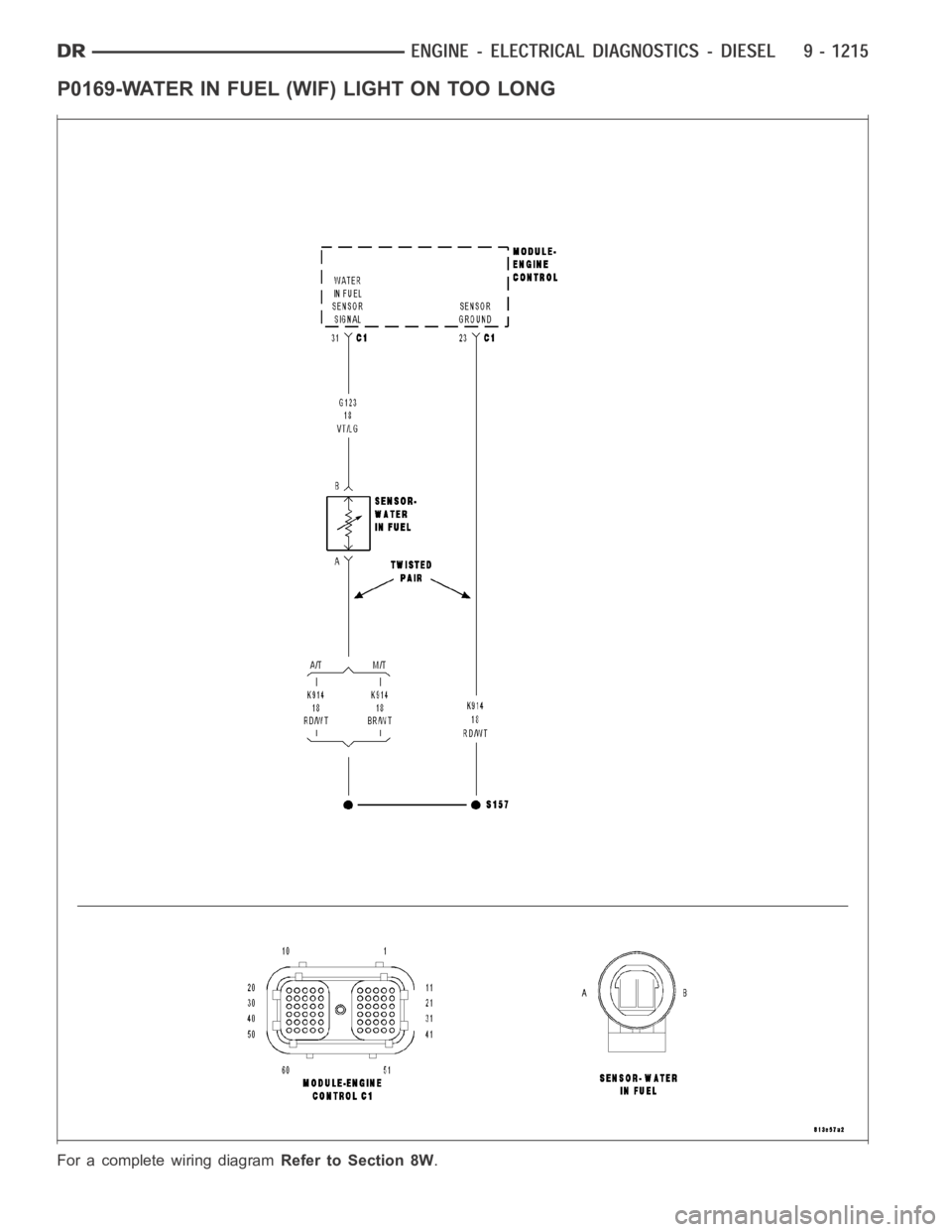
P0169-WATER IN FUEL (WIF) LIGHT ON TOO LONG
For a complete wiring diagramRefer to Section 8W.
Page 525 of 5267
When Monitored:
While the engine is running.
Set Condition:
Water in fuel light was on for a calibrated amount of time.
Possible Causes
OTHER DTC’S PRESENT
WATER IN FUEL
Always perform the Pre-Diagnostic Troubleshooting procedure before proceeding. (Refer to 9 - ENGINE -
DIAGNOSIS AND TESTING)
Diagnostic Test
1.OTHER DTC’S PRESENT
With the scan tool, read DTCs.
Is P2269 displayed?
Ye s>>
Repair P2269 DTC first.
Perform POWERTRAIN VERIFICATION TEST VER - 1 (DIESEL). (Refer to 8 - ELECTRICAL/ELEC-
TRONIC CONTROL MODULES/ENGINE CONTROL MODULE - DIAGNOSIS AND TESTING)
No>>
Drain water in fuel.
Page 582 of 5267
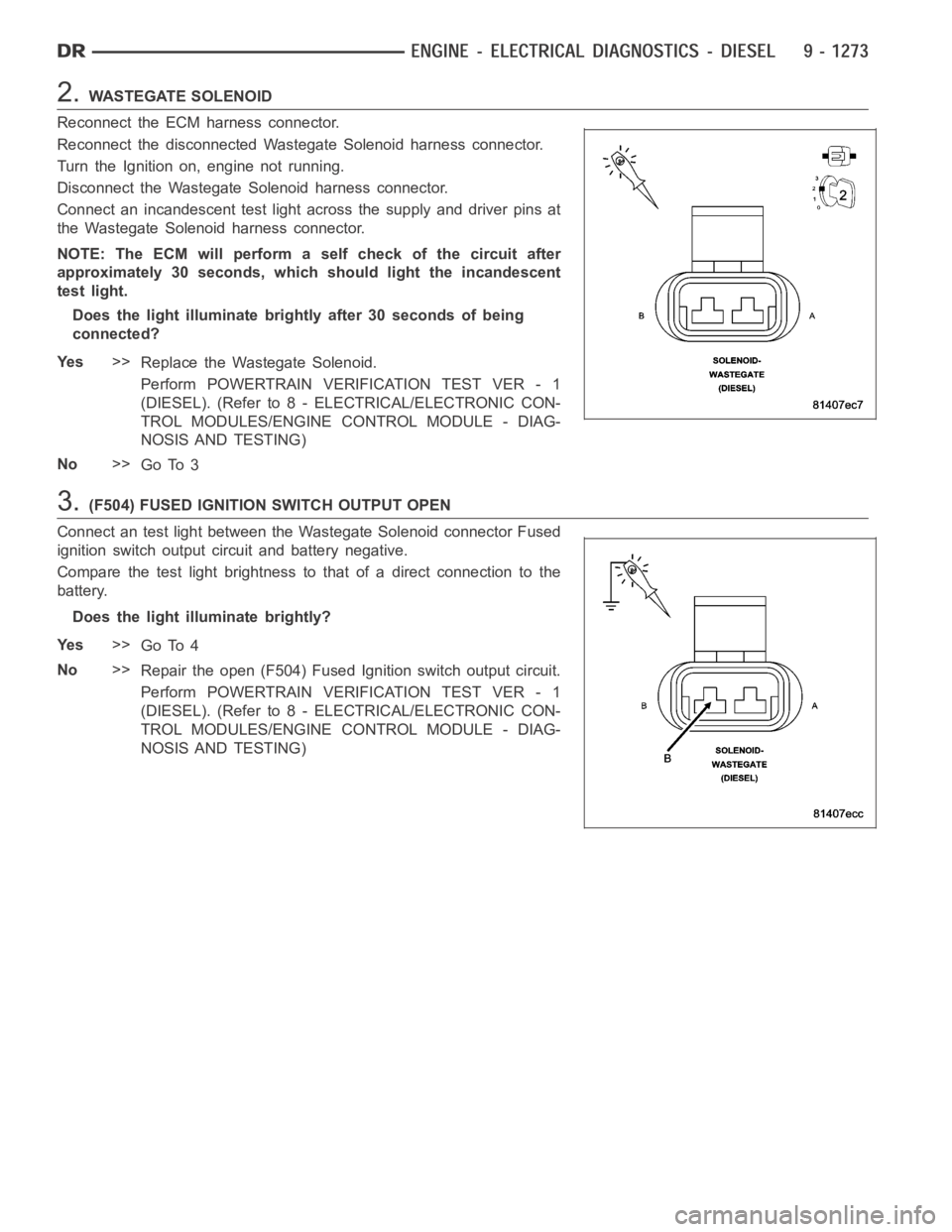
2.WASTEGATE SOLENOID
Reconnect the ECM harness connector.
Reconnect the disconnected Wastegate Solenoid harness connector.
Turn the Ignition on, engine not running.
Disconnect the Wastegate Solenoid harness connector.
Connect an incandescent test light across the supply and driver pins at
the Wastegate Solenoid harness connector.
NOTE: The ECM will perform a self check of the circuit after
approximately 30 seconds, which should light the incandescent
test light.
Does the light illuminate brightly after 30 seconds of being
connected?
Ye s>>
Replace the Wastegate Solenoid.
Perform POWERTRAIN VERIFICATION TEST VER - 1
(DIESEL). (Refer to 8 - ELECTRICAL/ELECTRONIC CON-
TROL MODULES/ENGINE CONTROL MODULE - DIAG-
NOSIS AND TESTING)
No>>
Go To 3
3.(F504) FUSED IGNITION SWITCH OUTPUT OPEN
Connect an test light between the Wastegate Solenoid connector Fused
ignition switch output circuit and battery negative.
Compare the test light brightness to that of a direct connection to the
battery.
Does the light illuminate brightly?
Ye s>>
Go To 4
No>>
Repair the open (F504) Fused Ignition switch output circuit.
Perform POWERTRAIN VERIFICATION TEST VER - 1
(DIESEL). (Refer to 8 - ELECTRICAL/ELECTRONIC CON-
TROL MODULES/ENGINE CONTROL MODULE - DIAG-
NOSIS AND TESTING)
Page 585 of 5267
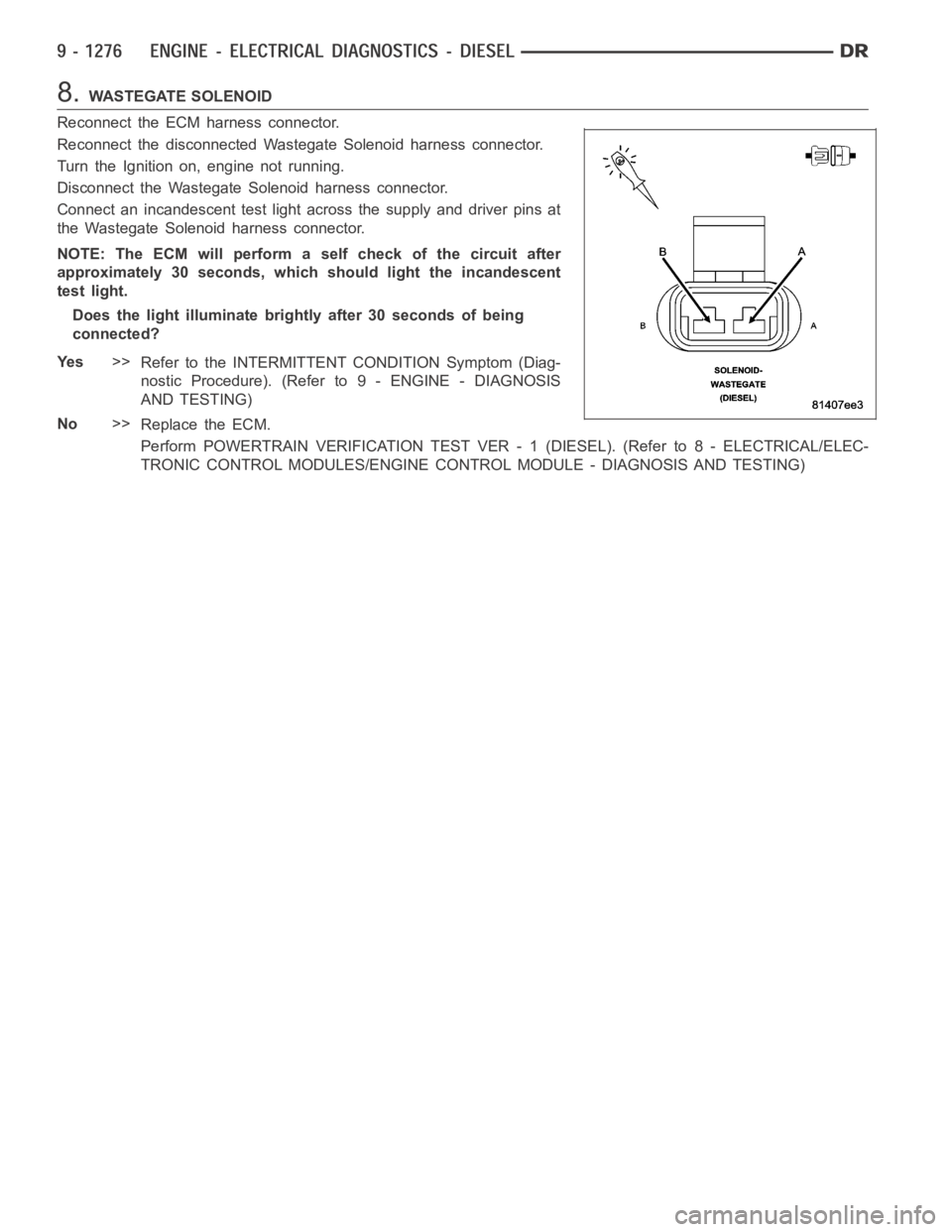
8.WASTEGATE SOLENOID
Reconnect the ECM harness connector.
Reconnect the disconnected Wastegate Solenoid harness connector.
Turn the Ignition on, engine not running.
Disconnect the Wastegate Solenoid harness connector.
Connect an incandescent test light across the supply and driver pins at
the Wastegate Solenoid harness connector.
NOTE: The ECM will perform a self check of the circuit after
approximately 30 seconds, which should light the incandescent
test light.
Does the light illuminate brightly after 30 seconds of being
connected?
Ye s>>
Refer to the INTERMITTENT CONDITION Symptom (Diag-
nostic Procedure). (Refer to 9 - ENGINE - DIAGNOSIS
AND TESTING)
No>>
Replace the ECM.
Perform POWERTRAIN VERIFICATION TEST VER - 1 (DIESEL). (Refer to 8 - ELECTRICAL/ELEC-
TRONIC CONTROL MODULES/ENGINE CONTROL MODULE - DIAGNOSIS AND TESTING)
Page 587 of 5267
When Monitored:
When the ignition is on.
Set Condition:
The ECM detects a discrepancy between the PWM supplied to the Electronic Fuel Control Actuator and the
PWM returned from the Electronic Fuel Control Actuator.
Possible Causes
FUEL PUMP
(K181) FUEL CONTROL ACTUATOR DRIVER OPEN
(K31) RETURN CIRCUIT OPEN FROM FCA TO ECM
(K181) FUEL CONTROL ACTUATOR DRIVER CIRCUIT SHORTED TO EXTERNAL VOLTAGE
(K31) FUEL CONTROL ACTUATOR RETURN CIRCUIT SHORTED TO EXTERNAL VOLTAGE
(K31) FCA RETURN CIRCUIT SHORTED TO (K181) FCA DRIVER CIRCUIT
(K181) FUEL CONTROL ACTUATOR DRIVER CIRCUIT SHORTED TO GROUND
(K181) FUEL CONTROL ACTUATOR DRIVER CIRCUIT SHORTED TO ANOTHER CIRCUIT
(K31) FUEL CONTROL ACTUATOR RETURN CIRCUIT SHORTED TO ANOTHER CIRCUIT
INTERMITTENT CONDITION
ECM
Always perform the Pre-Diagnostic Troubleshooting procedure before proceeding. (Refer to 9 - ENGINE -
DIAGNOSIS AND TESTING)
Diagnostic Test
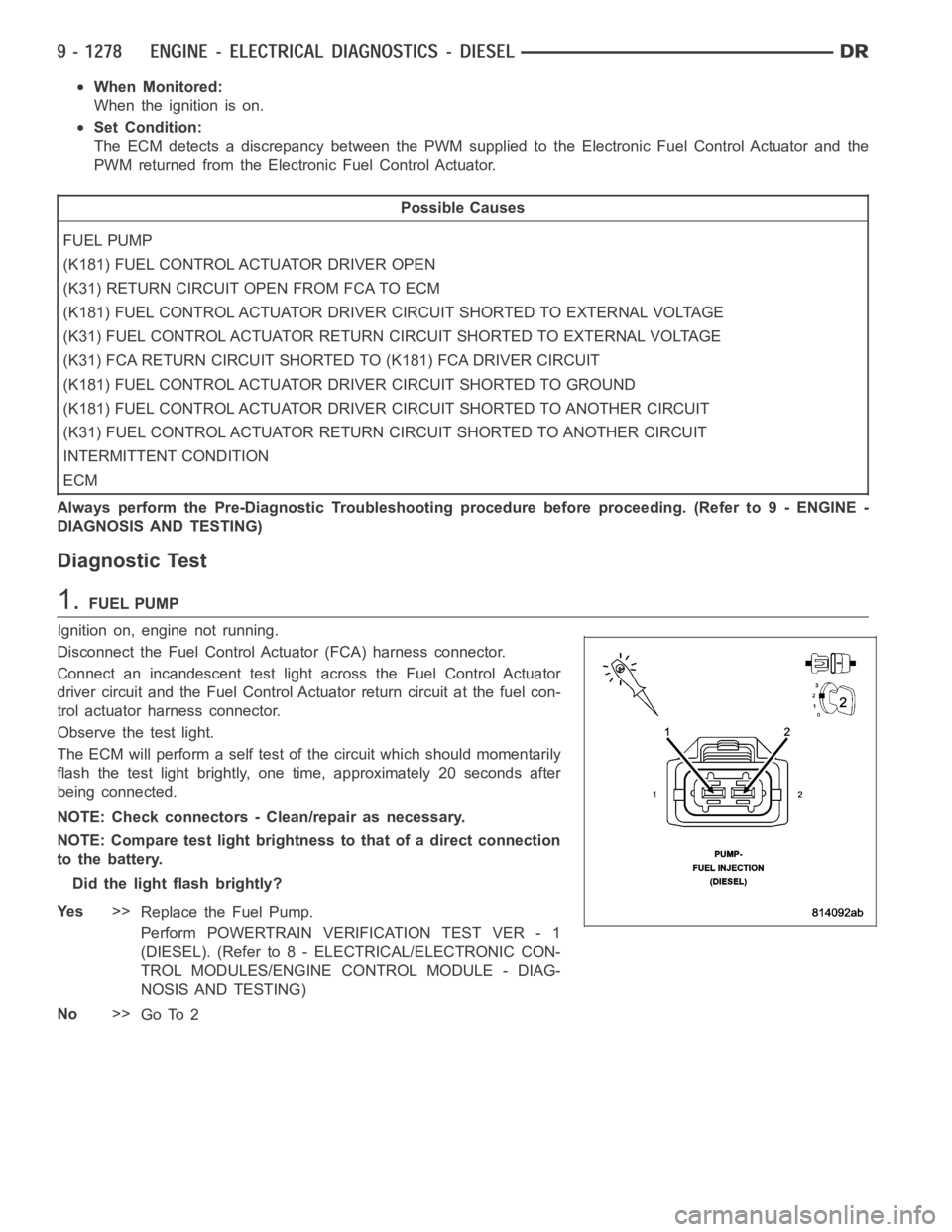
1.FUEL PUMP
Ignition on, engine not running.
Disconnect the Fuel Control Actuator (FCA) harness connector.
Connect an incandescent test light across the Fuel Control Actuator
driver circuit and the Fuel Control Actuator return circuit at the fuel con-
trol actuator harness connector.
Observe the test light.
The ECM will perform a self test of the circuit which should momentarily
flash the test light brightly, one time, approximately 20 seconds after
being connected.
NOTE: Check connectors - Clean/repair as necessary.
NOTE: Compare test light brightness to that of a direct connection
to the battery.
Did the light flash brightly?
Ye s>>
Replace the Fuel Pump.
Perform POWERTRAIN VERIFICATION TEST VER - 1
(DIESEL). (Refer to 8 - ELECTRICAL/ELECTRONIC CON-
TROL MODULES/ENGINE CONTROL MODULE - DIAG-
NOSIS AND TESTING)
No>>
Go To 2