engine DODGE RAM SRT-10 2006 Service Repair Manual
[x] Cancel search | Manufacturer: DODGE, Model Year: 2006, Model line: RAM SRT-10, Model: DODGE RAM SRT-10 2006Pages: 5267, PDF Size: 68.7 MB
Page 5197 of 5267
COMPONENT MONITORS
There are several components that will affect vehicle emissions if they malfunction. If one of these components
malfunctions the Malfunction Indicator Lamp (MIL) will illuminate.
Some of the component monitors are checking for proper operation of the part. Electrically operated components
now have input (rationality) and output (functionality) checks. Previously, a component like the Throttle Position sen-
sor (TPS) was checked by the PCM for an open or shorted circuit. If one of these conditions occurred, a DTC was
set. Now there is a check to ensure that the component is working. This is donebywatchingforaTPSindication
of a greater or lesser throttle opening than MAP and engine rpm indicate. Inthe case of the TPS, if engine vacuum
is high and engine rpm is 1600 or greater, and the TPS indicates a large throttle opening, a DTC will be set. The
same applies to low vacuum if the TPS indicates a small throttle opening.
All open/short circuit checks, or any component that has an associated limp-in, will set a fault after 1 trip with the
malfunction present. Components without an associated limp-in will taketwo trips to illuminate the MIL.
OPERATION
OPERATION
The Powertrain Control Module (PCM) monitors many
different circuits in the fuel injection, ignition, emission
and engine systems. If the PCM senses a problem
withamonitoredcircuitoftenenoughtoindicatean
actual problem, it stores a Diagnostic Trouble Code
(DTC) in the PCM’s memory. If the problem is repaired
or ceases to exist, the PCM cancels the code after 40
warm-up cycles. Diagnostic trouble codes that affect
vehicle emissions illuminatethe Malfunction Indicator
Lamp (MIL). The MIL is displayed as an engine icon
(graphic) on the instrument panel. Refer to Malfunction
Indicator Lamp in this section.
Certain criteria must be met before the PCM stores a
DTC in memory. The criteria may be a specific range
of engine RPM, engine temperature, and/or input volt-
age to the PCM.
The PCM might not store a DTC for a monitored cir-
cuit even though a malfunction has occurred. This
may happen because one of the DTC criteria for the
circuit has not been met.For example,assume the diagnostic trouble code criteria requires the PCM to monitor the
circuit only when the engine operates between 750 and 2000 RPM. Suppose thesensor’s output circuit shorts to
ground when engine operates above 2400 RPM (resulting in 0 volt input to thePCM). Because the condition hap-
pens at an engine speed above the maximum threshold (2000 rpm), the PCM willnot store a DTC.
There are several operating conditions for which the PCM monitors and setsDTC’s. Refer to Monitored Systems,
Components, and Non-Monitored Circuits in this section.
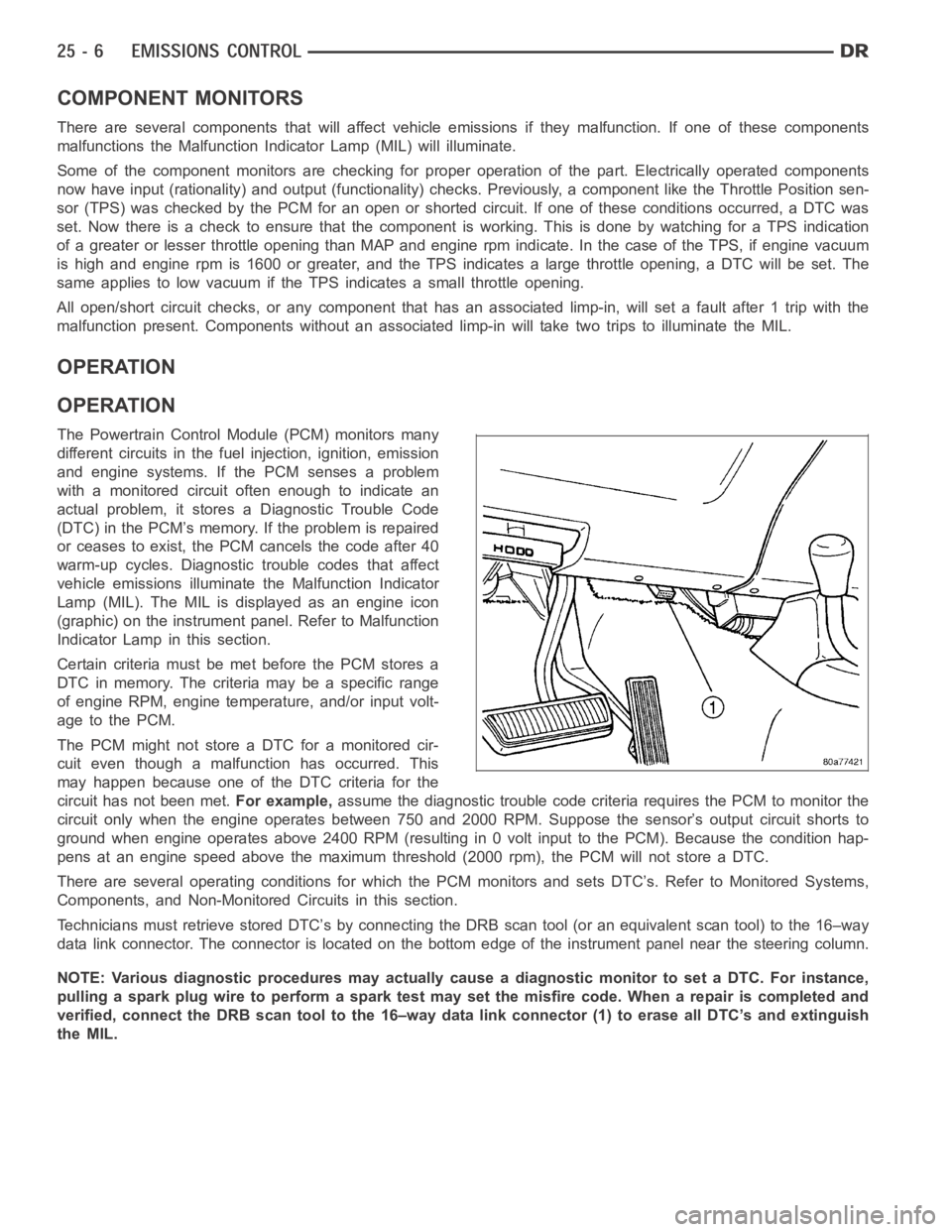
Technicians must retrieve stored DTC’s by connecting the DRB scan tool (oran equivalent scan tool) to the 16–way
data link connector. The connector is located on the bottom edge of the instrument panel near the steering column.
NOTE: Various diagnostic procedures may actually cause a diagnostic monitor to set a DTC. For instance,
pulling a spark plug wire to perform a spark test may set the misfire code. When a repair is completed and
verified, connect the DRB scan tool to the 16–way data link connector (1) toerase all DTC’s and extinguish
the MIL.
Page 5199 of 5267
Diagnostic Trouble Codes (DTCs)
With OBD II, different DTC faults have different priorities according to regulations. As a result, the priorities deter-
mine MIL illumination and DTC erasure. DTCs are entered according to individual priority. DTCs with a higher pri-
ority overwrite lower priority DTCs.
Priorities
Priority 0 —Non-emissions related trouble codes
Priority 1 — One trip failure of a two trip fault for non-fuel system and non-misfire.
Priority 2 — One trip failure of a two trip fault for fuel system (rich/lean)or misfire.
Priority 3 — Two trip failure for a non-fuel system and non-misfire or matured one trip comprehensive com-
ponent fault.
Priority 4 — Two trip failure or matured fault for fuel system (rich/lean) and misfire or one trip catalyst dam-
aging misfire.
Non-emissions related failures have no priority. One trip failures of twotrip faults have low priority. Two trip failures
or matured faults have higher priority. One and two trip failures of fuel system and misfire monitor take precedence
over non-fuel system and non-misfire failures.
DTC Self Erasure
With one trip components or systems,the MIL is illuminated upon test failure and DTCs are stored.
Two trip monitors are components requiring failure in two consecutive trips for MIL illumination. Upon failure of the
first test, the Task Manager enters a maturing code. If the component failsthe test for a second time the code
matures and a DTC is set.
After three good trips the MIL is extinguished and the Task Manager automatically switches the trip counter to a
warm-up cycle counter. DTCs are automatically erased following 40 warm-up cycles if the component does not fail
again.
For misfire and fuel system monitors, the component must pass the test under a Similar Conditions Window in order
to record a good trip. A Similar Conditions Window is when engine RPM is within ±375 RPM and load is within
±10% of when the fault occurred.
NOTE: It is important to understand that a component does not have to fail under a similar window of oper-
ation to mature. It must pass the test under a Similar Conditions Window whenitfailedtorecordaGood
Trip for DTC erasure for misfire and fuel system monitors.
DTCs can be erased anytime with a DRB III. Erasing the DTC with the DRB III erases all OBD II information. The
DRB III automatically displays a warning that erasing the DTC will also erase all OBD II monitor data. This includes
all counter information for warm-up cycles, trips and Freeze Frame.
Trip Indicator
TheTri pis essential for running monitors and extinguishing the MIL. In OBD II terms,atripisasetofvehicle
operating conditions that must be met for a specific monitor to run. All trips begin with a key cycle.
Good Trip
The Good Trip counters are as follows:
Specific Good Trip
Fuel System Good Trip
Misfire Good Trip
Alternate Good Trip (appears as a Global Good Trip on DRB III)
Comprehensive Components
Major Monitor
Warm-Up Cycles
Specific Good Trip
The term Good Trip has different meanings depending on the circumstances:
If the MIL is OFF, a trip is defined as when the Oxygen Sensor Monitor and the Catalyst Monitor have been
completed in the same drive cycle.
Page 5200 of 5267
If the MIL is ON and a DTC was set by the Fuel Monitor or Misfire Monitor (both continuous monitors), the
vehicle must be operated in the Similar Condition Window for a specified amount of time.
If the MIL is ON and a DTC was set by a Task Manager commanded once-per-trip monitor (such as the Oxy-
gen Sensor Monitor, Catalyst Monitor, Purge Flow Monitor, Leak DetectionPump Monitor, EGR Monitor or
Oxygen Sensor Heater Monitor), a good trip is when the monitor is passed on the next start-up.
If the MIL is ON and any other emissions DTC was set (not an OBD II monitor), a good trip occurs when the
Oxygen Sensor Monitor and Catalyst Monitor have been completed, or two minutes of engine run time if the
Oxygen Sensor Monitor and Catalyst Monitor have been stopped from running.
Fuel System Good Trip
To count a good trip (three required) and turn off the MIL, the following conditions must occur:
Engine in closed loop
Operating in Similar Conditions Window
Short Term multiplied by Long Term less than threshold
Less than threshold for a predetermined time
If all of the previous criteria are met, the PCM will count a good trip (threerequired) and turn off the MIL.
Misfire Good Trip
If the following conditions are met the PCM will count one good trip (three required) in order to turn off the MIL:
Operating in Similar Condition Window
1000 engine revolutions with no misfire
Warm-Up Cycles
Once the MIL has been extinguished by the Good Trip Counter, the PCM automatically switches to a Warm-Up
CycleCounterthatcanbeviewedontheDRBIII.Warm-UpCyclesareusedtoerase DTCs and Freeze Frames.
Forty Warm-Up cycles must occur in order for the PCM to self-erase a DTC and Freeze Frame. A Warm-Up Cycle
is defined as follows:
Engine coolant temperature must start below and rise above 160° F (71.1°C).
Engine coolant temperature must rise by 40° F (4.4°C)
No further faults occur
Freeze Frame Data Storage
Once a failure occurs, the Task Manager records several engine operating conditions and stores it in a Freeze
Frame. The Freeze Frame is considered one frame of information taken by an on-board data recorder. When a fault
occurs, the PCM stores the input data from various sensors so that technicians can determine under what vehicle
operating conditions the failure occurred.
The data stored in Freeze Frame is usually recorded when a system fails the first time for two trip faults. Freeze
Frame data will only be overwritten by a different fault with a higher priority.
CAUTION: Erasing DTCs, either with the DRB III or by disconnecting the battery, also clears all Freeze
Frame data.
Similar Conditions Window
The Similar Conditions Window displays information about engine operation during a monitor. Absolute MAP (engine
load) and Engine RPM are stored in this window when a failure occurs. There are two different Similar conditions
Windows: Fuel System and Misfire.
FUEL SYSTEM
Fuel System Similar Conditions Window— An indicator that ’Absolute MAP When Fuel Sys Fail’ and ’RPM
When Fuel Sys Failed’ are all in the same range when the failure occurred. Indicated by switching from ’NO’
to ’YES’.
Absolute MAP When Fuel Sys Fail— The stored MAP reading at the time of failure. Informs the user at
what engine load the failure occurred.
Absolute MAP— A live reading of engine load to aid the user in accessing the Similar Conditions Window.
RPM When Fuel Sys Fail— The stored RPM reading at the time of failure. Informs the user at what engine
RPM the failure occurred.
Page 5201 of 5267
Engine RPM— A live reading of engine RPM to aid the user in accessing the Similar Conditions Window.
Adaptive Memory Factor— The PCM utilizes both Short Term Compensation and Long Term Adaptive to
calculate the Adaptive Memory Factor for total fuel correction.
Upstream O2S Volts— A live reading of the Oxygen Sensor to indicate its performance. For example, stuck
lean, stuck rich, etc.
SCW Time in Window (Similar Conditions Window Time in Window)—Atimer used by the PCM that
indicates that, after all Similar Conditions have been met, if there has been enough good engine running time
in the SCW without failure detected. This timer is used to increment a Good Trip.
Fuel System Good Trip Counter—ATripCounterusedtoturnOFFtheMILforFuelSystemDTCs.To
increment a Fuel System Good Trip, the engine must be in the Similar Conditions Window, Adaptive Memory
Factor must be less than calibrated threshold and the Adaptive Memory Factor must stay below that threshold
for a calibrated amount of time.
Test Done This Trip— Indicates that the monitor has already been run and completed during the current trip.
MISFIRE
Same Misfire Warm-Up State— Indicates if the misfire occurred when the engine was warmed up above
160° F (71.1°C).
In Similar Misfire Window— An indicator that ’Absolute MAP When Misfire Occurred’ and ’RPM When Mis-
fire Occurred’ are all in the same range when the failure occurred. Indicated by switching from ’NO’ to ’YES’.
Absolute MAP When Misfire Occurred— The stored MAP reading at the time of failure. Informs the user at
what engine load the failure occurred.
Absolute MAP— A live reading of engine load to aid the user in accessing the Similar Conditions Window.
RPM When Misfire Occurred— The stored RPM reading at the time of failure. Informs the user at what
engine RPM the failure occurred.
Engine RPM— A live reading of engine RPM to aid the user in accessing the Similar Conditions Window.
Adaptive Memory Factor— The PCM utilizes both Short Term Compensation and Long Term Adaptive to
calculate the Adaptive Memory Factor for total fuel correction.
200 Rev Counter— Counts 0–100 720 degree cycles.
SCW Cat 200 Rev Counter— Counts when in similar conditions.
SCW FTP 1000 Rev Counter— Counts 0–4 when in similar conditions.
Misfire Good Trip Counter— Counts up to three to turn OFF the MIL.
Misfire Data— Data collected during test.
Test Done This Trip— Indicates YES when the test is done.
NON-MONITORED CIRCUITS
The PCM does not monitor the following circuits, systems and conditions that could have malfunctions causing
driveability problems. The PCM might not store diagnostic trouble codes for these conditions. However, problems
with these systems may cause the PCM to store diagnostic trouble codes for other systems or components.EXAM-
PLE:a fuel pressure problem will not register a fault directly, but could causea rich/lean condition or misfire. This
could cause the PCM to store an oxygen sensor or misfire diagnostic troublecode
FUEL PRESSURE
The fuel pressure regulator controls fuel system pressure. The PCM cannotdetect a clogged fuel pump inlet filter,
clogged in-line fuel filter, or a pinched fuel supply or return line. However, these could result in a rich or lean con-
dition causing the PCM to store an oxygen sensor or fuel system diagnostic trouble code.
SECONDARY IGNITION CIRCUIT
The PCM cannot detect an inoperative ignition coil, fouled or worn spark plugs, ignition cross firing, or open spark
plug cables.
CYLINDER COMPRESSION
The PCM cannot detect uneven, low, or high engine cylinder compression.
Page 5202 of 5267
EXHAUST SYSTEM
The PCM cannot detect a plugged, restricted or leaking exhaust system, although it may set a fuel system fault.
FUEL INJECTOR MECHANICAL MALFUNCTIONS
The PCM cannot determine if a fuel injector is clogged, the needle is sticking or if the wrong injector is installed.
However, these could result in a rich or lean condition causing the PCM to store a diagnostic trouble code for either
misfire, an oxygen sensor, or the fuel system.
EXCESSIVE OIL CONSUMPTION
Although the PCM monitors engine exhaust oxygen content when the system isin closed loop, it cannot determine
excessive oil consumption.
THROTTLE BODY AIR FLOW
The PCM cannot detect a clogged or restricted air cleaner inlet or filter element.
VACUUM ASSIST
The PCM cannot detect leaks or restrictions in the vacuum circuits of vacuum assisted engine control system
devices. However, these could cause the PCM to store a MAP sensor diagnostic trouble code and cause a high idle
condition.
PCM SYSTEM GROUND
The PCM cannot determine a poor system ground. However, one or more diagnostic trouble codes may be gener-
ated as a result of this condition. The module should be mounted to the body at all times, also during diagnostic.
PCM CONNECTOR ENGAGEMENT
The PCM may not be able to determine spread or damaged connector pins. However, it might store diagnostic
trouble codes as a result of spread connector pins.
Page 5204 of 5267
EVAPORATIVE EMISSIONS
DESCRIPTION - EVAP SYSTEM
The evaporation control system prevents the emission of fuel tank vapors into the atmosphere. When fuel evapo-
rates in the fuel tank, the vapors pass through vent hoses or tubes into the two charcoal filled evaporative canisters.
The canisters temporarily hold the vapors. The Powertrain Control Module(PCM) allows intake manifold vacuum to
draw vapors into the combustion chambers during certain operating conditions.
All gasoline powered engines use a duty cycle purge system. The PCM controls vapor flow by operating the duty
cycle EVAP purge solenoid. Refer to Duty Cycle EVAP Canister Purge Solenoid for additional information.
When equipped with certain emissions packages, a Leak Detection Pump (LDP) will be used as part of the evap-
orative system. This pump is used as a part of OBD II requirements. Refer to Leak Detection Pump for additional
information. Other emissions packages will use a Natural Vacuum Leak Detection (NVLD) system in place of the
LDP. Refer to NVLD for additional information.
NOTE: The hoses used in this system are specially manufactured. If replacement becomes necessary, it is
important to use only fuel resistant hose.
SPECIFICATIONS
TORQUE
DESCRIPTION Nꞏm Ft. Lbs. In. Lbs.
EVAP Canister Mounting
Nuts11 -95
EVAP Canister Mounting
Bracket-to-Frame Bolts14 10125
Leak Detection Pump
Mounting Bolts11 - 9 5
Breathers (PCV system) 12 - 106
Leak Detection Pump
Filter Mounting Bolt11 - 9 5
Page 5205 of 5267
SOLENOID-EVAP/PURGE
DESCRIPTION
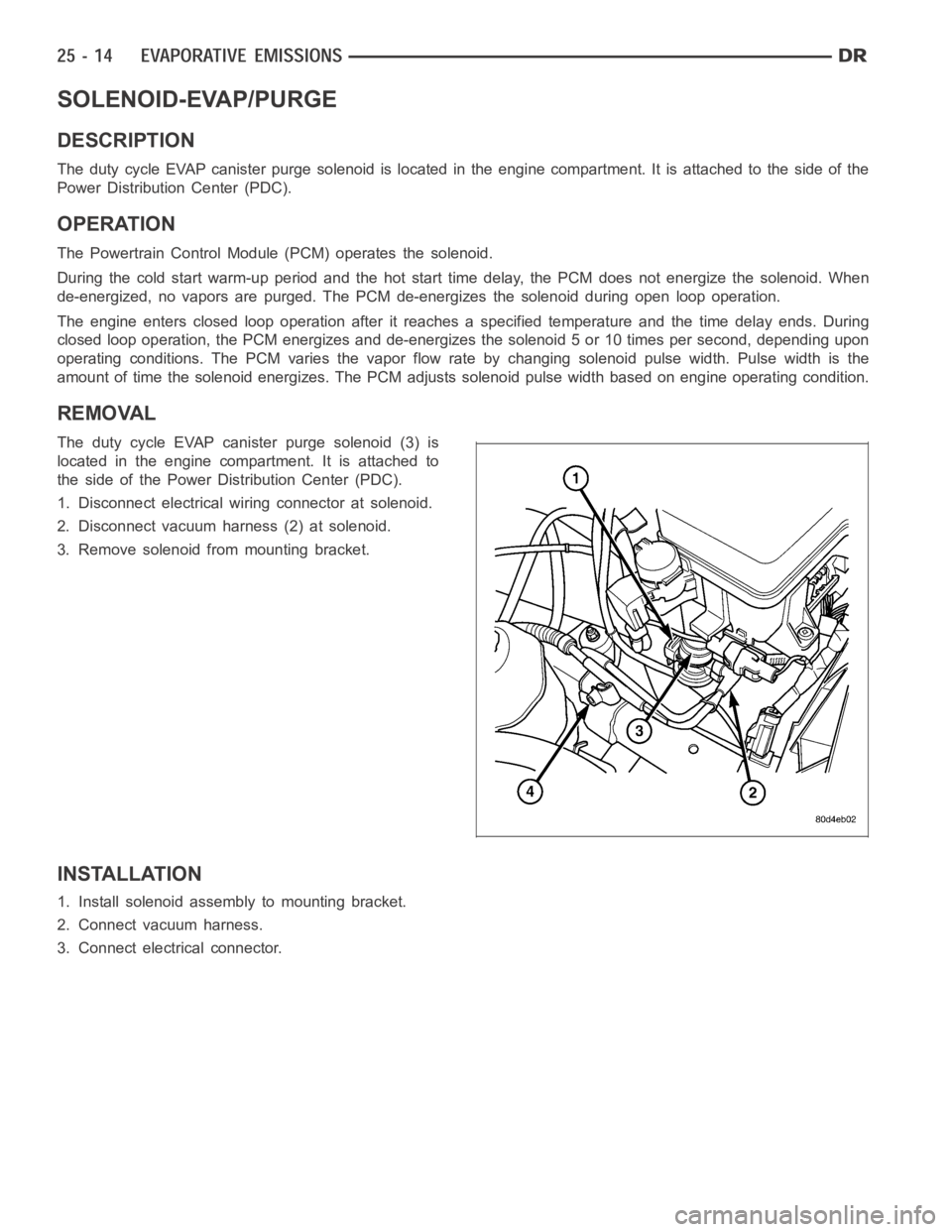
The duty cycle EVAP canister purge solenoid is located in the engine compartment. It is attached to the side of the
Power Distribution Center (PDC).
OPERATION
The Powertrain Control Module (PCM) operates the solenoid.
During the cold start warm-up period and the hot start time delay, the PCM does not energize the solenoid. When
de-energized, no vapors are purged. The PCM de-energizes the solenoid during open loop operation.
The engine enters closed loop operation after it reaches a specified temperature and the time delay ends. During
closed loop operation, the PCM energizes and de-energizes the solenoid 5 or 10 times per second, depending upon
operating conditions. The PCM varies the vapor flow rate by changing solenoid pulse width. Pulse width is the
amount of time the solenoid energizes. The PCM adjusts solenoid pulse width based on engine operating condition.
REMOVAL
The duty cycle EVAP canister purge solenoid (3) is
located in the engine compartment. It is attached to
the side of the Power Distribution Center (PDC).
1. Disconnect electrical wiring connector at solenoid.
2. Disconnect vacuum harness (2) at solenoid.
3. Remove solenoid from mounting bracket.
INSTALLATION
1. Install solenoid assembly to mounting bracket.
2. Connect vacuum harness.
3. Connect electrical connector.
Page 5207 of 5267
PUMP-LEAK DETECTION
DESCRIPTION
Vehicles equipped with JTEC engine control modules use a leak detection pump. Vehicles equipped with NGC
engine control modules use an NVLD pump. Refer to Natural Vacuum - Leak Detection (NVLD) for additional infor-
mation.
The evaporative emission system is designed to prevent the escape of fuel vapors from the fuel system. Leaks in
the system, even small ones, can allow fuel vapors to escape into the atmosphere. Government regulations require
onboard testing to make sure that the evaporative (EVAP) system is functioning properly. The leak detection system
tests for EVAP system leaks and blockage. It also performs self-diagnostics. During self-diagnostics, the Powertrain
Control Module (PCM) first checks the Leak Detection Pump (LDP) for electrical and mechanical faults. If the first
checks pass, the PCM then uses the LDP to seal the vent valve and pump air intothe system to pressurize it. If a
leak is present, the PCM will continue pumping the LDP to replace the air that leaks out. The PCM determines the
size of the leak based on how fast/long it must pump the LDP as it tries to maintain pressure in the system.
EVAP LEAK DETECTION SYSTEM
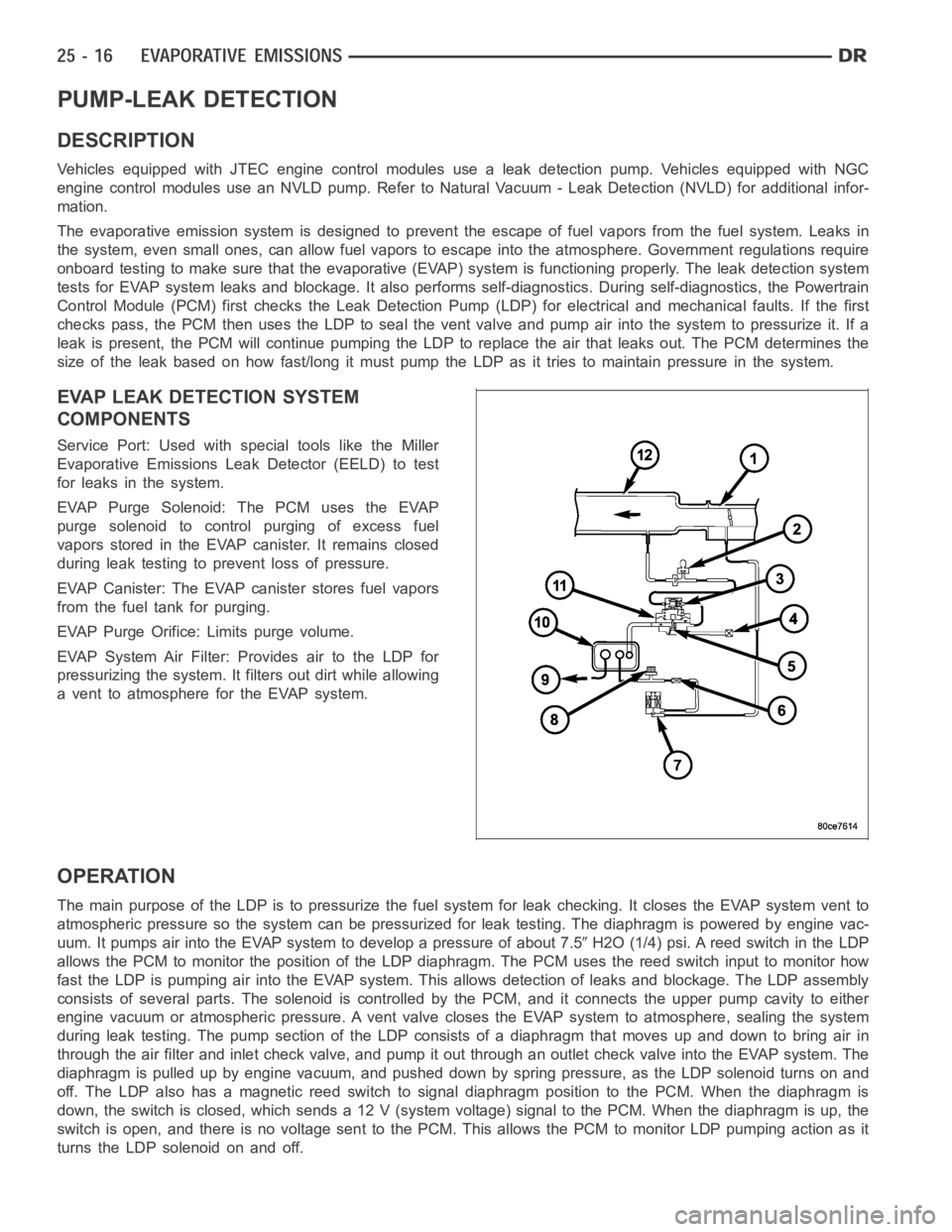
COMPONENTS
Service Port: Used with special tools like the Miller
Evaporative Emissions Leak Detector (EELD) to test
for leaks in the system.
EVAP Purge Solenoid: The PCM uses the EVAP
purge solenoid to control purging of excess fuel
vapors stored in the EVAP canister. It remains closed
during leak testing to prevent loss of pressure.
EVAP Canister: The EVAP canister stores fuel vapors
from the fuel tank for purging.
EVAP Purge Orifice: Limits purge volume.
EVAP System Air Filter: Provides air to the LDP for
pressurizing the system. It filters out dirt while allowing
a vent to atmosphere for the EVAP system.
OPERATION
The main purpose of the LDP is to pressurize the fuel system for leak checking. It closes the EVAP system vent to
atmospheric pressure so the system can be pressurized for leak testing. The diaphragm is powered by engine vac-
uum. It pumps air into the EVAP system to develop a pressure of about 7.5
H2O (1/4) psi. A reed switch in the LDP
allows the PCM to monitor the position of the LDP diaphragm. The PCM uses thereed switch input to monitor how
fast the LDP is pumping air into the EVAP system. This allows detection of leaks and blockage. The LDP assembly
consists of several parts. The solenoid is controlled by the PCM, and it connects the upper pump cavity to either
engine vacuum or atmospheric pressure. A vent valve closes the EVAP systemto atmosphere, sealing the system
during leak testing. The pump section of the LDP consists of a diaphragm that moves up and down to bring air in
through the air filter and inlet check valve, and pump it out through an outlet check valve into the EVAP system. The
diaphragm is pulled up by engine vacuum, and pushed down by spring pressure, as the LDP solenoid turns on and
off. The LDP also has a magnetic reed switch to signal diaphragm position tothe PCM. When the diaphragm is
down, the switch is closed, which sends a 12 V (system voltage) signal to thePCM. When the diaphragm is up, the
switch is open, and there is no voltage sent to the PCM. This allows the PCM tomonitor LDP pumping action as it
turns the LDP solenoid on and off.
Page 5208 of 5267

LDP AT REST (NOT POWERED)
When the LDP is at rest (no electrical/vacuum) the
diaphragm is allowed to drop down if the internal
(EVAP system) pressure is not greater than the return
spring. The LDP solenoid blocks the engine vacuum
port and opens the atmospheric pressure port con-
nected through the EVAP system air filter. The vent
valve is held open by the diaphragm. This allows the
canister to see atmospheric pressure.
DIAPHRAGM UPWARD MOVEMENT
When the PCM energizes the LDP solenoid, the sole-
noid blocks the atmospheric port leading through the
EVAP air filter and at the same time opens the engine
vacuum port to the pump cavity above the diaphragm.
The diaphragm moves upward when vacuum above
the diaphragm exceeds spring force. This upward
movement closes the vent valve. It also causes low
pressure below the diaphragm, unseating the inlet
check valve and allowing air in from the EVAP air fil-
ter. When the diaphragm completes its upward move-
ment, the LDP reed switch turns from closed to open.
Page 5212 of 5267
ORVR
DESCRIPTION
The ORVR (On-Board Refueling Vapor Recovery) system consists of a unique fuel tank, flow management valve,
fluid control valve, one-way check valve and vapor canister.
OPERATION
The ORVR (On-Board Refueling Vapor Recovery) system is used to remove excess fuel tank vapors. This is done
while the vehicle is being refueled.
Fuel flowing into the fuel filler tube (approx. 1” I.D.) creates an aspiration effect drawing air into the fuel fill tube.
During refueling, the fuel tank is vented to the EVAP canister to capture escaping vapors. With air flowing into the
filler tube, there are no fuel vapors escaping to the atmosphere. Once the refueling vapors are captured by the
EVAP canister, the vehicle’s computer controlled purge system draws vapor out of the canister for the engine to
burn. The vapor flow is metered by the purge solenoid so that there is no, or minimal impact on driveability or
tailpipe emissions.
As fuel starts to flow through the fuel fill tube, it opens the normally closed check valve and enters the fuel tank.
Vapor or air is expelled from the tank through the control valve and on to thevapor canister. Vapor is absorbed in
the EVAP canister until vapor flow in the lines stops. This stoppage occursfollowing fuel shut-off, or by having the
fuel level in the tank rise high enough to close the control valve. This control valve contains a float that rises to seal
the large diameter vent path to the EVAP canister. At this point in the refueling process, fuel tank pressure
increases, the check valve closes (preventing liquid fuel from spiting back at the operator), and fuel then rises up
the fuel filler tube to shut off the dispensing nozzle.