valve train DODGE RAM SRT-10 2006 Service Owner's Manual
[x] Cancel search | Manufacturer: DODGE, Model Year: 2006, Model line: RAM SRT-10, Model: DODGE RAM SRT-10 2006Pages: 5267, PDF Size: 68.7 MB
Page 449 of 5267
4.TP SENSOR NO.1 VOLTAGE GREATER THAN0.92 VOLTS WITH THROTTLE CLOSED
With the scan tool, read Throttle Position Sensor No.1 voltage.
Throttle must be against its stop.
Is the voltage 0.92 or less with the Throttle closed?
Ye s>>
Go To 5
No>>
Check for a binding throttle condition. If OK, replace the Throttle Position Sensor or the Throttle Body
Assemblyona5.7L.
Perform the POWERTRAIN VERIFICATION TEST. (Refer to 9 - ENGINE - STANDARD PROCEDURE)
5.ECT SENSOR OPERATION
NOTE: For this test to be valid, the thermostat must be operating correctly.
NOTE: This test works best if performed on a cold engine (cold soaked).
NOTE: If the vehicle was allowed to sit over night with no engine start, coolant temperature should be near
ambient temperatures.
Ignition on, engine not running.
With the scan tool, read the ECT value.
NOTE: If engine coolant temperature is above 82° C (180° F), allow the engine to cool until 65° C (150° F) is
reached.
Start the engine.
During engine warm-up, monitor the Engine Coolant Temperature value. Thetemperature value change should be a
smooth transition from start up to normal operating temp 82° C (180° F). Thevalue should reach at least 82° C
(180° F).
Did the Engine Temperature value increase smoothly and did it reach at least 82° C (180° F)?
Ye s>>
Go To 6
No>>
Replace the Engine Coolant Temperature Sensor.
Perform the POWERTRAIN VERIFICATION TEST. (Refer to 9 - ENGINE - STANDARD PROCEDURE)
6.OTHER POSSIBLE CAUSES OF START AND STALL CONDITION
The following additional items should be checked as a possible cause for a start and stall condition.
Refer to any Technical Service Bulletins (TSBs) that may apply to the symptom.
The exhaust system must be free of any restrictions.
The engine compression must be within specifications.
The engine valve timing must be within specifications.
Theenginemustbefreefromvacuumleaks.
The throttle body must be free of carbon buildup and dirt.
Do any of the above conditions exist?
Ye s>>
Repair as necessary.
Perform the POWERTRAIN VERIFICATION TEST. (Refer to 9 - ENGINE - STANDARD PROCEDURE)
No>>
Go To 7
Page 452 of 5267
23. If thelift foot setsare continually used, a speed control overshoot/undershoot condition will develop.
24. To
unlearnthe overshoot/undershoot condition, the vehicle operator has to press and release the set button
while maintaining the desired set speedusing the accelerator pedal (not decelerating or accelerating).
25. Then turn the cruise control switch to the OFF position (or press the CANCEL button if equipped) after waiting
10 seconds.
26. This procedure must be performed approximately 10-15 times to completely unlearn the overshoot/undershoot
condition.
Did the Speed Control pass the above test?
Ye s>>
Repair is complete.
No>>
Check for any related Technical Service Bulletins and/or refer to the appropriate Diagnostic Procedure.
3.POWERTRAIN VERIFICATION TEST 2
1. If this vehicle is equipped with an Electronic Throttle Control system,and the APP Sensors, PCM, or Throttle
Body Assembly has been replaced use a scan tool to perform the ETC RELEARN function.
NOTE: 2. After completing the Powertrain Verification Test the Transmission Verification Test must be per-
formed.
NOTE: 3. If the PCM has been replaced and the correct VIN and mileage have notbeen programmed, a DTC
will set in the ABS Module, Airbag Module and the SKIM/SKREEM.
NOTE: 4. If the vehicle is equipped with a Sentry Key Remote Entry, Secret Key data must be updated. Refer
to the Service Information for the PCM, SKIM/SKREEM and the Transponder (ignition key) for programming
information. Using the scan tool, program the Secret Key information intothe PCM using the PCM replaced
function under the WCM menu.
5. Inspect the vehicle to make sure that all components related to the repair are properly installed and connected.
6. With the scan tool, clear DTCs.
7. Perform generator output test. Refer to the appropriate service information as necessary.
8. Start the engine and set engine speed to 2000 RPM for at least thirty seconds.
9. Cycle the ignition key off and on.
10. With the scan tool, read the DTCs.
Are any DTCs or symptoms remaining?
Ye s>>
Check for any Technical Service Bulletins and/or refer to the appropriateDiagnostic Procedure.
No>>
Repair is complete.
4.POWERTRAIN VERIFICATION TEST 3
1. Install the Miller Tool #8404 Evaporative Emission Leak Detector (EELD) according to the instructions in the pre-
vious DTC table.
2. Set the smoke/air control switch to AIR.
3. Insert the tester’s AIR supply tip (clear hose) into the appropriate calibration orifice on the tester’s control panel
(based on DTC leak size).
4. Press the remote smoke/air start button.
5. Position the red flag on the air flow meter so it is aligned with the indicator ball.
6. When the calibration is complete, release the remote button. The EELD flow meter is now calibrated in liters per
minute to the size of leak indicated by the DTC set in the PCM.
7. Install the service port adapter #8404-14 on the vehicle’s service port.
8. Connect the Air supply hose from the EELD to the vehicle.
9. Press the remote button to activate AIR flow.
NOTE: 10. Larger volume fuel tanks, lower fuel levels or if the vehicle is equipped with a Flow Management
Valve may indicate high flow and will require 4 to 5 minutes to fill.
11. Compare the flow meter indicator ball reading to the red flag.
12. ABOVE the red flag indicates a leak present.
13. BELOW the red flag indicates a sealed system.
Page 521 of 5267
P0148-HIGH PRESSURE COMMON RAIL (HPCR) CHECKSUM
For a complete wiring diagramRefer to Section 8W.
When Monitored:
While the engine is running.
Set Condition:
A deviation between the fuel pressure set point and the actual fuel pressure.
Possible Causes
OTHERS DTC’S PRESENT
FUEL LEAKS
FUEL CONTROL ACTUATOR
FUEL PRESSURE SENSOR
CASCADE OVERFLOW VALVE
CHECK VALVE DAMAGED OR BLOCKED
FUEL RETURN LINES OBSTRUCTION, DAMAGE, OR DEBRIS
LIFT PUMP FLOW
AIRINFUELSYSTEM
LEAKING FUEL INJECTORS OR HIGH PRESSURE CONNECTORS
PRESSURE LIMITING VALVE
HIGH PRESSURE FUEL PUMP
INTERMITTENT CONDITION
Always perform the Pre-Diagnostic Troubleshooting procedure before proceeding. (Refer to 9 - ENGINE -
DIAGNOSIS AND TESTING)
Diagnostic Test
1.OTHERS DTC’S PRESENT
With the scan tool, read DTCs.
Are any other DTC’s present?
Ye s>>
Repair other DTC’s first.
Perform POWERTRAIN VERIFICATION TEST VER - 1 (DIESEL).
No>>
Go To 2
2.FUEL LEAKS
Ensure that the fuel level is above 15% using the scan tool.
Visually inspect the low and high pressure side of the fuel system for fuel leaks or damaged components.
Do you have any fuel leaks or damaged components?
Ye s>>
Repair the fuel leak.
Perform POWERTRAIN VERIFICATION TEST VER - 1 (DIESEL). (Refer to 8 - ELECTRICAL/ELEC-
TRONIC CONTROL MODULES/ENGINE CONTROL MODULE - DIAGNOSIS AND TESTING)
No>>
Go To 3
Page 522 of 5267
3.FUEL CONTROL ACTUATOR
Check for a mechanically stuck Fuel Control Actuator (FCA). Using the scantool, actuate the fuel control actuator.
NOTE: The fuel control actuator will only click when cycled off..
Do you hear a click from the actuator when you cycle the actuator off with thescan tool?
Ye s>>
Go To 4
No>>
Replace the fuel Injector pump.
Perform POWERTRAIN VERIFICATION TEST VER - 1 (DIESEL). (Refer to 8 - ELECTRICAL/ELEC-
TRONIC CONTROL MODULES/ENGINE CONTROL MODULE - DIAGNOSIS AND TESTING)
4.FUEL PRESSURE SENSOR
Using the scan tool, monitor the fuel pressure reading from the fuel rail pressure sensor at idle and at 2000 RPM
Is the fuel rail pressure reading higher at 2000 RPM than at idle?
Ye s>>
Go To 5
No>>
Replace the fuel pressure sensor.
Perform POWERTRAIN VERIFICATION TEST VER - 1 (DIESEL). (Refer to 8 - ELECTRICAL/ELEC-
TRONIC CONTROL MODULES/ENGINE CONTROL MODULE - DIAGNOSIS AND TESTING)
5.HIGH FUEL PRESSURE
Using the scan tool compare the fuel rail pressure set point with the actualfuel rail pressure.
Is the actual fuel rail pressure higher than the fuel rail pressure set point?
Ye s>>
Go To 6
No>>
Go To 9
6.CASCADE OVERFLOW VALVE
Perform the no trouble code test*fuel pump return flow test. (Refer to 9 - ENGINE - DIAGNOSIS AND TESTING)
Did the fuel injection pump pass the test?
Ye s>>
Go To 7
No>>
Replace the Fuel pump.
Perform POWERTRAIN VERIFICATION TEST VER - 1 (DIESEL). (Refer to 8 - ELECTRICAL/ELEC-
TRONIC CONTROL MODULES/ENGINE CONTROL MODULE - DIAGNOSIS AND TESTING)
7.CHECK VALVE DAMAGED OR BLOCKED
Check the fuel drain line check valve in the rear of the cylinder head for signs of damage, blockage, or debris.
Is the check valve damaged or blocked?
Ye s>>
Repair the cause of the damaged or blocked check valve or replace the valve.
Perform POWERTRAIN VERIFICATION TEST VER - 1 (DIESEL). (Refer to 8 - ELECTRICAL/ELEC-
TRONIC CONTROL MODULES/ENGINE CONTROL MODULE - DIAGNOSIS AND TESTING)
No>>
Go To 8
Page 523 of 5267
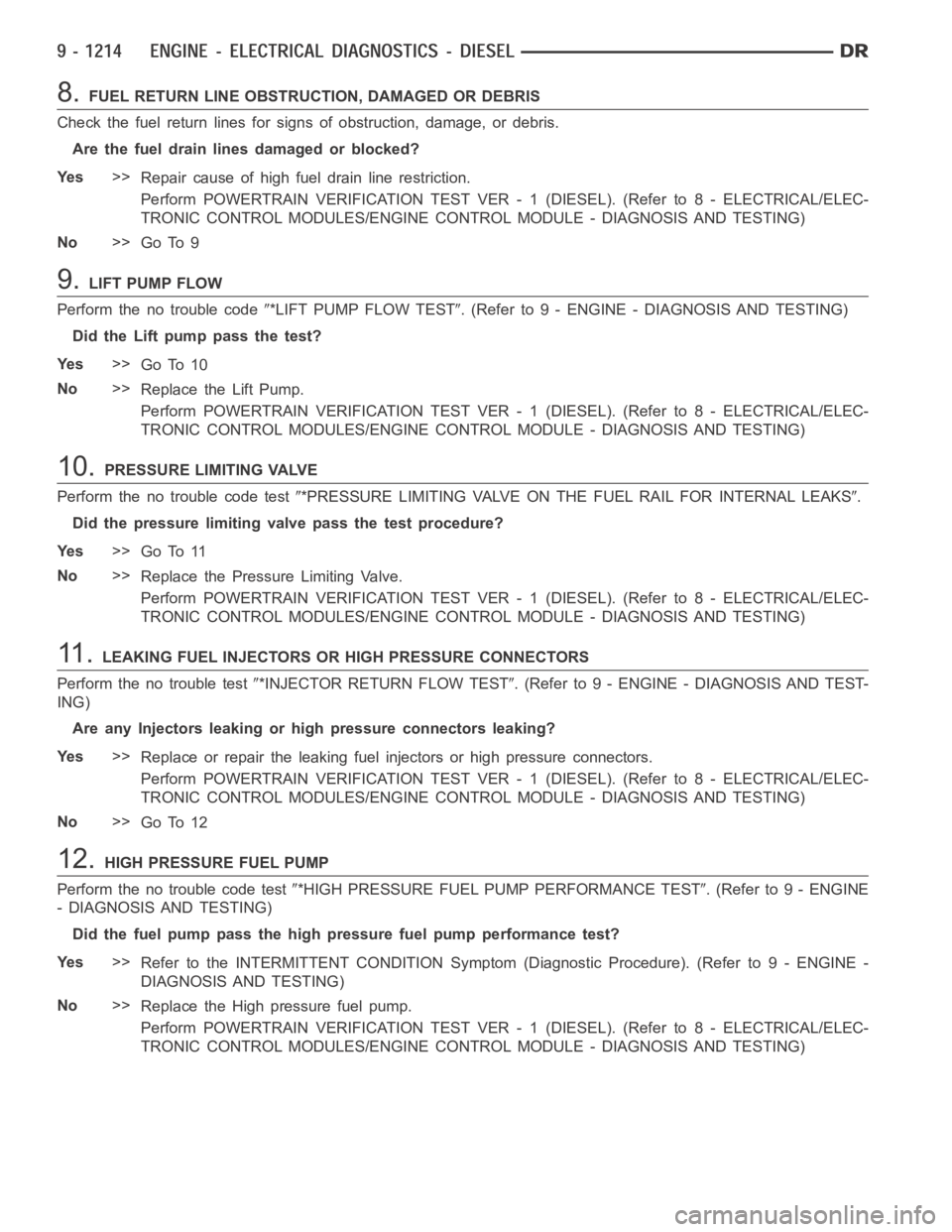
8.FUEL RETURN LINE OBSTRUCTION, DAMAGED OR DEBRIS
Check the fuel return lines for signs of obstruction, damage, or debris.
Are the fuel drain lines damaged or blocked?
Ye s>>
Repair cause of high fuel drain line restriction.
Perform POWERTRAIN VERIFICATION TEST VER - 1 (DIESEL). (Refer to 8 - ELECTRICAL/ELEC-
TRONIC CONTROL MODULES/ENGINE CONTROL MODULE - DIAGNOSIS AND TESTING)
No>>
Go To 9
9.LIFT PUMP FLOW
Perform the no trouble code*LIFT PUMP FLOW TEST. (Refer to 9 - ENGINE - DIAGNOSIS AND TESTING)
Did the Lift pump pass the test?
Ye s>>
Go To 10
No>>
Replace the Lift Pump.
Perform POWERTRAIN VERIFICATION TEST VER - 1 (DIESEL). (Refer to 8 - ELECTRICAL/ELEC-
TRONIC CONTROL MODULES/ENGINE CONTROL MODULE - DIAGNOSIS AND TESTING)
10.PRESSURE LIMITING VALVE
Perform the no trouble code test*PRESSURE LIMITING VALVE ON THE FUEL RAIL FOR INTERNAL LEAKS.
Did the pressure limiting valve pass the test procedure?
Ye s>>
Go To 11
No>>
Replace the Pressure Limiting Valve.
Perform POWERTRAIN VERIFICATION TEST VER - 1 (DIESEL). (Refer to 8 - ELECTRICAL/ELEC-
TRONIC CONTROL MODULES/ENGINE CONTROL MODULE - DIAGNOSIS AND TESTING)
11 .LEAKING FUEL INJECTORS OR HIGH PRESSURE CONNECTORS
Perform the no trouble test*INJECTOR RETURN FLOW TEST. (Refer to 9 - ENGINE - DIAGNOSIS AND TEST-
ING)
Are any Injectors leaking or high pressure connectors leaking?
Ye s>>
Replace or repair the leaking fuel injectors or high pressure connectors.
Perform POWERTRAIN VERIFICATION TEST VER - 1 (DIESEL). (Refer to 8 - ELECTRICAL/ELEC-
TRONIC CONTROL MODULES/ENGINE CONTROL MODULE - DIAGNOSIS AND TESTING)
No>>
Go To 12
12.HIGH PRESSURE FUEL PUMP
Perform the no trouble code test*HIGH PRESSURE FUEL PUMP PERFORMANCE TEST. (Refer to 9 - ENGINE
- DIAGNOSIS AND TESTING)
Did the fuel pump pass the high pressure fuel pump performance test?
Ye s>>
Refer to the INTERMITTENT CONDITION Symptom (Diagnostic Procedure). (Refer to 9 - ENGINE -
DIAGNOSIS AND TESTING)
No>>
Replace the High pressure fuel pump.
Perform POWERTRAIN VERIFICATION TEST VER - 1 (DIESEL). (Refer to 8 - ELECTRICAL/ELEC-
TRONIC CONTROL MODULES/ENGINE CONTROL MODULE - DIAGNOSIS AND TESTING)
Page 565 of 5267
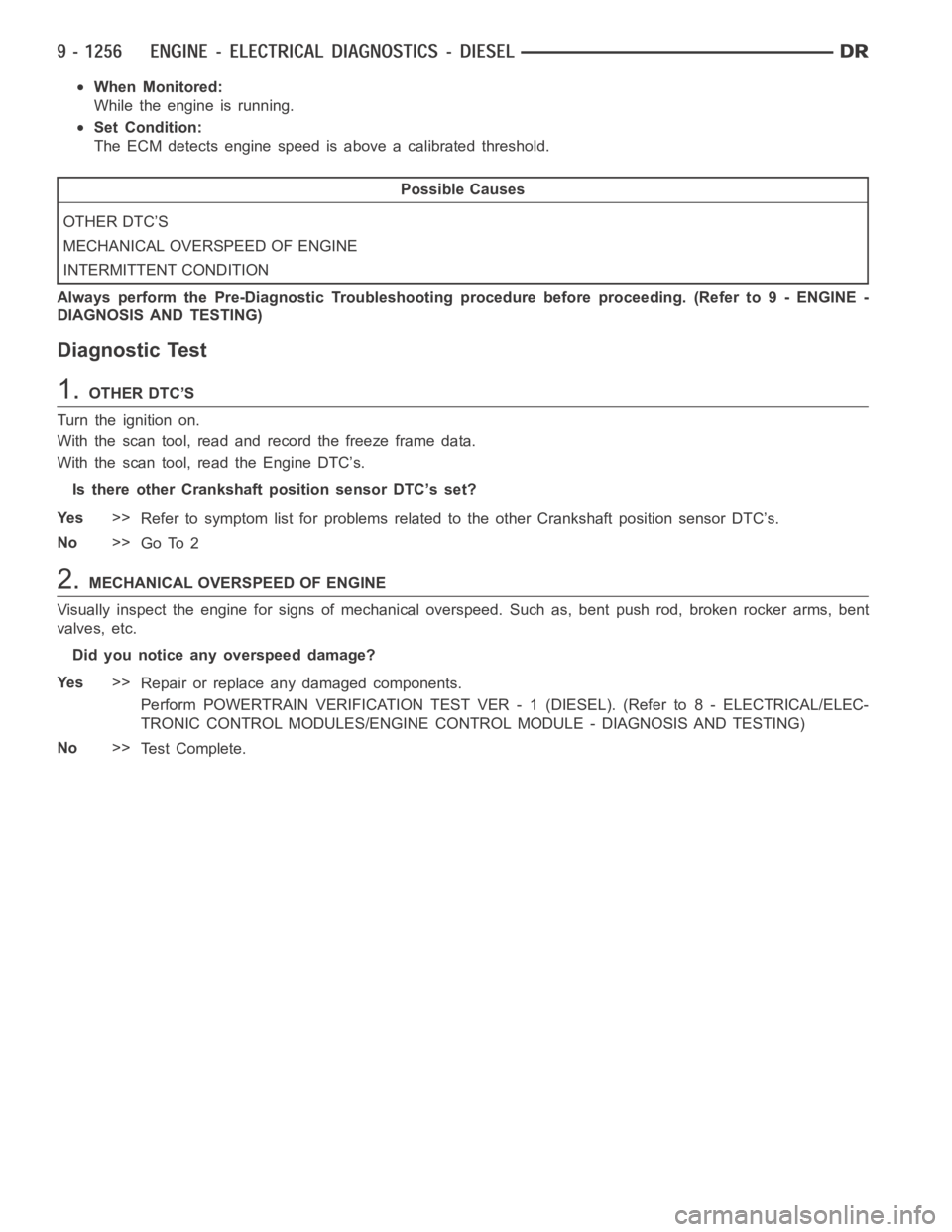
When Monitored:
While the engine is running.
Set Condition:
The ECM detects engine speed is above a calibrated threshold.
Possible Causes
OTHER DTC’S
MECHANICAL OVERSPEED OF ENGINE
INTERMITTENT CONDITION
Always perform the Pre-Diagnostic Troubleshooting procedure before proceeding. (Refer to 9 - ENGINE -
DIAGNOSIS AND TESTING)
Diagnostic Test
1.OTHER DTC’S
Turn the ignition on.
With the scan tool, read and record the freeze frame data.
With the scan tool, read the Engine DTC’s.
Is there other Crankshaft position sensor DTC’s set?
Ye s>>
Refer to symptom list for problems related to the other Crankshaft positionsensorDTC’s.
No>>
Go To 2
2.MECHANICAL OVERSPEED OF ENGINE
Visually inspect the engine for signs of mechanical overspeed. Such as, bent push rod, broken rocker arms, bent
valves, etc.
Did you notice any overspeed damage?
Ye s>>
Repair or replace any damaged components.
Perform POWERTRAIN VERIFICATION TEST VER - 1 (DIESEL). (Refer to 8 - ELECTRICAL/ELEC-
TRONIC CONTROL MODULES/ENGINE CONTROL MODULE - DIAGNOSIS AND TESTING)
No>>
Te s t C o m p l e t e .
Page 566 of 5267
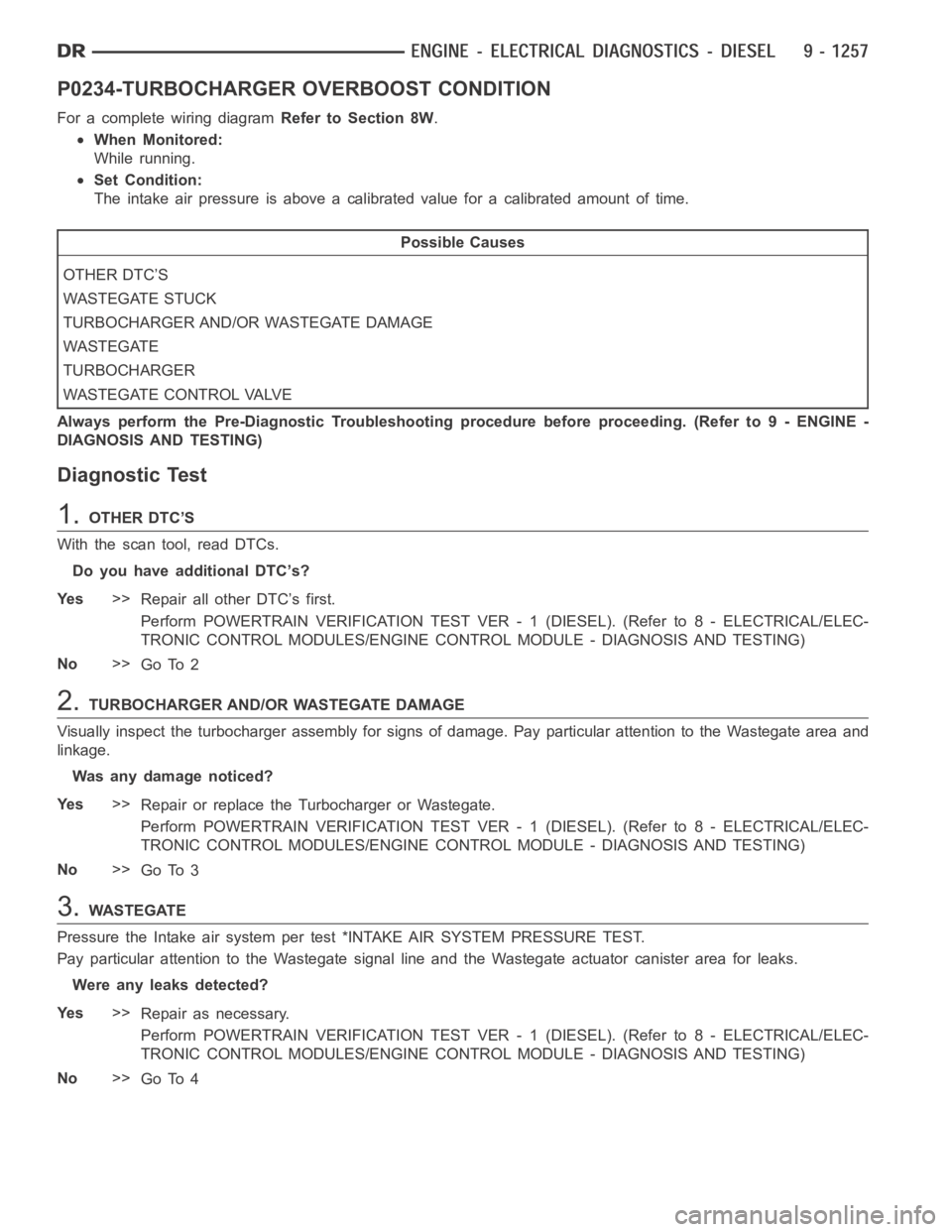
P0234-TURBOCHARGER OVERBOOST CONDITION
For a complete wiring diagramRefer to Section 8W.
When Monitored:
While running.
Set Condition:
The intake air pressure is above a calibrated value for a calibrated amountof time.
Possible Causes
OTHER DTC’S
WASTEGATE STUCK
TURBOCHARGER AND/OR WASTEGATE DAMAGE
WASTEGATE
TURBOCHARGER
WASTEGATE CONTROL VALVE
Always perform the Pre-Diagnostic Troubleshooting procedure before proceeding. (Refer to 9 - ENGINE -
DIAGNOSIS AND TESTING)
Diagnostic Test
1.OTHER DTC’S
With the scan tool, read DTCs.
Do you have additional DTC’s?
Ye s>>
Repair all other DTC’s first.
Perform POWERTRAIN VERIFICATION TEST VER - 1 (DIESEL). (Refer to 8 - ELECTRICAL/ELEC-
TRONIC CONTROL MODULES/ENGINE CONTROL MODULE - DIAGNOSIS AND TESTING)
No>>
Go To 2
2.TURBOCHARGER AND/OR WASTEGATE DAMAGE
Visually inspect the turbocharger assembly for signs of damage. Pay particular attention to the Wastegate area and
linkage.
Was any damage noticed?
Ye s>>
Repair or replace the Turbocharger or Wastegate.
Perform POWERTRAIN VERIFICATION TEST VER - 1 (DIESEL). (Refer to 8 - ELECTRICAL/ELEC-
TRONIC CONTROL MODULES/ENGINE CONTROL MODULE - DIAGNOSIS AND TESTING)
No>>
Go To 3
3.WASTEGATE
Pressure the Intake air system per test *INTAKE AIR SYSTEM PRESSURE TEST.
Pay particular attention to the Wastegate signal line and the Wastegate actuator canister area for leaks.
Were any leaks detected?
Ye s>>
Repair as necessary.
Perform POWERTRAIN VERIFICATION TEST VER - 1 (DIESEL). (Refer to 8 - ELECTRICAL/ELEC-
TRONIC CONTROL MODULES/ENGINE CONTROL MODULE - DIAGNOSIS AND TESTING)
No>>
Go To 4
Page 567 of 5267
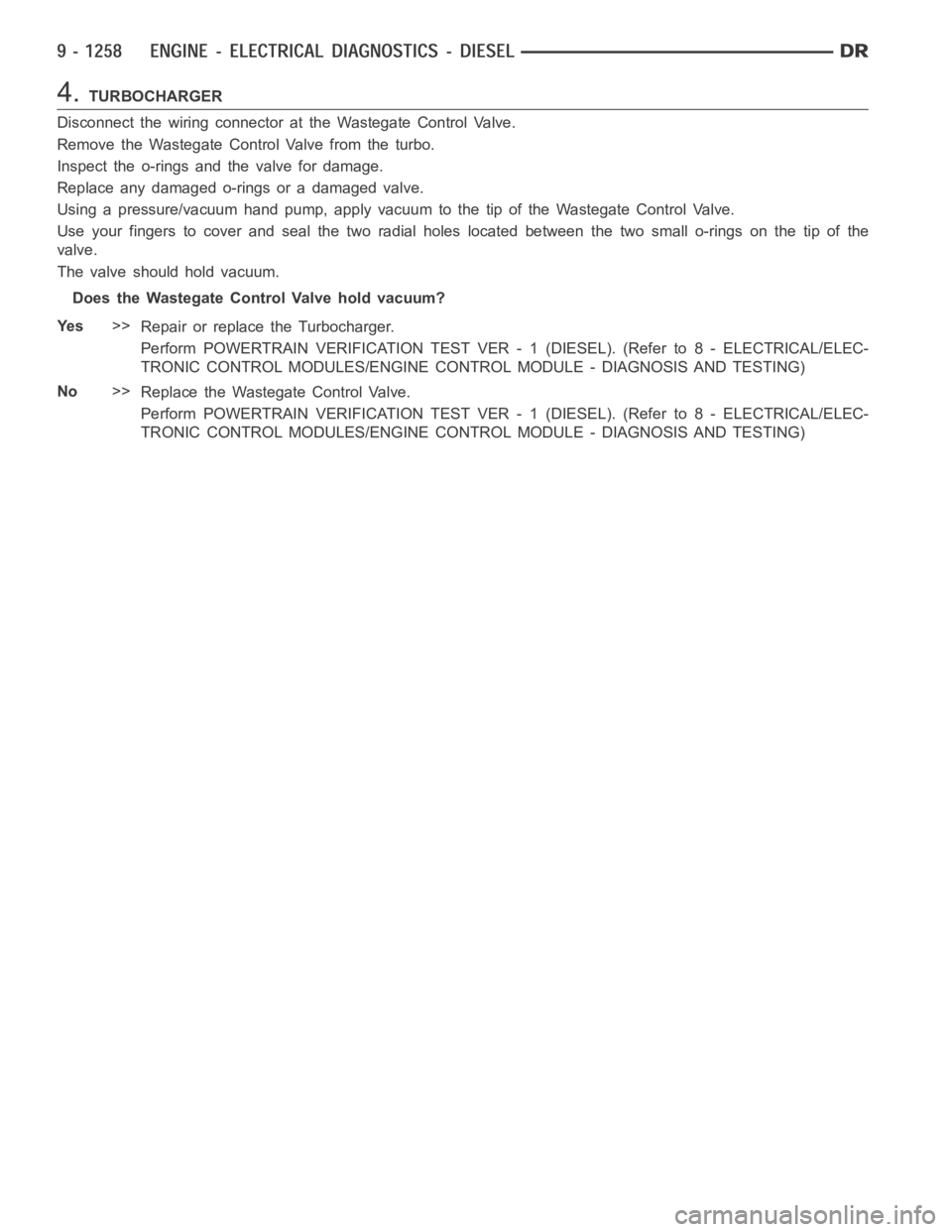
4.TURBOCHARGER
Disconnect the wiring connector at the Wastegate Control Valve.
Remove the Wastegate Control Valve from the turbo.
Inspect the o-rings and the valve for damage.
Replace any damaged o-rings or a damaged valve.
Using a pressure/vacuum hand pump, apply vacuum to the tip of the WastegateControl Valve.
Use your fingers to cover and seal the two radial holes located between the two small o-rings on the tip of the
valve.
The valve should hold vacuum.
Does the Wastegate Control Valve hold vacuum?
Ye s>>
Repair or replace the Turbocharger.
Perform POWERTRAIN VERIFICATION TEST VER - 1 (DIESEL). (Refer to 8 - ELECTRICAL/ELEC-
TRONIC CONTROL MODULES/ENGINE CONTROL MODULE - DIAGNOSIS AND TESTING)
No>>
Replace the Wastegate Control Valve.
Perform POWERTRAIN VERIFICATION TEST VER - 1 (DIESEL). (Refer to 8 - ELECTRICAL/ELEC-
TRONIC CONTROL MODULES/ENGINE CONTROL MODULE - DIAGNOSIS AND TESTING)
Page 596 of 5267
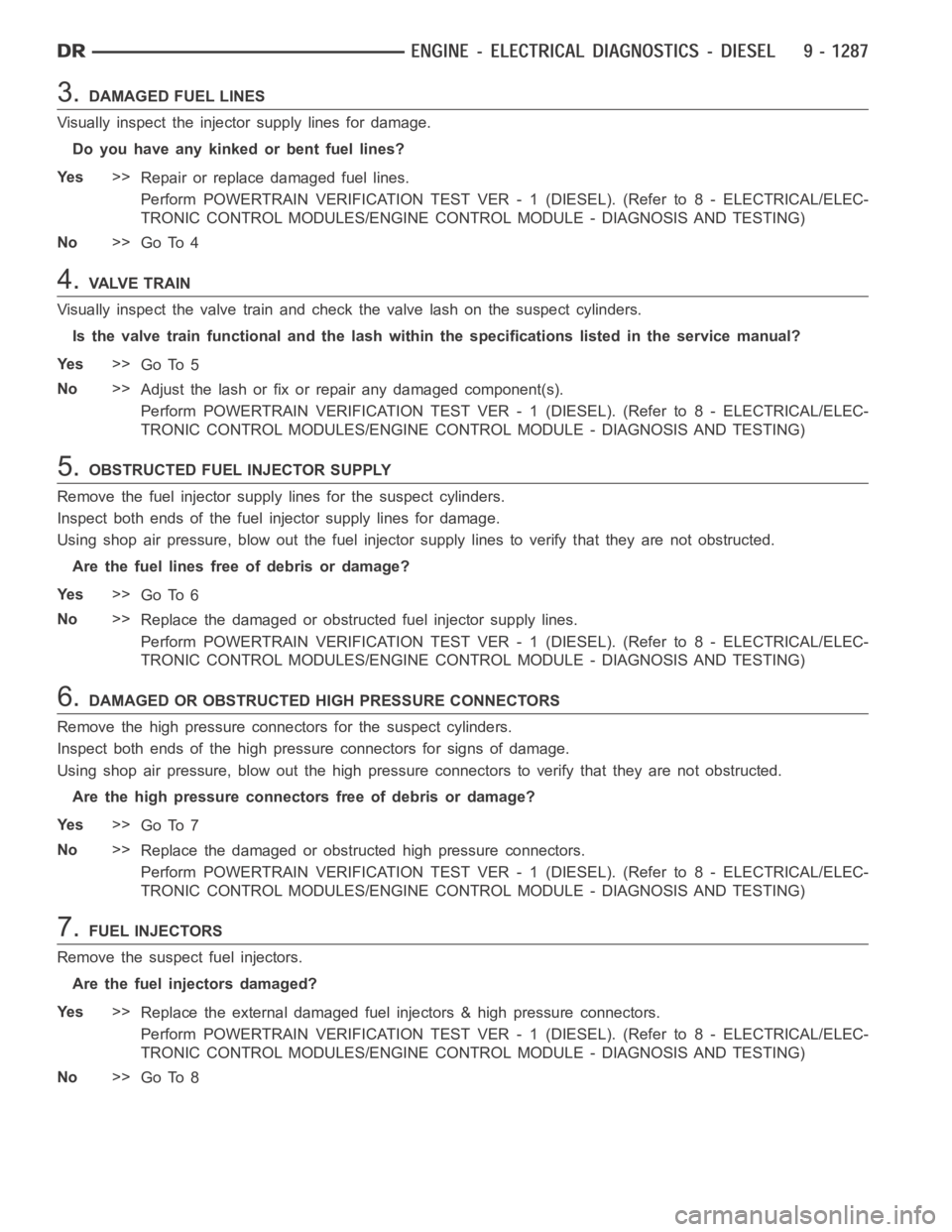
3.DAMAGED FUEL LINES
Visually inspect the injector supply lines for damage.
Do you have any kinked or bent fuel lines?
Ye s>>
Repair or replace damaged fuel lines.
Perform POWERTRAIN VERIFICATION TEST VER - 1 (DIESEL). (Refer to 8 - ELECTRICAL/ELEC-
TRONIC CONTROL MODULES/ENGINE CONTROL MODULE - DIAGNOSIS AND TESTING)
No>>
Go To 4
4.VA LV E T R A I N
Visually inspect the valve train and check the valve lash on the suspect cylinders.
Is the valve train functional and the lash within the specifications listed in the service manual?
Ye s>>
Go To 5
No>>
Adjust the lash or fix or repair any damaged component(s).
Perform POWERTRAIN VERIFICATION TEST VER - 1 (DIESEL). (Refer to 8 - ELECTRICAL/ELEC-
TRONIC CONTROL MODULES/ENGINE CONTROL MODULE - DIAGNOSIS AND TESTING)
5.OBSTRUCTED FUEL INJECTOR SUPPLY
Remove the fuel injector supply lines for the suspect cylinders.
Inspect both ends of the fuel injector supply lines for damage.
Using shop air pressure, blow out the fuel injector supply lines to verify that they are not obstructed.
Are the fuel lines free of debris or damage?
Ye s>>
Go To 6
No>>
Replace the damaged or obstructed fuel injector supply lines.
Perform POWERTRAIN VERIFICATION TEST VER - 1 (DIESEL). (Refer to 8 - ELECTRICAL/ELEC-
TRONIC CONTROL MODULES/ENGINE CONTROL MODULE - DIAGNOSIS AND TESTING)
6.DAMAGED OR OBSTRUCTED HIGH PRESSURE CONNECTORS
Remove the high pressure connectors for the suspect cylinders.
Inspect both ends of the high pressure connectors for signs of damage.
Using shop air pressure, blow out the high pressure connectors to verify that they are not obstructed.
Are the high pressure connectors free of debris or damage?
Ye s>>
Go To 7
No>>
Replace the damaged or obstructed high pressure connectors.
Perform POWERTRAIN VERIFICATION TEST VER - 1 (DIESEL). (Refer to 8 - ELECTRICAL/ELEC-
TRONIC CONTROL MODULES/ENGINE CONTROL MODULE - DIAGNOSIS AND TESTING)
7.FUEL INJECTORS
Remove the suspect fuel injectors.
Are the fuel injectors damaged?
Ye s>>
Replace the external damaged fuel injectors & high pressure connectors.
Perform POWERTRAIN VERIFICATION TEST VER - 1 (DIESEL). (Refer to 8 - ELECTRICAL/ELEC-
TRONIC CONTROL MODULES/ENGINE CONTROL MODULE - DIAGNOSIS AND TESTING)
No>>
Go To 8
Page 599 of 5267
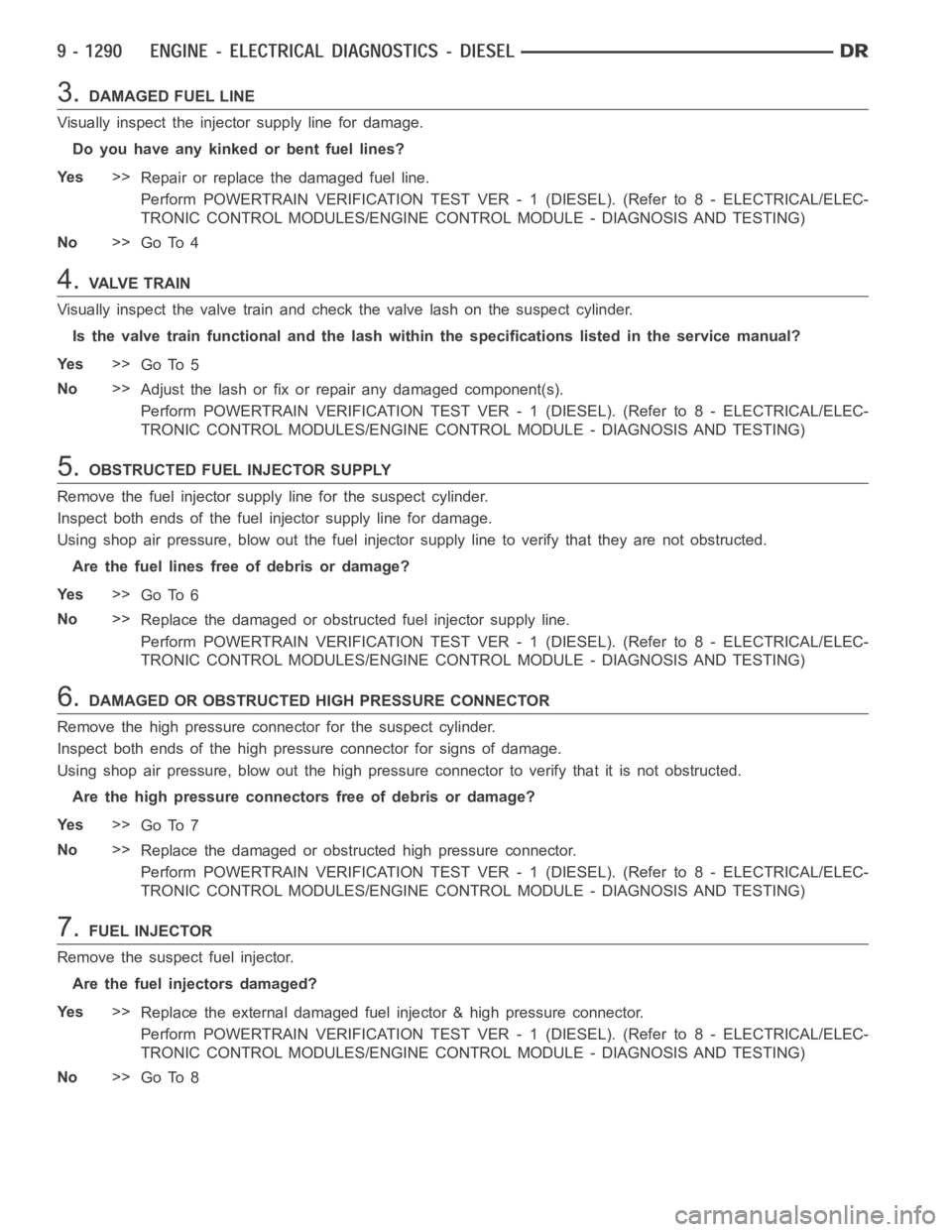
3.DAMAGED FUEL LINE
Visually inspect the injector supply line for damage.
Do you have any kinked or bent fuel lines?
Ye s>>
Repair or replace the damaged fuel line.
Perform POWERTRAIN VERIFICATION TEST VER - 1 (DIESEL). (Refer to 8 - ELECTRICAL/ELEC-
TRONIC CONTROL MODULES/ENGINE CONTROL MODULE - DIAGNOSIS AND TESTING)
No>>
Go To 4
4.VA LV E T R A I N
Visually inspect the valve train and check the valve lash on the suspect cylinder.
Is the valve train functional and the lash within the specifications listed in the service manual?
Ye s>>
Go To 5
No>>
Adjust the lash or fix or repair any damaged component(s).
Perform POWERTRAIN VERIFICATION TEST VER - 1 (DIESEL). (Refer to 8 - ELECTRICAL/ELEC-
TRONIC CONTROL MODULES/ENGINE CONTROL MODULE - DIAGNOSIS AND TESTING)
5.OBSTRUCTED FUEL INJECTOR SUPPLY
Remove the fuel injector supply line for the suspect cylinder.
Inspect both ends of the fuel injector supply line for damage.
Using shop air pressure, blow out the fuel injector supply line to verify that they are not obstructed.
Are the fuel lines free of debris or damage?
Ye s>>
Go To 6
No>>
Replace the damaged or obstructed fuel injector supply line.
Perform POWERTRAIN VERIFICATION TEST VER - 1 (DIESEL). (Refer to 8 - ELECTRICAL/ELEC-
TRONIC CONTROL MODULES/ENGINE CONTROL MODULE - DIAGNOSIS AND TESTING)
6.DAMAGED OR OBSTRUCTED HIGH PRESSURE CONNECTOR
Remove the high pressure connector for the suspect cylinder.
Inspect both ends of the high pressure connector for signs of damage.
Using shop air pressure, blow out the high pressure connector to verify that it is not obstructed.
Are the high pressure connectors free of debris or damage?
Ye s>>
Go To 7
No>>
Replace the damaged or obstructed high pressure connector.
Perform POWERTRAIN VERIFICATION TEST VER - 1 (DIESEL). (Refer to 8 - ELECTRICAL/ELEC-
TRONIC CONTROL MODULES/ENGINE CONTROL MODULE - DIAGNOSIS AND TESTING)
7.FUEL INJECTOR
Remove the suspect fuel injector.
Are the fuel injectors damaged?
Ye s>>
Replace the external damaged fuel injector & high pressure connector.
Perform POWERTRAIN VERIFICATION TEST VER - 1 (DIESEL). (Refer to 8 - ELECTRICAL/ELEC-
TRONIC CONTROL MODULES/ENGINE CONTROL MODULE - DIAGNOSIS AND TESTING)
No>>
Go To 8