valve train DODGE RAM SRT-10 2006 Service Owner's Guide
[x] Cancel search | Manufacturer: DODGE, Model Year: 2006, Model line: RAM SRT-10, Model: DODGE RAM SRT-10 2006Pages: 5267, PDF Size: 68.7 MB
Page 602 of 5267
3.DAMAGED FUEL LINE
Visually inspect the injector supply line for damage.
Do you have any kinked or bent fuel line?
Ye s>>
Repair or replace the damaged fuel line.
Perform POWERTRAIN VERIFICATION TEST VER - 1 (DIESEL). (Refer to 8 - ELECTRICAL/ELEC-
TRONIC CONTROL MODULES/ENGINE CONTROL MODULE - DIAGNOSIS AND TESTING)
No>>
Go To 4
4.VA LV E T R A I N
Visually inspect the valve train and check the valve lash on the suspect cylinder.
Is the valve train functional and the lash within the specifications listed in the service manual?
Ye s>>
Go To 5
No>>
Adjust the lash or fix or repair any damaged component(s).
Perform POWERTRAIN VERIFICATION TEST VER - 1 (DIESEL). (Refer to 8 - ELECTRICAL/ELEC-
TRONIC CONTROL MODULES/ENGINE CONTROL MODULE - DIAGNOSIS AND TESTING)
5.OBSTRUCTED FUEL INJECTOR SUPPLY
Remove the fuel injector supply line for the suspect cylinder.
Inspect both ends of the fuel injector supply line for damage.
Using shop air pressure, blow out the fuel injector supply line to verify that they are not obstructed.
Are the fuel lines free of debris or damage?
Ye s>>
Go To 6
No>>
Replace the damaged or obstructed fuel injector supply line.
Perform POWERTRAIN VERIFICATION TEST VER - 1 (DIESEL). (Refer to 8 - ELECTRICAL/ELEC-
TRONIC CONTROL MODULES/ENGINE CONTROL MODULE - DIAGNOSIS AND TESTING)
6.DAMAGED OR OBSTRUCTED HIGH PRESSURE CONNECTOR
Remove the high pressure connector for the suspect cylinder.
Inspect both ends of the high pressure connector for signs of damage.
Using shop air pressure, blow out the high pressure connector to verify that it is not obstructed.
Are the high pressure connectors free of debris or damage?
Ye s>>
Go To 7
No>>
Replace the damaged or obstructed high pressure connector.
Perform POWERTRAIN VERIFICATION TEST VER - 1 (DIESEL). (Refer to 8 - ELECTRICAL/ELEC-
TRONIC CONTROL MODULES/ENGINE CONTROL MODULE - DIAGNOSIS AND TESTING)
7.FUEL INJECTOR
Remove the suspect fuel injector.
Is the fuel injector damaged?
Ye s>>
Replace the external damaged fuel injector & high pressure connector.
Perform POWERTRAIN VERIFICATION TEST VER - 1 (DIESEL). (Refer to 8 - ELECTRICAL/ELEC-
TRONIC CONTROL MODULES/ENGINE CONTROL MODULE - DIAGNOSIS AND TESTING)
No>>
Go To 8
Page 605 of 5267
3.DAMAGED FUEL LINE
Visually inspect the injector supply line for damage.
Do you have any kinked or bent fuel line?
Ye s>>
Repair or replace the damaged fuel line.
Perform POWERTRAIN VERIFICATION TEST VER - 1 (DIESEL). (Refer to 8 - ELECTRICAL/ELEC-
TRONIC CONTROL MODULES/ENGINE CONTROL MODULE - DIAGNOSIS AND TESTING)
No>>
Go To 4
4.VA LV E T R A I N
Visually inspect the valve train and check the valve lash on the suspect cylinder.
Is the valve train functional and the lash within the specifications listed in the service manual?
Ye s>>
Go To 5
No>>
Adjust the lash or fix or repair any damaged component(s).
Perform POWERTRAIN VERIFICATION TEST VER - 1 (DIESEL). (Refer to 8 - ELECTRICAL/ELEC-
TRONIC CONTROL MODULES/ENGINE CONTROL MODULE - DIAGNOSIS AND TESTING)
5.OBSTRUCTED FUEL INJECTOR SUPPLY
Remove the fuel injector supply line for the suspect cylinder.
Inspect both ends of the fuel injector supply lines for damage.
Using shop air pressure, blow out the fuel injector supply lines to verify that they are not obstructed.
Are the fuel lines free of debris or damage?
Ye s>>
Go To 6
No>>
Replace the damaged or obstructed fuel injector supply line.
Perform POWERTRAIN VERIFICATION TEST VER - 1 (DIESEL). (Refer to 8 - ELECTRICAL/ELEC-
TRONIC CONTROL MODULES/ENGINE CONTROL MODULE - DIAGNOSIS AND TESTING)
6.DAMAGED OR OBSTRUCTED HIGH PRESSURE CONNECTOR
Remove the high pressure connector for the suspect cylinder.
Inspect both ends of the high pressure connector for signs of damage.
Using shop air pressure, blow out the high pressure connector to verify that it is not obstructed.
Are the high pressure connectors free of debris or damage?
Ye s>>
Go To 7
No>>
Replace the damaged or obstructed high pressure connector.
Perform POWERTRAIN VERIFICATION TEST VER - 1 (DIESEL). (Refer to 8 - ELECTRICAL/ELEC-
TRONIC CONTROL MODULES/ENGINE CONTROL MODULE - DIAGNOSIS AND TESTING)
7.FUEL INJECTOR
Remove the suspect fuel injector.
Are the fuel injectors damaged?
Ye s>>
Replace the external damaged fuel injector & high pressure connector.
Perform POWERTRAIN VERIFICATION TEST VER - 1 (DIESEL). (Refer to 8 - ELECTRICAL/ELEC-
TRONIC CONTROL MODULES/ENGINE CONTROL MODULE - DIAGNOSIS AND TESTING)
No>>
Go To 8
Page 608 of 5267
3.DAMAGED FUEL LINE
Visually inspect the injector supply line for damage.
Do you have any kinked or bent fuel line?
Ye s>>
Repair or replace the damaged fuel line.
Perform POWERTRAIN VERIFICATION TEST VER - 1 (DIESEL). (Refer to 8 - ELECTRICAL/ELEC-
TRONIC CONTROL MODULES/ENGINE CONTROL MODULE - DIAGNOSIS AND TESTING)
No>>
Go To 4
4.VA LV E T R A I N
Visually inspect the valve train and check the valve lash on the suspect cylinder.
Is the valve train functional and the lash within the specifications listed in the service manual?
Ye s>>
Go To 5
No>>
Adjust the lash or fix or repair any damaged component(s).
Perform POWERTRAIN VERIFICATION TEST VER - 1 (DIESEL). (Refer to 8 - ELECTRICAL/ELEC-
TRONIC CONTROL MODULES/ENGINE CONTROL MODULE - DIAGNOSIS AND TESTING)
5.OBSTRUCTED FUEL INJECTOR SUPPLY
Remove the fuel injector supply line for the suspect cylinder.
Inspect both ends of the fuel injector supply line for damage.
Using shop air pressure, blow out the fuel injector supply lines to verify that they are not obstructed.
Are the fuel lines free of debris or damage?
Ye s>>
Go To 6
No>>
Replace the damaged or obstructed fuel injector supply line.
Perform POWERTRAIN VERIFICATION TEST VER - 1 (DIESEL). (Refer to 8 - ELECTRICAL/ELEC-
TRONIC CONTROL MODULES/ENGINE CONTROL MODULE - DIAGNOSIS AND TESTING)
6.DAMAGED OR OBSTRUCTED HIGH PRESSURE CONNECTOR
Remove the high pressure connector for the suspect cylinder.
Inspect both ends of the high pressure connector for signs of damage.
Using shop air pressure, blow out the high pressure connectors to verify that it is not obstructed.
Are the high pressure connectors free of debris or damage?
Ye s>>
Go To 7
No>>
Replace the damaged or obstructed high pressure connector.
Perform POWERTRAIN VERIFICATION TEST VER - 1 (DIESEL). (Refer to 8 - ELECTRICAL/ELEC-
TRONIC CONTROL MODULES/ENGINE CONTROL MODULE - DIAGNOSIS AND TESTING)
7.FUEL INJECTOR
Remove the suspect fuel injector.
Are the fuel injectors damaged?
Ye s>>
Replace the external damaged fuel injector & high pressure connector.
Perform POWERTRAIN VERIFICATION TEST VER - 1 (DIESEL). (Refer to 8 - ELECTRICAL/ELEC-
TRONIC CONTROL MODULES/ENGINE CONTROL MODULE - DIAGNOSIS AND TESTING)
No>>
Go To 8
Page 611 of 5267
3.DAMAGED FUEL LINE
Visually inspect the injector supply line for damage.
Do you have any kinked or bent fuel line?
Ye s>>
Repair or replace the damaged fuel line.
Perform POWERTRAIN VERIFICATION TEST VER - 1 (DIESEL). (Refer to 8 - ELECTRICAL/ELEC-
TRONIC CONTROL MODULES/ENGINE CONTROL MODULE - DIAGNOSIS AND TESTING)
No>>
Go To 4
4.VA LV E T R A I N
Visually inspect the valve train and check the valve lash on the suspect cylinder.
Is the valve train functional and the lash within the specifications listed in the service manual?
Ye s>>
Go To 5
No>>
Adjust the lash or fix or repair any damaged component(s).
Perform POWERTRAIN VERIFICATION TEST VER - 1 (DIESEL). (Refer to 8 - ELECTRICAL/ELEC-
TRONIC CONTROL MODULES/ENGINE CONTROL MODULE - DIAGNOSIS AND TESTING)
5.OBSTRUCTED FUEL INJECTOR SUPPLY
Remove the fuel injector supply lines for the suspect cylinder.
Inspect both ends of the fuel injector supply lines for damage.
Using shop air pressure, blow out the fuel injector supply lines to verify that they are not obstructed.
Are the fuel lines free of debris or damage?
Ye s>>
Go To 6
No>>
Replace the damaged or obstructed fuel injector supply lines.
Perform POWERTRAIN VERIFICATION TEST VER - 1 (DIESEL). (Refer to 8 - ELECTRICAL/ELEC-
TRONIC CONTROL MODULES/ENGINE CONTROL MODULE - DIAGNOSIS AND TESTING)
6.DAMAGED OR OBSTRUCTED HIGH PRESSURE CONNECTOR
Remove the high pressure connectors for the suspect cylinder.
Inspect both ends of the high pressure connector for signs of damage.
Using shop air pressure, blow out the high pressure connector to verify that they are not obstructed.
Are the high pressure connector free of debris or damage?
Ye s>>
Go To 7
No>>
Replace the damaged or obstructed high pressure connector.
Perform POWERTRAIN VERIFICATION TEST VER - 1 (DIESEL). (Refer to 8 - ELECTRICAL/ELEC-
TRONIC CONTROL MODULES/ENGINE CONTROL MODULE - DIAGNOSIS AND TESTING)
7.FUEL INJECTOR
Remove the suspect fuel injector.
Are the fuel injectors damaged?
Ye s>>
Replace the external damaged fuel injector & high pressure connector.
Perform POWERTRAIN VERIFICATION TEST VER - 1 (DIESEL). (Refer to 8 - ELECTRICAL/ELEC-
TRONIC CONTROL MODULES/ENGINE CONTROL MODULE - DIAGNOSIS AND TESTING)
No>>
Go To 8
Page 614 of 5267
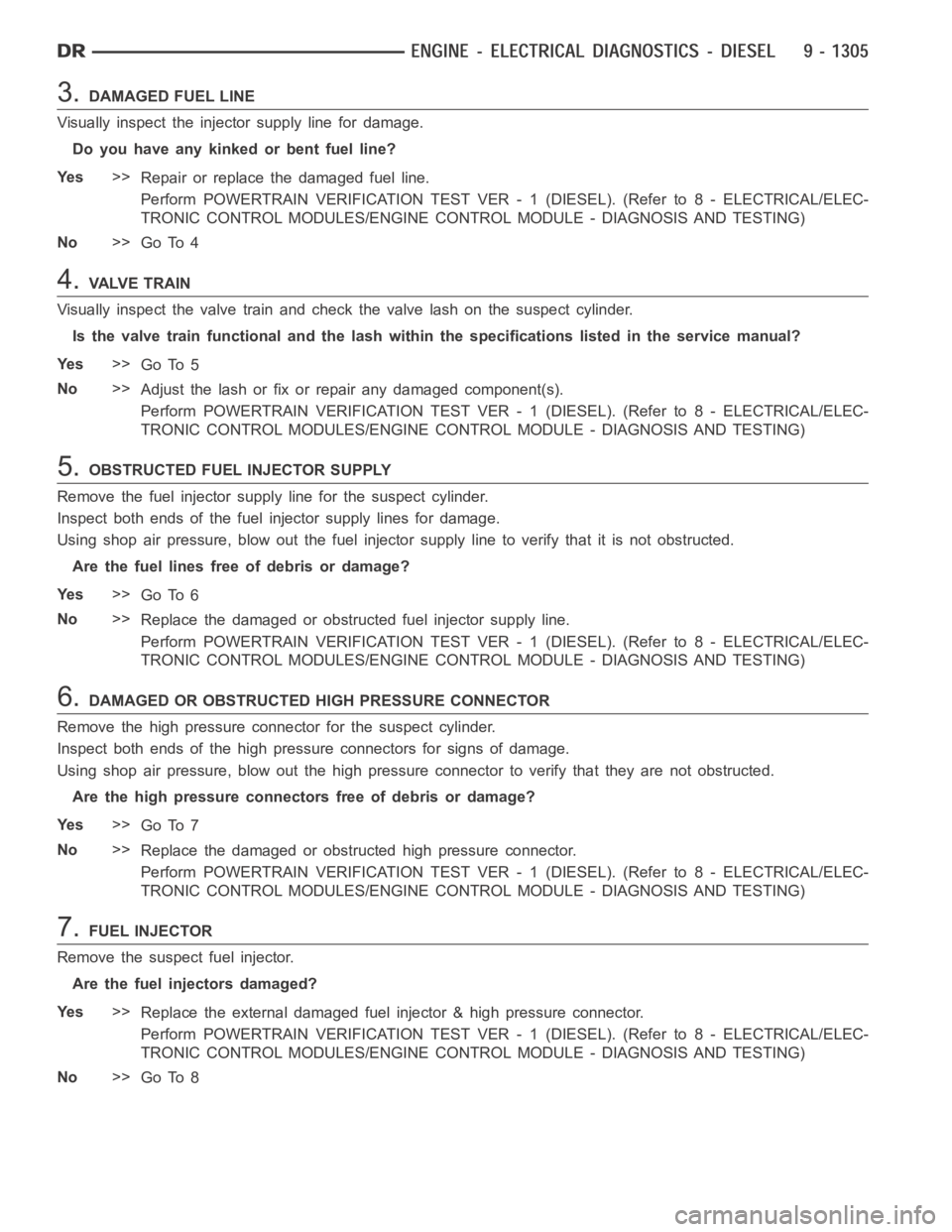
3.DAMAGED FUEL LINE
Visually inspect the injector supply line for damage.
Do you have any kinked or bent fuel line?
Ye s>>
Repair or replace the damaged fuel line.
Perform POWERTRAIN VERIFICATION TEST VER - 1 (DIESEL). (Refer to 8 - ELECTRICAL/ELEC-
TRONIC CONTROL MODULES/ENGINE CONTROL MODULE - DIAGNOSIS AND TESTING)
No>>
Go To 4
4.VA LV E T R A I N
Visually inspect the valve train and check the valve lash on the suspect cylinder.
Is the valve train functional and the lash within the specifications listed in the service manual?
Ye s>>
Go To 5
No>>
Adjust the lash or fix or repair any damaged component(s).
Perform POWERTRAIN VERIFICATION TEST VER - 1 (DIESEL). (Refer to 8 - ELECTRICAL/ELEC-
TRONIC CONTROL MODULES/ENGINE CONTROL MODULE - DIAGNOSIS AND TESTING)
5.OBSTRUCTED FUEL INJECTOR SUPPLY
Remove the fuel injector supply line for the suspect cylinder.
Inspect both ends of the fuel injector supply lines for damage.
Using shop air pressure, blow out the fuel injector supply line to verify that it is not obstructed.
Are the fuel lines free of debris or damage?
Ye s>>
Go To 6
No>>
Replace the damaged or obstructed fuel injector supply line.
Perform POWERTRAIN VERIFICATION TEST VER - 1 (DIESEL). (Refer to 8 - ELECTRICAL/ELEC-
TRONIC CONTROL MODULES/ENGINE CONTROL MODULE - DIAGNOSIS AND TESTING)
6.DAMAGED OR OBSTRUCTED HIGH PRESSURE CONNECTOR
Remove the high pressure connector for the suspect cylinder.
Inspect both ends of the high pressure connectors for signs of damage.
Using shop air pressure, blow out the high pressure connector to verify that they are not obstructed.
Are the high pressure connectors free of debris or damage?
Ye s>>
Go To 7
No>>
Replace the damaged or obstructed high pressure connector.
Perform POWERTRAIN VERIFICATION TEST VER - 1 (DIESEL). (Refer to 8 - ELECTRICAL/ELEC-
TRONIC CONTROL MODULES/ENGINE CONTROL MODULE - DIAGNOSIS AND TESTING)
7.FUEL INJECTOR
Remove the suspect fuel injector.
Are the fuel injectors damaged?
Ye s>>
Replace the external damaged fuel injector & high pressure connector.
Perform POWERTRAIN VERIFICATION TEST VER - 1 (DIESEL). (Refer to 8 - ELECTRICAL/ELEC-
TRONIC CONTROL MODULES/ENGINE CONTROL MODULE - DIAGNOSIS AND TESTING)
No>>
Go To 8
Page 883 of 5267
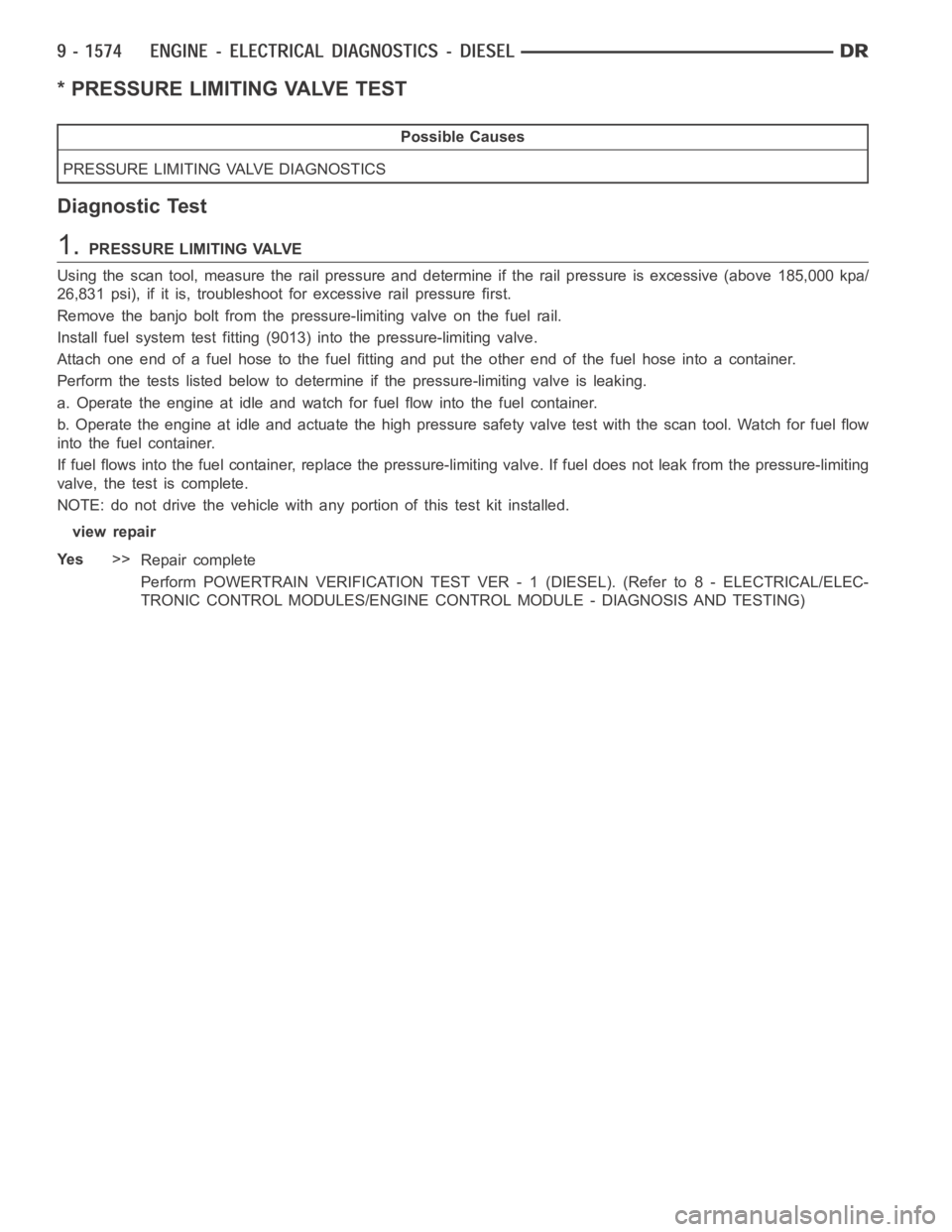
* PRESSURE LIMITING VALVE TEST
Possible Causes
PRESSURE LIMITING VALVE DIAGNOSTICS
Diagnostic Test
1.PRESSURE LIMITING VALVE
Using the scan tool, measure the rail pressure and determine if the rail pressure is excessive (above 185,000 kpa/
26,831 psi), if it is, troubleshoot for excessive rail pressure first.
Remove the banjo bolt from the pressure-limiting valve on the fuel rail.
Install fuel system test fitting (9013) into the pressure-limiting valve.
Attach one end of a fuel hose to the fuel fitting and put the other end of the fuel hose into a container.
Perform the tests listed below to determine if the pressure-limiting valve is leaking.
a. Operate the engine at idle and watch for fuel flow into the fuel container.
b. Operate the engine at idle and actuate the high pressure safety valve test with the scan tool. Watch for fuel flow
into the fuel container.
If fuel flows into the fuel container, replace the pressure-limiting valve. If fuel does not leak from the pressure-limiting
valve, the test is complete.
NOTE: do not drive the vehicle with any portion of this test kit installed.
view repair
Ye s>>
Repair complete
Perform POWERTRAIN VERIFICATION TEST VER - 1 (DIESEL). (Refer to 8 - ELECTRICAL/ELEC-
TRONIC CONTROL MODULES/ENGINE CONTROL MODULE - DIAGNOSIS AND TESTING)
Page 884 of 5267
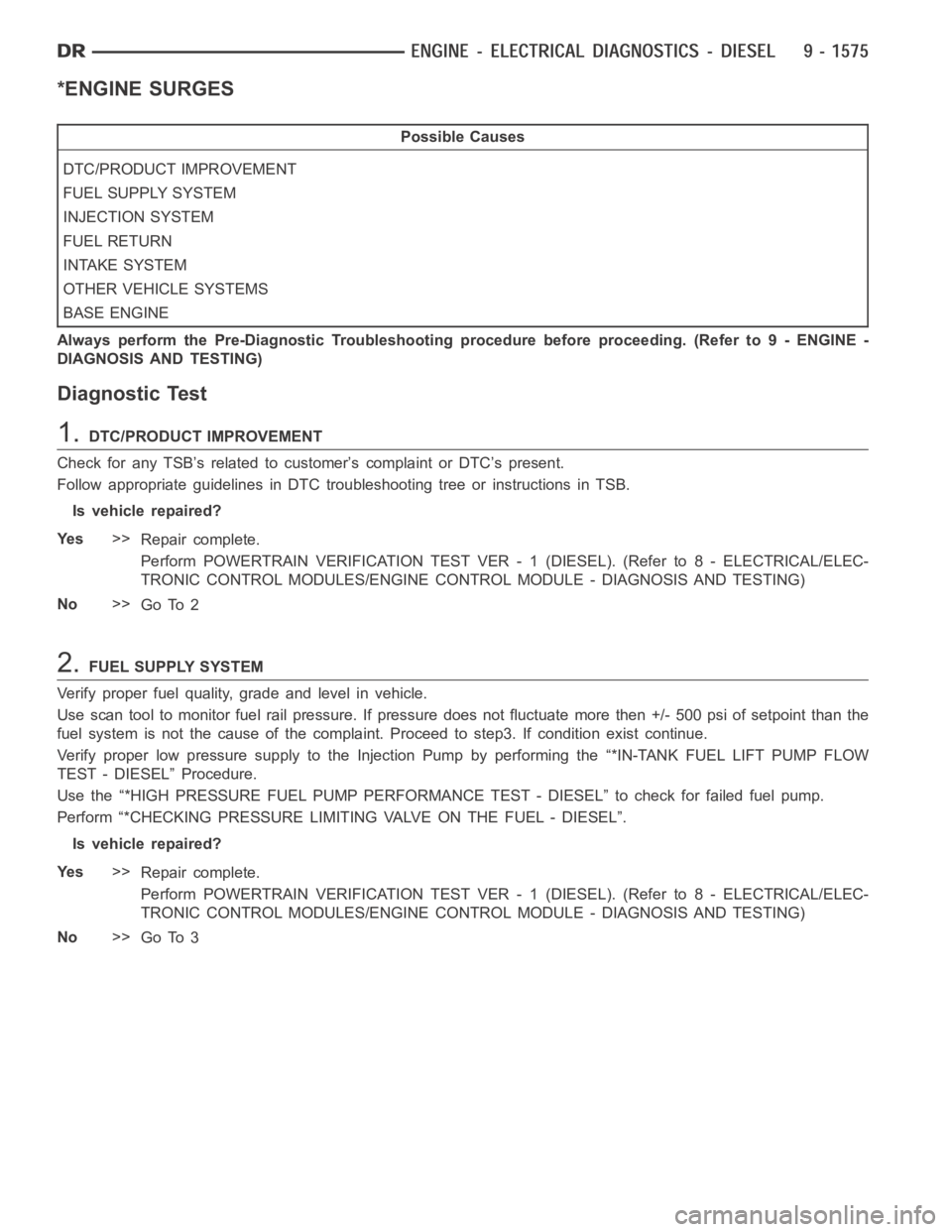
*ENGINE SURGES
Possible Causes
DTC/PRODUCT IMPROVEMENT
FUEL SUPPLY SYSTEM
INJECTION SYSTEM
FUEL RETURN
INTAKE SYSTEM
OTHER VEHICLE SYSTEMS
BASE ENGINE
Always perform the Pre-Diagnostic Troubleshooting procedure before proceeding. (Refer to 9 - ENGINE -
DIAGNOSIS AND TESTING)
Diagnostic Test
1.DTC/PRODUCT IMPROVEMENT
Check for any TSB’s related to customer’s complaint or DTC’s present.
Follow appropriate guidelines in DTC troubleshooting tree or instructions in TSB.
Is vehicle repaired?
Ye s>>
Repair complete.
Perform POWERTRAIN VERIFICATION TEST VER - 1 (DIESEL). (Refer to 8 - ELECTRICAL/ELEC-
TRONIC CONTROL MODULES/ENGINE CONTROL MODULE - DIAGNOSIS AND TESTING)
No>>
Go To 2
2.FUEL SUPPLY SYSTEM
Verify proper fuel quality, grade and level in vehicle.
Use scan tool to monitor fuel rail pressure. If pressure does not fluctuatemore then +/- 500 psi of setpoint than the
fuel system is not the cause of the complaint. Proceed to step3. If condition exist continue.
Verify proper low pressure supply to the Injection Pump by performing the “*IN-TANK FUEL LIFT PUMP FLOW
TEST - DIESEL” Procedure.
Use the “*HIGH PRESSURE FUEL PUMP PERFORMANCE TEST - DIESEL” to check for failed fuel pump.
Perform “*CHECKING PRESSURE LIMITING VALVE ON THE FUEL - DIESEL”.
Is vehicle repaired?
Ye s>>
Repair complete.
Perform POWERTRAIN VERIFICATION TEST VER - 1 (DIESEL). (Refer to 8 - ELECTRICAL/ELEC-
TRONIC CONTROL MODULES/ENGINE CONTROL MODULE - DIAGNOSIS AND TESTING)
No>>
Go To 3
Page 888 of 5267
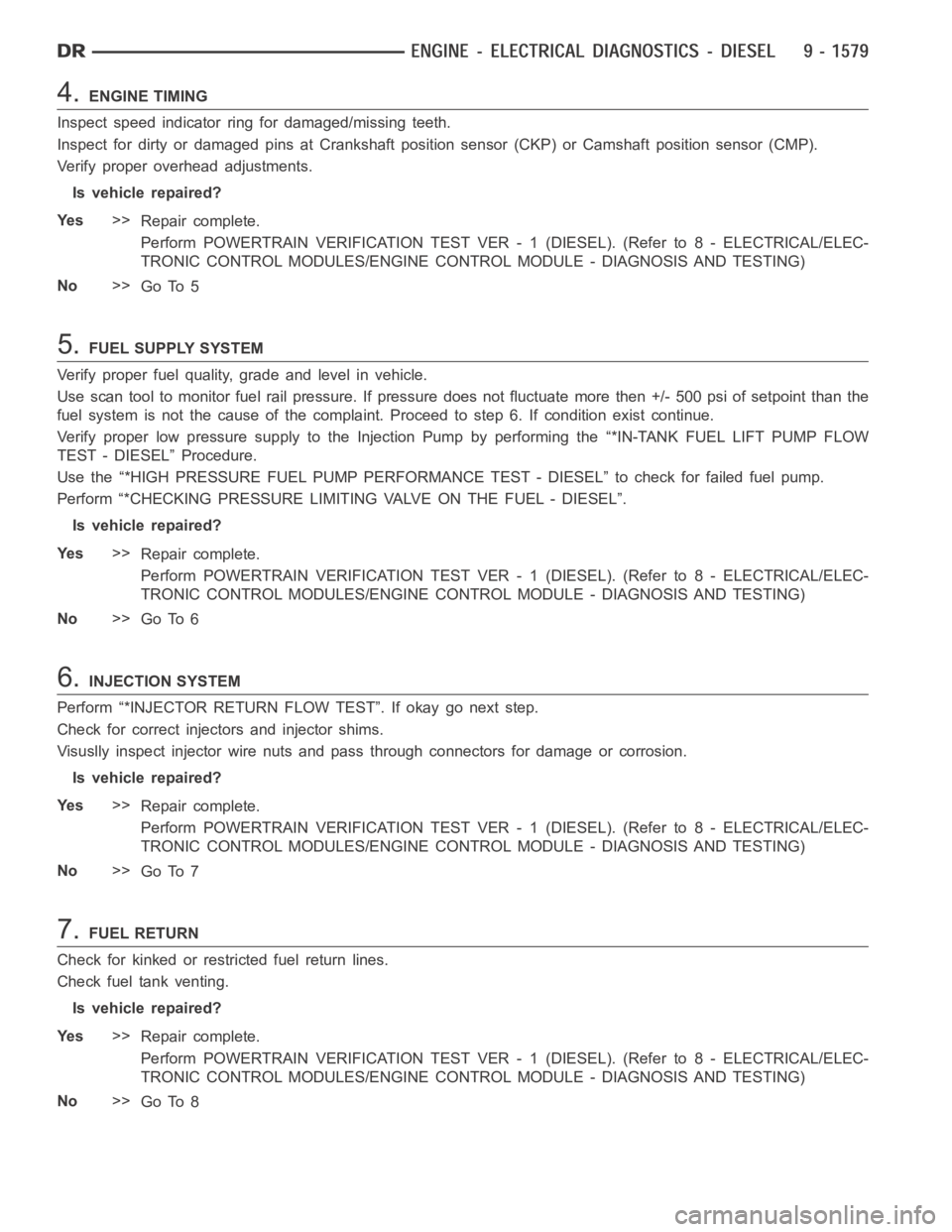
4.ENGINE TIMING
Inspect speed indicator ring for damaged/missing teeth.
Inspect for dirty or damaged pins at Crankshaft position sensor (CKP) or Camshaft position sensor (CMP).
Verify proper overhead adjustments.
Is vehicle repaired?
Ye s>>
Repair complete.
Perform POWERTRAIN VERIFICATION TEST VER - 1 (DIESEL). (Refer to 8 - ELECTRICAL/ELEC-
TRONIC CONTROL MODULES/ENGINE CONTROL MODULE - DIAGNOSIS AND TESTING)
No>>
Go To 5
5.FUEL SUPPLY SYSTEM
Verify proper fuel quality, grade and level in vehicle.
Use scan tool to monitor fuel rail pressure. If pressure does not fluctuatemore then +/- 500 psi of setpoint than the
fuel system is not the cause of the complaint. Proceed to step 6. If condition exist continue.
Verify proper low pressure supply to the Injection Pump by performing the “*IN-TANK FUEL LIFT PUMP FLOW
TEST - DIESEL” Procedure.
Use the “*HIGH PRESSURE FUEL PUMP PERFORMANCE TEST - DIESEL” to check for failed fuel pump.
Perform “*CHECKING PRESSURE LIMITING VALVE ON THE FUEL - DIESEL”.
Is vehicle repaired?
Ye s>>
Repair complete.
Perform POWERTRAIN VERIFICATION TEST VER - 1 (DIESEL). (Refer to 8 - ELECTRICAL/ELEC-
TRONIC CONTROL MODULES/ENGINE CONTROL MODULE - DIAGNOSIS AND TESTING)
No>>
Go To 6
6.INJECTION SYSTEM
Perform “*INJECTOR RETURN FLOW TEST”. If okay go next step.
Check for correct injectors and injector shims.
Visuslly inspect injector wire nuts and pass through connectors for damageorcorrosion.
Is vehicle repaired?
Ye s>>
Repair complete.
Perform POWERTRAIN VERIFICATION TEST VER - 1 (DIESEL). (Refer to 8 - ELECTRICAL/ELEC-
TRONIC CONTROL MODULES/ENGINE CONTROL MODULE - DIAGNOSIS AND TESTING)
No>>
Go To 7
7.FUEL RETURN
Check for kinked or restricted fuel return lines.
Check fuel tank venting.
Is vehicle repaired?
Ye s>>
Repair complete.
Perform POWERTRAIN VERIFICATION TEST VER - 1 (DIESEL). (Refer to 8 - ELECTRICAL/ELEC-
TRONIC CONTROL MODULES/ENGINE CONTROL MODULE - DIAGNOSIS AND TESTING)
No>>
Go To 8
Page 894 of 5267
*FUEL PUMP RETURN FLOW TEST
Possible Causes
EXCESSIVE FUEL PUMP RETURN FLOW
Diagnostic Test
1.FUEL PUMP RETURN FLOW TEST
Using the scan tool, idle the engine and measure the rail pressure and determine if the rail pressure is excessive
(above 185,00 kpa/26,831 psi), if it is, troubleshoot for excessive rail pressure first.
Remove the banjo bolt from the pressure-limiting valve on the fuel rail.
Install fuel system test fitting #9013 into the pressure-limiting valve.
Attach one end of a fuel hose to the fuel fitting and put the other end of the fuel hose into a container
Perform the tests listed below to determine if the pressure-limiting valve is leaking.
a. Operate the engine at idle and watch for fuel flow into the fuel container.
b. Operate the engine at idle and actuate the high pressure safety valve test with the scan tool. Watch for fuel flow
into the fuel container.
If fuel flows into the fuel container, replace the pressure-limiting valve. If fuel does not leak from the pressure-limiting
valve, the test is complete.
NOTE: do not drive the vehicle with any portion of this test kit installed
Operate the engine until the engine is at operating temperature.
Remove the banjo connector from the fuel drain tube at the rear of the fuel filter housing
Install fuel system test fitting #9012 in place of the banjo connector.
Install a piece of fuel line onto the test fitting and put the open end into the graduated cylinder.
Start the engine and let it idle for one minute.
Measure the amount of fuel in the graduated cylinder.
If the flow is less than 1000-ml/minute at idle, the test has successfully passed.
If the flow is greater than 1000 ml/minute at idle, replace the fuel injection pump.
Retest to confirm repair.
View Repair
Repair
Te s t C o m p l e t e .
Perform POWERTRAIN VERIFICATION TEST VER - 1 (DIESEL). (Refer to 8 - ELECTRICAL/ELEC-
TRONIC CONTROL MODULES/ENGINE CONTROL MODULE - DIAGNOSIS AND TESTING)
Page 1058 of 5267

12.ENGINE MECHANICAL PROBLEM
Check for any of the following conditions/mechanical problems.
AIR INDUCTION SYSTEM - must be free from leaks.
ENGINE VACUUM - must be at least 13 inches in neutral
ENGINE VALVE TIMING - must be within specifications
ENGINE COMPRESSION - must be within specifications
ENGINE EXHAUST SYSTEM - must be free of any restrictions or leaks.
ENGINE PCV SYSTEM - must flow freely
TORQUE CONVERTER STALL SPEED - must be within specifications
POWER BRAKE BOOSTER - no internal vacuum leaks
FUEL - must be free of contamination
FUEL INJECTOR - plugged or restricted injector; control wire not connectedtocorrectinjector
Are there any engine mechanical problems?
Ye s>>
Repair as necessary.
Perform the POWERTRAIN VERIFICATION TEST. (Refer to 9 - ENGINE - STANDARD PROCEDURE)
No>>
Refer to the INTERMITTENT CONDITIONSymptom (Diagnostic Procedure).
Perform the POWERTRAIN VERIFICATION TEST. (Refer to 9 - ENGINE - STANDARD PROCEDURE)
13.O2 SENSOR
NOTE: Wait a minimum of 10 minutes to allow the O2 Sensor to cool down before continuing the test.
Ignition on, engine not running.
Disconnect the harness connector(s) of the O2 Sensor(s) that had a voltagereading below 4.5 volts in the previous
step.
With the scan tool, monitor the O2 Sensor voltage reading(s).
Is the voltage above 4.5 volts for any of the O2 Sensors?
Ye s>>
Replace the O2 Sensor that had a voltage reading above 4.5 volts.
Perform the POWERTRAIN VERIFICATION TEST. (Refer to 9 - ENGINE - STANDARD PROCEDURE)
No>>
Go To 14
14.(K41) O2 SENSOR 1/1 SIGNAL CIRCUIT SHORTED TO GROUND
Turn the ignition off.
Disconnect the PCM harness connectors.
Measure the resistance between ground and the (K41) O2 Sensor 1/1
Signal circuit at the PCM harness connector.
Istheresistancebelow100ohms?
Ye s>>
Repair the short to ground in the (K41) O2 Sensor 1/1 Sig-
nal circuit.
Perform the POWERTRAIN VERIFICATION TEST. (Refer to
9 - ENGINE - STANDARD PROCEDURE)
No>>
Go To 15