ECU DODGE RAM SRT-10 2006 Service Repair Manual
[x] Cancel search | Manufacturer: DODGE, Model Year: 2006, Model line: RAM SRT-10, Model: DODGE RAM SRT-10 2006Pages: 5267, PDF Size: 68.7 MB
Page 5184 of 5267
5.7L ENGINE
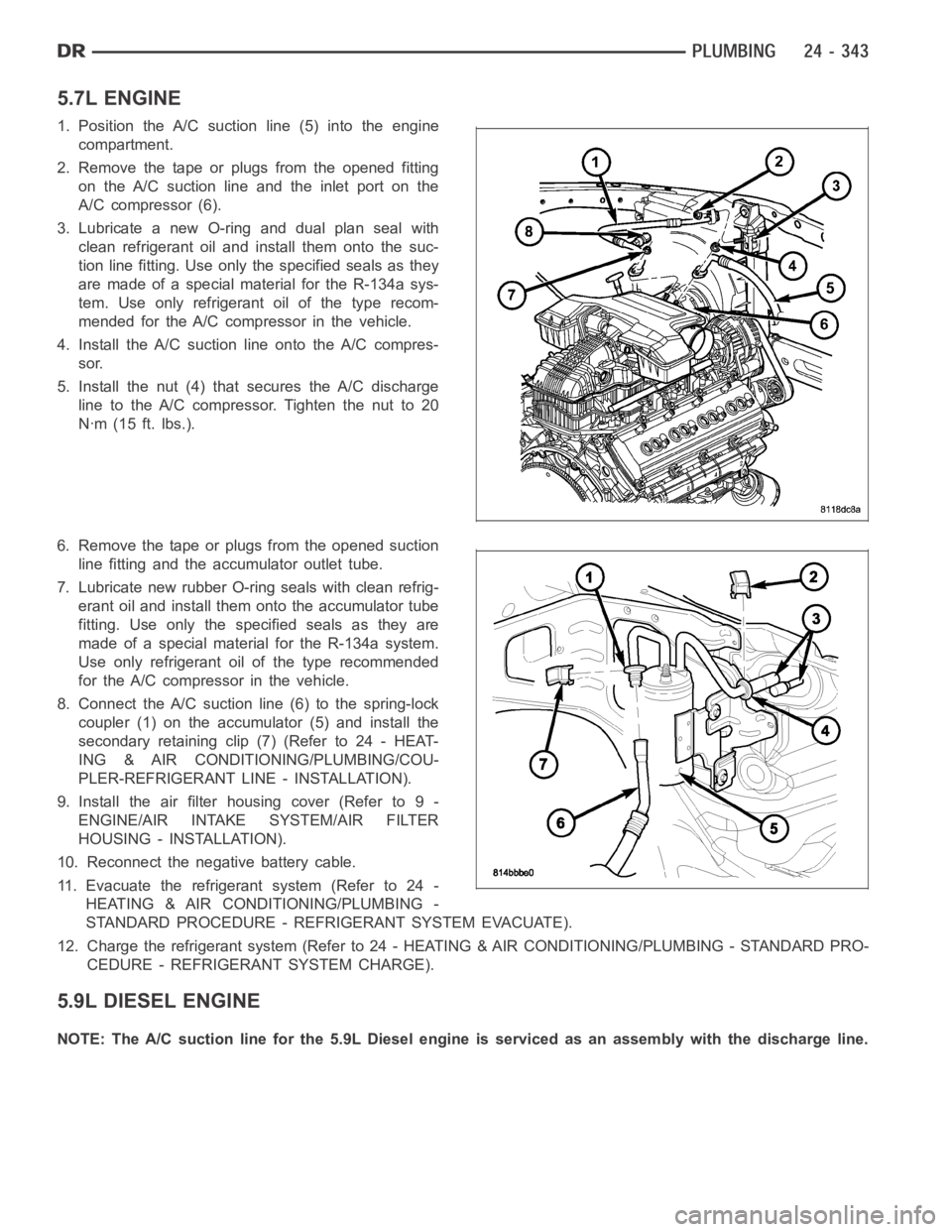
1. Position the A/C suction line (5) into the engine
compartment.
2. Remove the tape or plugs from the opened fitting
on the A/C suction line and the inlet port on the
A/C compressor (6).
3. Lubricate a new O-ring and dual plan seal with
clean refrigerant oil and install them onto the suc-
tion line fitting. Use only the specified seals as they
are made of a special material for the R-134a sys-
tem. Use only refrigerant oil of the type recom-
mended for the A/C compressor in the vehicle.
4. Install the A/C suction line onto the A/C compres-
sor.
5. Install the nut (4) that secures the A/C discharge
line to the A/C compressor. Tighten the nut to 20
Nꞏm (15 ft. lbs.).
6. Remove the tape or plugs from the opened suction
line fitting and the accumulator outlet tube.
7. Lubricate new rubber O-ring seals with clean refrig-
erant oil and install them onto the accumulator tube
fitting. Use only the specified seals as they are
made of a special material for the R-134a system.
Use only refrigerant oil of the type recommended
for the A/C compressor in the vehicle.
8. Connect the A/C suctionline (6) to the spring-lock
coupler (1) on the accumulator (5) and install the
secondary retaining clip (7) (Refer to 24 - HEAT-
ING & AIR CONDITIONING/PLUMBING/COU-
PLER-REFRIGERANT LINE - INSTALLATION).
9. Install the air filter housing cover (Refer to 9 -
ENGINE/AIR INTAKE SYSTEM/AIR FILTER
HOUSING - INSTALLATION).
10. Reconnect the negative battery cable.
11. Evacuate the refrigerant system (Refer to 24 -
HEATING & AIR CONDITIONING/PLUMBING -
STANDARD PROCEDURE - REFRIGERANT SYSTEM EVACUATE).
12. Charge the refrigerant system (Refer to 24 - HEATING & AIR CONDITIONING/PLUMBING - STANDARD PRO-
CEDURE - REFRIGERANT SYSTEM CHARGE).
5.9L DIESEL ENGINE
NOTE: The A/C suction line for the 5.9L Diesel engine is serviced as an assembly with the discharge line.
Page 5185 of 5267
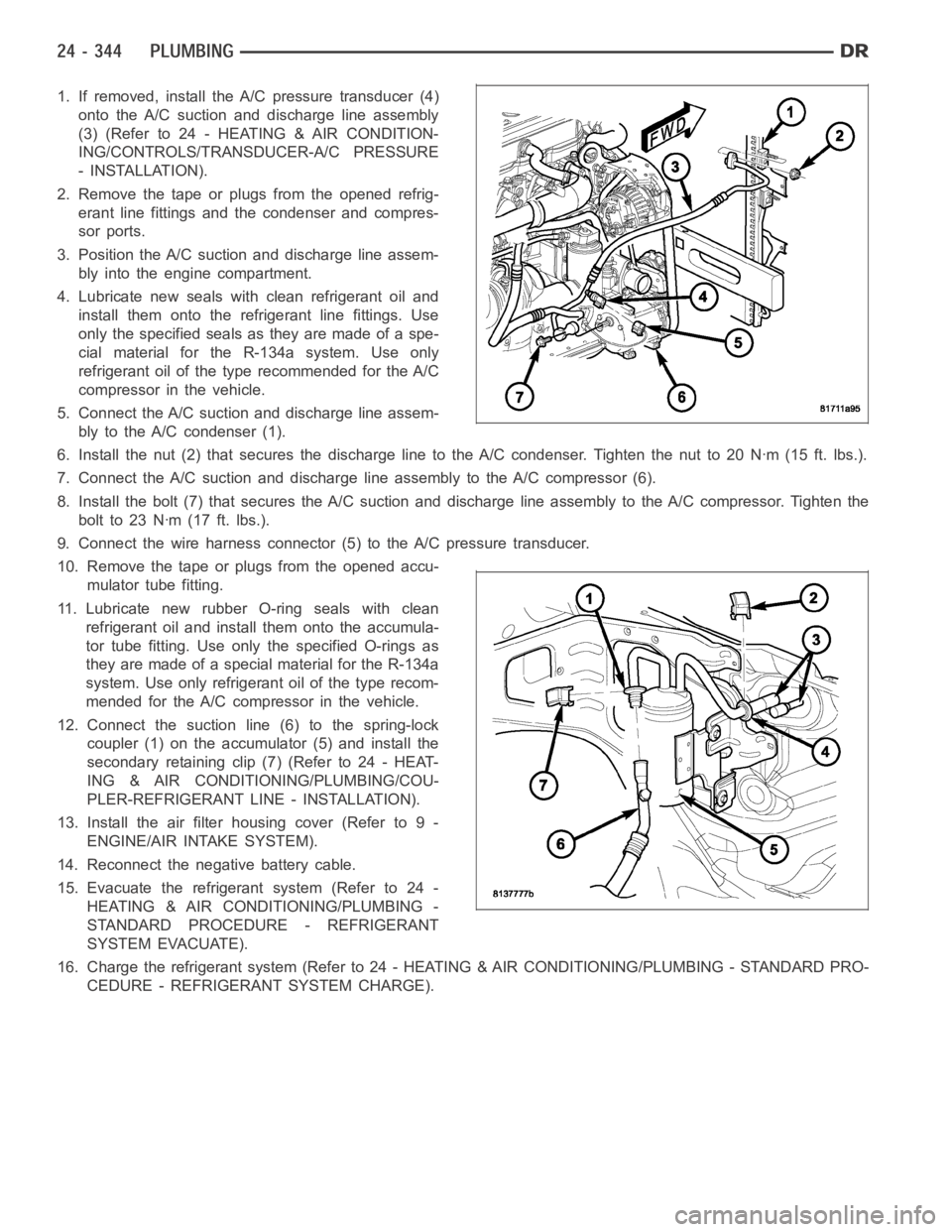
1. If removed, install the A/C pressure transducer (4)
onto the A/C suction and discharge line assembly
(3)(Referto24-HEATING&AIRCONDITION-
ING/CONTROLS/TRANSDUCER-A/C PRESSURE
- INSTALLATION).
2. Remove the tape or plugs from the opened refrig-
erant line fittings and the condenser and compres-
sor ports.
3. Position the A/C suction and discharge line assem-
bly into the engine compartment.
4. Lubricate new seals with clean refrigerant oil and
install them onto the refrigerant line fittings. Use
only the specified seals as they are made of a spe-
cial material for the R-134a system. Use only
refrigerant oil of the type recommended for the A/C
compressor in the vehicle.
5. Connect the A/C suction and discharge line assem-
bly to the A/C condenser (1).
6. Install the nut (2) that secures the discharge line to the A/C condenser.Tighten the nut to 20 Nꞏm (15 ft. lbs.).
7. Connect the A/C suction and discharge line assembly to the A/C compressor(6).
8. Install the bolt (7) that secures the A/C suction and discharge line assembly to the A/C compressor. Tighten the
boltto23Nꞏm(17ft.lbs.).
9. Connect the wire harness connector (5) to the A/C pressure transducer.
10. Remove the tape or plugs from the opened accu-
mulator tube fitting.
11. Lubricate new rubber O-ring seals with clean
refrigerant oil and install them onto the accumula-
tor tube fitting. Use only the specified O-rings as
they are made of a special material for the R-134a
system. Use only refrigerant oil of the type recom-
mended for the A/C compressor in the vehicle.
12. Connect the suction line (6) to the spring-lock
coupler (1) on the accumulator (5) and install the
secondary retaining clip (7) (Refer to 24 - HEAT-
ING & AIR CONDITIONING/PLUMBING/COU-
PLER-REFRIGERANT LINE - INSTALLATION).
13. Install the air filter housing cover (Refer to 9 -
ENGINE/AIR INTAKE SYSTEM).
14. Reconnect the negative battery cable.
15. Evacuate the refrigerant system (Refer to 24 -
HEATING & AIR CONDITIONING/PLUMBING -
STANDARD PROCEDURE - REFRIGERANT
SYSTEM EVACUATE).
16. Charge the refrigerant system (Refer to 24 - HEATING & AIR CONDITIONING/PLUMBING - STANDARD PRO-
CEDURE - REFRIGERANT SYSTEM CHARGE).
Page 5187 of 5267
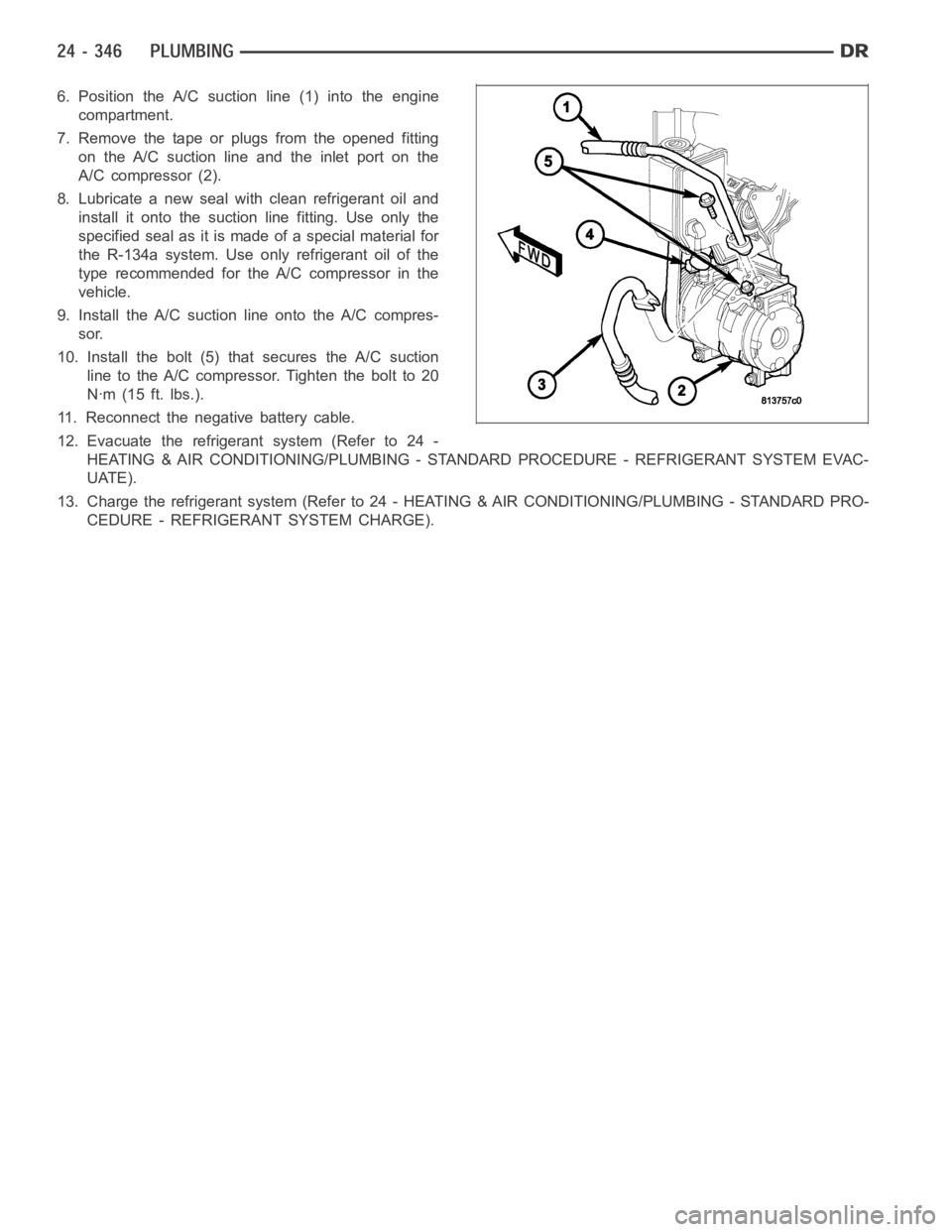
6. Position the A/C suction line (1) into the engine
compartment.
7. Remove the tape or plugs from the opened fitting
on the A/C suction line and the inlet port on the
A/C compressor (2).
8. Lubricate a new seal with clean refrigerant oil and
install it onto the suction line fitting. Use only the
specified seal as it is made of a special material for
the R-134a system. Use only refrigerant oil of the
type recommended for the A/C compressor in the
vehicle.
9. Install the A/C suction line onto the A/C compres-
sor.
10. Install the bolt (5) that secures the A/C suction
line to the A/C compressor. Tighten the bolt to 20
Nꞏm (15 ft. lbs.).
11. Reconnect the negative battery cable.
12. Evacuate the refrigerant system (Refer to 24 -
HEATING & AIR CONDITIONING/PLUMBING - STANDARD PROCEDURE - REFRIGERANT SYSTEM EVAC-
UATE).
13. Charge the refrigerant system (Refer to 24 - HEATING & AIR CONDITIONING/PLUMBING - STANDARD PRO-
CEDURE - REFRIGERANT SYSTEM CHARGE).
Page 5194 of 5267
The following is a list of the system monitors:
Misfire Monitor
Fuel System Monitor
Oxygen Sensor Monitor
Oxygen Sensor Heater Monitor
Catalyst Monitor
Leak Detection Pump Monitor (if equipped)
All these system monitors require two consecutive trips with the malfunction present to set a fault.
Refer to the appropriate Powertrain Diagnostics Procedures manual for diagnostic procedures.
The following is an operation and description of each system monitor:
OXYGEN SENSOR (O2S) MONITOR
Effective control of exhaust emissions is achieved by an oxygen feedback system. The most important element of
the feedback system is the O2S. The O2S is located in the exhaust path. Once it reaches operating temperature
300° to 350°C (572° to 662°F), the sensor generates a voltage that is inversely proportional to the amount of oxy-
gen in the exhaust. The information obtained by the sensor is used to calculate the fuel injector pulse width. This
maintains a 14.7 to 1 Air Fuel (A/F) ratio. At this mixture ratio, the catalyst works best to remove hydrocarbons (HC),
carbon monoxide (CO) and nitrogen oxide (NOx) from the exhaust.
The O2S is also the main sensing element for the Catalyst and Fuel Monitors.
The O2S can fail in any or all of the following manners:
slow response rate
reduced output voltage
dynamic shift
shortedoropencircuits
Response rate is the time required for the sensor to switch from lean to richonce it is exposed to a richer than
optimum A/F mixture or vice versa. As the sensor starts malfunctioning, itcould take longer to detect the changes
in the oxygen content of the exhaust gas.
The output voltage of the O2S ranges from 0 to 1 volt. A good sensor can easilygenerate any output voltage in this
range as it is exposed to different concentrations of oxygen. To detect a shift in the A/F mixture (lean or rich), the
output voltage has to change beyond a threshold value. A malfunctioning sensor could have difficulty changing
beyond the threshold value.
OXYGEN SENSOR HEATER MONITOR
If there is an oxygen sensor (O2S) shorted to voltage DTC, as well as a O2S heater DTC, the O2S fault MUST be
repaired first. Before checking the O2S fault, verify that the heater circuit is operating correctly.
Effective control of exhaust emissions is achieved by an oxygen feedback system. The most important element of
the feedback system is the O2S. The O2S is located in the exhaust path. Once it reaches operating temperature
300°C to 350°C (572°F to 662°F), the sensor generates a voltage that is inversely proportional to the amount of
oxygen in the exhaust. The information obtained by the sensor is used to calculate the fuel injector pulse width. This
maintains a 14.7 to 1 Air Fuel (A/F) ratio. At this mixture ratio, the catalyst works best to remove hydrocarbons (HC),
carbon monoxide (CO) and nitrogen oxide (NOx) from the exhaust.
The voltage readings taken from the O2S sensor are very temperature sensitive. The readings are not accurate
below 572°F (300°C). Heating of the O2S sensor is done to allow the engine controllertoshifttoclosedloopcontrol
as soon as possible. The heating element used to heat the O2S sensor must be testedtoensurethatitisheating
the sensor properly.
The O2S sensor circuit is monitored for a drop in voltage. The sensor outputis used to test the heater by isolating
the effect of the heater element on the O2S sensor output voltage from the other effects.
LEAK DETECTION PUMP MONITOR (IF EQUIPPED)
The leak detection assembly incorporates two primary functions: it must detect a leak in the evaporative system and
seal the evaporative system so the leak detection test can be run.
Page 5199 of 5267
Diagnostic Trouble Codes (DTCs)
With OBD II, different DTC faults have different priorities according to regulations. As a result, the priorities deter-
mine MIL illumination and DTC erasure. DTCs are entered according to individual priority. DTCs with a higher pri-
ority overwrite lower priority DTCs.
Priorities
Priority 0 —Non-emissions related trouble codes
Priority 1 — One trip failure of a two trip fault for non-fuel system and non-misfire.
Priority 2 — One trip failure of a two trip fault for fuel system (rich/lean)or misfire.
Priority 3 — Two trip failure for a non-fuel system and non-misfire or matured one trip comprehensive com-
ponent fault.
Priority 4 — Two trip failure or matured fault for fuel system (rich/lean) and misfire or one trip catalyst dam-
aging misfire.
Non-emissions related failures have no priority. One trip failures of twotrip faults have low priority. Two trip failures
or matured faults have higher priority. One and two trip failures of fuel system and misfire monitor take precedence
over non-fuel system and non-misfire failures.
DTC Self Erasure
With one trip components or systems,the MIL is illuminated upon test failure and DTCs are stored.
Two trip monitors are components requiring failure in two consecutive trips for MIL illumination. Upon failure of the
first test, the Task Manager enters a maturing code. If the component failsthe test for a second time the code
matures and a DTC is set.
After three good trips the MIL is extinguished and the Task Manager automatically switches the trip counter to a
warm-up cycle counter. DTCs are automatically erased following 40 warm-up cycles if the component does not fail
again.
For misfire and fuel system monitors, the component must pass the test under a Similar Conditions Window in order
to record a good trip. A Similar Conditions Window is when engine RPM is within ±375 RPM and load is within
±10% of when the fault occurred.
NOTE: It is important to understand that a component does not have to fail under a similar window of oper-
ation to mature. It must pass the test under a Similar Conditions Window whenitfailedtorecordaGood
Trip for DTC erasure for misfire and fuel system monitors.
DTCs can be erased anytime with a DRB III. Erasing the DTC with the DRB III erases all OBD II information. The
DRB III automatically displays a warning that erasing the DTC will also erase all OBD II monitor data. This includes
all counter information for warm-up cycles, trips and Freeze Frame.
Trip Indicator
TheTri pis essential for running monitors and extinguishing the MIL. In OBD II terms,atripisasetofvehicle
operating conditions that must be met for a specific monitor to run. All trips begin with a key cycle.
Good Trip
The Good Trip counters are as follows:
Specific Good Trip
Fuel System Good Trip
Misfire Good Trip
Alternate Good Trip (appears as a Global Good Trip on DRB III)
Comprehensive Components
Major Monitor
Warm-Up Cycles
Specific Good Trip
The term Good Trip has different meanings depending on the circumstances:
If the MIL is OFF, a trip is defined as when the Oxygen Sensor Monitor and the Catalyst Monitor have been
completed in the same drive cycle.
Page 5206 of 5267
CAP - FUEL FILLER
DESCRIPTION
The plastic fuel tank filler tube cap isthreaded onto the end of the fuel fill tube. Certain models are equipped with
a 1/4 turn cap.
OPERATION
The loss of any fuel or vapor out of fuel filler tube is prevented by the use ofa pressure-vacuum fuel fill cap. Relief
valves inside the cap will release fuel tank pressure at predetermined pressures. Fuel tank vacuum will also be
released at predetermined values. This cap must be replaced by a similar unit if replacement is necessary. This is
in order for the system to remain effective.
CAUTION: Remove fill cap before servicing any fuel system component to relieve tank pressure. If equipped
with a Leak Detection Pump (LDP), or NVLD system, the cap must be tightened securely. If cap is left loose,
a Diagnostic Trouble Code (DTC) may be set.
REMOVAL
REMOVAL/INSTALLATION
If replacement of the 1/4 turn fuel tank filler tube cap is necessary, it mustbereplacedwithanidenticalcaptobe
sure of correct system operation.
CAUTION: Remove the fuel tank filler tube cap to relieve fuel tank pressure. The cap must be removed prior
to disconnecting any fuel system component or before draining the fuel tank.