battery DODGE RAM SRT-10 2006 Service Manual PDF
[x] Cancel search | Manufacturer: DODGE, Model Year: 2006, Model line: RAM SRT-10, Model: DODGE RAM SRT-10 2006Pages: 5267, PDF Size: 68.7 MB
Page 293 of 5267
7.TP SENSOR
Connect the PCM harness connectors.
Ignition on, engine not running.
With a scan tool, monitor the TP Sensor voltage.
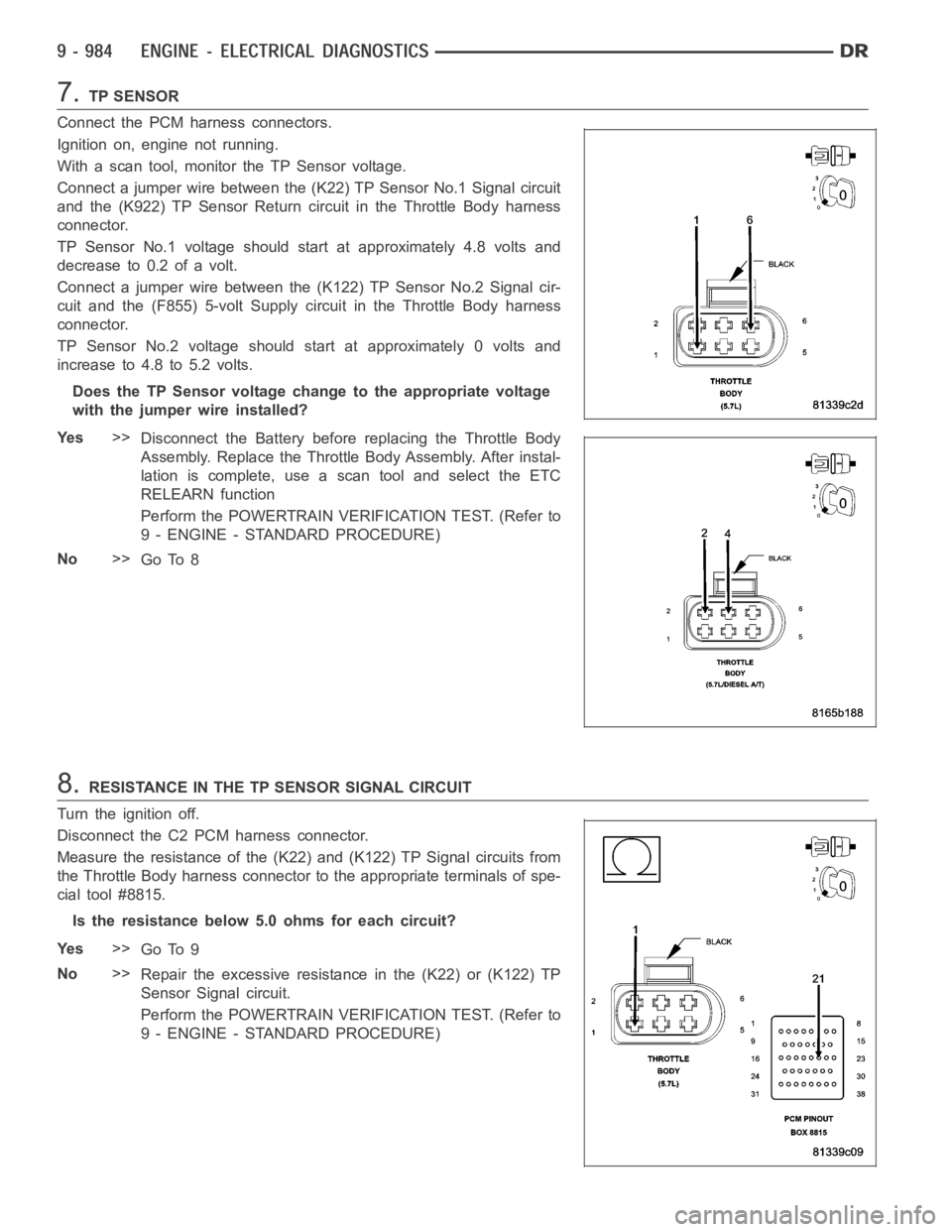
Connect a jumper wire between the (K22) TP Sensor No.1 Signal circuit
and the (K922) TP Sensor Return circuit in the Throttle Body harness
connector.
TP Sensor No.1 voltage should start at approximately 4.8 volts and
decrease to 0.2 of a volt.
Connect a jumper wire between the (K122) TP Sensor No.2 Signal cir-
cuit and the (F855) 5-volt Supply circuit in the Throttle Body harness
connector.
TP Sensor No.2 voltage should start at approximately 0 volts and
increase to 4.8 to 5.2 volts.
Does the TP Sensor voltage change to the appropriate voltage
with the jumper wire installed?
Ye s>>
Disconnect the Battery before replacing the Throttle Body
Assembly. Replace the ThrottleBody Assembly. After instal-
lation is complete, use a scan tool and select the ETC
RELEARN function
Perform the POWERTRAIN VERIFICATION TEST. (Refer to
9 - ENGINE - STANDARD PROCEDURE)
No>>
Go To 8
8.RESISTANCE IN THE TP SENSOR SIGNAL CIRCUIT
Turn the ignition off.
Disconnect the C2 PCM harness connector.
Measure the resistance of the (K22) and (K122) TP Signal circuits from
the Throttle Body harness connector to the appropriate terminals of spe-
cial tool #8815.
Is the resistance below 5.0 ohms for each circuit?
Ye s>>
Go To 9
No>>
Repair the excessive resistance in the (K22) or (K122) TP
Sensor Signal circuit.
Perform the POWERTRAIN VERIFICATION TEST. (Refer to
9 - ENGINE - STANDARD PROCEDURE)
Page 303 of 5267
7.TP SENSOR
Connect the PCM harness connector.
Ignition on, engine not running.
With a scan tool, monitor the TP Sensor voltage.
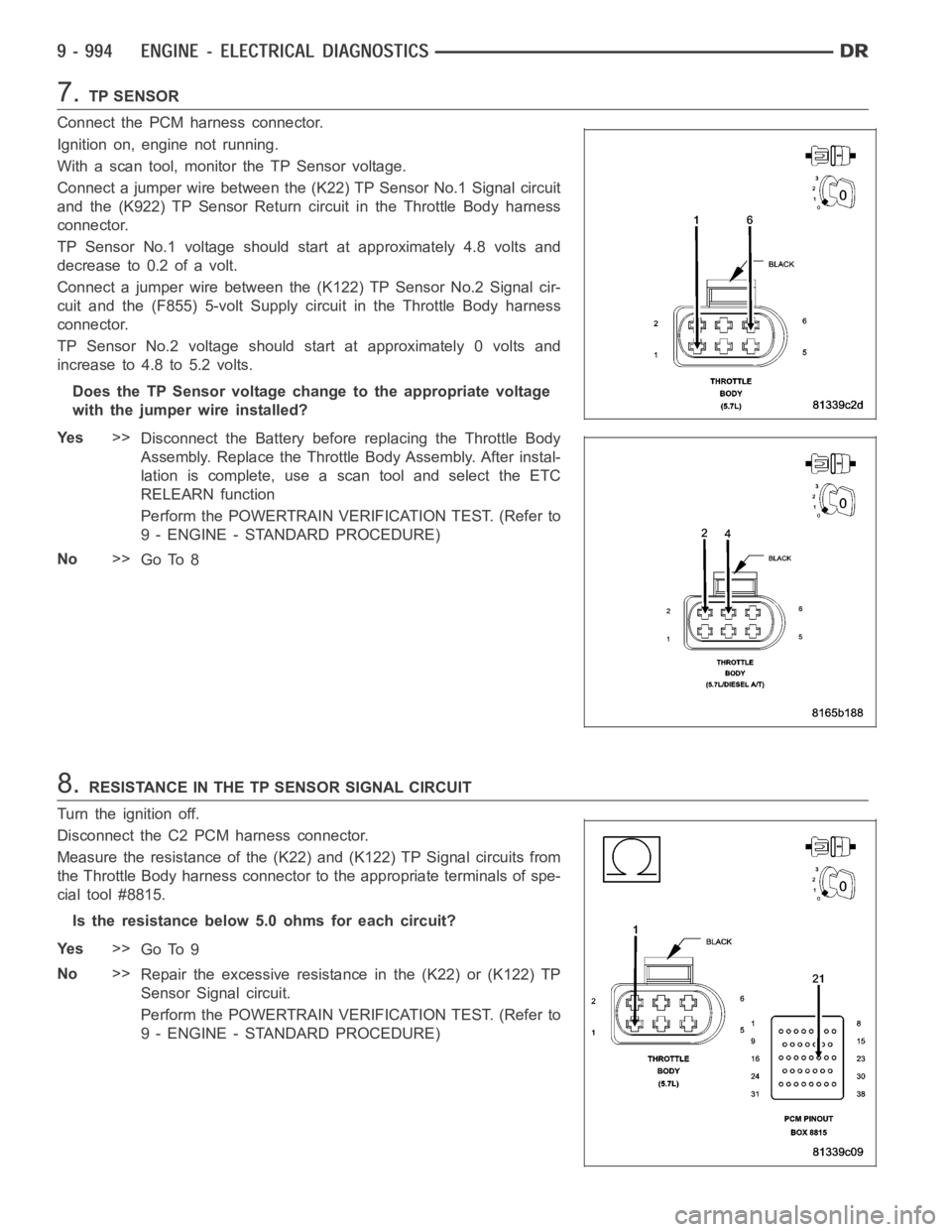
Connect a jumper wire between the (K22) TP Sensor No.1 Signal circuit
and the (K922) TP Sensor Return circuit in the Throttle Body harness
connector.
TP Sensor No.1 voltage should start at approximately 4.8 volts and
decrease to 0.2 of a volt.
Connect a jumper wire between the (K122) TP Sensor No.2 Signal cir-
cuit and the (F855) 5-volt Supply circuit in the Throttle Body harness
connector.
TP Sensor No.2 voltage should start at approximately 0 volts and
increase to 4.8 to 5.2 volts.
Does the TP Sensor voltage change to the appropriate voltage
with the jumper wire installed?
Ye s>>
Disconnect the Battery before replacing the Throttle Body
Assembly. Replace the ThrottleBody Assembly. After instal-
lation is complete, use a scan tool and select the ETC
RELEARN function
Perform the POWERTRAIN VERIFICATION TEST. (Refer to
9 - ENGINE - STANDARD PROCEDURE)
No>>
Go To 8
8.RESISTANCE IN THE TP SENSOR SIGNAL CIRCUIT
Turn the ignition off.
Disconnect the C2 PCM harness connector.
Measure the resistance of the (K22) and (K122) TP Signal circuits from
the Throttle Body harness connector to the appropriate terminals of spe-
cial tool #8815.
Is the resistance below 5.0 ohms for each circuit?
Ye s>>
Go To 9
No>>
Repair the excessive resistance in the (K22) or (K122) TP
Sensor Signal circuit.
Perform the POWERTRAIN VERIFICATION TEST. (Refer to
9 - ENGINE - STANDARD PROCEDURE)
Page 310 of 5267
When Monitored:
Ignition on, Engine running, and no ECT DTCs present.
Set Condition:
PCM recognizes that the ECT has failed its self coherence test. The coolanttemp should only change at a
certain rate, if this rate is too slow or too fast this fault will set. Two trip fault. Three good trips to clear MIL.
ETC light will illuminate on first trip failure.
Possible Causes
LOW COOLANT LEVEL
(K2) ECT SIGNAL CIRCUIT SHORTED TO BATTERY VOLTAGE
(K2) ECT SIGNAL CIRCUIT OPEN
(K900) SENSOR GROUND CIRCUIT OPEN
(K2) ECT SIGNAL CIRCUIT SHORTED TO GROUND
(K2) ECT SIGNAL CIRCUIT SHORTED TO THE (K900) SENSOR GROUND
THERMOSTAT
ECT SENSOR
PCM
Always perform the Pre-Diagnostic Troubleshooting procedure before proceeding. (Refer to 9 - ENGINE -
DIAGNOSIS AND TESTING).
Diagnostic Test
1.ACTIVE DTC
Ignition on, engine not running.
NOTE: If this code sets during extreme ambient temperatures, improper installation of a block heater could
be the cause of this DTC.
With a scan tool, read DTCs.
Diagnose all other ECT and Cooling System codes before continuing.
Is the DTC active at this time?
Ye s>>
Go To 2
No>>
Refer to the INTERMITTENT CONDITION Diagnostic Procedure.
Perform the POWERTRAIN VERIFICATION TEST. (Refer to 9 - ENGINE - STANDARD PROCEDURE)
2.LOW COOLANT LEVEL
NOTE: If a Engine Coolant Temperature (ECT) DTC is set along with this code,diagnose the ECT DTC first.
NOTE: Inspect the ECT terminals and related PCM terminals. Ensure the terminals are free from corrosion
and damage.
NOTE: The best way to diagnose this DTC is to allow the vehicle to sit overnight outside in order to have
a totally cold soaked engine.
NOTE: Extremely cold outside ambient temperatures may have caused this DTCtoset.
NOTE: Need to make sure that no Cooling System DTCs are set or changes that would make the warm up
much slower or much faster: broken water pump can set this, addition of aftermarket auxiliary cooler can
set this DTC.
WARNING: Never open the cooling system when the engine is hot. The system isunder pressure. Failure to
follow these instructions can result in personal injury or death. Allow the engine to cool before opening the
cooling system.
Page 312 of 5267
5.(K2) ECT SIGNAL CIRCUIT SHORTED TO BATTERY VOLTAGE
Turn the ignition off.
Disconnect the C2 PCM harness connector.
Ignition on, engine not running.
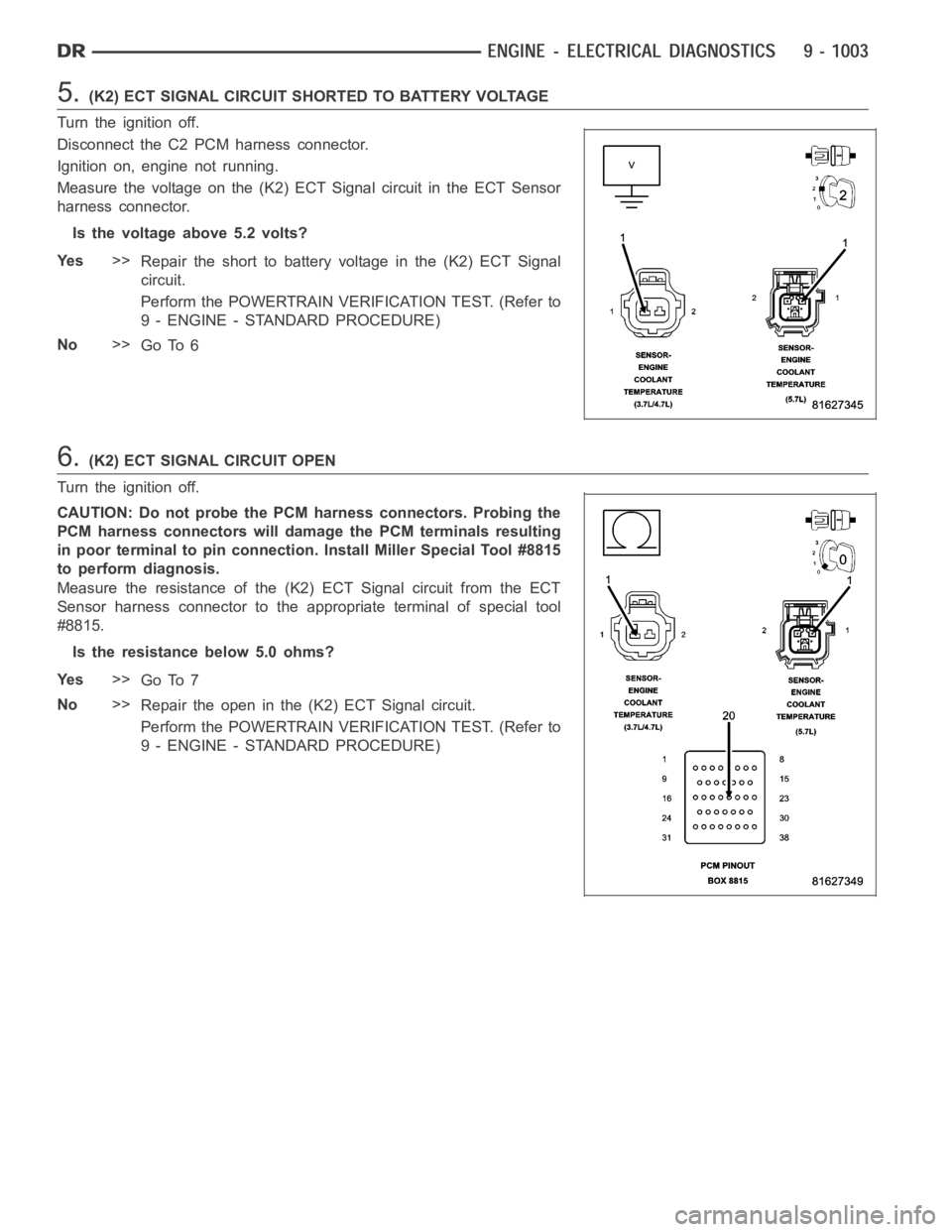
Measure the voltage on the (K2) ECT Signal circuit in the ECT Sensor
harness connector.
Is the voltage above 5.2 volts?
Ye s>>
Repair the short to battery voltage in the (K2) ECT Signal
circuit.
Perform the POWERTRAIN VERIFICATION TEST. (Refer to
9 - ENGINE - STANDARD PROCEDURE)
No>>
Go To 6
6.(K2) ECT SIGNAL CIRCUIT OPEN
Turn the ignition off.
CAUTION: Do not probe the PCM harness connectors. Probing the
PCM harness connectors will damage the PCM terminals resulting
in poor terminal to pin connection. Install Miller Special Tool #8815
to perform diagnosis.
Measure the resistance of the (K2) ECT Signal circuit from the ECT
Sensor harness connector to the appropriate terminal of special tool
#8815.
Is the resistance below 5.0 ohms?
Ye s>>
Go To 7
No>>
Repair the open in the (K2) ECT Signal circuit.
Perform the POWERTRAIN VERIFICATION TEST. (Refer to
9 - ENGINE - STANDARD PROCEDURE)
Page 319 of 5267
When Monitored:
Engine running and battery voltage greater than 10 volts.
Set Condition:
If PCM detects that the secondary ignition burn time is incorrect, too short, or not present, an error is detected.
One Trip Fault. Three good trips to turn off the MIL.
Possible Causes
(K342) ASD CONTROL OUTPUT CIRCUIT
(K19) COIL CONTROL NO.1 CIRCUIT OPEN
(K19) COIL CONTROL NO.1 CIRCUIT SHORTED TO GROUND
COIL ON PLUG
PCM
Always perform the Pre-Diagnostic Troubleshooting procedure before proceeding. (Refer to 9 - ENGINE -
DIAGNOSIS AND TESTING).
Diagnostic Test
1.ACTIVE DTC
NOTE: Diagnose any ASD related DTC’s before continuing.
Ignition on, engine not running.
With a scan tool, read DTCs.
Is the DTC active at this time?
Ye s>>
Go To 2
No>>
Refer to the INTERMITTENT CONDITION Diagnostic Procedure.
Perform the POWERTRAIN VERIFICATION TEST. (Refer to 9 - ENGINE - STANDARD PROCEDURE)
2.(K342) ASD CONTROL OUTPUT CIRCUIT
Turn the ignition off.
Disconnect the Coil on Plug harness connector.
Ignition on, engine not running.
With a scan tool, actuate the ASD Relay.
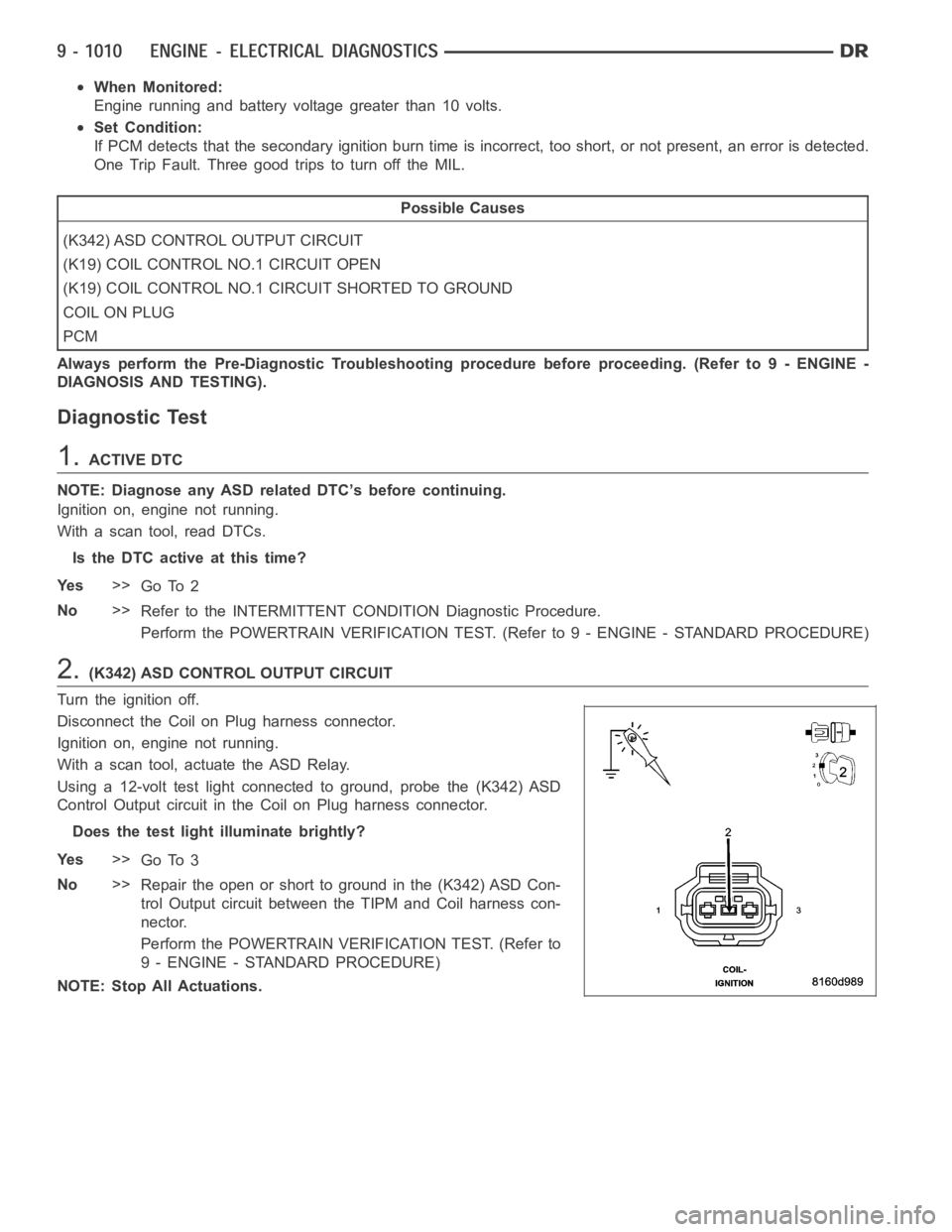
Using a 12-volt test light connected to ground, probe the (K342) ASD
Control Output circuit in the Coil on Plug harness connector.
Does the test light illuminate brightly?
Ye s>>
Go To 3
No>>
Repair the open or short to ground in the (K342) ASD Con-
trol Output circuit between the TIPM and Coil harness con-
nector.
Perform the POWERTRAIN VERIFICATION TEST. (Refer to
9 - ENGINE - STANDARD PROCEDURE)
NOTE: Stop All Actuations.
Page 323 of 5267
When Monitored:
Engine running and battery voltage greater than 10 volts.
Set Condition:
If PCM detects that the secondary ignition burn time is incorrect, too short, or not present, an error is detected.
One Trip Fault. Three good trips to turn off the MIL.
Possible Causes
(K342) ASD CONTROL OUTPUT CIRCUIT
(K17) COIL CONTROL NO.2 CIRCUIT OPEN
(K17) COIL CONTROL NO.2 CIRCUIT SHORTED TO GROUND
COIL ON PLUG
PCM
Always perform the Pre-Diagnostic Troubleshooting procedure before proceeding. (Refer to 9 - ENGINE -
DIAGNOSIS AND TESTING).
Diagnostic Test
1.ACTIVE DTC
Ignition on, engine not running.
With a scan tool, read DTCs.
Is the DTC active at this time?
Ye s>>
Go To 2
No>>
Refer to the INTERMITTENT CONDITION Diagnostic Procedure.
Perform the POWERTRAIN VERIFICATION TEST. (Refer to 9 - ENGINE - STANDARD PROCEDURE)
2.(K342) ASD CONTROL OUTPUT CIRCUIT
Turn the ignition off.
Disconnect the Coil on Plug harness connector.
Ignition on, engine not running.
With a scan tool, actuate the ASD Relay.
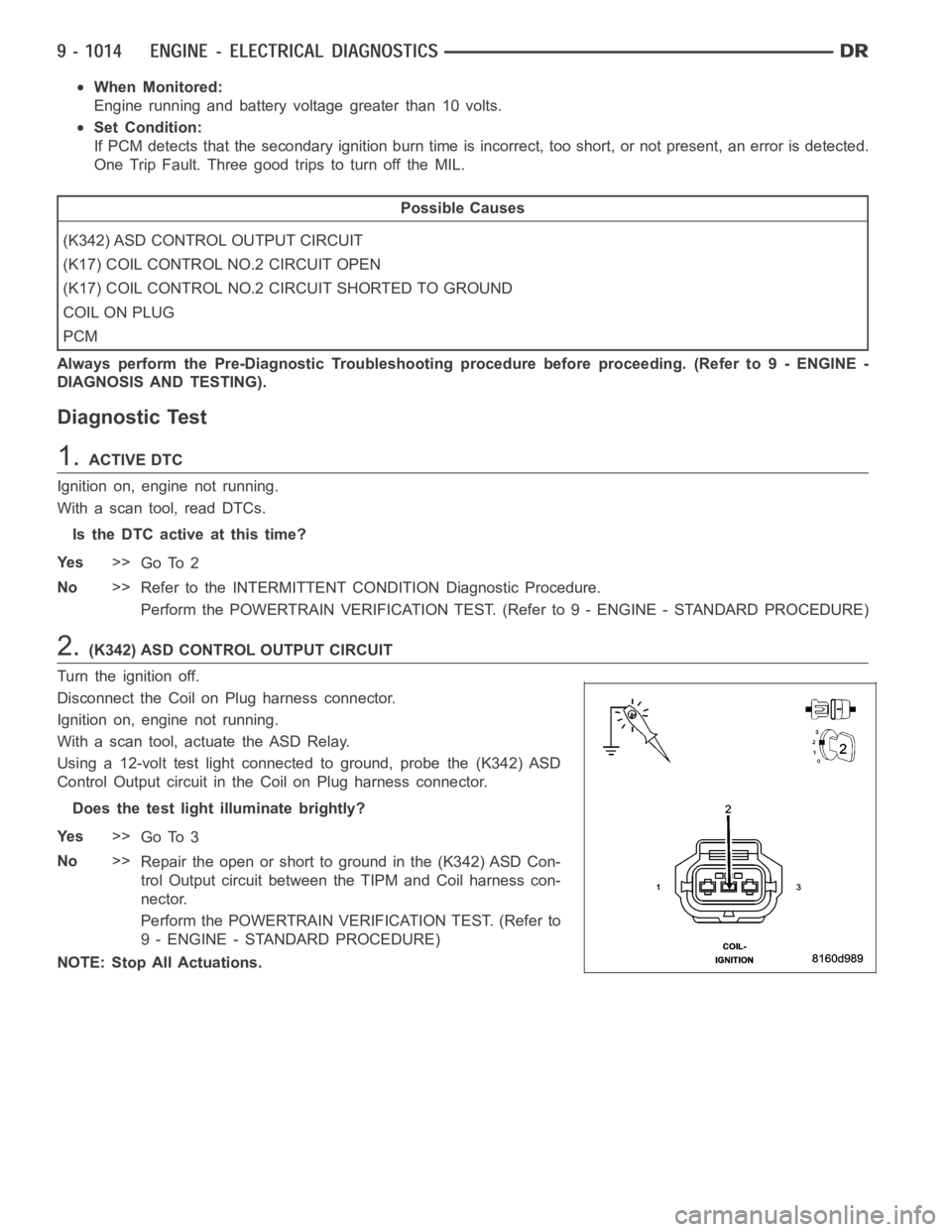
Using a 12-volt test light connected to ground, probe the (K342) ASD
Control Output circuit in the Coil on Plug harness connector.
Does the test light illuminate brightly?
Ye s>>
Go To 3
No>>
Repair the open or short to ground in the (K342) ASD Con-
trol Output circuit between the TIPM and Coil harness con-
nector.
Perform the POWERTRAIN VERIFICATION TEST. (Refer to
9 - ENGINE - STANDARD PROCEDURE)
NOTE: Stop All Actuations.
Page 327 of 5267
When Monitored:
Engine running and battery voltage greater than 10 volts.
Set Condition:
If PCM detects that the secondary ignition burn time is incorrect, too short, or not present, an error is detected.
One Trip Fault. Three good trips to turn off the MIL.
Possible Causes
(K342) ASD CONTROL OUTPUT CIRCUIT
(K18) COIL CONTROL NO.3 CIRCUIT OPEN
(K18) COIL CONTROL NO.3 CIRCUIT SHORTED TO GROUND
COIL ON PLUG
PCM
Always perform the Pre-Diagnostic Troubleshooting procedure before proceeding. (Refer to 9 - ENGINE -
DIAGNOSIS AND TESTING).
Diagnostic Test
1.ACTIVE DTC
NOTE: Diagnose any ASD related DTC’s before continuing.
Ignition on, engine not running.
With a scan tool, read DTCs.
Is the DTC active at this time?
Ye s>>
Go To 2
No>>
Refer to the INTERMITTENT CONDITION Diagnostic Procedure.
Perform the POWERTRAIN VERIFICATION TEST. (Refer to 9 - ENGINE - STANDARD PROCEDURE)
2.(K342) ASD CONTROL OUTPUT CIRCUIT
Turn the ignition off.
Disconnect the Coil on Plug harness connector.
Ignition on, engine not running.
With a scan tool, actuate the ASD Relay.
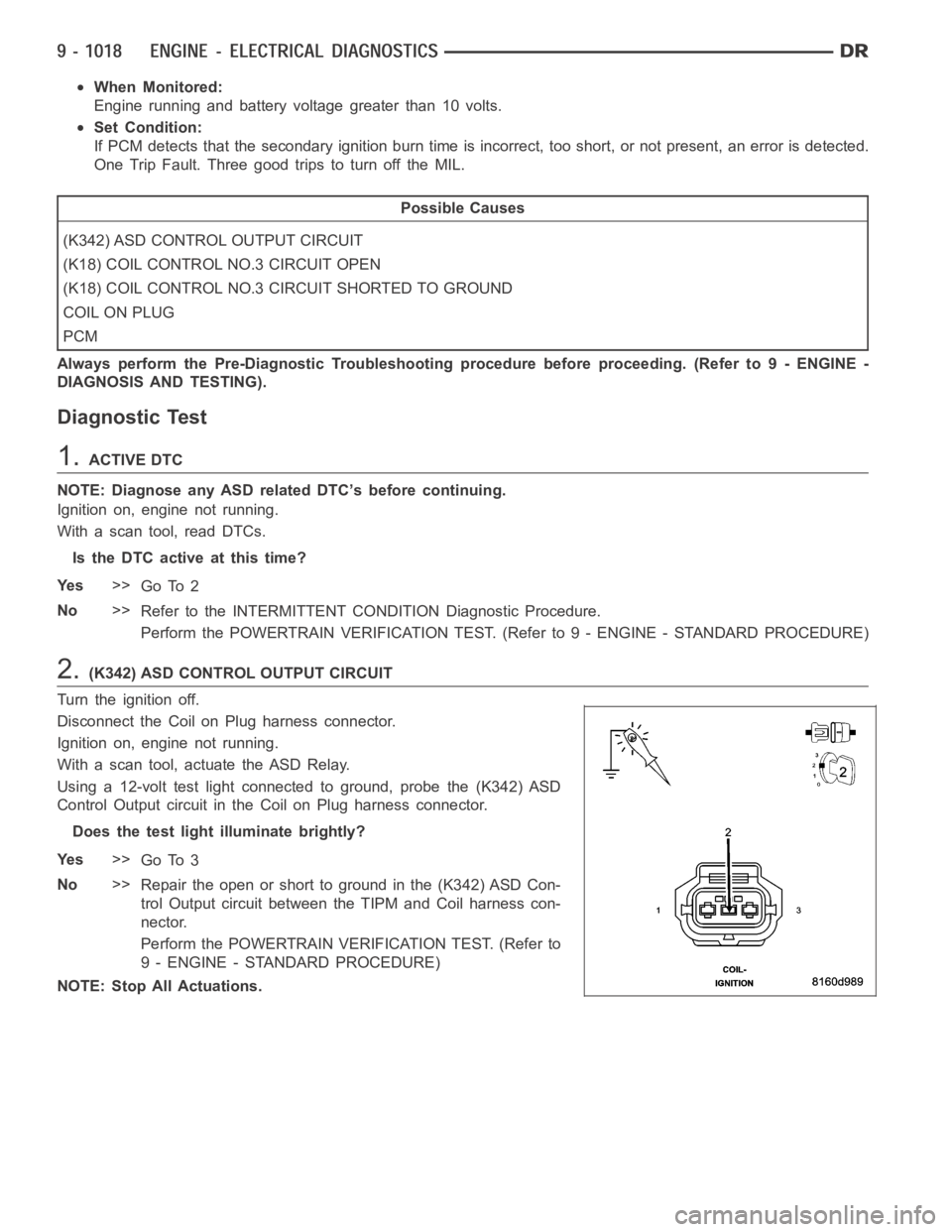
Using a 12-volt test light connected to ground, probe the (K342) ASD
Control Output circuit in the Coil on Plug harness connector.
Does the test light illuminate brightly?
Ye s>>
Go To 3
No>>
Repair the open or short to ground in the (K342) ASD Con-
trol Output circuit between the TIPM and Coil harness con-
nector.
Perform the POWERTRAIN VERIFICATION TEST. (Refer to
9 - ENGINE - STANDARD PROCEDURE)
NOTE: Stop All Actuations.
Page 331 of 5267
When Monitored:
Engine running and battery voltage greater than 10 volts.
Set Condition:
If PCM detects that the secondary ignition burn time is incorrect, too short, or not present, an error is detected.
One Trip Fault. Three good trips to turn off the MIL.
Possible Causes
(K342) ASD CONTROL OUTPUT CIRCUIT
(K15) COIL CONTROL NO.4 CIRCUIT OPEN
(K15) COIL CONTROL NO.4 CIRCUIT SHORTED TO GROUND
COIL ON PLUG
PCM
Always perform the Pre-Diagnostic Troubleshooting procedure before proceeding. (Refer to 9 - ENGINE -
DIAGNOSIS AND TESTING).
Diagnostic Test
1.ACTIVE DTC
NOTE: Diagnose any ASD related DTC’s before continuing.
Ignition on, engine not running.
With a scan tool, read DTCs.
Is the DTC active at this time?
Ye s>>
Go To 2
No>>
Refer to the INTERMITTENT CONDITION Diagnostic Procedure.
Perform the POWERTRAIN VERIFICATION TEST. (Refer to 9 - ENGINE - STANDARD PROCEDURE)
2.(K342) ASD CONTROL OUTPUT CIRCUIT
Turn the ignition off.
Disconnect the Coil on Plug harness connector.
Ignition on, engine not running.
With a scan tool, actuate the ASD Relay.
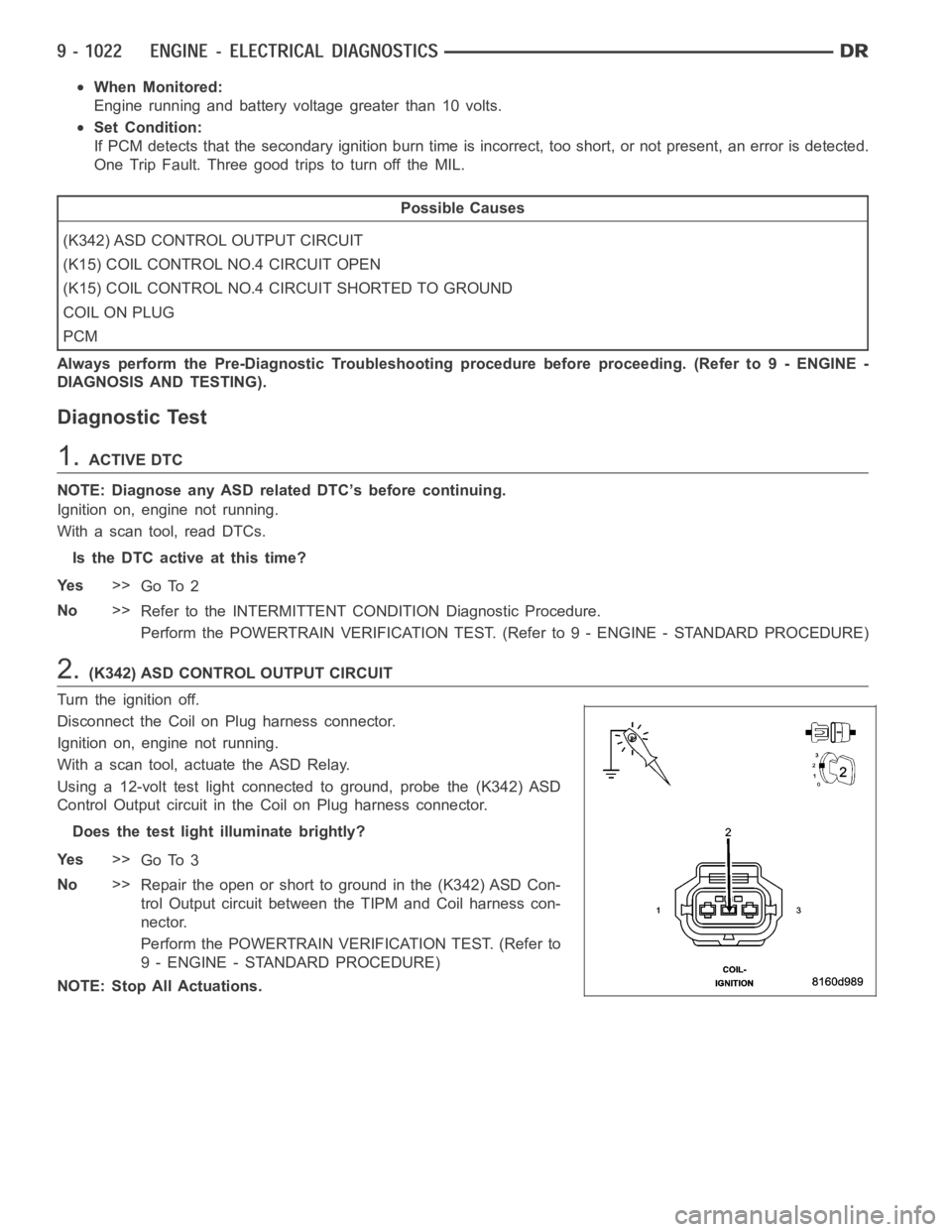
Using a 12-volt test light connected to ground, probe the (K342) ASD
Control Output circuit in the Coil on Plug harness connector.
Does the test light illuminate brightly?
Ye s>>
Go To 3
No>>
Repair the open or short to ground in the (K342) ASD Con-
trol Output circuit between the TIPM and Coil harness con-
nector.
Perform the POWERTRAIN VERIFICATION TEST. (Refer to
9 - ENGINE - STANDARD PROCEDURE)
NOTE: Stop All Actuations.
Page 335 of 5267
When Monitored:
Engine running and battery voltage greater than 10 volts.
Set Condition:
If PCM detects that the secondary ignition burn time is incorrect, too short, or not present, an error is detected.
One Trip Fault. Three good trips to turn off the MIL.
Possible Causes
(K342) ASD CONTROL OUTPUT CIRCUIT
(K16) COIL CONTROL NO.5 CIRCUIT OPEN
(K16) COIL CONTROL NO.5 CIRCUIT SHORTED TO GROUND
COIL ON PLUG
PCM
Always perform the Pre-Diagnostic Troubleshooting procedure before proceeding. (Refer to 9 - ENGINE -
DIAGNOSIS AND TESTING).
Diagnostic Test
1.ACTIVE DTC
NOTE: Diagnose any ASD related DTC’s before continuing.
Ignition on, engine not running.
With a scan tool, read DTCs.
Is the DTC active at this time?
Ye s>>
Go To 2
No>>
Refer to the INTERMITTENT CONDITION Diagnostic Procedure.
Perform the POWERTRAIN VERIFICATION TEST. (Refer to 9 - ENGINE - STANDARD PROCEDURE)
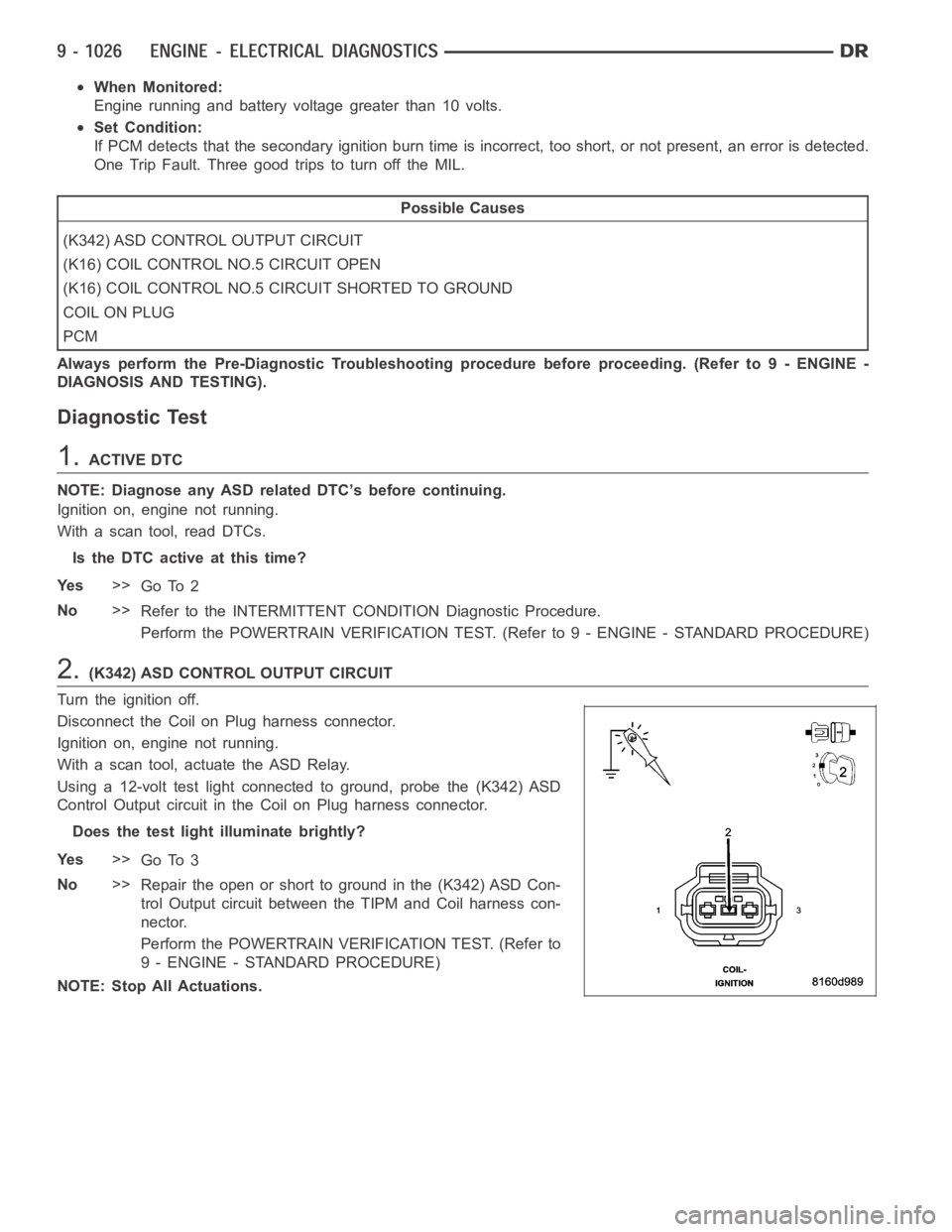
2.(K342) ASD CONTROL OUTPUT CIRCUIT
Turn the ignition off.
Disconnect the Coil on Plug harness connector.
Ignition on, engine not running.
With a scan tool, actuate the ASD Relay.
Using a 12-volt test light connected to ground, probe the (K342) ASD
Control Output circuit in the Coil on Plug harness connector.
Does the test light illuminate brightly?
Ye s>>
Go To 3
No>>
Repair the open or short to ground in the (K342) ASD Con-
trol Output circuit between the TIPM and Coil harness con-
nector.
Perform the POWERTRAIN VERIFICATION TEST. (Refer to
9 - ENGINE - STANDARD PROCEDURE)
NOTE: Stop All Actuations.
Page 339 of 5267
When Monitored:
Engine running and battery voltage greater than 10 volts.
Set Condition:
If PCM detects that the secondary ignition burn time is incorrect, too short, or not present, an error is detected.
One Trip Fault. Three good trips to turn off the MIL.
Possible Causes
(K342) ASD CONTROL OUTPUT CIRCUIT
(K10) COIL CONTROL NO.6 CIRCUIT OPEN
(K10) COIL CONTROL NO.6 CIRCUIT SHORTED TO GROUND
COIL ON PLUG
PCM
Always perform the Pre-Diagnostic Troubleshooting procedure before proceeding. (Refer to 9 - ENGINE -
DIAGNOSIS AND TESTING).
Diagnostic Test
1.ACTIVE DTC
NOTE: Diagnose any ASD related DTC’s before continuing.
Ignition on, engine not running.
With a scan tool, read DTCs.
Is the DTC active at this time?
Ye s>>
Go To 2
No>>
Refer to the INTERMITTENT CONDITION Diagnostic Procedure.
Perform the POWERTRAIN VERIFICATION TEST. (Refer to 9 - ENGINE - STANDARD PROCEDURE)
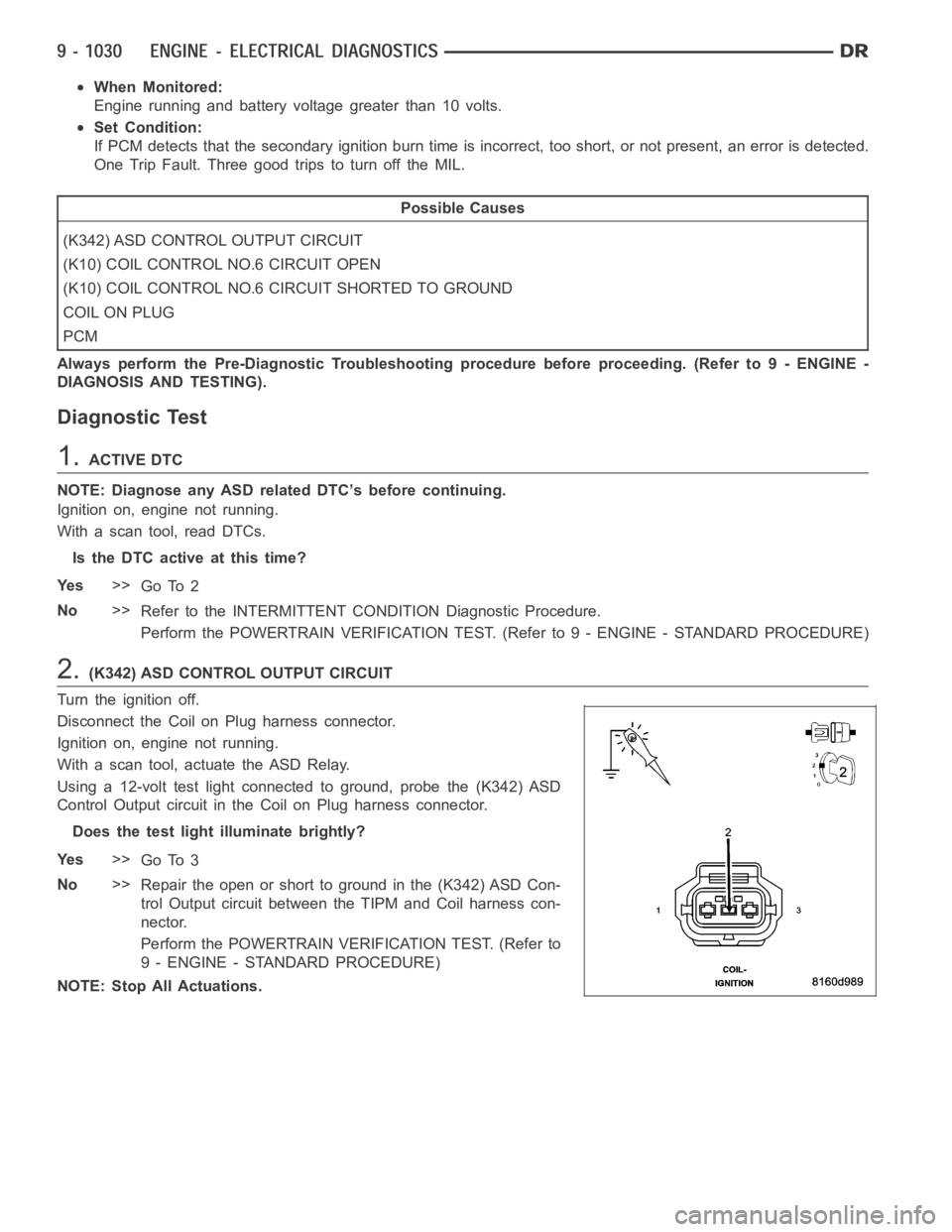
2.(K342) ASD CONTROL OUTPUT CIRCUIT
Turn the ignition off.
Disconnect the Coil on Plug harness connector.
Ignition on, engine not running.
With a scan tool, actuate the ASD Relay.
Using a 12-volt test light connected to ground, probe the (K342) ASD
Control Output circuit in the Coil on Plug harness connector.
Does the test light illuminate brightly?
Ye s>>
Go To 3
No>>
Repair the open or short to ground in the (K342) ASD Con-
trol Output circuit between the TIPM and Coil harness con-
nector.
Perform the POWERTRAIN VERIFICATION TEST. (Refer to
9 - ENGINE - STANDARD PROCEDURE)
NOTE: Stop All Actuations.