brakes DODGE SPRINTER 2004 1.G User Guide
[x] Cancel search | Manufacturer: DODGE, Model Year: 2004, Model line: SPRINTER, Model: DODGE SPRINTER 2004 1.GPages: 272, PDF Size: 22.71 MB
Page 159 of 272
STARTING AND OPERATING 159
5
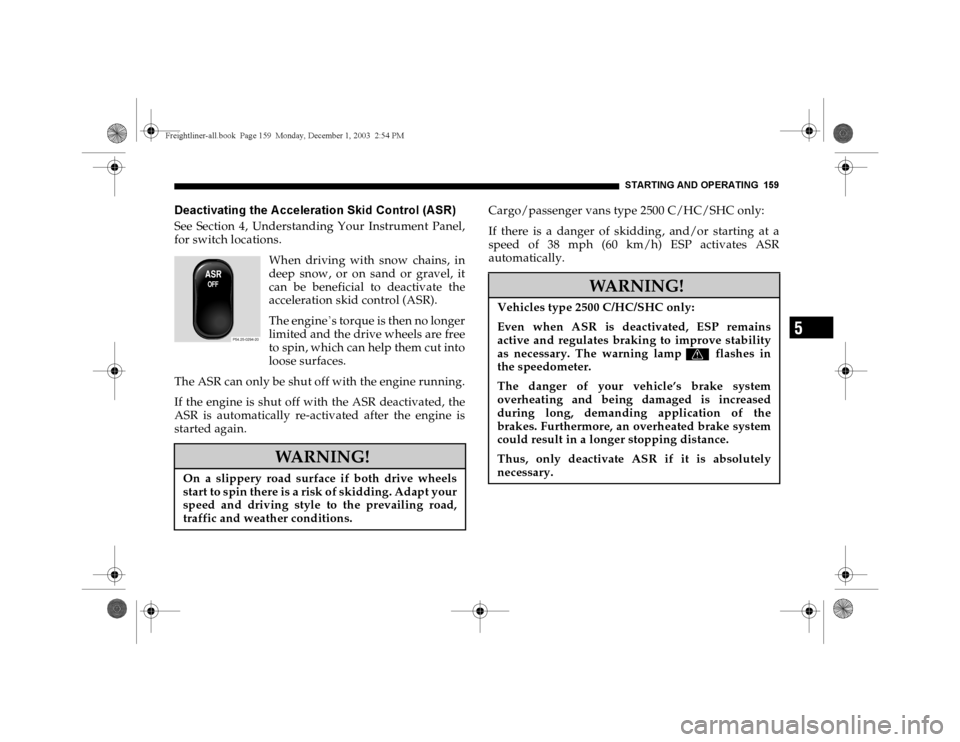
Deactivating the A cceleration Skid Control (A SR)See Section 4, Understanding Your Instrument Panel,
for switch locations.
When driving with snow chains, in
deep snow, or on sand or gravel, it
can be beneficial to deactivate the
acceleration skid control (ASR).
The engine
’s torque is then no longer
limited and the drive wheels are free
to spin, which can help them cut into
loose surfaces.
The ASR can only be shut off with the engine running.
If the engine is shut off with the ASR deactivated, the
ASR is automatically re-activated after the engine is
started again.Cargo/passenger vans type 2500 C/HC/SHC only:
If there is a danger of skidding, and/or starting at a
speed of 38 mph (60 km/h) ESP activates ASR
automatically.
WARNING!
On a slippery road surface if both drive wheels
start to spin there is a risk of skidding. Adapt your
speed and driving style to the prevailing road,
traffic and weather conditions.
P54.25-0294-20
WARNING!
Vehicles type 2500 C/HC/SHC only:
Even when ASR is deactivated, ESP remains
active and regulates braking to improve stability
as necessary. The warning lampv flashes in
the speedometer.
The danger of your vehicle’s brake system
overheating and being damaged is increased
during long, demanding application of the
brakes. Furthermore, an overheated brake system
could result in a longer stopping distance.
Thus, only deactivate ASR if it is absolutely
necessary.
Freightliner-all.book Pag e 159 Monday, December 1, 2003 2:54 PM
Page 160 of 272
160 STARTING AND OPERATINGTo deactivate the ASR:– Press the upper section of the switch – the warning
lamp
v in the speedometer lights up.
Traction control continues to cut in if, for example, a
wheel on one side of the vehicle reaches its limit of
adhesion. The wheel is then braked to increase the
vehicle’s overall traction.
The warning lamp v will flash in the speedometer
at any speed when a tire reaches its limit of adhesion.
To activate the ASR:
– Press the upper section of the switch again
– the
warning lamp v in the speedometer goes out.
Brake A ssist System (BA S) (Cargo/passenger vans
type 2500 C/HC/SHC only)The Brake Assist System (BAS) operates in emergency
situations. If you apply the brakes very quickly, the
BAS automatically provides full brake boost, thereby
potentially reducing braking distance.
Apply continuous full braking pressure until the
emergency braking situation is over.
The ABS will prevent the wheels from locking.
When you release the brake pedal, the brakes function
again as normal. The BAS is then deactivated.
WARNING!
If the indicator lamp k remains on, a malfunc-
tion may not only have occurred in the ASR sys-
tem but also in the BAS.
The handling and braking characteristics of your
vehicle change. Drive with extra caution.
Have the malfunction traced and repaired as soon
as possible by an authorized Sprinter Dealer.
Freightliner-all.book Pag e 160 Monday, December 1, 2003 2:54 PM
Page 161 of 272
STARTING AND OPERATING 161
5
For the indicator lamp k refer to
"Indicator Lamp
Acceleration Skid Control (ASR) and Brake Assist
System (BAS)
".
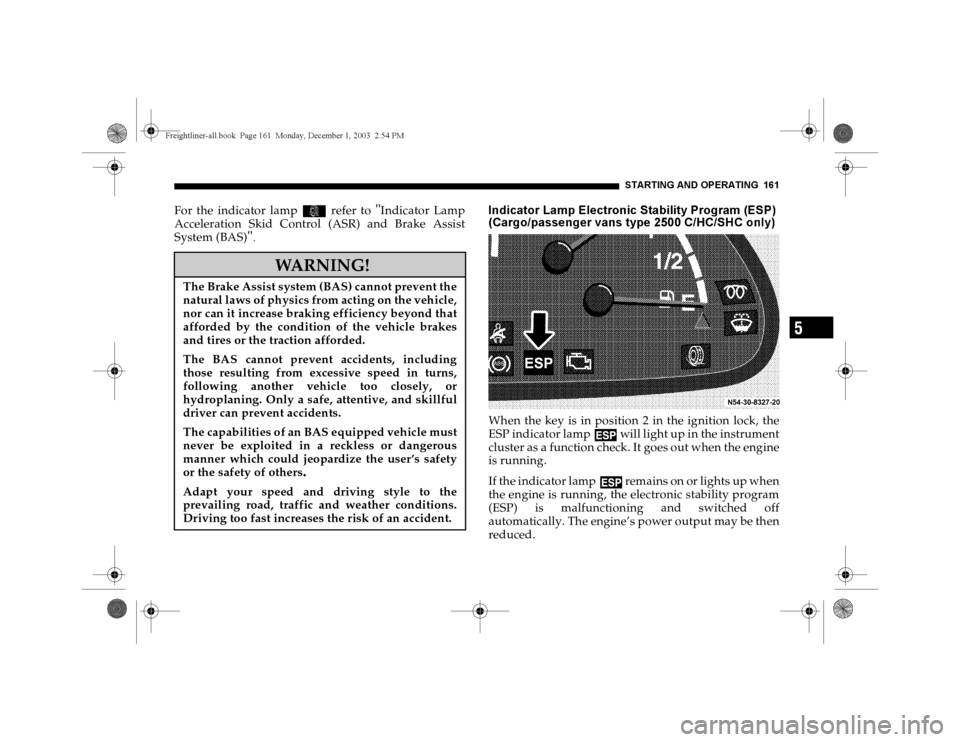
Indicator Lamp Electronic Stability Program (ESP)
(Cargo/passenger vans type 2500 C/HC/SHC only)When the key is in position 2 in the ignition lock, the
ESP indicator lamp will light up in the instrument
cluster as a function check. It goes out when the engine
is running.
If the indicator lamp remains on or lights up when
the engine is running, the electronic stability program
(ESP) is malfunctioning and switched off
automatically. The engine’s power output may be then
reduced.
WARNING!
The Brake Assist system (BAS) cannot prevent the
natural laws of physics from acting on the vehicle,
nor can it increase braking efficiency beyond that
afforded by the condition of the vehicle brakes
and tires or the traction afforded.
The BAS cannot prevent accidents, including
those resulting from excessive speed in turns,
following another vehicle too closely, or
hydroplaning. Only a safe, attentive, and skillful
driver can prevent accidents.
The capabilities of an BAS equipped vehicle must
never be exploited in a reckless or dangerous
manner which could jeopardize the user’s safety
or the safety of others
.
Adapt your speed and driving style to the
prevailing road, traffic and weather conditions.
Driving too fast increases the risk of an accident.
Freightliner-all.book Pag e 161 Monday, December 1, 2003 2:54 PM
Page 162 of 272
162 STARTING AND OPERATINGNOTE: If the ABS is malfunctioning or the voltage in
the vehicle’s electrical system drops below 10 volts, the
indicator lamp will also light up in the instrument
cluster and the ESP will be deactivated. The indicator
lamp will go out as soon as the voltage reaches this
level again or the ABS is operational again
– the ESP is
then reactivated.
Electronic Stability Program (ESP) (Cargo/
passenger vans type 2500 C/HC/SHC only)The Electronic Stability Program (ESP) monitors the
vehicle’s traction (force of adhesive friction between
the tires and the road surface) and handling.
The ESP recognizes when a wheel is spinning or if the
vehicle starts to skid. By applying brakes to the
appropriate wheel and by limiting engine output, the
ESP works to stabilize the vehicle. The ESP is especially
useful while driving off and on wet or slippery wet
surfaces.
The warning lamp v in the speedometer flashes
when the ESP is engaged, refer also to
"Warning Lamp
Acceleration Skid Control (ASR) and Electronic
Stability Program (ESP)
".
If wheels with tires of a different size than those offered
by an authorized Sprinter Dealer are used, the correct
operation of the ESP cannot be guaranteed.
WARNING!
If the ESP indicator lamp remains on, the
electronic stability program (ESP) is malfunction-
ing. The vehicle stability will no longer be auto-
matically regulated in good time.
The danger that your vehicle breaks into a skid, is
increased in certain driving situations. Drive with
extra caution.
Have the ESP repaired as soon as possible by an
authorized Spinter Dealer.
Freightliner-all.book Pag e 162 Monday, December 1, 2003 2:54 PM
Page 163 of 272
STARTING AND OPERATING 163
5
STEERINGWhen the engine is not running, there is no power
assistance for the steering. Greater force will be
required to steer the vehicle.WHEELS AND TIRESCheck tires regularly for even tread wear, tread depth
(note legal requirements) and signs of external
damage.
Only use wheels and tires of the same size, make and
pattern.
Do not install tires that are not approved for the size
and type of wheel installed or the vehicle itself. Only
use those wheel sizes which were delivered to you by
your authorized Sprinter Dealer.
Use only wheels and tires which have been tested and
approved by the vehicle manufacturer.
Break in new tires at moderate speeds for a distance of
about 65 miles (about 100 km).
WARNING!
ESP cannot prevent the natural laws of physics
from acting on the vehicle, nor can it increase the
traction afforded.
The ESP cannot prevent accidents, including
those resulting from excessive speed in turns,
following another vehicle too closely, or
hydroplaning. Only a safe, attentive, and skillful
driver can prevent accidents.
The capabilities of an ESP equipped vehicle must
never be exploited in a reckless or dangerous
manner which could jeopardize the user’s safety
or the safety of others.If the vehicle is to be towed away with the front
wheels clear of the ground, or if the brakes are to be
tested on a brake dynamometer, do not put the key
in position 2 in the ignition lock because the ESP
would engage the brakes to stabilize the vehicle.If the ESP function is used for a prolonged period
of time, the rear axle brakes may fail due to
overheating.
Freightliner-all.book Pag e 163 Monday, December 1, 2003 2:54 PM
Page 165 of 272
STARTING AND OPERATING 165
5
Tire GripTire grip is greatly reduced on a wet or icy road. Speed
and driving style must therefore be adapted to suit
road conditions.
In winter, install M+S radial tires.
Below a tread depth of 1/8 inch (3 mm), tire grip
begins to decrease rapidly on wet roads.HydroplaningDepending on the depth of the water layer on the road,
hydroplaning may occur, even at low speeds and with
new tires. Reduce vehicle speed, avoid grooves in the
road, and apply brakes cautiously in the rain.
TIRE PRESSURES
WARNING!
If tire pressures are too low, there is a risk of the
tire’s tread deteriorating and sudden loss of pres-
sure due to the excessive temperature of the tire.
This has an adverse effect on road safety and in-
creases the risk of an accident.
The limiting speed for the tires (tires and tire
pressure) must not be exceeded. Exceeding the
permissible maximum speed causes tire damage,
which can lead to loss of control of the vehicle.
Do not overinflate tires. Overinflating tires can
result in sudden deflation (blowout) because they
are more likely to become punctured or damaged by
road debris, potholes, etc. Follow recommended
inflation pressures.
Do not overload the tires by exceeding the specified
vehicle capacity weight as indicated by the label on
the base of the driver’s seat. Overloading the tires
can overheat them, possibly causing a blowout,
which could cause an accident resulting in severe
personal injuries, death and property damage.
Freightliner-all.book Pag e 165 Monday, December 1, 2003 2:54 PM
Page 179 of 272
STARTING AND OPERATING 179
5
Checking Weights of Vehicle and TrailerTo assure that the tow vehicle and trailer are in
compliance with the maximum permissible weight
limits, and to know the actual weights, have the loaded
vehicle-trailer combination (tow vehicle including
driver, passengers and cargo, trailer fully loaded)
weighed on a commercial scale.
Check the vehicle’s front and rear Gross Axle Weight
(GAW), the GTW and TW. The values as measured
must not be exceeded, according to the weight listed
under “Vehicle and trailer weight and ratings”.A ttaching a TrailerPlease observe maximum permitted trailer dimensions
(width and length).
Most states and all Canadian provinces require safety
chains between your tow vehicle and the trailer. The
chains should be crisscrossed under the trailer tongue.
They must be attached to the hitch receiver, and not to
the vehicle’s bumper or axle. Be sure to leave enough
slack in the chains to permit turning corners.
Most states and all Canadian provinces require a
separate brake system at various trailer weights.
WARNING!
Do not connect a trailer brake system (if trailer is
so equipped) directly to the vehicle’s hydraulic
brake system as your vehicle is equipped with an-
tilock brakes. If you do, neither the vehicle’s
brakes nor the trailer’s brakes will function prop-
erly. This could cause an accident resulting in
property damage, injury or death to you or others.
The provided vehicle electrical wiring harness for
trailer towing has a brake signal wire for hook-up
to a brake controller.
Most states and all Canadian provinces require a
break-away switch on trailers with a separate
brake system. The switch activates the trailer
brakes in the possible event that the trailer might
separate from the tow vehicle.
You should consider using a trailer sway control
system. For further information see your
authorized Sprinter Dealer.
Freightliner-all.book Pag e 179 Monday, December 1, 2003 2:54 PM
Page 180 of 272

180 STARTING AND OPERATINGTowing a TrailerThere are many different laws, including speed limit
restrictions, having to do with trailer towing. Make
sure that your vehicle-trailer combination will be legal,
not only for where you reside, but also for where you
will be driving. A good source for this information can
be the police or local authorities.
Before you start driving with the trailer, check the
trailer hitch, break-away switch, safety chains,
electrical connections, lighting and tires. Also adjust
the mirrors to permit unobstructed view beyond rear
of trailer.
If the trailer has electric brakes, start your vehicle and
trailer moving slowly, and then apply only the trailer
brake controller by hand to be sure the brakes are
working properly.
When towing a trailer, check occasionally to be sure
that the load is secure, and that lighting and trailer
brakes (if so equipped) are functioning properly.
Always secure items in the trailer to prevent load shifts
while driving.Take into consideration that when towing a trailer, the
handling characteristics are different and less stable
from those when operating the vehicle without a
trailer. It is important to avoid sudden maneuvers. The
vehicle and trailer combination is heavier, and
therefore is limited in acceleration and climbing ability,
and requires longer stopping distances. It is more
prone to reacting to side wind gusts, and requires more
sensitive steering input.
In order to gain skill and an understanding of the
vehicle’s behavior, you should practice turning, stopping
and backing up in an area which is free from traffic.If possible, do not brake abruptly, but rather engage
the brake slightly at first to permit the trailer to activate
its brake. Then increase the braking force.
Freightliner-all.book Pag e 180 Monday, December 1, 2003 2:54 PM
Page 181 of 272
STARTING AND OPERATING 181
5
WARNING!
Take into consideration that when towing a trail-
er, the handling characteristics are different and
less stable from those when operating the vehicle
without a trailer.
It is important to avoid sudden maneuvers.
Sudden maneuvers may lead to loss of control
over the vehicle-trailer combination. This could
cause an accident resulting in property damage or
injury to you or others.
CAUTION!
If the transmission hunts between gears on
inclines, manually shift to a lower gear (select
"4",
"3", "2" or
"1"). A lower gear and reduction of
speed reduces the chance of engine overloading
and / or overheating.
When going down a long hill, shift into a lower
gear and use the engine’s braking effect. Avoid
riding the brakes, thus overheating the vehicle
and trailer brakes.
If the engine coolant rises to an extremely high
temperature (coolant temperature needle
approaching the red zone) when the air
conditioner is on, turn off the air conditioner.
Engine coolant heat can be additionally vented by
opening the windows, switching the climate
control fan speed to high and setting the
temperature control to the maximum hot position.
Freightliner-all.book Pag e 181 Monday, December 1, 2003 2:54 PM
Page 212 of 272

212 MAINTAINING YOUR VEHICLEBrake fluidUse brake fluid approved to MB 331.0, or a DOT 4
brake fluid with: minimum dry boiling point (ERBP)
500
°F, minimum wet boiling point (WERBP)
356°F, maximum viscosity 1500 mm
2/s,
conforming to FMVSS116 and ISO 4925.
In the course of its service life, the boiling point of the
brake fluid will fall due to the continuous absorption of
moisture from the atmosphere.
If the brakes are placed under heavy loads (e.g., on
steep hills) bubbles of steam can then form in the brake
system.
This will adversely affect the brakes' effectiveness.
Engine CoolantThe coolant is a mixture of water and a corrosion
inhibitor/antifreeze additive. Within the cooling
system, the corrosion inhibitor/antifreeze ensures
anti-corrosion protection
antifreeze protection
a higher boiling point.
The coolant added in the factory ensures adequate
antifreeze and anti-corrosion protection.
Use coolant approved to MB 325.0, such as Valvoline
GO5, or an equivalent Extended Life Coolant.
To avoid damage to the cooling system, only use
manufacturer approved corrosion inhibitor/
antifreeze additives.
Information on the corrosion inhibitor/antifreeze
additive is available from any Sprinter Dealer.
For reasons of anti-corrosion protection and to increase
the boiling point, the coolant added to the cooling
system is designed for all year round operation – even
in countries with high prevailing temperatures.
Freightliner-all.book Pag e 212 Monday, December 1, 2003 2:54 PM