warning DODGE SPRINTER 2004 1.G Repair Manual
[x] Cancel search | Manufacturer: DODGE, Model Year: 2004, Model line: SPRINTER, Model: DODGE SPRINTER 2004 1.GPages: 272, PDF Size: 22.71 MB
Page 140 of 272
140 STARTING AND OPERATINGNOTE: After selecting any driving position from "N"
or "P", wait a moment to allow the gear to fully engage
before accelerating, especially when the engine is cold.A ccelerator PositionPartial throttle, for early upshifting and normal
acceleration
Full throttle, for later upshifting and rapid acceleration
Kickdown, (depressing the accelerator beyond full
throttle) for downshifting to a lower gear and
maximum acceleration. Once the desired speed is
attained, ease up on the accelerator, the transmission
shifts up again.StoppingFor brief stops, such as at traffic lights, leave the
transmission in gear and hold vehicle with the service
brake.
For longer stops with the engine idling, shift into "N"
or "P" and hold the vehicle with the service brake.
When stopping the vehicle on an uphill grade, do not
hold it with the accelerator, use the brake. This avoids
unnecessary transmission heat build up.
ManeuveringTo maneuver in tight areas, such as when pulling into
a parking space, control the vehicle speed by gradually
releasing the brakes. Accelerate gently and never
abruptly step on the accelerator.
To rock a vehicle out of soft ground (mud or snow),
alternately shift from forward to reverse, while
applying slight partial throttle.
WARNING!
Getting out of your vehicle with the selector lever
not fully engaged in position "P" is dangerous.
Also, when parked on an incline, position "P"
alone may not prevent your vehicle from moving,
possibly hitting people or objects.
Always set the parking brake in addition to
shifting to position "P".
When parked on an incline, also turn front wheel
against curb.
Freightliner-all.book Pag e 140 Monday, December 1, 2003 2:54 PM
Page 142 of 272
142 STARTING AND OPERATINGNOTE: Coasting the vehicle, or driving with selector
lever in "N" can result in transmission damage that is
not covered by the Sprinter Warranty.
wThe transmission automatically upshifts through
5th gear. Position "D" provides optimum driving
characteristics under all normal operating
conditions.Gear Selection for Special CircumstancesThe transmission gear ranges for special circumstances
can be selected by pushing the selector lever to the
right or the left with the selector lever in position "D".
The gear range currently selected is indicated in the
instrument cluster display.
Briefly press selector lever in the ç direction:
The transmission downshifts, one gear range at a time,
in the order "4", "3", "2", "1".
Press and hold selector lever in the ç direction:
The transmission will shift to a gear range which
favorably accelerates or decelerates the vehicle. This
way downshiftings can be caused.Briefly press selector lever in the æ direction:
The transmission will shift from the current gear range
to the next higher gear range. If the transmission is
already in gear range "D", an additional upshift of one
gear is not possible.
Press and hold selector lever in the æ direction:
The transmission will shift from the current gear range
directly to gear range "D".
NOTE: With transmission in gear range "D", "4"
or "3",
upshifting from 1st to 2nd to 3rd gear is delayed
depending on vehicle speed and engine temperature.
This allows the catalytic converter to heat up more
quickly to operating temperatures.
During the brief warm-up period this delayed upshift
and increased engine noise might be perceived as a
malfunction. However, neither the engine nor
WARNING!
On slippery road surfaces, never downshift in order
to slow the vehicle down. This could result in drive
wheel slip and reduced vehicle control. Your vehi-
cle’s ABS will not prevent this type of loss of control.
Freightliner-all.book Pag e 142 Monday, December 1, 2003 2:54 PM
Page 144 of 272
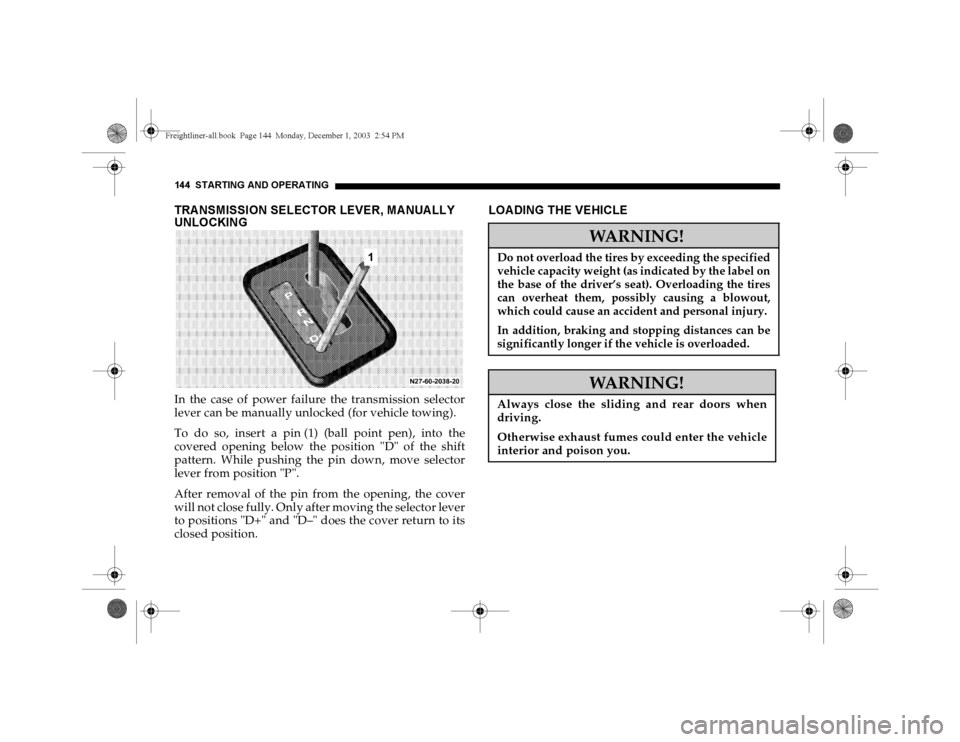
144 STARTING AND OPERATINGTRANSMISSION SELECTOR LEVER, MANUALLY
UNLOCKINGIn the case of power failure the transmission selector
lever can be manually unlocked (for vehicle towing).
To do so, insert a pin (1) (ball point pen), into the
covered opening below the position "D" of the shift
pattern. While pushing the pin down, move selector
lever from position "P".
After removal of the pin from the opening, the cover
will not close fully. Only after moving the selector lever
to positions "D+" and "D–" does the cover return to its
closed position.
LOADING THE VEHICLE
WARNING!
Do not overload the tires by exceeding the specified
vehicle capacity weight (as indicated by the label on
the base of the driver’s seat). Overloading the tires
can overheat them, possibly causing a blowout,
which could cause an accident and personal injury.
In addition, braking and stopping distances can be
significantly longer if the vehicle is overloaded.
WARNING!
Always close the sliding and rear doors when
driving.
Otherwise exhaust fumes could enter the vehicle
interior and poison you.
Freightliner-all.book Pag e 144 Monday, December 1, 2003 2:54 PM
Page 145 of 272
STARTING AND OPERATING 145
5
The handling characteristics of a vehicle when laden
are dependent on the type of load and the distribution
of the load within the vehicle.
Carrying heavy or bulky loads may alter the vehicle’s
handling characteristic.Loading GuidelinesPlease note and comply with the following information
when loading and transporting goods.
Do not allow the load, including passengers, to
exceed the permitted gross vehicle weight or the
permitted axle loads for the vehicle. Bear in mind
that the unladen weight could be increased by
installing items of optional equipment and
accessories.
Distribute the load uniformly. Excessive loads on
individual points of the load surface could cause
damage to the floor covering.
Transport heavy loads between the axles near the
rear axle as low as possible in the vehicle.
Secure any kind of load with sufficient wear and
tear-resistant load restraints. Lashing rings.
WARNING!
Unsecure or poorly secured loads, and seats that
have been removed, could move around the vehi-
cle interior uncontrollably in the event of sudden
braking, a rapid change in direction or an acci-
dent. This increases the risk of injury to occu-
pants in these situations.
Secure and position a load as described in the
following loading guidelines.
Piling up heavy objects or placing them on upper
shelves or loading them otherwise high up in the
vehicle will significantly raise the center of
gravity of the vehicle. Placing excessive loads on
individual points of the load surface or behind
the rear axle will also adversely affect the
handling characteristics of your vehicle and may
lead to loss of control over the vehicle.
Road safety and tire durability are adversely
affected if the permissible axle loads or gross
vehicle weight are exceeded due to the vehicle’s
load. Braking and stopping distances can be
significantly longer.
Freightliner-all.book Pag e 145 Monday, December 1, 2003 2:54 PM
Page 146 of 272
146 STARTING AND OPERATING Protect sharp edges with padding.
Check the tire pressures after loading the vehicle.
For passenger vans:
Do not stack loads higher than the upper edge of the
backrests.
Always place the load against the backrests of the
seat benches.
Whenever possible, transport loads behind seats
that are not occupied.
Distribute the load in such a way that the
permissible axle loads are not exceeded when the
vehicle is equipped with the maximum number of
seats. Loading the luggage compartment up to the
maximum payload would cause the permissible
rear axle load to be exceeded.
BRA KES
Service Brake
WARNING!
When the engine is not running, the brake and
steering systems are without power assistance.
Under these circumstances, a much greater effort
is necessary to stop or steer the vehicle.
After driving in heavy rain for some time without
applying the brakes or through water deep
enough to wet brake components, the first
braking action may be somewhat reduced and
increased pedal pressure may be necessary. Be
sure to maintain a safe distance from vehicles in
front.
Resting your foot on the brake pedal will cause
excessive and premature wear of the brake pads.
It can also result in the brakes overheating,
thereby significantly reducing their effectiveness.
It may not be possible to stop the vehicle in
sufficient time to avoid an accident.
Freightliner-all.book Pag e 146 Monday, December 1, 2003 2:54 PM
Page 149 of 272
STARTING AND OPERATING 149
5
NOTE: If you find that the minimum mark on the
brake fluid reservoir is reached, have the brake system
checked for pad thickness and leaks.
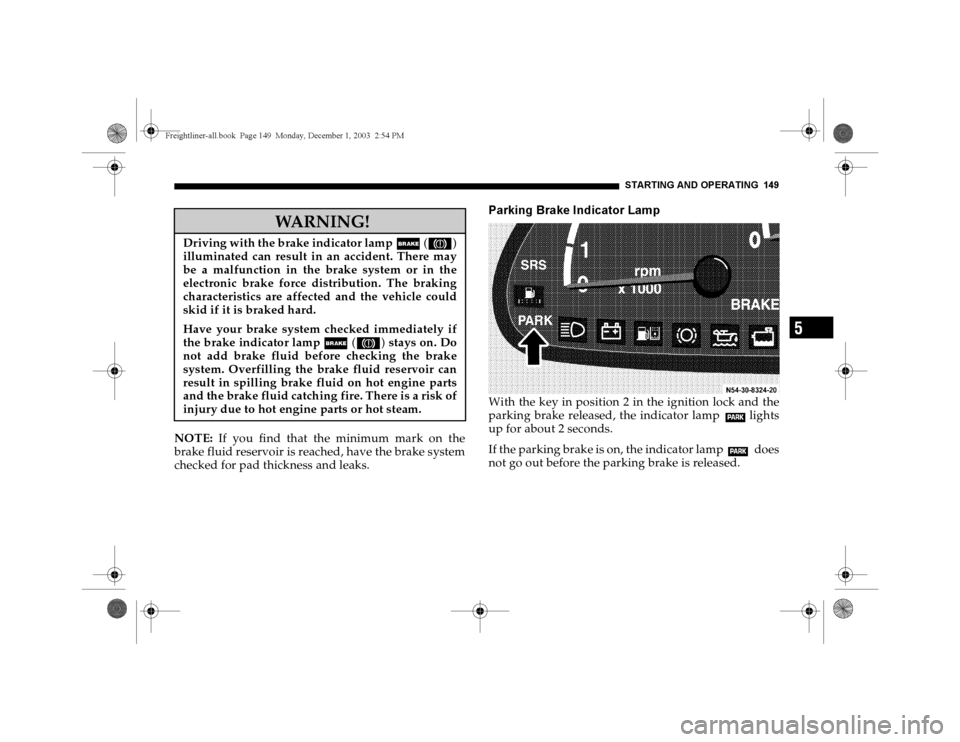
Parking Brake Indicator LampWith the key in position 2 in the ignition lock and the
parking brake released, the indicator lamp lights
up for about 2 seconds.
If the parking brake is on, the indicator lamp does
not go out before the parking brake is released.
WARNING!
Driving with the brake indicator lamp; (3)
illuminated can result in an accident. There may
be a malfunction in the brake system or in the
electronic brake force distribution. The braking
characteristics are affected and the vehicle could
skid if it is braked hard.
Have your brake system checked immediately if
the brake indicator lamp; (3) stays on. Do
not add brake fluid before checking the brake
system. Overfilling the brake fluid reservoir can
result in spilling brake fluid on hot engine parts
and the brake fluid catching fire. There is a risk of
injury due to hot engine parts or hot steam.
Freightliner-all.book Pag e 149 Monday, December 1, 2003 2:54 PM
Page 150 of 272
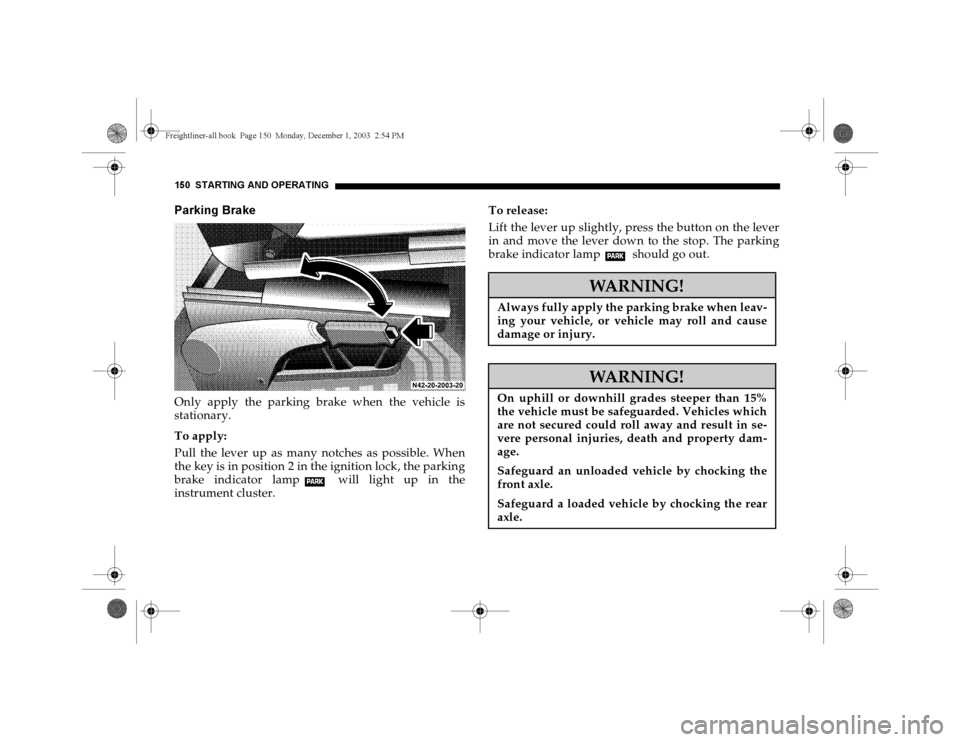
150 STARTING AND OPERATINGParking BrakeOnly apply the parking brake when the vehicle is
stationary.
To apply:
Pull the lever up as many notches as possible. When
the key is in position 2 in the ignition lock, the parking
brake indicator lamp will light up in the
instrument cluster.To release:
Lift the lever up slightly, press the button on the lever
in and move the lever down to the stop. The parking
brake indicator lamp should go out.
WARNING!
Always fully apply the parking brake when leav-
ing your vehicle, or vehicle may roll and cause
damage or injury.
WARNING!
On uphill or downhill grades steeper than 15%
the vehicle must be safeguarded. Vehicles which
are not secured could roll away and result in se-
vere personal injuries, death and property dam-
age.
Safeguard an unloaded vehicle by chocking the
front axle.
Safeguard a loaded vehicle by chocking the rear
axle.
Freightliner-all.book Pag e 150 Monday, December 1, 2003 2:54 PM
Page 151 of 272
STARTING AND OPERATING 151
5
Driving SystemsThe vehicle can be equipped with the following
Driving Safety Systems:
Anti-lock brake system (ABS)
Electronic brake force distribution (EBV)
Acceleration skid control (ASR)
Brake assist system (BAS)
1
Electronic stability program (ESP)
1
NOTE: The maximum effectiveness of ABS, EBV, ASR
and ESP is only achieved if you drive with correct tire
pressures and adjust tire pressures to correspond with
the vehicle’s load. In winter operation, the maximum
effectiveness of the ABS and the ESP is only achieved
with winter tires (M+S tires), or snow chains as
required.
WARNING!
When leaving the vehicle always remove the key
from the ignition lock, and lock your vehicle.
Do not leave children unsupervised in the vehicle,
even if they are secured by a child restraint
system. The children could
injure themselves on parts of the vehicle
release the child-proof locks by pressing the
central locking button and could thereby open
the doors and
cause injury to others as a result
get out of the vehicle and could either injure
themselves when doing so or they could be
injured by the traffic approaching from the rear
suffer serious or fatal effects in the event of long
periods of hot weather
release the parking brake. The vehicle could
then start moving of its own accord.Unsupervised use of vehicle equipment may cause
severe personal injuries, death and property damage.
Freightliner-all.book Pag e 151 Monday, December 1, 2003 2:54 PM
Page 152 of 272
152 STARTING AND OPERATING
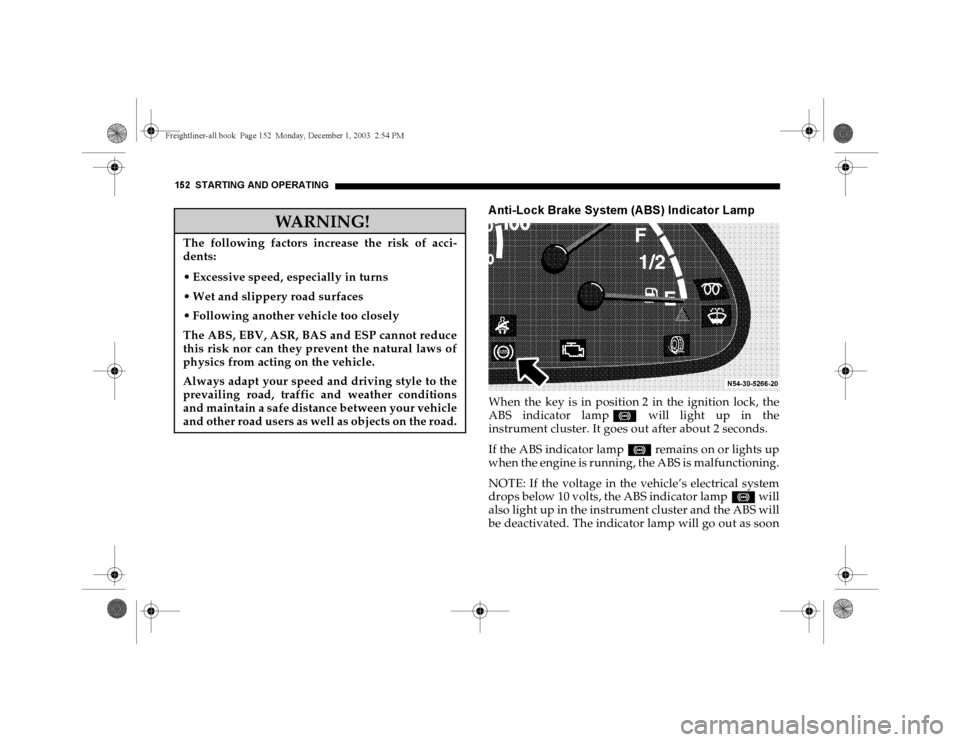
A nti-Lock Brake System (A BS) Indicator LampWhen the key is in position 2 in the ignition lock, the
ABS indicator lamp- will light up in the
instrument cluster. It goes out after about 2 seconds.
If the ABS indicator lamp- remains on or lights up
when the engine is running, the ABS is malfunctioning.
NOTE: If the voltage in the vehicle’s electrical system
drops below 10 volts, the ABS indicator lamp- will
also light up in the instrument cluster and the ABS will
be deactivated. The indicator lamp will go out as soon
WARNING!
The following factors increase the risk of acci-
dents:
Excessive speed, especially in turns
Wet and slippery road surfaces
Following another vehicle too closely
The ABS, EBV, ASR, BAS and ESP cannot reduce
this risk nor can they prevent the natural laws of
physics from acting on the vehicle.
Always adapt your speed and driving style to the
prevailing road, traffic and weather conditions
and maintain a safe distance between your vehicle
and other road users as well as objects on the road.
Freightliner-all.book Pag e 152 Monday, December 1, 2003 2:54 PM
Page 153 of 272
STARTING AND OPERATING 153
5
as the voltage reaches this level again
– the ABS is then
reactivated.
If ABS malfunctions, the other driving safety systems
are deactivated. The handling and braking
characteristics of your vehicle change. The other
braking and driving systems still function normally.
I
A nti-Lock Brake System (A BS)ABS prevents the wheels from locking at any speed
above about 5 mph (8 km/h), regardless of road
surface conditions. The vehicle remains steerable even
if the brakes are applied fully.
A light vibrating of the steering wheel and pulsating of
the brake pedal indicate that the ABS is working.
On slippery road surfaces, the ABS will respond even
with light brake pedal pressure because of the
increased likelihood of locking wheels. The pulsating
brake pedal can be an indication of hazardous road
conditions and works as a reminder to take extra care
while driving.
WARNING!
If the ABS indicator lamp- does not go out or
lights up again while driving, the ABS is malfunc-
tioning. If ABS malfunctions, the other driving
safety systems are deactivated. The vehicle’s brak-
ing characteristics may be affected. There is an in-
creased risk that your vehicle could skid in the
event of sharp braking. Have the malfunction
traced and repaired without delay by an autho-
rized Sprinter Dealer.
Adapt your speed and driving style to the
prevailing road, traffic and weather conditions.
Driving too fast increases the risk of an accident.
Freightliner-all.book Pag e 153 Monday, December 1, 2003 2:54 PM