lock DODGE SPRINTER 2005 1.G Owners Manual
[x] Cancel search | Manufacturer: DODGE, Model Year: 2005, Model line: SPRINTER, Model: DODGE SPRINTER 2005 1.GPages: 288, PDF Size: 27.89 MB
Page 183 of 288
STARTING AND OPERATING 183
5
BLEEDING DIESEL FUEL SYSTEMIf the fuel tank was run empty, the diesel fuel system
must be bled after refueling before starting the engine.– Turn the key in the ignition lock to position 2 for at
least 30 seconds.– Return the key to position 0.– Start the engine three to four times.
The malfunction indicator light (MIL) ± must go
out.
NOTE: Too many attempts to start the engine could
drain the battery. If the engine does not start after
several attempts, consult an authorized Sprinter
Dealer.
WARNING!
Possible tire damage resulting in serious personal
injury or death may occur if the vehicle’s electron-
ic speed controller is programmed at a speed
above the maximum speed allowed by the manu-
facturer of the specific tires mounted on the vehi-
cle. The maximum speed of the tires prescribed by
the tire manufacturer must be determined and ac-
curately programmed into the electronic speed
controller. The electronic speed controller must
never be programmed at a speed greater than the
maximum allowable tire speed as prescribed by
the manufacturer of the specific tires mounted on
the vehicle.
Page 184 of 288
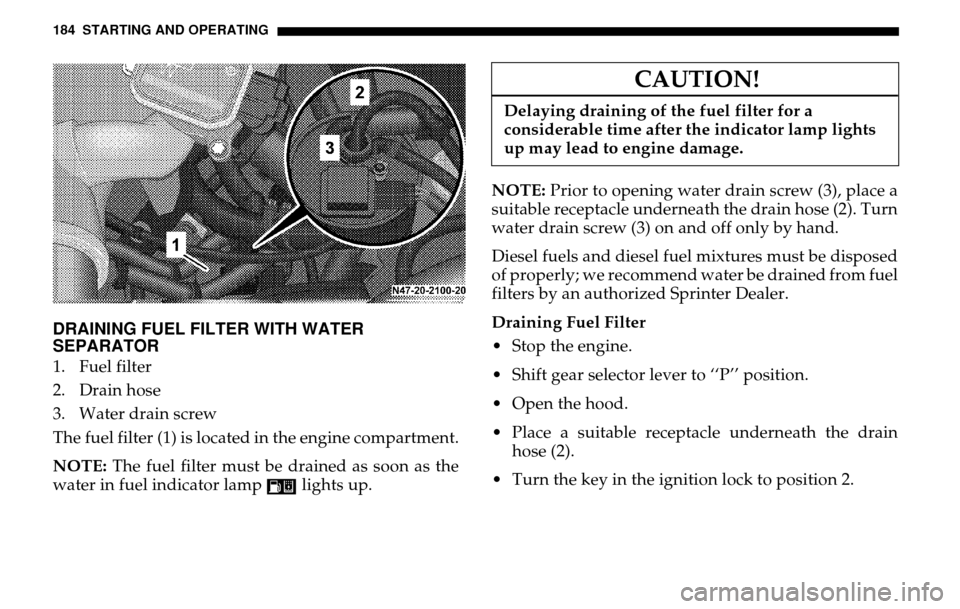
184 STARTING AND OPERATINGDRAINING FUEL FILTER WITH WATER
SEPARATOR1. Fuel filter
2. Drain hose
3. Water drain screw
The fuel filter (1) is located in the engine compartment.
NOTE: The fuel filter must be drained as soon as the
water in fuel indicator lamp lights up. NOTE:
Prior to opening water drain screw (3), place a
suitable receptacle underneath the drain hose (2). Turn
water drain screw (3) on and off only by hand.
Diesel fuels and diesel fuel mixtures must be disposed
of properly; we recommend water be drained from fuel
filters by an authorized Sprinter Dealer.
Draining Fuel Filter
Stop the engine.
Shift gear selector lever to ‘‘P’’ position.
Open the hood.
Place a suitable receptacle underneath the drain hose (2).
Turn the key in the ignition lock to position 2.
CAUTION!
Delaying draining of the fuel filter for a
considerable time after the indicator lamp lights
up may lead to engine damage.
Page 185 of 288

STARTING AND OPERATING 185
5
Open immediately the water drain screw (3) about 1 turn (counterclockwise) until fluid emerges. Ensure
that the fluid is collected in the receptacle.
Close the water drain screw (3) as soon as about 0.25 US qt (0.2 liters) are emerged.
After draining, return the key in the ignition lock to position 0.
Dispose of the collected fluid in an environmentally responsible manner.
If the filter is still saturated, drain the filter once more.
After draining, the engine may run briefly but stall for
lack of fuel. If this occurs, bleed the system.
NOTE: Should the water in the fuel indicator lamp
still not go out after the fuel filter has been drained
twice, the cause should be examined by an authorized
Sprinter Dealer.
Bleeding the Diesel Fuel SystemThe diesel fuel system must be bled before starting the
engine.
Turn the key in the ignition lock position 2 for at
least 30 seconds.
Return the key to position 0.
Start the engine three to four times. The engine control unit indicator lamp ± must go out.
NOTE: Too many attempts to start the engine could
drain the battery. If the engine does not start after
several attempts, consult an authorized Sprinter
Dealer.
Page 188 of 288

188 STARTING AND OPERATINGChecking Weights of Vehicle and TrailerTo assure that the tow vehicle and trailer are in
compliance with the maximum permissible weight
limits, and to know the actual weights, have the loaded
vehicle-trailer combination (tow vehicle including
driver, passengers and cargo, trailer fully loaded)
weighed on a commercial scale.
Check the vehicle’s front and rear Gross Axle Weight
(GAW), the GTW and TW. The values as measured
must not be exceeded, according to the weight listed
under “Vehicle and trailer weight and ratings”.Attaching a TrailerPlease observe maximum permitted trailer dimensions
(width and length).
Most states and all Canadian provinces require safety
chains between your tow vehicle and the trailer. The
chains should be crisscrossed under the trailer tongue.
They must be attached to the hitch receiver, and not to
the vehicle’s bumper or axle. Be sure to leave enough
slack in the chains to permit turning corners.
Most states and all Canadian provinces require a
separate brake system at various trailer weights.
WARNING!
Do not connect a trailer brake system (if trailer is
so equipped) directly to the vehicle’s hydraulic
brake system as your vehicle is equipped with an-
tilock brakes. If you do, neither the vehicle’s
brakes nor the trailer’s brakes will function prop-
erly. This could cause an accident resulting in
property damage, injury or death to you or others.
The provided vehicle electrical wiring harness for
trailer towing has a brake signal wire for hook-up
to a brake controller.
Most states and all Canadian provinces require a
break-away switch on trailers with a separate
brake system. The switch activates the trailer
brakes in the possible event that the trailer might
separate from the tow vehicle.
You should consider using a trailer sway control
system. For further information see your
authorized Sprinter Dealer.
Page 197 of 288
WHAT TO DO IN EMERGENCIES 197
6
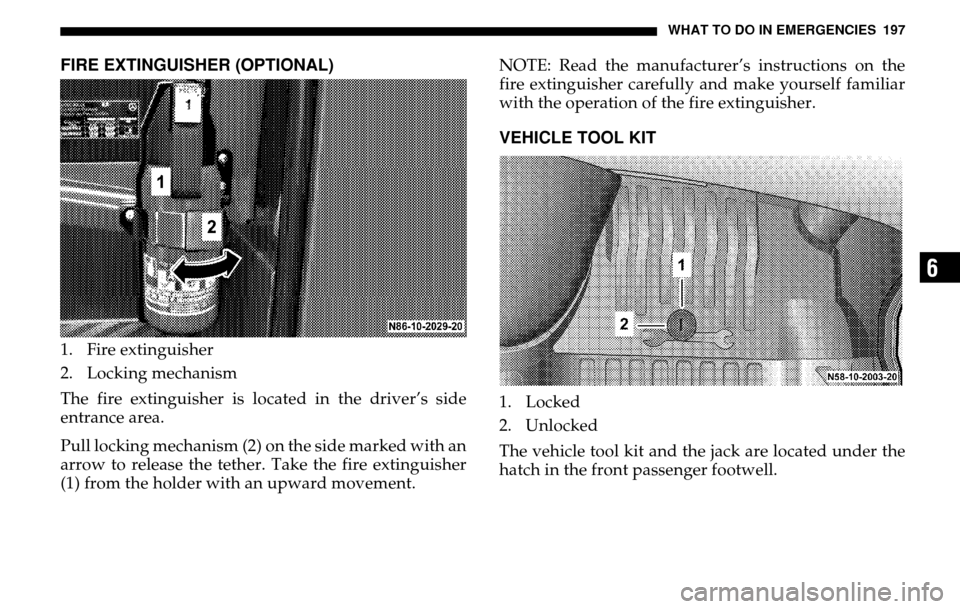
FIRE EXTINGUISHER (OPTIONAL)1. Fire extinguisher
2. Locking mechanism
The fire extinguisher is located in the driver’s side
entrance area.
Pull locking mechanism (2) on the side marked with an
arrow to release the tether. Take the fire extinguisher
(1) from the holder with an upward movement. NOTE: Read the manufacturer’s instructions on the
fire extinguisher carefully and make yourself familiar
with the operation of the fire extinguisher.
VEHICLE TOOL KIT1. Locked
2. Unlocked
The vehicle tool kit and the jack are located under the
hatch in the front passenger footwell.
Page 198 of 288
198 WHAT TO DO IN EMERGENCIESCHANGING THE TIREIf you get a flat tire while driving, gradually decrease
your speed. Hold the steering wheel firmly and slowly
move to a safe place on the side of the road. The
pressure of the spare wheel always has to be checked
regularly (at least after every tenth time at the filling
station).
WARNING!
Only certain tires meeting the tire size/load/speed
rating specifications contained in the Tire Pres-
sure Tables are certified to conform to FMVSS 120
for the Sprinter vehicle at this time. Please check
your side walls of your originally equipped tires
for specific makes/sizes, and speed load ratings
when you need to replace your tires.
To prevent accident, injury or possible death, use
only the correct tires for your tire replacement.
WARNING!
The jack is designed exclusively for jacking up the
vehicle at the jack take-up brackets built into ei-
ther side of the vehicle. To help avoid personal in-
jury, use the jack only to lift the vehicle during a
wheel change. Never get beneath the vehicle
while it is supported by the jack only.
Keep hands and feet away from the area under the
lifted vehicle. Always firmly set parking brake
and block wheels before raising vehicle with jack.
Do not disengage parking brake while the vehicle
is raised.
Always use the jack on a level surface.
Do not change wheels on either steep uphill or
downhill grades. Be sure that the jack arm end is
fully seated in the jack take-up bracket. The
vehicle may begin to move and fall from the jack
which could cause serious or fatal personal injury
and property damage.
Always lower the vehicle onto sufficient capacity
jack stands before working under the vehicle.
Page 199 of 288

WHAT TO DO IN EMERGENCIES 199
6
Procedure:
1. Park the vehicle on a firm, level, non-slippery surface.
2. Switch on the hazard warning flasher switch, apply the parking brake, and place the transmission
selector in "P".
3. Everyone must leave the vehicle before you jack it up.
4. Everyone must leave the danger zone, before jacking the vehicle. 5. The vehicle must be safeguarded in accordance
with legal regulations (such as using a warning
triangle).
6. Prevent vehicle from rolling away by blocking wheels with wheel chocks (not supplied with
vehicle) or sizable wood block or stone.
On a level road, place one chock in front of and one
behind the wheel that is diagonally opposite to the
wheel being changed.
When changing a wheel on mild uphill or downhill
grades, place chocks on the downhill side blocking
both wheels of the other axle.
Do not jack the vehicle up more than 1.2 in (30
mm) between the tire and the surface. Otherwise,
the vehicle may tip over and may cause serious
injury or death to you or others.
Precautions when changing a wheel:
For the torque, refer to
"Installing a wheel ";
Do not damage, grease or oil wheel bolts or their
threads.
WARNING!
Do not change wheels on either steep uphill or
downhill grades. The vehicle may begin to move
and fall from the jack which could cause personal
injury and property damage.
Page 203 of 288
WHAT TO DO IN EMERGENCIES 203
6
JACK Using the Jack
The jack is located together with the vehicle tool kit
under the hatch in the front passenger footwell, refer to
"Vehicle Tool Kit".
1. Loosen the wheel bolts before raising the vehicle.
2. Close the release valve on the jack.
3. Assemble the pump leve r provided and insert it
into the socket on the jack.
4. Secure the lever by turning it clockwise in the socket.
Position the jack under the appropriate jack point and
raise the vehicle by pumping the lever.
WARNING!
To avoid the risk of serious or fatal injuries or vehicle
damage, please bear the fo llowing points in mind:
The jack is intended only for raising the vehicle briefly, for instance, when changing a wheel. If it is
not designed to enable work to be carried out
underneath the vehicle.
Do not crawl under the jacked-up vehicle. For work
under the vehicle, stands must be used.
The jack must be placed on a firm, flat surface only.
Do not change wheels on uphill or downhill gradients under any circumstances.
Make sure that no persons are present in the vehicle when jacking up the vehicle.
Do not start the engine while the vehicle is raised.
Make sure that the distance between the underside of the tires and the ground does not exceed 1.2 in (30
mm). Otherwise the vehicle may tip over.
Page 205 of 288
WHAT TO DO IN EMERGENCIES 205
6
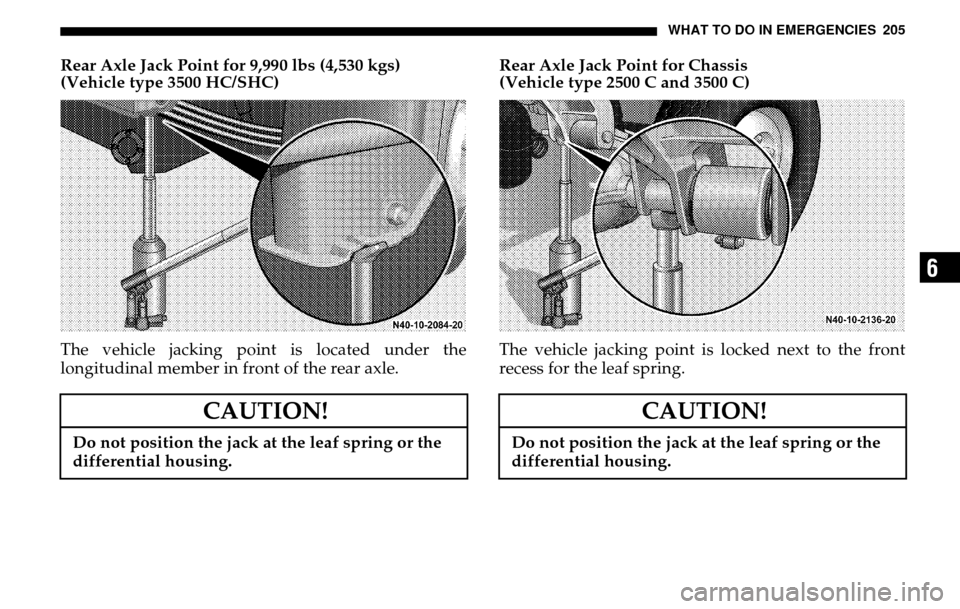
Rear Axle Jack Point for 9,990 lbs (4,530 kgs)
(Vehicle type 3500 HC/SHC)
The vehicle jacking poin t is located under the
longitudinal member in front of the rear axle. Rear Axle Jack Point for Chassis
(Vehicle type 2500 C and 3500 C)
The vehicle jacking point is locked next to the front
recess for the leaf spring.
CAUTION!
Do not position the jack at the leaf spring or the
differential housing.
CAUTION!
Do not position the jack at the leaf spring or the
differential housing.
Page 210 of 288
210 WHAT TO DO IN EMERGENCIES A dead battery can freeze at a temperature of 14
°F
(–10
°C). Never try to start the engine if the battery
is frozen. Thaw the battery out first.
Only use a battery of the same rated voltage and of approximately the same capacity for jump-starting.
The two vehicles must not touch.
Switch off all electrical accessories.
Run the vehicle with the booster battery at idle.
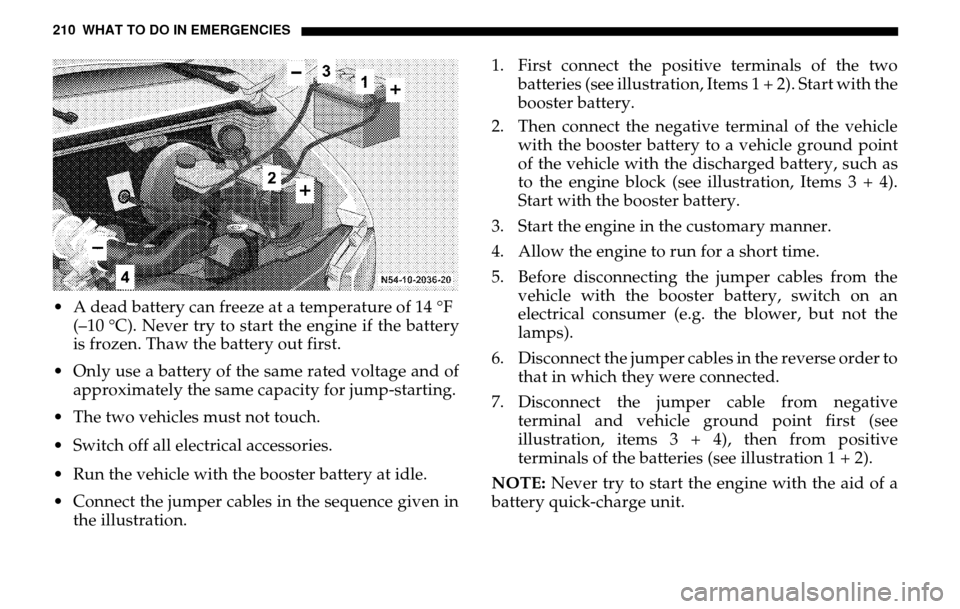
Connect the jumper cables in the sequence given in the illustration. 1. First connect the positive terminals of the two
batteries (see illustration, Items 1 + 2). Start with the
booster battery.
2. Then connect the negative terminal of the vehicle with the booster battery to a vehicle ground point
of the vehicle with the discharged battery, such as
to the engine block (see illustration, Items 3 + 4).
Start with the booster battery.
3. Start the engine in the customary manner.
4. Allow the engine to run for a short time.
5. Before disconnecting the jumper cables from the vehicle with the booster battery, switch on an
electrical consumer (e.g. the blower, but not the
lamps).
6. Disconnect the jumper cables in the reverse order to that in which they were connected.
7. Disconnect the jumper cable from negative terminal and vehicle ground point first (see
illustration, items 3 + 4), then from positive
terminals of the batteries (see illustration 1 + 2).
NOTE: Never try to start the engine with the aid of a
battery quick-charge unit.